Where to buy
Check the latest price, availability and delivery on Amazon. Orders are placed on Amazon. We may earn a commission from qualifying purchases.
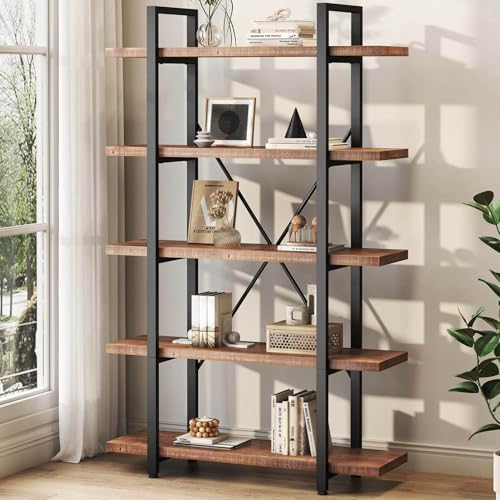
- Best overall: HSH 5 Tier Solid Wood Bookshelf, Natural Real Wood Bookcase, Distressed Brown — Check on Amazon
- Sauder Barrister Lane Bookcase, Scribed Oak Finish (Model 414724) — Check on Amazon
- Prepac Barrister 3 Column Tall Storage Cabinet, Black (Model BMB-1200) — Check on Amazon
- IRONCK Bookshelf and Bookcase, 6 Tiers Large Bookshelf with 4 Doors, Double Wide, Black (Model HK-CWG-14B) — Check on Amazon
See 2 more Amazon options
- Tribesigns 79-Inch Bookshelf, 7-Tier Tall Bookcase with 10 Open Shelves, Black (Model U0078) — Check on Amazon
- OAKHAM HOME Hampstead Bookcase, Rattan Bookcase with Doors Cabinet and Drawer, Weathered Oak, Set of 2 (Model OFBC0003LY-2PCS) — Check on Amazon
Read the full guide ↓
Disclosure: As an Amazon Associate, dailyhomedecorating.com earns from qualifying purchases. Links to Amazon on this page are affiliate links; they cost you nothing extra. Listing details such as price and availability change often, so check the current Amazon listing before you buy.
Searching for the best bookshelf under $2000 changes the question completely. At lower budgets you ask what a case can hold; at this ceiling you ask what a case is made of, how it is joined, and whether it will still look deliberate in ten years. The best bookshelf under $2000 is not a budget bookcase with a larger number attached — it is the tier where solid wood shelves, doored cabinets, library-scale cubby walls and genuinely designed pieces all become available at once, and where the wrong choice is usually a mismatch of purpose rather than a failure of quality. This guide is written for the general buyer furnishing a living room properly: one substantial bookcase, chosen once, that has to hold a real collection and carry the room visually.
A $2000 ceiling buys range, and range is the trap. Solid wood etageres, engineered-wood library walls, industrial double-wides with doors, sculptural display towers — all of them sit under this ceiling, all of them call themselves bookshelves, and they are not interchangeable. What separates them is construction honesty: whether the maker states dimensions and loads plainly, whether the shelves are solid timber or board, whether storage is open, closed or both, and whether the design serves books first or display first. Every pick below was verified against its Amazon listing during research for this guide, and throughout, prices are left where they belong — check price on Amazon for the current figure on any pick, because this tier’s listings move with finish and configuration.
Our short answer: start with the HSH 5 Tier Solid Wood Bookshelf, the only pick here whose shelves are solid timber, on a steel frame rated to a 600 lb maximum. Then choose by shape of need — the Sauder Barrister Lane for a classic cubby library, the Prepac triple column for sheer shelf count, the IRONCK double-wide when half the storage should hide behind doors, the Tribesigns 79-inch for a tall display wall, and the OAKHAM Hampstead pair when the room wants symmetry. Buyers whose rooms impose a shape on the choice should also see Best Bookshelf For Small Spaces Under $2000 and Best Bookshelf For Modern Homes Under $2000, which rank this same tier through those lenses.
In this guide
Quick Picks: Best Bookshelf Under $2000 at a Glance
Short on time? Each row names a buyer type and the bookcase that suits it, with a direct link to the listing. Every product below was verified on Amazon during research for this guide — check price on Amazon for the current figure.
| Buyer type | Pick | Why it stands out | Link |
|---|---|---|---|
| Best overall | HSH 5 Tier Solid Wood Bookshelf, Natural Real Wood Bookcase, Distressed Brown | Real solid fir shelves on a steel frame, 47.2 inches wide and a 600 lb maximum capacity as listed — the most honest build in this tier | Check on Amazon |
| Best classic library look | Sauder Barrister Lane Bookcase, Scribed Oak Finish (Model 414724) | Ten labelled cubbies, a gallery display top and the deepest shelves here at 13.5 inches | Check on Amazon |
| Best for a big collection | Prepac Barrister 3 Column Tall Storage Cabinet, Black (Model BMB-1200) | Three columns and 27 adjustable shelves in a footprint only 9.5 inches deep | Check on Amazon |
| Best hidden storage | IRONCK Bookshelf and Bookcase, 6 Tiers Large Bookshelf with 4 Doors, Double Wide, Black (Model HK-CWG-14B) | Six tiers at double width, four magnetic-catch doors and a stated 44 lb per shelf | Check on Amazon |
| Best tall display wall | Tribesigns 79-Inch Bookshelf, 7-Tier Tall Bookcase with 10 Open Shelves, Black (Model U0078) | Ten staggered open shelves climbing 78.7 inches — a display wall, not just a bookcase | Check on Amazon |
| Best premium pair | OAKHAM HOME Hampstead Bookcase, Rattan Bookcase with Doors Cabinet and Drawer, Weathered Oak, Set of 2 (Model OFBC0003LY-2PCS) | Two matched rattan-door bookcases with cabinet and drawer each, for symmetrical arrangements | Check on Amazon |
How These Picks Were Chosen
We began with the ceiling itself. Every bookcase below is a real, currently listed Amazon model positioned under this guide’s $2000 tier — check price on Amazon before ordering, because premium furniture listings shift with finish, configuration and seller. Models that were simply budget cases wearing a premium name were excluded, as were pieces whose listings hid their dimensions or materials behind adjectives. What remained had to earn its place on construction: solid materials or honestly specified engineered ones, stated dimensions, and a clear storage idea.
We did not hands-on test these bookcases. Instead we compared the evidence a careful buyer can verify: the maker’s stated dimensions, the maker’s stated load per shelf or in total where published, shelf adjustability, whether storage is open, doored or mixed, frame and shelf materials, and whether the design is a bookcase that displays or a display that holds books. Where a listing does not publish a load figure, the review says so plainly rather than inventing one — you will see that honesty applied to several picks below, because at this tier a missing number is itself information about how a maker positions a piece.
Finally, the six were chosen to be six different answers, not six versions of one case: a solid-wood etagere, a cubby library, a triple-column media wall, a doored double-wide, a staggered display tower and a matched rattan pair. If your budget actually sits lower, the same discipline at a friendlier tier is covered in Best Bookshelf Under $1000, and the step below that in Best Bookshelf Under $700.
The 6 Best Bookshelves Under $2000, Reviewed
HSH 5 Tier Solid Wood Bookshelf, Natural Real Wood Bookcase, Distressed Brown
Best for: Best overall
The HSH 5 Tier Solid Wood Bookshelf (manufacturer part BC0304-01) is the pick in this guide built from the material the whole category is named after. Its five shelves are solid fir wood — each shelf made from two solid planks, a construction HSH uses to resist the splitting and bending a single wide board can suffer — carried on a square steel tube frame with a black powder-coated finish. The assembled case measures 70 inches high, 47.2 inches wide and 10.3 inches deep, and the listing’s specification table gives a maximum weight capacity of 600 lb for the unit. At roughly 58 lb before a single book goes on it, this is a case with real heft: it feels planted in a way light flat-pack frames do not, and the distressed brown finish shows genuine wood grain because it is genuine wood, with the variation that implies.
For the general buyer, the HSH is the reference point the rest of this guide is measured against, because it answers the tier’s central question — what does the money buy? — with material. A 47.2-inch width is a full living-room case, not a tower; five solid shelves at that width hold long, serious rows, and the steel frame’s X-braced industrial manner pairs with farmhouse, loft and transitional rooms without asking the room to commit to a theme. Place it as the room’s main bookcase, load the heaviest rows low where the frame is strongest, and it does the quiet, permanent job this tier promises.
The honest trade-offs follow from the material. Solid fir is softer than oak or maple, so shelf edges can dent under careless handling, and HSH itself notes a fir-wood scent when the case is first unboxed, which fades with time and airing. The 10.3-inch depth is shallower than a traditional bookcase, so the largest art books sit close to the shelf edge. Assembly is described as minor, with tools and instructions included, but a 47-inch-wide solid-wood case is a two-person lift once built. What you get in return is the thing engineered-wood cases imitate: shelves that can be sanded, oiled and repaired, on a frame rated for a serious total load.
Pros
- Solid fir wood shelves — real timber that can be sanded, oiled and repaired
- 600 lb maximum capacity in the maker’s own specification table
- Full 47.2-inch width for long book rows, on a steel tube frame
- Distressed brown finish shows genuine grain, so no two cases look stamped out
Honest limitation: Solid fir is a softwood: shelf edges can dent, the 10.3-inch depth is shallower than a traditional bookcase, and the case carries a fir scent when first unboxed.
Choose this if you want one substantial, honest bookcase for a main living-room wall and value material over ornament.
Skip this if your collection is mostly oversized art books that need deeper shelves, or you want closed storage — look at the IRONCK or the Barrister Lane instead.
Check on Amazon to see the current listing, sizes and availability.
Once you have measured your wall, check on Amazon once more before ordering — finishes and stock move around in this tier.
Sauder Barrister Lane Bookcase, Scribed Oak Finish (Model 414724)
Best for: Best classic library look
The Sauder Barrister Lane Bookcase (model 414724) in Scribed Oak is the traditionalist of this guide: a cubby bookcase in the barrister tradition, with ten storage cubbyholes arranged across its shelves, a gallery display top with a raised edge for showing pieces you want seen, and the line’s signature ID label tags on the cubby fronts so a collection can be catalogued like a small library. It measures about 75 inches high, 35.55 inches wide and 13.5 inches deep — the deepest case in this guide — and that depth matters, because cubbies swallow storage bins, vinyl, board games and oversized books that shallow open shelves reject. The construction is engineered wood in a warm Scribed Oak finish, in Sauder’s cottage style, with an enclosed structure rather than an open frame.
In a general living room, the Barrister Lane works as furniture in the older sense: a piece with a job and a manner. The ten cubbies impose a pleasant order — a cubby for the novels, one for the art books lying flat, one for the storage bin of chargers, one deliberately left for a plant — and the ID label tags turn that order into a system you can actually maintain. The gallery top gives the room a display surface at standing eye level, which is where a bookcase earns its keep visually. For a buyer whose taste runs traditional, cottage or library, this is the pick that makes the room feel finished rather than merely stored.
Cubbies are a commitment as much as a feature. The fixed cubby grid decides your storage geometry for you: tall books must fit the cubby height or lie in a stack, and you cannot open one long shelf the way adjustable designs allow. Engineered wood at this size also means a heavy, methodical flat-pack build — Sauder instructions are thorough, but ten cubbies of panels and hardware is an afternoon project, not a twenty-minute one, and the finished case should be anchored like any tall unit. Choose it when the library look and the labelled, sorted order of cubbies are exactly what the room wants; the charm is real, and so is the structure behind it.
Pros
- Ten cubbies plus a gallery display top — storage and display in one traditional form
- 13.5-inch depth, the deepest here, swallows bins, vinyl and oversized books
- ID label tags on the cubby fronts for a genuinely organised library system
- Enclosed construction reads as finished furniture from every angle
Honest limitation: The fixed cubby grid sets your storage geometry — tall books must fit cubby height or lie flat — and the flat-pack build of a ten-cubby case is an afternoon project.
Choose this if you love the library look, want sorted, labelled order, and have a traditional or cottage room to furnish.
Skip this if you need adjustable open shelves for a changing collection, or you want a case you can assemble in under an hour.
Check on Amazon to see the current listing, sizes and availability.
Once you have measured your wall, check on Amazon once more before ordering — finishes and stock move around in this tier.
Prepac Barrister 3 Column Tall Storage Cabinet, Black (Model BMB-1200)
Best for: Best for a big collection
The Prepac Barrister 3 Column Tall Storage Cabinet (model BMB-1200) in black is the capacity specialist here. Across a 57-inch width it stacks three full columns of shelving — the listing counts 27 adjustable shelves — inside a footprint only 9.5 inches deep and 63.75 inches tall. That shallow depth is the design’s whole argument: it was conceived as library and media storage, so shelves are sized for dense rows of books, media and collectibles rather than a few styled objects, and the adjustable shelf count means rows can be set close together for paperbacks or spaced out for taller volumes. The wide, low stance gives it a naturally stable base, and the black finish keeps a very large storage wall visually quiet.
Every general guide needs the pick for the reader whose collection has stopped being decorative. The Prepac is that pick: twenty-seven adjustable shelves across three columns is not a bookcase so much as a wall of library, and because the depth is only 9.5 inches it delivers that capacity without eating the room. In a living room it works best as the collection wall behind the seating — rows of books read as texture at that scale — and its low, wide stance makes it the most inherently stable tall storage here. If your books number in the many hundreds, this is where they go.
The compromises are depth and delicacy. At 9.5 inches deep, big coffee-table books and deep storage bins simply do not belong here, and a case built to maximise shelf count uses thinner panels than a case built to maximise per-shelf load — Prepac does not headline a per-shelf load figure for this model, so load it as the dense-but-sensible media wall it is rather than as a hardcover vault, and check the current listing for its guidance. Assembly of a 57-inch, three-column unit is also a genuine project with a great many shelves to level. For a serious collection that has outgrown ordinary bookcases, though, nothing else in this guide stores as much per inch of floor.
Pros
- 27 adjustable shelves across three columns — the highest shelf count in this guide
- Only 9.5 inches deep, so a library wall costs very little floor
- Wide, low stance is naturally stable and easy to anchor
- Black finish keeps a huge storage wall visually quiet
Honest limitation: The shallow depth excludes deep bins and the largest art books, and Prepac does not headline a per-shelf load figure — load it as a dense media wall, not a hardcover vault.
Choose this if your collection is large and still growing, and you want maximum shelving per inch of floor.
Skip this if your books are mostly oversized volumes, or you want a single statement piece rather than a storage wall.
Check on Amazon to see the current listing, sizes and availability.
Once you have measured your wall, check on Amazon once more before ordering — finishes and stock move around in this tier.
IRONCK Bookshelf and Bookcase, 6 Tiers Large Bookshelf with 4 Doors, Double Wide, Black (Model HK-CWG-14B)
Best for: Best hidden storage
The IRONCK 6-tier double-wide bookshelf with four doors (model HK-CWG-14B) is built around a simple division of labour: open tiers up top for the books and objects you display, and four doored cabinets below and beside for everything you would rather not look at. It measures 47.24 inches wide, 11.81 inches deep and 71.46 inches high, is built from P2-grade MDF board, and IRONCK rates each shelf at up to 44 lb. The cabinet doors close on magnetic catches, so they shut with a clean click and stay shut, and the black industrial finish with a metal-look frame suits lofts and modern farmhouse rooms equally. Because it is double-wide, it reads as one deliberate furniture piece rather than two narrow towers pushed together.
The IRONCK double-wide answers the most common living-room complaint about bookcases: that everything you own ends up on show. Its plan — display above, doors below — matches how rooms actually live. The open tiers carry the edited version of your life; the four magnetic-catch cabinets take the board games, the cables, the paperwork and the toys-in-transit. At 47.24 inches wide it has the presence of a real furniture piece, and the stated 44 lb per shelf is a number most open competitors in this guide do not offer at all. For a general buyer whose room must be tidy at guest-notice, this is the pragmatic favourite.
Doors cut both ways, and the honest notes matter. The doored sections hide clutter, but they also hide books — this is not the case for a collection you browse by spine every day. P2 MDF is a respectable furniture board, yet it is still engineered board: keep it out of damp rooms, and respect the 44 lb per-shelf figure rather than treating the wide spans as solid timber. At over 71 inches tall it needs the wall anchor any tall case needs. As a first-listed date in mid-2025, it is also one of the newer designs in this guide, with a shorter track record than the long-running Sauder and Prepac lines. What it offers in exchange is the most complete open-plus-closed storage plan here.
Pros
- Four doored cabinets with magnetic catches hide the clutter layer completely
- Stated 44 lb per shelf — a published figure many rivals omit
- Double-wide format reads as one deliberate furniture piece
- Six tiers split between display and storage in a single footprint
Honest limitation: Doored sections hide books as well as clutter, the P2 MDF build must be kept out of damp rooms, and as a newer 2025 design it has a shorter track record than the Sauder and Prepac lines.
Choose this if you want one case that displays beautifully and hides honestly, in a modern or industrial-leaning room.
Skip this if you browse your whole collection by spine daily, or you prefer solid timber construction.
Check on Amazon to see the current listing, sizes and availability.
Once you have measured your wall, check on Amazon once more before ordering — finishes and stock move around in this tier.
Tribesigns 79-Inch Bookshelf, 7-Tier Tall Bookcase with 10 Open Shelves, Black (Model U0078)
Best for: Best tall display wall
The Tribesigns 79-inch bookcase (model U0078) is the tallest open display in this guide: seven tiers carrying ten open shelves across a 39.37-inch width, standing 78.7 inches high on an 11.8-inch depth, in a wood-and-metal construction with a black finish. The staggered shelf layout is the point — instead of six identical rectangles, the ten openings vary, so tall vases, stacked art books, plants and ordinary book rows each find a compartment shaped closer to their size, and the case reads as a display wall rather than a filing system. That makes it as much a room’s visual anchor as its storage: filled thoughtfully, it is the piece guests look at first.
Some living rooms do not need more storage so much as a focal point, and the Tribesigns is the pick for that room. At 78.7 inches with ten staggered openings, it behaves like a display wall that happens to hold books: a tall vase finds a tall compartment, ceramics cluster in a short one, and book rows break into compositions instead of a single block. In a general ranking it earns its place because many buyers at this tier are furnishing, not warehousing — and judged as furnishing, its vertical drama per inch of floor is unmatched here. Keep the heaviest pieces on the lowest tiers and anchor it as its height demands.
Staggering has a cost, and honesty requires naming it. Varied openings mean some compartments are too short for upright hardcovers and some too narrow for long rows, so a uniform library of tall books fits this case worse than it fits a plain adjustable bookcase. Tribesigns does not headline a per-shelf load figure for this model in its listing summary, so treat it as a display-weight case — books and decor in sensible amounts, heaviest items low — and check the current listing before loading it densely. It is also nearly 79 inches tall: anchoring is not optional, and in low-ceiling rooms the top tier sits close to the ceiling line. As a statement display for a mixed collection, though, it earns its footprint.
Pros
- Ten staggered openings across seven tiers — compartments shaped for display, not just rows
- 78.7 inches tall: the strongest vertical presence in this guide
- Wood-and-metal construction in a black finish that suits modern rooms
- 39.37-inch width gives real storage alongside the styling
Honest limitation: Varied openings fit a uniform tall-book library poorly, and no per-shelf load is headlined — treat it as a display-weight case with heavy items kept low.
Choose this if you are furnishing a room around a statement piece and your collection mixes books with objects.
Skip this if your library is mostly tall, uniform hardcovers, or your ceilings are low.
Check on Amazon to see the current listing, sizes and availability.
Once you have measured your wall, check on Amazon once more before ordering — finishes and stock move around in this tier.
OAKHAM HOME Hampstead Bookcase, Rattan Bookcase with Doors Cabinet and Drawer, Weathered Oak, Set of 2 (Model OFBC0003LY-2PCS)
Best for: Best premium pair
The OAKHAM HOME Hampstead bookcase (model OFBC0003LY-2PCS) is sold as a matched pair — two bookcases in weathered oak — which changes what it is for: not one wall of storage, but a composed arrangement, flanking a fireplace, a media console or a reading chair with symmetry no single case can give. Each unit pairs open shelving with a rattan-fronted cabinet and a drawer, the rattan hand-woven in the Hampstead collection’s farmhouse manner, with aluminum handles on the cabinet. The construction is exterior-grade MDF board, a denser, more moisture-tolerant board grade than standard flat-pack fibreboard, and the weathered oak finish keeps the pair warm rather than stark.
The Hampstead pair is the interior-design answer in a guide of storage answers. Two matched bookcases let a room be composed — either side of a fireplace, a window or a media wall — and each unit’s mix of open shelves, a rattan cabinet and a drawer gives both display and a place for the remote-control layer of life. In weathered oak the pair warms traditional and farmhouse rooms and softens modern ones. For the general buyer with a symmetrical wall and a designer’s instinct, this is the pick that looks commissioned rather than purchased, and the exterior-grade MDF board is a sensible, dense material under the finish.
A pair is also a pair of compromises. You are buying two footprints, so measure both walls, not one; the rattan fronts, while sturdy as door panels, are a textured natural material that wants gentle dusting rather than a soaked cloth; and OAKHAM does not headline a per-shelf load figure for this set, so load the open shelves as display-and-books storage and check the current listing for guidance. The drawer and cabinet on each unit are sized for the living-room layer of clutter — remotes, chargers, coasters, the good candles — not for archive boxes. Bought as the composed furniture it is, the Hampstead pair is the most designed object in this guide.
Pros
- Sold as a matched pair — symmetry no single bookcase can offer
- Each unit combines open shelves, a hand-woven rattan cabinet and a drawer
- Exterior-grade MDF board, denser and more moisture-tolerant than standard flat-pack board
- Weathered oak finish warms both traditional and modern schemes
Honest limitation: Two footprints to measure and place, rattan fronts that want gentle dry dusting, and no headlined per-shelf load figure — load as display-and-books storage.
Choose this if you have a wall that wants a composed pair and a farmhouse or warm-modern scheme to match.
Skip this if you need one maximum-capacity case, or your room has no symmetrical placement to offer.
Check on Amazon to see the current listing, sizes and availability.
Once you have measured your wall, check on Amazon once more before ordering — finishes and stock move around in this tier.
Comparison Table
Every figure below comes from the maker’s own listing — dimensions and stated load — so you can compare the six on facts rather than adjectives. Where a listing does not publish a load figure, the table says so instead of guessing.
| Bookcase | Dimensions (D x W x H) | Stated load | Back / doors | Best for |
|---|---|---|---|---|
| HSH 5-Tier Solid Wood | 10.3″D x 47.2″W x 70″H | 600 lb maximum, as listed | Open | Solid wood shelves on a steel frame |
| Sauder Barrister Lane | 13.5″D x 35.55″W x 75.04″H | See listing for current guidance | Cubby format, enclosed | Classic library cubbies with label tags |
| Prepac Barrister 3 Column | 9.5″D x 57″W x 63.75″H | See listing for current guidance | Enclosed columns | Maximum shelf count in a shallow depth |
| IRONCK 6-Tier with 4 Doors | 11.81″D x 47.24″W x 71.46″H | 44 lb per shelf, as listed | 4 doors plus open tiers | Hidden storage at double width |
| Tribesigns 79-Inch 7-Tier | 11.8″D x 39.37″W x 78.7″H | See listing for current guidance | Open | Tallest open display here |
| OAKHAM Hampstead, Set of 2 | Two-piece set — see listing for unit dimensions | See listing for current guidance | Doors cabinet plus drawer | A matched premium pair |
How to Choose the Best Bookshelf Under $2000
Start with material, because this tier is where material becomes a real choice. Solid wood shelves, like the HSH’s fir planks, can be repaired, refinished and kept for decades, and they carry heavy rows without the slow sag that long engineered spans can develop. Engineered wood — Sauder’s panels, Prepac’s laminated board, OAKHAM’s exterior-grade MDF — buys you size, cubbies, doors and design at dimensions solid timber cannot match under this ceiling. Neither is automatically better; the question is whether your priority is permanence of material or generosity of format.
Decide your open-to-closed ratio before you fall for a silhouette. Open cases display everything, including the clutter. Doored cases — the IRONCK’s four cabinets, the OAKHAM’s rattan doors — hide roughly half of life at the cost of hiding books too. Walk your current shelves mentally: the fraction you would rather not see is the fraction that should sit behind doors. Most households land near a third to a half, which is why the mixed designs in this guide exist.
Match depth to your largest books, not your average ones. The picks here run from 9.5 inches deep (the Prepac, built for dense standard rows) to 13.5 inches (the Barrister Lane, built for bins and oversized volumes). Measure your ten largest books and your favourite storage bin; if they exceed a case’s depth, that case will annoy you daily no matter how beautiful it is. Width works the same way in reverse: a 57-inch wall of shelving is glorious if the wall exists, and a mistake if it does not.
Treat stated loads as a honesty test. Makers in this guide that publish figures — 600 lb maximum on the HSH, 44 lb per shelf on the IRONCK and the Giantex-style spans, 55 lb per shelf on design-led frames — are telling you how the case was engineered. Where no figure is published, load conservatively: heaviest rows on the lowest tiers, weight spread rather than concentrated, and the case anchored. Books are heavier than they look; a single metre of hardcovers can outweigh the person shelving them.
Plan the anchor and the assembly before the delivery. Every tall case here should be fixed to the wall — it takes minutes and converts height from a hazard into storage. Assembly at this tier ranges from the HSH’s minor build to the Barrister Lane’s ten-cubby afternoon; check your doorway and ceiling clearances for the tallest pieces, and build big cases in the room they will live in.
What the Money Actually Buys at This Tier
It is worth being precise about what a $2000 ceiling changes, because the honest answer is: format and material, not magic. Below this tier, bookcases are almost entirely open, engineered-wood frames of modest width. Under $2000, four new things appear. First, solid timber shelves — the HSH’s fir — with the repairability that implies. Second, doors: cabinets that close, on magnetic catches or rattan fronts, turning a bookcase into mixed storage furniture. Third, scale: triple-column walls, double-wide formats and matched pairs that furnish a room rather than fill a gap. Fourth, design intent: staggered display towers and arched etageres that are composed objects, not shelving with ambitions.
What the money does not buy is immunity from physics. A 78-inch case still needs anchoring. A wide engineered span still has a load figure. A rattan door still wants gentle dusting. The discipline of this tier is to spend on the format your room and collection actually need — and to read a maker’s stated dimensions and loads as the truest description of the piece, truer than any photograph. The households that buy best under $2000 are the ones that measure twice: the wall, the largest books, and the fraction of their storage that should hide.
Assembly, Delivery and Living With a Premium Bookcase
The part of buying at this tier that guides underplay is logistics, and it deserves a section of its own. Cases in this guide arrive as flat-pack furniture weighing anywhere from a manageable single box to the Prepac’s three-column kit or the Barrister Lane’s ten-cubby panel set. Before ordering, walk the delivery path with a tape measure: door widths, the turn at the top of the stairs, the elevator if there is one. Premium-tier cases are built in the room they will live in — plan the build space, protect the floor with the packaging cardboard, and keep the hardware sorted in a tray, because a 70-inch case assembled in the wrong room is a problem no amount of strength solves elegantly.
Assembly order matters more than assembly speed. Build the frame loosely first, square it, then tighten in sequence; fit the back panel before final tightening, because the back is what locks a case square; and leave door alignment — on the IRONCK’s cabinets or the OAKHAM’s rattan fronts — until the case stands in its final position, levelled, since a door aligned on a sloped floor will gap on a level one. Two people make every build in this guide safer and faster, and the tallest pieces should be anchored before they are loaded, not after a week of meaning to.
Living with the case afterwards is a light discipline. Once a season, re-check the anchor, snug any cam locks the household’s vibration has loosened, and look along each shelf span for new sag that says a load should spread or move down. Solid wood wants the most rewarding care: a feed of oil or wax on the HSH’s fir once a year keeps the grain fed and lets you blend out the year’s small marks. Engineered finishes want the opposite — a damp cloth, no soaking, coasters under anything wet or hot. Rattan fronts dust best with a soft brush or the vacuum’s upholstery tool, working with the weave. None of this is onerous; it is the difference between a case that ages into the room and one that merely gets old in it.
Finally, buy for the collection you will have. A bookcase at this tier should be bought one size more honest than today’s need: the reader who fills five shelves this year fills seven in five years. The formats here scale differently — the Prepac absorbs growth by re-spacing its 27 shelves, the OAKHAM pair by giving each flank a job, the Barrister Lane by letting cubbies change assignment. Whichever you choose, leave one shelf or cubby deliberately under-filled on day one. It is the cheapest insurance in furniture: room to grow, designed in from the start.
Common Mistakes When Buying a Bookshelf Under $2000
Buying the silhouette before the storage plan. A staggered display tower is a beautiful answer to a question about display. If your actual question was where 400 hardcovers go, it will frustrate you within a month. Decide what the case must hold — books, objects, hidden clutter, in what proportions — and let that choose the format.
Ignoring depth. The most common premium-tier regret is a gorgeous case 10 inches deep bought for a collection of 12-inch art books. Measure your largest volumes first; depth is the one dimension no styling can fix.
Skipping the anchor because the case feels heavy. Weight is not stability. A tall case loaded top-heavy can tip under a climbing child or a bumped elbow regardless of how solid it felt empty. Every tall pick in this guide should be fixed to the wall; the hardware habit takes minutes.
Loading display cases like library cases. Where a maker publishes no load figure, that silence is guidance. Keep dense rows low and spread, and reserve the heaviest loading for the picks with stated numbers behind them.
Forgetting the delivery path. A 57-inch-wide or 79-inch-tall case must get through your doors and be built where it will stand. Measure the route, not just the wall — the most returned furniture is furniture that never reached its room.
Final Recommendation
For most buyers, the HSH 5 Tier Solid Wood Bookshelf is the best bookshelf under $2000: solid timber shelves on a steel frame, a full living-room width, and a published 600 lb maximum capacity make it the most honestly built case in this guide, and the one most likely to be in your home in twenty years. Choose the Sauder Barrister Lane if your heart is set on a labelled cubby library, the Prepac triple column if your collection has outgrown ordinary shelving, and the IRONCK double-wide if half your storage should disappear behind doors. The Tribesigns 79-inch is the display-maker’s pick, and the OAKHAM Hampstead pair is the designer’s. Whichever you choose, measure the wall and the books, anchor the case, load it bottom-first — and check price on Amazon before you order. Households furnishing for children should read the same tier through a safety lens in Best Bookshelf For Families Under $2000.
Shortlist it down to two and the choice usually makes itself: the HSH 5 Tier Solid Wood Bookshelf for material and permanence, or the Sauder Barrister Lane Bookcase for the classic cubby library — compare both listings side by side before you commit.
Frequently Asked Questions
Is a solid wood bookshelf worth it under $2000?
For a main living-room case, usually yes. Solid shelves like the HSH’s fir planks can be sanded, oiled and repaired rather than replaced, and they resist the slow sag long engineered spans can develop under hardcovers. Engineered wood still wins on format — cubbies, doors and sheer width — so the choice is permanence of material versus generosity of design.
How much weight can a bookshelf in this tier hold?
It varies by design, which is why this guide quotes each maker’s own figures: the HSH lists a 600 lb maximum for the unit, the IRONCK double-wide states 44 lb per shelf, and several design-led picks publish no figure at all. Where no figure is published, load conservatively — heaviest books on the lowest tiers, weight spread evenly — and check the current listing.
Do I really need to anchor a heavy, expensive bookcase?
Yes. Weight is not the same as stability: a tall case loaded with books is top-heavy by nature, and anchoring is what the STURDY-era safety guidance and every maker in this guide assume. It takes minutes, the hardware is discreet, and it is the single highest-value step in owning any tall case.
What depth of bookshelf do I need for large books?
Standard novels and hardcovers sit happily in 9.5 to 11 inches of depth. Large art books, atlases and storage bins want 12 inches or more — in this guide, the Sauder Barrister Lane’s 13.5-inch depth is the safe home for oversized volumes. Measure your ten largest books before choosing.
Should I choose open shelves or a bookcase with doors?
Decide by the fraction of your storage you would rather not see. Open shelves display everything and make browsing effortless; doors hide clutter, dust and visual noise but hide books too. Mixed designs — open display above, doored cabinets below — suit most living rooms, which is why several picks here are built exactly that way.
How do I stop a wide bookshelf shelf from sagging?
Respect the maker’s stated per-shelf load, spread heavy rows instead of concentrating them in one span’s middle, and keep the densest books on the lowest tiers where the structure is best supported. Solid wood shelves and shorter spans sag least; if a listing publishes no load figure, treat that as a reason to load gently.


