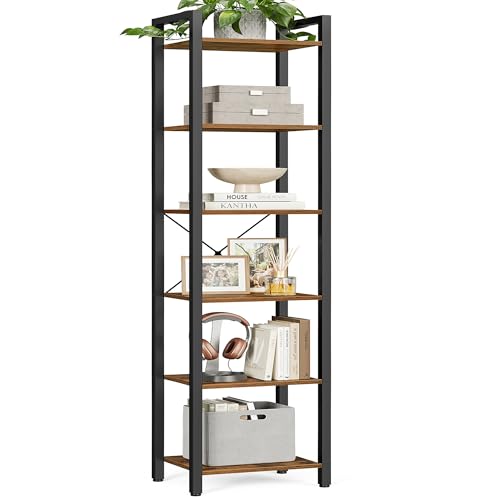
Where to buy
Check the latest price, availability and delivery on Amazon. Orders are placed on Amazon. We may earn a commission from qualifying purchases.
- Best overall for small spaces: VASAGLE 6-Tier Bookshelf with Steel Frame, Rustic Brown/Black — Check on Amazon
- VASAGLE 6-Tier Convertible Corner Bookshelf, Rustic Brown/Black — Check on Amazon
- Furinno Luder 5-Cube Bookcase, White — Check on Amazon
- VASAGLE CUSTOS 6-Tier Bookshelf, Cloud White — Check on Amazon
See 2 more Amazon options
- Nathan James Theo 5-Shelf Ladder Bookcase, Walnut/Black — Check on Amazon
- Sauder Beginnings 5-Shelf Bookcase, Brook Cherry — Check on Amazon
Read the full guide ↓
Disclosure: As an Amazon Associate, dailyhomedecorating.com earns from qualifying purchases. Links to Amazon on this page are affiliate links; they cost you nothing extra. Listing details such as price and availability change often, so check the current Amazon listing before you buy.
Every home has them: the corner that fits nothing, the hallway wall too narrow for a console, the alcove under the stairs, the twelve inches between the wardrobe and the door. Small spaces are not a type of home — they are the leftover geometry inside every home, and they are almost pure wasted storage. Choosing the best bookshelf for small spaces under $400 is the art of claiming them: finding the tower slim enough for the gap, the corner unit shaped for the angle, the low cube that slides under the eaves, and putting real, anchored, load-rated shelving where brooms and good intentions used to live.
The discipline is different from ordinary bookcase shopping. A normal buyer starts with the collection and finds a case to fit; a small-space buyer starts with the gap — measured to the half inch — and finds the case the gap allows. Depth matters more than width, because small spaces are usually circulation spaces: a shelf that juts two inches too far into a hallway is a shelf you will brush against ten thousand times. Height is the opportunity, because the gap’s floor area is tiny but its wall usually runs to the ceiling. And honesty matters most of all: a small-space bookcase will never hold a whole library, and pretending otherwise leads to overloaded slim shelves. What it can do — brilliantly — is hold the right slice of your life in a place that was holding nothing.
Our short answer: the steel-framed VASAGLE ULLS101 is the small-space default, a six-tier tower just 15.7 inches wide that turns slots of wall into storage. The convertible VASAGLE corner unit claims the corners. The low Furinno Luder cube fits the under-eaves and under-window spaces towers cannot. The white CUSTOS is the adjustable slim column for slightly wider gaps; the wall-mounted Nathan James Theo spends wall instead of floor entirely; and the Sauder Beginnings is the fullest real bookcase that still counts as small-space furniture. Homeowners in compact flats will also find our Best Bookshelf For Small Apartments Under $400 guide useful — the two lenses overlap, but this one is about the gaps in any home, not just small homes.
In this guide
Quick Picks
Six gap-claimers. Measure your space first — width, depth, height — then match the row.
| Buyer type | Pick | Why it stands out | Link |
|---|---|---|---|
| Best overall for small spaces | VASAGLE 6-Tier Bookshelf, Steel Frame | 15.7 inches wide, 73.2 tall, X-braced steel frame, adjustable feet | Check on Amazon |
| Best for corners | VASAGLE 6-Tier Convertible Corner Bookshelf | L-shape or straight layout; 330 lb total capacity; anti-tip kit | Check on Amazon |
| Best low profile | Furinno Luder 5-Cube Bookcase, White | 52 inches tall — fits under windows, eaves and sloped ceilings | Check on Amazon |
| Best adjustable slim tower | VASAGLE CUSTOS 6-Tier Bookshelf, Cloud White | Six tiers at 9.4 inches deep, several shelves adjustable | Check on Amazon |
| Best wall-space spender | Nathan James Theo 5-Shelf Ladder Bookcase | Mounts to the wall; 50 lb per shelf; minimal floor claim | Check on Amazon |
| Best small-room full case | Sauder Beginnings 5-Shelf Bookcase, Brook Cherry | Enclosed, adjustable, 24.6 inches wide — a real bookcase, shrunk | Check on Amazon |
How the picks for the best bookshelf for small spaces under $400 were chosen
Small-space judging is geometry first. We required every pick to claim a genuinely small footprint — the widest freestanding unit here is under 25 inches, the narrowest under 16 — and to pay for its floor with height, tiers or a shape (corner, cube, ladder) that fits where rectangles cannot. Dimensions, shelf counts and load ratings were verified against manufacturer specifications and Amazon listings for every ASIN before inclusion; in small spaces, a manufacturer’s optimistic tape measure is not a rounding error, it is the difference between fitting and returning.
Second, stability in miniature. Slim towers are inherently tippier than wide cases, so every tall pick here includes an anti-tip kit or wall-mounts by design, and we checked for the supporting details that make slim furniture feel solid — X-bracing, back panels, adjustable feet for imperfect floors. Third, realistic capacity: we favoured honest published ratings over headline totals, and each review states plainly what its pick should and should not be asked to carry.
We also thought about what small-space buyers actually get wrong, because the returns data of the furniture world is written in these mistakes: cases bought a half-inch too wide, towers too deep for the hallway, shelves too weak for the cookbooks. Every pick here was chosen to be forgiving of the space it enters — levelling feet for bad floors, convertibility for changing layouts, adjustable shelves for mixed loads, finishes that survive being brushed past daily. Forgiveness is a design quality, and in small spaces it is the quality that decides whether a purchase is still earning its place in year three.
Finally, price: the whole list sits under this guide’s $400 ceiling, and most of it sits far under — small-space shelving is one of the few furniture categories where the best answer is rarely the expensive one, because the engineering challenge is shape, not luxury. We print no static prices, so check price on Amazon for the current figure on anything that catches your eye.
A tour of the small spaces in your home
Before the reviews, walk the territory, because most people underestimate how many claimable gaps they own. The hallway wall is the classic: a run of wall, usually 4–8 feet long and needed only for walking past, that will host a 9.4-inch-deep tower without narrowing the passage below comfort. The corner — living room, bedroom, landing — is dead by default and holds, in most homes, a plant in a pot too big for it; a corner shelf holds the plant and five shelves of books besides. The gap beside the door and the pier between two windows are the narrow slots the ULLS101 was born for. Under the stairs and under the eaves, height runs out before width does, which is cube territory: low, wide storage that follows the slope. The wall above and beside the desk in a box room is ladder-shelf country, where the floor is fully employed and only the wall is free.
Two more territories deserve honourable mention. The bathroom-adjacent landing and the airing-cupboard wall are linen country, where a slim white tower holds towels and spares in homes whose bathrooms have no storage at all — choose the wipeable finishes (CUSTOS, Luder) and keep the load light and dry. And the child’s bedroom corner, where a low cube at child height turns the smallest room’s dead angle into the reading corner, is the small space with the longest future: today’s picture-book nook is tomorrow’s homework shelf. Small spaces reward whoever looks at them with a storage eye rather than a furnishing eye.
Each of those spaces has a natural pick in this guide, and the reviews below name the territory as well as the product. Measure your gap — width at the skirting board and at shoulder height, depth from the wall to the nearest door swing or walking line, height to the ceiling, the picture rail or the slope — and write the three numbers down before you read another word. Small-space buying is the one furniture purchase where the tape measure, not taste, makes the shortlist.
Detailed reviews
1. VASAGLE 6-Tier Bookshelf with Steel Frame (ULLS101) — best overall for small spaces
Who it suits. Anyone with a narrow slot of wall and a tall ceiling: hallway gaps, the space beside a wardrobe, the end of a kitchen run, the box room’s one free wall.
The details. The ULLS101 stacks six rustic-brown shelves in a black steel frame measuring just 15.7 inches wide, 11.8 inches deep and 73.2 inches tall. VASAGLE rates the unit at 110 lb total, braces the back with an X-frame, includes an anti-tip kit, and fits adjustable feet — a detail that matters disproportionately in small spaces, because slim towers live on the old, sloping floors of hallways and landings, and a rocking tower is an unloaded tower. The shelves are short, which shapes what it holds best: novels and paperbacks in single rows, stacked magazines, the coffee and tea station, a plant per shelf if you are that person. Think of it as a vertical chest of drawers for the things that otherwise colonise the kitchen table.
Pros. The smallest serious footprint in this guide — it stores in gaps that defeat every other format. Six tiers at over six feet tall is a lot of shelving for 1.3 square feet of floor. The steel frame feels disproportionately sturdy, and the adjustable feet make it trustworthy on imperfect floors. Its proportions are quietly sculptural; a slim tower reads as intentional in a way a squat case never does.
Honest limitation. Short rows and a modest total rating cap its ambitions: it is a supplement and a gap-filler, not a main library, and heavy loads must sit low and spread out. If your gap is wider than about two feet, the CUSTOS below gives you more shelf per inch.
Its finest habitat deserves a paragraph: the landing. Landings are the purest small spaces in the home — too small for furniture, too visible to ignore, walked past twenty times a day. A slim tower on the landing becomes the household’s exchange library and overflow shelf, the place books pause between rooms; it gives the landing a purpose and the household a pressure valve. If your home has a landing with a bare wall, this is very likely the highest-value fifteen inches of furniture you will ever buy — measure it tonight.
Choose it if your space is a slot and your ceiling is high. Skip it if you need wide rows or heavy-duty capacity.
2. VASAGLE 6-Tier Convertible Corner Bookshelf (ULLS606) — best for corners
Who it suits. Any room with a dead corner — living rooms, landings, home offices — and anyone whose small space is an angle rather than a slot.
The details. This six-tier unit, 40.2 inches wide in L-configuration, 9.4 inches deep and 69 inches tall, is built from particleboard shelves on a steel frame in rustic brown and ink black. Its defining feature is convertibility: assemble it as an L to wrap the corner, or as a straight run when the room changes — the only pick here that can change its mind. The ratings are the most generous of the slim picks: 33 lb on the large shelves, 22 lb on the small, 330 lb total, with an anti-tip kit included. Corner bays are naturally deep at the angle, which makes them the right home for the bulky, awkward residents of small spaces — the printer, the board-game stack, the big plant, the storage box that fits nowhere else.
Pros. Claims the one space no straight bookcase can use, and converts if you move or rearrange. The strongest total capacity among the slim designs here. Corner placement is inherently stable-feeling — the unit is embraced by two walls. The industrial finish suits the modern small spaces where corners most often go begging.
Honest limitation. The back of a corner bay is the longest reach in home storage; what goes there should be what you rarely need. Corner units also demand a genuinely empty corner — no radiator, no door swing, no curtain track — and they commit you to that corner for the long term.
Home offices in small homes are where it quietly shines. The corner behind or beside a desk is the one spot a work room can spare, and this unit fills it with the printer at elbow height, the reference shelf above, the paper and supplies below — a complete office wall in the space a filing cabinet would waste. If your small space problem is really a work-from-home problem wearing a disguise, start the shortlist here.
Choose it if your small space is a corner. Skip it if your corners are busy or your layout changes monthly.
3. Furinno Luder 5-Cube Bookcase, White — best low profile
Who it suits. Sloped, low or awkward spaces: under the eaves, under a window, beneath a staircase, along a low wall in a loft room or a child’s bedroom.
The details. The Luder is a five-cube open bookcase, 15.8 inches wide, 9.4 inches deep and 52 inches tall, in white engineered wood. Where towers need ceiling, the Luder needs none: 52 inches fits under window sills, under the mid-point of most stair slopes and in the knee-wall zones of converted lofts where nothing tall can stand. The cubes take standard fabric bins, turning the unit into half-open, half-closed storage, and the top surface is usable — a lamp, a plant, the landing strip by the door. It is light enough to carry to the space in one trip and simple enough to assemble in the space itself, which in a cramped nook is not a trivial virtue.
Pros. Fits the low spaces every tower fails. The lowest price in this guide by a wide margin. Cube-and-bin storage is endlessly reconfigurable. Its small scale suits children’s rooms and hallways alike, and it graduates between rooms as needs change.
Honest limitation. Light-duty construction and shallow cubes limit both load and book size; five cubes is a modest total capacity. It is the right answer for a low gap, not a substitute for a tall tower where height is available.
Under-stair space is its signature job, and worth picturing precisely: the slope that defeats every upright case is a staircase of heights, and a 52-inch cube unit tucks under the mid-flight where the headroom is exactly wrong for people and exactly right for storage. What lives there — the archive boxes, the out-of-season things, the board games — is what used to live in the cupboard you actually needed for coats. Small-space storage is a chain reaction of reclaimed cupboards, and the Luder is usually the first link.
Choose it if your space is low, sloped or under something. Skip it if you have full ceiling height going to waste — a tower stores three times as much on similar floor.
4. VASAGLE CUSTOS 6-Tier Bookshelf, Cloud White — best adjustable slim tower
Who it suits. Slightly wider gaps — two feet of wall in a hallway, bedroom or living room — where adjustable shelving can be tuned to a mixed load.
The details. The CUSTOS is a six-tier column in particleboard and MDF, 23.6 inches wide, only 9.4 inches deep and 63.3 inches tall, finished in cloud white. Several shelves adjust between three height positions — the feature that separates it from the fixed ULLS101 — so a single column can hold tall storage boxes at the base, hardcovers in the middle and paperbacks up top, each bay set close to its contents. VASAGLE rates each shelf at 22 lb and the unit at 154 lb total, includes an anti-tip kit, and backs the column with a slot-in panel for rigidity. The white finish is a small-space strategy in itself: it borrows the wall’s colour, so the tower reads as architecture rather than furniture.
Pros. Adjustability in a slim tower is rare and genuinely useful — wasted vertical inches are the enemy in small spaces, and this design refuses to waste them. The shallowest depth here alongside the corner unit. Six full tiers on under two square feet. White disappears against pale walls, enlarging the room it serves.
Honest limitation. The 22 lb per-shelf rating and 9.4-inch depth confine it to standard books and lighter storage; oversized formats and dense hardcover runs need a deeper, stronger case. White shows the scuffs that hallway life delivers.
Bedrooms are its second home. A two-foot column beside the wardrobe absorbs the bedtime library, the water carafe shelf, the charging tray and the overflow of the bedside table, in rooms where a full bookcase would crowd the bed. Because it is white and shallow, it does this without the visual argument a darker case would start at 7 a.m. — a small mercy, but small spaces are made of small mercies, and this tower collects them.
Choose it if your gap is about two feet wide and your load is mixed. Skip it if the gap is narrower (ULLS101) or the load is heavy (Theo, below).
5. Nathan James Theo 5-Shelf Ladder Bookcase, Walnut/Black — best wall-space spender
Who it suits. Small spaces where the floor is fully employed but the wall is free: above and beside desks, on the wall of a box room, in a living room where every floor inch already has a job.
The details. The Theo is a wall-mounted ladder bookcase — black metal frame, five walnut-finish shelves, about 24 inches wide, 12 inches deep and 72.5 inches tall — and Nathan James rates each shelf at 50 lb, by far the strongest figure among these small-space picks. Its small-space logic is radical: because it fixes to the wall, its floor claim is little more than the ladder’s feet, and the floor beneath stays in circulation for the chair, the storage ottoman, the dog bed. In a box room that converts a wall into a library without surrendering the room. The open frame keeps the wall visually light, which matters in small rooms where a solid case can feel like a wardrobe advancing on you.
Pros. Heavy-duty shelves in a minimal floor footprint — the best strength-to-footprint ratio here. Wall-mounting is the ultimate stability answer for a slim profile. The industrial look flatters the small modern rooms that most need it. Sold in pairs for symmetrical library walls.
Honest limitation. It needs a wall that can be drilled and can hold it — solid or stud construction — which rules out some partitions and all no-drill households. Shelves are fixed, and installation is a measure-three-times job; a mounted shelf in the wrong place is a shelf plus two filled holes.
One placement where it beats every freestanding rival: the wall over a desk or a sofa’s side in a small living room, where a floor-standing case would steal the seat or the workspace. Mounted at the right height, the lowest Theo shelf is a reach from the chair and the floor below stays entirely in play — in a small room, that recovered square footage can be the difference between a desk that fits and a desk that dominates. Measure the seated eye-line before fixing, and the installation will feel designed rather than improvised.
Choose it if your walls are strong and your floors are full. Skip it if you cannot drill, or the space is a low nook rather than a wall.

6. Sauder Beginnings 5-Shelf Bookcase, Brook Cherry — best small-room full case
Who it suits. Small rooms that need one honest bookcase rather than a gap-filler: the box-room study, the child’s bedroom, the guest room that stores the overflow library.
The details. The Beginnings (model 416439) compresses the classic bookcase into 24.57 inches of width, 11.5 inches of depth and 71.18 inches of height, with five shelves, adjustability and an enclosed back panel, in a warm Brook Cherry finish. Against the towers in this list it is the traditionalist: shelves deep enough for standard hardcovers, a back that keeps books from vanishing behind the case, and spacing that re-sets as the room’s job changes. At about 53 lb it is the heaviest pick here — the price of enclosed construction — but still a manageable move for one determined adult with a hand truck.
Pros. The most bookcase-like pick in a small-space guide: real depth, real adjustability, enclosed back. Sauder’s instructions and parts support lead the class. The cherry warmth suits bedrooms and studies where white towers feel clinical. A sensible price, comfortably inside this guide’s ceiling.
Honest limitation. At 24.6 inches wide and 11.5 deep it is the biggest footprint here — a small-room case, not a gap-filler for slots and corners. Entry-line materials sit a step below Sauder’s best. Anchor it: tall, enclosed and loaded is exactly the profile anti-tip straps exist for.
There is a dignity argument for it as well. Small rooms are often treated as storage problems to be hidden, but a box room with a proper bookcase, properly filled, reads as a study — the smallest room in the house becomes the one with the most character per square foot. The Beginnings, with its enclosed back and warm finish, is the pick that performs that transformation; the towers store, but this one furnishes. If your small space is a room you sit in rather than a gap you pass, furnish it.
Choose it if your small space is a whole small room. Skip it if your space is a slot, corner or nook — the specialists above fit those better.
Loading slim shelves: a weight strategy for small towers
Small-space shelving fails in one predictable way: it gets loaded like big shelving. A slim tower’s ratings — 22 lb a shelf here, 110 lb total there — are not fine print; they are the design. Load with a strategy and the tower will serve for years. Bottom-load by default. The heaviest shelf in any tower should be the lowest one, both for the shelf’s sake and for stability: mass at the base lowers the centre of gravity and makes the whole unit calmer in traffic. Work upward in descending weight — hardcovers low, paperbacks in the middle, and the top shelf reserved for the lightest residents: plants, baskets, the decorative boxes that are mostly air.
Spread, don’t stack. A slim shelf tolerates a distributed row of books far better than a concentrated pile in the middle, which is where bowing begins. If a set is genuinely heavy — the complete cookbooks, the textbook run — split it across two shelves or give it to a fixed bottom shelf. Use the walls. In a small space, the bookcase does not have to hold everything it displays: a heavy mirror or frame above it hangs on the wall, not the top shelf. And audit annually: small-space shelves accumulate silently, and a five-minute yearly edit — the books that have earned exile to the charity box — keeps every shelf inside its rating without a single new purchase. The towers in this guide are honest about their limits; meet them halfway and they will not let you down.
Beyond books: what small-space shelves should hold
The secret of small-space shelving is that books are often the minority tenant. The hallway tower is really the home’s landing strip: keys and post at hand height, the everyday bag below, hats and gloves in a basket on top. The landing column is the linen overflow and the guest-towel store. The box-room shelf is the office: printer on the sturdy bottom bay, paper and files in the middle, the router and its blinking constellation up top where the signal escapes. Choosing a pick for these jobs changes the judging: bins and boxes need cube or adjustable bays (Luder, CUSTOS), electronics need depth and ventilation (the open frames — ULLS101, Theo), and anything with a cable appreciates an open back it can escape through.
This is also why the convertible corner unit earns its keep in real homes: the corner bay that is awkward for books is perfect for the printer, the games console stack or the record player — the bulky citizens of small-space life. Judge your gap by what will actually live in it, be honest if the answer is “mostly not books”, and the pick that fits that answer will look right and work right long after a purist bookcase would have been returned.
Comparison table
| Pick | Size (W x D x H) | Shelves | Space it claims | Watch out for | Link |
|---|---|---|---|---|---|
| VASAGLE ULLS101 | 15.7 x 11.8 x 73.2 in | 6 fixed | Narrow slots and gaps | 110 lb total rating | Check on Amazon |
| VASAGLE Corner ULLS606 | 40.2 x 9.4 x 69 in (L-form) | 6 | Dead corners | Long reach to back bays | Check on Amazon |
| Furinno Luder | 15.8 x 9.4 x 52 in | 5 cubes | Low and sloped spaces | Light-duty build | Check on Amazon |
| VASAGLE CUSTOS | 23.6 x 9.4 x 63.3 in | 6 (several adjustable) | Two-foot wall gaps | 22 lb per shelf | Check on Amazon |
| Nathan James Theo | ~24 x ~12 x 72.5 in | 5 fixed | Free walls, full floors | Must drill and mount | Check on Amazon |
| Sauder Beginnings | 24.57 x 11.5 x 71.18 in | 5 (adjustable) | Whole small rooms | Biggest footprint here | Check on Amazon |
How to choose a bookshelf for a small space
Measure the gap, not the room. Width at floor and at shoulder height (walls bow), depth to the nearest door swing or walking line, height to the ceiling, rail or slope. Then buy to the smallest of those numbers with a half-inch of grace. In small spaces the tape measure is the entire shortlist — a case that misses by half an inch is not a near miss, it is a return.
Spend the dimension you have. Tall gap? Buy height (ULLS101, CUSTOS). Dead angle? Buy shape (the corner unit). Low slope? Buy the cube. Free wall, full floor? Buy the wall-mount (Theo). Every small space is rich in exactly one dimension; the right pick is the one that spends it.
Respect the ratings — slim shelves forgive less. Narrow towers concentrate loads on small structures. Read the per-shelf and total figures in the comparison table, load heavy things low and spread out, and treat the numbers as ceilings, not challenges. A slim tower loaded within its rating is a decade of service; overloaded, it is a season.
Anchor as if it were wide. Slim and tall is the tippiest geometry in furniture, and small spaces are high-traffic by definition — the hallway tower gets brushed a hundred times a week. Every tall pick here includes its kit or its mounting system. Fit it before loading, into a stud or with rated anchors, and re-check it whenever the unit is moved. Families should cross-read our Best Bookshelf For Families Under $400 guide for the full anchoring method.
Check the route in, not just the spot. A small space at the end of a narrow hallway, up a turning stair or through a low doorway filters what can reach it. Slim towers and cube units travel well; an assembled corner frame does not travel at all, so plan to build it in place. Measure the tightest point of the route with the same care as the destination — the gap you cannot get the bookcase to is a gap unclaimed.
Keep the visual weight low. In a small space, a bookcase is always in your peripheral vision. Pale finishes, open frames and shallow depths keep it quiet; dark, deep, enclosed cases advance. Match the visual weight to the space’s tolerance — a hallway wants a ghost, a study can handle a presence.
Claiming two gaps: the small-space system
One gap is a purchase; two gaps are a system, and the system is where small-space storage becomes genuinely sufficient. The pattern that works in most homes pairs a tall, slim tower in the highest-traffic gap — the hallway or landing — with a second, different format where the load actually lives: the corner unit in the living room, the cube under the stairs, the Beginnings in the box room. Divide by purpose, not by overflow: the tower takes the everyday and the exchangeable, the second unit takes the archive and the bulky. Matching finishes across the two (white with white, black-metal with black-metal) make the system look planned rather than accumulated, and because each unit is small, the pair can be bought a season apart without a single heroic furniture budget. This is how homes with no obvious storage end up with more usable shelving than homes twice their size: not one big bookcase, but every dead gap in the building, claimed.
Assembling furniture inside a small space
A practical word that listing pages never mention: slim furniture is often assembled in the very gap it will occupy, and that changes the build. Towers like the ULLS101 and CUSTOS go together upright or in short sections, which suits a hallway; but a six-foot frame laid flat for assembly needs six feet of clear floor that a box room may not have. Check the assembly method in the instructions before ordering — most makers publish them — and plan the build location as carefully as the final location. Build on a blanket to protect both the floor and the finish, keep the hardware in a bowl (small spaces swallow screws the way sofas swallow remotes), and fit the anti-tip strap while the unit is empty and can still be tilted toward you. The corner unit is the one to assemble in place: an L-shaped frame does not enjoy being carried through doorways, and its convertibility means a mistake in configuration can be corrected on the spot rather than after a struggle down the hall.
Common mistakes when buying for small spaces
Measuring once, at the top. Skirting boards, bowed walls and sloping floors all eat width at different heights. Measure at the floor, at the middle and at the top, and buy to the tightest figure.
Blocking the swing. A tower that fits the wall but catches the door, the wardrobe or the loft hatch is a daily irritation with a shelf life of years. Tape the footprint on the floor and act out the room’s movements before ordering.
Wasting the vertical. A 52-inch case under an 8-foot ceiling in a narrow gap is a missed opportunity measured in cubic feet. Where height is free and the space is a slot, go tall — that is what the towers exist for.
Cramming the slim shelves. Small-space shelves loaded past their ratings bow quickly and visibly. If the collection does not fit, the answer is a second gap claimed elsewhere in the home, not a harder shove.
Buying for the collection you wish you had. Small-space shelves styled for a minimalist fantasy will be defeated by the real household within a month. Count what actually needs storing — including the unglamorous boxes, devices and archives — and let that inventory, not the photograph, choose between the cube, the tower and the corner.
Forgetting the space has a day job. The hallway is a thoroughfare, the landing is a turning circle, the under-stair nook is where the vacuum lives. A bookcase that ignores the space’s existing job will be resented daily; one that respects it disappears into the home’s routine.
Final recommendation
For the classic small space — the narrow gap with a tall ceiling — buy the VASAGLE ULLS101: no other pick converts so little floor into so much honest shelving, and its steel frame and levelling feet make it feel like furniture rather than a compromise. If your space is an angle, the VASAGLE corner unit is the answer; if it is low, the Luder; if it is a wall, the Theo. Measure your gap’s three numbers, spend the dimension you have, anchor what you buy, and the dead square feet of your home will quietly start paying rent. Start with one gap — the worst one, the one that has annoyed you longest — and claim it properly: measured, anchored, loaded within its ratings. The satisfaction of a formerly useless corner holding six shelves of your life is out of all proportion to the money involved, and it tends to spread: gap by gap, the home gets bigger without a single wall moving. That is the whole promise of small-space shelving, and under $400 it is one of the best-value promises in furnishing a home.
FAQ
What is the narrowest useful bookshelf? Around 15–16 inches wide is the practical floor for a freestanding tower — the VASAGLE ULLS101 in this guide is 15.7 inches wide and still offers six tiers. Narrower than that, shelving becomes a spice-rack proposition rather than book storage.
How deep does a small-space bookshelf need to be? For paperbacks and standard novels, 9.4 inches is enough and keeps hallways passable. Standard hardcovers are happier at 11–12 inches. Measure your deepest everyday books and buy to them, not to the biggest book you own — that one can live lying flat.
Are corner bookshelves actually useful or a gimmick? Useful, when the corner is genuinely dead: a convertible corner unit turns the least-used floor area in the home into six shelves and can re-form as a straight run if you move. The trade-off is reach — the back of the corner bay suits rarely used storage.
How do I stop a slim tower from wobbling? Level it with its adjustable feet if fitted, load it bottom-heavy, and anchor it to the wall with the included kit — in that order. A slim tower that is level, low-loaded and anchored is a stable piece of furniture; skip any step and it will remind you.
Where is the best small space for a bookshelf in most homes? The hallway wall is the most common winner — long, underused and shallow-friendly — followed by the living-room corner. Walk your home with a tape measure before ordering; most people find at least two claimable gaps they had never considered furniture-shaped.
Should a small-space bookshelf match my other furniture? It helps if it does not fight it. Slim towers are visually light, so a black-metal or white finish usually blends with anything; the risk is a strong wood tone in a small sightline, where it becomes the room’s loudest object. When in doubt, choose the finish that matches the wall, not the sofa.
How do I find small spaces worth claiming in my home? Walk each room with a tape measure and look only at the gaps: beside doors, between windows, under slopes, along hallways, in corners. Write down every gap over about fifteen inches wide with its height and depth. Most homes yield three to five claimable spaces; match them against the formats in this guide — slot, corner, low, wall — and you have a storage plan that costs no room at all.
What can I do with the space under the stairs? Treat it as a staircase of heights: the tallest part takes a slim tower or the Beginnings if width allows, the mid-slope takes a low cube like the Luder, and the lowest wedge takes boxes on the floor. Measured honestly, most under-stair voids hold more than the cupboard they replace.
Can small-space bookshelves hold heavy books? Within their ratings, yes — and one pick here, the wall-mounted Theo, is rated at 50 lb per shelf, stronger than many full-size cases. The slim towers are lighter-duty by design, so put the heavy sets low, spread them out, or give them to the Theo and the Beginnings.


