Where to buy
Check the latest price, availability and delivery on Amazon. Orders are placed on Amazon. We may earn a commission from qualifying purchases.
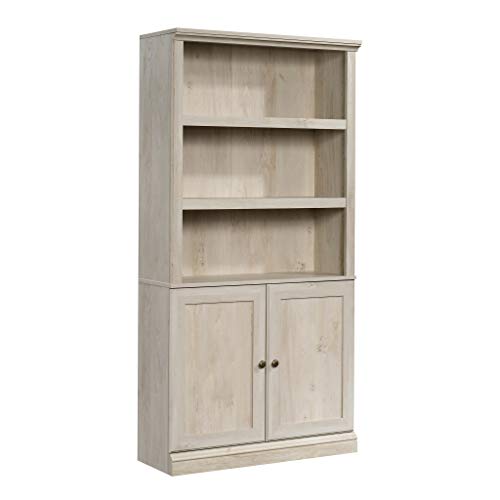
- Best overall for families: Sauder 5-Shelf Bookcase with Doors, Chalked Chestnut — Check on Amazon
- Sauder Select 5-Shelf Bookcase, Pacific Maple — Check on Amazon
- VASAGLE CUSTOS 6-Tier Bookshelf, Cloud White — Check on Amazon
- Furinno Luder 5-Cube Bookcase, White — Check on Amazon
See 2 more Amazon options
- Nathan James Theo 5-Shelf Ladder Bookcase, Walnut/Black — Check on Amazon
- Sauder Beginnings 5-Shelf Bookcase, Brook Cherry — Check on Amazon
Read the full guide ↓
Disclosure: As an Amazon Associate, dailyhomedecorating.com earns from qualifying purchases. Links to Amazon on this page are affiliate links; they cost you nothing extra. Listing details such as price and availability change often, so check the current Amazon listing before you buy.
A bookcase in a family home leads a harder life than a bookcase anywhere else, and choosing the best bookshelf for families under $400 means judging it by family rules, not showroom rules. It will be climbed on, or at least leaned on. Its lower shelves will hold board books with chewed corners, then picture books, then homework folders, then the games nobody plays but nobody will throw away. It will be bumped by ride-on toys, wiped down after juice incidents, and asked to hide a mountain of clutter in the ten minutes before grandparents arrive. And above all, it must never — ever — be able to fall on a child. Tip-over is the one non-negotiable in this guide: every tall pick here ships with an anti-tip kit or is designed to fix to the wall, and we will keep saying so until it stops needing to be said.
Families also need a bookcase to be two pieces of furniture at once. The bottom half belongs to the children: low, reachable, forgiving, ideally with doors or bins that small hands can manage and that hide the chaos when the doors swing shut. The top half belongs to the adults: the novels, the photo albums, the breakable things that live above the grab line. The best family bookcases under $400 understand that split. They offer adjustable shelves so the children’s zone can grow with them, finishes that wipe clean instead of absorbing every spill, and enough sheer capacity that the family’s paper — school forms, manuals, the folder of important documents — has a home that is not the kitchen counter.
Our short answer: start with the Sauder bookcase with doors, because doors are the single most family-friendly feature a bookcase can have — they hide clutter, slow down toddlers, and keep dust and pet hair off what is stored. The open Sauder Select is the big-library alternative for families past the toddler stage. The VASAGLE CUSTOS brings six adjustable tiers and an included anti-tip kit in a slim footprint; the low Furinno Luder cube is the children’s own bookcase; the wall-mounted Nathan James Theo is the stability champion; and the Sauder Beginnings is the narrow, gentle-on-the-budget option for hallways and kids’ bedrooms. This guide is the family cut of our main roundup of the Best Bookshelf Under $400 — same verified products, judged by stricter rules.
In this guide
Quick Picks
Six family-tested formats. Match the row to your children’s ages and your clutter situation.
| Buyer type | Pick | Why it stands out | Link |
|---|---|---|---|
| Best overall for families | Sauder 5-Shelf Bookcase with Doors, Chalked Chestnut | Doors hide clutter and slow toddlers; full-size capacity above and below | Check on Amazon |
| Best big family library | Sauder Select 5-Shelf Bookcase, Pacific Maple | Widest shelves here, three adjustable, light finish brightens family rooms | Check on Amazon |
| Best slim with anti-tip kit | VASAGLE CUSTOS 6-Tier Bookshelf, Cloud White | Six tiers, adjustable shelves, anti-tip kit included, shallow 9.4-inch depth | Check on Amazon |
| Best for young children | Furinno Luder 5-Cube Bookcase, White | Only 52 inches tall — kids reach their own books; cubes fit toy bins | Check on Amazon |
| Best for stability | Nathan James Theo 5-Shelf Ladder Bookcase | Mounts to the wall by design; 50 lb per shelf for heavy family loads | Check on Amazon |
| Best narrow budget pick | Sauder Beginnings 5-Shelf Bookcase, Brook Cherry | 24.6 inches wide for hallways and kids’ rooms, adjustable shelves | Check on Amazon |
How the picks for the best bookshelf for families under $400 were chosen
Family judging starts with safety, so that filter came first. Every tall unit in this guide either includes an anti-tip kit in the box or — in the Theo’s case — is engineered to be fixed to the wall as part of its design. We excluded open towers with no anchoring provision at all, however pretty, because a family recommendation we could not stand behind in a toddler’s bedroom is not a recommendation. Second came durability under real family loads: shelf ratings, frame construction and back panels were checked against manufacturer specifications, and every ASIN in this guide was verified against its live Amazon listing and the maker’s published dimensions before inclusion.
Third, we judged family logistics. Can the shelves adjust as children grow — low and wide for board books today, taller bays for schoolbooks in five years? Does the finish forgive wiping, or does it demand coasters and anxiety? Is there anywhere for the non-display 80 percent of family storage to go — doors, cubes that swallow bins, deep shelves that take storage boxes? And does the price leave room in the family budget for the bins, bookends and wall fixings that complete the job? All six picks sit under the $400 ceiling of this guide, most of them far under; as always we do not print static prices, so check price on Amazon for the current figure.
Finally, honesty about limits. No bookcase is childproof, only child-safer: anchoring, sensible loading and keeping climbable temptations off the top shelves remain the parents’ job. Where a pick has a real weakness for family use — glass would be one, which is why the glass display case from our main roundup is not in this list — we say so.
Detailed reviews
1. Sauder 5-Shelf Bookcase with Doors, Chalked Chestnut — best overall for families
Who it suits. Families whose living room is also the playroom, the office and the homework station — which is to say, most families. If your shelves need to look calm while containing multitudes, this is the one.
The details. This Sauder uses the company’s full-size bookcase frame — 35.28 inches wide, 13.23 inches deep, 69.76 inches tall, model 426310 — and closes the lower portion behind a pair of doors in a warm Chalked Chestnut finish. Open shelves above take the display layer: the good books, the family photos, the plant the toddler cannot reach. Behind the doors, adjustable shelving takes everything else: board games, craft supplies, the school-paper archive, the game controllers and their cable tangle, the photo boxes. The depth — a genuine 13-plus inches — swallows standard storage boxes and big picture-book formats that defeat shallower cases. For families, the doors do triple duty: they hide visual clutter in seconds, they put a meaningful pause between a determined toddler and the stored contents, and they keep dust and pet hair off things you store for months at a time.
Pros. The door feature is transformative in a family room — tidy is a door-swing away, not a half-hour away. Full-width, full-depth capacity means it can be the household’s only bookcase. The chestnut finish hides scuffs and fingerprints better than white or black. Sauder’s instructions, labelled parts and parts support make the build and any later repair painless, and the enclosed back keeps the case rigid and the contents in.
Honest limitation. Doors hide the lower shelves from adults too — this is not the pick for a family that wants its whole library on show. It is a heavy, two-person build, and like every tall case it must be anchored to the wall; the doors are a clutter solution, not a safety device, and they are not child-locks. Budget a few extra minutes at assembly to level the door gaps.
One underrated family benefit deserves a mention: the doors change tidying from a project into a gesture. Any parent knows the specific panic of the unexpected doorbell — the video call from the grandparents, the neighbour at the door. With open shelves, the living room’s paper piles, game stacks and craft sprawl are on permanent display; with this case, the worst of it lives behind two doors that close in a second, and the room instantly reads as adult space. That is not vanity — in a home where the living room is also the office and the playroom, the ability to close a door on the chaos is a genuine quality-of-life feature, and it is the reason this format outsells its open twin in family households year after year.
Choose it if your living room does family double-duty and clutter is the enemy. Skip it if you want maximum visible shelving, or your children are old enough that hidden storage no longer matters — the open Select below is the same frame without doors.
2. Sauder Select 5-Shelf Bookcase, Pacific Maple — best big family library
Who it suits. Reading families with a real and growing library — the households where books live in every room and the living-room bookcase is mission control. Also the best pick here for families whose children are past the climbing stage.
The details. The Select is the open version of the big Sauder frame: 35.28 inches wide, 13.23 deep, 69.76 tall, with five shelves of which three adjust. That adjustability is a family feature in disguise. Set one bay tall at the bottom for picture books and atlases, tighten the middle shelves for paperbacks and early chapter books, and the configuration can be re-spaced in minutes as the children’s reading — and height — changes. Sauder rates the adjustable shelves at 25 lb each, honest capacity for books; put the encyclopedia set and the full cookbook row on a fixed shelf. The Pacific Maple finish is pale and warm, which matters in family rooms that are already visually busy: it does not add another dark mass to the room, and it wipes clean with a damp cloth.
Pros. The most usable shelf space in this guide, full stop — wide rows, real depth, flexible spacing. The light finish brightens rather than dominates. It is the bookcase most likely to still be the family’s bookcase in ten years, migrating from living room to teen bedroom to spare room without looking wrong anywhere. Sauder’s warranty and parts support back that lifespan up.
Honest limitation. Everything is visible, always — there is nowhere for the mess to go, so tidy families love it and the rest of us learn to love bookends and baskets on the shelves. It is heavy in the box and a two-person assembly, and anchoring is essential: a case this size, loaded, is exactly the profile anti-tip kits exist for.
Choose it if capacity and flexibility top your list and your kids are past toddlerhood. Skip it if you need clutter hidden or the room is small enough that a 35-inch case overwhelms it.
3. VASAGLE CUSTOS 6-Tier Bookshelf, Cloud White — best slim pick with anti-tip kit
Who it suits. Families in smaller homes — apartments, narrow hallways, shared kids’ bedrooms — who need tall storage on a small footprint and want the safety hardware in the box.
The details. The CUSTOS stacks six tiers into 23.6 inches of width and only 9.4 inches of depth, standing 63.3 inches tall in particleboard and MDF with a cloud-white finish. Several shelves adjust between three heights, which lets a family column do mixed work: tall picture books at child height, chapter books above, adult paperbacks and the family paperwork near the top, out of the crayon zone. VASAGLE rates each shelf at 22 lb and the unit at 154 lb total, and — the detail that earns it this slot — includes an anti-tip kit in the box, with a slot-in back panel and H-shaped structure keeping the narrow tower rigid. In a hallway it is shallow enough to pass without sidling; in a child’s room the white finish keeps the room feeling light.
Pros. Six tiers is the most rows in this guide, in the second-smallest footprint. The included anti-tip kit and back panel show safety was designed in, not bolted on. Adjustable shelves at this size are rare. The white finish pairs with any kids’-room scheme and makes a small room feel bigger.
Honest limitation. The 22 lb per-shelf rating means discipline: heavy hardcover sets must be spread across shelves or live elsewhere, and the 9.4-inch depth will not take the biggest picture-book formats or deep storage boxes. White shows scuffs and crayon adventures more than wood tones — keep a magic eraser in the drawer.
Choose it if space is tight and you want height, adjustability and the safety kit included. Skip it if your family library is mostly heavy hardcovers.
4. Furinno Luder 5-Cube Bookcase, White — best for young children
Who it suits. Toddlers and preschoolers, and the parents who want them choosing their own bedtime books. Also playrooms, where low, bin-friendly storage beats tall shelving every time.
The details. The Luder is a five-cube open bookcase, 15.8 inches wide, 9.4 inches deep and — the headline number for this audience — just 52 inches tall. Every cube is within a small child’s reach and sightline, which changes behaviour: children who can see and reach their books choose them, carry them, and (eventually, with training) put them back. The cube format takes standard fabric bins, so half the unit can be books and half can be the toy rotation, puzzles and dressing-up clutter. It is light, simple engineered wood in a white finish, assembles quickly with basic tools, and one adult can carry it from room to room as needs change — nursery this year, playroom next, hallway after that.
Pros. The low profile removes the worst tip-over geometry of tall towers — still anchor it if your child climbs, but there is far less to fall. It is by far the most affordable pick here, so a juice disaster is an annoyance, not a financial event. Cubes plus bins is the most forgiving storage system ever devised for under-sevens. Its small size means it fits the corners and alcoves of children’s rooms where nothing else goes.
Honest limitation. Light-duty is the honest description: thin panels and modest load tolerance mean it is a children’s and light-storage piece, not the family library. The 9.4-inch cubes limit book sizes, and children will outgrow its capacity by the early school years — think of it as the first bookcase, not the only one.
A practical note on using it well: put the Luder where the reading actually happens — beside the bed, next to the reading chair, at the end of the sofa — rather than in a dedicated “book corner” children must make a trip to. Books stored at the point of use get used; books stored in a special place get visited. Rotate the stock monthly from a larger collection stored elsewhere (the bottom of the big Sauder is perfect), because a refreshed shelf of ten books holds a young child’s attention far better than a static shelf of fifty. When the Luder is eventually outgrown, it graduates gracefully — shoes and bags in a hallway, towels in a bathroom, craft storage in a spare room — which is more than can be said for most furniture bought for the under-seven years.
Choose it if your children are under seven and independence is the goal. Skip it if you need one case to serve the whole family for a decade.
5. Nathan James Theo 5-Shelf Ladder Bookcase, Walnut/Black — best for stability
Who it suits. Families who want the tip-over question answered by engineering rather than by a strap: households with climbers, big dogs, or teenagers who treat furniture as terrain.
The details. The Theo is a wall-mounted ladder bookcase: a matte black metal frame, about 24 inches wide and 72.5 inches tall, carrying five engineered-wood shelves in a brown walnut finish, each rated by Nathan James at 50 lb — the strongest per-shelf figure in this guide. The frame fixes to the wall at the top as part of its design, which means a properly installed Theo cannot tip forward at all; it is not a freestanding unit with an accessory strap but a piece of the wall. For family use that is the gold standard. The shallow, open shelves — about 12 inches deep — suit standard books and display items, and the open sides mean a child can see everything on the shelf from the room, which reduces the pulling-everything-out-to-look behaviour that empties enclosed shelves onto the floor.
Pros. Wall-mounting by design is the strongest stability story in family furniture. The 50 lb shelves take the heavy family loads — full cookbook rows, textbook sets, the complete works of a child’s favourite author in hardcover. The industrial walnut-and-black look survives the family years and still looks intentional in a teen’s room or a home office afterwards. Sold in pairs and multiple finishes if you want a matched run.
Honest limitation. It must be drilled into the wall — renters who cannot drill, and families in homes where the right wall is plasterboard with no stud where you need it, should choose a strapped freestanding pick instead. The shelves are fixed, so the tall-bay flexibility of the Sauder cases is absent, and at 24 inches wide a single unit is a modest library; most families will want two.
There is also a behavioural benefit families notice after a few months: because the Theo’s shelves are open and everything is visible, children treat it more like a display than a cupboard — books get browsed rather than excavated, and the shelf stays tidier than enclosed storage that hides its own mess. Parents of older children and teenagers rate it especially highly, because it survives the toddler years as the safest case in the house and then transitions, without looking childish for a single day, into exactly the industrial-style shelving a teenager would choose for themselves. Few family purchases manage to be the safety-first choice at age three and the style choice at age fifteen; this is one of them.
Choose it if stability is your first priority and you can mount to a solid wall. Skip it if you cannot drill, or you need adjustable shelving for fast-growing kids’ formats.

6. Sauder Beginnings 5-Shelf Bookcase, Brook Cherry — best narrow budget pick
Who it suits. Families who need a real bookcase in a narrow place: the hallway landing, the corner of a child’s bedroom, the gap beside the wardrobe. Also a sensible first “grown-up” bookcase for an older child’s room.
The details. The Beginnings (model 416439) stands 24.57 inches wide, 11.5 inches deep and 71.18 inches tall in a warm Brook Cherry finish — a full-height, five-shelf case that fits where the 35-inch Sauder frames cannot. The shelves adjust, so a child’s room setup can start with tall bays for picture books and board games and re-space for schoolbooks later. At about 53 lb it is the lightest tall case here, which makes it the easiest to move between rooms as the family’s geography changes — and in family homes, furniture geography always changes. The enclosed back panel adds rigidity and keeps books from sliding through.
Pros. Genuine Sauder build and instructions at the gentlest price of the tall picks — check price on Amazon, but expect it to sit well below the ceiling of this guide. The narrow footprint fits real family homes, not showroom walls. Adjustable shelves give it growing room. The cherry finish is warm and hides the scuffs of bedroom duty.
Honest limitation. Narrow means fewer books per row — it is a supplement or a child’s-own case, not the main family library. The Beginnings line is Sauder’s entry range, so materials and hardware are a step simpler than the Select’s. And as a tall, relatively light case, the anti-tip strap is absolutely non-negotiable — fit it before a single book goes on.
Choose it if you need tall storage in a narrow spot at a gentle price. Skip it if you need maximum capacity — that is the Select’s job.
Family safety in depth: anchoring, loading and placement
Because this is the section that actually protects your children, it gets its own space. Furniture tip-over is a well-documented household hazard: tall storage furniture that is loaded at the top, stood on carpet, or climbed by a child can come forward with terrifying speed, and safety regulators have warned about it for years. The good news is that tip-over is almost entirely preventable with three habits, all of which apply to every pick in this guide.
Anchor to structure, not to plaster. An anti-tip strap screwed into plasterboard alone is decoration. The fixing must reach a wall stud, a masonry wall with proper plugs, or use rated hollow-wall anchors where studs are genuinely unavailable. Stud finders are inexpensive; the right anchor for your wall type is a question your hardware store will answer in a minute. On the Theo, the wall fixing is structural and part of the product design — install it exactly as Nathan James specifies. On the strapped cases, fit the strap before loading, while you can still tilt the case and reach the wall easily.
Load bottom-heavy, always. Physics is not negotiable: weight low in the case lowers the centre of gravity and dramatically increases the force needed to tip it. Encyclopedias, cookbooks, photo albums and storage boxes go on the bottom shelf or two. The top shelves get paperbacks, soft toys and light display pieces. This rule has a second benefit — it puts the heaviest loads on the fixed shelves, which are the strongest, and spares the adjustable ones.
Remove the reasons to climb. Children climb toward things they want. The tablet charger, the interesting box, the treat tin — none of these live on top of the bookcase, ever. Children’s own books and toys live at child height, where no climbing is required; that is the entire design logic of the low Luder cube, and it applies to the bottom two shelves of every tall case in this guide. Teach the rule early — shelves are not steps, not ladders, not forts — and make it easy to obey by keeping the good stuff low.
Placement matters too. Avoid standing a tall case where a door swings into it, where it narrows a hallway escape route, or on a slope of thick carpet near a play area where it will be crashed into daily. A bookcase in a calm corner, anchored, loaded low and zoned sensibly, is one of the safest pieces of furniture in the house; the same bookcase freestanding in a play corridor is a risk you chose. The five minutes of anchoring and the five minutes of thought about placement are the best-value minutes in this entire guide.
A shelf-by-shelf plan for a family bookcase
Families often ask not which bookcase, but how to organise it once it arrives. Here is the arrangement that works in most households, top to bottom, using the big Sauder frames as the model. The top shelf is adult territory: light, breakable or boring-to-children things — the good photo frames, the plant, the reference books used twice a year. The second shelf is the family library’s front row: the novels and nonfiction in current rotation, at adult eye level where they will actually be browsed. The middle shelf is the shared zone: family games with their boxes stacked flat, the atlases and big shared books, the homework reference set.
The second-from-bottom shelf belongs to the children who can read: chapter books, comics, school project folders, arranged at their eye level so the shelf feels like theirs. The bottom shelf is the heavy and the toddler-proof: board books in a bin, the encyclopedia set, storage boxes of outgrown treasures. If your case has doors, the doored section takes the visual chaos — craft supplies, cables, the games with broken boxes — while the open shelves carry the presentable library. Review the arrangement twice a year; children grow faster than furniture, and the shelf that was safely out of reach in January is a step-stool target by December. The adjustable shelves on the Sauder cases and the CUSTOS make that twice-yearly re-spacing a ten-minute job rather than a new purchase.
What family life does to a bookcase — and how these picks cope
It is worth being specific about the abuse, because each kind has a defence. Spills are the daily one: juice, milk, water from the plant, the mysterious sticky patch of unknown origin. Laminate and melamine finishes — every pick in this guide — wipe clean and do not absorb, provided spills are wiped the same day; standing liquid at a panel edge is what swells engineered board, so the rule is simply “wipe it when you see it.” Impacts come next: toy cars, dragged chairs, the vacuum cleaner’s weekly kiss. Mid-tone finishes hide the evidence; the enclosed backs of the Sauder cases keep the structure square even after years of small collisions, while the metal frames of the Theo and the CUSTOS shrug off knocks that would chip an all-board case.
Overloading is the slow damage. Children do not load shelves evenly; they cram. A shelf of board books in a bin can outweigh a shelf of novels, and the games shelf always ends up double-stacked. This is why the per-shelf ratings in the comparison table matter more in a family home than anywhere else, and why the loading rule — heavy low, light high — protects both the children and the furniture. Reconfiguration fatigue is the final test: family bookcases get moved, re-spaced and re-purposed more than any other furniture. Cam-lock cases tolerate a few careful rebuilds; wall-mounted and strapped cases need their anchors re-fitted at every new position. The families who get a decade from an under-$400 bookcase are not the ones who bought magic materials — they are the ones who anchored it, loaded it sensibly, wiped the spills and re-tightened the fixings once a year. Every pick here rewards exactly those habits.
Comparison table
| Pick | Size (W x D x H) | Shelves | Family strength | Watch out for | Link |
|---|---|---|---|---|---|
| Sauder Bookcase with Doors | 35.28 x 13.23 x 69.76 in | 5, lower behind doors | Hidden storage, clutter control | Heavy build; doors are not child-locks | Check on Amazon |
| Sauder Select 5-Shelf | 35.28 x 13.23 x 69.76 in | 5 (3 adjustable) | Capacity that grows with kids | Everything visible | Check on Amazon |
| VASAGLE CUSTOS 6-Tier | 23.6 x 9.4 x 63.3 in | 6 (several adjustable) | Anti-tip kit included; slim | 22 lb per shelf; shallow | Check on Amazon |
| Furinno Luder 5-Cube | 15.8 x 9.4 x 52 in | 5 cubes | Child-height, bin-friendly | Light-duty; kids outgrow it | Check on Amazon |
| Nathan James Theo | ~24 x ~12 x 72.5 in | 5 fixed | Wall-mounted; 50 lb shelves | Must drill; fixed shelves | Check on Amazon |
| Sauder Beginnings 5-Shelf | 24.57 x 11.5 x 71.18 in | 5 (adjustable) | Narrow and affordable | Modest capacity; anchor essential | Check on Amazon |
How to choose a family bookshelf under $400
Start with the anchor, not the colour. Before comparing finishes, confirm how each candidate fixes to the wall. Included anti-tip kits (the CUSTOS), wall-mount designs (the Theo) and standard strap points on the big Sauder cases are all acceptable; a tall case with no anchoring provision is not a family bookcase at any price. Check your wall type — studs, masonry, plasterboard — and buy the right fixings at the same time as the bookcase, so safety does not wait for a second shopping trip that never happens.
Zone by height. The working rule for family shelving: children own the shelves they can reach, adults own the rest. Low shelves get board books, bins and unbreakables; mid shelves get the everyday family library; the top gets breakables, heavy reference and anything with small parts. Choose adjustable shelves so the boundary can move up as your children do — the bookcase you set for a three-year-old should re-space for a ten-year-old in minutes, which the Sauder cases and the CUSTOS all allow.
Doors and bins beat willpower. Family clutter is not a character flaw; it is a storage-design problem. If your living room doubles as a playroom, a doored case or a cube-and-bin system will look tidy every day, while an open case will look tidy only on cleaning day. Match the storage to the household you have, not the one in the catalogue. Families in compact homes should also read our guide to the Best Bookshelf For Small Apartments Under $400 — the space rules overlap heavily with family rules.
Check the finish against your actual life. Laminates that wipe clean (all six picks) survive juice, felt-tip and sticky fingers; pale finishes show scuffs, dark finishes show dust, mid wood tones hide both best. If the bookcase will live in an eating-adjacent family room, the chestnut and cherry tones in this list are the forgiving choices.
Load it like a parent. Heaviest books on the lowest shelves — this lowers the centre of gravity and makes the case safer as well as kinder to the shelves. Never put heavy items on top shelves, never let children use shelves as steps, and re-check the anchor after any move, redecoration or earthquake of the domestic variety (a sofa relocation counts).
Common mistakes when buying a family bookshelf
Skipping the anti-tip kit “for now”. The most dangerous sentence in family furniture. Anchor the case the day it is built, before it is loaded, while the wall is reachable and the tools are out. “Later” is how accidents are scheduled.
Buying a tall case for a toddler’s room. Young children need low, reachable storage — the 52-inch Luder exists for this. A 71-inch tower in a three-year-old’s room is a climbing frame with books on it.
Putting the tempting things on top. The interesting object on the top shelf is an invitation to climb. Top shelves are for boring, light, adult things; the climbing incentive should be zero.
Choosing glass. Glass shelves and family life can coexist in a display cabinet adults control, but as the main family bookcase, glass plus thrown toys plus juice is a combination we deliberately kept out of this list.
Forgetting the family will grow. A case that fits today’s picture books but cannot re-space for tomorrow’s schoolbooks has a three-year life. Adjustable shelving is the cheapest future-proofing in furniture.
Final recommendation
For most families, buy the Sauder Bookcase with Doors: it is the only pick that solves the clutter problem, the dust problem and the toddler-access problem in one piece of furniture, on a full-size frame that will not be outgrown. If your children are older and your library is the priority, the same frame without doors — the Sauder Select — is the capacity champion. Add the Luder in the children’s room, anchor everything to the wall, and the family’s books, games and glorious mess all have a home. One last encouragement: do not let the perfect be the enemy of the safe and tidy. A mid-priced case from this list, bought this month, anchored the day it is built and zoned with the children’s books at the bottom, will do more for your family’s daily calm than a dream bookcase you research for a year while the piles grow on the floor. Choose by your children’s ages and your clutter reality, fit the anchor before the books, and let the shelves get on with the unglamorous, essential work of holding a family’s life together.
Budgeting honestly for a family bookcase
A final word on money, because family budgets have competition. The bookcase itself is not the whole purchase: add fabric bins if you choose a cube, bookends for open shelves, the correct wall fixings for your wall type, and — if your case is going in a child’s room — perhaps a soft-close of the budget for a small step stool so children can reach the middle shelves safely instead of climbing. None of that is expensive, and all of it together still sits comfortably inside the under-$400 framing of this guide for most picks here. What is expensive is buying twice: the too-small case replaced in a year, the unanchored case replaced after a scare, the finish ruined because it could not be wiped. The picks in this guide were chosen so that a family buys once, anchors once, and then gets on with the important part — filling the shelves with a childhood’s worth of books.
FAQ
Are tall bookcases safe in a home with toddlers? Only when anchored. Any tall bookcase can tip if a child climbs or pulls on it, which is why every tall pick in this guide includes an anti-tip kit or wall-mounts by design. Fit the hardware before loading the shelves, keep heavy items low, and keep climbable temptations off the top.
What is the best bookshelf height for young children? Around 52 inches or lower lets preschoolers see and reach every shelf, which encourages independent book choices and tidying. The Furinno Luder in this guide is built to exactly that idea; taller cases are for shared family spaces where adults manage the upper shelves.
Are bookcases with doors better for families? For living rooms and shared spaces, usually yes: doors hide clutter instantly, slow down toddlers, and keep dust and pet hair off stored items. They are not child-locks, though — anything genuinely unsafe for children should be stored out of the bookcase entirely.
How do I stop a bookcase from wobbling on carpet? Stand the case in its final position so its weight compresses the pile, load the heaviest books at the bottom, and always fit the anti-tip kit — on thick carpet the anchor matters even more, because the base is less stable than on hard flooring.
Where should a family bookcase go in the house? Where the family actually reads and plays — usually the living room — rather than in a formal room nobody uses. A bookcase in the flow of daily life gets used, tidied and enjoyed; a bookcase exiled to a spare room becomes storage for books nobody opens. If space forces a choice, put the children’s shelves where the children are and the adults’ overflow in the bedroom, not the other way round.
What finish survives family life best? Mid-tone wood laminates hide both dust and scuffs and wipe clean with a damp cloth — the chestnut and cherry finishes in this guide are the forgiving options. White shows marks but brightens small rooms; the honest answer is to choose by room and accept a weekly wipe.
Can one bookcase serve a family from toddlerhood to teenagers? Yes, if it has adjustable shelves and full-size capacity. Start with low bins and board books, re-space the shelves as formats change, and a case like the Sauder Select or the doored Sauder can serve the whole journey. Small starter cubes like the Luder will be outgrown — plan for them to migrate to a hallway or spare room.
How much should a family spend on a bookcase? Enough to get adjustable shelves, a real anchor system and a finish that wipes clean — all available well under the $400 ceiling of this guide. Families on a tighter budget can start with our Best Bookshelf For Families Under $300 roundup and trade up later.