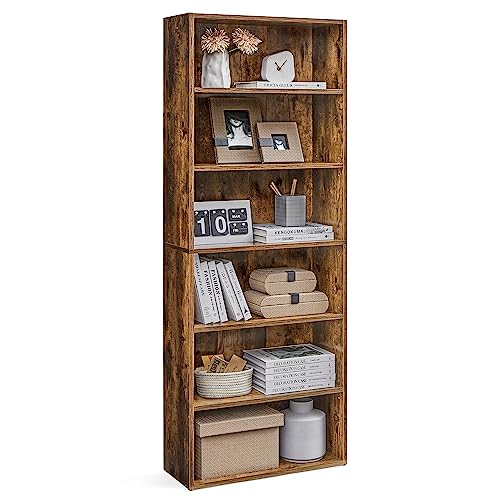
Where to buy
Check the latest price, availability and delivery on Amazon. Orders are placed on Amazon. We may earn a commission from qualifying purchases.
- Best overall for small spaces: VASAGLE Custos 6-Tier Bookcase, Rustic Brown — Check on Amazon
- Nathan James Theo 5-Shelf Ladder Bookcase, Walnut/Black — Check on Amazon
- Yoobure Tree Bookshelf, 6-Shelf, Rustic Brown — Check on Amazon
- Furinno Luder 5-Tier Bookcase with Door Cabinet, White — Check on Amazon
- HSH 3-Tier Solid Wood Bookshelf, Natural — Check on Amazon
See 1 more Amazon option
- Tribesigns 72-Inch 6-Tier Bookcase, White — Check on Amazon
Read the full guide ↓
Disclosure: As an Amazon Associate, dailyhomedecorating.com earns from qualifying purchases. Links to Amazon on this page are affiliate links; they cost you nothing extra. Listing details such as price and availability change often, so check the current Amazon listing before you buy.
A small space does not forgive a wrong bookcase. In a spare room, a hallway nook, a box bedroom or the corner of a studio, the wrong shelf does not merely underperform — it blocks the door swing, eats the light, or turns the one usable corner into a monument to good intentions. The best bookcase for small spaces under $400 is therefore chosen by a ruthless metric: storage delivered per inch of floor surrendered. That metric favors designs most furniture shopping ignores — cases under ten inches deep, tree shelves that occupy a square foot and a half, ladders that store on the wall instead of the floor, low shelves that slip under windowsills — and it is why this guide exists separately from our apartment roundup. An apartment is a home that happens to be small; a small space is a specific, awkward geometry — the alcove, the landing, the under-stair triangle — and it deserves its own shortlist.
The six picks below were each chosen for a geometry. The VASAGLE Custos brings six adjustable tiers in the shallowest full bookcase footprint we could verify. The Nathan James Theo removes the footprint almost entirely by mounting to the wall. The Yoobure tree shelf turns a 15-inch-wide sliver of floor into six shelves. The Furinno Luder adds the one thing small spaces never have — a door to hide things behind. The HSH goes low, under windows and sightlines. And the tall white Tribesigns answers the opposite brief: when the small space is a whole small room and the collection is not small at all. Tighter budgets are covered in Best Bookcase For Small Spaces Under $300; this guide spends the full under-$400 envelope on space efficiency.
Our short answer: for most small spaces, the Custos is the safest pair of hands — shallow, narrow, adjustable and light, it fits the wall runs small spaces actually offer and reconfigures as the space’s job changes. If you can mount to the wall, the Theo stores more while touching less floor than anything else here. If your “space” is a corner or a sliver beside a desk, the Yoobure tree is the only pick designed for exactly that. Measure your inches first — the reviews below are organized around them.
In this guide
Quick Picks
In a hurry? This table matches each bookcase to the small-space geometry it solves.
| Buyer type | Pick | Why it stands out | Link |
|---|---|---|---|
| Best overall for small spaces | VASAGLE Custos 6-Tier Bookcase | Six adjustable tiers at 9.4 in deep and 23.6 in wide — the shallowest full case here | Check on Amazon |
| Best near-zero footprint | Nathan James Theo 5-Shelf Ladder Bookcase | Wall-mounted, 24 in wide; 50 lb per shelf and a lifetime warranty | Check on Amazon |
| Best for corners and slivers | Yoobure Tree Bookshelf, 6-Shelf | Branch shelves on a 15 in wide, 7.8 in deep footprint; anti-tip straps included | Check on Amazon |
| Best with hidden storage | Furinno Luder 5-Tier Bookcase with Door Cabinet | Open tiers plus a closed cabinet in a compact, low frame | Check on Amazon |
| Best low profile | HSH 3-Tier Solid Wood Bookshelf | Three solid-wood tiers that fit under windows and keep sightlines open | Check on Amazon |
| Best storage per square foot | Tribesigns 72-Inch 6-Tier Bookcase, White | Six full tiers at 11.8 in deep with a rigid particleboard back | Check on Amazon |
How These Picks Were Chosen
Footprint arithmetic governed everything. We calculated each candidate’s floor area and set it against its shelf count, and the ranking pressure was relentless: a case that stores six tiers on two square feet outranks a prettier case that stores four on four. Depth was the sharpest filter — every pick here is under 12 inches deep or, in the tree shelf’s case, under 8 — because in small spaces depth is what collides with door swings, bed edges and walkways. Width came next, with a preference for the 15- to 24-inch modules that fit the wall fragments small rooms actually offer: the strip beside a wardrobe, the return wall by a door, the chimney breast alcove.
We did not hands-on test these bookcases. We compared verified specifications: dimensions first, then load honesty (a stated per-shelf rating where the maker publishes one), back and frame construction, anchoring provisions — small-footprint cases need wall fixing more, not less, than big ones — and the practicalities of getting the piece into a small space, including unit weight and whether it can be built in the room it will serve. Where a specification could not be verified consistently across sources, the review avoids printing it rather than guessing; small-space buying is measurement-driven, and an invented inch is worse than no inch.
Finally, each pick had to justify its geometry against a real small-space scenario: the hallway wall, the box-room, the studio corner, the under-window run, the home-office nook. A bookcase that was merely “compact” in the abstract did not make the list; every pick below is the answer to a specific awkward place, and its review names that place.
The 6 Best Bookcases for Small Spaces Under $400
VASAGLE Custos 6-Tier Bookcase, Rustic Brown
Who it suits: The classic small-space wall run — the shallow strip along a bedroom wall, the hallway that can spare ten inches, the living-room alcove — and anyone who needs one adaptable case that fits almost anywhere.
The Custos leads this guide because it makes the fewest demands of a small space while delivering the most conventional storage. Its footprint is 23.6 inches wide by 9.4 inches deep — a shelf depth that slips along walls where a standard 12-inch case would crowd the passage — yet it stands 63.3 inches tall with six full tiers, and the shelves adjust. That adjustability is what makes it a small-space survivor: the same case holds paperbacks in the bedroom this year, board games and school files in the box room next year, and kitchen or hobby overflow whenever a small home reassigns its corners, which small homes do constantly. The Rustic Brown finish is warm and unobtrusive, the assembled unit is light enough for one person to reposition, and VASAGLE’s build instructions are among the clearer ones in flat-pack furniture — no small mercy when you are assembling in a room with four feet of clear floor.
It sits at the value end of this guide’s budget — check the current price on Amazon — and that positioning unlocks the small-space strategy this guide recommends most: two narrow cases in two useful places beat one wide case in one wrong place. A Custos in the hallway and another in the bedroom distribute storage to where life happens, at a combined footprint no single large case could match. Shoppers furnishing a whole small home will find its companions in Best Nesting Tables Under $400, which follows the same space-per-inch logic.
The honest costs of shallow and light: the 9.4-inch shelves exclude the largest art books and deepest storage boxes, load capacity sits a class below the heavier picks, and a tall, narrow, shallow case is precisely the geometry that must be wall-anchored — its small footprint gives it the least natural resistance to tipping in this guide. Anchor it, load the heavy material low, and those costs are fully managed.
- Six adjustable tiers on a 23.6 in × 9.4 in footprint — the shallowest full bookcase here.
- Light and solo-movable; reconfigures as the space’s job changes.
- Value pricing makes a two-case, two-corner strategy realistic.
Honest limitation: Shallow shelves exclude oversized items, load limits are modest, and anchoring is essential given the small footprint.
Choose it if your small space offers a shallow wall run and you want maximum adaptability. Skip it if every inch of the space is a corner — the Yoobure tree below is built for corners.
Nathan James Theo 5-Shelf Ladder Bookcase, Walnut/Black
Who it suits: Small spaces with a fixable wall — the home-office nook, the bedroom wall beside the desk, the studio’s one free vertical surface — where the floor itself has no inches to give.
When the floor is fully spoken for, the wall is the remaining real estate, and the Theo is how a bookcase moves onto it. This ladder bookcase mounts to the wall: five walnut-finish shelves on a black metal frame, 24 inches wide, 12 inches deep, 72 inches tall. Its floor demand is a strip the size of a doormat, and because the frame is open, even that strip stays visually unoccupied — the room keeps its floor lines, its light and its sense of size, while five shelves of storage appear on a wall that was previously holding a picture. For the smallest spaces in this guide — the desk nook carved from a bedroom, the reading corner in a studio — that trade is not an optimization; it is the difference between having a bookcase and not having one.
The engineering is verified and unusually strong for the format: 50 lb per shelf, 250 lb total, a lifetime manufacturer warranty, a unit weight of about 30 lb and a maker-estimated assembly of roughly 25 minutes. It sits in the middle of this guide’s budget — check the current price on Amazon. In small-space terms, its cost per stored book is among the lowest here once you price the floor it does not consume, and its see-through profile pairs with the approach in our sister guide, Best Bookcase For Small Apartments Under $400, for whole small homes planned wall-first.
The condition is absolute, though: the Theo works by fixing to the wall, so it belongs to owners and to renters whose leases permit screws. A small space in a strict no-fixings rental should take the Custos or the tree shelf instead. Shelf spacing is fixed, favoring books and display objects, and the open sides mean nothing is hidden. Judge it as architecture that stores, and it is the strongest pick in this guide; judge it as a cupboard, and it was never auditioning for that job.
- Wall-mounted: five shelves on a doormat-sized floor strip, visually weightless.
- Verified 50 lb per shelf and 250 lb total, lifetime warranty, about 30 lb unit weight.
- Open frame preserves light and sightlines in the smallest rooms.
Honest limitation: Requires wall fixings — not an option under strict no-screw leases — and shelf spacing is fixed.
Choose it if your floor is full but a wall is free and fixable. Skip it if you cannot mount anything — the Custos gives you six freestanding tiers instead.

Yoobure Tree Bookshelf, 6-Shelf, Rustic Brown
Who it suits: Corners, slivers and dead zones — the 15 inches beside a desk, the gap between wardrobe and wall, the landing corner — plus anyone who wants a small, characterful shelf for a working collection of favorites.
Every small home has a piece of floor too narrow for furniture and too visible to waste. The Yoobure tree shelf was designed for exactly that floor. Its six branch-style shelves rise from a footprint just 15 inches wide and 7.8 inches deep, standing about 45 inches tall — a vertical garden of small shelves, each holding a handful of books, sized by the maker at roughly five to ten books per branch. Total capacity is a curated collection rather than a library, but that is the honest trade of the format: it converts a sliver that stored nothing into storage for the books in current rotation, the bedside stack, the child’s favorites, the cookbooks beside the kitchen doorway. In small spaces, found storage is the best storage, and no other pick here finds it in places this small.
The details suit its mission. The unit weighs about 15 lb, so it can be carried to whichever corner is auditioning this month; it ships with anti-tip straps and a reinforced backboard, the correct safety instincts for a tall, narrow piece; and the rustic brown tree silhouette earns its visibility, reading as a deliberate decorative object rather than a compromise. It sits at the accessible end of this guide’s budget — check the current price on Amazon — and for genuinely tiny budgets the entry point to this whole category is surveyed in Best Bookcase Under $150.
Be clear-eyed about the limits. Branch shelves hold books at display angles, not in dense military rows, so per-shelf counts are modest and very large or heavy volumes do not belong here. It is a favorites shelf, a rotation shelf — the library’s front window, not its warehouse. Households whose whole collection must live in one piece should step up to the Custos or the tall Tribesigns. But as the answer to “that corner does nothing,” the tree shelf has no rival in this guide.
- Six branch shelves on a 15 in × 7.8 in footprint — storage for corners nothing else fits.
- About 15 lb, with anti-tip straps and a reinforced backboard included.
- Decorative tree silhouette that makes a virtue of a dead zone.
Honest limitation: Modest per-branch capacity for books in current rotation — not a whole-library solution, and oversized volumes need not apply.
Choose it if your small space is a corner or a sliver and your shelf is for favorites. Skip it if you need to store a full collection in one piece.
Furinno Luder 5-Tier Bookcase with Door Cabinet, White
Who it suits: Small spaces that need one closed door as much as they need shelves — the box room, the studio corner, the hallway where the household’s unsightly essentials currently live in the open.
Open shelving in a small space has a hidden cost: everything stored is also displayed, and in a small room there is nowhere for the eye to rest from it. The Luder’s compact five-tier frame — about 52 inches tall, in white — builds in the remedy: a door cabinet section alongside the open tiers, so the same small footprint offers display for the books and objects that earn it, and concealment for the cables, paperwork, tools and supplies that never do. In a box room or a studio corner, that single door is the difference between storage that calms a space and storage that fills it visually as fast as it fills it physically.
Its scale is the other virtue. At roughly 52 inches it fits under window lines, under sloping ceilings’ useful height and beneath the sightlines that make small rooms feel open, and it can serve positions no tall case can: the end of a hallway, the wall beside a bed, the entryway strip where a small home’s landing zone lives. Furinno builds the Luder line from composite wood to keep it light and at the most accessible price position in this guide — check the current price on Amazon — with one-person assembly that suits a room where there is barely space to build, let alone space to store. Pair it with Best Storage Ottoman For Small Spaces Under $400 and a small room gains two closed compartments that between them swallow most of the visual noise of daily life.
The class compromises apply: composite construction and modest load limits make this an everyday-storage piece rather than a vault for heavy reference sets, and the compact tiers favor paperbacks and standard objects over oversized volumes. Its low height reduces tip risk compared with tall cases but does not repeal physics — anchor it where children or pets will climb or collide. Within its brief, it is the only pick here that both shelves and hides at this size.
- Open tiers plus a door cabinet — display and concealment in one compact frame.
- About 52 in tall: fits under windows, eaves and sightlines.
- Light, one-person assembly at the guide’s most accessible price position.
Honest limitation: Composite build and modest loads suit everyday storage, not heavy reference collections; compact tiers exclude oversized books.
Choose it if your small space needs a door as much as shelves. Skip it if capacity is the whole brief — the tall Tribesigns below stores multiples of this.
HSH 3-Tier Solid Wood Bookshelf, Natural
Who it suits: The under-window wall, the low-ceilinged room, the space beside a sofa or bed — anywhere a small space’s only available wall is a low one, and where real wood warmth is wanted at a modest scale.
Some small spaces are not narrow but low: the room under the eaves, the wall beneath a wide window, the area under a staircase’s slope where the ceiling gives you four feet and not an inch more. Tall cases are simply not candidates there, and the HSH is the pick designed for that horizon. Three tiers of solid wood on a metal frame keep the whole piece below most windowsills, preserving the light that small rooms can least afford to lose, while providing the most useful shelf altitude in daily life — the height of a seated reader’s hand. Beside a bed it is the bookcase and the nightstand’s shelf in one; beside a sofa it carries the reading stack, the lamp and the plant at exactly the level life happens.
Solid wood is the durability argument at this size. Small-space furniture gets moved, bumped and re-purposed more than any other kind, and solid shelves can be sanded and refinished after the knocks accumulate, where laminate simply accumulates them. The natural finish brings the warmth that small, pale rooms often lack, and the low center of gravity is inherently forgiving — though a wall fixing remains the routine precaution. It sits at the accessible end of this guide’s budget — check the current price on Amazon — and of all the picks here it is the one most certain to fit the next small space too, whatever shape it is.
Its limit is capacity, plainly: three tiers is a working shelf, not a library. Pair it with a tall case elsewhere, or accept it as the curated surface of a small room whose bulk storage lives in closed furniture. The rustic grain also varies unit to unit. As the answer to a low wall, though, nothing taller is even eligible, and nothing else at its height offers real wood.
- Three low tiers fit under windowsills, eaves and sloping ceilings.
- Solid wood shelves — refinishable through years of small-space rearrangement.
- Doubles as bedside or sofa-side surface at seated height.
Honest limitation: Three tiers is working-shelf capacity, not library capacity; natural grain varies between units.
Choose it if your available wall is a low one. Skip it if you need maximum storage from the space — go vertical with the Tribesigns instead.
Tribesigns 72-Inch 6-Tier Bookcase, White
Who it suits: The small room with a big collection — the box-room library, the studio’s one full wall, the spare room that must store like a room twice its size.
Sometimes “small space” describes the whole room, and the collection refuses to shrink to match. This Tribesigns is the maximum-storage answer that still respects a small room’s rules: six full tiers across about 35.4 inches of width, at a depth of just 11.8 inches — inside the walkway-safe zone — rising 72 inches to use the vertical volume small rooms waste. Its storage-per-square-foot is the highest in this guide, and its structure suits the duty: the back panels are selected particleboard rather than folded cardboard, keeping the tall case rigid and square under full loads, and the white, water-resistant finish brightens a small room instead of darkening it, which is what a wall of books in a dark finish would do.
The small-room math is compelling. One of these on the single usable wall of a box room converts that room into a genuine library, office store or hobby archive while leaving the floor almost entirely free for the desk, the chair or the bed the room also holds. It sits in the lower-middle of this guide’s budget — check the current price on Amazon — and for small-space dwellers it reframes the problem correctly: the question is rarely how little storage you can survive with, but how much storage one wall can be made to hold. This is close to the honest maximum.
The conditions are the tall case’s usual ones, sharpened by small rooms. It must be wall-anchored — a loaded 72-inch case is a serious object, and small rooms put people close to it constantly. Its 35-inch width needs one genuinely clear wall run, measured between door swings and radiators. And white shows dust, the standing tax on brightness. Meet those terms and it is the pick that ends a small home’s storage argument outright.
- Highest storage per square foot in this guide: six tiers at 11.8 in deep.
- Particleboard back keeps the tall, loaded case rigid and square.
- Bright, wipe-clean white finish keeps a small room feeling larger.
Honest limitation: Needs one clear 35-inch wall run and a non-negotiable anchor; white shows dust fastest.
Choose it if the whole room is small and the collection is not. Skip it if your space is a fragment rather than a room — the Custos, Theo or tree shelf fit fragments better.
Comparison Table
| Product | Type | Best use | Link |
|---|---|---|---|
| VASAGLE Custos 6-Tier Bookcase | Compact adjustable shelving | Shallow wall runs anywhere | Check on Amazon |
| Nathan James Theo 5-Shelf Bookcase | Wall-mounted ladder | Storing on the wall when the floor is full | Check on Amazon |
| Yoobure Tree Bookshelf | Branch tree shelf | Corners, slivers and dead zones | Check on Amazon |
| Furinno Luder Bookcase with Door | Compact shelves + cabinet | Small spaces needing one hidden compartment | Check on Amazon |
| HSH 3-Tier Solid Wood Bookshelf | Low natural-wood shelving | Under windows and sloping ceilings | Check on Amazon |
| Tribesigns 72-Inch Bookcase, White | Tall library case | Maximum storage in a small room | Check on Amazon |
How to Choose a Bookcase for a Small Space
- Start from the geometry, not the catalog. Name the space first — corner, sliver, low wall, shallow run, whole small room — then choose the design family built for it. Small-space buying fails when a normal bookcase is asked to fit an abnormal place.
- Price the floor, not the shelf. Divide what a case stores by the floor it takes. Tall, shallow and wall-mounted designs win this arithmetic every time, and in a small space the arithmetic is the product.
- Keep depth under 12 inches. Beyond that, a case starts taxing walkways, door swings and bed-making room. Under 10 inches, check that your largest regular books still fit.
- Anchor the small cases hardest. Narrow footprints tip most easily. Every pick here should be fixed to the wall, and the tree shelf’s included straps are the model to follow.
- Give the space one closed compartment. Small spaces display everything by default. A single door — on the bookcase or a companion piece — is what keeps the space looking intentional.
- Protect the light. In small rooms, daylight is floor area you cannot buy. Low cases under windows and pale finishes on tall ones keep the space’s brightness — and therefore its felt size — intact.
- Choose pieces that can change jobs. Small spaces get reassigned constantly. Adjustable shelves, light weight and neutral finishes let a case follow the room’s next purpose instead of blocking it.
- Measure the route in. The case must travel the hallway, the doorway and possibly the stairs, then be built in a room with little clear floor. Compact and light are logistics features, not just dimensions.
Measuring a Small Space for a Bookcase
Small-space measuring has three extra steps beyond the usual width-height-depth. The first is the swing audit: open every door, drawer and wardrobe within reach of the intended spot and mark their arcs on the floor with tape — a bookcase that fits the wall but blocks a door’s last fifteen degrees does not fit the space. The second is the heat audit: radiators, baseboard heaters and vents claim wall space that looks free, and books and finishes both dislike living against heat; leave genuine clearance. The third is the future audit: small spaces change jobs more than any others, so favor the spot and the case that still work if the desk moves, the bed turns or the room becomes a nursery — which in practice means the flexible picks, the Custos and the low HSH, over the most specialized geometry.
Then do the tape test. Outline the footprint on the floor and live around it for a day: make the bed, open the drawers, carry the laundry basket through. Small spaces reveal their objections in use, not in measurement, and an evening with a tape outline is cheaper than a return. Finally, photograph the space with the tape in place and check the light: if the outline sits on the window wall, ask whether a low case preserves what a tall one would spend. In small rooms, the tape test and the light test together predict satisfaction better than any specification sheet.
Common Buying Mistakes
- Buying a standard-depth case for a shallow space. Twelve-plus inches of depth in a ten-inch world means a permanent obstruction. Depth is the first measurement in a small space.
- Forgetting door and drawer swings. The case fits the wall and blocks everything that opens near it. Audit the arcs before ordering.
- Assuming small cases do not need anchoring. The narrowest footprints are the least stable. Small cases get fixed to walls first, not last.
- Blocking the window wall with a tall case. The light a tall case spends is worth more than the storage it buys in most small rooms. Go low on window walls.
- Choosing open shelves for a space with no other storage. Everything will be displayed, including everything you hate looking at. Include one door somewhere.
- Cramming the space’s only corner with a rectangular case. Corners are geometry problems with their own solutions — tree and corner formats exist precisely for them.
- Ignoring the delivery route. A case that cannot come up the stairs or be built in the room is not small-space furniture, whatever its footprint says.
- Filling every shelf to signal value. In a small space, a case at 100 percent makes the whole room feel like storage. Eighty percent reads as a home.
Final Recommendation
- Most small spaces: VASAGLE Custos 6-Tier Bookcase.
- Floor completely full: Nathan James Theo 5-Shelf Ladder Bookcase.
- Corners and slivers: Yoobure Tree Bookshelf, 6-Shelf.
- Needs a hidden compartment: Furinno Luder 5-Tier Bookcase with Door Cabinet.
- Low walls and eaves: HSH 3-Tier Solid Wood Bookshelf.
- Whole small room, big collection: Tribesigns 72-Inch 6-Tier Bookcase, White.
Our top two for small spaces are the Custos — the shallow, adjustable all-rounder that fits the wall runs small spaces actually have — and the Theo, for the spaces where the floor has nothing left to give and the wall must do the work. Corners belong to the Yoobure tree, low walls to the HSH, and the small room with the serious collection to the tall white Tribesigns. Measure the geometry, audit the swings and the light, anchor whatever you choose, and check the live listing for price and finish before ordering. In a small space, the right bookcase does not feel like a purchase — it feels like found room.
Small Spaces Beyond the Living Room
The geometries in this guide recur all over a home, and the same picks solve them room by room. In a hallway, the shallow Custos turns a passage wall into the household’s library without narrowing the route anyone walks — the test is whether two people can still pass with laundry baskets, and at 9.4 inches deep it passes. On a landing, the Yoobure tree converts the deadest square footage in most houses into the children’s book corner or the household’s current-reading shelf, lit by the stairwell window that was previously illuminating nothing. In a home office squeezed into a bedroom, the Theo above the desk stores the professional library on the wall the desk already faces, keeping the floor clear for the chair’s full travel. In a nursery or child’s room, the low HSH keeps books at the height of their readers and later graduates to toy and keepsake duty without leaving the house’s furniture ecosystem.
The under-stair space deserves its own sentence, because it is the small space most often wasted entirely. Its ceiling height changes along its length, which defeats standard furniture and rewards exactly the mixed-height approach this guide is built on: a low case where the slope is lowest, a compact doored unit in the middle height, and the family’s overflow — the board games, the photo albums, the seasonal boxes — organized in the tall end if the geometry allows. Measured honestly and furnished in sections, the under-stair void becomes the storage a small home was missing, and none of it required a single new wall.
Keeping a Small Space Feeling Bigger with Shelving
The final small-space skill is restraint, because shelving can shrink a room it was bought to serve. Three habits protect the feeling of space. First, leave the top shelf of any tall case partly empty or purely decorative — a case that stops visually before the ceiling keeps the room’s height legible. Second, keep one finish family per room: the eye reads mixed-finish shelving as more furniture, and matching tones as one calm installation. Third, light the shelves rather than the room’s center where you can — a small lamp on a low case draws the eye horizontally and low, which is how small rooms feel widest. The bookcases in this guide were chosen to reward those habits: shallow enough to keep floors open, pale or warm enough to keep walls calm, and honest enough in construction to stay square and quiet while the small space around them changes, as small spaces always do.
Assembly in a Small Space: A Short Survival Guide
Building flat-pack furniture in a small space is its own discipline, and the picks here were partly chosen for surviving it. Work in the room the case will live in — a bookcase assembled in the kitchen and carried through a narrow doorway arrives with its first damage already done. Clear the floor rectangle first, even if that means the bed holds every object you own for an hour, and lay the packaging cardboard down as your work surface to protect both the floor and the panels. Build tall cases on their backs and stand them up only when the back panel is fixed and the structure is rigid; in a small room, plan the standing-up arc before you begin, because a 72-inch case needs a clear diagonal as it rises, and discovering the ceiling fan’s position mid-lift is a story nobody enjoys telling.
Keep the hardware discipline small-space assembly demands: one bowl for fasteners, the instructions on the wall where you can see them standing up, and a pause before the final tightening of every fastener — cases are squared by their backs, and a case tightened crooked in a small room will lean in full view for years. Anchor immediately, while the tools are out and the case is empty; anchoring a loaded case means unloading it, which means it does not happen. Finally, keep the spare hardware bag taped inside a rear panel. Small spaces offer nowhere to store a “furniture bits” drawer, and the owners who can still adjust a shelf in year three are the ones who stored the parts on the furniture itself.
One Shelf, Many Jobs: Rotating a Small Space Through the Year
A small space rarely keeps one job for long, and the bookcase that serves it best is the one that rotates gracefully. In winter the hallway case holds the household’s reading and the board games that come out in the dark months; by spring the same shelves take the gardening books, the seed boxes and the outdoor gear migrating back into use. The adjustable Custos and the compartmented Luder absorb those rotations without new furniture, because their shelves re-space and their door swallows the out-of-season category whole. Even the tree shelf rotates: cookbooks by the kitchen in baking season, children’s favorites in the school holidays, the current novel stack always. Planning the rotation when you buy — choosing adjustability and one closed compartment over a fixed, all-open design — is what turns a small space from a compromise into a system, and it is why the flexible picks lead this guide ahead of several prettier but more rigid alternatives.
Frequently Asked Questions
What is the best bookcase depth for a small space?
Between about 8 and 12 inches covers nearly every small-space situation. Under 10 inches suits hallways, slivers and shallow wall runs; 11 to 12 inches suits whole small rooms where standard hardcovers and storage boxes must fit. Deeper than 12 inches, a case begins taxing walkways and door swings in genuinely small spaces.
How can I add book storage to a corner?
Use a format designed for it rather than a rectangular case wedged diagonally. The tree shelf in this guide occupies a 15-inch-wide corner footprint and turns it into six small shelves for books in rotation — the realistic corner solution. Keep corner loads light, use the included anti-tip straps, and treat the corner as a favorites shelf rather than the main library.
Do small bookcases really need wall anchoring?
Yes — more than large ones, if anything. A narrow footprint and a tall profile is the least stable combination in furniture, and small spaces put people, children and pets in constant contact with the case. Anchoring takes minutes, and several picks here include the straps or kit to do it.
Is a tall or low bookcase better for a small room?
Tall stores more per square foot and suits the small room whose problem is volume; low preserves light and sightlines and suits the small room whose problem is feeling cramped — especially on window walls. Many small rooms use one of each: tall on the solid wall, low beneath the window.
How many books can a small-space bookcase hold?
It varies by format more than by price. A six-tier compact case holds a respectable working library of paperbacks and standard hardcovers; a tree shelf holds a curated rotation of a few dozen favorites across its branches; a tall six-tier case at apartment depth holds a full collection. Match the format to the honest size of your collection rather than the size you hope it becomes.
Can a bookcase work under a sloping ceiling or stairs?
Yes, if you shop by height first. Low three-tier cases fit where the ceiling gives you limited clearance, and their shelves sit at the most usable height in the space. Measure the ceiling height at the exact spot the case will stand — slopes make wall-total measurements meaningless — and leave a few inches above the case for access.


