Disclosure: As an Amazon Associate, dailyhomedecorating.com earns from qualifying purchases. Links on this page are affiliate links; they cost you nothing extra. Prices and availability change often, so check the current Amazon listing before you buy.
Learning how to choose a stick vacuum is mostly learning to ignore the loudest numbers and ask seven quieter questions instead. The category’s marketing leads with runtime and suction figures that are measured in ways that barely resemble your hallway, while the things that decide whether you still love the machine in year three — battery arrangement, bin rhythm, balance, spare parts — get a footnote each. This guide reverses that order. Work through the steps in sequence, writing down your own answers as you go, and by the final step the shortlist will be short for the right reasons.
Key Takeaways
- Start with your floor map and your longest real session, not with models.
- The swappable-versus-sealed battery decision is the most consequential in the category.
- Headline runtime is an eco-mode figure; plan around modes, not the box number.
- Match tools to your furniture, stairs and car — not to an attachment count.
- Confirm spare filters, rolls and packs are sold before buying anything.
What You Need to Know Before Comparing
A stick vacuum is a slim, upright cleaner built around a long wand, with the motor, dust cup and battery carried in a compact body at the top and a floor head at the bottom. The format exists for one reason: speed of access. Instead of dragging a full-size machine out of a closet, connecting a hose and finding an outlet, you lift the stick off its dock, clean the mess in front of you, and put it back. That grab-and-go rhythm changes how often a home gets vacuumed at all. Floors that once waited for a weekly deep clean get a quick pass after dinner, after the dog shakes off, or after a child finishes a crumb-heavy snack. The stick format trades raw capacity for frequency, and for many households that trade is exactly the right one, because most everyday dirt is light, recent and spread thin rather than ground deep into carpet pile.
Suction claims in this category deserve calm scepticism. Makers quote figures measured in different ways, at the motor rather than at the floor head, in modes you will rarely use, and the numbers do not translate neatly into how a machine behaves on your floors. What you can judge sensibly is behaviour: does the head pick up crumbs without scattering them, does it lift hair from your rug type, does it clean to the edge, and does performance stay consistent as the bin fills and the battery drains? A well-sealed airflow path and a well-designed head routinely beat a bigger headline number in real rooms. Treat specifications as a rough sorting tool, then weight design, tools, battery handling and brand support more heavily in the final decision.
Battery honesty matters more with stick vacuums than with almost any other appliance, because the headline runtime printed on a box is almost always measured in the gentlest mode, often with a non-motorised tool attached. Switch to the high or max mode that you actually need for carpet, and the usable runtime is a small fraction of that headline figure — sometimes dramatically smaller. This is not a scandal; it is physics. Spinning a brush roll and pulling hard suction drains a compact pack quickly. What it means practically is that you should plan your cleaning around modes: eco or standard for hard floors and daily passes, higher modes reserved for rugs, entry mats and the spots that genuinely need them. A stick vacuum that feels adequate on hard floors can feel frustratingly short-legged if your home is mostly carpet and you run it flat out everywhere.
In this guide
How to Choose a Stick Vacuum in 7 Steps
Step 1: Map Your Floors Before You Look at a Single Model
Write down, room by room, what is actually on your floors: timber, tile, laminate, rugs, low-pile or deep-pile carpet, and roughly how much of each. This unglamorous list decides more of the purchase than any specification, because it sets the head type you need, how hard the brush roll must work, and how much of your cleaning will happen in battery-hungry higher modes. A home that is mostly hard flooring with two rugs shops in a different part of the category from a home that is wall-to-wall carpet, and confusing the two is the root of most disappointed purchases. Include the awkward zones too: stairs, a carpeted hallway, the mat inside the front door. If a room would embarrass the machine, you want to know now, on paper, rather than in your first week of ownership.
Step 2: Measure Your Longest Real Cleaning Session
Think about the longest clean you actually do, not the one you intend to do. Is it a whole-house session, or three separate room-sized bursts across a day? Stick vacuums reward the burst pattern, because the machine returns to its dock and tops up between jobs. A whole-house, single-session household needs to plan harder: favour swappable packs, consider a spare, and be realistic that higher modes on carpet last a small fraction of the headline runtime figure. A burst-pattern household can choose almost anything in the category and be happy. Be honest here; the gap between the cleaning life you have and the one in the advertisement is where battery disappointment lives.
Step 3: Decide the Battery Question — Swappable or Sealed
With your session pattern in hand, the battery decision makes itself. Swappable packs suit larger homes, long sessions and anyone who keeps appliances for many years, because a spare covers big days and a faded pack can be replaced without replacing the vacuum. Sealed packs suit smaller homes and shorter sessions, keep the body slimmer, and only become a liability if the pack fades while the rest of the machine still has life in it. Check, for any model you shortlist, whether a replacement pack exists and is actually sold. That one check, which takes two minutes, predicts long-term satisfaction better than any runtime claim printed on the box.
Step 4: Match the Head and Tools to Your Mess
Now match hardware to debris. Hard floors want a head with good front intake and edge cleaning so crumbs are swallowed rather than pushed. Carpet wants a motorised brush roll with real agitation. Pet homes want wrap resistance or an easily cleared roll, plus a motorised mini tool for sofas and beds. Every home with stairs or a car wants a crevice tool that is actually long enough. Read tool lists against your own furniture, not as a count: five attachments you will never use are worth less than the two you will use daily, stored on the dock where your hand expects them.
Step 5: Judge Filtration and Bin Design by Your Household’s Sensitivities
If anyone at home has allergies, move filtration up the priority list: a genuinely sealed system, proper exhaust filtration and a bin that empties without a dust cloud — or an auto-empty dock that removes the moment entirely. If nobody is sensitive, bin size and emptying style still matter, because they set your rhythm: pet and family homes may empty daily, so a mechanism that is pleasant at the fiftieth repetition beats a clever one that is fiddly at the fifth. Check which filters are washable, which are replace-only, and whether both are stocked as spares.
Step 6: Handle the Machine — Balance, Switch and Standing
Specifications cannot tell you how a stick feels at minute fifteen. The motor and battery sit near your hand, so balance and switch style decide whether longer sessions tire your wrist: a hold-down trigger suits short bursts, a latching switch suits long cleans and grip issues. Check whether the machine stands on its own for pauses, how it steers around chair legs, and whether the wand length suits your height. If you cannot handle a model in person, weight the reviews that discuss handling from owners of a similar build and home, and favour sellers whose returns policy lets your own hallway be the test track.
Step 7: Check the Parts Shelf and the Dock Plan, Then Buy
Finish with the two checks buyers skip. First, the parts shelf: confirm that filters, brush rolls and battery packs for your exact model are listed and sold, because that is the difference between a machine that ages gracefully and one that becomes disposable. Second, the dock plan: decide exactly where the vacuum will live and charge — near the kitchen or entry, on a wall you may drill or a freestanding dock if you rent — because a stick stored far from the mess loses the instant-start habit that justifies the whole format. With floors mapped, battery decided, tools matched and parts confirmed, buy the model that fits the list, not the one with the loudest headline.
Gear for This Guide
Four models illustrate the main branches of the decision tree: the balanced benchmark, the pet-focused all-rounder, the dock-centred system for larger homes, and the battery-platform value route. All are described in prose here; check the current listing for the exact configuration before buying.

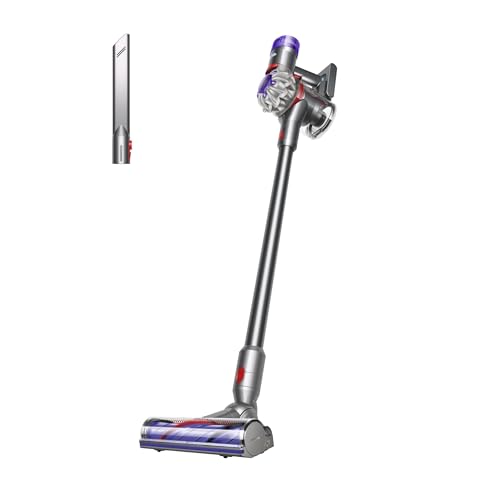
Dyson V8
a long-standing benchmark in the premium tier, known for a compact, well-balanced body, a trigger-style power control, and a hygienic bin-emptying action that pushes debris out without you touching it. In daily use its character is light and nimble rather than brute-force: it suits hard floors and mixed homes cleaned often, converts to handheld in a click, and is supported by a wide ecosystem of heads and tools. The honest limitations are a small bin that pet-heavy homes will empty often, and a sealed-in ownership model where you should confirm pack replacement options before buying for the long term. As a reference point for what the format should feel like, it earns its place in any shortlist — check the current listing for the exact configuration on offer.
Shark Stratos Cordless
a feature-led contender from the value-conscious end of the premium tier, built around hair-wrap resistance, odour-neutralising touches on some configurations, and a flexible wand on certain versions that bends for under-furniture reach and compact storage. Its personality is practical: strong everyday pickup, a head that handles mixed floors without swapping, and tools aimed squarely at pet households. Trade-offs to weigh are a slightly heavier in-hand feel than the lightest rivals and a busier design with more nooks to keep clean. For buyers who want modern conveniences without stepping to the very top of the market, it is one of the most complete packages going, and the one many pet owners end up choosing after comparing tool kits side by side.

LG CordZero
the systems thinker’s stick vacuum, from a brand that treats the dock as part of the product: some configurations pair the vacuum with a tower that charges, stores tools and can auto-empty the bin, and dual-battery bundles exist in the range for long sessions. The cleaning character is composed and thorough, with a compression feature on some bins that squeezes debris down to delay emptying. It suits larger or multi-storey homes that want a permanent, tidy charging station and the option of back-to-back packs. The trade-off is footprint and complexity — a tower dock needs its own corner — and you should confirm exactly which dock and battery arrangement the listing describes, because the range spans several quite different packages under similar names.

Hoover ONEPWR
the pragmatic, system-minded choice from a heritage floor-care brand, built around a shared removable battery platform that also powers other tools in the same family. That ecosystem thinking is its charm: a spare pack is a natural purchase rather than an exotic one, and the machines themselves favour straightforward, repairable design over showpiece styling. Cleaning character is honest mid-tier — well suited to hard floors, flats and everyday family mess — without pretending to out-gun the premium names on deep carpet. For households that already own, or plan to own, other tools on the same battery platform, the value logic is strong. Check the exact tool bundle in the listing, because configurations in this range vary more than most.
Common Mistakes
Stick vacuums carry small dust cups, and that single fact shapes the ownership experience. A compact bin is fine for crumbs and dust, but pet hair, household fluff and renovation dust fill it fast, and a bin that looks only partly full can already be choking airflow because hair wraps and bridges across the intake. Expect to empty the cup often — in a shedding-pet home, possibly more than once in a single session. Emptying is usually a one-button affair over a trash can, but it is not dust-free, which matters for allergy-sensitive households. Some designs add compression or auto-empty docks that pull debris into a larger base after each clean; those add cost and bulk but genuinely reduce how often you handle dust. Judge bin size against your actual debris, not against a showroom demo.
Honesty about limits makes the rest of this guide trustworthy: a stick vacuum complements rather than replaces a full-size machine for deep cleans. Before guests, after a renovation, at the seasonal changeover, or when thick carpet needs grit pulled from the base of the pile, sustained power, a larger brush and a big bin still win. Many households settle into a sensible division of labour — the stick handles the daily and weekly surface load, and a corded upright or canister comes out monthly or seasonally for the heavy work. Others, particularly in flats and hard-floor homes, find the stick genuinely sufficient on its own. Neither answer is wrong. What matters is matching the machine to the floors and the mess, and not expecting a lightweight battery cleaner to do a job it was never built for.
A small design choice with daily consequences is how the machine switches on. Some sticks use a hold-down trigger: the motor runs only while your finger squeezes, which saves battery during pauses but tires the hand on longer cleans. Others use a click-on switch or power button that stays on until you stop it, which suits longer sessions and anyone with grip issues, at the cost of the motor running while you move furniture. Neither is objectively better; it depends on your session length and your hands. If your cleans are short bursts around the kitchen, a trigger is fine and even helpful. If you regularly clean several rooms in one go, a latching switch is usually the kinder choice. It is the kind of detail that never appears in headline marketing and matters every day.
Pro Tips
If you are choosing between models, build a fair home trial in your head before you buy, then run it in the first days while returns are simple. Time how your real rooms feel on standard mode, not just max. Empty the bin and note how much of your actual debris it held. Convert to handheld and clean the sofa and the car. Carry it up the stairs. Dock it, charge it, and live with where it stands. These ordinary tests expose the things that matter — balance, bin rhythm, tool usefulness, noise at your hours — far better than any showroom push across a polished floor. A stick vacuum is a daily-use tool; judge it the way you would judge a kettle or a favourite knife, by how it behaves in your hands across a normal week.
Getting the most from a battery machine is partly technique. Clean in a route rather than at random: start in the rooms that need the higher modes — the rug zones and entry mats — while the pack is fresh, then finish on hard floors in the gentler modes that sip power. Use max mode like a tool, in short bursts on the spots that need it, rather than as a default setting for the whole home. Keep the brush roll and filters clean, because a machine fighting clogs drains its pack doing wasted work. And plug the stick back into its dock every time, so the next session always starts full. Owners who adopt this rhythm routinely find the same machine feels far more capable than owners who run it flat out, everywhere, from a half-charged start.
Headlights on the floor head sound like a gimmick until you clean under a sofa or along a shaded hallway for the first time. Low, angled light rakes across hard floors and reveals dust, hair and crumbs that ceiling light hides completely — most people are quietly shocked by how much debris appears in the beam the first time they use one. Once seen, it changes habits: you slow down in the lit zone, you notice the grit line along baseboards, and you stop declaring a floor clean when it only looks clean from standing height. Not every model has lights, and they are not a reason to buy one machine over another on their own, but as a tiebreaker between two otherwise equal sticks, the light is worth more than it sounds.
Worked Examples
The Two-Bedroom Hard-Floor Flat With a Cat
Floors: timber and tile, one rug. Sessions: short bursts. The map says hard-floor head and edge cleaning matter most; the session pattern says a sealed pack is acceptable, though swappable is safer; the cat says wrap-resistant brush, mini tool and sealed filtration. The dock goes by the kitchen door. This buyer should spend on head design and tools, not on maximum battery, and will be happy for years.
The Four-Bedroom Family Home, Mostly Carpet
Floors: carpet dominant, some deep pile. Sessions: one long weekly clean plus daily kitchen bursts. The honest reading is a partnership: a swappable-pack stick with a strong motorised head for the daily and weekly surface load, and the existing corded machine kept for seasonal deep cleans. This buyer should weight battery arrangement and brush agitation above everything, and should not let a headline runtime figure talk them out of the spare pack.
The Downsizer Townhouse With Stairs and a Dog
Floors: mixed, stairs carpeted. Sessions: floor-by-floor bursts. Weight and balance lead the list, because the machine travels stairs daily; the dog adds the mini tool and bin rhythm; the stairs add the crevice tool. A lighter model with a latching switch and a dock on the ground floor fits, and the upstairs landing gets cleaned on impulse for the first time in years — which is precisely the outcome this format exists to produce.
Final Word
The purchase is only the start of what a stick vacuum costs you, and the rest is paid in attention and consumables rather than headline money. Filters need replacing on a cycle even when they are washable, because washing restores airflow but not forever. Brush rolls wear, especially on rough hard floors. Batteries, as covered earlier, are wear parts with a finite life. None of these costs is large individually, and none should scare anyone off, but a model whose maker keeps filters, rolls and packs available for years is a fundamentally better long-term proposition than one whose parts vanish from sale within a couple of seasons. Before buying, spend two minutes checking that the brand lists spares for the model you want. That tiny check predicts ownership satisfaction better than most headline specifications do.
Swappable versus sealed batteries is one of the most consequential choices in this category. A removable pack clicks out in seconds, which means a spare can sit on the charger ready for big cleaning days, a faded pack can be replaced without replacing the whole vacuum, and the machine can be stored away from its charger if your outlet situation demands it. A sealed, built-in pack keeps the body slimmer and simpler, but when that battery fades, the whole vacuum fades with it. For small flats cleaned in short bursts, a sealed pack may never become a problem within the life of the machine. For larger homes, pet-heavy homes, or anyone who wants a vacuum to last as long as possible, a swappable pack is the safer long-term bet and one of the first specifications worth checking.
Living With It Day to Day
Stick vacuums are not quiet, but they are used in short bursts, which changes how the noise lands in a household. A two-minute pass after dinner is a different proposition from twenty minutes of a big upright on a Sunday morning. Higher modes are noticeably louder, and some designs have a higher-pitched motor note that some people find more tiring than the raw volume suggests. For flats with thin walls, homes with sleeping babies, or anyone who cleans early or late, it is worth favouring standard modes for routine passes and saving max mode for short, targeted work. Pets react differently too: many animals that flee a full-size machine tolerate a stick’s shorter sessions, especially when the machine appears often and briefly rather than rarely and at length.
Whether a stick vacuum stands up on its own sounds trivial and turns out to be a daily quality-of-life detail. Many sticks cannot: they must be leaned against a wall, laid flat, or returned to the dock every time you pause to move a chair, answer the door or empty the bin mid-clean. A design that stands upright, even temporarily, makes stop-start cleaning around furniture far less fiddly, and reduces the slow slide-down-the-wall crash that chips paint and cracks plastic. If you shop in person, stand the machine up and let go. If you shop online, read the design notes carefully for self-standing or park features. It is a small thing you will notice several times a week for the entire life of the machine, which makes it a big thing in disguise.
Seasonal moments test any cleaning system. Spring brings pollen and open windows; autumn brings leaves, mud and grit at every door; the festive season brings tree needles, glitter and guests. A stick vacuum’s contribution is frequency: short, cheerful passes that stop seasonal debris becoming embedded grime. Pair those passes with the deeper clean the season deserves — the full-size machine, the mop, the moved furniture — and the home stays ahead of the calendar. It also helps to give the stick itself a seasonal service: a proper filter clean or replacement, a brush-roll clear-out, and a check of the head wheels and seals. Ten minutes of attention at the season change keeps the machine performing like the one you bought, rather than the tired version of it.
The handheld mode earns a permanent place in car care. Crumbs in footwells, grit in boot liners, and pet hair on seats are exactly the small, frequent messes a stick handles well, and there is no cord to run from the house. A crevice tool reaches between seats, a mini motorised brush lifts hair from upholstery and mats, and the short body works in a footwell where a full-size machine simply cannot go. Battery discipline matters — a car interior is a longer handheld session than most — so start with a charged pack and work in zones. For households that treat the car as another room of the house, this second job alone justifies the handheld conversion for many owners, and it costs nothing beyond the tools already in the box.
Above-floor cleaning is where attachments stop being accessories and become the product. Sofas collect crumbs, hair and dust in seams that a floor head never touches; curtains and pelmets gather dust that rains down whenever they move; shelves, skirting and the tops of door frames all hold the fine layer that makes a room feel less clean than its floor suggests. A stick in handheld form with a soft dusting brush handles the delicate jobs without the blast of a big machine, and a motorised mini tool does the heavy lifting on fabric. Working top-down — high dusting first, floors last — means the floor pass collects whatever the upper work dislodged. Households that build this loop into a monthly routine notice the difference in how the whole home feels, not just in how the floor looks.
Multi-storey homes get a particular benefit from the stick format: the machine travels. A light stick carried by its wand goes up and down stairs without planning, which means upstairs bedrooms and landings get cleaned on the same impulse as the ground floor rather than waiting for a scheduled expedition with a heavy machine. Some households eventually add a second charging point upstairs, or even a second, simpler stick for the top floor, but most find one machine moved freely does the job. The battery planning changes slightly — a whole-house session across floors is exactly the scenario where swappable packs or a mid-session top-up earn their keep — but the format itself is naturally suited to homes split across levels, which is more than can be said for most full-size cleaners.
Charging habits shape battery life more than most owners realise. Lithium packs are happiest when they are neither left flat for long periods nor baked in heat, so a dock in a cool laundry or hallway beats one beside a hot water heater or in a sun-struck garage. The docked-and-ready habit that stick vacuums encourage — the machine lives on its charger — is generally fine for modern packs with proper charge management, and the convenience is the point of the format. If you store the vacuum unused for a long stretch, such as at a holiday home, leaving the pack partly charged rather than brim full or empty is the kinder choice. And if the pack is removable, taking it out for long storage keeps it away from any parasitic drain in the body.
For allergy-conscious households, the vacuum is part of air management, not just floor care. A sealed system with effective exhaust filtration, a bin that empties without puffing dust back at your face, and a routine of frequent light cleaning all push in the right direction: allergens are picked up often, in small amounts, and kept inside the machine. Bagless sticks do ask you to empty them, ideally outdoors or into a bag you can tie, and auto-empty docks exist partly to solve exactly this moment. Filter discipline matters doubly here, because a loaded filter both weakens cleaning and risks leaking finer dust. Households managing allergies should read the filtration description carefully, favour genuinely sealed designs, and treat the empty-and-filter routine as part of the appliance’s job, not an afterthought.
Homes with children generate a special category of mess: cereal under high chairs, craft glitter that migrates through whole rooms, sand from shoes, and the mysterious crumb trail that appears between meals. A stick vacuum fits this life because it is fast enough to deploy between activities and light enough that older children can genuinely help with it — many families find the stick is the first cleaning tool a child will use voluntarily. The light weight and simple controls matter here, as does storage at an accessible height. The cautions are equally practical: small bins fill fast with craft debris, and the brush roll will find every hair tie, ribbon and string in the house, so a quick floor scan for treasures before cleaning saves both the machine and the tears.
Ergonomics decides long-term satisfaction more than most buyers expect. Beyond weight and balance, consider the grip shape, how the machine pivots at the wrist when the head steers around chair legs, and whether the wand length suits your height — stooping through every clean because the wand feels short is a slow route to a sore back. The best stick designs steer with a loose wrist, keep the hand in a neutral position, and put controls where the thumb naturally rests. If you can, mimic your real cleaning in the shop: push, turn, lift to handheld, carry up a step. Two minutes of honest mimicry tells you more than an hour of reading specifications, and it is the cheapest insurance against a machine that is powerful on paper and punishing in the hallway.
Edge cleaning separates thoughtful head designs from lazy ones. Dirt accumulates exactly where the floor meets the wall, and a head that cannot clean to its own front and sides leaves a permanent grey line that a crevice tool then has to chase room by room. Good designs pull debris in from the front corners, keep suction channels open at the edges, and let the head run flush along skirting. Watch for this in demonstrations and reviews more than in specifications, because no headline number captures it. In kitchens, where crumbs migrate to the toe-kick line under cabinets, a head that reaches under low furniture and cleans at its edge saves the second pass with a handheld that lesser designs force on you every single time.
The real value of a stick vacuum shows up in the rhythm of an ordinary week. Crumbs under the breakfast table, litter tracked out of the laundry room, grit at the front door and hair along the hallway baseboards are all two-minute jobs, and a machine that starts instantly gets used for all of them. Owners consistently describe the same shift: the floor simply looks better most of the time, not because any single clean is more powerful, but because cleaning happens four or five times as often. This is also why judging a stick vacuum purely against a big corded upright on a single deep-clean test misses the point. The honest comparison is a home that gets frequent light cleaning against a home that gets one heroic session a week, and for surface dirt, pet hair and kitchen debris, the frequent light cleaning usually wins on visible results.
A final habit separates happy owners from frustrated ones: they clean little and often, and they stop expecting one session to do everything. Ten relaxed minutes across a day keeps a home visibly ahead of its dirt, while one exhausting weekly battle against a week’s accumulation makes any machine feel inadequate. The stick format is built for the first pattern. If your household can adopt it, the machine will feel generous; if your household is locked into the second pattern by work, children or sheer floor area, judge the machine by that reality and choose the battery arrangement, bin size and partner appliances that the pattern demands, rather than hoping the pattern will change for the machine.
Neighbours, flatmates and family members all experience a vacuum differently, and a shared home argues for the quietest reasonable routine: standard modes for early and late cleaning, higher modes reserved for the middle of the day, and a dock location that does not turn charging cables into a hallway trip hazard. These are small courtesies, but they decide whether the machine is welcomed as part of the household or resented as an intruder, and welcomed machines get used — which, as every section of this guide keeps concluding, is the entire point of the format.
Second-hand stick vacuums deserve a word of caution. The machine you can see — body, wand, head — is usually the healthy part; the battery you cannot see is where the value has quietly drained away. A used stick with a faded, sealed pack can be worse value than a modest new machine, while a used model with a swappable pack can be revived cheaply and honestly. If you buy used, price in a replacement pack from the start, test the machine on carpet and not just hard floor, and check that filters and the charger are included, because missing accessories erase the saving.
Renters have a particular version of the storage question. Many sticks offer freestanding docks, lean-to designs or charging stands that need no screws, and a machine that can live in a laundry corner on its charger keeps the format’s benefits without touching a wall. If you do mount a dock in a rental, a couple of small, fillable holes are usually all that is at stake — but the freestanding route removes the conversation entirely, and several of the designs discussed in this guide offer exactly that option in their current configurations.
Guests change the cleaning equation in ways worth planning for. The week before visitors is when households attempt the deep clean the stick was never built for, and conclude unfairly that it has failed them. The settled pattern is the reverse: let the stick hold the daily line all year, so the pre-guest session is a genuine deep clean of a home that is already tidy, done with the big machine, the mop and the moved furniture. Homes that live this way describe the stick as the reason hosting stopped being stressful, which is a benefit no specification sheet knows how to print.
There is an environmental ledger to this category too, and it favours longevity over novelty. A stick vacuum whose battery, filters and brush roll can be replaced is a machine that stays out of landfill for years; a sealed, unsupported design becomes waste the day its pack fades. Choosing replaceable parts, using the machine fully rather than upgrading on a whim, and recycling spent lithium packs through proper collection points are the meaningful choices here. The greenest stick vacuum, as with most appliances, is the one that is still working in your home a long time from now.
Weather writes the cleaning calendar in many homes. Rainy weeks track mud and grit to every entrance; dry windy weeks blow dust through every gap; pollen season coats sills and floors alike. A docked stick answers all three without ceremony, which is why owners in changeable climates rate the format so highly. Keep a mat at each door, give entrances the short daily pass they ask for in wet weeks, and the rest of the home stays remarkably untouched by whatever the sky is doing outside.
Finally, a word about expectations at the moment of unboxing. The first clean with a new stick is usually a small shock: the bin fills with a quantity of hair and fine dust that the old routine had been leaving behind, especially along edges and under furniture. That shock fades within a fortnight as the home reaches its new, cleaner baseline. Judge the machine at week three, not hour one — by then the frequency habit has formed, the battery rhythm is understood, and what you are evaluating is the ownership experience you will actually have for years.
Apartment living adds one more consideration: shared walls and close neighbours reward a machine used briefly and at civilised hours, and punish marathon sessions at dawn. The stick format’s short-burst pattern is naturally neighbourly, and standard modes are noticeably gentler than maximum settings. If your lease or your conscience limits noisy work to certain hours, the format’s ability to do a whole flat in a few short, well-timed passes is a genuine practical advantage rather than a marketing line, and one that owners in dense housing mention often.
A Room-by-Room Fitting Walkthrough Before You Choose a Stick Vacuum
Technique matters more with a stick vacuum than most instructions admit, because the same product can feel clumsy or effortless depending on the order you do things in and the setup you repeat each time. Start by standardising your starting position: the stick vacuum in the same place, at the same setting, height or configuration each time, so that any change in results tells you something about the job rather than about a forgotten adjustment. Plan the storage home for the stick vacuum before it arrives, naming the exact cupboard, corner, shelf, hook or stretch of floor, because a product without a home migrates around the house and slowly becomes the clutter it was bought to reduce. When something about the stick vacuum disappoints, change one variable at a time — position, setting, timing, load, accessory or technique — and give the change a fair trial, because changing three things at once leaves you with a better or worse result and no idea why.
Measure before anything else, and measure the stick vacuum in its working state rather than its packed or folded state, because handles extend, lids open, cords trail, doors swing and users stand somewhere, and all of that belongs in the measurement. Photograph your setup once the stick vacuum is working well — the position, settings, arrangement or layout you settled on — so that after a move, a deep clean or a seasonal break you can recreate the arrangement that worked instead of rediscovering it. Test the stick vacuum in the first week under deliberately ordinary conditions rather than saving it for a special occasion, so that any problem surfaces while returning, exchanging or adjusting your setup is still simple. Keep a short note of what you adjusted on the stick vacuum during the first month, even just a line on your phone, since those notes turn vague impressions into a setup you can repeat, share or troubleshoot months later.
Consider the cleaning rhythm honestly: a stick vacuum that needs attention after every use suits a household that enjoys small rituals, and frustrates a household that wants to finish a job and walk away, so match the upkeep to the temperament, not the intention. Work in one direction and finish each zone completely before moving on, since a stick vacuum used in scattered passes tends to leave the edges, corners and transitions half-done, and those leftovers are usually what people later blame on the product. Finally, remember that the best stick vacuum for your home is the one whose size, habits and upkeep disappear into your routine, leaving only the result behind — a cleaner surface, a better-lit seat, a tidier shelf, an easier job — week after ordinary week. For troubleshooting, start with the boring causes first: power, water, fit, blockage, alignment, a full container, a loose connection or a setting changed by the last person who used the stick vacuum, because boring causes account for most apparent failures.
Check the floor, wall, ground or surface the stick vacuum will meet, since level, texture, moisture and finish decide more about everyday performance in home cleaning settings than most shoppers expect when they are comparing listings on a screen. Build a tiny finishing ritual: a quick inspection of the result, a wipe, empty, coil, cover or reset of the stick vacuum as appropriate, and a note of anything that felt different, so the next session starts from a known state instead of a mystery. Read the manual’s warnings page for the stick vacuum even if you read nothing else, because that page is a compressed list of every way the product has ever been misused, and it tells you exactly which of your own habits needs adjusting. Use a simple decision checklist at the end: the stick vacuum fits the measured space, suits the real frequency of the job, matches the household’s cleaning temperament, has obtainable parts, and has a named storage home — five yeses make a confident order.
Frequently Asked Questions
What is the most important thing to consider when choosing a stick vacuum?
The match between the machine and your home: your floor mix first, then your longest real cleaning session, then the battery arrangement those two imply. Buyers who start there rarely go wrong. Buyers who start with headline runtime or suction figures often end up with a powerful machine that does not fit their floors, their sessions or their storage.
Is a swappable battery worth choosing over a sealed one?
For larger homes, long sessions and long ownership, yes — a spare pack covers big cleaning days and a faded pack can be replaced without replacing the whole vacuum. For small flats cleaned in short bursts, a sealed pack is a reasonable simplification. The deciding factors are your session length and how many years you expect to keep the machine.
How do I know which head type my floors need?
Hard floors need good front intake, soft contact points and strong edge cleaning. Low and medium pile carpet needs a motorised brush roll with real agitation. Deep plush pile is the format’s limit and should temper expectations. If your home mixes floors, favour a head designed to cross between them without swapping, and check reviewer experience on your dominant floor type.
Should I pay more for an auto-empty dock?
Only if emptying the bin is your friction point. Allergy-sensitive and heavy pet households gain the most, because the dock removes the dust-cloud moment and stretches intervals. Otherwise a simple charging dock delivers most of the benefit for less money and less floor space. Decide from your household’s sensitivities, not from novelty.
What is the biggest mistake people make when choosing?
Buying the headline: an eco-mode runtime figure or a motor-measured suction number, while ignoring the parts shelf, the bin rhythm and where the dock will live. The second biggest is mismatching the format to the home — expecting deep-clean, whole-mansion performance from a compact battery machine in a large, thick-carpet house.
How can I test a stick vacuum before committing?
In a shop, mimic your real cleaning: push, turn, lift to handheld, carry it up a step, hold the switch as you would at home. Online, favour sellers with straightforward returns and run a home trial in the first days — your real rooms, your rug, your sofa, your stairs — while returning is simple. Ordinary use exposes what matters faster than any specification.
Related Guides
a detailed stick vacuum review
the best stick vacuums for hardwood floors
vacuums for pet hair on carpet
