Disclosure: As an Amazon Associate, dailyhomedecorating.com earns from qualifying purchases. Links on this page are affiliate links; they cost you nothing extra. Prices and availability change often, so check the current Amazon listing before you buy.
This hammock stand review does something deliberately unfashionable: instead of skimming a dozen frames, it puts one benchmark design — the space-saving steel stand sold as a matched package with a double hammock — under sustained scrutiny, and uses the wider category only where comparison sharpens the verdict. A hammock stand is a simple product with nowhere to hide. If its geometry is right, its joints are honest and its finish survives weather, it disappears beneath years of good naps. If any of those fail, you notice every single session.
Key Takeaways
- Verdict: the benchmark steel stand-and-hammock package is the easiest setup in the category to live with.
- Best for: first-time buyers, small-to-medium gardens, and anyone without trees. Not suited for: fabric choosers who want a specific hammock.
- Geometry, joint quality and finish — in that order — decide whether any stand in this class succeeds.
- Assembly is genuinely tool-free; the pin-and-clamp check at the end of it is the owner’s one real duty.
Short verdict. Buy this class of package if you want to be lying in a hammock this weekend with the compatibility questions already answered. Look elsewhere only if you already own a hammock you love, or if your garden is crying out for a wooden arc as furniture.
In this guide
Hammock Stand Review: What This Class of Stand Is and Where It Fits
A hammock stand exists to solve one simple problem: most gardens, patios and balconies do not come with two perfectly spaced trees. The stand replaces the trees with a frame that holds both ends of the hammock at the right height and distance, so the fabric can take its natural curve and carry you the way it was designed to. That independence is the real product here. You are not buying bent metal or curved timber for its own sake; you are buying the freedom to put a hammock exactly where you actually want to rest, and to move it when the sun, the season or your plans change.
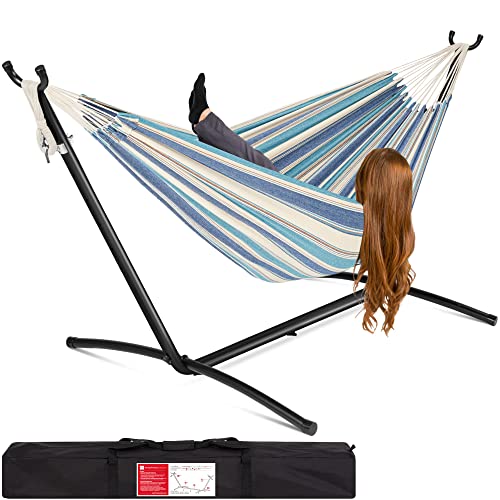
The classic steel A-frame stand is the design most people picture first: two angled legs at each end, a long central spine or paired side rails, and hooks at the top of each end from which the hammock hangs. It is popular because it is comparatively light for its strength, it breaks down into a handful of tubes for storage, and it tolerates being moved around the garden as the shade moves. Finishes are usually a powder coat over steel tube, which keeps the look tidy and slows corrosion, provided the coating stays intact at the joints and feet where water likes to sit.
Style matters alongside length. A gathered-end hammock, where the fabric bunches into a single loop at each end, settles into a deep, cocooning curve and is forgiving about exact hang geometry. A spreader-bar hammock, held open by a wooden or metal bar at each end, lies flatter and looks tidier, but it is less forgiving: it needs its ends held at a steadier height and distance, and it can feel tippy if the frame lets it twist. Neither is better in the abstract. The stand simply has to suit the style, and most general-purpose frames are designed with gathered-end hammocks in mind first.
The benchmark package format — frame and fabric designed together — exists because the category’s most common failure is a mismatch the buyer only discovers at first assembly. By fixing the hammock’s length and the stand’s span as a pair, the maker removes that failure mode entirely, and what remains to judge is execution: how the frame is built, how it behaves under a real body across a real afternoon, and how gracefully it ages. That is the standard this review applies, and it is the standard the alternatives in the comparison section are held to as well.
Design, Build and Setup
Assembly on most modern stands is deliberately undemanding. Tubes slot together with spring-loaded push buttons or hand-tightened knobs, uprights meet the base rails, and hooks or carabiner-style clips close over the hanging points. No part of a correct assembly should need force. If a joint resists, the usual causes are misalignment, a burr, or paint thickness in a socket — all solved by reseating the parts squarely, never by hammering. Before the hammock goes on, walk the frame once and physically check every locking pin and button is fully engaged and every clamp point is closed. That thirty-second circuit is the whole safety system of the product, and it deserves to be a ritual.
A calm first setup goes like this. Lay every part out on the ground in the shape of the finished stand, so missing pieces announce themselves before you start. Build the base first and set it exactly where the stand will live, feet flat and level. Add the uprights or arc sections, engaging every pin and button fully as you go rather than planning to tighten up later. Fit the hooks or chains at matching heights on both ends. Only then hang the empty hammock, adjust the suspension a link at a time until the curve looks right, and sit down gently, feet still on the ground, before committing your full weight to the first lie-down.
Longevity in this category is decided by joints, welds and water management more than by the headline material. Look for clean, continuous welds where uprights meet base rails, for end caps that fit snugly and stay put, and for hardware that feels like metal rather than foil. A frame that keeps water out of its tubes and keeps its coating intact has no particular reason to fail: there are no electronics, no fabrics under tension in the frame itself, and nothing to wear except the hanging points. Treat a stand as a ten-year purchase and judge it that way, and the slightly better-made options start to look like the sensible ones.
The space-saving layout deserves specific credit. By bringing the frame’s footprint in closer to the hammock’s own length than a traditional long-spine design does, this class of stand fits patios and small lawns that would otherwise be excluded from hammock ownership altogether. The compromise is a slightly more upright stance to the ends, which some traditionalists notice in the hang; in practice the curve settles quickly and the space dividend is worth more than the geometric purity costs. Feet are wide and flat, end caps are fitted, and the whole frame has the slightly over-engineered feel of a product designed by people who expected it to be left outside and judged harshly.
The points where a stand can fail are almost never the big tubes; they are the small connections. Locking pins must pass fully through and be secured, push buttons must pop fully into their holes, clamp points where hooks meet uprights must be closed rather than resting half-open, and any hand knob should be snug, not merely touching. Make it a habit to check these points when you assemble, again after the first use, and at the start of each season. Movement works on joints over time, and a pin that was perfect in spring can be a quarter-turn loose by late summer without anyone noticing.
Site the stand on level, firm ground, every time. A frame that rocks on a slope or sinks one foot into soft lawn changes its geometry under load: the hang tightens on one side, the frame can walk sideways as you sway, and the whole setup feels nervous instead of restful. On a deck or patio, check that all feet sit flat and that the surface is not slick with algae or water. On grass, choose the flattest, firmest patch you have, press the feet down before hanging the fabric, and re-check after the first sit, because soil gives a little under the first real load and then settles.
Performance in Real Use
The Solo Afternoon Nap
A well-hung hammock is a curve, not a line. The ends sit noticeably higher than the middle, the fabric dips into a gentle banana shape, and when you lie diagonally across that curve your body settles almost flat while the fabric supports you along your whole length. Stands make this geometry easier to repeat than trees do, because the hanging points are fixed: once you have found the hook positions and chain lengths that produce your curve, the setup is the same every single time. That repeatability is an underrated pleasure — the hammock feels identical on Friday evening to how it felt on Sunday morning.
A stand changes how a hammock feels in ways people rarely expect. Compared with trees, a frame is consistent: the distance never changes, the heights never change, and the slight spring of long steel tubes adds a gentle give that many people find soothing. Frames can also talk. A faint creak at a joint or the soft tick of chain links as you settle is normal in this category and usually silenced by reseating a joint or adding the fabric washers some makers include. What should not be there is movement at the feet or a sense of the frame twisting — those are siting and assembly issues, and they are fixable.
Two People, One Hammock
Sharing a hammock on a stand is one of the category’s great pleasures and one of its real tests. Two people change everything about the hang: the dip deepens, the sway slows and widens, and every movement one person makes arrives, amplified, in the other person’s back. Wider, double-width fabric earns its keep here, as does a frame that feels planted rather than lively. Enter one at a time, settle into the diagonal together, and treat the first minutes as negotiation. Couples who love hammock sharing swear by it; couples who need their own space learn quickly and buy a second hammock, which is also a perfectly good outcome.
Moving It Around the Garden
Portability splits the category cleanly in two. Knock-down steel frames come apart into a bundle of tubes that one person can carry to a car, a shed or a different corner of the garden in a few minutes, and many include or suit a carry bag. Arc stands, by contrast, are effectively furniture: two people can shuffle one across a lawn, but nobody packs an arc into a hatchback for a weekend away. Decide which life your stand will actually live. A frame bought for camping trips that never leaves the garage is wasted money, and a beautiful arc bought for a tiny rented patio is a beautiful problem.
Where the stand lives decides how much you use it. Most people instinctively chase full sun and then discover that a hammock in direct midday heat is a short-lived pleasure; dappled shade or a spot that takes sun in the morning and shade in the afternoon gets far more hours of use. Think about the view from lying height, which is lower and different from the view standing up, and about what is overhead — a tree that drops sap, berries or enthusiastic birdlife onto the fabric will shorten your sessions. Finally, leave walking room around the frame, because a stand you have to squeeze past is a stand you will use less.
Children and Pets in the Real World
Children read a hammock as playground equipment, and a stand does not change that instinct, so set the rules early. No standing, no jumping in, no swinging high enough to test the frame’s manners, and an adult nearby while small children are aboard. A stand on level ground with its pins checked is a stable piece of kit, but it is tall, hard and heavy compared with a child, and it deserves respect. Dogs, meanwhile, mostly want to be underneath in the shade or, given encouragement, in the hammock itself; keep nails and fabric in mind, and never leave a pet tangled unattended in the netting or cloth.
A quiet word about noise, because it surprises new owners. Metal frames communicate: a soft creak as you settle, the tick of a chain link finding its seat, a faint groan from a joint on a cold morning. Nearly all of it is harmless and most of it is curable — reseat the joint, check the pin, add a washer, or shift the feet a centimetre so the frame sits unstressed. What deserves investigation is new noise: a click that was not there last month, or movement you can feel through the fabric. New sounds mean something has changed at a connection, and the correct response is to get out, inspect, and fix it before the next session.
Strengths and Trade-Offs
- Strength: matched frame and fabric remove the length-matching gamble that ruins other setups.
- Strength: tool-free assembly with positive locking at every joint makes the safety check simple and quick.
- Strength: the compact footprint opens up patios and small gardens that exclude longer frames.
- Trade-off: a package means the maker’s fabric choice, not yours — colours are plentiful, materials are not negotiable.
- Trade-off: steel still needs coating care; chips left alone outdoors will rust.
- Trade-off: the space-saving geometry gives a slightly different hang from a long traditional frame.
How It Compares
| Pick | Badge | Positioning | Choose it if |
|---|---|---|---|
| Benchmark package (this review) | Reference | mid-tier combination | you want the matched, low-drama setup |
| Best Choice Products Double Hammock with Steel Stand | Alternative | entry-tier combination | you want the simplest one-box start |
| Sunnydaze Decor Heavy-Duty Steel Hammock Stand | Alternative | mid-to-premium stand only | you already own a hammock you love |
| Zupapa 2 Person Steel Hammock Stand | Alternative | mid-tier stand only | your setup moves and stores often |
Against the entry-tier combination, the benchmark justifies its step up mainly in finish quality and in how planted the frame feels once sited. Against the stand-only frames, the comparison reverses: they offer freedom the package cannot, at the price of measuring homework the package never asks for. There is no loser in that table — there are four different answers to the question of what you already own and how you live.
Vivere Double Hammock with Space-Saving Steel Stand — Best Overall
The Vivere combination pairs a double-width gathered-end hammock with a compact steel stand designed to save space, and it has become the benchmark this category is judged against for a reason: the two halves were designed together, so the length question that trips up so many buyers is answered before you start. The frame assembles with push-button connections and no tools, the fabric is a comfortable cotton-feel weave in a wide range of colours, and the whole thing packs down more willingly than most. As an ownership proposition it is the low-drama option — set it up, adjust a link or two, and get on with resting.
Reviewed as the benchmark, its deepest virtue is boredom: nothing about it surprises you after the first week, and in load-bearing garden equipment, boring is the highest praise available.
Best for: the buyer who wants the reference setup, once Not suited for: owners with a beloved hammock already in hand Positioning: a mid-tier combination package, so judge it against others in that band and check the current listing before you buy.

Best Choice Products Double Hammock with Steel Stand — Best Entry Point
Best Choice Products sells this Brazilian-style cotton hammock and steel stand as one approachable package, and its appeal is straightforward: everything arrives in one box, the frame is a conventional A-frame that assembles without tools, and the hand-woven-look fabric has the soft, cocooning feel that gathered-end hammocks are loved for. Cotton asks for a little more care than synthetic weaves — it should come in out of prolonged rain and be stored dry — and the finish on the frame rewards the usual end-cap and touch-up habits. Judged as a first hammock setup rather than a lifetime heirloom, it makes a persuasive case.
Considered against the benchmark, this package trades a little finish refinement for simplicity and approachability, and for many first setups that trade is honestly judged.
Best for: first-timers who value simplicity over refinement Not suited for: finish perfectionists and fabric choosers Positioning: an entry-tier combination package, so judge it against others in that band and check the current listing before you buy.
Sunnydaze Decor Heavy-Duty Steel Hammock Stand — Best Stand-Only Frame
Sunnydaze sells this frame on its own, without fabric, which makes it the natural candidate for anyone who already owns a hammock they love and simply has nowhere to hang it. The design is a classic steel A-frame with a powder-coated finish, multiple hanging points for adjusting the hang, and a reputation for feeling planted once it is sited properly. Because no hammock is included, the measuring discipline in this guide applies in full: check your fabric’s total end-to-end length against the frame’s hanging points before ordering, and expect to fine-tune with the chain or hook positions once it arrives.
As a frame alone it out-specialises the benchmark — stronger focus, no fabric compromises — while demanding the measuring discipline the benchmark’s buyers never face.
Best for: hammock owners who need a frame only Not suited for: anyone who has not measured their hammock Positioning: a mid-to-premium stand-only purchase, so judge it against others in that band and check the current listing before you buy.
Zupapa 2 Person Steel Hammock Stand — Best for Moving Around
The Zupapa stand is a steel frame sold for two-person hammocks, and its distinguishing habit is mobility: it is designed to come apart and go back together readily, and it is commonly supplied with a carry bag, which suits owners who move their setup between lawn, patio and storage rather than dedicating one permanent spot. The frame uses the familiar A-frame layout with adjustable hanging points, so gathered-end doubles hang from it happily once the length check is done. Owners who treat setup as a five-minute ritual rather than a building project tend to get the most from this design.
Judged against the benchmark it is the traveller of the group, happier disassembled in a bag than standing as a garden fixture, and none the worse for knowing it.
Best for: movers and seasonal storers Not suited for: gardeners wanting a permanent visual feature Positioning: a mid-tier stand-only purchase, so judge it against others in that band and check the current listing before you buy.
Who Should Buy It and Who Should Skip It
Buy this class of stand if you are starting from zero, your garden lacks trees, your space is modest, and your goal is a hammock that simply works this weekend and for seasons after. Skip it if you already own a hammock you adore — buy a stand-only frame instead — or if what you truly want is a sculptural wooden arc as the centrepiece of the garden, in which case buy the furniture your heart is set on and accept its care routine. Before ordering either way, run the short checklist: measure your space including its diagonal, decide where the frame winters, and confirm what hardware is included in the box.
Before buying, run the unglamorous checks that prevent returns. Measure your hammock’s full end-to-end length, including its suspension, and compare it with the stand’s hanging-point distance as the maker describes it — conceptually, the stand must give the hammock room to curve, not stretch it flat or drown it in sag. Confirm what is actually in the box: hooks, chains and connecting hardware are sometimes included and sometimes assumed. Check how the frame packs down if storage matters to you, and read the maker’s guidance on loading and use rather than guessing. A stand is a simple product, which means the few details it has are exactly the ones that matter.
Setup, Care and Maintenance Essentials
Left outdoors, a steel stand’s enemies are standing water and damaged coating, in that order. Water pools where tubes join, inside open tube ends, and under feet that sit in wet grass. Fit and keep the plastic end caps, because they are not decoration — they are plugs. After heavy rain, a quick wipe of the joints costs nothing. At season’s end, wash the frame down, let it dry fully, touch in any chips so corrosion cannot start under the paint, and store it somewhere dry if you can. A stand treated this way stays sound for many seasons; a stand abandoned wet in a corner can look tired surprisingly fast.
Care splits neatly into frame and fabric, and the two should not be confused. The frame wants washing-down, drying and inspection: mud off the feet, grit out of the joints before it grinds the coating, and a look at welds and bends once a season. The hammock fabric wants whatever its own label says — usually a gentle wash and thorough air-drying — and it should never be stored damp, because mildew colonises a folded, wet hammock with depressing speed. Store fabric indoors even if the frame overwinters outside; cloth is the half of the partnership that forgives the least.
Winter storage is where stands either last a decade or quietly die. The ideal is dull: clean, dry, indoors, off a damp floor, with the fabric stored separately in a breathable bag. If the frame must live outside, raise it off the soil, cover it with something that sheds water without trapping condensation against the paint, and expect to do more touch-up in spring. Knock-down frames earn their keep here — five minutes with the push buttons turns a garden fixture into a bundle that leans in a shed corner. Whatever you choose, do the autumn inspection while you still remember how the stand felt in use.
Most stand problems have boring causes and quick fixes. Rocking almost always means uneven ground or one foot not fully seated — move the frame a few centimetres before you blame the product. A hammock that hangs too low usually wants a link or two removed from each end, evenly. One that feels tight and flat wants the opposite. Sway that feels sideways rather than gentle usually traces back to the frame being twisted on its site, with diagonal feet at different heights. Work through ground, pins, then suspension length, in that order, and you will solve nearly everything this category can present without tools or drama.
Final Verdict
The benchmark package earns its position not by being the most beautiful, the cheapest or the most portable stand, but by having no weakness that matters to its intended owner. Its geometry is right, its joints are honest, its footprint is merciful, and its demands — a pin check, a wiped joint, a dry winter — are the smallest subscription in the category. For the treeless majority, this is what a hammock stand should be: invisible beneath the nap it makes possible.
Going Deeper: Details That Decide Long-Term Satisfaction
Arc stands take a different visual approach. A single sweeping curve of laminated wood or bent steel rises at each end, and the hammock hangs between the two high points. The shape is undeniably handsome — an arc stand reads as garden furniture rather than equipment — and the open design leaves the space beneath the hammock clear. The trade-offs are bulk and weight. Arc stands are the least portable option in the category, they occupy a generous footprint, and wooden versions ask for more attentive care outdoors, because a large laminated curve exposes a lot of surface to sun and rain across the year.
Portable and telescoping stands are built around travel and storage rather than permanence. Their tubes nest, slide or fold so the whole frame packs down into a carry bag, which suits renters, campers who drive to their pitch, and anyone whose hammock has to disappear into a shed or cupboard between uses. The compromise is feel. A frame designed to collapse cannot be as rigid as one designed to stay assembled, so a portable stand may flex or shift a little more under movement. For occasional, relaxed use that trade is usually worth it; for a daily nap spot, a fixed frame feels calmer.
A close cousin worth knowing about is the hanging chair stand, a single C-shaped or tripod frame that suspends a hammock chair from one overhead point. It is not a substitute for a full-length stand, and this guide treats it only as context: if what you really want is an upright reading seat rather than a full recline, the chair format uses far less floor space. For everyone who wants to lie down properly, though, the two-ended stand is the tool for the job, and everything that follows is about choosing and using that frame well.
Powder-coated steel is the default frame material for good reasons. It is strong in thin sections, so stands stay manageable to carry, and the coating gives a smooth, coloured finish that shrugs off casual knocks. Its weakness is what happens when the coating is breached. A chip at a foot or a scratch along a rail exposes bare metal, and outdoors that spot will rust quietly under the paint if it is ignored. The fix is simple and cheap — dry the frame, touch the spot in, and keep end caps fitted so water cannot sit inside the tubes — but it does need to become a habit.
Wooden arc stands, usually built from laminated spruce, larch or similar weather-tolerant timber, trade on warmth and presence. The lamination matters: thin layers glued under pressure resist the warping and splitting that a single solid beam would suffer outdoors, and the curve itself is only practical because laminated stock can be bent and will hold the bend. Wood asks for a seasonal rhythm of care — a clean, a check of the finish, and a fresh coat of suitable outdoor oil or sealant when water stops beading on the surface. Owners who enjoy that ritual find wood ages gracefully; owners who skip it watch silvering and surface cracks arrive early.
Compatibility between hammock and stand is, at heart, a question of length, and it is the single most common reason a new setup disappoints. What matters is the hammock’s total end-to-end length, including its suspension loops or chains, set against the distance between the stand’s two hanging points. If the hammock is too long for the frame, it sags until your backside brushes the ground or the frame’s spine. If it is too short, it hangs drum-tight and flat, which feels like lying on a shelf rather than in a hammock. Measure the hammock you own, or the one you are buying, before you measure anything else.
Most stands give you a few ways to fine-tune the hang. Multiple hook positions or a short length of chain at each end let you lengthen or shorten the effective suspension, which raises or lowers the dip of the fabric. Small changes make a surprising difference: one link shorter at each end can lift a dragging hammock into comfort, while one link longer can turn a tight, perched hang into a relaxed one. Adjust both ends evenly, change one link at a time, and test by sitting gently in the middle rather than launching yourself in. Two minutes of patience here decides how the hammock feels for years.
Measure the space honestly before you fall for a stand. The frame’s footprint is longer and wider than the hammock itself, because the legs splay for stability and the ends rise beyond the fabric’s ends. On a small patio or balcony, pace out the diagonal as well as the straight dimensions — a stand that technically fits lengthways may block a door swing or a walkway at its corners. Remember, too, that the hammock sways: allow clearance on both sides so the fabric, and your elbows, never meet a wall, a railing or a thorny shrub at the bottom of the swing.
It is not shallow to care how a stand looks; it is the largest single object many gardens gain in a year, and you will look at it far more often than you lie in it. Steel A-frames read as equipment — tidy, neutral, easy to ignore once the hammock is up. Wooden arcs read as sculpture and ask to be placed where they can be seen. Dark finishes disappear against planting; bright ones make a feature of the frame. The honest advice is to choose the look you will enjoy in February, when the hammock is in the shed and the frame stands alone in the rain, because that is the view you get most.
The oldest alternative is two trees, and where they exist at the right spacing they remain wonderful: free, beautiful, and springy in a way no frame quite matches. The costs are hidden rather than absent. You need straps wide enough to protect bark, you inherit whatever spacing the garden happens to offer, the hang changes as you experiment, and the perfect spot is rarely where the shade, the view and the breeze agree. A stand is what you buy when the trees are missing, wrongly spaced, too young to load, or in the wrong place — which, in most gardens, is most of the time.
Fixed posts are the other permanent answer: two sturdy timbers set in the ground, concreted, with eyebolts at hammock height. Done properly, posts are rock-solid, invisible compared with a frame, and cheaper in materials than most stands. Done casually, they are a leaning disappointment that has to be dug out. Posts also commit you absolutely to one spot and one hammock length, they may need permission in rented homes, and they are real work to install well. A stand is the same idea made honest and reversible — which is why so many people who fully intend to install posts end up, happily, with a frame instead.
Judge a stand’s value over seasons, not weekends. A frame that is used three afternoons a week from spring to autumn delivers hundreds of hours of rest across its life, and against that measure even a premium arc works out as modest entertainment. Value leaks away in predictable places instead: a stand that does not fit the hammock and so is never comfortable, a frame too heavy to move that ends up in the wrong spot, or a cheap finish that rusts into an eyesore within two winters. The most expensive stand is the one that gets replaced; the best value is the one that fits, survives and is still being used in five years.
The mistakes in this category are remarkably consistent. People buy the stand first and measure the hammock never. They site the frame on the prettiest slope in the garden and then wonder why it rocks. They hang the fabric banjo-tight because a flat hammock looks tidy in photographs, then conclude that hammocks are uncomfortable. They leave a steel frame out all winter with its caps missing and act surprised by rust. And they skip the pin check because it assembled fine in April. Every one of these is avoidable with a tape measure, a flat patch of ground, and thirty seconds of attention at setup — which is most of what this guide exists to say.
Indoor use deserves a mention, because a stand turns a hammock into furniture that needs no wall fixings — a real consideration in rentals where drilling into studs for eye bolts is unwelcome. Indoors, the checks change slightly: protect floors from the feet, allow more side clearance than you think because walls are unforgiving, and remember the frame’s full length when you measure the room rather than the hammock’s. A stand in a bright spare room or a covered veranda gets used in months when the garden version would be rained off, and for many owners that shoulder-season use is what quietly justifies the purchase.
A note on gathered-end hammocks, since they are what most stands in this guide will carry. The fabric bunches to a point at each end, so your weight is cradled rather than spread, and the sides of the cloth rise around you in a way many people find secure and others find enclosing. Getting in is a small technique: sit in the middle first, then swing your legs up and settle onto the diagonal. Once learned, it is ten seconds of choreography that buys hours of comfort, and it works identically on every stand in this category because the geometry that makes it possible is the frame’s, not the trees’.
Spreader-bar hammocks deserve their own paragraph because they behave so differently on a stand. Held open and flat by their bars, they look inviting and photograph beautifully, and they are easy to climb onto — but they have a defined tipping axis and they punish wriggling. On a stand, keep their suspension tauter than you would a gathered-end hammock’s, enter from the centre, and treat them as a lounger for stillness rather than a cocoon for curling up. Owners who love them really love them; owners who expected a cocoon should exchange early rather than adapt miserably.
Fabric choice interacts with the stand more than buyers expect. Cotton is soft, breathable and traditional, and it is the least weather-tolerant option in the drawer — it wants bringing in. Woven synthetics shrug off showers and dry fast, at a small cost in that broken-in softness. Quilted and padded fabrics add insulation for shoulder seasons. None of this changes which stand you buy, but it changes how the partnership lives: a weatherproof fabric on a coated steel frame is the closest this category gets to fit-and-forget, while a cotton hammock on any frame is a small, pleasant ritual of care.
Hang height is the adjustment owners fiddle with most and understand least. The goal is a seated middle: when you sit in the centre of the empty hammock as if it were a chair, your feet should rest comfortably on the ground. That single test predicts the lying experience surprisingly well — if you can sit, you can recline, and if the hammock strands you with your feet dangling or dumps you near the soil, the suspension length wants changing by a link at each end. Test seated, adjust evenly, and resist judging the hang from a photograph of the empty setup.
Under the Surface: The Hammock Stand Details That Decide Long-Term Satisfaction
Listings present a hammock stand at its best, so this section slows the assessment down and looks at the evidence an individual model offers: its construction, its finish, its listing detail and the checks you can run before and just after it arrives. The aim is a verdict based on inspection rather than impression.
Start With Your Space and Your Routine
Plan where the packaging and any old item being replaced will go on delivery day, a small step that prevents a rushed, careless first setup of the new hammock stand. Colour and finish samples in listings are taken under controlled light, so expect the hammock stand to look different at home and favour options that sit comfortably with the tones already in the room. A slight wobble, a stiff action or a small misalignment on day one rarely improves on its own, so address it during setup while adjustments are still easy to make. If the listing offers accessories for the hammock stand, decide which ones solve a problem you already have, and set aside the ones that only solve problems the listing itself invented.
Details that look minor in isolation, such as how a hammock stand is finished at the back or underneath, matter because they reveal whether shortcuts were taken where the camera rarely goes. Equally, list what your old hammock stand did well, because replacements sometimes quietly lose a virtue you relied on, such as a size, a shape or a simplicity the new model has redesigned away. Apply the same checks to each shortlisted example, whether that is the Vivere Double Hammock with Space-Saving Steel Stand; the Zupapa 2 Person Steel Hammock Stand; the Sunnydaze Decor Heavy-Duty Steel Hammock Stand, because consistent testing is what makes the differences between models visible. Guests notice different things than owners do, so if the hammock stand will be used by visitors, test it from a fresh user’s point of view, without the habits you have already built around it.
When Small Problems Appear
Recheck any adjustable part of the hammock stand after the first week of use, once materials have settled and the household has stopped being careful with it. Measure the space where the hammock stand will live, including the clearance needed to use it, move around it and clean behind or beneath it, and keep those numbers beside you while you compare options. Where the hammock stand meets the floor, the wall or another surface, check what protects both sides, because scuffs and marks in those contact zones are the most common early complaint. Keep the care routine simple enough to repeat: a hammock stand that needs ten minutes of attention weekly will usually get it, while one that needs an hour monthly often gets none.
Seasonal checks suit most Patio & Outdoor Living items well, so tie a quick inspection of the hammock stand to a job you already do, such as changing clocks or clearing gutters.
A Short Decision Checklist
- Assembly needs, tools required and whether help is needed
- The measured space, including clearance to use and clean around the hammock stand
- Where the hammock stand and its accessories will be stored when not in use
- Who will use the hammock stand most, and any limits they have
- The material and finish, matched to light, moisture and wear in its spot
- How the hammock stand will be cleaned in an ordinary week
- The one feature you will not compromise on
- What your current arrangement does badly that the hammock stand must fix
Taken together, these checks take only a little time, yet they answer the questions that decide whether the hammock stand suits your home, your household and your routine, and they do so before money changes hands rather than after.
Frequently Asked Questions
How long does a hammock stand like this take to assemble?
First assembly is a relaxed job measured in tens of minutes rather than hours, most of it spent laying parts out and understanding how the frame goes together. Every connection after that is faster: owners who knock the frame down for storage routinely rebuild it in a few minutes, because push-button and hand-knob joints need no tools and no force. The step that should never be rushed is the final check — every locking pin fully through, every button popped into its hole, every clamp point closed — which takes under a minute and is the whole safety system.
Will this kind of stand fit on a small patio?
Space-saving steel frames exist precisely for that question, and they are the most patio-friendly full-length option in the category. Measure your paving honestly, including the diagonal, and remember the frame is somewhat longer and wider than the hammock itself, with sway clearance needed on both sides. On a firm, level patio the feet sit flat and the setup feels planted. If the frame technically fits but blocks a door or the only walkway, a hanging chair on a compact stand may serve the space better.
What should I check before the first use of the season?
Work through the frame in a fixed order. Ground first: level, firm, all feet flat. Connections second: every locking pin fully engaged, push buttons seated, clamp points closed, hand knobs snug. Finish third: look for chips or rust starting at feet and joints, and touch in anything you find. Fabric last: hang the hammock, check its suspension and stitching, and adjust the chain a link at a time until the curve looks right. Sit gently before you lie. The whole circuit takes a few minutes and prevents nearly every bad experience this category offers.
Can I use a different hammock on a stand that came as a package?
Usually, yes — with the measuring caveat that governs the whole category. A replacement hammock needs a total end-to-end length, suspension included, that lets it take a proper curve between the frame’s hanging points. Gathered-end hammocks are the most forgiving swaps; spreader-bar designs are fussier about height and distance. Many owners keep the package fabric as a spare and rotate a favourite hammock onto the frame, which is one of the quiet advantages of a stand over a permanently rigged tree setup.
How do I stop a steel hammock stand from rusting?
Rust starts where water meets bare metal, so the whole strategy is keeping the coating between them. Keep the plastic end caps fitted so rain cannot sit inside the tubes. Wipe joints and feet after heavy rain. Touch in any chip promptly, before corrosion can creep under the surrounding paint. At the end of the season, wash the frame, dry it completely, and store it somewhere dry if you possibly can. None of this is skilled work; all of it together is the difference between a stand that ages gracefully and one that looks tired in two winters.
Related Reading
hammock stand reviews compared
best hammock chairs for relaxing outdoors