As an Amazon Associate, DailyHomeDecorating.com earns from qualifying purchases. If you buy through links in this article, we may earn a commission at no additional cost to you.
The best vacuums for hardwood floors and pet hair have to solve two different problems in the same home. On sealed wood, fur often rolls into visible tumbleweeds, collects along baseboards, and scatters when a floor head pushes it forward. On rugs and carpets, the same hair can become woven into fibers and call for a powered brush or specialized pet tool. A vacuum that excels on thick carpeting may be unnecessarily aggressive on a wood finish; a gentle bare-floor head may not lift embedded fur from a rug.
This guide focuses on the combination: picking up loose fur from hardwood while still removing hair from carpets, area rugs, furniture edges, and other pet zones. It compares canister, upright, and wet-dry floor-cleaning options by their floor heads, hair tools, filtration, and maintenance. For broader guidance on pet-hair cleaning across furniture and stairs, see our general dog-hair vacuum guide. For a mixed-floor comparison without the pet-hair emphasis, see our hardwood-and-carpet buying guide. If your home has hardwood but little or no carpet, our cordless hardwood vacuum comparison covers that narrower floor setup.
Quick recommendations for homes with pets and mixed floors
- Hardwood plus carpeted rooms: look for a machine with a clear floor-mode control, separate hard-floor and carpet tools, or a head designed to transition between surfaces.
- Long-haired pets: prioritize a roller that is accessible for cleaning, a pet upholstery tool, and replacement brush or filter availability.
- Mostly hardwood with occasional rugs: a canister with a parquet or bare-floor head and a separate turbo tool can offer more control than a fixed aggressive brushroll.
- Wall-to-wall carpet plus wood hallways: an upright with a brushroll shutoff or floor setting can make transitions easier; check that the wood mode truly stops the brush.
- Tracked-in wet paw prints: vacuum loose fur and grit dry first. A separate wet-dry floor cleaner can help on sealed floors, but it is not a replacement for a dry vacuum on carpet.
- Pet odors and dander: check the exact filtration system and bag type rather than relying on generic “pet vacuum” language.
Why pet hair behaves differently on hardwood and carpet
On a smooth floor, loose hair does not have fibers to hold it in place. Airflow from the nozzle, brush rotation, and movement of the head can push a light clump ahead instead of lifting it. The debris may then gather against a wall, under a toe kick, or around furniture legs. A floor head that has an open intake and a suitable hard-floor mode can help, but the operator’s approach matters too: shorter passes along edges and a slow pull across clumps are often more controlled than fast sweeping motions.
Carpet and rugs hold fur between loops and pile. Suction alone may remove some surface hair but leave material embedded below. A motorized brush can agitate the fibers and guide loosened hair into the intake. The tradeoff is that a rotating brush can tangle with long hair, grab fringe, or be too aggressive on delicate rugs. A combination household may need one machine with a switchable floor head, or a canister with separate tools for hard floors and carpet.
Pet debris is not only fur. Fine dander, dust carried in from paws, kibble crumbs, litter granules, and dry soil have different sizes and weights. A large clump may need a wider opening than a fine filter. Heavy grit should be picked up before it is dragged across a finished floor. Wet paw marks or food spills are a separate cleaning problem: use the appropriate floor-safe method after the dry debris is removed, and do not treat every vacuum as a wet-pickup machine.
Surface and finish also matter. Sealed hardwood, engineered wood, laminate, and hand-scraped boards do not all respond identically to a powered brush. Check the flooring manufacturer’s care guidance and the vacuum manual. Keep wheels, rollers, and brush housings clean so sand or hard particles do not become abrasive. If you are unsure whether a head is suitable, test it gently in an inconspicuous area and stop if you see marks.
Product examples for different pet and floor combinations
The models below represent different approaches, not a hands-on ranking. Their identifiers and product images were supplied through Amazon Creators API. Confirm the exact model, included floorhead, power setting, filtration, and package contents on the current listing before buying. Similar model names can come with different brushes or accessories.
Miele Guard M1 Cat & Dog: separate tools for floors and fur
The Miele Guard M1 Cat & Dog is a bagged canister option for homes that need both a general floorhead and a dedicated pet-hair attachment. Miele lists a FiberTeQ AllFloor head for hard floors and carpets plus a TurboTeQ brush for hair and threads on short-pile carpets and rugs. A canister separates the main body from the floorhead, so the cleaning head can be changed to suit the surface rather than asking one brush to perform every job. Its Active AirClean filter is intended to help neutralize odors, and the bag provides a contained way to dispose of collected fur and dust.
This format may suit a home where fur is embedded in area rugs but hard floors need a gentler head. The tradeoffs are changing tools, storing the attachments, buying replacement bags, and pulling a canister behind the wand. Check which floorhead and turbo-brush package ships with the exact model variation.
Kenmore 600 Series 81615: pet tool and bare-floor options
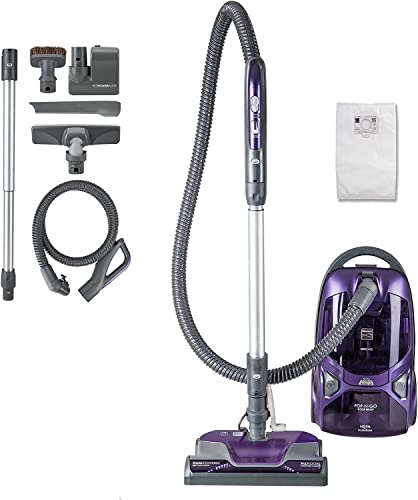
The Kenmore 600 Series canister family includes a motorized Pet PowerMate attachment for upholstery and pet hair, as well as a bare-floor tool and other accessories. Kenmore describes the series as an all-floor design for hardwood, laminate, and carpet, with HEPA media filtration. Separate tools can make the transition from a wood hallway to a carpeted room explicit: use a suitable hard-floor attachment on boards, then fit the carpet tool or Pet PowerMate where hair is worked into textiles. Confirm the exact 81615 package and attachment list because bundles and color variants differ.
A canister’s wand may be easier to maneuver under furniture than a bulky upright, while the body rolls behind the user. That can help when cleaning around pet beds or table legs, but the hose and canister need a path through the room. Store the motorized pet head carefully and check its brush roll for wrapped hair after use.
Hoover WindTunnel 3 High Performance Pet: upright for carpet and hard floors
Hoover describes the WindTunnel 3 High Performance Pet line as an upright for carpets and hard floors, with pet tools and a brushroll that should be used according to the surface setting. Hoover support guidance for related WindTunnel models says to use the brushroll on carpet and turn it off on hardwood or tile. Confirm the instructions for the exact UH72625/UH72625V variant before operating it, since model suffixes and controls matter. A corded upright avoids battery-runtime planning and can cover a large room, but the body is heavier and less agile around small obstacles than a canister.
This option may fit a pet household with broad carpet areas, frequent hair pickup, and a need to clean wood transitions. It is less convenient if most of the floor is a delicate wood surface and the main head is difficult to steer. Make sure the brushroll-off control is straightforward and that the floor mode is used whenever you leave carpet.
Dyson Ball Animal 3: upright with a de-tangling Motorbar head
Dyson describes the Ball Animal 3 as an all-floor upright with a Motorbar cleaner head that deep-cleans carpets and seals suction on hard floors. Dyson says its de-tangling vanes clear wrapped hair as the head operates. That can be useful in a mixed home where pet hair is a regular issue, though a motorized head still needs inspection and cleaning, and floor-specific behavior should be checked for your finish. A ball-style upright can turn differently from a canister or stick, so consider its steering feel and the clearance beneath your furniture.
Before buying, compare the standard Ball Animal 3 with the Extra or Complete bundles. Some pet-grooming tools or additional attachments may appear in one bundle but not another. Do not assume that an accessory shown in a general product image is included with the selected ASIN.
BISSELL CrossWave Pet Pro: a wet-dry supplement for sealed floors
The CrossWave Pet Pro is not a conventional dry vacuum replacement. It vacuums and washes at the same time on sealed hard floors and can clean area rugs according to BISSELL’s instructions. Its tangle-free brush design and pet-hair strainer address hair and wet debris in a different way from a dry canister or upright. This can be useful for sealed-floor paw marks or sticky pet messes after dry fur and grit are removed. It requires solution, tank emptying, and a clean-out routine; it should not be treated as a deep carpet vacuum.
Choose this type only if you want the wet-cleaning function too and the floor finish is approved for it. BISSELL advises checking its surface guidance, and its support material notes restrictions such as waxed floors. Keep the roller and tanks maintained so damp residue does not remain in the appliance.
Amazon product examples

Miele Guard M1 Cat & Dog
ASIN: B0FJ2TNXT7
Kenmore 600 Series 81615
ASIN: B08JTVDQ2G

Hoover WindTunnel 3 Max Performance Pet
ASIN: B07MFM81RX

Dyson Ball Animal 3
ASIN: B0B75Q388N

BISSELL CrossWave Pet Pro 2306A
ASIN: B079WCPPQD
Certain content that appears on this site comes from Amazon. This content is provided “as is” and is subject to change or removal at any time. Product images and descriptions are supplied through Amazon Creators API; confirm exact model, included floorheads, filtration, approved surfaces, and availability on the current listing.
How to match a vacuum head to both surfaces
Separate heads or one all-floor head?
Separate floorheads can provide more control: a parquet tool with soft contact points for wood and a powered brush for carpet or rugs. The user must switch tools, and both heads need storage. A universal or all-floor head saves time but can ask one brush to handle unlike surfaces. The most important question is whether the hard-floor setting turns off an aggressive roller or otherwise changes how the head works. Verify that control in the manual and practice changing it before cleaning the entire room.
If the vacuum has a bare-floor tool, use it on wood where appropriate and use a motorized head on compatible carpet. If it has a single head, inspect whether it offers brushroll on/off or a hard-floor mode. A head that cannot be adjusted may still clean both surfaces, but it may be less forgiving on delicate flooring or fringe rugs. Avoid assuming an “all floors” label means the exact same setting is optimal everywhere.
Brushroll shutoff and height settings
A brushroll shutoff can prevent a spinning brush from scattering loose fur across a hard floor and can reduce contact with the finish. Some uprights use a floor-mode selector; some have height settings; some have a fixed head. Check model-specific documentation: a brushroll can continue spinning even when the suction mode changes, and turning it off can affect carpet performance. On carpet, the brush helps lift hair from pile; on wood, smooth suction and an open intake may be preferable.
Height settings affect how the head seals against carpet and how freely it moves. A setting too low can make an upright difficult to push over plush pile; a setting too high may reduce pickup. Transition from hardwood to carpet with the recommended adjustment and ensure the cleaner head is not dragging on rug fringe. Test the settings in a small area and avoid forcing the vacuum when it resists.
Soft rollers, bristle rollers, and turbo tools
A soft roller may collect fine dust and larger debris on hard floors while limiting forward scatter, but it can collect fur and fibers that need cleaning. A bristle roller can agitate carpet to lift embedded hair, but may tangle or catch delicate rug loops. A turbo brush uses airflow to rotate a smaller tool; it can be useful for rugs, stairs, and upholstery where a large floor head cannot reach. Check whether replacement rollers and belts are available for the exact vacuum.
In a mixed home, a canister with a soft bare-floor tool and a separate powered pet tool can be versatile. An upright with a shutoff can be quicker for broad carpet rooms. A multi-surface wet-dry cleaner can address sealed-floor spills but requires chemical, tank, and roller maintenance. These machine types solve different parts of the problem; decide whether you need one dry vacuum or a second appliance for damp paw marks and sticky messes.
Hardwood pickup: fur, grit, and edges
To pick up loose fur without scattering it, slow down near clumps and approach them with the head aligned to the airflow opening. Edge fur often sits in a narrow strip along baseboards. A crevice or bare-floor tool can reach there more deliberately than repeatedly sweeping a wide rotating head past the same spot. Keep the wheels and underside clean; a grain of litter or sand caught under the head can scratch as it moves.
Pet litter granules and tracked-in grit should be collected before they are dragged across the floor. Use an appropriate nozzle opening so the particles do not clog a narrow tool. If the vacuum pushes a larger piece ahead, lift or angle the head as directed by its manual, or use a hand tool to collect it. Fast repeated passes can spread debris through the room and increase abrasion risk.
Static can cause lightweight hair to cling along corners or beneath furniture. A soft dusting tool or a gentle edge pass may help, but avoid brushing grit across the finish. If hair remains in a crack between boards, use a narrow nozzle without forcing the tip into the gap. Do not use a powered roller against delicate trim or unfinished wood without confirming compatibility.
Carpet and rug pickup: embedded fur without damage
Hair pressed into carpet usually needs mechanical agitation. A powered brush can loosen it, but pile height and construction affect how the head should be set. Short, dense pile may tolerate more agitation than a high-pile shag or a looped wool rug. Check the carpet or rug care instructions. Move the vacuum slowly enough for the brush to do work, and stop if the vacuum pulls strongly, catches fringe, or distorts fibers.
Use a pet turbo attachment on upholstery or stairs when the main head is too large. Keep the tool flat and let its brush rotate rather than pressing hard. Hair can wrap around the small roller just as it does on a full-size head, so inspect it after each room. For long hair, remove buildup with the tool or cleaning method the manufacturer recommends; avoid cutting into brush bristles or a belt.
Area rugs create a transition edge where a vacuum can push the rug or catch tassels. Fold fringe underneath or use a compatible suction-only tool along the edge. Do not run a high-speed brush over loose tassels. On a rug over hardwood, make sure the rug backing and pad are stable so repeated vacuuming does not shift the entire surface.
Filtration and pet odors
Pet hair is visible, but fine dander and dust are not. A vacuum’s filtration claims apply to a specific model and filter configuration. Confirm the exact filter type, whether the unit is sealed, and what bags or replacement filters are compatible. A bagged canister can contain collected debris during disposal; a bagless vacuum avoids buying bags but may release dust when its bin is emptied. Choose the maintenance routine that you can follow consistently.
Odor filters and pet-specific exhaust filters can help with smells according to their manufacturers, but a filter does not replace cleaning a pet bed, treating a source, or emptying the bin. If a vacuum smells musty, check for hair or damp debris in the brushroll, filter, hose, and dust cup. Never store a wet brush or dirty-water tank inside a closed appliance unless the manual specifically allows it.
Replace filters at the interval specified for the vacuum, and wash only components marked washable. Allow washed filters to dry completely before reinstalling. A clogged filter can reduce airflow and make hair pickup worse. Check that the dust bag, tank, and seals are properly seated after maintenance; an air leak can affect performance and dust containment.
Choosing the machine type for your household
Canister vacuums
A canister keeps the motor and dust container on wheels behind the wand. This design can make it easier to use multiple floorheads and reach under furniture with a lighter handle. Bagged canisters offer contained disposal; bagless ones avoid buying bags but require cleaning the bin. The canister must follow the user around, so check wheel movement and hose length in a furnished room. Pet owners may benefit from a dedicated upholstery turbo tool, but it needs routine hair removal.
Upright vacuums
An upright combines the body and floorhead into one unit. It can cover carpet efficiently and store in a closet without separate hoses, but its weight and size may be less convenient around table legs and tight corners. Look for a brushroll shutoff or floor-mode control if hardwood sections are extensive. For homes with fragile rugs, confirm that the head can be adjusted and that the brush can be turned off before it reaches fringe.
Wet-dry cleaners
Wet-dry floor cleaners can pick up and wash sealed floors, and some are approved for area rugs. They can be helpful for tracked paw marks after loose fur is removed. They are not a standard dry vacuum for deep carpet, upholstery, stairs, or all pet hair. Consider them as a supplement if wet messes are frequent. Tank emptying, roller rinsing, filter care, and formula cost should be part of the decision.
A practical routine for pet hair on mixed floors
- Start with dry pickup. Remove loose fur, litter, food, and grit before any wet cleaning.
- Use a hard-floor head on wood. Turn off the brushroll or switch tools if the manufacturer directs; move slowly along edges and avoid dragging grit.
- Switch for carpet and rugs. Engage the approved motorized head or carpet setting and adjust height as specified.
- Detail upholstery separately. Use a pet turbo tool or soft brush that suits the fabric, and check the attachment for wrapped hair.
- Handle wet paw marks after vacuuming. Use a floor-safe cleaner or an approved wet-dry appliance only on compatible sealed surfaces.
- Empty and inspect the vacuum. Remove fur from brushrolls, check filters, and keep bags or bins below the fill line.
- Clean the machine before storing. Dry washable parts fully and leave tanks or brushes ventilated as the manual recommends.
Common mistakes in pet homes with wood floors
- Using a carpet brush on wood without checking its mode: turn off or adjust the roller as the model’s instructions specify.
- Expecting suction alone to remove every carpet hair: embedded fur may need an appropriate powered pet tool.
- Assuming “pet” means hardwood-safe: check floorhead and flooring guidance, not only the product label.
- Choosing a wet-dry cleaner as the only vacuum: it may not clean deep carpet, stairs, or upholstery like a dry vacuum.
- Ignoring model suffixes: similar names can have different floorheads or included accessories.
- Letting grit stay under the head: trapped particles can scratch a wood finish when the vacuum moves.
- Overlooking bag and filter costs: compare replacement availability and the routine required for clean airflow.
- Forgetting to check hair wrap: remove fur before it blocks a roller, belt, or airflow path.
- Over-wetting sealed floors: use only a floor-compatible method and dry moisture promptly.
Frequently asked questions
Can one vacuum clean hardwood, carpet, and pet hair?
Yes, if its head and settings are suitable for each surface and it has a useful pet-hair tool. A model with separate floorheads or an effective brushroll shutoff can make transitions easier. Check the manual and exact package; one fixed head may not perform equally well on delicate hardwood and embedded carpet hair.
Should the brushroll be on or off on hardwood?
Follow the vacuum and floor manufacturers’ directions. Some heads are designed for hard floors with the brush on; other models should have the roller off to avoid scattering debris or contacting the finish. If uncertain, use a suitable bare-floor attachment and test gently in a hidden spot.
Is a canister or upright better for pet hair?
Neither style is universally better. Canisters can make separate floorheads and upholstery tools easier to use; uprights can cover broad carpet areas quickly. Choose based on your floor ratio, stairs, furniture layout, storage, and willingness to switch tools or maintain a brushroll.
Does a HEPA filter remove pet odors?
A HEPA filter is designed for particles, not necessarily odors. Some models add an odor-control filter or bag, but its performance and replacement schedule are model-specific. Check the manufacturer specifications and clean the vacuum if hair or moisture is causing a smell.
Can a CrossWave clean dog hair from hardwood?
BISSELL states the CrossWave Pet Pro can handle pet hair and debris on sealed hard floors and area rugs, while also washing the floor. It is a wet-dry cleaner that needs formula and tank maintenance, not a universal dry vacuum for carpet, stairs, or upholstery. Check floor compatibility and use it according to the manual.
How often should I clean the vacuum brush?
Inspect it whenever hair begins to wrap or pickup changes, and follow the maintenance schedule for the exact model. Long hair may require more frequent checks. Unplug corded models or remove the battery before servicing if the manual says so, and use only the cleaning method recommended by the manufacturer.
Bottom line: choose for the whole pet-and-floor routine
The best vacuums for hardwood floors and pet hair balance a gentle, effective bare-floor pass with enough agitation and tooling for rugs and carpet. A canister with a parquet or all-floor head plus a pet turbo brush offers flexibility. An upright with a carpet brush and a hard-floor shutoff can suit broad carpet areas. A wet-dry cleaner can help with sealed-floor paw messes, but it belongs beside a dry vacuum rather than replacing one for every surface.
Before ordering, verify the precise model, floorheads, brush controls, filters, and included pet tools. Match the hard-floor setting to the wood finish, use the correct tool for carpet, and remove grit before it can scrape the surface. Empty bags and bins on schedule, inspect rollers for fur, and dry washable filters fully. For general hair-heavy cleaning across stairs and furniture, continue to the pet-hair vacuum guide; for the broader floor-surface comparison, see our hardwood-and-carpet article.
Manufacturer references
- Miele Guard M1 Cat & Dog product details
- Kenmore 600 Series Pet PowerMate product overview
- Hoover WindTunnel High Performance Pet product details
- Dyson Ball Animal 3 product details
- BISSELL CrossWave Pet Pro 2306A product details
Certain content that appears on this site comes from Amazon. This content is provided “as is” and is subject to change or removal at any time. Product images and descriptions are supplied through Amazon Creators API; confirm the exact model, floorheads, filtration, approved surfaces, and availability on the current listing. This is an editorial guide based on manufacturer information, not a hands-on comparative test.