Disclosure: As an Amazon Associate, reviewstook.com earns from qualifying purchases. Links to Amazon on this page are affiliate links; they cost you nothing extra. Listing details such as price and availability change often, so check the current Amazon listing before you buy.
The queen bed is the most common mattress in American homes, which means the choice of bedding is huge and a little confusing. Quilt, comforter, coverlet, bedspread and duvet all sound alike, but they behave differently once they are on the bed. This guide to the best quilts and comforters queen buyers can pick from narrows the field to four real sets from familiar brands.
We look at how each set is put together, who it suits, and where the trade-offs sit. The aim is practical: you should finish reading with a clear idea of which style belongs on your bed and which listing details to check before you buy. Because fill weights, thread counts and finished sizes vary between sellers and over time, we leave those to the listing rather than guess.
The guide is for anyone refreshing a main bedroom, outfitting a guest room, or replacing a set that has worn thin after years of washing. It is also useful if you are not sure whether you want a quilt or a comforter at all, because we explain the difference in plain terms.
Quick Comparison
| Product | Best for | Main point | Link |
|---|---|---|---|
| Utopia Bedding Quilt Set | Simple, ready-to-use bedding | Stitched quilt with matching shams | Check on Amazon |
| Amazon Basics Lightweight Microfiber Quilt Set | Easy care, everyday sleeping | Light microfiber build | Check on Amazon |
| Greenland Home Fashions Thomas Quilt Set | Traditional country style | Patterned bedspread look | Check on Amazon |
| Cozy Line Home Fashions Quilt Set | Cottage and floral bedrooms | Decorative, set-style styling | Check on Amazon |
In this guide
How These Options Were Chosen
We read manufacturer listings and published descriptions, and we picked sets that differ clearly from one another in style and in how they are meant to be used. We have not used these products ourselves, so we make no claims about long-term durability or how a set feels after many washes.
Where a detail matters but we cannot confirm it, such as the exact fill or finished dimensions, we tell you to check the listing. Colors and size options change often, so use the guide as a way to narrow your search before you read the full product page.
The 4 Best Quilts and Comforters for a Queen Bed
Utopia Bedding Quilt Set
Utopia Bedding is a well-known name for basic household textiles, and its quilt set is aimed at shoppers who want a clean, ready-to-use answer without any extra decoration. You get a stitched quilt and shams in a coordinated look, which saves you from piecing together a bed from separate parts.
On a queen bed this kind of set shines in a guest room or a first apartment. It makes up quickly, it is easy to straighten each morning and it does not demand much from the owner. The surface pattern is simple, so sheets of nearly any color sit well beneath it.
The limit is that simple sets offer little drama. If you love texture or bold color, you will find it plain. Also check the listing for the queen dimensions and for what is included in the box, since some listings sell a quilt alone and others bundle shams.
Who should skip it: anyone who wants a thick, fluffy comforter feel. This is a quilt, so expect a flatter profile.
Amazon Basics Lightweight Microfiber Quilt Set
Amazon Basics covers everyday household needs, and its microfiber quilt set is aimed at easy care. Microfiber is a polyester-style fabric that tends to resist wrinkles and dry quickly, which is why it appears so often in bedding for busy households.
For a queen bed that is changed every week, convenience matters. A lighter quilt is simpler to flip over the bed, quicker to wash and light enough to throw over a chair while you remake the sheets. It is also a good layer to keep on hand for warm months, when a heavy comforter would be a burden.
Keep your expectations in line with the name. Lightweight means you will probably want something additional in deep winter. Read the listing for the colors, the sham count and the care instructions, since these sets often come in several variants under one product page.
Who should skip it: people who sleep cold and want a single heavy cover. Pair it with a blanket or choose a thicker option from another list.
Greenland Home Fashions Thomas Quilt Set
Greenland Home Fashions makes patterned quilt sets with a traditional, country-leaning look. This one suits a bedroom with wood furniture, framed prints and a classic palette. Unlike plainer sets, it treats the bed as a decorative feature.
The strength of a traditional set is that it hides the everyday evidence of use. Pattern masks small wrinkles and minor marks, so the bed looks presentable even after a rushed morning. It also pairs well with solid-color sheets, which keeps the overall look from getting too busy.
The trade-off is that pattern commits you to a style. If you change your decor often, a bold quilt can limit your options. Check the listing for size, shams and fabric, and make sure the name and pattern you pick match the picture you saw, since similar sets from the same seller can have close titles.
Who should skip it: minimalists and anyone with a modern, uncluttered bedroom.
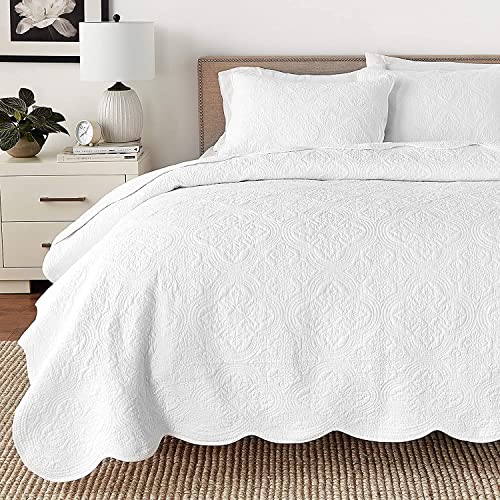
Cozy Line Home Fashions Quilt Set
Cozy Line Home Fashions focuses on decorative bedding, often with floral, patchwork or country designs. The brand suits a cottage-style bedroom where the bed is meant to look soft, a little romantic and relaxed.
Sets like this typically come as a quilt plus shams, which is convenient on a queen bed because it gives the pillows a finished frame. The decorative focus also makes it a nice gift for a new home or a refreshed spare room.
Take care with the details. Decorative sets often come in many patterns, each with its own listing, and sizes may be limited. Read the dimensions, confirm the queen option and check how the set should be washed, because stitched decorative fabrics sometimes prefer a gentler cycle.
Who should skip it: shoppers who want a plain hotel look or who need heavy winter bedding. This is chosen for style and softness of appearance.
Best for Guest Rooms
The Utopia Bedding set is the sensible choice for a guest room. Neutral looks suit most visitors, the set is simple to make up, and it is easy to wash between stays. Add a folded throw at the foot so people can adjust the temperature.
Best for Busy Households
For a house with kids, pets and constant laundry, the Amazon Basics microfiber quilt is the easiest to keep up with. Quick drying and a lighter weight keep the weekly routine short, and you can replace pieces without agonizing over the style.
Best for Traditional Decor
The Greenland Thomas set belongs in a bedroom with classic furniture. The pattern gives the bed a finished, patterned look that sits easily with warm woods, brass lamps and framed prints.
Best for Cottage Styling
Cozy Line suits a soft, floral or patchwork room. If you like a bedroom that looks collected rather than matched, the decorative detail here fits the idea well.
Quilt or Comforter: How to Choose for a Queen Bed
Begin with the basic difference. A comforter is a thick, filled cover that is often used as the main layer and usually changes shape as it ages. A quilt is flatter, with stitching that holds the filling evenly across the surface. A quilt tends to be easier to layer and wash, while a comforter feels fluffier and needs fewer extra pieces.
Many of the best quilts and comforters queen shoppers choose are really quilted comforter-style sets, so the listing language is not always strict. Use the description to see how the product is built, and look at the stitching in the photos.
Next, think about use. For a daily-driver bed in a warm house, a lighter quilt is usually enough. For a drafty room, plan on a thicker comforter or an extra layer. Do not expect a lightweight cover to behave like a heavy one.
Check the dimensions against your mattress. A queen is commonly described as about 60 inches wide by 80 inches long, but your bed may be taller than average, which changes how far the cover hangs down. A deeper mattress needs a more generous cut, and a bed frame with a visible base looks better with a longer drop.
Look at what is in the set. Some come with shams, some with a bedskirt, and some with decorative pillows. A bundle can save time, but it may include pieces you will never use.
Think about fabric and care. Cotton surfaces feel crisp, while polyester and microfiber are easier to wash and often dry faster. Check that the care label matches what your washer and dryer can handle.
A few common mistakes to avoid:
- Choosing by photo without reading the dimensions.
- Assuming a quilt will feel as plush as a comforter.
- Ordering a pattern that clashes with your sheets or walls.
- Skipping the return terms on a bulky item.
Queen Size Versus Full and King
A queen is wider than a full and narrower than a king, so a cover cut for a neighboring size will either look skimpy or swamp the bed. Many listings bundle full and queen into one option because the two are close, which can work if your mattress is slim. If your mattress is tall or you use a thick topper, go for a queen-specific or oversized cut. Shoppers searching for the best quilts and comforters queen size often discover that a few inches of extra drop make the bed look far more settled, while a short cover makes even a good set look like it belongs somewhere else. Take the tape measure to the mattress before you take the credit card to the checkout.
It also helps to picture where the cover will end. Standing at the foot of the bed, the edge of the quilt should fall about a hand below the mattress top for a tailored look, or lower if you want to hide the box spring. Pillows are another consideration: queen shams are sized for standard or queen pillows, so a set built around king shams will look oversized beside your own pillows unless you plan to switch.
Safety and Setup Notes
New bedding often carries a packaging smell or creases, so unpack it a day early and air it out. Keep covers away from space heaters, candles and lamp bulbs. If you plan to use an electric blanket underneath, follow its manual about what may go on top of it.
Always read the care label, and do not assume a bundle can be washed together. Sham zippers or closures sometimes need to be fastened before the wash to protect the fabric.
Care and Troubleshooting
Wash a queen quilt on a gentle cycle with a mild detergent, using enough water to let it move. Dry on low heat and shake the cover out halfway so the fill stays even. If you live in a humid place, make sure it is completely dry before folding it away.
| Problem | Likely cause | What to try |
|---|---|---|
| Shams slip out of shape | Heavy washing cycle | Use a gentle cycle |
| Pilling on the surface | Friction in the dryer | Wash inside out, dry low |
| Color looks uneven | Detergent residue | Run a rinse cycle |
Warmth, Climate and Layering
Quilts and comforters are not rated for temperature in a standardized way, so you have to judge warmth from construction. Weight, fill type and thickness give clues. A thin, lightweight quilt with a polyester fill and tight stitching works as a three-season cover in many homes, while a thicker comforter with more loft traps more heat for cold bedrooms.
Climate and sleeping habits matter as much as the cover. People who sleep warm often prefer a lighter quilt even in winter, with a flannel sheet or a blanket underneath for cold spells. People who sleep cold tend to choose a heavier option, or stack a quilt on top of a blanket.
Layering is the flexible solution. A light quilt as the base, a throw or blanket at the foot and perhaps a coverlet for show lets you adjust throughout the year. The Utopia Bedding and Amazon Basics sets, being lightweight microfiber quilts, are natural candidates for this approach. Remember that a shared bed can have two comfort levels, so a cover that is easy to adjust or pull back is useful.
Measuring a Queen Bed for Overhang and Drop
Queen mattresses are nominally 60 by 80 inches, but the cover that fits well depends on mattress depth and how you like it to hang. Modern mattresses with toppers can reach 14 inches or more, which eats into the drop on each side. A quilt that looks generous on a thin mattress may barely cover the sides of a thick one.
To measure, lay a flexible tape across the bed from one side edge to the other, running over the top. Then measure the height from the top surface down to where you want the cover to end, such as the bottom of the box spring or the floor. Add the mattress width and double the drop to get the width you need. Do the same for length, and add a few inches for tuck-in or pillows.
Listed dimensions deserve a close look. Quilt sets labeled “queen” can range by several inches in width and length across brands. Compare product dimensions to your own measurements rather than trusting the label alone. If two sleepers share the bed, extra width reduces tug-of-war at night.
Fabric, Fill and Stitching
The construction details determine feel and durability. Most quilt sets at this level are made of polyester or microfiber, which is lightweight, wrinkle-resistant and easy to wash. Cotton covers feel more breathable and can have a more traditional look, but may shrink or wrinkle more.
The stitching pattern holds the filling in place. Channel, diamond and traditional patchwork designs all keep the fill from shifting. Tighter stitching spacing generally means a flatter, more stable quilt, while wider spacing allows more loft but may let the fill drift over time. Check the edges, which should have a finished binding that is tight and consistent.
Look at the finish of the fabric as well. A brushed or pre-washed surface feels softer from the start. Sets with matching shams, like those in the Greenland Home Fashions and Cozy Line styles, bring a coordinated look, but make sure the sham sizes suit your pillows.
Making the Bed Look Finished
A quilt is partly decor, and a few styling choices make the bed look intentional. Start with clean, smooth sheets and a flat top sheet or fitted sheet that is not bunching. Lay the quilt so the seams are centered, with a roughly even drop on both sides.
For a layered look, fold the quilt back a third of the way toward the foot, and add a throw blanket across the bottom. Standard pillows go at the head, with decorative or sham pillows in front. Keep patterns in mind: a patterned quilt works best against solid sheets and neutral rugs, while a solid quilt can take a busier accent pillow.
For everyday use, simplicity helps. A bed that can be made in thirty seconds gets made more often. Choose a cover that smooths out quickly after you get up, and avoid heavy layers that need fussing to look neat.
Buying Checklist Before You Order
A few questions narrow the choice quickly. What is your mattress depth, and how much drop do you want? Does the set include shams, and in what size? Is the care label machine-washable on a normal cycle, and will it fit in your washer? What is the return policy if the color looks different in your room? Photos vary with lighting and screens, so a neutral tone is usually safer if your decor is not set. Finally, consider how the set will age: tight stitching, bound edges and modest fill tend to hold up better through repeated washing than thin, loosely quilted covers.
Making a Queen Bed That Works Every Single Day
A queen bed is the hardest-working piece of furniture in most homes, and its cover has to survive a routine far rougher than any styled photograph: nightly use, weekend lie-ins, children climbing up with books, pets claiming the warm side, laundry days fitted around work. When you choose between a quilt and a comforter for that life, judge the candidates as working textiles first and decorations second. The cover that looks beautiful but needs delicate handling, slow drying or constant rearrangement will slowly lose to the plain spare set in the cupboard, whatever its merits on the day it arrived.
Think about how the bed gets made in your household, honestly rather than aspirationally. If mornings are a rush, a single cover that can be pulled straight in ten seconds beats a layered arrangement that needs folding, aligning and tucking. If making the bed is a small daily pleasure, layers give you more to enjoy and more ways to adjust the bed’s warmth and appearance across the year. Neither household is doing it wrong; they simply need different bedding, and a queen quilt or comforter chosen to match the real routine will be loved rather than tolerated.
The Two-Cover Rotation That Simplifies Laundry
Owning two queen covers in rotation is the quiet secret of households whose beds always look fresh. While one is in the wash or drying, the other is on the bed, so laundry never has to be finished against a deadline, and each cover rests between uses, which is kinder to its stitching and fill. The pair does not need to match: many people keep one quilt for its looks and structure and one comforter for deep winter, rotating by season as much as by wash day.
Rotation also spreads the wear that queen bedding inevitably takes at its stress points, the top edge that hands grip, the centre where sleepers turn, and the corners that get dragged. Two covers used alternately will outlast the same two used one after the other to exhaustion, and the bed gains a small change of character each time you swap, which keeps a bedroom feeling tended rather than static.
Warmth Planning for a Queen Bed Through the Year
A queen bed usually sleeps two, and two sleepers rarely agree on temperature. Plan the bed as a system with a shared base and individual adjustment. The shared cover, quilt or comforter, sets the bed’s appearance and its general warmth; then each sleeper adds or sheds a personal layer, a throw or a lighter sheet, on their own side. This is far more peaceful than searching for one perfect cover that suits two different bodies in every month of the year, because no such cover exists.
Across the seasons, the same queen cover can serve very different duties. In summer a quilt alone over a sheet is enough for most sleepers and lets the bed breathe. In the shoulder seasons a blanket joins it underneath. In deep winter the quilt can move to the top as the visible layer over a comforter, giving the bed its finished look while the comforter does the heavy insulating. Buying with that year-round system in mind favours versatile, midweight pieces over extremes at either end.
Guest Beds and the Queen in the Spare Room
The spare-room queen has a different brief: it must welcome a guest at short notice, suit people whose warmth preferences you do not know, and look cared for after weeks of standing empty. A quilt scores well here because it lies flat and neat without plumping, and its layered look suggests a prepared bed even when it was made a fortnight ago. Leave a folded extra blanket at the foot or in the wardrobe and tell guests it is there; the choice of more or less warmth is the hospitality, more than any particular cover.
Wash and remake the guest bed after each stay rather than before the next one arrives, because bedding stored made-up for months gathers the room’s dust and staleness. A quilt that washes and dries easily makes that habit painless, which is another practical argument for choosing the guest bed’s cover by its laundry behaviour as much as by its pattern.
Fitting a Queen Cover to the Bed You Actually Own
Queen mattresses vary more than the name suggests. Depths differ widely, pillow-top and hybrid designs add height, and a mattress topper adds more again. A cover that draped perfectly on a slim mattress can look mean and short on a deep one, so measure your mattress depth and check the cover’s drop against it before ordering, especially if you like the sides of the bed properly covered. The overhang is not vanity: a cover that reaches well down the sides stays in place through the night, while a short one creeps, twists and ends up bunched around the sleepers.
Bed height matters as well. A tall bed frame with a deep mattress presents a long drop that a standard cover may not fill, leaving the frame or the bedding beneath exposed in a way that looks unfinished. In that case, sizing up to the next cover size is a common and sensible trick, provided the extra width does not pool on the floor. Measure from the top of the mattress down to where you want the cover to end, double it, add the width across the top, and compare that figure with the cover’s stated width rather than trusting size names alone.
Pillows, Shams and the Head of the Bed
Queen beds usually carry two or four pillows, and the cover’s relationship with them shapes the whole look. Matching shams create a composed, hotel-like finish that suits a comforter’s plumpness, while a quilt often looks best with the pillows in plain cases and the quilt folded down to reveal the sheet, a more relaxed arrangement that suits its character. Decide which picture you are making before you buy add-ons, because shams bought out of habit and never used are a common waste in bedding drawers.
Practical sleepers should also consider the nightly reality: decorative pillows and shams get moved to a chair or the floor every evening and returned every morning, or, in real households, they stop being returned at all. If that is your household, invest in the cover itself and in good sleeping pillows, and let the bed’s daytime beauty come from the quilt or comforter’s own texture and colour.
Reading Queen Bedding Listings With a Skeptical Eye
Photographs of queen bedding are styled on beds that may not match yours, with covers steamed, pinned and lit to perfection. Look for the unglamorous information instead: the exact dimensions, the fill and fabric description, the washing instructions, and whether the photographs include a close view of stitching and edges. A listing that tells you plainly how the cover is made and how to wash it respects your intelligence; one that offers only lifestyle images and adjectives asks you to buy a mood.
Check, too, whether the set’s pieces are genuinely useful to you. Extra decorative pieces raise the count in a listing’s title without raising the value in your bedroom. A well-made cover with pillowcases you will use beats a larger set padded with items destined for a drawer. Queen bedding is bought to be slept under for years, and the listings worth trusting are the ones that help you imagine exactly that.
When to Replace a Queen Cover
Replace a quilt when its stitching begins to fail in several places, when the fill or batting has thinned into uneven patches that no amount of shaking redistributes, or when the fabric has worn shiny or thin at the grip points along the top edge. Replace a comforter when its loft will not recover after washing and airing, because a flat comforter has lost the trapped air that made it warm. Cosmetic fading alone is not a reason; a softened, even fade is part of a much-used cover’s honesty, and many households keep a faded favourite in service for guests, sofas and winter layering long after its promotion from the main bed.
Colour and Pattern Decisions for a Large, Central Bed
A queen bed dominates its room, so its cover is effectively the largest piece of decoration you own. Strong patterns earn their place when the rest of the room is calm, and quiet, textured covers earn theirs when curtains, rugs and artwork are already busy. If you are undecided, stand in the bedroom doorway with the listing open on your phone and compare the cover’s overall tone with the room as it is, not as you hope to redecorate it one day. Bedding bought for a future room tends to disappoint in the present one.
Reversible covers deserve special mention for queen beds because they offer two complete looks for one laundry routine, and flipping the cover is a five-minute room refresh when guests are coming or the season turns. Check that both sides genuinely please you; a reverse side you dislike is not a feature, it is half a cover you will never show. The same realism applies to bold colours: a saturated tone you love in a photograph will be the first and last thing you see each day, so choose the version of bold that you can imagine waking up to in February as happily as in June.
Sharing a Queen Bed With Pets and Children
Where pets sleep on the bed, the cover’s job description changes again. Choose fabrics that release hair in the wash rather than holding it, colours that do not show every paw print between laundry days, and construction that tolerates frequent washing without complaint. Many pet households keep a washable throw over the foot of the bed as a sacrificial layer, protecting the main cover and giving the animal a defined territory that can be laundered weekly.
Children turn a queen bed into a fort, a reading island and occasionally a trampoline, and the cover takes the strain at its seams. Inspect stitching when the cover is new, reinforce nothing, but note any weak point early while a return is still possible. After that, let the bed be used. A queen cover that survives family life with grace is worth more than a pristine one that everyone is afraid to sit on, and the quilts and comforters in this guide were chosen with real households, not showrooms, in mind.
A Sensible First Month With a New Queen Cover
Wash the cover before its first night if the maker’s guidance allows, both for freshness and to reveal how it behaves in your machine while returning it is still simple if something shrinks, twists or sheds badly. Note how long it takes to dry in your home, because that figure will govern your laundry routine for years, and a cover that needs two days of airing in a small flat is a different ownership proposition from one that dries overnight on a rack.
During the first weeks, pay attention to the small frictions: whether the cover creeps toward one side, whether it feels clammy or breathes well, whether the person who runs warmer is comfortable, whether making the bed is as quick as you hoped. Most of these have small fixes, a blanket layer moved, a fold changed, the cover rotated end for end, and the first month is when those fixes are easy to discover. A queen cover that has been tuned to its bed in this way stops being a purchase and becomes part of the household’s furniture in the best sense: relied upon nightly and rarely thought about at all.
The Bottom Line on Choosing Between the Picks
Within this guide, the honest way to choose is by your bed’s life rather than by small differences in description. Pick the quilt if you value structure, layering and a made look that survives a rushed morning. Pick the comforter if you value loft, simplicity and warmth without assembling layers. Then check the measurements against your mattress, confirm the washing story suits your laundry, and order with the confidence that either style, well chosen, will serve a queen bed faithfully for years.
How a Queen Cover Ages, and How to Slow It Down
Bedding ages at predictable places. The top edge suffers from hands pulling it up through the night, the foot from being sat on while shoes are tied, and the centre from the turning of two sleepers. You can slow all of it with habits that cost nothing: rotate the cover end for end each time you change the bed, so the head becomes the foot and wear distributes; shake it out outdoors or at an open window occasionally rather than only ever in the bedroom, which lifts dust that vacuuming the room never reaches; and wash it on the gentlest cycle that genuinely cleans it, because agitation is cumulative and stitching remembers every rough wash.
Sunlight deserves the same respect on a queen bed as on any large textile. A bed standing in strong sun will fade on its exposed half, and rotating the cover is again the simplest defence, evening the exposure across both ends over the months. If the bed must sit in a sunny spot, a throw across the most exposed section during the brightest part of the day protects the cover while adding the layered look many people want anyway.
Storing the Off-Season Cover
When a queen cover rests for a season, store it clean, completely dry and folded loosely in a breathable bag or on a shelf where air can move. Compression sacks are tempting for such a bulky item, but months of tight compression flatten comforter loft and crease quilt stitching along the same lines, so use them only for short moves, not for storage. A lavender bag or cedar nearby is a pleasant guard for stored textiles, and a label with the date and the bed it belongs to saves the small confusion that arises when a household owns several large white or cream covers that all look alike in a cupboard.
Bring the stored cover back with a day of airing before it goes on the bed, and inspect the seams in good light at the same time. That seasonal inspection, two minutes twice a year, catches the loose thread and the small tear while they are still small, which is the entire secret of bedding that lasts a decade rather than a couple of winters.
When the Bed Is Also the Sofa, Desk and Cinema
In smaller homes the queen bed often doubles as the place to watch films, fold laundry, work on a laptop and eat the occasional breakfast. A cover for that life should be chosen like upholstery: a surface that brushes clean, a colour that forgives crumbs and newsprint, and a construction that does not mind being sat on in one spot for hours. Quilts, with their stitched-down layers, generally take sitting better than lofty comforters, whose fill migrates away from a favourite sitting hollow over time.
Protect the arrangement with one simple rule: a tray or a large book under anything that could spill, and a washable throw over the sitting zone on film nights. Those tiny disciplines keep a hard-working bed looking like a bed rather than a lived-on nest, and they cost the cover nothing in comfort. The bed can be the home’s favourite piece of furniture in every role, provided its cover was chosen for all of them and not only for sleep.
What Visitors Notice, and What They Never Do
Hosts preparing a guest bed often fuss over details no visitor will ever register, while missing the ones that decide a night’s comfort. Guests notice whether the bed is warm enough, whether there is a spare layer within reach, whether the cover feels clean and smooth, and whether they can make the bed in the morning without a puzzle. They do not notice whether the cover matches the curtains. Choose and arrange the queen bed in your spare room by that honest list, spend the saved effort on a folded extra blanket and a clear place to put it, and your guests will sleep better than they would under the most coordinated bedding in the world.
The Bed at the Centre of the Photograph Album
A queen bed appears in a household’s photographs more than any other furniture: birthdays breakfasted in it, children reading in it, cats enthroned in it, new babies welcomed home to it. The cover you choose will be the background of all of that, which is a gentle argument for choosing a colour and texture you will be glad to see across years of pictures, and for keeping the bed’s making simple enough that it looks like itself, calm and welcoming, in the unposed photographs as well as the arranged ones.
Frequently Asked Questions
What is the difference between a quilt and a comforter?
A quilt is flatter with stitched patterns, while a comforter is thicker and puffier. Both can serve as the top layer of a queen bed.
Do I need a duvet cover with a quilt?
No. A quilt is made to be used as is, which is one reason it is simpler than a duvet insert.
Are shams included with these sets?
Commonly yes, but it varies by listing. Check the number and size before ordering.
How often should I wash a queen quilt?
Wash sheets weekly and the quilt less often, following the care label and your own habits.
Can I use a full or queen cover on a queen bed?
Many listings cover both sizes in one set. Choose the dimensions that match your mattress depth.
Which style looks best with a patterned rug?
A plainer quilt keeps the room calm, while a patterned one suits solid rugs.
Is a quilt warm enough for winter?
A quilt may be enough in a mildly cold bedroom, particularly with flannel sheets, but heavy winter nights often call for another layer. Add a blanket or throw, or choose a thicker comforter. Warmth depends on fill weight, so judge by thickness and your own sleeping temperature.
What size quilt do I need for a thick queen mattress?
Measure the mattress depth and the drop you want. For a mattress with a topper of 14 inches or more, a standard queen quilt may leave little side coverage. Consider an oversized queen or a king-size cover for a deeper drop.
Can I layer a quilt with a comforter?
Yes. Layering is common, and either piece can go on top depending on the look. Keep total weight in mind, since too many layers can feel heavy or overheat you. A lighter quilt over a comforter is easy to adjust through the night.
How should I store a quilt between seasons?
Wash and dry it completely, then fold loosely and store in a breathable cotton bag or a ventilated container. Avoid sealed plastic, which can trap moisture, and keep it away from direct sun. Refold occasionally along different lines to prevent permanent creases.
Bottom Line
For the best quilts and comforters queen beds can use, match the style to the room. Utopia Bedding is the clean everyday set, Amazon Basics is the easy-care option, Greenland leans traditional and Cozy Line leans cottage. Check the size, the sham count and the care label on the listing, and you will end up with bedding that fits your life.