Disclosure: This article contains affiliate links. As an Amazon Associate, Daily Home Decorating earns from qualifying purchases. Amazon links may earn us a commission at no extra cost to you.
The best office water coolers make drinking water easy to access, keep up with the number of people using them, and fit the workplace’s maintenance routine. A small studio may do well with a countertop bottleless dispenser. A shared office with frequent refills may prefer a bottom-loading cooler that avoids lifting a heavy jug onto the top. A team that already pays for filtered water and has a suitable water line may find a bottleless floor model simpler over time. These are different operating choices, not just different cabinet styles.
This guide compares office water coolers by staff size, demand, bottle handling, plumbing, temperature options, sanitation, filter replacement, noise, and hot-water safety. It includes four examples: Avalon A5 and B8 bottleless models, Brio’s Moderna bottom-load line, and a Primo top-loading dispenser. Product names and images were verified through Amazon’s Creators API. Specifications and versions can vary between sellers, so verify the exact model and current product page before ordering. We have not conducted an independent water-quality or capacity test.
As with our other shopping guides, we identify product versions and explain practical tradeoffs rather than claiming a hands-on test. See how we choose products for buying guides and our affiliate disclosure for more about the site.
A useful office cooler is also a small workplace system. Someone has to order bottles or replace filters, clean the dispensing area, empty the drip tray, and respond to leaks or an empty jug. Before choosing a model, work out who will own those tasks. If no one has time to maintain it, an impressive feature list may not translate into consistently available water.
Office water coolers to compare
The product titles, images, and ASINs below were verified through Amazon Creators API. Model suffixes, temperature controls, filter sets, and bottle adapters can differ between listings. Match the exact configuration to the manufacturer page before ordering.
ASIN: B07VPFGSPJ

ASIN: B084GCYF28

ASIN: B0081SOFZO

ASIN: B089LGBJKZ
Quick recommendations by office setup
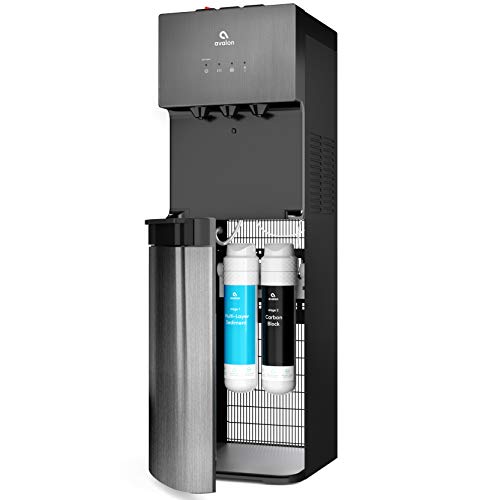
Best bottleless floor-standing starting point: Avalon A5BLK. It dispenses hot, cold, and cool water, includes an initial filter set and installation kit, and has NSF-certified filters and a UV self-cleaning function on the manufacturer’s A5 product information. It requires a nearby water connection and periodic filter changes, so it suits a fixed break room more than a space where equipment must move often.
Best bottleless countertop option for a small team: Avalon B8. It provides hot and cold water from a countertop unit, includes filters and an installation kit, and uses a direct water connection. Measure counter clearance and check how the filter installation will be routed before buying. Its drip tray does not have a drain, so staff still need to empty it.
Best bottom-load choice when avoiding heavy lifts matters: Brio Moderna 720. The manufacturer describes a self-cleaning bottom-load cooler that accepts 3- or 5-gallon bottles, provides hot, cold, and ambient water, and includes an empty-bottle indicator and hot-water safety lock. The exact Moderna suffix determines features such as ozone versus UV cleaning and dispense height.
Best simple bottled setup when the office already has jug delivery: Primo’s top-loading dispenser. The current Primo top-loader line provides hot and cold water, and the 601132-C manufacturer page lists Energy Star 3.0 compliance. The bottle is visible, making the fill level easy to see, but staff must lift the jug onto the unit. Check the exact Primo model because temperature settings and safety controls differ across variants.
These are format recommendations, not claims that one machine has been tested as best for every office. Current product names, versions, and availability can change. Check each manufacturer page and the live retailer listing for model code, included filter or bottle adapter, warranty, and operating requirements.
How to estimate the water cooler your office needs
Start with real consumption rather than a staff-count label. For one or two weeks, estimate how many people use the cooler on a normal workday, how often they refill a bottle or glass, and how much water they draw at each visit. A simple planning formula is: daily demand equals users multiplied by average servings per user multiplied by the average serving volume. Add a margin for visitors and unusually busy days. This does not need to be perfect; even a rough count is better than buying a machine based only on the word “office.”
For example, a ten-person team might make a few small refills each and use a larger pitcher for meetings. That pattern differs from an office where staff fill large reusable bottles several times per shift. The second location needs both adequate chilled-water recovery and convenient dispensing height. Check the manufacturer’s stated cooling or heating capacity per hour, reservoir size, and dispensing flow rate where those figures are available.
Reservoir size is not the same as all-day output. A cooler may store a certain volume of cold water but need time to chill more after repeated draws. If multiple people expect icy water at the same moment, a small household model may feel slow. Likewise, the hot reservoir may be enough for occasional tea yet slow during a meeting break when several people want hot drinks together. Look for capacity and recovery data instead of relying on the number of temperature buttons.
Plan for peak use, not only the daily average. If the cooler serves a conference room, the demand can spike between meetings. A larger office may want two dispensers in different areas rather than one unit with a single central queue. Place it where people can access it without blocking a hallway or requiring them to pass through a busy work zone.
1. Avalon A5BLK: a floor-standing bottleless cooler
Avalon describes the A5BLK as a bottleless cooler with hot, cold, and cool water, dual-stage filtration, an installation kit, and a self-cleaning UV function. Its product page lists NSF-certified filters, a 3.6-liter cold tank, a 1-liter hot tank, and filter life of up to 1,500 gallons or six months, depending on use and the manufacturer’s guidance. The unit connects to a water supply rather than relying on staff to replace a large bottle.
The bottleless format can make sense for an office that uses water steadily and wants to reduce bottle deliveries and jug handling. It converts recurring bottle orders into filter replacement and installation responsibilities. Before choosing it, confirm that the room has a suitable water line, a shutoff, accessible power, and a practical way to route the tubing. A facilities professional may need to assess the site; do not improvise a connection that could leak or violate local building requirements.
The A5 includes an initial filter set and installation kit according to Avalon, but office buyers should budget for future cartridges and track the replacement schedule. Filter capacity depends on water conditions and use; follow the manufacturer’s instructions rather than assuming the maximum gallon rating will always apply. Keep a spare filter on hand if the cooler is a primary shared source.
Its UV cleaning feature should be understood as a product feature, not a substitute for cleaning the spouts, drip tray, or surrounding surfaces. Follow the manual’s cleaning instructions and keep a log if the office has formal sanitation procedures. A dispenser can remain hygienic only if staff maintain the surfaces that users touch.
This is a fixed-location appliance rather than a portable solution. Measure the machine, doorways, and counter clearance; verify the electrical outlet and water connection; and consider access for filter changes. If the office relocates frequently or cannot install a water line, a bottled model may be more practical even if the per-gallon cost is higher.
2. Brio Moderna 720: bottom loading for shared offices
Brio’s Moderna 720 bottom-load line is designed for 3- or 5-gallon bottles and offers hot, cold, and ambient water. The official product information for CLBL720SC describes a compressor-cooled reservoir, stainless-steel reservoirs, an ozone self-cleaning cycle, a night light, an empty-bottle indicator, and a two-step child safety lock for hot water. The model page lists a 40.9-inch height, 13.4-inch depth, and 12.2-inch width. Check the specific suffix because Moderna variants differ.
Bottom loading removes the need to lift a full jug above shoulder height. Staff place the bottle in the lower cabinet and connect its probe or adapter. A five-gallon water bottle contains about 41.7 pounds of water before adding the container, so avoiding an overhead lift can matter in a shared workplace. The lower cabinet still requires bending, and staff must follow the model’s bottle-change procedure to keep the probe clean and avoid spills.
A self-cleaning cycle can reduce some internal maintenance tasks, but the drip tray, spout, cabinet, bottle neck, and touch controls remain part of the cleaning routine. Confirm what the product means by “self-cleaning” and which parts the cycle treats. Keep the manual accessible near the break room and record the last sanitation date if multiple people share responsibility.
Bottom loading also hides the bottle, giving the cooler a cleaner appearance in a reception area or staff kitchen. That convenience has a tradeoff: someone may not notice the bottle is low until the machine’s indicator illuminates or dispensing slows. Assign a person or schedule for checking the empty-bottle alert and keeping a spare jug nearby.
The exact Brio Moderna version matters. Some models use ozone cleaning, others UV; one version may have a standard dispense height while another is extra tall; the number of water temperatures can differ. Compare the model code, hot-water lock, bottle compatibility, warranty, and included adapter rather than shopping by “Moderna” alone.
3. Primo top-loading dispenser: simple setup with visible bottle level
Primo’s top-loading dispenser is a basic bottled-water format. The current Primo Water product page for model 601132-C describes hot and cold dispensing and Energy Star 3.0 compliance. Other Primo model numbers can include different features, such as additional temperature settings, child-resistant hot-water controls, or a spill-proof bottle connection. The Amazon listing linked in the card is a cross-store example; compare its exact model with the current Primo product page before ordering.
The top-loading design is straightforward: a bottle sits above the cooler, so staff can see when the water level is low. It does not require a plumbing connection and can be moved if the break room layout changes. It may suit a small office that already receives bottled water and has an employee who can safely change jugs.
The main drawback is handling. A full 5-gallon jug is heavy, and lifting it onto the dispenser can cause strain or spills. If several people will be responsible for bottle changes, choose a bottom-load model or establish a safe procedure with suitable lifting assistance. Do not ask employees to lift a heavy bottle overhead if they cannot do so safely.
Top-load coolers also make the bottle visible in a shared room, which may not suit a front office or customer-facing area. Check the dispenser’s footprint and height, and leave enough clearance above the unit to install a new bottle without hitting a shelf or cabinet. A visible bottle can be easy to monitor but should be kept away from direct heat or sunlight if the water supplier recommends that.
Verify the safety lock for hot water, whether cold and hot functions can be switched off independently, the drip tray design, reservoir material, bottle sizes supported, and cleaning instructions. The Primo manual recommends periodic cleaning; follow the model’s current manual rather than relying on a generic schedule.
4. Avalon B8: countertop bottleless dispenser for a small team
Avalon’s B8 is a countertop bottleless cooler that provides hot and cold water. The manufacturer says it includes the first set of filters and an installation kit, is UL listed, and uses NSF-certified dual filtration. Its published page describes a 3.6-liter cold tank, a 1-liter hot tank, a removable drip tray with no drain, and filter life up to 1,500 gallons or six months. Check the current model and filter details before purchase.
A countertop unit can save floor space in a small office, reception area, or shared studio. It avoids lifting water bottles and can deliver filtered water from a line connection. Its compact body can be easier to fit than a full-size floor cooler, but it occupies valuable counter space and still needs room above the spout for a glass or bottle.
Because the B8’s drip tray has no drain, staff need to empty and clean it. That is easy to forget in a busy office. Put the drip tray on a routine and position the unit where occasional splashes will not damage paperwork, electronics, or finished wood. Check that the counter can safely support the unit when full and that the water connection can be routed without pinching a tube.
Countertop bottleless models work best when water demand is modest or when the office has another drinking-water source. Compare cooling and heating capacity with expected meeting peaks. A compact tank may recover more slowly than a commercial floor model after several consecutive fills. The manufacturer’s reported tank volumes are useful but should be considered alongside hourly output.
Bottled or bottleless: calculate total cost of ownership
Bottled coolers have a low setup barrier. You buy or rent a cooler, arrange bottle delivery or refill, and change bottles as needed. Ongoing costs include water, delivery, deposits or container fees, and staff time. A bottom-loader can reduce lifting effort, but the bottles still occupy storage space and need to be ordered before the supply runs out.
Bottleless models replace recurring jug logistics with a water-line connection, filter cartridges, and installation. The initial purchase and setup can cost more. You also need a plan for filter replacements, leak checks, sanitation, and service if the cooler stops chilling. If the office changes locations, plumbing access and removal become additional considerations.
To compare, calculate a year of expected use. For a bottled system, total the cooler purchase or rental, water cost, delivery charges, deposits, storage, and staff time. For a bottleless system, total the unit, installation, filters, water-line work, electricity, and maintenance. Use actual supplier prices and your own water use; there is no universal point at which a bottleless model becomes cheaper.
For a low-use office, bottled water may be easier and less expensive because filters and installation have a fixed cost. For a larger team that consumes many bottles, a bottleless system may reduce recurring orders and handling. The best choice depends on your local water quality, filter replacement price, delivery cost, building access, and expected years in the location.
Choose the loading style around staff and placement
Top loading
Top loading is generally simple to install and makes the remaining water visible. It usually has a lower purchase price and requires no water-line connection. The tradeoff is lifting a heavy bottle onto the unit. Choose it only when the office can change bottles safely and has storage space nearby.
Bottom loading
Bottom loading hides the bottle and reduces the overhead lift. It can be more approachable for shared workplaces and front-of-house areas. The bottle sits in a lower cabinet, and a pump or probe moves water into the reservoirs. Staff should know how to connect the probe, prevent contamination, and respond when an empty-bottle indicator appears.
Bottleless floor standing
A bottleless floor unit avoids jug deliveries and stores, but it needs a suitable water source and space for installation. It may be a good choice for steady demand and stable office layouts. Check filter costs, rated output, water pressure requirements, and whether the cooler needs a drain or only a drip tray.
Countertop bottleless
Countertop models free floor space and can suit a small team. They consume counter area, need a nearby line, and may have smaller reservoirs. Make sure there is enough clearance to fill reusable bottles and a routine to empty a drip tray.
Temperature options and hot-water safety
Some office coolers offer cold and hot water; others add room-temperature or cool water. Decide whether the office needs hot water for tea, instant meals, or coffee, or whether a cold-only unit would be safer and less complex. Hot-water tanks can dispense water hot enough to scald. Choose a model with a clear safety lock and instruct users how to operate it.
Keep a hot-water dispenser away from children or visitors who could press a paddle accidentally. Use a lockout or disable the hot function when it is not needed. Post a short instruction label near the spout, especially if the control requires pressing a button and a lever together. Do not place the unit where a person must reach over the hot outlet to retrieve cups.
Temperature claims vary by model and conditions. Room temperature, incoming water, ambient air, usage, and recovery time can affect actual output. If the office needs a reliably hot supply for frequent use, check heating capacity per hour and reservoir volume. For cold water, check the cooling capacity and temperature range. Do not infer capacity from a “hot/cold” label alone.
Filtration, water source, and maintenance
A bottleless cooler filters incoming water, but the system’s exact capabilities depend on the certified filter and model. Read what the manufacturer says the filter is certified to reduce, and confirm that its replacement cartridge remains available. NSF certification references should be checked against the exact filter model and claims; a “filtered” label alone does not mean every contaminant is removed.
If your office water supply has a known issue, test the source or consult a qualified water professional before choosing a filter. A dispenser is not automatically a treatment system for any water concern. Use a filter rated for the specific substance you need addressed, and follow local requirements for drinking water.
Filter replacement intervals may be given by months, gallons, or both. Change them according to the first applicable limit and the manual. Heavy use or water quality may shorten the interval. Keep a record of installation date, cartridge model, and next due date. Stale filters can affect flow and taste even when the cooler still runs.
Bottled systems also need cleaning. Clean the bottle neck, probe, spout, cabinet, and drip tray at the interval specified by the maker. Replace bottles without touching the opening or probe with dirty hands. Some coolers use an ozone or UV self-cleaning cycle, but that feature does not remove the need to clean user-contact surfaces and follow the manual.
Noise, location, and accessibility
Compressor coolers can make a sound when cooling water, and bottleless models can also make pump or flow sounds. If the cooler will sit next to a quiet office, reception desk, or recording room, look for a published noise rating or arrange a trial if possible. A unit that is acceptable in a break room may be distracting beside a workstation.
Measure the footprint and clearance before ordering. Leave room for a bottle to be lifted onto a top loader, a cabinet door to open on a bottom loader, and filters to be accessed on a bottleless unit. Check whether the outlet is grounded and whether a water shutoff is reachable. Keep electrical connections away from splashes and use a stable, level surface.
Consider who will use the spout. A high dispensing area can fit reusable bottles and pitchers, while a low unit may be easier for children or wheelchair users. Check reach, control force, button placement, and whether users can fill a container without lifting it above shoulder height. An accessible location should have a clear approach and not obstruct an exit route.
For a shared office, the location should also support orderly queues. Avoid placing the cooler where a line blocks a door, printer, or work aisle. If demand is high, a second unit or a larger break-room layout may solve the problem better than buying a more complicated dispenser.
Common office water-cooler mistakes
Buying only by staff count. Two offices with the same headcount can have very different refill habits. Measure actual use and peak demand before choosing tank and recovery capacity.
Ignoring filter and bottle logistics. A bottleless model can become inconvenient if no one tracks cartridges. A bottled unit can run dry if delivery and spare storage are not assigned. Choose a maintenance owner before installation.
Assuming self-cleaning means maintenance-free. Spouts, trays, bottles, touch panels, and filters still need cleaning or replacement. Follow the exact manual.
Forgetting the hot-water lock. Hot water can cause burns. Choose a safety control and train staff, or select a model without hot output if the office does not need it.
Ordering before measuring. A cooler may not fit under a counter or may block a cabinet door. Measure the unit, service clearance, cup space, and delivery route.
Comparing price without installation. Bottleless coolers may need plumbing work and filters; bottled models need recurring water delivery and handling. Compare the total cost over the expected time in the office.
How to set up an office maintenance routine
Assign one primary and one backup person for routine checks. For bottled machines, the checklist can include bottle level, spare supply, probe cleanliness, drip-tray condition, and whether the unit needs sanitizing. For bottleless machines, track filter dates, leaks, water pressure concerns, spout cleaning, and the maintenance cycle.
Place a simple cleaning schedule near the dispenser. It should identify what needs wiping, which parts can be removed, what cleaning agent the manual permits, and how to avoid contaminating the water path. Never pour cleaning chemicals into a reservoir or filter housing unless the manual explicitly instructs it.
Keep a small log with the model number, serial number, purchase date, warranty contact, filter type, last cleaning, and next maintenance date. This makes it easier to troubleshoot a slow flow or temperature problem and helps a new office manager take over. Store the user manual where employees can find it.
If the water tastes unusual, flow slows, the cooler leaks, or hot/cold temperatures drift, stop using the affected function and consult the manufacturer’s troubleshooting instructions. Do not open electrical or pressurized components. For water-line issues, use a qualified technician or facilities professional.
Frequently asked questions
What type of water cooler is best for a small office?
A small office can use a top-loading bottle cooler if staff can handle bottle changes, a bottom-loader if reducing lifting is a priority, or a countertop bottleless unit if a water connection is available. Estimate peak use and counter or floor space before choosing.
Is bottleless always cheaper for an office?
No. Bottleless avoids jug deliveries but adds installation and filter costs. A low-use office may spend less with bottled water; a high-use office may save through fewer deliveries. Calculate costs using your local water service, cartridge price, plumbing work, and expected time in the location.
How many people can one office water cooler serve?
There is no universal headcount because cooler capacity, usage, and refill patterns differ. Check manufacturer cooling and heating recovery ratings and compare them with measured peak demand. For busy offices, consider a second unit or a higher-capacity commercial model.
Do bottleless water coolers need plumbing?
Yes, bottleless models connect to a water supply. They may include a tubing kit, but suitability depends on water pressure, distance, shutoff access, and local installation requirements. Have facilities staff or a qualified installer review the location.
Are self-cleaning water coolers maintenance-free?
No. A self-cleaning cycle may treat parts of the internal water path, but staff still need to clean touch surfaces and drip trays and replace filters or bottles. Follow the model’s manual and maintain a written schedule.
Should an office water cooler have hot water?
Only if the office will use it. Hot output is convenient for tea and instant foods but adds a scald risk. If you choose it, use a clear safety lock, place the unit thoughtfully, and show employees how to operate the control. Cold-only models can be simpler where hot water is unnecessary.
How often should water cooler filters be changed?
Use the manufacturer’s interval for the exact filter and model, often based on time, gallons, or both. Heavy use and incoming water conditions can affect life. Keep a replacement schedule and do not extend the interval simply because the machine still dispenses water.
Bottom line: choose around office demand and upkeep
For a fixed office with a suitable water line, Avalon’s A5 or B8 bottleless options can reduce jug handling, with filter changes and installation as ongoing responsibilities. A Brio Moderna bottom-loader can make bottle changes easier for a shared team. A Primo top-loader is a simpler bottled setup when staff can safely lift and replace jugs. Each format trades setup cost, convenience, and maintenance differently.
Measure demand, pick a location, confirm the exact model and safety controls, and assign someone to maintain it. Check filter or bottle costs, confirm the installation requirements, and verify current availability before ordering. The right office cooler is the one that reliably serves the people who use it and has a maintenance plan the workplace can actually keep.
Amazon content disclosure: As an Amazon Associate, Daily Home Decorating earns from qualifying purchases. Prices and availability are accurate only when checked and may change. Amazon and the Amazon logo are trademarks of Amazon.com, Inc. or its affiliates.