Disclosure: As an Amazon Associate, reviewstook.com earns from qualifying purchases. Links to Amazon on this page are affiliate links; they cost you nothing extra. Listing details such as price and availability change often, so check the current Amazon listing before you buy.
The best no pill blankets are almost always woven or knitted from long cotton yarn, not brushed polyester. Pilling is the fuzzy little balls that collect where a fabric rubs against itself, and it is the main reason a favorite blanket begins to look tired after a few seasons. Cotton waffle weaves, thermal weaves and muslin layers keep their surface flat because the yarn is spun and set in a pattern that holds together, so there is less loose fiber to roll up.
This guide is written for shoppers who are tired of lint on the sofa, fluff on dark clothes and blankets that look worn within a year. We compare five real cotton blankets and throws, explain who each one suits, give an honest limitation for every pick and finish with a checklist you can run through before you add anything to your cart. Nothing here is a lab result. We read the maker listings and describe what the fabrics are, so always glance at the current listing for size and color before you buy.
In this guide
Quick Picks: Which No Pill Blanket Fits You
If you only have a minute, use this table. Each row names one blanket and the situation it answers best.
| Pick | Best for | Why it stands out | Link |
|---|---|---|---|
| Bedsure Cotton Waffle Weave Blanket | Best overall | Textured cotton weave with a flat surface | Check on Amazon |
| Utopia Bedding Cotton Thermal Blanket | Best for layering on a bed | Cellular cotton weave in bed sizes | Check on Amazon |
| Kingole Muslin Cotton Throw Blanket | Best for warm rooms | Soft gauzy muslin layers | Check on Amazon |
| Nate Home by Nate Berkus Cotton Waffle Weave Throw | Best for a styled living room | Designer look with a tidy finished edge | Check on Amazon |
| Welhome Cotton Thermal Blanket | Best everyday workhorse | Simple cellular cotton that suits repeated washing | Check on Amazon |
What No Pill Really Means
No fabric is completely immune to pilling, and any honest buyer should know that up front. What shoppers mean by the phrase is a blanket that resists the problem better than the average fleece, which is made of short synthetic fibers that work loose and tangle. Cotton is a natural fiber with longer staples in good grades, and when it is woven into a waffle or cellular structure the yarns lock into place instead of sitting on top as a fluffy pile.
That is why this guide leans toward woven cotton. We have left out the thick plush throws that look wonderful in a photo but shed and bobble where a lap or an elbow rubs. If you want that look anyway, our fleece and sherpa guides cover it, though you should expect more lint from those materials.
How We Picked These Blankets
We did not test these blankets ourselves and we do not claim to know how long any particular unit will last in your home. Instead, we looked at the published product descriptions, the stated materials, the weave type and the sizes the makers list. We then favored blankets made entirely of cotton with a structured weave, because that combination is the most reliable route to a smooth surface.
We also looked for a spread of uses, from bed layering to sofa throws, so that the five picks do not all answer the same question. Where we are unsure of a detail, such as an exact dimension, we tell you to check the listing instead of guessing.
The 5 Best No Pill Blankets

Bedsure Cotton Waffle Weave Blanket Throw
Who it suits: Anyone who wants one dependable cotton blanket for the sofa, the foot of the bed and the occasional picnic. It is the pick we would name first for a shopper who has been burned by fleece.
- The waffle weave creates small recessed squares, so the surface looks textured but stays flat and tidy.
- It is made from cotton, which means a gentle, breathable feel without the static that some synthetic fabrics carry.
- Bedsure sells it in several colors and sizes, so you can match a room or buy two to share between chairs.
Honest limitation: Waffle weaves are open by design, so the blanket looks lighter than a plush throw and may feel less enveloping on a very cold evening.
Choose it if you want a flat, easy-care cotton throw for everyday use. Skip it if you want the heavy, cocooning feel of a thick sherpa.
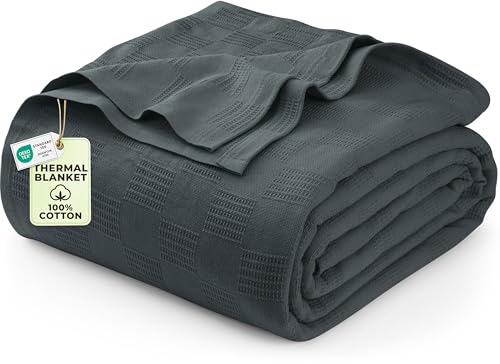
Utopia Bedding Cotton Thermal Blanket
Who it suits: Shoppers who need a bed blanket in a full range of sizes and who want a mid-layer to sit between sheets and a quilt. The cellular weave is a classic hotel and hospital style that has been around for generations.
- The cellular, honeycomb-like weave traps a little air between the yarns without adding a pile that can bobble.
- It comes in bed sizes, which is useful because most no pill options are sold only as throws.
- The plain finish makes it easy to blend in with sheets and a duvet cover you already own.
Honest limitation: The look is utilitarian. It does not have the decorative texture of a waffle weave, so it works better under a layer than draped as a display piece.
Choose it if you are building a layered bed and want a practical cotton middle layer. Skip it if you want a showpiece for a living room sofa.
Kingole Muslin Cotton Throw Blanket
Who it suits: People who run warm, live in a mild climate or want a blanket that works from spring through early fall. Muslin is the airy, gauzy cotton often used for baby swaddles, scaled up here to a throw.
- Muslin is a loosely woven cotton cloth, so the surface is smooth to the touch and has no pile to roll into balls.
- The fabric is generally light, which makes it easy to fold into a bag, a basket or a carry-on.
- Muslin tends to soften with repeated washing, a trait many shoppers like in a throw.
Honest limitation: Its gauzy weave is not meant to be thick or heavy, and it will not give the weight some people want in colder months.
Choose it if you want a breathable cotton throw for warm days and cool nights. Skip it if you need a substantial winter blanket.
nate home by nate berkus Cotton Waffle Weave Throw Blanket
Who it suits: Shoppers decorating a living room or bedroom who want a throw that looks intentional. This is a designer-labeled home line sold through major retailers and online.
- The waffle texture adds visual interest to a plain sofa or chair without needing a bold pattern.
- Cotton construction means the throw sits well folded over an arm or draped across an ottoman.
- The neat finished edge helps it look styled in a photo or a guest room.
Honest limitation: It is aimed at appearance as much as function, and the size is throw proportioned, so it is better for one person than for sharing across a large bed.
Choose it if you want a cotton throw that doubles as decor. Skip it if you need bed-sized coverage.
Welhome Cotton Thermal Blanket
Who it suits: Households that wash blankets often and want a plain, durable cotton piece to put on a guest bed, a child’s room or a dorm. Welhome is a home textile brand that sells a number of cotton blanket styles.
- A woven cotton construction keeps the surface free of the loose pile that causes balling.
- The simple style hides well under other bedding, so it is easy to use year round.
- Several sizes and colors are usually offered, which helps when you are outfitting more than one bed.
Honest limitation: It is a quiet, practical blanket with little decorative character, so check the listing for the weave and color before you commit.
Choose it if you want a straightforward cotton layer for a guest room or kids’ room. Skip it if you want a statement texture.
Side by Side Comparison
| Product | Material | Style and size type | Key feature | Best use | Link |
|---|---|---|---|---|---|
| Bedsure Cotton Waffle Weave | Cotton | Throw, several sizes listed | Waffle texture | Sofa and bed foot | Check on Amazon |
| Utopia Bedding Thermal | Cotton | Bed sizes | Cellular weave | Layering on a bed | Check on Amazon |
| Kingole Muslin Throw | Cotton muslin | Throw | Airy gauze | Warm rooms, travel | Check on Amazon |
| nate home Waffle Weave | Cotton | Throw | Designer look | Living room decor | Check on Amazon |
| Welhome Thermal | Cotton | Bed sizes listed | Plain durable weave | Guest rooms | Check on Amazon |
How to Choose a Blanket That Stays Smooth
Run through this checklist before you buy. It will filter out most of the blankets that disappoint.
- Look at the fiber content first. A label that says 100 percent cotton, or cotton with linen, is a better first filter than a long polyester blend.
- Prefer structure over fluff. Waffle, cellular, muslin and tight knit surfaces hold their yarns in place. Deep pile and long-hair faux fur do the opposite.
- Check the size against your use. A throw is meant for one person on a sofa; a bed blanket needs the width of your mattress plus some overhang.
- Read the care label. Cotton usually tolerates machine washing, but heat and rough cycles are what rough up a surface, so follow what the maker says.
- Think about weight. Open weaves feel lighter than brushed fabrics. Decide whether you want a mid-weight layer or a cozy blanket you can bury yourself in.
- Be honest about lint. Even cotton sheds a little during its first washes, so wash a new blanket on its own before it meets dark furniture.
Why Cotton Weaves Beat Plush Fabrics for Pilling
When a polyester fleece rubs against a sofa cushion or a pair of jeans, the short fibers on the surface twist together and form hard little knots. Because synthetic fibers are strong, those knots do not fall off, which is why a pilled fleece looks worse the longer you use it. Cotton fibers are weaker, so the same friction tends to release lint instead of anchoring it. In a tight weave there is simply less loose material to rub free.
That does not make cotton perfect. Low-grade cotton with short fibers can still shed, and a poorly finished edge can fray. It means your odds are better when you choose a woven structure from a maker that spells out what the blanket is made of.
Cotton Versus Wool Versus Bamboo Blends
Many shoppers wonder whether to step outside cotton. Wool is naturally springy and can look rich, but some wool throws can pill in high-friction spots, especially softer blends. Bamboo-derived fabrics feel silky and drape nicely, but quality varies between makers and the label matters more than the plant name. For a straightforward, low-fuss option, a cotton weave is the easiest to understand and compare, which is why all five picks above stick with it.
If you already own a cotton blanket and like it, buying a second in a different weave is a simple way to add variety without adding risk.
Waffle Weave, Cellular or Muslin: Which Structure Fits
The three structures in this guide look different but share one trait: the yarns are interlaced so that the surface stays put. A waffle weave raises a grid of ridges with small hollows between them. It reads as textured, photographs well and is the structure most people picture when they think of a modern cotton throw. A cellular weave is more regular and almost quiet in appearance, like the blankets found in hotel linen cupboards. Muslin is the plain, open cloth, the lightest of the three.
If you share a sofa with a pet or a toddler, the waffle ridges can catch crumbs and hair in the hollows, so a shake outdoors helps now and then. A cellular blanket is flatter and brushes clean more easily. Muslin releases lint more readily when new, but it is also the quickest to dry on a line. None of these differences are dramatic, so choose the structure whose look you will enjoy seeing every day.
Color deserves a thought too. Lighter shades show lint from a dark sweater, while darker blankets show pale pet hair. A medium neutral hides both quite well, which is why gray, oatmeal and taupe options are so common in cotton lines.
Using a No Pill Blanket Through the Seasons
A single cotton blanket can work year round if you think of it as a layer instead of a finished bedding set. In summer, a muslin throw or a waffle weave over the sheet adds a light covering when the room is cool at night. In winter, the same blanket becomes a base layer under a quilt or duvet, where it also protects the heavier piece from body oils and wear. Treating it this way means you wash the blanket more often than the quilt, and a tough woven cotton is built for exactly that routine.
On the sofa, keep one blanket folded on the arm and a second in a basket so you can rotate them. That simple habit spreads the wear and keeps both looking fresh for longer.
Picking the Right Size and Weight
Size is the most common regret with blankets, so decide it before you shop for color. A standard throw is sized for one person on a sofa or armchair. A bed layer should clear the sides of your mattress by a comfortable margin, so measure your bed and compare it to the listing dimensions instead of trusting the size name alone.
Weight is a matter of taste. A muslin throw such as the Kingole feels airy and floats when you shake it out. A cellular blanket like the Utopia Bedding option feels more substantial because the weave has body. Waffle weaves sit somewhere in the middle and are the usual first choice for people who are not sure.
Care Tips to Keep the Surface Flat
- Wash a new cotton blanket before first use, separate from dark garments, to release the loose lint that comes off every new cotton item.
- Use a gentle cycle and a mild detergent, and skip fabric softener, which can coat natural fibers.
- Close zippers and hook-and-loop strips on other laundry so they do not snag the weave.
- Dry on a low setting or hang the blanket flat, and remove it while it is slightly damp if the label allows.
- Fold and store it somewhere dry. Rotating two blankets also reduces wear on either one.
As always, the care label on your specific blanket outranks any general advice here.
Common Buying Mistakes
- Judging by a photo. A thick, silky surface in a product image is often brushed polyester, the very material you want to avoid.
- Ignoring dimensions. A throw labeled queen is not a bed blanket. Compare actual measurements.
- Buying one for every purpose. A muslin summer throw and a thermal bed blanket solve different problems.
- Skipping the first wash. Some lint on day one is normal and does not mean the blanket is a dud.
- Assuming cotton means soft immediately. Many woven cotton blankets soften over time, so judge the feel after a few washes.
Who Should Look Elsewhere
If your top priority is a deep, fuzzy feel, a woven cotton blanket may feel plain to you. Sherpa and plush throws deliver that sensation and are fine choices as long as you accept some lint and surface wear. Likewise, if you need an exact warmth level or a certain weight, a cotton throw is not built for that and you should look at products designed for it. For decorative statements, a chunky knit or a faux fur piece will usually look bolder, though the trade-offs are shedding and care.
Reading the Picks Side by Side: A Deeper Comparison
Looked at alongside the rest of the shortlist, What No Pill Really Means is best understood by the job it does most confidently rather than by any single feature. Compare it directly with The 5 Best No Pill Blankets on the points this guide has already laid out: who it suits, where it feels most at home, and what its stated trade-off is. If your needs match its strengths, that trade-off will rarely trouble you. If your needs sit closer to the limitation noted in its review, one of the neighbouring picks will almost certainly serve you better, and recognising that before you order is the whole point of a comparison guide.
The 5 Best No Pill Blankets rewards a particular kind of buyer, and its section above is worth rereading with your own household in mind. Set it against What No Pill Really Means and ask which description sounds more like your rooms, your routine, and the people who will actually use it. Shoppers often choose on the most impressive-sounding feature and then live with the everyday details, so reverse that order: decide on size, care, storage, and day-to-day fit first, and only then let the headline feature break a tie between two picks that both suit your life.
For Bedsure Cotton Waffle Weave Blanket Throw, the choose-or-skip question comes down to fit rather than quality. Choose it if the use case in its review is the use case you have most weeks, if its care and storage demands fit your space, and if its limitation is one you can accept without a workaround. Skip it if you found yourself hoping it would behave like What No Pill Really Means instead, because that hope usually means the other pick is your real answer. A guide like this one earns its keep not by crowning one winner for everyone, but by steering each reader to a different, correct winner.
Looked at alongside the rest of the shortlist, Utopia Bedding Cotton Thermal Blanket is best understood by the job it does most confidently rather than by any single feature. Compare it directly with What No Pill Really Means on the points this guide has already laid out: who it suits, where it feels most at home, and what its stated trade-off is. If your needs match its strengths, that trade-off will rarely trouble you. If your needs sit closer to the limitation noted in its review, one of the neighbouring picks will almost certainly serve you better, and recognising that before you order is the whole point of a comparison guide.
For Kingole Muslin Cotton Throw Blanket, the choose-or-skip question comes down to fit rather than quality. Choose it if the use case in its review is the use case you have most weeks, if its care and storage demands fit your space, and if its limitation is one you can accept without a workaround. Skip it if you found yourself hoping it would behave like What No Pill Really Means instead, because that hope usually means the other pick is your real answer. A guide like this one earns its keep not by crowning one winner for everyone, but by steering each reader to a different, correct winner.
nate home by nate berkus Cotton Waffle Weave Throw Blanket rewards a particular kind of buyer, and its section above is worth rereading with your own household in mind. Set it against What No Pill Really Means and ask which description sounds more like your rooms, your routine, and the people who will actually use it. Shoppers often choose on the most impressive-sounding feature and then live with the everyday details, so reverse that order: decide on size, care, storage, and day-to-day fit first, and only then let the headline feature break a tie between two picks that both suit your life.
Size is the quiet decision that determines whether a blanket feels generous or mean. A throw that is slightly too short leaves ankles uncovered every time the sleeper or sitter stretches out, and no softness compensates for that nightly irritation. Check the stated dimensions against the sofa seat depth, the bed width, or the plants and furniture you intend to cover, and allow extra length for tucking, draping, or shrinkage in the wash where the care label suggests it may occur. For shared use, bigger is usually kinder: two people under one undersized throw will spend the evening negotiating territory instead of relaxing.
Fabric behaviour matters more than fabric name alone. How a material handles washing, whether it pills or sheds, how it feels after ten washes rather than on day one, and whether it dries quickly or stays damp for hours all shape ownership far more than the first impression in the shop. Read the care notes for each pick in this guide alongside its comfort description. A blanket that needs unusually delicate handling can be a lovely choice for a guest room and a frustrating choice for a family sofa. The right blanket is the one whose care routine you will genuinely keep up with, not the one you intend to treat carefully and then wash like everything else.
How to Judge Best No Pill Blankets in Real Life
Finally, buy for the household you have, including its least careful member. Children, pets, guests, and tired adults at the end of a long day will treat any blanket in reach as a blanket, whatever its intended status. If a pick needs protection from ordinary life to stay beautiful, assign it a protected role such as a guest bed or a reading chair. If you need an everyday workhorse, choose the pick praised for durability, easy washing, and staying smooth, and accept a slightly less delicate look as the fair price of daily use. That honest matching of blanket to lifestyle is what separates satisfied owners from people with a cupboard of beautiful blankets they are afraid to use.
Appearance and texture should be tested against your real room, not a catalogue image. Colours read differently in warm evening light than in bright daylight, and pale blankets show everyday marks far sooner than mid-tone or patterned ones. Texture interacts with the rest of the room too: a high-pile, cosy throw softens a leather sofa visually and physically, while a smooth, tightly woven blanket looks crisper on a made bed. If the blanket will be photographed, gifted, or used for themed occasions, that visual role is a legitimate part of the choice, but let it rank after size, warmth, and care rather than before them, because you will feel the practical qualities every day and admire the colour only sometimes.
Storage protects a blanket during the months it is not earning its place. Store it clean and fully dry, folded loosely in a breathable place rather than sealed damp in plastic, and keep it away from rough surfaces that could snag the weave or pile. For seasonal items, a quick inspection before storage catches small damage, stains, or damp patches while they are still easy to deal with. When the blanket comes back out, air it before use and check seams, edges, and any fastenings. This small twice-a-year ritual is the difference between a blanket that lasts for many seasons and one that disappoints at exactly the moment it is needed again.
A Practical First-Week Routine
Warmth should be judged as a layering question. Few blankets are used entirely alone across a whole year; most work as one layer in a system with sheets, duvets, heating settings, and room temperature. A lighter blanket that layers well can serve for more months than a single very warm blanket that is unusable in milder weather. Think about when you actually feel cold: in the evening on the sofa, in the early morning in bed, or during a specific season or event. Choose the pick whose weight and breathability suit that moment, and keep in mind that adding a second light layer gives you adjustment options that one heavy layer never will.
Choosing well in this category starts with matching the blanket to the job it will actually do most weeks, not the job in the prettiest photograph. A throw that lives on a sofa arm faces crumbs, pets, frequent washing, and being pulled around by children. A blanket that lives on a bed faces nightly use, layering with other bedding, and a different balance of warmth and breathability. A specialist cover used outdoors or seasonally faces weather, storage, and rough handling. The picks in this guide overlap less than they first appear once you sort them by real use, so name your primary job first and let that ranking, rather than colour or novelty, drive the decision.
For gifts and themed purchases, think about the recipient’s habits as carefully as their enthusiasm. A beautiful themed blanket delights most when it is also soft enough, large enough, and easy enough to wash that it gets used weekly rather than folded away as a keepsake. Consider where it will live, whether the household has pets or young children, and whether the recipient prefers light layers or heavy warmth. The picks in this guide include options at different weights and care levels for exactly this reason: matching the blanket to the person’s everyday life is what turns a fun gift into a favourite object.
Care, Troubleshooting and Getting More From Your Choice
Washing and drying deserve a plan before the blanket arrives. Check whether your machine can handle the blanket’s size and weight when wet, because a blanket that must be washed elsewhere will simply not get washed often enough. Separate dark or strongly coloured blankets for the first washes, follow the temperature guidance on the label rather than your household default, and dry in the way that protects the surface finish the pick is known for. Pilling, roughness, and fading are often laundry outcomes rather than manufacturing faults, and the owners who keep blankets looking good longest are usually the ones who wash them a little more gently and a little less often.
Troubleshooting common disappointments is usually straightforward. A blanket that feels less soft after washing may have been dried too hot or washed with rougher items; a gentler cycle and a separate wash often restore much of the feel. A blanket that sheds should be washed and dried according to its label before first use and kept away from abrasive surfaces. A blanket that is warm enough on the sofa but cold in bed is not failing; it is being asked to do a different layering job. Naming the real problem precisely, rather than declaring the blanket poor quality, usually reveals a simple adjustment in use, washing, or layering.
More Questions, Answered
Is a themed or novelty blanket a good gift?
It can be an excellent gift when the practical basics are right as well as the theme. Check that the size is generous, the feel is genuinely soft, and the care routine suits the recipient’s household, especially if there are children or pets. A themed blanket that is used on the sofa every evening succeeds far better than a more dramatic one that is kept folded away. Match the weight to how the person lives: light and easy for a student or renter, warmer and more substantial for a settled reading corner at home.
How often should a blanket be washed?
Wash it often enough that it stays fresh for skin contact, and gently enough that the finish survives. Everyday sofa throws and bed blankets benefit from regular washing on the cycle the label recommends, with extra washes after illness, spills, or heavy pet use. Seasonal or occasional blankets should always be washed or aired before storage and checked when they come back out. A blanket stored clean and dry lasts longer, smells better, and is ready at the moment it is needed.
What size blanket do I need for a sofa or a bed?
Measure the surface you want to cover and add enough extra for tucking, draping, and the way people actually pull a blanket around themselves. For a sofa, the blanket should cover a seated person’s legs and feet with room to spare when they stretch out. For a bed, decide whether it must cover the mattress top only or drape over the sides, and allow for any shrinkage the care label suggests. When in doubt between two sizes for shared or everyday use, the larger one is usually the kinder choice.
Can one blanket work all year round?
A single mid-weight blanket used as part of a layering system comes closest. In colder months it sits over a sheet and under or over a duvet depending on your preference; in milder months it may be the only layer you need. Very heavy blankets tend to be unusable in warm weather, and very light ones cannot be made warmer without help. If you want one purchase to cover the most nights, choose the pick whose breathability and weight layer most flexibly, and adjust the rest of the system around it.
How do I stop a new blanket from shedding or pilling?
Start by washing and drying it exactly as its care label directs before first use, separately from rougher items such as towels with hooks or garments with zips. Avoid very hot drying unless the label allows it, and keep the blanket away from abrasive surfaces during use. Some initial loose fibre is common with soft finishes and usually settles after the first few washes. Persistent heavy shedding after gentle, correct care is a quality concern, but most early shedding is a laundry and friction issue that improves once the loose surface fibres are gone.
Planning for the Longer Term
Consider how this choice plays out across an ordinary month rather than a single first impression. In week one, everything is new and carefully handled. By week three, the routines in this guide, the storage reality, and the care demands are what determine whether you still feel you chose well. Readers shopping for best no pill blankets: cotton picks that stay smooth often focus on the day of delivery, but satisfaction in this category is a slow verdict delivered by dozens of ordinary uses. Revisit the pick descriptions with that longer horizon in mind, and favour the option whose daily habits you can picture yourself keeping without effort or resentment.
Planning for the Longer Term
It also helps to write down your two non-negotiables before you order, and to refuse to let a third, less important feature talk you out of them. For one household that might be size and easy care; for another it might be quiet operation, storage, or suitability for a particular sleeper, guest, room, or season. The picks in this guide each win on a different combination, which is why a clear personal ranking beats a general ranking every time. If a pick fails one of your non-negotiables, cross it off without regret and compare the survivors closely; that short, honest process is faster and far more reliable than rereading every review hoping a compromise will disappear.
Planning for the Longer Term
When the choice finally arrives, set it up exactly as its own instructions direct before improvising improvements of your own. Many early complaints in this category trace back to a skipped setup step, a protector, base, floor, or storage detail that did not match what the product expected, or an accessory borrowed from a different product entirely. Give the pick a fair first trial in the conditions it was designed for, note anything that genuinely bothers you in the first days rather than relying on memory later, and only then adjust bedding, position, routine, or accessories one change at a time so you can tell what actually helped.
Planning for the Longer Term
Keep the paperwork, order details, and care instructions together in one place, digital or physical, for as long as you own the product. If you need help later, the fastest route to a useful answer, whether from a seller, a maker, or a repair guide, is knowing exactly which model you have, when it arrived, and how it has been used and cared for. That small administrative habit, unfashionable as it sounds, saves more time and money across the life of household purchases than almost any shopping trick, and it turns a vague complaint into a specific, solvable question.
Living With Your Choice: Practical Notes
Finally, remember that the cheapest outcome is usually the purchase you only make once. A slightly better-matched pick that you keep, use, and maintain for years costs less, in money and in frustration, than a bargain that disappoints and is replaced within a season. That does not mean always choosing the most elaborate option in this guide; it means choosing the option whose strengths align with your most frequent needs and whose weaknesses fall on the days you can tolerate them. Read the limitation line of your favourite pick one last time before ordering. If you can accept it with a shrug, you have almost certainly found your product.
Another useful test is to imagine the least convenient version of using this product, not the easiest one. Picture the tired evening, the rushed morning, the unexpected guest, the sudden cold snap, or the mess discovered five minutes before someone arrives. Does your chosen pick still work in that moment, with the space, time, and energy you will actually have? Products in this category are rarely abandoned because they failed in ideal conditions; they are abandoned because they were awkward in real conditions. Choosing the pick that survives your worst plausible Tuesday, rather than the one that shines in a staged photograph, is a far more dependable way to shop.
Households also differ in how much maintenance they will honestly sustain, and this choice should respect that. Some owners enjoy a small ritual of checking, washing, rotating, patching, or storing things properly. Others need products that forgive neglect, survive the general wash, tolerate being grabbed in a hurry, and still perform after a month in a cupboard. Neither household is wrong, but they should not buy the same pick. Rank the options in this guide by the care they demand as well as the comfort or cleanliness they promise, and choose the one whose demands match the routine you already keep, not the routine you aspire to start.
Living With Your Choice: Practical Notes
Take a moment to think about who else will interact with this purchase and what they need from it. A partner may have a different temperature preference, a guest may not know the setup routine, a child may treat the item as furniture, and a pet will certainly treat it as an invitation. The most successful household purchases are the ones that work without a briefing: intuitive to use, forgiving of slightly rough handling, and easy to return to a tidy state afterwards. If your pick needs a particular technique, plan to demonstrate it once or leave the essentials where the next user will naturally find them, rather than discovering the confusion at midnight.
Sound, smell, and feel are the three senses that decide whether a household product becomes a favourite, and none of them appears fully in a specification list. A new item may carry a faint manufacturing smell that airs out in a day or two, may sound different in a quiet room at night than it did in a busy shop, and may feel different against skin, flooring, or foliage than a description suggests. Air new items before first use where appropriate, test them in the actual room and lighting where they will live, and give your senses a fair chance to settle before making a final judgement based on the first ten minutes.
Seasonality quietly changes what good looks like in this category. The pick that delights in one season may need a partner layer, a different storage spot, or a small adjustment in routine when the weather, the daylight, or the household rhythm changes. Before you commit, walk the product mentally through the full year in your home: the busiest month, the warmest month, the coldest or wettest month, and any holiday or term-time period when guests, children, or extra mess arrive. A choice that has a sensible answer for each season will serve you far longer than one optimised for the week in which you happened to buy it.
Final Recommendation: One Pick per Buyer
- Best overall: the Bedsure Cotton Waffle Weave Blanket, for its balance of texture, flat surface and flexibility.
- Best for beds: the Utopia Bedding Cotton Thermal Blanket, for bed sizes and a practical weave.
- Best for warm weather: the Kingole Muslin Cotton Throw, for its airy gauze.
- Best for decor: the nate home waffle weave throw, for a styled look.
- Best for guest rooms: the Welhome Cotton Thermal Blanket, for simple, repeat-wash practicality.
If you are still undecided, the two most dependable places to begin are the waffle weave throw for the living room and the thermal blanket for the bed. Both let you judge cotton construction at a low risk of regret.
Frequently Asked Questions
Will a cotton blanket ever pill?
It can, particularly in spots that rub against furniture or clothing, but a tight weave of decent cotton tends to develop far less than fleece or brushed polyester. Wash it gently and avoid heavy friction for the best result.
Is a waffle weave warmer than a thermal blanket?
The two are different constructions rather than a clear ranking. Waffle weaves offer texture and a lighter drape, while cellular thermal weaves are built as layering pieces. Check the maker description for the feel you want.
How do I pick the right size?
Measure your mattress or the sofa seat, then compare against the dimensions listed on the product page. Sizing names vary from brand to brand, so the numbers matter more than the label.
Can I machine wash these blankets?
Most cotton blankets are made to be machine washed, but each maker sets its own instructions. Read the care tag, use a gentle cycle for a new blanket and avoid high heat when drying.
Do they shed at first?
Almost every new cotton textile releases some loose fiber at first. Washing it separately before first use clears most of this, and it is not a sign of a defect.
Which one works best as a gift?
The nate home throw is the most gift-friendly because of its styled appearance, while the Bedsure waffle weave is the most dependable all-purpose choice because it suits many rooms and tastes.
What if I receive the wrong color or size?
Amazon handles returns according to its own policy for each seller, so check the return terms on the listing at the time you order. Keep the packaging until you have confirmed the size and color.
Is muslin too thin for a real blanket?
It depends on the climate and the layers you pair it with. Muslin is a light, breathable cloth, so it suits warm rooms and mild nights. Pair it with another layer if you need more body.