Disclosure: As an Amazon Associate, reviewstook.com earns from qualifying purchases. Links to Amazon on this page are affiliate links; they cost you nothing extra. Listing details such as price and availability change often, so check the current Amazon listing before you buy.
The best low camp chairs sit close to the ground, pack down small and set up in seconds, and six names keep coming up for people who want that mix: Helinox, NEMO, REI Co-op and Crazy Creek. For a lightweight, low-slung seat that suits fireside evenings, the Helinox Ground Chair is where most shoppers should begin. If you want a more reclined, lounge-style position, the NEMO Stargaze Recliner Luxury is the one to check. The sections below tell you who each chair fits, what it does well and what to watch for.
A low camp chair is simply a folding seat with a short leg height, so your body sits near the ground instead of at table height. People choose them for campfires, concerts on a lawn, beach days, sports sidelines and anywhere a taller chair would block a view or catch the wind. They also tend to be compact, which matters when your trunk or backpack is already full.
Each product is followed by a link to its current listing, and a comparison table later on shows all six together.
In this guide
Quick Picks at a Glance
| Need | Pick | Why it stands out | Check it |
|---|---|---|---|
| Best overall low chair | Helinox Ground Chair | Very short seat height and a pack size aimed at backpackers | Check on Amazon |
| Best for a roomier seat | Helinox Sunset Chair | Larger, laid-back design from the same trusted maker | Check on Amazon |
| Best for small packs | REI Co-op Flexlite Air Chair | Made to be carried on long trips where every ounce counts | Check on Amazon |
| Best for lounging | NEMO Stargaze Recliner Luxury Chair | Reclined position designed for stargazing and long evenings | Check on Amazon |
| Best simple ground seat | Crazy Creek Hex 2.0 Original Chair | A foam-panel seat that folds and clips, with no frame to assemble | Check on Amazon |
| Best compact all-rounder | Helinox Chair One | Small folded size from a brand known for lightweight poles | Check on Amazon |
Why Choose a Low Camp Chair at All
A regular camp chair puts the seat at about knee height. That works around a picnic table, but it is a poor fit at a fire ring, on sand or on a hillside. A low chair keeps you below the smoke line of a small fire, below the wind that rolls along a beach and out of the way of the people standing behind you at a crowded show.
There is another reason, and it is mostly practical. Short legs mean shorter poles and less fabric to fold, which usually translates into a smaller package. Backpackers, cyclists and anyone traveling by plane tend to find low chairs the easiest category to bring along. The honest trade-off is getting up. A very low seat asks more of your legs than a standard chair, so if standing up from the ground is hard for you, a higher seat may serve you better.
Low chairs also behave differently on soft ground. Feet that sink slightly into sand or grass can tilt a seat, which is why makers add wider feet or sand-friendly end caps to some designs. We mention which chairs have that kind of detail below, based on what the manufacturers describe.
How We Picked These Six
We have not unfolded, carried or sat on any of these chairs ourselves. The picks come from manufacturer descriptions, published specifications and how each product is positioned in its listing. We looked for chairs whose makers describe a low seat as a main selling point, for brands that are easy to find again, and for variety in format. You will see frame-based chairs, a reclined lounger and a foam-panel seat with no poles at all.
Some popular low chairs from Kijaro, GCI Outdoor, Kelty and Big Agnes are covered in other guides on this site, so they are left out here to give you fresh options. Check each live listing for dimensions, packed size and included accessories before you order, since these details change between versions.
The Six Low Camp Chairs Worth a Look

1. Helinox Ground Chair
Who it suits: Backpackers, festival-goers and fireside regulars who want a seat close to the earth without carrying much.
The Ground Chair is Helinox’s answer to the question of how little chair a person can bring and still enjoy sitting. It uses the brand’s aluminum pole structure with a fabric seat, and as the name suggests, the seat sits very near the ground. Helinox describes it as quick to set up, folding into a small bundle that slips into a pack or a bag.
- Strength one: Very low seating position, which suits fire rings and beach sand.
- Strength two: A compact, easily carried packed form that will not take over your gear space.
- Strength three: Helinox has a strong reputation for pole design, which is the part that matters most in a frame chair.
Honest limitation: The seat is minimal. If you like a high back and big armrests, this is not that kind of chair.
Choose it if you want a light, low seat for short stops. Skip it if you plan to spend hours in it with a book.
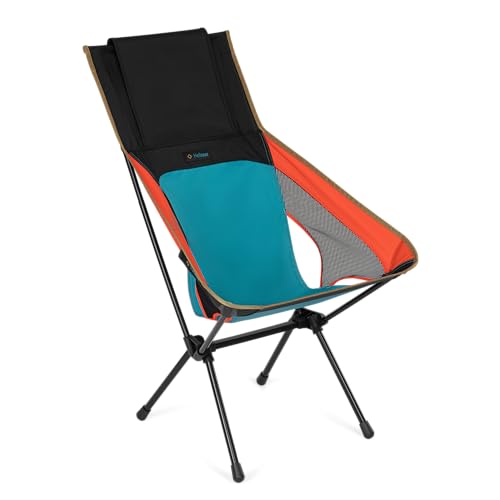
2. Helinox Sunset Chair
Who it suits: Campers who like the low look but want a more generous, lounge-style seat for evening hours.
Think of the Sunset Chair as the roomier relative of the Ground Chair. It sits low, but the frame and fabric are laid out for more reclined seating, and the overall package is built for relaxing rather than perching. Helinox positions it for sunsets, beaches and long fire-lit evenings, and the pole system follows the same snap-and-go idea as the rest of the brand’s chairs.
- Strength one: A larger seat area than the minimalist Ground Chair.
- Strength two: A laid-back angle that suits unhurried evenings.
- Strength three: Same pole family and set-up logic, so the experience is familiar if you already own Helinox gear.
Honest limitation: It packs larger and weighs more than the Ground Chair, so it is better suited to car camping than to carrying over a mountain.
Choose it if comfort matters more than ounces. Skip it if every pack ounce counts.
3. REI Co-op Flexlite Air Chair
Who it suits: Long-trip hikers and cyclists who prioritize small size and low carried weight.
REI built the Flexlite line around the idea of an ultralight chair that still feels like a chair. The Air version shaves weight with slimmer materials and a streamlined frame, according to the retailer’s description. The seat height is modest rather than ground level, so it sits in the lower end of the camp chair range and suits people who want a bit more height to stand up from.
- Strength one: Designed with light weight as the central goal.
- Strength two: Small packed size that fits easily into a pack pocket.
- Strength three: Backed by a retailer with a clear return policy for its own products, which many buyers appreciate when trying a new chair.
Honest limitation: Ultralight materials mean you should read the listing carefully about care and setup, and it is not made for rough treatment.
Choose it if you carry your chair a long way. Skip it if you want a plush, padded seat.
4. NEMO Stargaze Recliner Luxury Chair
Who it suits: People who want to lean far back, watch a night sky and settle in rather than perch.
NEMO’s Stargaze line is built around reclined seating, and the Luxury version adds extra padding and features compared with the standard model. The chair’s low, leaned-back position is the point: it is a camp lounger first, and a travel chair second. We have not used it, so the details here follow the maker’s description, which stresses reclining positions and padded seating.
- Strength one: A reclined profile that suits stargazing and long conversations.
- Strength two: Extra padding on the Luxury version for sitting longer.
- Strength three: From a brand with a solid reputation for camp gear, including the Moonlite chair covered elsewhere on this site.
Honest limitation: It is bulkier than a pole-and-fabric stool-style seat, so it fits car camping better than backpacking.
Choose it if you want a camp lounger. Skip it if you need maximum packability.

5. Crazy Creek Hex 2.0 Original Chair
Who it suits: Trekkers, climbers and sideline sitters who like the idea of a seat with no poles to snap together.
Crazy Creek has been making this style of folding foam seat for a long time. Instead of poles, you get a padded panel that folds into a seat with a back, secured by straps and clips. The Hex 2.0 updates the Original with a hexagonal pattern and tweaks to the design, according to the maker. The result sits right on the ground, and it can be dropped onto a log, a rock or a patch of dirt.
- Strength one: No frame to assemble and no poles to lose.
- Strength two: Packs flat and can be strapped to the outside of a pack.
- Strength three: Works on uneven ground where frame chairs may wobble.
Honest limitation: It has no legs, so you sit at ground level with no airflow beneath you, and it feels very different from a traditional chair.
Choose it if you want the simplest possible seat. Skip it if you want a chair that feels like furniture.

6. Helinox Chair One
Who it suits: Travelers and day-trippers who want a small, simple chair with a bit more height than a ground seat.
Chair One is Helinox’s entry-level take on the compact folding chair. It is not ground-level like the Ground Chair, but the seat is still low compared with a household chair, which puts it in the lower tier of camp seating. It folds small and uses the brand’s pole system. Check the listing for the exact seat height before ordering, since that is the number that matters in this category.
- Strength one: Compact when folded, a good match for a daypack.
- Strength two: The simple design is quick to set up and take down.
- Strength three: Often easier to stand up from than the very low options.
Honest limitation: It is not as low as the Ground Chair, so it does not fully suit sandy beaches or small fires.
Choose it if you want a small chair with a slightly higher seat. Skip it if the lowest possible seat is the goal.
Comparison Table
| Chair | Format | Material | Key feature | Best use | Check it |
|---|---|---|---|---|---|
| Helinox Ground Chair | Pole frame, very low | Aluminum poles, fabric | Ground-level seat | Fireside and festivals | Check on Amazon |
| Helinox Sunset Chair | Pole frame, laid-back | Aluminum poles, fabric | Roomier lounge seat | Car camping and beach | Check on Amazon |
| REI Co-op Flexlite Air | Pole frame, lightweight | Lightweight frame and fabric | Low carried weight | Backpacking | Check on Amazon |
| NEMO Stargaze Recliner Luxury | Reclining frame | Frame with padded fabric | Reclined, padded seat | Stargazing, car camping | Check on Amazon |
| Crazy Creek Hex 2.0 Original | Foam panel, no poles | Foam and fabric | Folds flat, strap-on | Trails and sidelines | Check on Amazon |
| Helinox Chair One | Pole frame, compact | Aluminum poles, fabric | Small packed size | Day trips and travel | Check on Amazon |
The format column is the quickest way to narrow things down. Pick a pole frame, a recliner or a foam panel first, and then compare the specific models inside that type.
Best Low Camp Chair for Beach Days
Sand is hard on small feet. A chair with tiny contact points sinks, tilts and sometimes becomes difficult to sit in. For beach use, the Helinox Sunset Chair is a sensible pick because its larger layout gives you more to work with, and the Ground Chair is also a natural fit if you like sitting right at the sand line. The foam-panel Crazy Creek has no feet to sink at all, which makes it quietly useful on loose ground.
Whichever you choose, rinse any sand off before you pack it. Grit trapped in joints or poles is the usual cause of stiff movement and wear.
Best Low Camp Chair for Backpacking
Backpacking is where every item has to justify its ounces. The REI Co-op Flexlite Air and the Helinox Ground Chair are the natural picks, because their makers focus on small packed size and low weight. The Crazy Creek can ride outside the pack and double as a sit pad at rest stops. A recliner like the NEMO Stargaze is a poor choice here, since its bulk is not designed for carrying on foot.
Compare packed dimensions in the listings, and picture where the chair will sit in your pack. A chair that is light but awkward in shape can be more annoying than a slightly heavier one that fits neatly.
How to Choose a Low Camp Chair
- Decide how you will carry it. Car boot, daypack or backpack each lead to a different best choice.
- Check seat height. This is the defining number. Make sure it matches the low feel you want and that you are happy standing up from it.
- Look at the format. Pole frames feel most like a chair, recliners feel most like a lounger, and foam panels are the simplest.
- Review packed size. Look for a length and a diameter that fit your bag.
- Consider the ground. Sand, soft grass and hard dirt each favor different foot designs.
- Read the setup instructions. Pole chairs are easy once you know the trick, and the listing or manual usually shows it.
- Check the return policy. Seat feel is personal, so a clear return window matters.
When two chairs look similar, choose the one with the format that matches how you travel. Packability usually decides satisfaction more than a small difference in seat fabric.
Common Buying Mistakes
- Buying the lowest chair without thinking about getting up. A seat near the ground is fun at the fire and trickier at the end of a long day.
- Ignoring packed size. A chair that does not fit the space you have will stay home.
- Choosing a recliner for a backpack trip. Lounge chairs belong in car camps.
- Overlooking the ground type. Narrow feet on soft sand can be frustrating.
- Skipping the listing details. Read the dimensions, the materials and what is in the box.
Low Chairs Versus Standard Camp Chairs
If you already own a quad-style camp chair, a low chair is not a replacement so much as a second tool. The standard chair stays in the car for the picnic table, the sideline and the tailgate, while the low one comes out when the group gathers around a fire or heads to the shore. Many households end up with one of each.
The main differences are easy to list. Standard chairs offer cup holders, armrests and a higher seat that is simple to leave. Low chairs offer a smaller carried size, a closer connection to the ground and a view that does not block anyone behind you. Neither type is better in every case, so think about the three places you sit outdoors most often and let that guide the choice.
Buyers who only want one chair should lean toward a middle option such as the Helinox Chair One, which lands between the two worlds in seat height.
Care and Storage
Most low chairs ask for simple care. Wipe the fabric with a damp cloth and a mild soap, let it dry fully before you pack it and store it somewhere cool and dry. Shake out sand and grit from the pole joints, and follow the maker’s instructions on whether the poles should be pulled apart or left connected. Fabric left damp in a bag can pick up odors, so unpack it when you return home.
For pole chairs, check the cords and tips now and then. A worn tip is easy to replace if the maker sells spare parts, and some brands do. For foam seats, keep them away from sharp objects, since a puncture in the cover is the main thing to avoid.
Final Recommendation
Here is our short list, one pick per kind of buyer:
- Most buyers: Helinox Ground Chair, for the low seat and the compact size.
- Roomier evenings: Helinox Sunset Chair.
- Long trips on foot: REI Co-op Flexlite Air Chair.
- Stargazing at camp: NEMO Stargaze Recliner Luxury Chair.
- Simplest seat: Crazy Creek Hex 2.0 Original Chair.
- Slightly higher compact seat: Helinox Chair One.
If you want a quick decision, these are the two to open first. The Ground Chair covers the broadest range of uses, and the Sunset Chair is the better answer when you plan to sit for a while. Open the listings, check the dimensions and choose the one that fits your plans.
Living With a Low Camp Chair: What the First Week Tells You
Most people judge a low camp chair in the first thirty seconds, and that first impression is not worthless — a seat that feels wrong immediately rarely improves. But the honest test of any low camp chair starts later, in the second and third stretch of sitting, when your body stops being polite about it. Pressure builds in predictable places: under the thighs where the seat edge meets circulation, across the lower back where support either shows up or does not, and in the shoulders if the backrest encourages you to hunch. None of that is visible in a product photo, which is why this guide keeps returning to how a chair behaves over time rather than how it looks in a listing.
Posture is the quiet half of comfort. A good low camp chair lets your feet rest flat, keeps your knees at a natural angle and supports your back without pushing you into a military pose. If you find yourself sliding forward, bracing with your feet or rolling a cushion behind your back within the first sitting, the geometry is fighting you, and no amount of attractive upholstery will fix that over months of use. On the other hand, a chair that lets you change position — upright for conversation or a meal, settled back for reading or watching — will feel comfortable for far longer, because the human body dislikes any single position held too long, however well supported it is.
It also helps to think about who else will sit here. The picks in this guide will host guests, family members and possibly children or older relatives whose bodies want different things from yours. A seat that suits a tall adult may leave a shorter person perched; a deep, soft seat that feels luxurious to one sitter can be genuinely hard to get out of for someone with stiff knees. If the low camp chair will be shared, weight the reviews toward designs with forgiving, middle-ground geometry rather than the most specialised shape, and remember that a cushion or a footstool — a groundsheet or picnic blanket and a low side table or cooler to act as one — can fine-tune a good chair for a particular person far more cheaply than replacing the chair itself.
Finally, give any new low camp chair a fair trial before you judge it. Bodies adapt a little over the first week, cushions settle, and mechanisms loosen into their natural feel. Use the chair the way you actually live: full sessions, real activities, ordinary clothes rather than a careful test sit. If, after that honest week, you are still aware of the chair every few minutes, the fit is wrong for you — and that is useful information, not a failure. The reviews above flag which designs lean firm, deep, upright or relaxed, so you can swap toward a better match rather than starting the search from zero.
Three Ways a Low Camp Chair Gets Used — and What Each One Demands
Specifications flatten every low camp chair into numbers, but nobody lives with a chair in the abstract. You live with it in beaches, campsites, festival fields and picnic spots where sitting close to the ground is the point, at particular hours, for particular activities. The three scenarios below describe the patterns of use that most often decide whether a purchase feels right six months later. Find the one closest to your life and let it steer you through the reviews above.
Beach days sitting at the waterline
This is the pattern where where the chair sits in damp sand, faces the sea for hours, and gets rinsed, shaken and packed more often than it gets sat in. For this kind of use, the details that matter are the unglamorous ones: how the chair feels on the twentieth sitting rather than the first, how much patience its upkeep asks for, and whether it still looks presentable when it has not been tidied for a photograph. Work through the picks above with this scenario in mind and you will find the shortlist shortens itself — designs that shine in a showroom sense often fade here, while quieter, better-judged chairs come forward.
Campsite evenings around the fire
Here, where everyone sits in a low circle, the chair faces warmth and conversation, and stability on uneven ground matters nightly. The practical lesson is to buy for this reality rather than for an idealised version of it. That means favouring the low camp chair whose compromises land where you will not feel them: easy cleaning if life is messy, compact manners if space is tight, generous comfort if the sittings are long. It also means being suspicious of any feature you would only use in this scenario’s best version — the chair has to serve the ordinary Tuesday, not just the special occasion.
Festivals and outdoor cinema
In this pattern, where you carry the chair between stages, sit on grass among a crowd, and need it light, quick and low enough not to block anyone’s view. What decides satisfaction is usually fit in the broadest sense: the chair against the body, the chair against the room, and the chair against the routine it joins. Readers planning around this scenario should pay closest attention to the sizing and placement guidance in this guide, because a low camp chair that is right in every way except where it stands will be resented out of all proportion to its actual faults.
When the Shortlist Gets Short: Choosing Between These Picks
Comparison tables compress differences into rows; real life is messier. What follows revisits each low camp chair on this page in turn and asks the practical question — given what the review above describes, who should stop scrolling here, and who should keep reading to the next pick?
Helinox Ground Chair is the one to weigh carefully if its particular strengths match your main use. Set it against Helinox Sunset Chair: the review above draws the contrast in shape and intent, and the honest way to choose is to picture your most ordinary day with the chair, not your best one. If the ordinary day favours Helinox Ground Chair, the decision is already made; if you keep inventing occasions to justify it, Helinox Sunset Chair is probably the truer fit.
With Helinox Sunset Chair, the deciding factor is rarely the headline feature — it is whether the details the review mentions, the seat feel, the footprint and the upkeep, suit your household’s habits. Compare it directly with REI Co-op Flexlite Air Chair before you commit: readers often find that the pick they expected to love is beaten by the one whose compromises they mind least, and that is a perfectly good way for a low camp chair to win.
Think of REI Co-op Flexlite Air Chair as the specialist on this stretch of the list. Its review reads the way it does because the design commits to a direction, and committed designs delight the people they are aimed at. NEMO Stargaze Recliner Luxury Chair, by contrast, hedges differently. Choosing between them is really choosing which kind of compromise you would rather live with daily — and daily, not occasionally, is the right time frame for the decision.
NEMO Stargaze Recliner Luxury Chair rewards buyers who know their priority. If your priority is the one this design is built around, it will feel like the obvious choice; if it is not, Crazy Creek Hex 2.0 Original Chair covers the neighbouring ground with a different balance. Neither is the better chair in the abstract — they are better for different sitters, which is exactly why both earned a place on this page.
With Crazy Creek Hex 2.0 Original Chair, the deciding factor is rarely the headline feature — it is whether the details the review mentions, the seat feel, the footprint and the upkeep, suit your household’s habits. Compare it directly with Helinox Chair One before you commit: readers often find that the pick they expected to love is beaten by the one whose compromises they mind least, and that is a perfectly good way for a low camp chair to win.
With Helinox Chair One, the deciding factor is rarely the headline feature — it is whether the details the review mentions, the seat feel, the footprint and the upkeep, suit your household’s habits. Compare it directly with Helinox Ground Chair before you commit: readers often find that the pick they expected to love is beaten by the one whose compromises they mind least, and that is a perfectly good way for a low camp chair to win.
The Tape-Measure Hour That Saves a Return
More low camp chairs are returned for fit than for any defect, and almost every one of those returns was preventable with a tape measure and ten honest minutes. Start with the space, not the chair. Mark the footprint you can genuinely spare with painter’s tape on the floor — including the room the chair needs in use, not just at rest. For this kind of chair, the measurement that catches people out is your own flexibility — a low seat is wonderful until you have to get up from it twenty times a day, so be honest about knees and hips before choosing the lowest option. Check that first, in the actual spot, with the actual furniture it will live beside.
Next, measure the route, not just the destination. Doorways, hallway corners, stair turns and lift doors have ended more furniture plans than small rooms ever have. Note the narrowest point of the journey from front door to final position, and compare it with the packaged and unpackaged dimensions in the listing. If a design arrives partly assembled, find out which pieces travel separately; a chair that cannot be carried in whole can often be carried in parts, and that distinction decides whether a delivery day ends with a chair in place or a chair in the hall.
Then sit — or simulate sitting — at the right scale. If you already own a chair you find comfortable, measure its seat height, depth and back height and use those numbers as your personal reference when reading the reviews above. Bodies have preferences that no size chart captures, and your existing furniture is the best record of yours. Where the low camp chair will pair with a table, a desk or other seating, measure those too: the relationships between pieces matter more than any single dimension, because comfort lives in the gaps between things.
Finally, write the numbers down and shop with them open beside you. It is remarkable how a chair that was obviously too wide at the tape-measure stage can look plausible at midnight after an hour of browsing. The reviews in this guide give you the character of each pick; your measurements give you the constraints. A low camp chair that satisfies both is the one that stays.
Maintenance, Honestly: The Small Habits That Add Years
Every low camp chair in this guide is made largely of aluminium or steel pole frames with ripstop fabric, or folding foam pads, depending on the design. That combination decides how the chair ages, and it ages along predictable lines: sunlight fades, dust grinds, moisture swells or stains, and small loosenesses grow into wobbles when they are ignored. The good news is that the care that matters is boring, brief and infrequent — the bad news is that it only works if it actually happens, so the routines below are deliberately the minimum effective dose rather than a perfectionist’s programme.
Start with the habit specific to this kind of chair: brush sand and grit out of the hubs and joints before packing away, and dry the fabric fully, because a low chair lives its whole life in the dirtiest few inches above the ground. Beyond that, a light weekly once-over beats an annual deep clean. Dust with a soft cloth or a vacuum’s brush attachment before grit works into seams and mechanisms. Deal with spills by blotting, never rubbing, and test any cleaner on a hidden patch first — the underside of a seat or the back of a leg — because finishes and fabrics vary even between chairs that look alike in photographs.
Think about placement as a form of care, too. A low camp chair kept out of the harshest sun, away from direct heat and off damp floors will outlast an identical chair in a punishing spot with no other difference in treatment. Where a chair must live in a tough position, rotate it with another if you can, or accept the trade knowingly and choose the finish the reviews describe as the most forgiving. Placement is the one care decision you make once and benefit from daily.
And keep the paperwork. Photograph the listing details, note the date of purchase and keep any assembly instructions somewhere findable. If a part fails or a finish disappoints, that small file turns a frustrating search into a short conversation. Chairs are long-lived objects; the low camp chair you choose from this page may well serve a decade, and a decade deserves ten minutes of filing.
Troubleshooting the Complaints Every Chair Owner Meets
Almost every complaint about a low camp chair falls into a handful of families, and most of them have causes you can find with your hands and eyes before you reach for a returns label. Work through them in order: the floor, the fixings, the fit, and only then the chair itself. A surprising share of ‘faulty chair’ stories end with an uneven floorboard and a felt pad. Because this chair lives at least partly outdoors, add weather to every diagnosis: sun, rain and temperature swings loosen, fade and corrode on their own schedule, and a problem that appears every spring is usually storage, not the chair.
The wobble first. Sit the chair on the flattest surface you have and press down on each corner in turn. If the rock follows the chair, a leg or the frame is out of true or a fixing has backed off; if it stays with the spot, the floor is the culprit and pads or a different position solve it. Creaks come next: they are usually two parts moving against each other at a joint, which means a quarter-turn on the right fixing, or a trace of suitable lubricant where the manual allows it, ends the noise. Tighten gradually and evenly — over-tightening one corner simply moves the stress, and the creak, elsewhere.
Comfort complaints deserve the same calm approach. A seat that felt right in week one and wrong in month two has usually changed less than you think: cushions settle into their working shape, and what you are feeling is often the difference between shop plumpness and honest support. Give a settling chair a few weeks before judging, and try the cheap adjustments first — a cushion, a throw, a groundsheet or picnic blanket and a low side table or cooler to act as one — before concluding the chair itself is wrong. Discomfort that is sharp, localised or getting worse, though, is different: that points to a failed component or a genuine mismatch, and it is worth acting on while your options are widest.
Appearance problems — a mark, a fade line, a finish that looks different from the listing — are best documented early and in natural light. Photograph them the day you notice them, even if you decide to live with them; if the issue grows, you will be glad of the dated evidence. And if a problem defeats home diagnosis, describe symptoms rather than conclusions when you contact the seller: what happens, when, and what you have tried. That gets you a useful answer faster than any verdict you could offer about the chair’s quality.
From Box to Favourite Chair: The First Two Weeks
Delivery day decides more than it should. Before the box is opened, clear the route you measured and lay the packaging out where you can inspect every part against the instructions before anything is assembled. Photograph any damage to the box before opening it, and any damage to parts as you find them. Assemble on a soft surface — a rug or the flattened box — so a dropped component marks cardboard rather than itself, and keep every screw and tool until the chair has survived its first fortnight, because the piece you throw away is always the piece the fix would have needed.
Build loosely first, then tighten in sequence. Most chair frames settle into their true shape only when every fixing is started, and tightening the first corner fully is how wobbles are manufactured. Once assembled, sit in the low camp chair properly: full weight, several positions, the ordinary contortions of real use. Check that nothing flexes that should not, nothing knocks, and moving parts travel their whole range smoothly. Then place it where it will live, with a groundsheet or picnic blanket and a low side table or cooler to act as one alongside, and resist rearranging the room around it for at least a few days — first impressions of placement are as unreliable as first impressions of comfort.
The fortnight that follows is the chair’s probation, and yours. Live with it fully rather than saving it: daily use reveals in two weeks what occasional use hides for a year. Note anything that nags — a height you keep noticing, a sound, a spot that collects dust or crumbs — and address the small things while returns and adjustments are still easy. If the low camp chair passes its probation, do the final round: re-check the fixings now that everything has settled under real weight, file the paperwork, and let the chair stop being a purchase and start being furniture.
Budget deserves one honest paragraph. With chairs, money buys materials, construction and finish more reliably than it buys comfort, and the relationship between price and satisfaction flattens quickly once basic quality is met. Decide your ceiling before you browse, judge every pick in this guide against the job you actually need done, and remember that the expensive mistake is rarely the chair that cost a little more — it is the chair that has to be replaced because the first one was chosen in a hurry.
Frequently Asked Questions
How low is a low camp chair?
Seat heights vary by model, from a few inches off the ground to about knee height. Check the number in the listing, since it is the best single indicator of how low the chair feels.
Are low chairs good for sand?
Many people use them on beaches. Look at the foot design in the listing, and rinse sand off after use.
Do they fit in a carry-on or a backpack?
Smaller models usually do, but dimensions vary. Compare the packed size in each listing against your bag before ordering.
How do I clean one?
Use a damp cloth and mild soap, let it dry fully and follow the maker’s guidance in the manual.
Can I use a low chair at home?
Yes, many people use them on lawns, decks and at the back of a yard. Just remember the seat is low, so consider whether that suits you.
Which is better, a pole chair or a foam seat?
Pole chairs feel more like a real chair, while foam seats are simpler and lighter. It comes down to how and where you will use it.
What if it does not suit me?
Check the return window on Amazon before you buy. Seat feel is personal, and a clear policy makes trying a new chair easier.
What is the most dependable default pick?
The Helinox Ground Chair is the default for most buyers. It combines a low seat, a compact size and a respected brand.
What should I check in the first week after my low camp chair arrives?
Treat the first week as probation. Set the chair up on the ground it will actually live on and check it sits true; work any locks, latches or folding joints through their range until the motion is familiar; and sit in it for your longest typical session rather than a quick test. Check fixings again after a few days outdoors, since new frames settle, and keep the packaging until the week is out. Anything that nags daily in week one deserves action while your options are widest.
Can I leave a low camp chair out in the rain occasionally?
Occasionally, most outdoor designs forgive it; habitually, almost none do. The frame usually tolerates weather better than the fabric, the padding and the small moving parts, which are where water lingers and does its quiet damage. The practical rule is about drying: a chair that gets wet and dries fully in open air will shrug off seasons of showers, while a chair folded away damp even once can come out smelling of it for good. When in doubt, stand it, open it and let the air do the work.
Is a heavier low camp chair always a sturdier one?
No — weight is a clue, not a verdict. Heavy can mean thick frame walls and honest materials, or it can mean inefficient design; light can mean flimsy, or it can mean good engineering in aluminium or modern composites. Judge sturdiness by behaviour instead: the chair should feel planted without creaking, joints should not shift when you lean, and moving parts should travel smoothly and stop where they are told. The reviews above note which picks feel solid in use, which is worth more than any number on a scale.