Disclosure: As an Amazon Associate, reviewstook.com earns from qualifying purchases. Links to Amazon on this page are affiliate links; they cost you nothing extra. Listing details such as price and availability change often, so check the current Amazon listing before you buy.
A family sofa has a harder job than a showroom sofa. It becomes a reading nook, a fort, a homework desk, a snack table and a place where the dog has strong opinions. The best family friendly sofas are not the fanciest ones. They are the ones whose fabric, cushion design and overall shape suit a household where things get spilled and rearranged every single day.
This guide gives you the short answer first: for a straightforward three-seat sofa, begin with the Ashley Signature Design Bladen. For a layout the whole family can sprawl across, look at the HONBAY modular sectional. For a wipe-friendly look, the Acanva faux leather sofa is the one to read about. Below you will find six picks, what each is good at, where each one falls short, and who should skip it.
In this guide
Quick Picks for Family Households
| Pick | Best for | Why it stands out | Link |
|---|---|---|---|
| Ashley Signature Design Bladen Sofa | Best overall | Plain, familiar shape that suits most living rooms | Check on Amazon |
| HONBAY Reversible Modular Sectional | Best for movie nights | Reversible chaise and ottoman give everyone a spot | Check on Amazon |
| Lifestyle Solutions Serta Copenhagen Sofa | Best for small family rooms | Compact build for apartments and dens | Check on Amazon |
| Acanva Luxury Vintage Faux Leather Sofa | Best for easy wiping | Smooth faux leather surface | Check on Amazon |
| Ashley Signature Design Calicho Sofa | Best premium look | Soft, textured upholstery with a relaxed profile | Check on Amazon |
| Ashley Signature Design Cashton Sofa | Best classic style | Traditional lines with a roomy seat | Check on Amazon |
How These Sofas Were Chosen
This is a desk-research guide. We compared manufacturer listings and published specifications, and we looked at the features families ask about most: how the cushions come off, how the fabric is described, how much seating the layout provides and how the box gets into the house. We have not used these sofas ourselves, so you will not find invented impressions here.
Product pages change. Fabric names, colors and even dimensions are updated by makers from time to time, so treat every detail in this guide as a first draft and confirm it on the current listing before you order.
We also kept the field varied on purpose. The six sofas below cover a plain three-seat sofa, a compact option, a modular sectional, a wipe-friendly faux leather design and two traditional-looking models, so whichever way your household leans, there is a realistic candidate to compare.
Ashley Signature Design Bladen Sofa
Who it suits: households that want one dependable, no-fuss sofa and do not want to spend a weekend researching furniture. The Bladen is a conventional three-seat sofa from a brand that stocks a very wide range of living room furniture, which makes matching a loveseat or chair later a realistic plan. Families tend to appreciate that kind of flexibility, because the living room often changes as children grow and the household begins hosting more friends.
- A traditional silhouette with a moderate arm height, so it blends into almost any family room.
- Separate seat cushions, which means you can rotate or flip them when one side gets more use than the other.
- Part of a larger Ashley line, so coordinating pieces are usually easy to find.
Honest limitation: it is a standard sofa, not a statement piece. If you want deep lounging space for several people at once, the seat will feel more ordinary than a sectional.
Choose it if you want a dependable, familiar shape and the freedom to add matching pieces later. Skip it if your priority is a big sprawl-out surface for movie nights.
HONBAY Reversible Modular Sectional
Who it suits: families with kids who like to pile onto the furniture together, and parents who rearrange the room often. This sectional is sold in a convertible, reversible chaise format with an ottoman, so the shape can follow your layout instead of the other way round. For a home with several kids, that flexibility can matter more than any single feature on the spec sheet, because the way the family uses the room will keep changing.
- A reversible chaise lets you put the lounging side on the left or the right, which helps in rooms with an awkward wall.
- The included ottoman can serve as extra seating or a footrest when the family is watching something together.
- The modular idea means you can change the arrangement if you move house or rework the room.
Honest limitation: sectionals of this type are put together from sections, and online listings vary in the way pieces connect. Check the listing for how the pieces attach and whether the cover details match your expectations.
Choose it if your family wants one large shared seating zone and you value being able to move the layout around. Skip it if the room is narrow or you prefer a single, simple sofa that never changes shape.
Lifestyle Solutions Serta Copenhagen Sofa
Who it suits: smaller households, apartments, dens and playrooms where a very large sofa would crowd the floor. The Copenhagen comes from the Lifestyle Solutions range that carries the Serta name, and it is offered in a few fabric colors. Think of it as the quiet, practical choice for a room that also has to hold a play table, a bookshelf or a desk in the corner.
- A scaled, compact look that can fit beside a play area without taking the whole room.
- Offered in several fabric colors, so you can pick a shade that hides everyday life better than white or cream.
- A straightforward design that is easy to pair with a rug and a pair of side tables.
Honest limitation: a compact sofa leaves less room for a whole family. If four people regularly want to sit together, you may wish for a longer seat.
Choose it if floor space is limited and you want a modest, simple sofa. Skip it if your household usually has three or more people on the couch at once.
Acanva Luxury Vintage Faux Leather Sofa
Who it suits: parents who care most about how fast a spill can be wiped away. A faux leather surface is generally easier to clean with a damp cloth than woven fabric, which is why many families lean toward this finish for rooms with young children. If your biggest daily task is wiping juice off a cushion, this category deserves a place on your shortlist.
- A smooth surface that, by the maker’s description, is meant for simple wipe-down cleaning.
- A vintage-leaning look with tufting, which brings some character to a plain room.
- Pairs well with throw blankets, which you can wash separately from the sofa itself.
Honest limitation: faux leather can show scratches from pet claws or toys with sharp edges, and surfaces can feel cooler or stickier than fabric depending on the room. Read the listing material notes with care.
Choose it if spills and sticky fingers are your main worry. Skip it if you want a soft woven texture or have pets that scratch furniture.
Ashley Signature Design Calicho Sofa
Who it suits: families who want a sofa that looks a little more grown-up without turning the room into a museum. The Calicho is a soft-looking, textured design that leans relaxed rather than formal. It is the kind of sofa that looks calm in a photo and still feels at home beside a basket of toys.
- A textured upholstery look that tends to disguise small marks better than a flat, smooth weave.
- A relaxed profile that suits an open family room better than a stiff, formal shape.
- Available through a mainstream furniture brand with a broad range of companion pieces.
Honest limitation: texture hides crumbs and marks but also catches pet hair and fluff. Plan to vacuum it regularly if you share the house with an animal.
Choose it if you want a calm, adult look that still copes with ordinary family traffic. Skip it if you want a high-gloss surface that wipes clean in one pass.

Ashley Signature Design Cashton Sofa
Who it suits: households that like classic furniture shapes and plan to keep the same sofa through many seasons of family life. The Cashton follows a traditional pattern with a generous seat. It will appeal to anyone who has watched trendy furniture age badly and would rather buy a shape that has always worked.
- A traditional shape that does not look dated quickly, which matters if you plan to keep the sofa for years.
- A generous seating area for a mixed group of adults and children.
- A companion-friendly range, so a matching loveseat or chair is easy to look for.
Honest limitation: a traditional frame is on the larger side. Measure the doorway and the hall before you buy so the delivery goes smoothly.
Choose it if you want a classic look and a roomy seat. Skip it if your space is small or you prefer a clean, modern line.
Comparison of All Six Family Sofas
| Sofa | Size and type | Material | Key feature | Best use | Link |
|---|---|---|---|---|---|
| Ashley Bladen | Three-seat sofa | Fabric upholstery | Separate seat cushions | Everyday family room | Check on Amazon |
| HONBAY Sectional | Modular sectional | Fabric upholstery | Reversible chaise and ottoman | Movie nights | Check on Amazon |
| Serta Copenhagen | Compact sofa | Fabric upholstery | Space-saving footprint | Small rooms and dens | Check on Amazon |
| Acanva Vintage | Tufted sofa | Faux leather | Smooth wipe-down surface | Homes with young kids | Check on Amazon |
| Ashley Calicho | Three-seat sofa | Textured fabric | Relaxed soft look | Open living rooms | Check on Amazon |
| Ashley Cashton | Three-seat sofa | Fabric upholstery | Traditional roomy seat | Classic family rooms | Check on Amazon |
Best Sofas for Families With Young Children
Young children change how a sofa gets used. The cushions become a stage, the arms become a slide, and the gap between the seat and the back becomes a hiding place for every small toy in the house. In this stage of family life, you want a sofa you can reset in a minute.
Look for separate seat cushions, a surface that wipes or brushes clean, and a color that does not show every mark. Between our picks, the Acanva faux leather sofa gives the quickest cleanup, while the Bladen offers a familiar cushion layout that is simple to refresh. Keep a washable throw on the sofa for the messiest hours.
It is also worth deciding where food is allowed. Many parents settle on a simple rule such as snacks at the coffee table only, and a tray or lap desk for anything else. A sofa stays tidier in a home with a clear rule than in one with a perfect fabric but no habits attached to it.
Best Sofas for Families With Teenagers
Teenagers want to stretch out, share the room with friends and keep one eye on a screen. The sofa needs space, not delicate details. A sectional such as the HONBAY layout makes that easy, because the chaise and ottoman let several people spread out without fighting over the middle seat.
The main thing to check is the room. A teen-friendly sectional works best in a family room or basement where people can walk around it. In a small living room the same piece may overwhelm the space.
It also helps to think about charging and storage. Teenagers carry phones, tablets and game controllers everywhere, so a sofa with a side table within reach saves a lot of cables dragged across the floor. A simple end table, a lamp and a basket for blankets turn any of these sofas into a calmer, tidier space.
How to Choose a Family Friendly Sofa
Use this checklist before you add anything to your basket.
- Fabric first. Decide whether you want a smooth wipe-down surface or a woven fabric. Smooth surfaces clean quickly, woven fabrics feel softer and look less shiny.
- Color and texture. Mid-tone colors and textured weaves hide daily marks better than very light shades or flat dark ones that show dust.
- Cushion design. Separate seat cushions can be rotated and refreshed. A single long seat cushion cannot.
- Layout. Count how many people sit together on an ordinary evening and choose a length that fits that number, not the occasional holiday guest count.
- Room measurements. Measure the room, the doorway, any hall turns and the stairs. Then compare with the listed dimensions.
- Cover and care notes. Read the maker’s care tags and recommendations. Some fabrics should only be cleaned in a specific way.
- Return terms. Large furniture often has a special return process. Read the seller terms before you order.
Think about the weekly routine, too. A sofa that gets a quick vacuum on Saturday morning and a spot clean when needed will look better than one treated as an exhibit. Write down who sits where, which spots get the most use and which side is nearest the snack table. That small map tells you whether you need a chaise, an extra seat, or simply a simpler set of cushions that can be turned and refreshed.
If two sofas tie on this list, pick the one with the simpler shape. Simple shapes are easier to clean around, easier to move, and easier to cover with a throw when guests arrive.
Fabric Choices Explained
Most family friendly sofas fall into three material groups. Woven fabrics, including microfiber-style weaves, give a soft feel and wide color choice. Faux leather gives a smooth surface that is quick to wipe. Textured or boucle-style fabrics bring a cozy look but can catch hair and loose threads.
No fabric is magic. Every material has a trade-off, and the best match is the one whose trade-off you can live with. If you hate vacuuming, avoid heavily textured weaves. If you dislike the feel of faux leather in summer, a woven fabric is the better home for you. Check the listing for the exact fabric name and care recommendation instead of relying on a general idea of the material.
A practical trick is to match the fabric to the room. In a family room that doubles as a play space, choose the surface that cleans fastest. In a formal living room that sees less daily use, you can afford a softer, more delicate weave. Many households end up with one sofa of each type, and that split is perfectly sensible when space and time allow it.
Common Buying Mistakes
Most regrets with family sofas come from a short list of avoidable errors. Run through them before you pay.
- Buying by photo color. Screens change colors. Look at fabric swatch images and the written color name, and pick a mid-tone for a family home.
- Skipping measurements. A sofa that fits the living room but not the stairwell is a very expensive disappointment. Measure the entire path.
- Ignoring the cleaning routine. Pick a sofa whose upkeep you will really follow. A fabric that needs gentle cleaning will not suit a household that never has time.
- Choosing a sectional for a small room. More seats do not help if there is no walking space left.
- Forgetting the extras. Throws, washable covers and a floor rug protect the sofa and make cleanup easier.
One last mistake is buying for the family you hope to be rather than the one you are. If dinner usually ends up on the couch, plan for that. A sofa that suits your real habits will always feel better than one chosen to impress guests who visit twice a year.
Final Recommendation
If you want the most dependable all-round choice, go for the Ashley Signature Design Bladen. It is a simple, familiar sofa with separate cushions and a wide range of matching pieces nearby. If your family loves gathering for film nights, the HONBAY modular sectional gives you the layout to do it. For a small room, the Serta Copenhagen keeps the footprint modest. For quick wipe-downs, choose the Acanva faux leather sofa. For a softer, more adult look, the Calicho is the one to open first, and if you prefer traditional lines, the Cashton is the classic option.
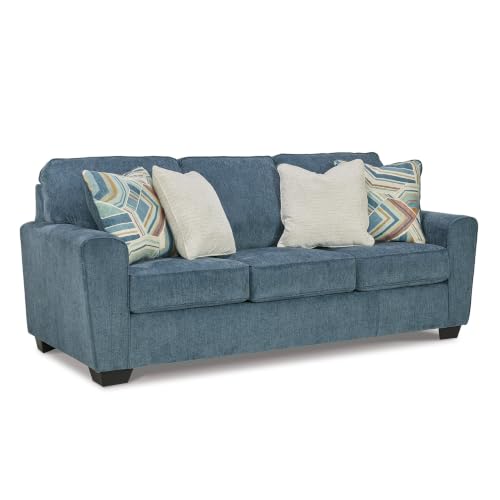
Whichever you pick, confirm the fabric name, dimensions and return terms on the live listing, then order with the confidence that comes from knowing exactly what you are getting. Here are the two picks most families end up comparing:
Living With a Family Friendly Sofas Week After Week
The first evening on a new sofa is a poor test. Cushions feel fresh, the fabric looks unmarked, and everyone sits a little more carefully than usual. With a family friendly sofas, that longer test is mostly about rhythm: how the seat feels at breakfast with a laptop, how it holds up through a long film, and how quickly it recovers after guests, children or pets have rearranged it. Pay attention to the small frictions. A cushion that needs plumping every single day is not a disaster, but it is a chore you are signing up for, and it is worth deciding in advance whether that chore fits your household or will quietly irritate you by month three.
Early on, make a point of using different seats on different days. Foam and fibre fills settle where the weight lands, so the favourite spot softens faster than the rest. Rotating seats evens that process out and keeps the whole piece feeling consistent for longer. The same logic applies to cushions you can flip or swap: if the design allows it, exchanging the left and right seat cushions every month or so is a two-minute job that pays back in even wear. None of this is complicated, but it is much easier to build the habit at the start than to correct a lopsided seat later.
Sound is another detail nobody mentions in a showroom. Frames and mechanisms that are silent in week one should stay silent, so if a creak appears, find its source early while adjustments are simple. Sometimes it is a foot that is not fully tightened, sometimes a cushion zip rubbing against the frame, and sometimes the floor itself. Work through the boring explanations first before assuming the worst. Keeping a short note on your phone of when a noise happens — turning, sitting down, getting up — makes any conversation with the seller far more productive, because you can describe a pattern instead of a vague complaint.
Measuring Again, Properly: The Route In and the Room Itself
More family friendly sofas purchases go wrong on measurements than on comfort, fabric or colour combined. The room measurement is the one everyone takes; the route measurement is the one everyone forgets. Walk the full path from the street to the final spot with a tape measure: front door, hallway turns, stairwell corners, lift doors if you have them, and any low beams or tight landings. Write down the narrowest point, not the average. Then compare that figure against the smallest dimension of the packaged piece, remembering that packaging adds bulk on every side. If the numbers are close, ask the seller before ordering whether the piece can travel on its back or side, whether feet or backs come off, and whether the delivery team will attempt a difficult turn or simply leave the box at the door.
Inside the room, tape the footprint on the floor before you commit. Painter’s tape is cheap and honest: mark the full outline, leave it down for a day, and live around it. You will quickly learn whether the coffee table still works, whether the walkway to the kitchen feels pinched, and whether doors and drawers still open fully. Sit on the floor inside the outline at the height the seat will be, and check the sightline to the television, the window and the people you will talk to. A family friendly sofas that fits the tape test almost always feels right on delivery day; one that fails it rarely grows on you.
Leave breathing room in the plan as well. A few centimetres behind the back lets curtains hang properly and keeps radiators or vents from baking the upholstery. Space at the sides makes vacuuming possible without dragging the whole piece across the floor. If the design reclines or converts, measure that extended shape too, in both directions, with someone standing where a passer-by would walk. The extended footprint is the one your shins will meet in the dark, so it deserves the same care as the closed one.
How the Picks in This Guide Differ in Daily Use
Comparison tables are good at dimensions and materials, but daily life separates these picks in subtler ways. Take What are the best sofas for families with pets and kids together?: the character described in its review above — its seat feel, its proportions, the household it suits — plays out differently on a weekday morning than on a Saturday with visitors. Set it beside How do I know if a sofa will fit through my door? and the contrast is rarely about which is better in the abstract. It is about which set of trade-offs you will notice least. A firmer seat that feels strict in week one often wins by year two, because it asks less of you in plumping and support. A softer, deeper seat wins every single evening and asks for a little more upkeep in return.
Is a sectional better than a sofa for a family? is worth a second look for a different reason: buyers often skip past it because another pick matches their first instinct, then come back to it once they think about the room they actually have rather than the room in the photograph. Re-read its section above with your tape measurements and your household in mind. If your home includes shift workers sleeping at odd hours, enthusiastic dogs, toddlers with sticky hands or a teenager who treats every seat as a bed, the practical details — cover care, cushion construction, frame feel — matter more than the silhouette. The best family friendly sofas for you is the one whose weaknesses land in places your household will never test.
A final way to choose between close picks: imagine the worst ordinary day, not the best one. It is raining, everyone is home, someone is working from the sofa, someone else is napping, and the dog has claimed the warmest seat. Which pick handles that day with the least negotiation? That mental picture is surprisingly decisive, and it tends to favour honest comfort and easy care over showroom drama. If two picks still tie after that test, choose the one with the simpler delivery, assembly and returns story, because a calm first week colours how you feel about a piece for years.
Care Routines That Actually Fit a Busy Household
Care advice fails when it asks for more discipline than a real household has. Build the routine around things you already do. When you vacuum the room, run the upholstery tool across the seats in the same pass; it takes minutes and lifts the grit that slowly abrades fabric and dulls leather. When you rotate cushions, shake them outside or by an open window rather than beating them indoors and redistributing the dust. Keep a small kit where the sofa lives — a soft cloth, a suitable cleaner for your cover type, a lint roller — because a spill treated in two minutes is a non-event, while the same spill found on Sunday evening becomes a project.
Sunlight deserves a standing rule. Direct sun fades every upholstery eventually, and it does so unevenly, which looks worse than honest overall fading. If one end of your family friendly sofas sits in a bright window, rotate the piece or the cushions seasonally, and use curtains or a throw on the exposed section during the harshest weeks. Throws are not just decoration here: they take the wear of daily lounging, they wash easily, and they let the seats underneath age at the same pace. The same thinking applies to armrests, which receive more contact than almost any other surface and benefit from a cover or throw long before they show it.
Spills follow a simple order of operations: lift, blot, then treat. Scoop or lift solids first so nothing is pushed deeper, blot liquids with a clean cloth rather than rubbing them wider, and only then use a cleaner appropriate to the cover, tested in a hidden spot. Work from the outside of a mark towards the centre to avoid spreading it. For leather and leather-look covers, keep the surface clean and conditioned according to the maker’s guidance, and keep heat sources at a sensible distance, since dry heat is a slow enemy of any coated or natural hide. Write down what worked on a note in the kit; six months later you will not remember which cloth and cleaner solved the coffee incident, and future-you will be grateful.
Troubleshooting: Small Problems and What They Usually Mean
Cushions that feel uneven in the first month are usually settling, not failing. Fills compress where weight concentrates, and a week of deliberate rotation plus firm plumping — lift, shake, and pat the cushion back into shape rather than punching it — restores most of the balance. If one seat keeps collapsing long after its neighbours have stabilised, photograph it beside an unused seat and contact the seller while the purchase is recent; a clear comparison makes the conversation simple. Pilling on woven fabrics is similarly normal early on, as loose fibres work free; a fabric shaver or a gentle pass with the upholstery tool manages it, and it slows markedly once the surface has settled.
Wobbles almost always trace back to the floor or the feet rather than the frame. Check that every foot is fully seated and tightened, then check the floor itself with a level or a marble; older floors slope in ways that make even a perfect frame rock. A thin felt pad under the short foot is a legitimate fix, not a compromise. Squeaks when someone sits down point to a joint or mechanism that needs attention; note whether the sound comes from one side, whether it happens under movement or under still weight, and whether it changes after the room warms up. That pattern separates a dry joint from a loose fixing, and both are easier to resolve early than after a season of use.
If a reclining or moving section starts to feel stiff, resist the urge to force it. Work the mechanism slowly through its full travel a few times, check underneath for anything that has migrated into the mechanism’s path — toys, blankets and charging cables are the usual suspects — and make sure the piece is sitting level, since a twisted stance binds moving parts. Keep the area under a family friendly sofas on your regular cleaning route for exactly this reason: what collects underneath does not stay harmless once mechanisms and cables live there too.
More Questions Buyers Ask About This Kind of Sofa
How long should a sofa like this realistically last?
Longevity is set more by the frame and the quality of the seat construction than by the cover, and more by your household than by the calendar. A well-built frame with honest joinery can serve through several cover refreshes, while cushions are the consumable part: expect to plump, rotate and eventually consider refill or replacement of inserts as the years pass. Households with heavy daily use will move through that cycle faster. Treat the frame as the long investment and the cushions as maintainable parts, and the piece will age gracefully instead of all at once.
Is it better to prioritise seat depth or seat height?
Prioritise the dimension your body meets first. Seat height decides how easily you sit down and stand up, which matters every single time, and it matters more with every year and for any household member with stiff knees. Seat depth decides how you lounge once you are down: deeper seats invite curling up and suit taller legs, while shallower seats keep feet on the floor and posture honest for working or eating. If the household spans both needs, look for the middle ground and use cushions and throws to tune the deep end rather than choosing an extreme that only suits one person.
What should I check in the first week after delivery?
Inspect the piece in daylight before the packaging leaves: seams, corners, feet, mechanisms and every moving section through its full travel. Sit in every seat, not just your usual one. Photograph anything that looks off, even if you decide it is acceptable, because a dated photograph settles later questions instantly. Then live with the piece normally for the rest of the week — a sofa should be tested by real evenings, not preserved like an exhibit — while keeping the paperwork and order details somewhere you can find them.
Can I make a firm sofa feel softer without replacing it?
Yes, within limits. A quality topper cushion, a throw with some loft, and back cushions arranged to shorten the effective seat depth all soften the experience without touching the structure. What you cannot do is turn a genuinely unsupportive seat into a supportive one with accessories, which is why the reviews above distinguish between firm-and-supportive and simply hard. Tune comfort at the surface first; if the underlying support is wrong for your back, that is a returns conversation to have early, not a problem to decorate over.
A Final Round of Practical Notes on the Family Friendly Sofas
Before you order, re-read the comparison section above one last time with a short written list beside you: the measurements of your space, the habits of your household, and the one or two qualities you refuse to compromise on. Purchases like a family friendly sofas go wrong when the list in the buyer’s head changes between reading and ordering — a photograph catches the eye, a feature sounds appealing, and the original priorities quietly leave the room. Your written list is the anchor. If the pick you are about to choose satisfies it, the opinions of the internet, however confident, are entitled to very little further say in the matter.
After the purchase, give the decision a fair settling period before judging it. Almost every substantial home purchase passes through a week of heightened scrutiny in which every small imperfection feels larger than it is, followed by a calmer period in which the piece simply becomes part of the home. Judge it at the end of that calmer period, on the criteria you wrote down, in the situations you bought it for. That is the honest test — and it is the same test the picks in this guide were chosen to pass: not perfection in a showroom, but dependable, repeatable satisfaction in an ordinary home, on ordinary days, for a long time.
Hosting, Guests and the Sofa as the Room’s Social Centre
A family friendly sofas rarely serves only the people who live with it. Sooner or later it hosts the film night, the visiting relatives, the neighbour who stayed for one drink and remained for three hours. Judge your shortlist partly by that social test. Can two people sit at the corner without negotiating for the same cushion? Is there a seat a guest with a bad back can use without help getting up? Does the layout invite conversation — people facing each other at least partly — or does every seat point at a screen like a row of passengers? Neither answer is wrong, but the household that entertains often should weight the social shape as heavily as the solitary lounge, because guests remember an awkward room long after they forget a beautiful fabric.
Small additions change how a sofa hosts. A side table within reach of each end removes the balancing of drinks on cushions. A spare throw folded over the back gives a chilly guest comfort without a household expedition for blankets. Cushions that can move — genuinely move, not wedged in place — let visitors tune a seat to their own body in seconds, which is the difference between a guest who settles and a guest who perches. None of these details appear in a comparison table, yet together they decide whether your living room is the one friends drift towards or the one they admire politely from the doorway.
Sleeping guests are the other honest test. Few sofas make a genuinely good bed, and this guide does not pretend otherwise, but some make a far better emergency one than others: a level seat, cushions that do not slide apart at midnight, and enough length that a tall guest is not folded. If your home regularly hosts overnight visitors, test your favourite pick against that scenario honestly — lie down on it in the showroom or during the returns window, in daylight, without embarrassment. Ten minutes of honesty then is worth more than a apologetic air mattress bought in a panic later.
Seasons, Light and Living With Colour
The room a sofa lands in changes across the year, and the piece has to hold its own in every version. In winter the sofa is a refuge: lamps are on early, throws come out, and everyone sits for longer, so seat support and the warmth of the fabric under bare hands matter more than they did in a bright showroom. In summer the same seat can feel very different — covers that breathe, colours that do not glare in strong light, and a layout that does not block the breeze from an open window all earn their keep. If you are choosing between two finalists, picture each of them in February and in July; the one that works in both pictures is usually the right one.
Colour deserves a decision made in your own light, not the shop’s. Order swatches where they are offered and live with them for several days: tape them to the sofa’s future wall, look at them in morning light, lamplight and the grey middle of an overcast afternoon. Colours shift dramatically between those conditions, and a tone that looked calm under retail lighting can turn loud at home — or the reverse. Live with the swatch beside your existing floor and curtains too, because a family friendly sofas does not need to match the room so much as it needs to belong in it, and belonging is judged against the things that are already staying.
Finally, plan for the room to evolve around the piece rather than expecting the piece to survive every redesign untouched. A sofa in a settled, confident colour can anchor several generations of cushions, throws, rugs and paint, each refresh making the room feel new while the expensive element stays put. That is the quiet economics of buying well in this category: the frame and seat you chose carefully become the constant, and the cheap, changeable layers do the fashionable work. Choose the constant with patience, and the rest of the room becomes easy.
Frequently Asked Questions
What are the best sofas for families with pets and kids together?
Look for a mid-tone, textured or smooth wipe-down surface, separate cushions and a simple frame. Of the six picks here, the Acanva faux leather sofa is the easiest to wipe, while the Calicho uses a textured fabric that hides small marks. Check the listing for fabric details.
How do I know if a sofa will fit through my door?
Measure the width of the doorway, the narrowest hallway point and any stairwell turns. Compare those against the sofa depth, width and height on the listing, then check whether the piece comes assembled or in sections.
Is a sectional better than a sofa for a family?
A sectional gives more total seating and room to spread out, but it needs more floor space. A standard sofa is easier to place and works better in narrow rooms. Many families do best with a sofa plus a chair.
Can I clean these sofas at home?
Cleaning depends on the fabric. Faux leather is usually wiped with a damp cloth, while woven fabrics may need a vacuum and a spot cleaner suited to the care tag. Always follow the maker’s own instructions.
Should I buy a slipcover or washable cover?
A cover can protect a sofa during messy years and is easy to wash. Check that the cover is made for your specific sofa dimensions, because a poor fit looks untidy and slides around.
What is the return process for a large sofa?
Large furniture often follows different return rules than small items. Open the listing, read the seller return terms and note whether pickup or restocking steps apply before you buy.
Do I need to assemble these sofas?
Many sofas ship with legs, backs or sections that attach on arrival. The listing usually says what assembly is required. Allow time for it, and keep the instructions in case you move the sofa later.
Which color is best for a busy household?
Mid-tone grays, warm taupes and deep blues tend to conceal everyday marks better than white or very dark colors. Textured fabrics help as well. Order a fabric sample if the seller offers one.
Can these sofas be matched with a loveseat or chair?
The Ashley models belong to broader product lines, so searching the same line name can turn up companion pieces. For modular sets, check the listing for add-on sections.