Best Electric Pole Saws: How to Choose a Corded or Battery Model
The best electric pole saws help remove accessible branches from the ground without carrying a separate chainsaw overhead. They combine a small powered cutting head with an extension pole, so the operator can reach above shoulder height while remaining on the ground. Corded models draw power from an outlet and can run continuously near a suitable supply. Battery-powered models move freely around a yard, but their working time depends on the battery and workload. Both types still use a moving chain and bar, and both can cause severe injury if the head, branch, pole, or nearby surroundings are not controlled.
“Electric” is often used for both corded and battery-powered pole saws. The power source changes the work setup: a corded saw needs an outlet and a safely routed extension cord, while a battery saw needs a compatible charged pack and charger. It does not change the basic pruning hazards. A branch can fall or spring, the chain can kick back, the head can bind, and long poles can become tiring or difficult to control when fully extended. A pole saw is not a license to cut directly overhead, work from a ladder, or approach power lines.
This guide focuses on electric pole saws rather than manual pole pruners or gas-powered tools. It compares corded and battery designs, extension systems, balance, cutting head position, bar and chain compatibility, maintenance, and practical limits. Our broader pole saw guide covers the overall category; this article narrows the choice to electric power. For smaller branches within arm’s reach, compare long-reach loppers or cordless hedge trimmers. For ground-level wood that exceeds a pole saw’s intended work, see our separate battery chainsaw guide.
Affiliate disclosure: DailyHomeDecorating.com may earn a commission from qualifying purchases through links in this article. This does not change the price you pay.
Amazon product examples to compare

ASIN: B0C5L18PKM

ASIN: B0FCBHMYGT
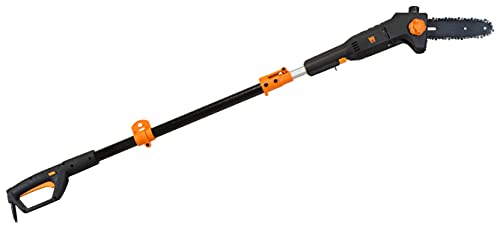
ASIN: B07DYL4JX2
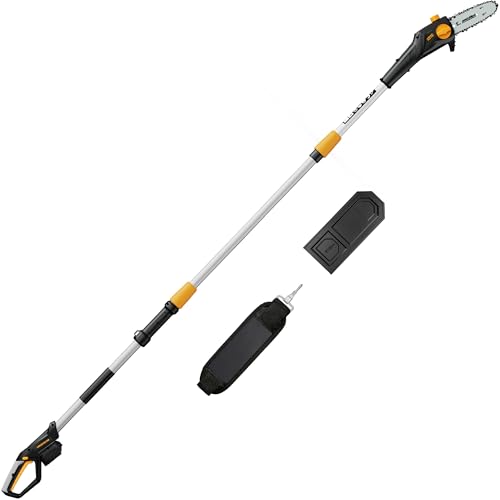
ASIN: B0FHWGB2XG
Certain content that appears on this site comes from Amazon. This content is provided “as is” and is subject to change or removal at any time. Product examples and images are supplied through Amazon Creators API; confirm specifications and availability on the current listing.
Table of contents
- What an electric pole saw does
- Corded versus battery-powered pole saws
- Reach, weight, and balance
- Extension-pole design and head adjustment
- Bar, chain, and cutting capacity
- How to choose the right electric pole saw
- Setup and safe operation
- Maintenance and storage
- Research-based selection method
- Frequently asked questions
What an electric pole saw does
An electric pole saw is a pruning saw head attached to a long shaft. Many designs use a small chainsaw bar and chain; others use a reciprocating blade or a powered lopper head. This guide is about electric pole saws with a chain-and-bar head because they are the main category commonly sold under that search phrase. Always check the actual head design in a listing and manual, since the words “pole saw” alone do not guarantee a chainsaw-style head.
A chain-style pole saw is suited to planned cuts on accessible branches that fit the saw’s limits and can fall without striking people, structures, vehicles, or utility lines. The pole keeps the operator’s hands farther from the cutting attachment and can allow ground-based trimming. It does not make every elevated limb safe. The tool has substantial leverage when extended; a modest head movement can create a large swing at the tip. The cutting head can pull or bounce as it engages the wood, and the branch can move as fibers release.
It can be useful for routine pruning of smaller limbs, clearing branches from a walkway, removing deadwood that is within a safe reach envelope, or cutting back growth that is not under significant tension. It is not appropriate for felling a tree, cutting a hung-up limb, working from an unstable ladder, cutting over a roof or road, or approaching an electrical line. Those jobs need trained professionals and specialized equipment.
Electric saw head or powered lopper?
Some products are called pole saws even though the cutting mechanism is a bypass lopper or reciprocating blade rather than a chain. A powered lopper closes two jaws around a branch. A reciprocating pole saw uses a narrow blade that moves back and forth. A chainsaw pole pruner moves a chain around a guide bar. Each has different cut speed, branch handling, maintenance, and pinch behavior. Verify the product type before comparing specifications.
If your branches are small enough for a lopper, a manual or powered lopper may be more controlled and simpler to maintain than a chain head. If you need fine cuts around shrubs, a hedge trimmer is a different tool; it is not meant for thick limbs. For a broad comparison of pruning equipment, see the site’s guides to loppers and hedge trimmers.
Corded versus battery-powered pole saws
Corded electric pole saws
A corded saw uses an outlet and extension cord when needed. It can make sense for a small yard or a work area where an appropriate outlet is close enough to keep the cord behind the operator and away from the branch, chain, pole, water, sharp edges, and foot traffic. Continuous power can be convenient during a longer session, but cord management becomes part of every cut. A pole moving through branches can snag the cord, pull it toward the head, or bring the operator off balance.
Before buying, determine the saw’s electrical rating and follow its manual for extension-cord type, gauge, and maximum length. Do not guess from a generic chart. The cord must be suitable for outdoor use when required, undamaged, and routed so it cannot contact the chain. Keep plugs and connections dry, and do not use a corded pole saw in rain, standing water, or conditions prohibited by the manufacturer. If the safe cord route is awkward or crosses the work zone, choose another power format rather than improvising.
Some corded designs combine a detachable chainsaw head with an extension pole so the head can also be used as a handheld saw. A two-in-one arrangement can save storage space, but each configuration has different handling and safety instructions. Use the head only in modes approved by the manufacturer, and do not remove a pole or guard in a way that exposes a hazard.
Battery-powered pole saws
A battery-powered pole saw has no trailing power cord, which can make movement around the yard simpler. It can be helpful when branches are far from outlets or when a cord would repeatedly snag on shrubs. Runtime depends on battery capacity, charge condition, wood species, branch diameter, chain sharpness, and how often the saw is triggered. The battery system also adds weight at the power head or rear of the tool, depending on the design.
Check whether the listing includes a battery and charger or sells the pole saw as a bare tool. Confirm that the battery is approved for that exact model and that replacements remain available. A compatible battery from the same brand family is not automatically compatible with every tool. Follow the battery and charger manuals for storage, temperature, and charging.
Battery convenience does not make a pole saw safe near a power line. The pole, branch, or operator can still contact a conductor. Battery tools also need regular chain lubrication, tension checks, and cleaning. Compare weight with the battery installed, not just the bare-tool number.
What changes and what does not
Corded and battery saws differ in electrical setup, mobility, weight distribution, and operating time. Their shared risks include chain contact, kickback, falling or springing branches, overhead hazards, and fatigue from holding an extended pole. Choose the power source around the property layout, then evaluate the reach and handling independently. Do not treat one power source as a safety substitute.
Reach, weight, and balance
Reach is not the same as safe working height
Manufacturers may describe a pole saw by the pole length or an estimated reach. These are not the same as the height of a branch that every user can cut safely. Reach estimates depend on operator height, grip position, stance, extension configuration, head angle, and how much control remains with the pole fully extended. A longer pole can increase leverage and fatigue, and it may be harder to position accurately.
Think about the branches you can access while standing on stable ground with the pole at a manageable angle. If the head can reach a limb only when you raise the pole vertically overhead, lean backward, or stand on a ladder, that limb is outside a safe homeowner work zone. OSHA’s tree-care inspection guidance notes the electrical hazard when tools, workers, or branches contact overhead power lines. Keep pole saws and branches well away from lines and call the utility or a qualified arborist for work near them.
Weight at full extension
Weight on a pole feels different from weight held close to the body. The farther the head is from your hands, the more leverage it creates. A saw that feels light at waist height can become tiring when extended. Pole material, battery location, saw head, and shoulder strap all affect balance. A shoulder strap may distribute some weight but does not support the head or make an unstable stance safe.
Compare weight in the actual operating configuration: bar and chain installed, battery attached if applicable, oil added, and extension sections fitted. If possible, hold a display unit in a two-handed grip without starting it. Check whether you can keep the head positioned without locking your elbows or leaning into the pole. If the tool feels hard to control at the intended reach, select a shorter configuration, use a manual pruner for smaller limbs, or hire a tree professional.
Balance and handle layout
Some saws place the motor and battery near the cutting head; others use a rear-mounted motor with drive transmission along the shaft. A front-heavy design can place more load at the tip. A rear motor can shift weight toward the operator but may increase shaft complexity. There is no universally best balance because user strength, reach, pole angle, and branch location differ.
Look for secure grips, a positive trigger lockout, clear controls, and a strap attachment if the manufacturer provides one. Confirm that the switch can be released quickly while holding the pole in the approved position. Keep both hands on the designated handles. Do not hold the shaft at a point that the manual does not identify as a grip area.
Extension-pole design and head adjustment
Fixed, sectional, and telescoping poles
A fixed pole has a set length and can be simple to use, but may be less convenient to store or transport. A sectional pole adds or removes segments. A telescoping pole adjusts length with a lock or collar. Each design needs secure connections that do not slip under cutting load. Read the manual for the assembly sequence and minimum or maximum extension limits.
Sectional and telescoping systems let you choose a working length for each task. A shorter setup can improve control and reduce leverage. Fully extending the pole for every cut is rarely necessary. Lock every collar, clamp, pin, or coupling before use and inspect for cracks or looseness. Do not extend beyond the marked limit or modify a section to gain extra reach.
Cutting-head angle
An adjustable head can help align the bar with a branch while keeping the shaft at a more manageable angle. This is useful only if the adjustment locks securely and the manual permits that configuration. More joints can mean more places to inspect. Check that the head cannot rotate unexpectedly under load, and do not adjust it while the chain is moving.
Before cutting, position yourself so the bar is not directly over your body and the branch can fall in a clear direction. Avoid cuts that force the head to bind against the trunk or require you to stand under the branch. If a cut cannot be lined up while maintaining a stable stance and clear escape path, do not attempt it.
Transport and storage
Some poles separate into sections, while telescoping designs collapse. Verify that disassembly does not expose a live battery connection, loose chain, or unprotected cutting head. Fit the bar sheath before transport. Store poles where they cannot fall onto people or block an exit. Keep cords loosely coiled, not sharply bent, and disconnect the tool from power before storage or service.
Bar, chain, and cutting capacity
Bar length and branch size
The guide bar length helps describe the cutting head, but it does not establish the maximum branch size that every user can cut safely. A branch may be larger than the bar yet still require a multi-step method that is inappropriate for an inexperienced user. A long bar also adds head weight and exposes more chain. Choose a saw whose manual covers the branch sizes and methods you expect to use.
For a homeowner, it is usually wiser to choose a saw for manageable routine branches than to buy a longer bar for large limbs. If the branch diameter, position, or weight makes it hard to predict where the limb will go, a trained arborist is the safer choice. Never use a pole saw to fell a tree or remove a heavy limb suspended over a building.
Bar and chain compatibility
Bar and chain are a matched system. The chain pitch, gauge, drive-link count, bar mount, sprocket, and saw model must be compatible. A chain that looks close may not fit or may run incorrectly. Use the exact manufacturer part number or a replacement explicitly identified as compatible with the model. Do not fit a longer bar or different chain to increase capacity unless the manufacturer approves that combination.
Chain tension and lubrication are essential. A loose chain can derail; an overtight chain can increase friction and wear. Check tension only with the saw disconnected and when the chain is at the temperature described by the manual. Automatic oiling does not remove the need to inspect the reservoir and verify oil delivery according to the maker’s procedure.
Chain type and sharpness
Some chains are designed to reduce kickback tendency, but no chain eliminates kickback. Follow the manufacturer’s recommendation and do not remove or alter safety features. A sharp chain cuts more predictably than a dull one and should not require forceful pushing. If it produces fine dust rather than normal chips, pulls to one side, smokes, or cuts slowly, stop and inspect it after disconnecting power.
Sharpening requires the correct file size and angles. If you do not know the chain specification, have a qualified dealer service it. Do not sharpen or adjust a chain while the tool is connected to power or while the battery is installed. Wear suitable cut-resistant gloves when handling a stationary chain and follow the manual’s procedure.
How to choose the right electric pole saw
Match the tool to the yard
Measure the distance from your normal standing area to the branches you plan to remove. Note obstacles such as fences, roofs, wires, shrubs, and neighboring property. The safe working area is smaller than the tool’s maximum reach. If branches are close to power lines, are above a roof, or require cutting from a ladder, do not solve the problem by buying a longer pole.
Consider how often you will use the saw. Occasional pruning may not justify a heavy-duty or maximum-reach tool. A larger yard may make cord management inconvenient and favor a battery model. A small yard with branches near an outlet could suit a corded option, provided the extension cord can stay clear of the work. Include the storage space for the pole and sheath.
Compare corded and battery costs
With corded tools, account for a manufacturer-approved outdoor extension cord, the correct gauge and length, and a safe route. A too-long or undersized cord can cause voltage drop and overheating. With battery saws, account for the battery and charger if they are not included, along with replacement availability. Do not compare a bare-tool price with a complete kit as if the packages were identical. Prices and availability change, so verify current package details directly.
Check adjustment and trigger controls
Read the manual before deciding that a feature is convenient. A trigger lockout should help prevent accidental start, not complicate a quick release. Pole locks should be easy to inspect and should hold against movement. Head-angle controls should not require a hand near the chain. If you cannot understand how to lock the extension, choose another model or ask the manufacturer for clarification.
Inspect the tool’s safety documents
Verify the saw’s complete model number, manual, chain and bar parts, electrical requirements, and any safety certification stated by the manufacturer. A retailer title may omit a recall, revision, or model suffix. Check the manufacturer’s support page for current manuals and safety notices before purchasing or using an older unit. In 2025, the CPSC announced a recall covering identified serial-number or manufacturing-date ranges of certain corded chainsaws and pole saws because a switch could fail; see the official CPSC recall notice and check the exact model and serial number if you own a potentially affected tool. The notice applies to specified units, not automatically every saw from a brand.
Setup and safe operation
Read and follow the complete owner’s manual. For a corded model, plan the power source and cord path before extending the pole. For a battery model, install only a compatible, charged battery as directed. Wear the personal protective equipment specified by the manufacturer, including eye and hearing protection and appropriate leg, foot, hand, and head protection for the task. Keep bystanders and pets well outside the drop zone.
OSHA’s tree-care inspection guidance notes that workers, tools, equipment, or branches can contact energized overhead lines. Do not use an electric pole saw near power lines, and do not approach a branch entangled with a line. Contact the utility or a qualified tree-care professional. A pole saw is not insulated against electric shock just because it has a plastic shaft or runs on a battery.
Pre-use checks
- Inspect the housing, trigger, lockout, pole sections, clamps, head joint, bar, chain, sheath, and fasteners.
- For corded saws, inspect the cord and plug for cuts or exposed conductors and verify the extension cord against the manual.
- For battery models, inspect the pack and contacts; do not use a swollen, cracked, wet, or damaged battery.
- Confirm the bar and chain match the model, are installed in the correct direction, are tensioned as instructed, and are lubricated.
- Identify the branch’s weight, supports, tension, and likely fall direction; remove people and property from the drop zone.
- Check for power lines, utility wires, roofs, fences, windows, and other hazards around the full pole path.
- Set the pole to the shortest length that safely reaches the branch and lock every joint.
- Choose stable footing and a position that lets you keep both hands on the designated grips.
Keep the pole and chain away from power lines
Maintain a generous distance from all overhead electrical lines. Do not estimate clearance by eye or assume a line is insulated. Branches touching a line may also be energized. If a limb is near or caught in wires, keep people away and contact the utility. Never maneuver a long pole, cord, or branch around a line.
OSHA accident records document fatal incidents involving pole saws or tree limbs contacting power lines. These reports are reminders that a pole extends the operator’s reach and can bring a conductive or non-insulated tool into a hazard zone. This article is not a substitute for line-clearance training or utility instructions.
Choose a safe branch and stance
Work only on branches that are stable, visible, and within the saw’s instructions. Stand to the side of the branch’s fall path, not underneath it. Do not make a cut directly overhead. Keep the saw head where you can see it and retain control of the pole without leaning or stretching. If you need to step onto a ladder, roof, or unstable slope to reach a limb, stop and hire a qualified professional.
Branches under tension can spring when released. A limb may also rotate, fall toward the operator, or trap the bar. Do not cut a heavy limb whose support or tension you cannot assess. Use a trained arborist for large, dead, split, hanging, storm-damaged, or high branches. Do not work alone when the task could leave you injured without help.
Control cord and extension pole
On corded models, keep the cable behind you and well away from the cutting head. Use only extension cords that meet the manual’s outdoor rating, length, and gauge requirements. Do not use a damaged cord, run it through water, or place it where the branch can fall on it. Stop and unplug before moving the cord or changing the pole configuration. Avoid looping the cable around your body or the shaft.
Before switching on, ensure the chain is not touching a branch, the ground, or another object. Hold the tool with both hands in the designated positions, start it as described by the manufacturer, and let the chain reach its intended operating condition before engaging the wood. Do not force the bar or twist the pole to widen a cut. If the chain binds, release the trigger, disconnect power, wait for the chain to stop, and reassess the branch.
Keep the cut controlled
Follow the model’s cutting procedure. Some manuals describe a first cut on the underside of a branch to reduce bark tearing, followed by a cut from above. That sequence is not universal and does not make a large or tensioned branch safe. Use only the method and branch size permitted by the manual. Position the head so the branch can fall freely, and do not cut so close to the trunk that the bar becomes trapped.
After a cut, release the trigger and wait for the chain to stop before lowering or repositioning the tool. Keep the head pointed away from people while moving. Do not carry the saw by its cord. Use the sheath for transport and disconnect the battery or plug before assembly, cleaning, or maintenance.
Maintenance and storage
Unplug a corded saw or remove the battery before cleaning, tension adjustment, chain replacement, or storage. Follow the manual for cleaning the bar groove, oil ports, sprocket cover, and vents. Remove sawdust and resin with an approved method; keep liquids away from the motor, switch, battery contacts, and electrical connections. Do not use a pressure washer.
Check chain tension at the temperature and frequency specified by the manufacturer. Inspect cutters, drive links, bar rails, sprocket, and chain catcher for wear or damage. Use the correct chain oil and verify oil delivery using the maker’s procedure. Empty or store oil as directed if the saw will sit for an extended time. Bar and chain parts must match the exact model; similar-looking components may not be compatible.
Inspect extension-pole locks, clamps, pins, and joints for movement or cracks. Tighten only as the manual specifies. On corded tools, inspect the full cord and plug before each use and replace damaged equipment through an authorized service channel. On battery tools, store the pack and charger within their specified temperature and moisture limits. Do not leave a battery in a hot vehicle or near the cutting head.
Fit the bar cover, shorten or separate the pole as directed, and store the tool where children cannot reach it. Keep it dry and secure so it cannot fall. A saw that has been dropped, exposed to water, or shows unusual vibration, noise, heat, oil leakage, or switch behavior should be removed from use and inspected by a qualified technician.
Research-based selection method
This guide compares electric pole saws by design and documented use rather than claiming hands-on testing. The selection method is to verify the actual power source, pole configuration, model-specific reach information, total operating weight, approved bar and chain, extension locks, lubrication method, cord or battery requirements, and safety devices using official manufacturer manuals and product documentation. For example, the WORX corded pole-saw manual identifies components such as the extension-cord holder, pole locking collar, chain tension control, and oil system; these details are model-specific and should not be assumed for other brands. A battery model’s manual may specify a different battery, extension assembly, and service procedure.
Safety guidance is checked against OSHA material on chainsaw operation and tree-care electrical hazards, together with current CPSC recall notices. OSHA’s chainsaw safety guidance calls for following manufacturer instructions, checking safety devices, planning cuts, maintaining a firm grip and footing, avoiding overhead cutting, and working within the operator’s skill level. Those practices are especially important for a pole tool because the extended shaft adds leverage and the operator may be tempted to reach beyond a stable position.
To build your own shortlist, compare complete model numbers and manuals rather than relying on search snippets. Record cord length and gauge instructions for corded saws; battery, charger, and compatibility for cordless tools; operating weight; pole length and lock design; permitted bar and chain; oiling method; and safety notices. Verify the exact serial or date code for a product recall when applicable. No prices, lab tests, or field-test rankings are asserted here.
Frequently asked questions
Are corded electric pole saws better than battery models?
Neither is best for every yard. Corded models can run continuously near a suitable outlet, but the cable must stay away from the cutting head and work area. Battery models move freely but have runtime and battery-system considerations. Choose based on yard layout and safe work position.
How much reach do I need?
Choose a reach that covers branches you can cut from a stable position with the pole at a manageable angle. A manufacturer’s reach estimate is not the same as a safe cutting height for every user. If you need to stand under a branch, use a ladder, or fully extend the pole awkwardly, the job is outside a safe homeowner setup.
Can I use an extension cord with a corded pole saw?
Only if the manual permits one and specifies the cord type, outdoor rating, wire gauge, and length. Route it behind you and away from the chain and falling branch. Do not use damaged cords, wet connections, or a cord route that crosses the cutting zone.
Can an electric pole saw cut thick branches?
Use only the branch sizes and cutting methods allowed by the exact saw manual. Bar length alone does not establish a safe diameter. Large, heavy, high, or tensioned limbs can move unpredictably and should be handled by a qualified arborist.
What chain fits my pole saw?
The compatible chain depends on the exact model and bar. Pitch, gauge, drive links, mount, and sprocket must match. Check the manufacturer’s part number or compatibility chart rather than choosing by bar length alone.
Can I use a pole saw near power lines?
No. Keep the pole saw, cord, branches, and operator well away from overhead lines. Do not cut a branch touching or near a wire. Contact the utility or a qualified tree-care professional for that work.
Do electric pole saws need chain oil?
Chain-and-bar models typically require lubrication, but use the oil and filling procedure specified by the manufacturer. Check the reservoir and oil delivery before cutting. Do not use the saw with a dry chain or substitute unapproved fluid.
What should I check before buying a used pole saw?
Check the full model and serial number against current recall notices; inspect the switch, guards, pole locks, cord or battery, bar, chain, oiling system, and parts availability. Do not buy or use a recalled unit until the official remedy has been completed. Ask for the manual and verify that the saw starts, stops, and locks correctly only if you can test it safely.
Is a shoulder strap enough to make a long pole saw manageable?
No. A strap can distribute some load but cannot control a falling limb, prevent kickback, or make an unstable stance safe. Compare the saw’s balance at the required extension and follow the maker’s strap and grip instructions.
Final thoughts
The best electric pole saws for your work are the ones that reach only as far as you can safely control, match the branch sizes you actually prune, and fit the power source available in your yard. Corded models require careful extension-cord routing; battery models require compatible packs and realistic runtime planning. In either case, total weight, balance, pole locks, head angle, bar and chain compatibility, and service support deserve attention.
Before every cut, inspect the tool and branch, keep people out of the fall zone, and plan how the wood will move. Never cut near power lines, directly overhead, from an unstable ladder, or beyond the saw’s instructions. Maintain a sharp compatible chain, correct tension, and working lubrication. If the branch is large, high, unstable, or difficult to assess, hire a qualified arborist rather than trying to solve a reach problem with a longer pole.