Amazon product examples to compare

ASIN: B013XR6W26View on Amazon

ASIN: B0098ZSOX8View on Amazon

ASIN: B000O89BCQView on Amazon
Certain content that appears on this site comes from Amazon. This content is provided “as is” and is subject to change or removal at any time. Product examples and images are supplied through Amazon Creators API; check the current listing for specifications and availability.
As an Amazon Associate, DailyHomeDecorating.com earns from qualifying purchases.
Every boat takes on some water. Rain, spray, a dripping shaft seal, and washdown water all find their way to the lowest point inside the hull — the bilge — and something has to move that water back overboard. That something is the bilge pump, and its real job only becomes obvious on the worst day: when a fitting fails, a hose splits, or a storm fills the cockpit faster than drains can clear it. A well-chosen system handles routine water automatically for years; a neglected or undersized one fails quietly, usually discovered by stepping into ankle-deep water.
Shopping for the best bilge pumps is therefore not about a single headline number. It is about capacity matched to your boat, a switch that actually turns the pump on when you are not aboard, plumbing that does not throw away the pump’s output, and wiring that survives a damp, corrosive environment. This guide works through each decision in plain terms, without rankings or invented test results, so you can build a short list that fits your boat.
What to Look for First
Start with the boat, not the box. Its type, where it is kept, how much water it normally collects, and whether it stays in the water unattended all shape what a sensible setup looks like.
Flow Rate and Real-World Capacity
Bilge pumps are rated by flow, usually in gallons per hour. The printed rating describes the pump under near-ideal conditions: little or no lift and no restrictive plumbing. Your installation is never ideal. The pump has to lift water from the bilge up to a discharge fitting above the waterline — a vertical rise called head — push it through hose and fittings, and do all of that on battery voltage that may be well below the level used in a catalog test.
Each factor reduces output, and together they can cut delivered flow dramatically compared with the rating. That is not a flaw in any particular pump; it is physics. The practical response is to size generously: choose rated capacity comfortably above what routine water requires, use smooth, correctly sized hose, keep the run short, and remember that in a genuine flooding emergency, no single small electric pump keeps up with a large hole for long. Capacity buys time — time to find the leak, slow it, and get help.
As a general approach, small open boats need enough capacity for rain and spray, boats kept on the water need automatic handling of steady leaks and storm water, and larger boats justify larger pumps, often more than one. Think in terms of the worst plausible inflow, not the driest normal week.
Head Height and the Discharge Path
Head is mostly the vertical distance from the pump to the discharge outlet, plus the resistance of everything in between. Corrugated hose, sharp elbows, undersized fittings, and a check valve all add resistance. Corrugated hose in particular can rob a surprising amount of flow, which is why smooth-bore hose is the better choice.
Route the discharge so water leaves the boat above the normal waterline and cannot siphon back in. On many boats that means a vented loop at the high point of the run, especially where the outlet sits low or the boat heels under sail. Keep the run short, smooth, and steadily rising, and avoid low sags where water sits and adds resistance.
Power Draw and Battery Reality
A bilge pump is only as good as the battery behind it. Automatic pumps run when nobody is aboard, drawing from the battery bank for days or weeks between visits. Consider the pump’s current draw, how often it will cycle, the health of your battery, and whether shore power or a solar panel keeps it topped up. A boat on a mooring with a small, aging battery needs a conservative setup and regular checks.
Wiring matters as much as the battery. Voltage drop in long, thin, corroded wire starves the pump and cuts output further. Use marine-grade tinned wire of adequate gauge, sealed connections kept high out of bilge water, and a fuse sized as the manufacturer directs, close to the power source. An unprotected circuit in a wet bilge is both a failure risk and a fire risk.
Materials and Build Quality
The bilge is a hostile place: standing water, oil residue, heat, and constant vibration. Look for a housing that resists impact and chemicals, corrosion-resistant hardware, and a strainer base that keeps debris away from the impeller. A base that snaps off for cleaning without tools is a genuine advantage, because a pump you can clear in a minute actually gets cleared.
Check the float switch or sensor with the same care. Switches live submerged, cycle thousands of times, and are a leading cause of bilge system failure when they jam. Whatever design you choose, you should be able to reach it, test it by hand, and replace it without removing half the boat.
Types of Bilge Pumps Explained
Submersible Centrifugal Pumps
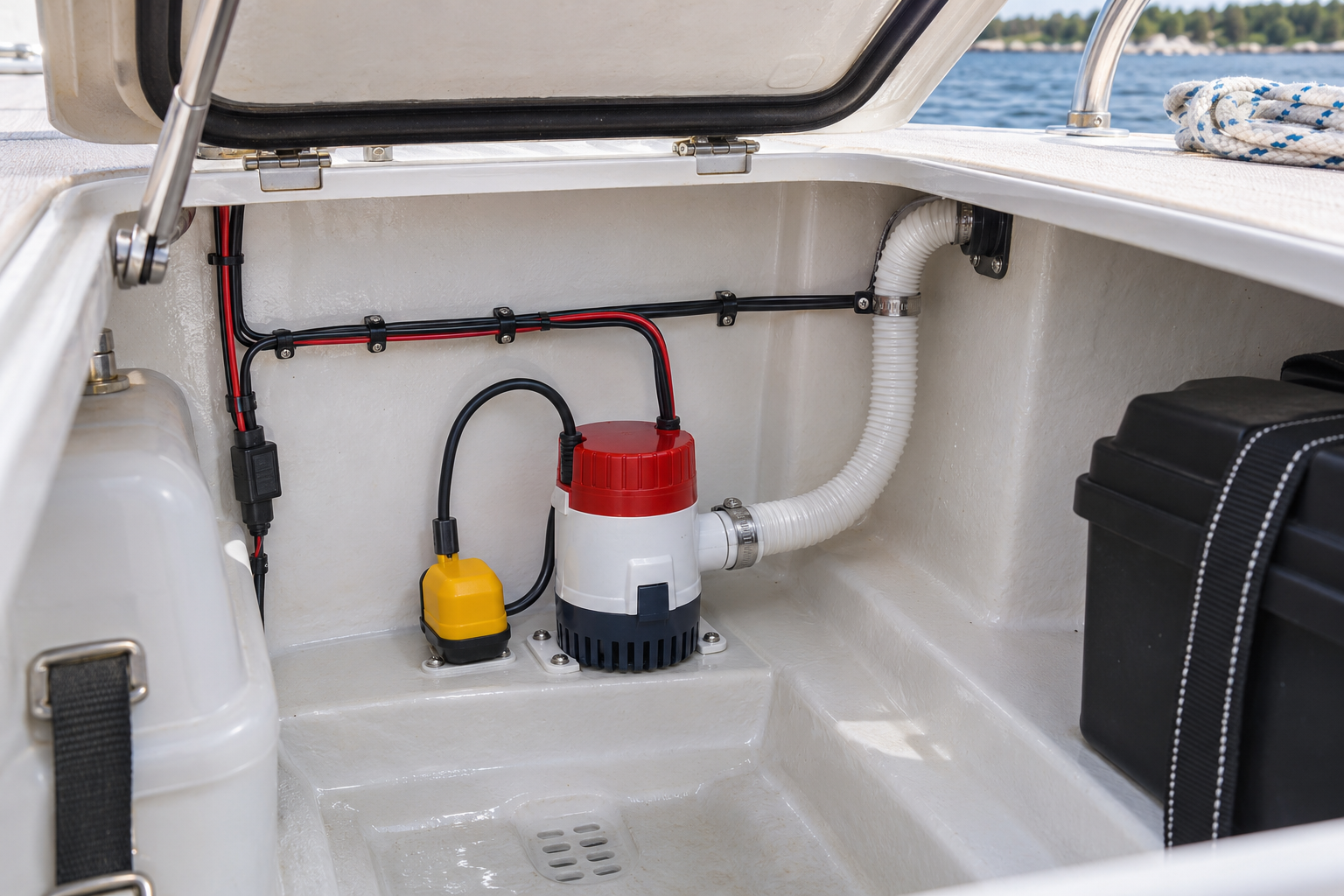
The standard electric bilge pump is a compact submersible centrifugal unit that sits at the lowest point of the bilge. It is simple, easy to install, and available in a wide range of capacities. Its limits define its role: it leaves a shallow layer of water behind on each cycle, and its real output falls quickly with lift and hose resistance. For routine rain and minor leaks it is the workhorse of most boats — one layer of defense, not the only one.
Automatic Pumps With Built-In Switches
Some pumps integrate the water sensor inside the housing. These simplify installation and suit tight bilges where a separate float switch is awkward. The trade-off is that if the sensing side fails, you may be replacing the whole unit, and some electronic designs draw a small amount of power as they check for water periodically. Read what a design draws at rest before choosing it for an unattended boat.
Manual Pumps
A fixed manual pump, worked by a handle from the cockpit or cabin, moves a meaningful amount of water with no electricity at all. That independence is its value: in a flooding event that has killed the batteries, the manual pump still works, paced only by the person pumping. Many owners treat it as essential backup on larger boats, and a portable hand pump or sturdy bucket remains worthwhile on any boat.
Diaphragm and High-Capacity Specialty Pumps
Electric diaphragm pumps can be mounted above the bilge with a pickup hose reaching down into it, keeping the motor out of the water and pulling the bilge lower than a centrifugal pump can. They suit boats that want a drier bilge, at the cost of more plumbing and typically lower peak flow. For most recreational boats, the realistic emergency plan is layered electric capacity plus a manual backup.
Key Features That Actually Matter
The Float Switch Decision
How the pump switches on matters as much as the pump. A traditional mechanical float switch rises with the water and activates the pump, then shuts it off as the level falls. It is simple and draws no standby power, but it can jam if debris wedges under it. Electronic switches have no moving float to jam and fit tight spaces, but some draw a small standby current. Whichever you choose, install it slightly above the pump’s intake so the pump does not run dry, and test it regularly.
Manual Override
Every automatic installation should include a manual override at the panel — a switch that lets you run the pump on demand. You will use it to clear the last water after a washdown, to check in seconds that the pump runs, and to respond the moment you see water where it should not be. An indicator light showing when the pump runs doubles as an early warning that the system is cycling unusually often — often the first sign of a developing leak.
Anti-Flooding Details: Check Valves and Alarms
A check valve stops water in the hose from running back into the bilge when the pump stops, which reduces rapid re-cycling. It also adds resistance and can clog, and many experienced installers avoid them on primary pumps for that reason, preferring correct hose routing to manage runback. Weigh the trade-off rather than adding one automatically. A high-water alarm, by contrast, is an almost pure win: a sensor mounted above the normal level that sounds when water rises beyond what the primary pump is handling, turning a silent failure into a loud one while there is still time to act.
Strainer, Mounting, and Service Access
Look for a strainer base that keeps the intake clear of debris and a mounting you can secure firmly so the pump cannot tip. Plan the installation so pump and switch can be reached and cleaned without dismantling joinery; if service requires heroics, service will not happen.
How to Choose by Use Case
Small Open and Trailered Boats
A modest automatic pump covers rain and spray for boats that also spend time on a trailer with the drain plug out. Prioritize simple wiring direct to the battery through a proper fuse, a switch you can test in seconds, and a discharge routed safely above the waterline.
Boats Kept in a Slip or on a Mooring
Unattended boats live or die by automation and battery health. Choose capacity with real-world losses in mind, an automatic switch you trust, and a charging arrangement that replaces what the pump consumes. On a mooring without charging, be conservative about standby draws and test the system often. A high-water alarm is worth serious consideration for any boat left in the water.
Larger Boats and Multiple Bilge Areas
Bigger boats have divided bilge spaces that do not share water freely, so one pump in one compartment does nothing for a leak in another. Plan a pump for each significant watertight area, with the largest capacity protecting the area with the most through-hull fittings. Many owners fit a smaller everyday pump set low for routine water and a larger pump mounted slightly higher, so the big pump only runs when inflow exceeds the small pump’s capacity.
Sailboats
Sailboats add heel and a deep, narrow bilge around the keel. Choose pumps and switches that fit the narrow space and keep working at angles of heel, route discharge with a vented loop so heeled sailing cannot siphon the sea back in, and expect a thin layer of water that a sponge finishes off.
Safety on Board
Bilge work is electrical work in a wet, fuel-adjacent space, so treat it with respect. Disconnect battery power before wiring, and remember that the automatic circuit normally stays live even with the main battery switch off — deliberate, so the pump can protect the boat unattended — so verify a wire is truly dead before cutting it. Fuse the circuit as directed, near the source. Keep connections out of standing water, use only marine-grade components, and seal every splice, because a corroded connection is the most common reason a sound pump does nothing.
Gasoline-powered boats demand extra care: any electrical device in an engine or bilge space must be ignition-protected, so sparks cannot ignite fuel vapor. Never install automotive parts in those spaces. Finally, never discharge oily bilge water overboard; it is harmful and illegal in most waters. Use absorbent pads to lift oil out, dispose of them properly ashore, and fix the leak.
Installation Tips That Prevent Problems
Mount the pump at the true low point of the bilge, secured firmly to a clean, flat surface so it cannot tip. Fit the switch nearby, slightly higher than the pump intake, with room to operate freely. Wire the automatic circuit directly to the battery through its fuse, so turning off the boat’s main switch does not disable your flood protection, and wire the manual override through the panel as the instructions describe.
Run smooth-bore discharge hose of the size the pump specifies, rising steadily to a fitting above the waterline, with a vented loop where back-siphoning is possible. Avoid corrugated hose and sagging runs. Before you close everything up, test with real water: pour water into the bilge and watch the switch activate, the pump run, and the discharge flow strongly overboard, then confirm the pump shuts off without short-cycling and the manual override works.
Care and Maintenance
Bilge pumps fail from neglect far more often than from defects. Every month or so — and before any period away from the boat — activate the float switch to confirm the pump runs, pour in enough water to run a full cycle occasionally, and clear the strainer and the area around the switch of debris. Check that the discharge outlet is not blocked by growth or a wasp nest, a mundane failure that is surprisingly common on laid-up boats.
Inspect wiring for corrosion and chafe, and keep the bilge reasonably clean and oil-free so switches sense water rather than sludge. Exercise a manual pump occasionally so its diaphragms stay supple. Note how often the automatic pump cycles between visits; a sudden increase is the boat telling you a leak is developing. Listen early, when the fix is a hose clamp rather than a salvage claim.
Common Mistakes to Avoid
The most common mistake is believing the rating on the box. A pump chosen by its headline gallons per hour, then installed on a long corrugated hose lifting several feet, on thin wire from a tired battery, may deliver a fraction of that number when it matters. Size for the installed reality, not the catalog.
Other frequent errors include wiring the automatic circuit through the main battery switch so protection vanishes when the boat is shut down; mounting the float switch where debris or stored gear can jam it; skipping the fuse; and using automotive wire and unsealed crimps that corrode within a season. Owners also neglect redundancy — one pump, one switch, one aging battery is a chain of single points of failure on a boat that sits unattended. Finally, many skippers never test the system with real water until the day it fails. Ten minutes with a bucket, a few times a year, prevents most bilge surprises.
Frequently Asked Questions
How big a bilge pump does my boat need?
Choose by worst-case thinking rather than by the driest week you can remember. Consider the boat’s size, how it is kept, and how many fittings could leak, then select rated capacity well above routine needs, knowing real output will be lower once lift, hose, and voltage losses apply. Larger boats kept in the water usually justify larger pumps, and more than one.
Should I choose an automatic or a manual bilge pump?
For most boats, both. An automatic electric pump handles routine water and protects the boat while you are away, while a manual pump provides backup that works when electrical power does not. A boat that is only ever used attended and trailered after each outing is the main case where a simpler setup may be enough.
Why does my bilge pump run but move little water?
Likely causes are a clogged strainer or impeller, a kinked or corrugated discharge hose, too much lift, low voltage from thin or corroded wiring, or a blocked outlet. Work through them in that order — intake, plumbing, power — before concluding the pump itself has failed.
Where should a bilge pump discharge?
Through a dedicated fitting above the normal waterline, by the shortest smooth route practical, with a vented loop where siphoning back is possible. It should never discharge below the waterline without proper anti-siphon protection, or be teed into another drain in a way that lets water flow back into the boat.
How often should I test my bilge pump and float switch?
Test the switch and run a real water cycle at least monthly in season, before leaving the boat unattended, and after any work in the bilge that might have disturbed wiring or left debris behind. Testing takes minutes and is the cheapest insurance on the boat.
Can one bilge pump protect the whole boat?
Only if all bilge water can actually reach it. Many boats have separate compartments divided by bulkheads, and water in a sealed-off area cannot flow to a distant pump. Each significant watertight area needs its own pumping arrangement, and a high-water alarm adds a second layer of warning.
Bilge Pump Models to Compare
- Rule 27DA: A 12 V standard bilge pump listed at 1,100 GPH; it requires a suitable float switch or panel switch for automatic operation. Search Amazon by exact model · Xylem model table.
- Rule 27SA: The automatic 12 V version in the 1,100 GPH class. Search Amazon by exact model · Xylem automatic model table.
Rated flow is not the same as installed flow; account for lift, hose diameter, wiring, and discharge routing.
Conclusion
The best bilge pumps are not the ones with the biggest number on the box. They are the ones sized honestly for installed conditions, switched on reliably when you are not there, plumbed through smooth hose to a safe discharge, wired with marine-grade materials and proper fusing, and backed up by a manual option and a high-water alarm. Build the system in layers, test it with real water on a schedule, and keep the bilge clean enough for switches and strainers to do their jobs. Shortlist a few pumps that fit your boat and the way you keep it, and choose the setup you will actually maintain.