Amazon product examples to compare

ASIN: B0013H94MOView on Amazon

ASIN: B07GJXRZ1VView on Amazon

ASIN: B0GJ43DPB8View on Amazon
Certain content that appears on this site comes from Amazon. This content is provided “as is” and is subject to change or removal at any time. Product examples and images are supplied through Amazon Creators API; check the current listing for specifications and availability.
As an Amazon Associate, DailyHomeDecorating.com earns from qualifying purchases.
A sump pump tends to fail at the worst possible moment, for a simple reason: the storm that fills your sump pit fastest is also the storm most likely to knock out your power, strain an aging pump, or overwhelm a single unit. A primary pump alone, however good, is a single point of failure standing between your basement and a flood.
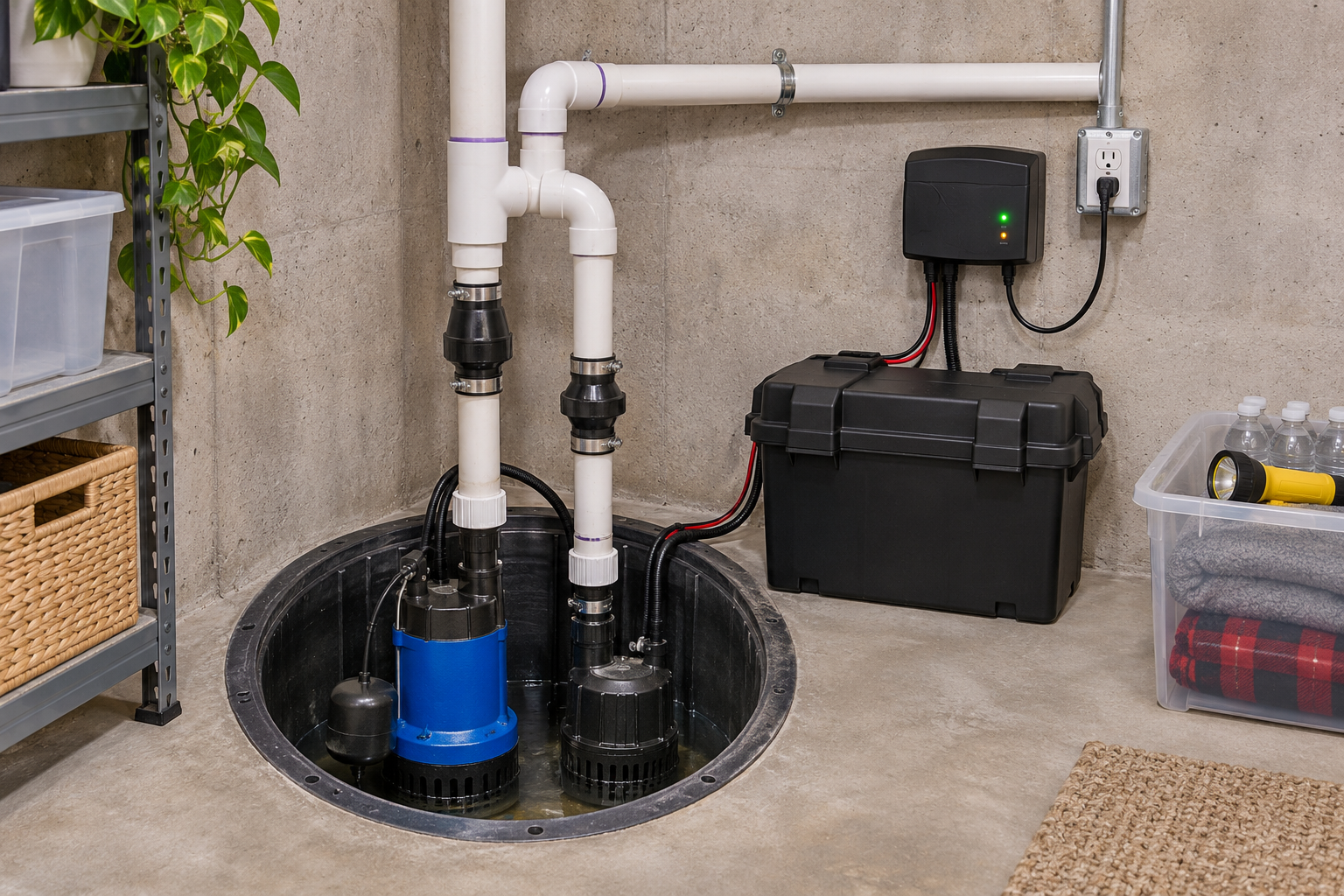
This guide takes the overview angle. It compares every major backup approach side by side: battery backup systems, water-powered backups, dual and secondary pump arrangements, and the alarms and monitors that warn you before water wins. No single option is best for every house.
What to Look for First
Every backup system, whatever its type, should be judged on the same fundamentals first: how much water it can move, against how much resistance, using what power, and built from what materials.
Flow Rate
A backup only earns its place if it can keep up with the water arriving in your pit, or at least slow the rise enough to protect what matters until help or power returns. Flow is usually expressed in gallons per hour or gallons per minute, and for backups it is often lower than the primary pump’s rating. That gap is the central planning question: during the heaviest inflow you realistically face, can the backup hold the level, or will the pit still rise, just more slowly?
Head Height
Head is the vertical lift from the water in the pit to where the discharge line exits, plus the resistance of elbows, check valves, and the pipe run itself. Backup pumps, especially smaller ones, lose flow quickly as lift increases. A rating quoted at little or no lift can shrink dramatically by the time the pump is pushing water up and out of a deep basement. Measure your actual lift, then judge any backup by the flow it delivers at that height, not by its headline number.
Power Source and Runtime
For backups, the power source is the product. A battery system is independent of the grid but finite: its runtime depends on battery capacity, how often the pump cycles, and the battery’s age and condition. A water-powered system has no battery to exhaust but depends entirely on your municipal water pressure and supply staying on. A secondary electric pump shares the primary’s weakness if both run from the same circuit in an outage. Match the power logic to your failure risk.
Materials and Build Quality
A backup pump may sit idle for months and then be asked to work perfectly, in dirty pit water, at 2 a.m. That duty cycle punishes cheap construction. Look for corrosion-resistant housing and components, a float switch design that moves freely and resists hanging up on the pit wall or discharge pipe, and a charger or control unit that reports its status clearly.
Types of Backup Sump Pumps Explained
With the criteria set, here are the main approaches, what each one protects against, and where each one falls short.
Battery Backup Systems
The most common approach pairs a secondary pump with a battery and a charger or controller. When the primary pump fails to run, the water level rises to a second, higher float, and the battery pump takes over. The controller keeps the battery charged from household power and, on many systems, sounds an alarm and shows status lights so you know the backup has been called on — information that matters, because a silent backup can quietly drain its battery saving your basement while the primary sits broken for weeks.
Battery systems protect against both power outages and primary pump failure, which is their great strength. Their limits are runtime and maintenance. A battery is a consumable: it ages whether it works or not, its capacity falls over the years, and a neglected battery can be nearly useless by the night it is needed. Sizing the battery to your inflow and outage pattern, and replacing it on schedule rather than on failure, is part of owning this type.
Water-Powered Backup Pumps
A water-powered backup uses pressurized municipal water flowing through a venturi device to create suction that draws sump water up and out. It has no battery, no charger, and no motor to burn out, and in principle it can run for as long as the city water supply flows. For homes with strong, reliable municipal pressure and no well, that is a genuinely attractive profile, especially for owners who know they will not maintain a battery.
The costs are water itself and dependence. These systems consume municipal water to move pit water, so a long event uses a large amount of treated water, which shows on a water bill and matters during restrictions. Performance depends on incoming pressure, so a home at the low end of acceptable pressure gets less pumping. A backflow preventer is typically required to protect the drinking water supply, and local plumbing codes may govern or restrict installation.
Dual and Secondary Pump Systems
A dual arrangement installs a second full pump in the pit — sometimes a matched pair designed as one system with alternating controls, sometimes simply a second, independent primary-style pump set with its float slightly higher. The second pump starts if the first cannot keep up or does not start at all, and in the alternating design the two share everyday duty, which evens out wear and proves both pumps regularly.
This approach is excellent against mechanical failure and overwhelming inflow, the two failures a battery pump’s limited capacity may not cover. Its obvious weakness is power: two electric pumps on household current both stop in an outage unless one of them is battery-backed or a generator is involved. Wide pits suit dual systems; a narrow pit crowded with two pumps, two floats, and discharge piping invites the interference and stuck floats you are trying to avoid.
Alarms and Monitoring
An alarm is not a pump, but it belongs in every backup conversation. A high-water alarm floats in the pit and sounds, or sends a notification on connected models, when water rises above the normal operating level. That warning converts silent failures into solvable problems: you can move valuables, start a generator, bail, or call for help while there is still time.
Key Features That Actually Matter
Across all types, a few features separate dependable backups from decorative ones. A dedicated, correctly installed check valve on the backup’s discharge keeps pumped water from flowing back into the pit and forcing the pump to move the same water twice. The activation method matters: a float set at the right height gives the primary its chance first, then engages the backup before water reaches the top of the pit, and it must swing freely without touching walls, pipes, or the other pump’s float.
How to Choose by Use Case
Your Main Risk Is Power Outages
If outages are your history, start with a battery backup sized generously for your inflow, or a water-powered system if you have strong municipal water, no well, and codes allow it. Homes with long, frequent outages should think in layers: battery backup for the first hours, and a plan beyond it, whether that is a generator, a second battery, or simply an alarm that ensures you know the situation early.
Your Main Risk Is Primary Pump Failure
Pumps die mechanically with the power still on, and a battery backup sized only for short duty may not match a primary’s capacity for days while you arrange a replacement. A dual or secondary full-size pump answers this risk best, ideally on a separate circuit so one tripped breaker cannot disable both. Pair it with a high-water alarm so the failure is announced, not discovered by wet carpet.
Your Main Risk Is Overwhelming Inflow
If the primary runs almost continuously in major storms and the pit still gains, your problem is capacity, not redundancy. A second pump that joins in at peak inflow, discharging through its own adequately sized line where possible, is the backup that actually changes the outcome. Battery and water-powered units, with their typically lower flow, may still help at the margins but should not be the whole plan.
You Travel or the Home Sits Empty
Absence changes the ranking. You need systems that act without you and report to you: a battery or dual setup with remote notification, or a monitoring service, matters more than raw specifications. A water-powered backup’s independence from batteries can also appeal here, since there is no battery quietly dying between visits — but have someone test the system on a schedule regardless, because idle equipment in an empty house fails silently by default.
Safety: Electricity and Water
Sump pits combine water, electricity, and often a damp, confined working space, so safety rules are strict and simple. The primary and backup pumps and their receptacles should be protected by a ground-fault circuit interrupter (GFCI), which cuts power fast if current leaks where it should not. Plug pumps into a properly grounded receptacle rather than extension cords or power strips, which are not made for this duty and corrode in pit-side dampness.
Always switch off power at the breaker before reaching into the pit, handling a pump, or adjusting floats and wiring, and be careful about standing in pooled water while working on anything electrical. Batteries add their own rules: follow the manufacturer’s instructions for ventilation, terminal protection, and handling, keep connections clean and secure, and never let tools bridge the terminals. Water-powered installations touch your drinking water plumbing, so backflow protection and code compliance are safety issues, not paperwork, and are a strong reason to use a licensed plumber. If you smell burning, find damaged cables, or have a GFCI or breaker that repeatedly trips, stop and call an electrician rather than resetting and hoping.
Installation Notes
Good backup installation is mostly geometry and testing. Position the backup pump and its float so nothing can interfere: floats need clear vertical travel, away from the pit wall, the incoming drain tile, and each other. Set the backup’s activation level above the primary’s normal shut-off level but comfortably below the top of the pit and any drain tile inlets you are protecting.
For battery systems, place the battery and controller somewhere dry, accessible, and off the floor if the very flood you fear could reach them, with cables routed so they cannot fall into the pit. For water-powered systems, plan the supply line, shut-off valve, and backflow preventer with a plumber, and confirm your water pressure under flow, not just at rest. Whatever you install, finish by testing under realistic conditions: unplug the primary, run water into the pit, and watch the backup take over, discharge outside, and shut off cleanly.
Care and Maintenance
Backups fail from neglect more than from defects, so a small routine is the real product you are buying into. Test the system several times a year and always before your wet season: lift floats or follow the controller’s test procedure, run water through the pit, and confirm discharge leaves the house. Clean the pit of silt and debris that can jam floats and clog intakes, and check that nothing stored nearby has fallen in.
For battery systems, check the battery as its manufacturer directs — charge status, terminal condition, and fluid level on types that require it — and replace the battery on its expected service schedule even if it seems fine, since capacity loss is invisible until runtime is suddenly short. For water-powered systems, exercise the valve and confirm supply pressure and backflow preventer condition during plumbing checkups. Keep a short written log on the wall by the pit: install dates, battery date, test dates, and any time the alarm sounded.
Common Mistakes to Avoid
The classic mistake is buying a backup by headline flow without checking what it delivers at your lift height, then discovering during a storm that it moves half what the label suggested. A second is installing a battery backup and never touching it again, allowing the battery — the entire point of the system — to age into uselessness unnoticed. A third is choosing a water-powered backup for a home on a private well, where its power source vanishes in every outage.
Other frequent errors include crowding a narrow pit so floats foul each other, sharing a discharge line in a way that lets pumps back-feed, setting the backup float so high that water is already at the pit rim before it starts, and skipping the high-water alarm because a backup exists. That last one deserves emphasis: backups can fail too, and the alarm is the only layer whose whole job is to tell you so.
Frequently Asked Questions
Which is better, a battery backup or a water-powered backup?
Neither is universally better. A battery backup works regardless of your water supply and also covers primary pump failure, but it has a finite runtime and a battery that must be maintained and replaced. A water-powered backup can run as long as municipal water pressure holds and needs no battery care, but it uses a lot of water, depends on pressure and code approval, and is useless on a private well during an outage. Choose based on which supply — stored electricity or city water — is more dependable in your home.
How long will a battery backup pump run during an outage?
It depends on the battery’s capacity and condition, the pump’s draw, and how often it cycles, which in turn depends on how fast water enters your pit. In light inflow, a healthy system may protect a basement intermittently for many hours or longer; in heavy inflow with near-continuous running, far less. Treat any single runtime figure with suspicion, size generously, and keep the battery young and charged so the real answer on the night you need it is the best one available.
Can a backup pump replace my primary pump if it fails?
A full-size secondary pump in a dual arrangement is designed to do exactly that. A battery or water-powered backup, however, is usually a lower-capacity emergency measure meant to hold the line until the primary is repaired or replaced, not a permanent substitute. If your backup has been carrying the house, treat that as an urgent repair situation, and let the alarm and controller warnings remind you rather than settling into it.
Do I need a backup if I have never had water in my basement?
The honest answer is that your primary pump has been winning so far, and backups insure against the day it does not — because of age, a stuck float, a tripped breaker, or one exceptional storm. If a finished basement, stored valuables, or a furnace and water heater sit at floor level, the cost of one flood dwarfs the cost of a backup and an alarm. At minimum, install a high-water alarm so a first failure is an inconvenience you hear about, not a discovery you wade into.
Should the backup pump have its own discharge line?
Where practical, a separate discharge gives each pump an independent path out and avoids one pump forcing water back through the other. Where a shared line is unavoidable, correct check valves on each pump are essential, and the shared pipe must be sized for the flow. This is a detail worth discussing with an installer, because discharge design quietly decides how much of your pumps’ rated flow you ever actually get.
How often should I test my backup system?
Test it several times a year, and always at the start of your wet season. Run water into the pit with the primary unplugged, confirm the backup starts at the right level, discharges outside, and shuts off properly, then restore the primary and confirm it resumes normally. Check battery status at the same visits. Testing takes minutes; discovering a dead backup during a storm takes considerably longer to forgive.
Backup Sump Systems to Compare
- Liberty Pumps Model 441: A 12 V battery backup designed to supplement a 120 V primary sump pump; the battery is sold separately. Search Amazon by model · Manufacturer details.
- WAYNE WSS30Vn: A preassembled system combining a 1/2 HP primary pump with a 12 V backup pump; verify basin fit and battery requirements. Search Amazon by exact model · Manufacturer details.
Conclusion
The best backup sump pumps are not a single product type but a strategy matched to your failure risk. Battery systems cover outages and primary failure but demand battery discipline. Water-powered systems trade that maintenance for dependence on municipal pressure and generous water use, and make no sense on a well. Dual and secondary pumps answer mechanical failure and overwhelming inflow, yet still need a plan for lost power. Alarms watch over all of it and cost the least.