Disclosure: As an Amazon Associate, dailyhomedecorating.com earns from qualifying purchases. Links to Amazon on this page are affiliate links; they cost you nothing extra. Prices and availability change often, so check the current Amazon listing before you buy.
Soap scum is the defining enemy of the fiberglass tub, and finding the best soap scum remover for fiberglass tubs means understanding what scum actually is before choosing what dissolves it. Soap scum is not dried soap. It is a chemical reaction product, formed when soap meets the calcium and magnesium in hard water and binds with body oils and skin cells into a waxy, gray, remarkably stubborn film. On fiberglass it bonds to the gelcoat’s microscopic texture and cures harder the longer it sits, which is why the best soap scum remover for fiberglass tubs is the one matched to scum’s chemistry, surfactants and chelating agents that lift the film, or careful acidity that dissolves its mineral skeleton, used with dwell time and soft cloths so the gelcoat survives its own cleaning. This guide ranks three verified removers you can buy today, all with fiberglass among their intended surfaces, and adds three prose-only methods that complete the system, because removing scum once is a task, while ending its return is a strategy.
Two honesties frame everything below. First, prevention outperforms removal by an embarrassing margin: a weekly no-scrub spray or a thirty-second squeegee habit will save more gelcoat and more Saturdays than any rescue product ever bottled. Second, fiberglass sets the rules of engagement. The scouring pad that would strip scum from porcelain in a minute will scar gelcoat in the same minute, and the scarred surface will hold the next layer of scum tighter, so every act of force is a loan taken against future cleaning. The general fiberglass cleaning system lives in Best Cleaner For Fiberglass Tubs And Showers; this guide is the deep dive on the single soil that fills most fiberglass owners’ search bars.
Read the Quick Picks for the fastest route to your situation, fresh film, established scum, or scum married to mineral scale. Then read the reviews for the chemistry and the cautions, the buying guide for how to judge any remover’s label, and the how-to sections for the complete removal sequence and the prevention system that makes it a once-a-season event instead of a monthly war.
Where to Buy
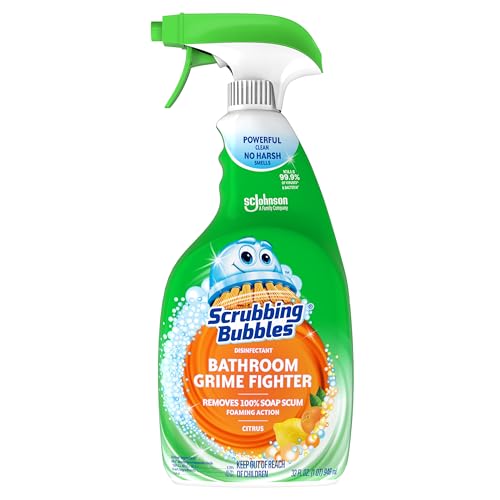
The three linked picks are sold on Amazon, where you can check current price, availability, and complete label directions. Begin with the Scrubbing Bubbles Grime Fighter Disinfectant Bathroom Cleaner Spray, the foaming remover formulated for soap scum on fiberglass among its listed surfaces, and verify it through its Check on Amazon link. The other linked picks are the Wet & Forget Shower Cleaner Spray — Check on Amazon — for prevention, and the Zep Shower Tub and Tile Cleaner — Check on Amazon — for scum hardened by mineral scale, with the acid cautions its review carries. The prose-only methods use products and tools sold in every cleaning aisle; check that any label you substitute names fiberglass as a safe surface.
In this guide
Quick Picks
| Pick | Badge | Why it earns its place |
|---|---|---|
| Scrubbing Bubbles Grime Fighter Disinfectant Bathroom Cleaner Spray | Best Overall | A foaming cleaner formulated to remove soap scum, with fiberglass explicitly among its surfaces and dwell that works on walls. |
| Wet & Forget Shower Cleaner Spray | Best Prevention | A bleach-free weekly no-scrub spray that stops scum from forming a cured layer in the first place. |
| Zep Shower Tub and Tile Cleaner | Best for Scum With Scale | An acidic scrub-free formula that dissolves the mineral skeleton inside hardened scum, used briefly and carefully. |
| Enzyme and Chelating Scum Cleaner (Type) | Best Gentle Removal | Surfactant and chelating chemistry that lifts fresh to moderate scum with dwell alone. |
| Non-Abrasive Cream Cleanser (Type) | Best for the Waterline Ring | Hand-controlled treatment of the concentrated ring where scum is thickest. |
| Squeegee and Daily Spray System (Type) | Best No-Chemical Prevention | Removing the water removes the reaction: the simplest anti-scum system ever devised. |
Key Takeaways
- Soap scum is a mineral-and-soap reaction product; removing it is chemistry, not elbow grease.
- On fiberglass, dwell time replaces scrubbing force in every method that works safely.
- Foaming removers suit walls and surrounds; soaks suit the base; creams suit the waterline ring.
- Scum hardened by scale may need brief, careful acidity, spot-tested and rinsed exhaustively.
- Prevention, weekly spray or daily squeegee, is worth more than any remover in this guide.
- Bar soap builds scum faster than liquid soap; switching the household’s soap is a legitimate anti-scum intervention.
How These Picks Were Chosen
Linked picks come from the verified supplement pool, each with fiberglass named among its manufacturer’s intended surfaces, and each assigned the role its chemistry actually fits: a foaming surfactant remover for established scum, a no-scrub weekly system for prevention, and an acidic formula for the scum-and-scale composite that defeats gentler products. Features are reported from the manufacturers’ listings, with spec boxes carrying the pool’s verified data. The prose-only methods, a gentle chelating cleaner type, a cream cleanser type, and the squeegee system, complete the honest toolkit without invented specifications.
Excluded were abrasive scum removers, scouring tools, and any product whose label omits fiberglass, because a scum remover that damages gelcoat manufactures tomorrow’s worse scum problem. Strong bleach routines were excluded as scum removers on the simple ground that bleach does not dissolve scum’s mineral structure and risks yellowing the surface while failing. The acidic pick is included with its cautions attached in every mention, because scum-plus-scale is a real and common fiberglass condition that gentle chemistry cannot always solve, and readers deserve the tool with its instructions rather than a silence they will fill at the hardware store alone.
The evaluation standard is gelcoat-safe removal: scum gone, gloss intact, and a prevention path left behind so the removal does not need to be repeated at the same intensity.
The 6 Best Soap Scum Remover for Fiberglass Tubs — Reviewed

Scrubbing Bubbles Grime Fighter Disinfectant Bathroom Cleaner Spray
Our badge: Best Overall
The Scrubbing Bubbles Grime Fighter Disinfectant Bathroom Cleaner Spray is the remover most fiberglass owners should reach for first. It is formulated to remove soap scum and bathroom grime, it lists fiberglass among the surfaces it is made for, alongside tubs, shower walls and doors, tile, and fixtures, and its foam format is the right physics for the job: foam clings to vertical gelcoat and sloped ends long enough for the chemistry to soften the scum’s structure, where a thin spray would run to the drain and take its dwell time with it. Used as directed, it also disinfects, which matters in shared and family bathrooms where the scum layer is not the only thing living on the surface.
Strengths
- Purpose-formulated against soap scum with fiberglass a named surface.
- Foam dwell works where scum actually accumulates: walls, ends, and around fixtures.
- Disinfectant action completes the reset in one product.
Trade-offs
- Established, months-old scum may need two applications rather than one heroic soak.
- Active, scented formula in a small bathroom calls for ventilation.
- Not a mineral scale specialist; scum with heavy scale may need the Zep step after it.
| Size | 32 Fl Oz (Pack of 1) |
|---|
The method matters as much as the bottle. Spray the foam onto the damp scum, give it the label’s full dwell without touching it, then wipe with a soft cloth or sponge, working the waterline and fixture bases where scum concentrates, and rinse until the water sheets off the gelcoat rather than beading on residue. On the textured floor, a soft brush in small circles helps the foam into the pattern. Owners are often surprised that the second application, a week later under the prevention system, finishes what the first began, because scum built in layers usually leaves in them.
Best for: established soap scum on fiberglass walls, surrounds, and bases / Not suited for: heavy mineral scale alone or daily use
Choose Scrubbing Bubbles as the remover of record. Skip it only if your scum is primarily scale, and start with the Zep protocol instead. Check on Amazon

Wet & Forget Shower Cleaner Spray
Our badge: Best Prevention
The Wet & Forget Shower Cleaner Spray is in a remover guide because the best removal is the one that never becomes necessary. Its bleach-free, no-scrub weekly formula is sprayed on, left for eight to twelve hours, and rinsed at the next use, and the maker positions it to clean and prevent soap scum, grime, and body oils on fiberglass, acrylic, tile, and glass, with a bottle lasting up to twelve weeks of weekly use. On light, fresh scum it genuinely removes; on established scum its honest role, which the maker itself states, is to take over after a pre-clean and then hold the line indefinitely.
Strengths
- Zero-contact prevention eliminates both scum buildup and abrasion risk.
- Bleach-free chemistry protects gelcoat color across years of use.
- Weekly rhythm is short enough to survive real household life.
Trade-offs
- Not a rescue remover for cured, heavy scum on its own.
- The long dwell must be scheduled around showers.
- Prevents hard-water staining but does not dissolve established scale.
| Color | Fresh Scent |
|---|---|
| Size | 64 Fl Oz (Pack of 1) |
| Dimensions | 7.75 x 4.1 x 9 inches |
| Weight | 4.94 pounds |
The pairing this guide recommends is explicit: rescue once with the Scrubbing Bubbles pick, then hand the tub to Wet & Forget and never rescue again. Households that adopt the handover describe fiberglass cleaning shrinking from a dreaded project to a spray they barely remember doing, which is the highest praise a prevention product can earn. In hard-water homes the weekly rhythm also slows scale’s return, because scum and scale grow together and denying them their partnership denies both.
Best for: keeping a clean fiberglass tub scum-free with no scrubbing / Not suited for: first removal of heavy, cured buildup
Choose Wet & Forget as the permanent prevention layer. Skip it as a standalone rescue. Check on Amazon

Zep Shower Tub and Tile Cleaner
Our badge: Best for Scum With Scale
The Zep Shower Tub and Tile Cleaner addresses the composite soil that defeats gentle removers: scum whose mineral skeleton has hardened into scale. Zep describes the product as an acid-based, scrub-free formula that dissolves many common water-related bathroom stains and removes soap scum and scale from shower, tub, and tile. The acid dissolves the calcium structure that gives old scum its armor, after which the whole layer can be rinsed and wiped away without force. On fiberglass that power carries the strictest protocol in this guide: spot-test hidden gelcoat first, apply briefly and never beyond the label’s direction, keep it off refinished surfaces unless their maker approves, wear gloves, ventilate, rinse exhaustively, and never let it meet another cleaner on the surface, above all nothing containing bleach.
Strengths
- Dissolves the mineral component that makes old scum immovable.
- Scrub-free action adds no abrasion to the chemistry.
- Ready-to-use and occasional, so the strong tool stays controlled.
Trade-offs
- Highest-caution product here on gelcoat; brief contact and spot tests are mandatory.
- Not a routine cleaner and not for refinished tubs without approval.
- Overkill, and therefore unjustified risk, where scum is fresh and soft.
| Size | 32 Fl Oz (Pack of 1) |
|---|---|
| Dimensions | 3 x 11.2 x 4.4 inches |
| Weight | 2.01 pounds |
Diagnose before you deploy it: scum alone is waxy and smears under a fingernail, while scum-with-scale is rough, gritty, and catches. Only the second diagnosis earns the acid. Work in small sections so no area exceeds its brief contact, and follow the rescue by handing the surface to the prevention system, because a household that needs the Zep step twice has a water problem to manage, through interval, drying, or softening, rather than a cleaning problem to repeat.
Best for: hardened scum-and-scale on sound factory fiberglass, used briefly / Not suited for: fresh scum, routine use, or refinished surfaces
Choose Zep for the armored cases only. Skip it whenever gentler chemistry answers. Check on Amazon
Enzyme and Chelating Scum Cleaner (Type)
Our badge: Best Gentle Removal
An enzyme and chelating scum cleaner, described as a type, is the gentle chemist of the group: surfactants lift the soap and oil fraction, chelating agents seize the calcium and magnesium ions that hold scum together and carry them away in the rinse, and enzymes digest the organic binder. On fresh to moderate scum, given a real dwell, it removes without any acid and without any contact beyond a soft cloth. It is the right first attempt on any fiberglass scum whose age you do not know, because it cannot harm the surface while it tells you how serious the deposit is.
Strengths
- Chemistry aimed at scum’s actual structure, at gelcoat-safe strength.
- Safe first response that diagnoses while it cleans.
- Suitable for frequent use in a maintenance rhythm.
Trade-offs
- Cured, armored scum will outlast it; escalation is sometimes honest.
- Demands full dwell; a hurried wipe wastes its design.
- Labels vary widely, so fiberglass-safe wording must be verified per product.
Apply it to the damp surface, let it sit while you do anything else in the bathroom, and wipe softly from the least soiled areas toward the worst, rinsing the cloth as you go so you are not redistributing the film. If a second application lifts noticeably more than the first, the deposit is layered and the method is working; continue the rhythm under prevention rather than reaching for force.
Best for: fresh to moderate scum and maintenance households / Not suited for: armored scum-and-scale as a sole method
Choose the gentle cleaner first, always. Skip it only when the fingernail test proves scale.
Non-Abrasive Cream Cleanser (Type)
Our badge: Best for the Waterline Ring
Every fiberglass tub grows its scum unevenly, and the waterline ring, where water, soap, and air meet after every bath, grows it thickest. A non-abrasive cream cleanser, applied by hand on a soft cloth in small amounts, is the ring’s specialist: controlled chemistry on the exact band that needs it, for exactly as long as it needs, and no longer. Described as a type, it also serves the fixture bases and the end ledges where bottles sit and scum concentrates in outlines.
Strengths
- Precision treatment of the thickest scum zones.
- Grit-free formulas protect the gloss they clean.
- A little goes far; the bottle outlasts the problem.
Trade-offs
- Impractical for whole-unit removal.
- Abrasive-containing creams exist; the non-abrasive promise must be on the label.
- Needs complete rinsing to avoid a hazy band of its own.
Work the ring in sections, checking after a few strokes and stopping the moment it releases, then rinse the whole zone so no cream dries in the texture. For dye-tinted scum, where a bath product has colored the film, expect two gentle sessions rather than one long one, and rinse bath products off the surface promptly in future to stop the tint setting at all.
Best for: waterline rings and fixture-base scum / Not suited for: whole-tub removal
Choose the cream for the ring. Skip unverified labels without exception.
Squeegee and Daily Spray System (Type)
Our badge: Best No-Chemical Prevention
The squeegee and daily spray system is the anti-remover that outperforms removers: a squeegee pass over walls and glass after each shower, plus a light daily or alternate-day mist of a diluted, fiberglass-safe spray, rinsed or left per its directions. Its logic is scum’s own chemistry run backward. Scum needs soap residue, minerals, and time on a wet surface; removing the water removes the minerals’ delivery vehicle and the reaction’s medium, so the film never forms beyond a rinse’s ability to clear it. Described as a type because it is a habit with tools rather than a product, it is the system behind every fiberglass tub that looks permanently new.
Strengths
- Prevents scum at its chemical source with almost no product.
- Costs seconds per shower and pennies per month.
- Extends every other method’s results indefinitely.
Trade-offs
- Removes nothing already cured; it is purely preventive.
- Depends on household habit, the least reliable ingredient in cleaning.
- Shared bathrooms need the squeegee placed where the habit can actually form.
Engineer the habit rather than exhorting it: squeegee hung inside the shower, spray bottle at hand, and the pass paired with the shower’s end so it borrows an existing routine. Households that build the system find the remover shelf shrinking to the prevention spray and the occasional cream, which is the natural end state of every method in this guide.
Best for: disciplined households and newly cleaned tubs / Not suited for: rescue work
Choose the squeegee system as the permanent background. Skip it as a removal method; remove first, then prevent.
Comparison Table
| Pick | Role | Scum Stage | Contact Style | Check price on Amazon |
|---|---|---|---|---|
| Scrubbing Bubbles Grime Fighter | Remover | Established | Foam, dwell, soft wipe | Check price on Amazon |
| Wet & Forget Shower Cleaner | Prevention | Fresh, and post-rescue keeping | Spray weekly, rinse later | Check price on Amazon |
| Zep Shower Tub and Tile | Scale-scum rescue | Armored | Brief acidic application | Check price on Amazon |
| Enzyme / Chelating Cleaner (Type) | Gentle remover | Fresh to moderate | Apply, dwell, wipe | Check price on Amazon |
| Cream Cleanser (Type) | Spot remover | Ring and bases | Hand-applied | Check price on Amazon |
| Squeegee System (Type) | Prevention | Before it forms | Daily water removal | Check price on Amazon |
How to Choose the Best Soap Scum Remover for Fiberglass Tubs
Diagnose the Deposit Honestly
Run the fingernail test before buying anything. Waxy and smearing means scum alone, and the foaming or gentle removers will answer. Rough, gritty, and catching means scum armored with mineral scale, and the careful acid step enters the plan. Slippery and dull with no texture means fresh film, which prevention chemistry and a cloth will clear. Each diagnosis has a different cheapest correct product, and buying the strongest bottle for the mildest diagnosis is how gelcoat gets hurt by people who meant well.
Insist on the Fiberglass Label
As everywhere in this lot, the label’s surface list is the gate. A scum remover that does not name fiberglass was not balanced for gelcoat, and scum removers as a class run strong. All three linked picks pass the gate; any substitute you consider must pass it in writing, on the bottle or the manufacturer’s site, before it touches the tub.
Match the Format to the Surface
Foam for walls and sloped ends, where dwell is the battle. Soaks and gels for the base and its texture. Cream for the ring and the fixture bases. A single-format household will always have one zone that cleans worse than the others, and on fiberglass that zone is where force gets invited in, so format coverage is a safety feature, not a shopping indulgence.
Choose the System, Not Just the Remover
Decide at purchase which prevention layer will follow the removal, the weekly spray or the squeegee habit, and buy it in the same order. A remover bought alone is a recurring appointment; a remover bought with its prevention is a one-time rescue. The price difference is trivial and the gelcoat difference is measured in years.
How to Remove Soap Scum From a Fiberglass Tub, Step by Step
Rinse the unit with warm water and clear away hair and grit. If the base is heavily filmed, run the oxygen soak described in the fiberglass cleaning guide first, because a base that starts clean lets you judge the walls honestly. Apply the foaming remover to the walls, ends, and fixture surrounds, and give it the label’s full dwell while you stay out of the steam. Wipe with a soft cloth or sponge in long strokes, working the waterline ring last with the cream cleanser if it resists, and rinse the entire unit until the water sheets off the gelcoat in a continuous film, the visual sign that no residue remains. Inspect at a low angle under the light, where surviving scum shows as a matte map against the gloss, and spot-treat only what the inspection proves is there.
If the fingernail test proved scale, insert the Zep step between the foam and the final rinse, in small sections, briefly, gloved and ventilated, and rinse each section before moving on. Then, while the tub is at its cleanest it will ever be, start the prevention system the same day: the weekly spray scheduled, or the squeegee hung in its place. Removal day is the cheapest day to begin prevention, because every later day starts from a worse surface.
Problem: The scum comes back within a fortnight — The interval is the issue, not the remover; shorten the prevention rhythm, add the squeegee pass, and consider whether bar soap is rebuilding the film faster than any routine can clear it.
Problem: A gray shadow remains after removal — That shadow is usually scum inside micro-scratches or the texture, managed by repeated gentle cycles and prevention, not by force; if it sits in visible scratches, the surface, not the cleaning, is the remaining problem.
Problem: Scum is worst behind the bottles on the ledge — Standing water and product drips concentrate there; move bottles to a caddy that drains, and wipe the ledge in the weekly rhythm.
Problem: The remover worked on walls but not the floor — Floors hold the thickest, oldest layer in their texture; soak the base, then foam and soft-brush it, rather than repeating the wall method louder.
The Chemistry of Scum, and Why Bar Soap Is an Accomplice
Traditional bar soap is made with fats and alkalis that react eagerly with hard water’s minerals, which is why scum is historically a bar-soap disease. Liquid soaps and synthetic detergent body washes are formulated to rinse cleaner in hard water and produce markedly less of the reaction product. For a household locked in a monthly scum war on fiberglass, switching the shower’s soap is a legitimate, zero-effort intervention that can halve the enemy’s supply line before any cleaner is bought. It will not remove existing scum, and it will not soften the water, but combined with the prevention system it changes the war’s arithmetic entirely. Households attached to bar soap can keep it and pay in interval instead; the guide’s only insistence is that the trade be seen clearly, because scum is one of the few household problems whose cause sits in plain sight on the soap dish.
Scum on Textured Floors, Seats, and Other Fiberglass Topography
Fiberglass units are not smooth bowls; they have anti-slip textures, molded seats, grab ledges, and the curve where wall meets base, and scum collects in that topography like snow in a plowed field’s furrows. Each feature has its method in this guide: texture wants soaking and a soft brush, seats want the foam given extra dwell because they hold standing water longest, ledges want the weekly wipe that bottle rings demand, and the wall-base curve wants the cloth folded to a firm edge so it reaches the angle rather than bridging it. Owners who clean the topography deliberately stop finding the mysterious patches that survive a general clean, because there was never anything mysterious about them, only geometry that a flat method could not reach.
Common Buying Mistakes
Reaching for the Scouring Pad When the Foam Seems Slow
Dwell feels like waiting and force feels like progress, but on gelcoat the pad’s progress is damage. Reapply, extend the dwell within the label, and let the second application do what the first began.
Buying a Scale Product for a Scum Problem
Acid on soft scum is risk without benefit. Diagnose with the fingernail test and let the deposit, not the shelf’s loudest bottle, choose the chemistry.
Removing Without Installing Prevention
The rescue will be repeated at the deposit’s pace, not yours. Buy the weekly spray or hang the squeegee in the same week as the removal, while motivation is high and the surface is perfect.
Ignoring the Soap Dish
If bar soap and hard water built the scum, they will rebuild it on schedule. Change the soap, shorten the interval, or soften the water; pick at least one cause to retire.
Letting Remover Dry on the Gelcoat
Dried remover is tomorrow’s film and a dulling agent today. Work in sections, keep the surface wet through its dwell, and rinse to the sheeting test.
Scum in the Guest Bathroom and Other Low-Use Fiberglass
Low-use fiberglass grows a distinctive scum: not the thick daily deposit of the family tub, but a thin, tenacious film that dries onto the surface between visits and cures like varnish. Guest bathrooms, second homes, and the tub in the spare suite all suffer it, and their owners make the characteristic mistake of attacking the film with the strongest product in the cupboard on the day guests arrive. The better system borrows this guide’s whole logic at lower intensity: a soak and a gentle chelating clean when the house is opened, the prevention spray applied before the house is closed again, so the film never gets its curing week, and a note in the house book so the rhythm survives whoever opens the house next. For rental properties the same logic becomes a turnover line item, since guests judge a fiberglass unit’s cleanliness by its shine at a glance, and scum’s matte map is the shine’s exact negation. A host who runs the prevention rhythm between stays will never face the rescue clean during a same-day turn, which is where gelcoat goes to be scrubbed by desperation.
Reading the Tub: What the Scum Pattern Is Telling You
A scum deposit is a map of the household’s water behavior, and learning to read it turns cleaning into diagnosis. Heavy scum at the waterline with clean walls below says the bath is the main event and the soak’s ring is where prevention should concentrate. Uniform film on the walls with a clean base says showers and soap overspray, and points at the soap itself and the squeegee habit. Scum that concentrates behind fixtures and at the drain, while the open surfaces stay clear, says water is standing where it should drain, a slope or a seal worth a plumber’s opinion. Colored scum, tinted by a bath product, names its own culprit on sight. Owners who read the map before reaching for the bottle find that half their scum problem is a behavior or a fitting, and that the remover, aimed by the diagnosis, finishes in one application what blind effort used to chase across three. The tub has been reporting on the household all along; the fingernail test and the low-angle light are simply how the report gets read.
Hard Water Softening: Attacking Scum at the Source
Every method in this guide treats scum after it forms, and a complete treatment owes the reader the one intervention that prevents it at the source: softening the water itself. A whole-house softener exchanges the calcium and magnesium that build scum for sodium, and households that install one describe the fiberglass tub’s transformation in terms that sound exaggerated until they are experienced: soap rinses instead of filming, the weekly prevention stretches to a monthly courtesy, and the remover shelf quietly retires. The investment is a household decision far larger than a bathroom’s, and this guide does not pretend a tub justifies it alone, but for homes already weighing softening for their plumbing’s, laundry’s, and skin’s sake, the fiberglass unit’s testimony belongs in the ledger. The middle options deserve their honest grading too: shower-head filters soften a trickle’s worth of perception without changing the water’s chemistry meaningfully, and salt-free conditioners alter how minerals behave on surfaces without removing them, which some households find helps cleaning modestly. Neither is softening, and labels that blur the distinction should be read with the same skepticism this guide applies to cleaner claims. Where softening is genuinely installed, keep one habit from this guide anyway, the rinse and the inspection, because even soft water leaves soap itself, and the tub that is checked stays ahead of the film that remains.
The Landlord, the Cleaner, and the Turnover: Scum at Scale
Professional cleaners and landlords fight scum on a schedule rather than a whim, and their methods, stripped of romance, ratify this guide’s system. The turnover clean that works is the rescue sequence compressed by practice: soak the base while the walls dwell with foam, work the ring with the cream, rinse to the sheeting test, and finish with the prevention spray so the next inspection starts from a defended surface. What professionals refuse to do is equally instructive: no abrasive pads in the kit, no mystery acids, because a professional’s reputation is a portfolio of other people’s gelcoat returned unharmed. Landlords who specify the method in the cleaner’s scope, and leave the prevention spray in the unit for tenants, report the fiberglass surviving tenancies that destroy unprotected units, at a cost per turn lower than the rescue cleans used to run. The household reader can steal the whole system intact, since a family bathroom is simply a rental with a longer tenancy and better conversation, and the scum does not care whose name is on the deed.
Scum and resale: The Bathroom Photograph Problem
A house sale gives soap scum a financial dimension it rarely enjoys, and sellers of fiberglass bathrooms should hear the arithmetic plainly. Buyers and their photographs judge a bathroom in seconds, and a scum-matte tub reads in those seconds as a tired bathroom regardless of the money spent elsewhere in the room, while a gelcoat at full gloss reads as renovated. The pre-listing protocol is this guide’s rescue sequence performed once, properly, in the week before photography rather than the morning of it: the full diagnosis, the soak, the foam’s dwell, the ring’s cream, the rinse to the sheeting test, and then the prevention spray begun immediately so the surface holds its gloss through the showing season, which can outlast every schedule the seller was promised. What the seller must not do is reach for the abrasive rescue in listing week, since a freshly scarred gelcoat photographs worse than an honestly dull one and cannot be unscarred before the buyers arrive. Agents who stage bathrooms professionally run exactly this play, gentle chemistry, gloss, prevention, because they know the tub is the room’s largest single surface and its condition is the room’s first sentence. Sellers who run it too will find the fiberglass, often the bathroom’s oldest component, testifying in their favor.
The Children’s Bath Problem: Rings, Toys, and Tinted Water
Children’s baths manufacture a scum all their own, and households with young bathers should adapt the system rather than merely repeat it louder. The ingredients are specific: bubble preparations and bath colorants that film and tint, toys that live in the water and carry their own biofilm to the surface, long soaks at high waterlines that paint the ring exactly where small chins rest, and the grit of a day’s play arriving on small feet. The management is equally specific and mostly upstream: bath products chosen with the tub in mind, since the heavily fragranced and dyed end of the children’s aisle writes on fiberglass in colors that take the cream cleanser a full session to retire; toys stored in a draining caddy outside the tub, rinsed as part of the bath’s ending ritual, so the fleet does not winter in a puddle of its own making; and the two-minute rinse from the plastic tub guide promoted to a game, the rain shower that ends every bath and takes the day’s film with it before it can think about curing. The ring itself, when it forms, is the cream pick’s home ground, and a weekly sixty seconds there, folded into the prevention rhythm, keeps the children’s end of the tub as honest as the adults’. Families who run this version of the system report the same discovery as every other household in this guide: the scum was never a cleaning problem with a product answer, it was a set of small habits, and habits, once installed, work for free.
When the Scum Wins a Round: Escalation Without Damage
Even good systems meet a deposit that outmatches them, a tub inherited with years of armor, a rental returned in a state, a season where life simply outran the rhythm, and the escalation path for that day deserves to be written before it is needed, because desperation improvises badly around gelcoat. The path climbs one rung at a time with a test at each: repeat the foaming remover’s full cycle twice, days apart, since layered scum leaves in layers and patience is a solvent; add the oxygen soak’s long dwell to the base’s campaign; deploy the cream at the ring and the fixture bases in sections; and only then, with the fingernail test still proving mineral armor, bring the acidic pick into play under its full protocol, small sections, brief contact, exhaustive rinsing, and the spot test honored even in a hurry. What the path never contains, at any rung, is force: no pad, no blade, no powder, because a deposit that survives this entire ladder is telling the owner something about the surface itself, etching, crazing, a finish at its end, and that conversation belongs to the refinishing guide in this lot, not to a stronger afternoon. Escalation with discipline is how professionals rescue terrible tubs and return them gleaming; escalation without it is how terrible tubs become refinishing estimates.
Final Recommendation
The top pick for removing soap scum from fiberglass is the Scrubbing Bubbles Grime Fighter Disinfectant Bathroom Cleaner Spray: fiberglass-listed, foam-formatted for dwell, and formulated for exactly this soil. The runner-up, and the pick that should follow it home in the same order, is the Wet & Forget Shower Cleaner Spray, through its Check on Amazon link, because prevention is what turns a removal into a result. Keep the Zep for armored scum-and-scale under its strict protocol, a chelating cleaner for gentle maintenance, a cream for the ring, and a squeegee in the shower, and soap scum will go from being your fiberglass tub’s defining problem to a story you tell about its first year.
Frequently Asked Questions
What dissolves soap scum on fiberglass without damaging it?
Surfactant and chelating removers formulated for the job and labeled for fiberglass, given their full dwell and wiped with soft cloths, dissolve scum’s structure safely. The foaming pick in this guide is the worked example. Force and abrasives also remove scum, along with the gelcoat’s gloss, which is why they are excluded here.
Is vinegar a good soap scum remover for fiberglass?
Vinegar is a mild acid that can loosen light mineral content in scum, but it is slow on established deposits, easy to over-dwell, and not a product labeled for gelcoat. This guide’s position is to use formulated, fiberglass-listed products whose dwell and rinsing are specified, and to reserve improvised acids for people willing to spot-test and accept the risk knowingly.
Why does soap scum form faster in my fiberglass tub than in my old porcelain one?
Two reasons: gelcoat’s microscopic texture gives the film more to grip than glazed porcelain’s glassy face, and any micro-scratching from past cleaning multiplies that grip. The remedy is the same in both cases: gentler cleaning from now on, and prevention that stops the film curing in the texture.
How do I get scum out of a textured fiberglass floor?
Soak first, with the oxygen method from the fiberglass cleaning guide, then apply the foaming remover and work it with a soft brush in small circles, rinsing thoroughly. Texture surrenders to time and chemistry, not pressure, and a floor cleaned this way keeps both its grip and its gloss.
Will switching to liquid soap really reduce scum?
Yes, measurably in most hard-water homes, because liquid and synthetic cleansers are formulated to rinse without forming the mineral reaction product that bar soap creates. It is a reduction, not an abolition, and it works best combined with the prevention rhythm.
How often should I use a scum remover if I also use a prevention spray?
With weekly prevention working, a dedicated remover becomes a quarterly or as-needed tool for the ring and the fixture bases rather than a whole-unit event. If you find yourself removing monthly despite prevention, the diagnosis has changed, usually toward scale or a soap cause, and this guide’s buying section will help you re-diagnose.


