Disclosure: As an Amazon Associate, dailyhomedecorating.com earns from qualifying purchases. Links to Amazon on this page are affiliate links; they cost you nothing extra. Prices and availability change often, so check the current Amazon listing before you buy.
The best ice bath tubs for athletes are won and lost on training-day logistics, not on looks. The best ice bath tubs for athletes fill fast after a session, chill with a sane amount of ice, hold a big frame in a stable seated posture, and drain completely so the next training day starts clean. Athletes are also harder on tubs than casual plungers: more sessions per week, more size and weight in the water, more mud, chalk, and tape residue arriving with the bather. This guide ranks six verified soaking tubs for athletic use by depth, insulation, capacity, and durability of routine, from an efficient 45-gallon deep tub that suits daily plungers to a 75-inch oval built for the tallest frames in the gym.
One boundary belongs at the front. Cold immersion is a training ritual and a comfort practice; this guide makes no claims that it treats injuries, speeds healing, or improves performance, because a tub cannot promise those things and neither can this page. Athletes with injuries, cardiovascular or circulation conditions, or any medical question should work with their clinician or physiotherapist, and nobody should plunge alone, after drinking, or on a dare. What the right tub honestly delivers is control and repeatability: the same depth, the same temperature discipline, and a station that is ready when training ends. For the home-bathroom version of this decision, see Best Tubs For Ice Baths, which ranks similar tubs for general home use rather than training routines.
Start with the Quick Picks, then read the reviews with your own week in mind: how many sessions, how much ice you are willing to buy or freeze, and where the tub will live. The buying guide translates athlete-specific factors, frame size, fill speed, drainage, and station layout, into checks, and the how-to sections build a repeatable post-training routine around the tub you choose.

Where to Buy
Every pick is sold on Amazon, where you can check the current price, availability, and freight delivery terms before ordering. Begin with the Empava 59 Inch Freestanding Bathtub for the most efficient daily plunge, and verify its listing through its Check on Amazon link. The other five are the WOODBRIDGE Acrylic Freestanding Contemporary Soaking Tub — Check on Amazon; the Streamline 75″ Freestanding Soaking Bathtub — Check on Amazon; the FerdY Tahiti 55″ Acrylic Freestanding Bathtub — Check on Amazon; the DeerValley 55″ Acrylic Freestanding Bathtub — Check on Amazon; and the KINGSTON BRASS 60-Inch Contemporary Alcove Acrylic Bathtub — Check on Amazon.
In this guide
Quick Picks
| Pick | Badge | Why it earns its place |
|---|---|---|
| Empava 59 Inch Freestanding Bathtub | Best Overall | 45 gallons and 15-inch depth: the fastest, cheapest-to-chill serious plunge for daily training routines. |
| WOODBRIDGE Acrylic Freestanding Contemporary Soaking Tub | Best Deep Plunge | Tall, double-walled, and reinforced, with chest-level immersion and a non-slip surface for post-session exits. |
| Streamline 75″ Freestanding Soaking Bathtub | Best for Large Athletes | 75 inches and 82 gallons fit the tallest, biggest frames at full extension. |
| FerdY Tahiti 55″ Acrylic Freestanding Bathtub | Best Budget | Double-walled insulation and a toe-tap drain at the most accessible point in the guide. |
| DeerValley 55″ Acrylic Freestanding Bathtub | Best Compact | A space-saving deep tub for apartment athletes and small training corners. |
| KINGSTON BRASS 60-Inch Contemporary Alcove Acrylic Bathtub | Best Permanent Station | A plumbed 58.2-gallon alcove install for a dedicated recovery room that is always ready. |
Key Takeaways
- For athletes, running cost beats purchase price: smaller, insulated tubs save ice and time every session, all season.
- Depth and a stable seated posture matter more than length, except for genuinely tall athletes, who should size up honestly.
- Anti-slip surfaces, a grippy rim, and a staged exit are performance features when legs are tired and cold.
- A permanent station with fast filling and complete drainage is what turns occasional plunges into a training habit.
- Keep sessions short, progressive, and logged; never plunge alone, injured without advice, or as a substitute for medical care.
- Choose a tub that also serves as a hot soak, and the recovery corner earns its floor space on rest days too.
How These Picks Were Chosen
Every linked pick comes from the verified product pool for this site, with dimensions, capacities, and construction drawn from manufacturer listing data and shown in the spec boxes. Athletic selection weighted repeat-use factors above spa factors: ice efficiency, because athletes plunge often; depth and interior stability, because tired legs need a tub that holds a posture for them; surface grip and rim design, because exits happen on numb feet; and drainage and cleanability, because a tub used after training meets more dirt than a tub used after a bubble bath.
Filtered out were shallow tubs that cannot immerse an athlete’s torso, jetted models whose plumbing traps grime and complicates cold use, and any product marketed with recovery or injury claims this guide will not endorse. Inflatable plunge tubs were also set aside: they have their place for travel, but their puncture risk, wobble, and slow drainage lose to rigid tubs across a full training season at home.
The approach is specification-based and routine-based rather than laboratory-based. No pick is credited with physiological effects; the reviews judge the vessel, the station, and the habit it supports. Athletes should treat temperature and duration as personal, progressive variables, ideally discussed with their coaching or medical support, and logged like any other training input.
The 6 Best Ice Bath Tubs for Athletes — Reviewed

Empava 59 Inch Freestanding Bathtub
Our badge: Best Overall
The Empava 59 Inch Freestanding Bathtub wins this ranking on training arithmetic. Its 45-gallon capacity is the smallest here, yet it still offers a 15-inch soaking depth, so it chills faster and cheaper than any rival while immersing a seated athlete properly. Double-wall acrylic holds the temperature once reached, the textured anti-slip bottom steadies tired legs, ergonomic back support holds your posture as the cold sets in, and the center drain empties the tub fully between sessions. cUPC certification and adjustable leveling feet make it a clean, correct install in a bathroom, garage conversion, or training room with plumbing.
Strengths
- Lowest ice and water demand per session, with genuine 15-inch depth.
- Anti-slip bottom and shaped back support for stable post-training plunges.
- Double-wall insulation, center drain, and leveling feet for a repeatable station.
Trade-offs
- The largest athletes will find 45 gallons and 59 inches snug.
- Back support favors one end, so posture is set rather than flexible.
- Needs an external filler, planned as part of the station.
| Color | White |
|---|---|
| Size | 59 Inch |
| Dimensions | 59.1 x 29.5 x 26.8 inches |
| Weight | 66.1 pounds |
Across a training week, the Empava’s virtues compound. Monday’s plunge costs the same small amount of ice as Friday’s; the fill is quick enough to start while you are still stretching; and the wipe-down afterward is two minutes, because the non-porous surface releases the day’s grime without scrubbing. Its light 66.1-pound build also makes it the easiest serious tub to install on an upper floor or in a rented space where permanent work is limited, subject to sensible load checks.
Athletes who share the station with a partner will find the center drain and depth work for two seated plungers in a pinch, though this is fundamentally a solo training tub. Pair it with a thermometer, a timer, and a stack of frozen bottles in a chest freezer, and you have the most sustainable daily cold routine in this guide.
Best for: athletes who plunge several times a week and count ice as a training cost / Not suited for: the largest frames wanting full extension
Choose the Empava for efficiency across a season. Skip it if your frame demands a long tub, and step up to the Streamline. Check on Amazon
WOODBRIDGE Acrylic Freestanding Contemporary Soaking Tub
Our badge: Best Deep Plunge
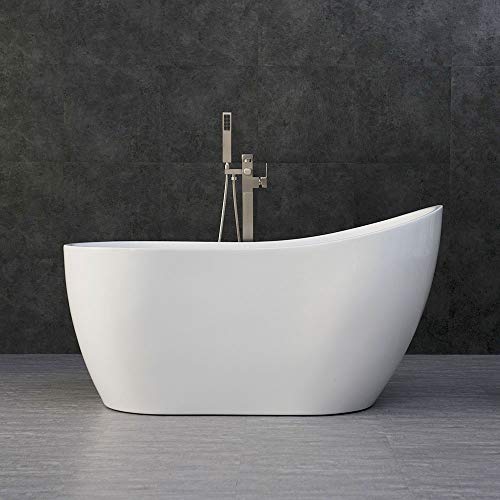
The WOODBRIDGE Acrylic Freestanding Contemporary Soaking Tub is the depth specialist: 29 inches tall, 55 gallons, double-walled Lucite acrylic reinforced with resin and fiberglass, and a non-slip surface meeting ASTM slip-resistance standards. Seated inside, an athlete’s torso goes properly under, and the tall walls keep displaced water in the tub when a big frame lowers in. The maker rates the reinforced bottom for loads up to 1000 pounds, which is the kind of structural headroom heavy athletes and heavy use appreciate, and the brushed nickel drain and overflow are included.
Strengths
- Deepest seated immersion here, with insulated double walls to hold the chill.
- Reinforced construction with a high stated load capacity and non-slip surface.
- Compact footprint fits a permanent station into modest rooms.
Trade-offs
- Tall athletes sit tucked; length is the sacrifice for depth.
- The high rim demands a staged, careful exit on cold legs.
- 55 gallons still needs planning on ice for daily use in warm climates.
| Color | Brushed Nickel |
|---|---|
| Size | 54 inches long |
| Dimensions | 54 x 29 x 29 inches |
| Weight | 75 pounds |
For field-sport and strength athletes whose training leaves their legs heavy, the WOODBRIDGE’s deep seated posture is the point: hips and torso fully in, knees up, back supported by the sloped interior, hands free to hold the rim. The insulation keeps a pre-chilled fill honest through the session, and the glossy surface cleans fast even after muddy sessions, with a rinse, a soft cloth, and mild cleaner. It also moonlights as the best hot soak here on rest days, which is when a recovery corner justifies itself to the rest of the household.
Set the station up properly: a stable step, a non-slip mat, towels staged, and a house rule that nobody plunges with nobody home. With that discipline, this is the deep plunge most athletes in this guide will actually use daily. Surface care for its reinforced acrylic follows the same approach as Best Cleaner For Fiberglass Tubs And Showers.
Best for: athletes who want maximum torso immersion in a compact station / Not suited for: tall athletes who need leg extension
Choose the WOODBRIDGE for depth and structure. Skip it if your height is your defining constraint. Check on Amazon

Streamline 75″ Freestanding Soaking Bathtub
Our badge: Best for Large Athletes
The Streamline 75″ Freestanding Soaking Bathtub exists for the athletes the other tubs apologize to. At 74.8 inches long, over 35 inches wide, and 82 gallons, it fits the tallest guards, rowers, and heavyweights with legs extended and shoulders submerged at the same time. The 3.2mm acrylic is insulated with fiberglass over a stainless-steel reinforced frame, the internal drain is pre-installed, and the included bamboo tray holds a timer, a thermometer, and a phone for the training log, the unglamorous tools of a disciplined routine.
Strengths
- Full-extension immersion for the largest frames, with room for a training partner.
- Thick insulated shell and reinforced frame at flagship size.
- Tray included for timers and session logging.
Trade-offs
- Highest ice and water demand in the guide, every session.
- Requires a large room, a planned delivery path, and floor confidence.
- Excess tub for average frames, who pay its running costs for space they never use.
| Color | Polished Chrome |
|---|---|
| Dimensions | 74.8 x 35.4 x 27.6 inches |
| Weight | 134.5 pounds |
The Streamline asks for a system: cold tap fill, overnight pre-chill where the climate allows, reusable ice blocks from a chest freezer rather than bagged ice, and a session schedule that batches plunges instead of chilling 82 gallons for a whim. Run that way, it delivers what no compact tub can, a genuinely full-body cold immersion for a genuinely large athlete, with space for a partner to share the discipline and the safety of not plunging alone. The insulated shell slows warming once cold, and the wide interior lets you adjust posture without sloshing half the fill onto the floor.
If you are tall enough to need it, nothing else in this guide substitutes. If you are not, its running costs are a tax on space you will never occupy, and the Empava or WOODBRIDGE will serve your training better across a season.
Best for: tall and heavy athletes, and partners who plunge together / Not suited for: small rooms, small frames, or small ice budgets
Choose the Streamline when your frame makes the decision for you. Skip it otherwise, without regret. Check on Amazon

FerdY Tahiti 55″ Acrylic Freestanding Bathtub
Our badge: Best Budget
The FerdY Tahiti 55″ Acrylic Freestanding Bathtub is the budget route into a rigid, insulated plunge tub. Double-walled fiberglass insulation, sloped lumbar support that keeps a cold athlete seated safely, a pre-installed brushed nickel drain worked by a toe tap, an integrated slotted overflow, and cUPC certification cover the essentials, and its 72.84-pound weight and 55-inch footprint make installation a light job in almost any room with plumbing. For student athletes, garage gyms, and anyone testing whether the cold habit will stick before investing more, it is the sensible starting point.
Strengths
- Insulated double walls at the most accessible position in the range.
- Lumbar support and toe-tap drainage designed for clumsy, cold exits.
- Light, compact, and quick to install and clean.
Trade-offs
- 14-inch water depth is shallower than the deepest picks.
- Seated, tucked posture only at this size.
- Drain finish alternatives are extra.
| Color | Brushed Nickel Drain |
|---|---|
| Size | Tahiti 55″ |
| Dimensions | 55.31 x 30.91 x 23.43 inches |
| Weight | 72.84 pounds |
The FerdY’s training value is that it removes friction from the routine. It fills from a standard filler without drama, chills with a moderate ice load thanks to its insulation and modest volume, and the toe-tap drain means the tub is emptying while you are toweling off. The lumbar slope, designed for hot soaking comfort, turns out to be a safety feature in cold water, holding your seated line as muscles stiffen. Clean it with soft, non-abrasive care and it will take season after season of post-training rinses.
Its ceiling is depth and size, honestly stated. Athletes who outgrow it, in frame or in ambition, will find the Empava’s depth or the WOODBRIDGE’s structure the natural next step, and the FerdY will still serve the household as an excellent everyday soaking tub.
Best for: budget-conscious athletes and first cold stations / Not suited for: deep-immersion or large-frame athletes
Choose the FerdY to start the habit without overspending. Skip it if depth is your first priority. Check on Amazon
DeerValley 55″ Acrylic Freestanding Bathtub
Our badge: Best Compact
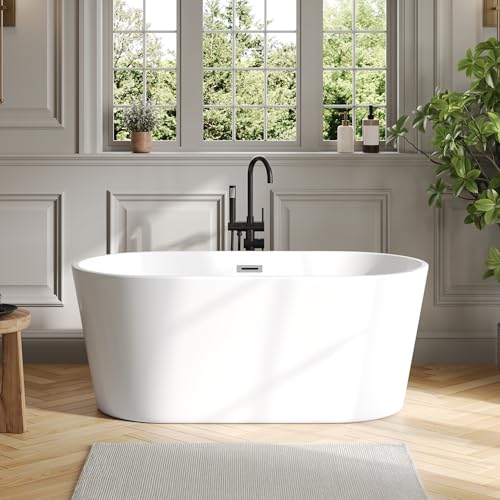
The DeerValley 55″ Acrylic Freestanding Bathtub is the apartment athlete’s answer: a deep soaking tub with a compact, space-saving silhouette, a center drain and integrated overflow, an ergonomic interior, and a smooth acrylic surface that resists stains and wipes clean in moments. Its maker designs the interior to maximize soaking space within the 55-inch footprint, which is precisely the trade a small training corner needs. In a studio, a spare bathroom, or a garage corner with plumbing, it gives a real seated plunge without surrendering the room.
Strengths
- Maximized interior in a 55-inch footprint for tight training spaces.
- Center drain for complete drainage and a stain-resistant, fast-cleaning surface.
- Clean contemporary look that suits a home, not just a gym.
Trade-offs
- No insulation is claimed, so chill shortly before use and expect higher ice use than double-walled picks.
- Tucked seated posture for most adults.
- Pool data lists no weight; confirm handling on the listing.
| Color | White |
|---|---|
| Size | 55 Inch |
| Dimensions | 55.12 x 29.53 x 22.05 inches |
Used on a training schedule, the DeerValley rewards a fill-chill-plunge sequence done in one flow: cold fill while you foam-roll, ice in, session, drain, wipe, done. Because there is no insulation claim, do not fill it in the morning for an evening session in a warm room and expect miracles; treat it as a fresh-fill station and its economy is acceptable, especially at lower session frequencies. Its easy-clean surface is a genuine asset after outdoor training, when the bather brings the field in with them.
It also remains a handsome everyday soaking tub, which matters in a small home where every fixture must do two jobs. If your training corner is truly tight, this is the pick that fits it without apology.
Best for: apartment athletes and compact training corners / Not suited for: users wanting long temperature holds
Choose the DeerValley when space rules. Skip it if insulation-led ice economy is the priority. Check on Amazon

KINGSTON BRASS 60-Inch Contemporary Alcove Acrylic Bathtub
Our badge: Best Permanent Station
The KINGSTON BRASS 60-Inch Contemporary Alcove Acrylic Bathtub turns a standard alcove into a permanent athletic plunge station: acrylic construction with fiberglass and resin reinforcement, a three-wall tile flange and integral apron, right-hand drain, 14 inches of water depth, and 58.2 gallons of capacity. Plumbed, tiled, and always in place, it removes setup from the routine entirely. The overhead shower most alcoves carry makes pre-plunge rinsing and post-session cleaning effortless, which is a training-room luxury disguised as an ordinary bathroom.
Strengths
- Permanent plumbed station in a standard 60-inch alcove, always ready.
- 58.2 gallons and 14-inch depth for a proper seated immersion.
- Reinforced acrylic with an apron face that wipes down in seconds.
Trade-offs
- Drain kit sold separately; right-hand drain must match plumbing.
- Alcove walls limit posture variety compared with freestanding ovals.
- No insulation claim; mid-pack ice economy, helped by the sheltered alcove.
| Color | Glossy White |
|---|---|
| Size | 60 inch (L) x 30-11/16 inch (W) x 22-1/16 inch (H) |
| Dimensions | 60 x 30.69 x 22.06 inches |
| Weight | 95 pounds |
For a home gym with an adjoining bath, a basement training suite, or a club-style recovery room at home, the Kingston is the infrastructure choice. Teams and training partners can cycle through it across an evening, the tile surround shrugs off the splashing that volume use guarantees, and the fixture needs no floor space beyond the alcove it was always going to occupy. Keep a thermometer and timer mounted at the wall and the station runs itself.
Confirm the drain hand, budget the separate drain kit, and install it level and well supported, and this becomes the most durable routine in the guide: no moving, no filler planning, no excuses on dark winter mornings.
Best for: dedicated training bathrooms and shared athletic households / Not suited for: freestanding layouts or unplumbed rooms
Choose the Kingston to build the habit into the house. Skip it if your station must stay flexible. Check on Amazon
Comparison Table
| Pick | Capacity | Depth Note | Best Training Trait | Check price on Amazon |
|---|---|---|---|---|
| Empava 59 Inch | 45 gallons | 15-in soak depth | Ice efficiency | Check price on Amazon |
| WOODBRIDGE 54 Inch | 55 gallons | Deep tall profile | Torso immersion | Check price on Amazon |
| Streamline 75″ Freestanding | 82 gallons | Full-length interior | Large frames | Check price on Amazon |
| FerdY Tahiti 55″ | Not stated | 14-in water depth | Insulated value | Check price on Amazon |
| DeerValley 55 Inch | Not stated | Deep soaking interior | Compact fit | Check price on Amazon |
| KINGSTON BRASS Alcove 60″ | 58.2 gallons | 14-in water depth | Permanent station | Check price on Amazon |
How to Choose the Best Ice Bath Tubs for Athletes
Size the Tub to Your Frame, Not Your Ambition
Measure your seated height and be honest about your build. Average frames immerse well in deep 54- to 59-inch tubs with knees tucked; tall and heavy athletes need the length and width of a 67- to 75-inch tub to get shoulders and hips under together. A tub that leaves your torso half out is not a bargain at any price, and a tub far larger than your frame taxes every session in ice and time.
Budget Ice Like a Training Expense
Multiply honestly: sessions per week, across a season, at the ice load your tub size and climate demand. Insulated, modest-volume tubs cut that number dramatically, and a chest freezer with reusable blocks cuts it further. Athletes track every other recurring cost of training; the plunge station deserves the same discipline, because the routine that survives is the one whose running costs were faced at purchase time.
Build the Station, Not Just the Tub
Decide where the tub lives, how it fills, where the thermometer and timer mount, where towels and a mat stage, and how the floor drains or dries. A freestanding tub needs a filler plan; an alcove tub needs the right drain hand. The best station is the one with no friction left in it: finish training, and the plunge is simply the next step, not a project.
Set Safety Rules Before the First Session
Short, timed sessions; gradual temperature progression; a thermometer, never a guess; another person in the house; no plunging after alcohol, with an untreated injury, or against medical advice. Athletes respect protocols in every other part of training, and cold water, which is a genuine physiological stressor, deserves the same respect. Log temperature and duration beside your training, and let the log drive progression.
A Post-Training Plunge Routine That Actually Repeats
The routine that works is boring by design. Finish training, rinse off briefly, and while you change, start the cold fill if your station is a fresh-fill design, or check the thermometer on a pre-chilled insulated tub. Add ice in stages, stir, and confirm the target temperature. Stage the mat, towel, timer, and warm clothes. Enter steadily, breathe slowly, and stay for your planned, logged duration, which for most people building the habit means a few minutes, not a feat of endurance. Exit on the timer, sit on the rim for a breath, stand slowly, dry, and dress warm.
Then close the loop like an athlete: drain the tub fully, rinse and wipe the surface, note temperature and duration in the training log, and reset the station for the next day. The whole cycle, practiced, takes less time than the debate about whether to do it. Rest days are when the same tub earns goodwill as a hot soak, a duality the whole household can enjoy, and readers planning that side of the room can borrow staging ideas from Best Wall Shelves For Bedrooms Under $100.
Problem: The station is never ready when training ends — Pre-chill in an insulated tub, or adopt a fresh-fill routine timed to your cool-down, and keep ice blocks frozen and staged rather than bought in a panic.
Problem: Sessions keep creeping longer and colder — Return to the log and the timer; progression should be planned in small steps, and any session that leaves you unwell is data to share with a clinician, not a challenge to beat.
Problem: The tub smells or films between heavy-use days — Drain fully every time, rinse after muddy sessions, and clean weekly with a soft cloth and mild cleaner; standing water is the enemy, not the athletes.
Problem: A tall athlete cannot get shoulders under — The tub is too small for the frame; move to a long model rather than compensating with dangerously cold water at shallow depth.
Training Rooms, Garages, and Bathrooms: Placing the Station
Where an athlete plunges shapes the habit as much as the tub does. A bathroom station is warm, plumbed, and private, ideal for freestanding tubs like the Empava and WOODBRIDGE, but it competes with the household’s mornings. A garage or basement training room keeps the ritual beside the weights and the bike, and suits an alcove install like the Kingston or a compact tub with a planned filler, provided the floor, drainage, and winter temperatures are thought through, since an unheated room changes both the ice arithmetic and the pleasure of getting out. An outdoor station is possible in mild climates with a suitable tub and serious attention to water hygiene, but for the rigid acrylic tubs in this guide, an indoor, plumbed home is the intended and happiest setting. Whichever room you choose, protect the floor, plan the wet path from tub to towel, and remember that a recovery corner should lower the friction of training, never add a second workout of setup and cleanup. Garden-facing homes may enjoy Best Solar Bird Bath Water Pumps as the household’s other, gentler water feature.
Cold Routines Across a Training Week
Experienced plungers periodize cold like everything else. Heavy training blocks may call for more frequent, shorter sessions; taper weeks and rest days may call for none at all, or for the same tub filled warm. The vessel does not care which ritual it hosts, which is the deepest argument for buying a real bathtub rather than a single-purpose plunge barrel: the station flexes with the training plan, the season, and the household. Keep the log honest, keep the temperatures gradual, and let coaches or clinicians who know your body have the final word on how cold work fits your program. The tub’s job is narrower and entirely achievable: to be deep enough, cold enough, clean enough, and ready enough, every time you ask it. Athletes comparing notes with the general home guide in Best Tubs For Ice Baths will find the same tubs ranked by household fit, a useful cross-check before ordering.
Common Buying Mistakes
Buying for the Highlight Reel
The biggest, coldest, most extreme setup is usually the first abandoned. Buy for the routine you will repeat in week twelve, not the photo you will take in week one.
Ignoring Running Costs
Ice and water across a season dwarf small price differences between tubs. Do the multiplication before you fall for the flagship oval.
Treating Cold as Treatment
A plunge is not physiotherapy. Athletes who use a tub to avoid getting an injury assessed trade a ritual for a risk; get the assessment, then plunge with a clear head.
Skipping the Exit Plan
Tired, cold legs plus a tall rim plus a wet floor is a foreseeable fall. Stage the step, mat, and towels, and keep the no-solo-plunge rule without exceptions.
Neglecting Drainage and Cleaning
A tub that does not empty fully or takes scrubbing after every session will be skipped on exactly the days training was hardest. Prioritize complete drainage and wipe-clean surfaces.
Team Sports, Shared Stations, and the Household Athlete
Many athletic households are really small teams: two partners who train, siblings home from university programs, a parent coaching and a teenager playing. A shared plunge station changes the buying math in ways solo athletes miss. Throughput matters, because three athletes cycling through a tub on a Sunday evening need a station that either holds its temperature across consecutive sessions, which favors the insulated picks and a spare set of ice blocks staged in rotation, or drains and refills fast enough that nobody’s session is delayed into oblivion, which favors modest volumes and strong fillers. The Kingston alcove station and the Empava score particularly well in shared life, one for its plumbed permanence and shower-over convenience, the other for its speed and ice economy across repeated fills. Hygiene rules scale up too: rinse before entry stops being a courtesy and becomes the system, and the drain-wipe-refill discipline between heavy training days is what keeps a shared tub pleasant in week ten.
There is also a fairness question worth settling early: whose schedule owns the station after the big training days, and who owns the ice run. Households that answer those questions with a shared freezer stock and a simple booking habit, even an informal one, keep the station an asset. Households that do not will find the tub becoming one athlete’s territory and everyone else’s resentment, which is a people problem no purchase can fix but a purchase can certainly inflame. Buy the size the household’s training actually needs, stock it communally, and the plunge corner becomes part of the family’s sporting infrastructure.
Travel, Competition, and Keeping the Habit Away From Home
Athletes eventually face the away fixture: the competition trip, the training camp, the holiday where the home station is a thousand miles away. The honest advice is that the habit travels imperfectly and that is fine. A standard hotel bathtub filled with cold water and ice from the machine gives a shallow, short, better-than-nothing session for athletes who have medical clearance and a routine worth maintaining; cold showers give a mild version of the stimulus with none of the immersion. What does not travel is the protocol’s precision, so away sessions should be shorter and warmer than home ones, never colder in an unfamiliar setting with no one who knows your routine. Athletes who travel constantly and depend on the ritual sometimes use inflatable plunge tubs on the road, accepting the puncture and drainage compromises this guide filtered out for home use, because portability outranks durability when the tub lives in a kit bag.
The deeper point is that the home station’s value includes the baseline it creates. A logged, repeatable home routine teaches an athlete exactly how their body responds to a given temperature and duration, and that self-knowledge is what makes away improvisation safe rather than guesswork. Buy the home tub well, log it honestly, and the habit becomes robust enough to survive travel, taper weeks, and off-seasons, returning each time to the same deep, cold, ready station in the corner of the bathroom.
Strength Days, Endurance Days, and Matching the Plunge to the Work
Without prescribing any protocol, which belongs to coaches and clinicians, it is fair to observe how athletes commonly organize the ritual around different training. After long endurance work in the heat, the plunge is often as much about the relief of cooling down and sitting still as about any formal routine, and athletes tend to favor the deep tubs and unhurried sessions. After heavy strength work, many athletes keep sessions shorter and treat the tub as one element among sleep, food, and mobility work rather than the centerpiece, and some deliberately separate the plunge from the lifting session by hours on their coach’s advice. The tub cannot arbitrate those choices, but the right tub supports all of them: deep enough for the endurance day, efficient enough that a short strength-day dip does not demand a full chilling production, and comfortable enough that the athlete who simply wants ten quiet minutes in cold water after a hard week gets exactly that. Versatility across the training week, not extremeness on any single day, is the quality that keeps an athletic plunge tub in use for years, and it is why dual-purpose soaking tubs fill every slot in this ranking.
The Evidence, Stated Plainly: What Cold Does and Does Not Do for Athletes
Athletes deserve the research picture without the marketing varnish, and this guide’s position throughout, comfort and routine over medical promise, comes from reading it honestly. The consistent finding across sports-science studies is that cold water immersion reduces perceived muscle soreness in the day or two after hard training, and that athletes who plunge feel recovered sooner, which matters enormously across a congested competition calendar. The same literature carries the caution this guide has repeated: plunging immediately after strength sessions, done chronically, can blunt some of the adaptations those sessions exist to create, which is why the scheduling sections separate plunge days from lifting days where possible. Evidence for direct performance enhancement is thin, evidence for injury treatment is a different and medical question this guide does not touch, and evidence about immune effects is mixed enough that no honest article should print a promise in either direction.
What remains, after the varnish is stripped, is still a strong case, and it is the case the athletes who sustain the habit actually make. The plunge is a repeatable ritual that marks the end of training, imposes a few minutes of deliberate breathing and composure under stress, and leaves the athlete feeling reset in a way that supports the next session’s willingness, which is the currency training blocks are truly spent in. Coaches who use cold well treat it as one tool in the recovery orchestra, sleep first, food second, easy movement third, cold where it fits, rather than as a soloist. This guide’s tubs earn their badges inside that honest frame: they make the ritual easy enough to repeat, safe enough to trust, and cheap enough to sustain, and an athlete who wants more than that from a tub of cold water should be sold it by someone willing to show the studies rather than the slogans.
The Household Negotiation: Sharing a Home With a Plunge Tub
An athlete’s plunge tub lives in a home, not a laboratory, and its long-term survival depends on diplomacy as much as drainage. The negotiations are predictable and worth having in advance. The bathroom plungers must agree on the tub’s double life: it is a bath for everyone else in the house, which means the plunge schedule, the ice storage, and the post-plunge rinse are courtesies owed to the people who will soak in it warm that evening, and the athlete who leaves meltwater and a ring of tape residue for the next bather is spending goodwill the habit needs. The garage and garden plungers negotiate over territory and appearance instead: a dedicated corner, hoses and cables routed like they belong there, and a cover that makes the station look kept rather than abandoned, because a station the household is proud of is a station nobody campaigns to remove in the spring cleanup. Partners who plunge together need the least negotiation and gain the most, since a shared ritual doubles the accountability that keeps any habit alive, and many couples report the plunge becoming the day’s strangest and best ten minutes together, which no training plan can prescribe and no athlete should underestimate as a recovery tool in its own right.
The ice supply is the household’s second negotiation, and it is solved with systems rather than goodwill. A dedicated freezer shelf or a small standalone freezer for ice removes the daily conflict with the food storage, and a standing arrangement, who buys ice, whose car it travels in, what the weekly ice budget is, prevents the small resentments that accumulate around any training habit’s logistics. Athletes who train early should also negotiate the noise honestly: a plunge at dawn involves water, movement, and occasionally language, and a household that has agreed the ritual’s hour will sleep through it with far better grace than one ambushed by it. None of this appears in any product specification, and all of it decides whether the tub in this guide is still in use at month six, which is why this guide ends its teaching here: the best ice bath tub for an athlete is the one the whole household has made peace with, filled on schedule, drained without drama, waiting tomorrow exactly where the training plan expects it to be.
Final Recommendation
The top pick for athletes is the Empava 59 Inch Freestanding Bathtub: the depth is real, the ice bill is the lowest here, and its anti-slip, easy-clean design fits a daily routine. The runner-up is the WOODBRIDGE, for athletes who want the deepest seated immersion in a compact station; find it via its Check on Amazon link. Large athletes should go straight to the Streamline, budget starters to the FerdY, apartment athletes to the DeerValley, and anyone building a permanent recovery room to the Kingston alcove. Keep the protocol gradual, logged, and shared with the professionals who know your body, and the station will serve your training for years.
Frequently Asked Questions
What size ice bath tub does an athlete need?
Enough depth to immerse the torso seated, which deep 54- to 59-inch tubs provide for most frames, and enough length for tall athletes to extend, which pushes them to 67 inches and above. Judge by interior dimensions and water depth in the listing, not by exterior styling.
How often do athletes typically plunge?
Habits vary widely, from a few sessions a week to daily during heavy blocks, and this guide does not prescribe a protocol. Frequency, temperature, and duration are training variables to set gradually, log honestly, and discuss with coaching or medical support, especially around injuries or health conditions.
Is a rigid tub better than an inflatable plunge tub for home training?
For a fixed home station, generally yes: rigid tubs drain completely, clean faster, hold temperature better when insulated, and carry no puncture risk across a season of heavy use. Inflatable designs keep an advantage only where storage or travel dominates the decision.
How do athletes keep ice costs down?
Choose a modest-volume insulated tub, fill with the coldest tap water, plunge at the coolest time of day, and switch from bagged ice to reusable blocks or bottles frozen in a chest freezer. The tub choice is the biggest lever, which is why the 45-gallon Empava leads this ranking.
Can an ice bath tub double as a normal bathtub?
Every pick in this guide is a full-quality soaking bathtub, chosen partly for that duality. Warm soaks on rest days, ordinary baths for the household, and cold plunges on training days all come from the same fixture, which is the strongest value argument in the category.
What safety rules should an athletic plunge station have?
A thermometer and a timer, short progressive sessions, warm clothes staged, a non-slip exit, another person in the house, and a hard rule against plunging with an unassessed injury, after alcohol, or against medical advice. Cold is a stressor to be dosed, not a test to be passed.


