Disclosure: As an Amazon Associate, dailyhomedecorating.com earns from qualifying purchases. Links to Amazon on this page are affiliate links; they cost you nothing extra. Prices and availability change often, so check the current Amazon listing before you buy.
The best fabric pens for quilts do two opposite jobs, and confusing them is how quilts get ruined. One job is to disappear: marking quilting lines, tracing templates, and sketching designs that must vanish completely before the quilt is finished. The other job is to last forever: signing labels, inking names and dates, and drawing details that must survive decades of washing. The best fabric pens for quilts are therefore not one pen but a small, deliberate kit — the best fabric pens for quilts include at least one pen engineered to be permanent and at least one engineered to leave, and the craft lies in never letting them swap roles, because a swapped pen does not fail politely or immediately — it fails months later, in the wash or in the cold, when the quilt is finished and the mistake has become permanent in the worst direction.
This guide separates the four pen families quilters actually use — archival permanent pens, heat-erasable marking pens, water-erasable marking pens, and opaque paint pens — and matches each to its proper work. The pen picks are presented as real product types, described qualitatively, with the testing discipline each one demands. Two finished quilts close the list, clearly labelled as alternatives for readers who decide to buy rather than mark and make. For colour applied with a brush rather than a nib, the companion guide to Best Fabric Paint For Quilts covers the paint side of the same worktable.
Where to Buy
All four pen types below are stocked on Amazon, as are the two finished-quilt alternatives; check the current listing for tip sizes and pack colours, and note that pens are sold in many near-identical variants — read the exact product name twice before ordering. The six picks are: Sakura Pigma Micron Pens; Pilot FriXion Heat-Erasable Pens; Clover Water-Erasable Marking Pens; Opaque Fabric Paint Pens (Arteza type); the Levtex Home Adare quilt set — Check on Amazon; and the Cozy Line Home Fashions patchwork quilt set — Check on Amazon.
In this guide
Quick Picks
| Pick | Badge | Why it earns its place |
|---|---|---|
| Sakura Pigma Micron Pens | Best Overall | The permanent standard for quilt labels, signatures, and fine inked detail — archival pigment ink in many tip sizes. |
| Pilot FriXion Heat-Erasable Pens | Best for Temporary Marking | Marks that vanish under a warm iron, for piecing lines and quilting guides you never want to see again. |
| Clover Water-Erasable Marking Pens | Best for Lines That Wash Out | The traditional marking choice: visible lines that rinse away with water when the quilting is done. |
| Opaque Fabric Paint Pens (Arteza Type) | Best for Bold Designs | Paint in pen form for drawn motifs, hand-lettered blocks, and colour that covers dark fabrics. |
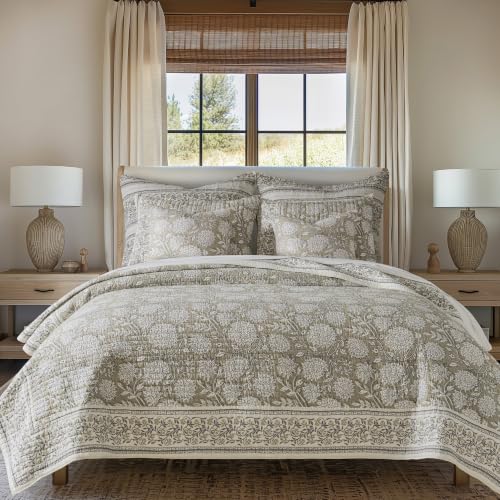
| Levtex Home Adare Taupe Reversible King/Cal King Quilt Set | Best Finished Alternative | Not a pen — a finished pre-washed cotton quilt set for readers who decide to buy rather than make and mark. |
| Cozy Line Home Fashions 100% Cotton Hand Piecing Real Patchwork Love of Lilac Bedding Quilt Set | Best Patchwork Finished Alternative | Not a pen — a finished hand-pieced patchwork quilt set, the bought version of the handmade result. |
Key Takeaways
- Separate your pens by destiny: permanent pens for labels and artwork, erasable pens for guides — and never let an erasable pen sign anything.
- Pigma-type archival pigment pens are the label standard because the ink is waterproof and fade-resistant once dry.
- Heat-erasable lines can ghost back in freezing temperatures; use them only where a returning line would be invisible or harmless.
- Every marking pen must be tested on your actual fabric and removed by your actual method before it touches the quilt top.
- Tip size is a design decision: fine tips for lettering and detail, broader tips for bold drawn motifs.
- Store pens as their makers direct and cap them immediately — a dried-out pen mid-label is a small, preventable heartbreak.
How These Picks Were Chosen
The evaluation began by splitting the keyword into its two honest halves. For permanent work, pens were judged on ink chemistry — pigment-based archival inks that sit in the fibre and resist water and light, rather than dye inks that can bleed in the wash or fade on a sunny bed. For temporary work, pens were judged on the completeness and safety of their disappearing act: a marking pen whose lines rinse out of one fabric may stain another, and a heat-erasable line that returns in a cold room is a feature only if you planned for it. Paint pens were judged as paint, with pen manners: opacity, flow control, and cured flexibility.
What was filtered out: ordinary ballpoints and gel pens (their inks are not made for laundering and can bleed or vanish unpredictably), permanent markers not intended for fabric (harsh solvents, bleeding nibs, ink that can yellow), and any pen whose maker gives no guidance on removal or permanence. Those products appear below only in the mistakes section. The finished quilts were included under the standing honesty rule for this cluster: labelled as finished alternatives in every appearance, never described as pens.
A note on neighbouring tools: pens overlap with the marker family, and readers comparing formats should also see Best Fabric Markers For Quilts for broader-nib options, and Best Permanent Fabric Markers For Quilts where permanence is the whole question. This guide keeps its focus on pen-format tools — finer tips, controlled lines, and label-grade lettering.
The 6 Best Best Fabric Pens for Quilts — Reviewed
Sakura Pigma Micron Pens
Our badge: Best Overall
Sakura Pigma Micron pens are the closest thing quilting has to a universal answer for permanent ink work. Their archival pigment ink is waterproof and fade-resistant once dry, it does not bleed through quilting cotton the way dye inks can, and the range of tip sizes runs from hairlines for tiny lettering to bolder points for drawn detail. When a quilter signs a label, inks a date into a signature block, or draws the whiskers on an appliqué cat, this is the pen already in her hand — and decades of surviving labels are the reason.
Strengths
- Archival pigment ink: waterproof and fade-resistant, made for work that must outlast its maker.
- Many tip sizes, so lettering, outlining, and fine detail can all be done in one ink family.
- Minimal bleed on quilting cotton, keeping fine lines fine through washing.
Trade-offs
- Permanent means permanent: a slip on a finished top is forever, so practise and masking matter.
- Fine tips are delicate; pressing hard, as on paper, can damage the nib.
- Ink needs a short drying window before handling or washing — impatience smears.
| Type | Archival pigment ink pen (permanent) |
| Best work | Quilt labels, signatures, dates, fine drawn detail |
| Fabric fit | Quilting cotton and most natural fibres; test first |
| Removal | None — this is the pen you choose when removal must be impossible |
Label craft deserves its own paragraph, because the label is where this pen earns its keep for a lifetime. Write on a stabilised piece of label fabric — iron it to freezer paper so it cannot shift or stretch — with a light hand and the tip size that matches your lettering: most makers settle on a mid-fine tip for body text and a finer one for dates. Let the ink dry fully, heat-press briefly with a dry iron if you want extra insurance, then sew the label on. Practise the entire inscription on scrap first, including the spelling of your own name, which nervous hands have been known to fumble at the final line.
Beyond labels, Microns draw beautifully for inked-detail techniques: faux embroidery outlines, drawn faces on folk-art blocks, and the fine cross-hatching that shades a printed motif. In every case the discipline is the same — test on the project fabric, let it dry, and only then commit the quilt.
Best for: labels, signatures, and any ink on a quilt that must be permanent / Not suited for: marking guides or any line you will ever want to remove
Choose Pigma Microns if permanence is the job. Skip them entirely for layout lines — that is what the next two picks exist for.
Pilot FriXion Heat-Erasable Pens
Our badge: Best for Temporary Marking
Pilot FriXion pens write like ordinary gel pens and vanish with heat — a warm iron pass and the line is gone — which made them an instant favourite for marking piecing lines, placement guides, and quilting paths. For quilt work, their appeal is precision: a fine, dark, continuous line exactly where you want it, erasable without water, sprays, or waiting for anything to dry. Used in their proper place, they are the most convenient marking tool in the modern sewing room.
Strengths
- Lines erase with a warm iron — no washing or rinsing step needed to remove guides.
- Fine, consistent line quality that suits precise piecing and template marking.
- Available in several colours, so a visible line exists for light and dark fabrics alike.
Trade-offs
- The known catch: erased lines can ghost back in freezing cold, because the ink is heat-reactive, not destroyed.
- Not archival and not for labels, signatures, or anything meant to be kept.
- On some fabrics a faint residue can remain; testing on the real cloth is mandatory.
| Type | Heat-erasable gel pen (temporary) |
| Best work | Piecing lines, placement marks, quilting guides on blocks |
| Fabric fit | Most quilting cottons after a successful test |
| Removal | Warm iron; lines may reappear in deep cold |
The ghosting behaviour deserves honest framing rather than fear. The ink turns invisible with heat and can reappear if the quilt gets genuinely cold — a quilt stored in an unheated space in winter, or shipped in a freezing truck. For most marking jobs this is harmless: a piecing line hidden inside a seam allowance can ghost forever and nobody will ever see it. The danger is only where a returning line would show — a quilting guide drawn across a pale block that will live in a cold cabin. Rule of use: FriXion for lines that end up hidden, trimmed, or inside seams; another method for lines drawn on visible faces of quilts destined for cold places.
Also respect the pen’s temperament while you work: friction and heat from an iron are the eraser, so do not press a marked top before you mean to erase it, and do not leave marked pieces in a hot car. Mark, sew, then erase as a deliberate final step, checking the whole piece under good light.
Best for: hidden construction lines and guides that will end up inside seams / Not suited for: labels, signatures, or visible-face guides on quilts that may face freezing storage
Choose FriXion for convenient hidden marking. Skip it for anything archival — that word should physically stop your hand from reaching for this pen.
Clover Water-Erasable Marking Pens
Our badge: Best for Lines That Wash Out
Clover’s water-erasable marking pens are the traditional answer: a clear blue line that rinses away with plain water when the work is done. Generations of quilters have drawn quilting motifs, marked appliqué placement, and traced templates with them, because the removal method is the gentlest possible — water, the same thing the quilt will meet in its first wash anyway. For visible-face quilting guides, where a heat-erasable pen’s ghosting is a real risk, water-erasable remains the professional’s default.
Strengths
- Removal by water alone: no heat, no chemicals, no special process at the end of quilting.
- Clear visible line that is easy to follow with a needle or a machine foot.
- Long track record on quilting cotton, with fine-tip versions for detailed motifs.
Trade-offs
- Lines must actually be rinsed out — plan the quilt’s first wash as part of the making, not an afterthought.
- On some fabrics and in some water conditions, lines left for very long periods can set; test and do not mark months ahead.
- Not for anything permanent; a signed label in this pen is a label until its first wash.
| Type | Water-erasable marking pen (temporary) |
| Best work | Quilting motifs on visible faces, appliqué placement, template tracing |
| Fabric fit | Quilting cotton; test each new fabric and colour |
| Removal | Rinse or wash with plain water |
Working method matters with water-erasable pens. Mark shortly before you quilt that section rather than marking the whole top weeks in advance; keep the marked top away from steam and damp rooms, which can fade lines unevenly; and when the quilting is done, remove the lines with a thorough rinse — a dab with a wet cloth can merely move the colourant around, while a proper rinse or the quilt’s planned first wash takes it out completely. Test the full cycle on your fabric first: draw, wait the length of your real project, rinse, dry, and inspect in daylight, including under the angle of light that reveals ghosts.
One more honest note: “water-erasable” describes the maker’s intent, and individual fabric dyes occasionally interact with marking inks in surprising ways. The test is not bureaucracy; it is the entire safety system. Quilters who test never have the horror story; quilters who have the horror story never tested.
Best for: quilting guides on visible faces and any marking that will be rinsed out at the first wash / Not suited for: permanent writing, or projects that will sit marked for months
Choose Clover water-erasable pens for visible guides with a planned wash at the end. Skip them for labels — permanence is a different pen’s job.
Opaque Fabric Paint Pens (Arteza Type)
Our badge: Best for Bold Designs
Opaque fabric paint pens — the Arteza type is the familiar example — put paint under pen control: a valve-fed nib delivers opaque colour that can draw, letter, and fill on light and dark fabrics alike. For quilters, they bridge the gap between the paint pots in Best Fabric Paint For Quilts and the fine pens above: bolder than an ink pen, more controlled than a brush, and able to lay bright colour onto a dark block where transparent inks would vanish.
Strengths
- Opaque coverage: designs show on dark fabrics that defeat dye-based inks.
- Pen control with paint body — drawn motifs, hand lettering, and filled shapes without a brush.
- Wide colour ranges in sets, including metallics, for decorative quilt blocks.
Trade-offs
- Paint sits on the surface: heavy application can feel stiff and must be kept thin on quilts that fold.
- Nibs need priming and care; a neglected paint pen blobs at the worst moment.
- Permanence depends on the maker’s curing and heat-set guidance — follow it exactly.
| Type | Opaque fabric paint pen (permanent when cured per maker) |
| Best work | Drawn motifs, bold lettering, designs on dark fabrics |
| Fabric fit | Quilting cotton and blends; keep coats thin for flexibility |
| Removal | None once cured — test and plan accordingly |
Technique is everything with paint pens. Prime the nib on scrap, never on the quilt. Work with the fabric stabilised flat, draw in confident single passes rather than scrubbing back and forth, and build colour in two thin passes instead of one loaded one — the cured hand stays softer and the line edges stay clean. Between colours, let each dry; paint pens reward the same patience as paint, because that is what they are. Hand-lettered dedication blocks are their party trick: lettering that reads like a poster rather than handwriting, in colours matched to the quilt, permanent once cured as directed.
Store them as the maker directs — usually capped, often horizontal — and revive a reluctant nib on scrap with gentle pressure rather than force. A paint pen that has been shaken, primed, and tested is a joy; the same pen taken straight to a finished block is a slot machine.
Best for: bold drawn designs, dark-fabric work, and hand-lettered feature blocks / Not suited for: fine label lettering or any area that must stay buttery soft under heavy paint
Choose paint pens when the design needs paint’s opacity with a pen’s control. Skip them for archival fine print — Micron territory — and for guides, which should never be permanent.

Levtex Home Adare Taupe Reversible King/Cal King Quilt Set
Our badge: Best Finished Alternative
Stated plainly: the Levtex Home Adare Taupe Reversible King/Cal King Quilt Set is not a pen. It is a finished king-size quilt set — a 106 by 92 inch pre-washed cotton quilt with a taupe floral design, two king shams, and a coordinating reverse — included for readers who arrived here mid-project, weighed the marking and making still ahead of them, and honestly concluded that a finished quilt serves the actual need. Its pre-washed cotton construction is also a fair picture of the finished state all that careful marking is aiming at.
Strengths
- 100% cotton face with a cotton-rich fill, pre-washed for softness, per the maker.
- Reversible designer floral pattern gives two coordinated looks in one set.
- King/cal king sizing with king shams covers large beds generously.
Trade-offs
- A finished set offers no creative role for your pens, fabrics, or design.
- Taupe floral styling suits traditional and French-country rooms more than modern minimal ones.
- King sizing only in this set; smaller beds should look at other finished options.
| Color | Taupe |
| Size | King/Cal King Quilt |
| Weight | 8.2 pounds |
| Set contents | 1 quilt (106x92in) and 2 pillow shams (36x20in) |
The maker notes the cotton construction softens further with washing and advises cold gentle washing with low tumble drying. In a master bedroom or guest suite it reads as a considered, traditional quilt — the kind of finished object a well-marked, well-made handmade quilt becomes. Buy it if the bed needs covering beautifully now; do not buy it as a substitute for the pens if your quilt top is already underway and merely waiting for its lines and label.
Best for: large beds needing a finished traditional cotton quilt immediately / Not suited for: quilters mid-project who need actual marking or writing tools
Choose this set if buying finished is the honest answer. Skip it if your quilt is in progress — the four pens above are your shortlist. Check on Amazon

Cozy Line Home Fashions 100% Cotton Hand Piecing Real Patchwork Love of Lilac Bedding Quilt Set
Our badge: Best Patchwork Finished Alternative
The Cozy Line Home Fashions 100% Cotton Hand Piecing Real Patchwork Love of Lilac Bedding Quilt Set is also a finished quilt, not a pen: real hand-pieced patchwork in lilac florals, with a 100% cotton shell and cotton fill, reversible, in a queen three-piece set. It appears here as the second honest shortcut — the bought version of the handmade, hand-finished quilt that pens, marking, and patience otherwise produce.
Strengths
- Real hand-pieced patchwork construction rather than a printed pattern.
- 100% cotton shell and fill, per the maker, for breathable natural comfort.
- Reversible design offers a second look without a second purchase.
Trade-offs
- Finished product: your design, fabrics, and label have no place in it.
- Lilac floral palette is romantic and specific, and will lead the room’s colours.
- Cotton construction wants gentle cold washing and slower drying than synthetics.
| Color | Lilac |
| Size | Queen |
| Weight | 6 pounds |
| Set contents | 1 quilt (88 in wide x 92 in long), 2 standard shams (20 in x 26 in) |
For a reader whose true project was “a patchwork quilt on that bed,” this set closes the question tonight, with genuine piecing and cotton character that respect the tradition the pens serve. For a reader whose project is a quilt of their own — marked with the pens above, signed with pride — this set is at most a stand-in for a spare bed while the real work proceeds at its proper pace.
Best for: readers who want a real patchwork cotton quilt without the making timeline / Not suited for: anyone who needs pens for a quilt already in progress
Choose this set if a finished patchwork quilt is the need. Skip it if you came to mark, draw, or sign your own work. Check on Amazon
Comparison Table
| Pick | Type | Permanent? | Removal / behaviour | Best work | Check price on Amazon |
|---|---|---|---|---|---|
| Sakura Pigma Micron | Archival pigment ink pen | Yes — the point | None; waterproof and fade-resistant | Labels, signatures, detail | Check price on Amazon |
| Pilot FriXion | Heat-erasable gel pen | No | Erases with warm iron; may ghost in deep cold | Hidden construction lines | Check price on Amazon |
| Clover Water-Erasable | Water-erasable marking pen | No | Rinses out with water | Visible quilting guides | Check price on Amazon |
| Opaque Fabric Paint Pens | Paint pen | Yes, when cured per maker | None once cured | Bold designs, dark fabrics | Check price on Amazon |
| Levtex Home Quilt Set (finished) | Finished cotton quilt set | Not applicable — finished product | Not applicable | Buying the finished result | Check price on Amazon |
| Cozy Line Quilt Set (finished) | Finished patchwork quilt set | Not applicable — finished product | Not applicable | Buying the handmade look | Check price on Amazon |
How to Choose the Best Fabric Pens for Quilts
Start With the Only Question That Matters: Stay or Go?
Before brands, before tip sizes: should this line exist in fifty years, or should it be gone by Friday? Labels, signatures, dates, and drawn artwork must stay — archival pigment pens and cured paint pens. Piecing lines, placement marks, and quilting guides must go — heat-erasable for hidden lines, water-erasable for visible ones. Every disaster in this category is a pen answering the wrong version of that question: the label that washed away was written with a marking pen; the guide line that will not leave was drawn with a permanent one. Build your kit as two clearly separated families, store them apart, and consider different barrel colours a safety feature, not a preference. The same permanence-first thinking governs thread and ink choices across a project, as the discussion in Best Thread For Piecing Quilts shows for the stitched side of the work.
Test on the Real Fabric, With the Real Removal Method
There is no universal safe pen, only pens proven safe on your cloth. The test protocol is short and non-negotiable: on a scrap of the exact project fabric, draw lines with every pen you intend to use; leave them for the length of your real project timeline; remove them by your real method — iron, rinse, or wash; then inspect dry, in daylight, at an angle. Include a permanent-pen control line so you can confirm which marks are supposed to remain. Ten minutes of testing has saved more quilts than any product in this guide.
Match Tip Size to the Line’s Job
Lettering wants a tip fine enough to form letters at your writing size without flooding the counters of small characters — most label writers land on a fine or medium-fine point, with an ultra-fine reserved for dates and tiny details. Drawn motifs want the opposite progression: outline fine, fill bold. Marking pens want a tip that lays a line visible enough to follow at sewing distance without being so broad it hides the true stitch path. Buying a multi-tip set of your chosen permanent family is usually wiser than buying one perfect pen, because a quilt asks for several line weights across its life.
Think About the Quilt’s Climate and Laundry Future
Where will this quilt live? A quilt for a cold-climate cabin should not carry visible-face guides in heat-erasable ink, however convenient, because ghosting is a climate event. A quilt that will be washed weekly needs permanent ink with a proven wash record and marking pens whose removal is total in a normal cycle. A wall quilt that will never be washed changes the marking calculus again — removal by water may never happen, so guides must be chosen accordingly. Match the pens to the quilt’s future, not to your worktable’s convenience today.
Buy the Kit, Not the Pen
A working quilt-pen kit is small: one archival permanent family in two or three tip sizes, one heat-erasable set for construction lines, one water-erasable pen for visible guides, and — if you draw designs — one set of paint pens. Bought as a kit and stored together in a labelled pouch, it ends the mid-project scramble that leads to the true villain of this category: the ordinary desk pen, grabbed in a hurry, whose ink was never promised to anyone. Restock on schedule rather than in emergencies; seasonal events such as Black Friday Bedding Deals 2026 often discount the surrounding craft and bedding supplies together.
How Do You Mark a Quilt Top Without Leaving a Trace?
Marking well is a sequence, not a moment. First, finish all pressing before you mark — heat and steam are erasers and shifters, and a top pressed after marking is a top whose lines have moved or vanished unevenly. Lay the top flat, smooth, and fully supported; a line drawn across a sagging section will be a different line when the quilt lies flat. Mark in the order you will sew: construction lines before assembly, quilting guides after the sandwich is basted, so the guide sits where the quilting will actually run. Work in good, raking light, and mark a section at a time rather than the whole quilt, because every marking family has a comfortable lifespan on cloth.
Removal is the second half of the craft. Erase heat-erasable lines as a deliberate pass with a warm iron once sewing is done, then inspect. Rinse water-erasable lines with a genuine wash or thorough rinse, not a nervous dab. Then inspect again, dry, in daylight, tilting the fabric — ghost lines reveal themselves at an angle long before they show face-on. Only when the top passes that inspection does it go to binding and beyond, because after the quilt is finished, every remaining mark is a resident, not a guest.
Problem: a marking line will not rinse out completely — it may have been left too long, or the fabric’s dye interacted with it. Soak the area in plain cool water, repeat rather than escalating to chemicals, and in future test that pen on that fabric for the full project duration before use.
Problem: erased lines came back in a cold room — the signature behaviour of heat-erasable ink. Warm the quilt and the lines fade again; for visible areas, prevent recurrence by choosing water-erasable marking for quilts that will live or be stored in the cold.
Problem: permanent ink bled into fuzzy lines on the label — the fabric was unstabilised or the ink was applied too slowly, letting it wick. Stabilise label fabric on freezer paper, write with a confident, moving hand, and choose a tip one size finer than your instinct.
Problem: a paint pen blobbed on a finished block — the nib was over-primed or pressed too hard. Blot instantly with a clean cloth without rubbing; if a mark remains, incorporate it — a leaf, a button, an appliqué patch — rather than fighting cured paint with solvents near other work.
Problem: lettering looks shaky and uneven — handwriting on cloth is a skill separate from handwriting on paper. Practise the exact inscription on stabilised scrap at final size, rule faint guides with a water-erasable pen, and write slowly with the fabric taped so it cannot creep.
Labels: The Small Square That Carries the Quilt’s History
Every other section of this guide serves the making; this one serves the remembering. A quilt without a label becomes anonymous within a generation — its maker, date, occasion, and recipient dissolve into “someone in the family made it, I think.” A quilt with a good label is a document. The craft standard is simple: maker’s name, date, place, recipient and occasion where relevant, in archival ink, on a fabric that matches the quilt’s own care life. Pigma-type pens dominate this work because their pigment ink is the closest thing to a guarantee the craft has, and the label technique — stabilised fabric, practised inscription, full drying, a setting press — is fifteen minutes of care that buys a century of provenance.
Signatures deserve the same seriousness on signature and album quilts, where guests or family members sign individual blocks. Provide the permanent pens yourself, in tested tip sizes, with stabilised blocks and a practise scrap and clear instructions — because a guest handed an unknown pen will press too hard, write too big, or sign with whatever is in their pocket, and the block will carry that accident forever. Curating the signing table is not fussiness; it is the difference between an heirloom and a cautionary tale. The fabric under those signatures matters too, which is why label and block cloth choices pair naturally with the guidance in Best Fabric For Quilts.
Pens in the Wider Marking Toolbox
Pens are one instrument in a larger marking orchestra, and experienced quilters choose per passage. Chalk and chalk pencils excel on dark fabrics and brush away, but blur under handling. Hera markers crease a line without any pigment at all — the only marking guaranteed to leave nothing, ideal for straight quilting lines on delicate cloth. Stencils with any of this guide’s pens turn one motif into a border’s worth of repeats. Light boxes and transfer methods place complex designs that freehand pens cannot. Knowing the pens’ limits is part of choosing them well: reach for a pen when the line must be fine, continuous, and exactly placed; reach for chalk, creases, or stencils when the job is broad, dark-fabric, or repetitive. A quilt marked with three methods, each where it is strongest, looks effortless — because for the maker, it nearly was. If your household restocks craft supplies alongside bedding during sale seasons, Black Friday Throw Pillow And Blanket Deals season is a practical moment to replace dried pens before a project depends on them.
Common Buying Mistakes
Signing a Label With a Marking Pen
The pens look similar, sit in the same drawer, and differ only in destiny — until the first wash erases the maker’s name from the quilt forever. The consequence is the single saddest preventable loss in quilting. The better move: store permanent and temporary pens in separate, labelled pouches, and read the barrel aloud before any label is signed. It feels silly exactly once, and then it is a habit that protects every quilt you will ever make.
Using an Ordinary Desk Pen “Just for One Line”
Ballpoint and gel inks are formulated for paper. On fabric they can bleed into halos, fade unevenly, or — worst — appear fine for months and then migrate in a hot wash. The consequence lands long after the moment of laziness, when repair is impossible. The better move: no desk pens in the sewing room, full stop. If the right pen is not within reach, the line waits.
Skipping the Removal Test
Every marking horror story shares this sentence: “It came out of the sample at the shop.” Your fabric, your water, your timeline are the test conditions that matter. The consequence of skipping is discovering a set line or a ghost across a finished top. The better move is the full protocol from the choosing section — draw, wait the real duration, remove the real way, inspect in daylight at an angle.
Marking the Whole Top Weeks in Advance
Marking inks age on cloth: water-erasable lines can set, heat-erasable lines fade unevenly in warm rooms, and all lines blur with handling as the top is folded and moved. The consequence is a top that must be re-marked over ghosts of the first attempt. The better move: mark section by section, close to when each section will be sewn or quilted.
Pressing Down on Fine Tips Like a Ballpoint
Fine pigment-pen tips are engineered for a light, gliding touch; ballpoint pressure bends and mushrooms them, after which the “fine” pen writes like a brush and bleeds like one too. The consequence is a ruined pen and, often, a ruined label line. The better move: slow down, lighten the hand, and let the ink flow — and teach anyone signing a block for you to do the same, with a practise scrap first.
Final Recommendation
Build the kit this guide describes and the keyword answers itself: Sakura Pigma Micron pens for everything that must stay — they are the best fabric pens for quilts when permanence is the job — water-erasable pens for visible guides, heat-erasable pens for hidden construction lines, and opaque paint pens when a design needs paint’s body under pen control. Keep the families separate, test every pen on every new fabric, and no quilt of yours will ever lose its name or keep a guide line it should have shed. Readers who conclude that the making itself is more than this season allows can see the finished result ready-made in the Levtex Home set: Check on Amazon. Everyone else: label your pouches, practise your inscription, and sign your work like it will be read in a hundred years — because it might be.
Frequently Asked Questions
What pen should I use to sign a quilt label?
An archival pigment ink pen — the Pigma Micron family is the standard — in a tip size that suits your handwriting, on stabilised label fabric, allowed to dry fully before sewing. Test the exact pen on the exact label fabric first, practise the whole inscription on scrap, and never substitute a marking pen, however similar it looks.
Do heat-erasable pen lines really come back in the cold?
They can. The ink becomes invisible with heat rather than being destroyed, and deep cold can make erased lines ghost back. Use heat-erasable pens where a returning line would be hidden — inside seams and construction lines — and choose water-erasable marking for visible faces of quilts that may be stored or used in freezing conditions.
How do I remove water-erasable pen marks completely?
With a genuine rinse or wash in plain water, not a spot-dab, which can redistribute the colourant. Remove marks as part of the quilt’s planned first wash where possible, and inspect the dried fabric in daylight at an angle before declaring them gone. Lines left on cloth for very long periods can be harder to remove, which is why marking close to sewing time matters.
Can I use a regular permanent marker on a quilt?
It is a poor idea. Markers not made for fabric can bleed at the edges, carry solvents that affect fibres, and fade or yellow unpredictably through washing and light. Fabric-specific permanent pens and paint pens cost little more and are formulated and tested for exactly this life. The one-line shortcut is the most expensive pen choice in quilting.
What tip size is best for writing on quilt labels?
Most makers settle on a fine to medium-fine tip for the main inscription — small enough for neat letters, bold enough to stay legible for decades — with a finer tip for dates and details. Your own handwriting size decides it: write the label text at final size on scrap with two or three tip sizes and choose the one whose letters stay open and clear rather than blotted or spidery.
How long do fabric pens last in storage?
It varies by family, but capped, correctly stored pens generally serve for years; pigment pens and paint pens suffer most from being left uncapped or stored nib-up against their maker’s guidance. Test any long-stored pen on scrap before it touches a project — a pen that skips or blobs on scrap has told you everything, for free. Restocking the kit calmly, before a deadline does the choosing for you, keeps fresh pens on hand; a sensible rhythm is to audit the pouch whenever you start a new quilt, replace anything that writes dry or uneven on the test scrap, and note the purchase date on the pouch so the next audit takes seconds. Pens are cheap; the moment a failing pen chooses for you is always the moment a label is half-written.


