Disclosure: As an Amazon Associate, dailyhomedecorating.com earns from qualifying purchases. Links to Amazon on this page are affiliate links; they cost you nothing extra. Prices and availability change often, so check the current Amazon listing before you buy.
The best fabric paint for quilts has to earn a small act of faith: you are putting colour onto cloth that someone will sleep under, love, and eventually wash without thinking twice about your artistry. Painting on a quilt is a promise you make to the future: this colour, this line, this handprint or stencil or freehand vine has to survive being slept under, folded, and washed for years. That is why the search for the best fabric paint for quilts is really a search for permanence with a soft hand. The best fabric paint for quilts bonds with cotton fibres instead of sitting on top of them like a plastic skin, stays flexible enough to fold without cracking, and keeps its colour through wash after wash — and the wrong paint fails on exactly those three counts, peeling at the fold lines of a quilt that gets used the way quilts are meant to be used.
This guide compares the paint families quilters actually use — soft-finish fabric paints, professional textile colours, budget fabric acrylics, and flowing dye-like paints for watercolour effects — and explains which suits whole-cloth painting, stencilling, handprints, and detail work. The four paint picks are presented as product types with the characteristics to look for, described qualitatively. Two finished patchwork quilts close the list, clearly labelled, for readers who want the painted-patchwork look without picking up a brush. If your project is marking rather than painting, the companion guide to Best Fabric Pens For Quilts covers the pen side of the same craft table.
Where to Buy
All four paint types below are stocked on Amazon, as are the two finished-quilt alternatives; check the current listing for the colour range and set size you need, and always buy enough of a colour to finish a project, because dye lots and batches vary. The six picks are: Tulip Soft Fabric Paint; Jacquard Textile Color; DecoArt SoSoft Fabric Acrylic; Jacquard Dye-Na-Flow; the Whale Flotilla patchwork quilt set — Check on Amazon; and the Madison Park patchwork quilt set — Check on Amazon.
In this guide
Quick Picks
| Pick | Badge | Why it earns its place |
|---|---|---|
| Tulip Soft Fabric Paint | Best Overall | The beginner-friendly standard: soft flexible finish, huge colour range, and forgiving application on quilting cotton. |
| Jacquard Textile Color | Best Premium | Professional-grade textile paint with intense pigment and a soft hand when heat-set — the choice for quilts meant to last. |
| DecoArt SoSoft Fabric Acrylic | Best Budget | Formulated to stay soft without a fabric medium, in small affordable bottles that suit trying many colours. |
| Jacquard Dye-Na-Flow | Best for Watercolor Effects | A flowing, dye-like paint that soaks into fibres for translucent washes, sun printing, and soft backgrounds. |
| Whale Flotilla Patchwork Quilts Queen Size | Best Printed-Look Finished Alternative | Not a paint — a finished quilt with a printed patchwork design, for the colourful look without painting. |
| Madison Park Patchwork Farmhouse Red/Black Queen Quilt Set | Best Patchwork-Look Finished Alternative | Not a paint — a finished reversible patchwork quilt set for readers who decide to buy the look instead. |
Key Takeaways
- For quilts, hand feel is destiny: choose paints formulated to dry soft and flexible, because a stiff painted patch will crack at fold lines.
- Heat-setting is not optional decoration — follow the maker’s heat-set instructions or expect the design to fade early.
- Test on your actual quilt fabric, washed the way the quilt will be washed, before any paint touches the real top.
- Opaque paints sit on the surface and cover dark fabrics; transparent and dye-like paints soak in and need light fabrics to shine.
- Buy the whole project’s worth of each colour at once, and keep painted blocks out of the wash for the maker’s full curing time.
- Pre-wash quilt fabric without fabric softener before painting, or the paint bonds to the finish instead of the fibre.
How These Picks Were Chosen
Quilt painting makes demands that t-shirt painting does not. A quilt is folded along the same lines for years, washed as bedding rather than as a garment, and expected to stay soft enough to sleep under — so the first filter was flexibility after curing: any paint family known for a stiff, plasticky film was excluded from the top spots no matter how vivid its colours. The second filter was wash permanence when the maker’s own process is followed, including heat-setting where required. The third filter was behaviour on quilting cotton specifically: how the paint moves on a tight plain weave, whether it bleeds under a stencil edge, and whether it can be thinned for washes without losing its grip.
What was filtered out: generic craft acrylic used without a fabric medium (it dries like a shell and cracks on bedding), paints whose makers do not publish wash or heat-set guidance, and glitter and dimensional paints for large areas — fun on a label or a child’s handprint block, structurally wrong for a quilt that must fold. Those products appear below only as cautions. The two finished quilts were included under the same honesty rule used across this cluster: labelled as finished alternatives everywhere, never described as paint, and chosen because their printed and patchwork designs represent what many readers are trying to achieve with a brush.
One more scoping note: this guide is about paint applied to quilt tops and finished quilts. Readers painting outdoor wooden quilt blocks need the different, weather-first advice in Best Paint For Barn Quilts, and readers choosing the cloth itself should start with Best Fabric For Quilts, because paint behaviour begins with the fabric underneath it.
The 6 Best Best Fabric Paint for Quilts — Reviewed
Tulip Soft Fabric Paint
Our badge: Best Overall
Tulip Soft Fabric Paint is where most quilters should start painting, because it removes the two beginner killers: stiffness and fuss. It is formulated to dry with a soft, flexible finish rather than the plastic plate cheaper paints leave, it goes onto quilting cotton smoothly with a brush or sponge, and its colour range is enormous, including matte, metallic, and glow varieties. For stencilled motifs on blocks, handprint quilts, and painted accents on appliqué, it behaves predictably — which, on a quilt top that represents weeks of piecing, is the highest praise a paint can earn.
Strengths
- Soft, flexible cured finish that folds with the quilt instead of cracking across fold lines.
- Very wide colour range, so matching an existing quilt palette is usually possible.
- Forgiving application: brushes, sponges, and stamps all work, and mistakes wipe off before drying.
Trade-offs
- Coverage on dark fabrics needs multiple coats, which thickens the hand of the painted area.
- Heat-setting per the maker’s directions is required for best wash permanence — do not skip it.
- Large whole-cloth backgrounds consume a lot of small bottles; buy project quantities deliberately.
| Type | Soft-finish fabric paint (opaque family) |
| Best techniques | Stencils, stamps, handprints, brush motifs, appliqué accents |
| Fabric fit | Quilting cotton and cotton blends, pre-washed without softener |
| Permanence routine | Allow full dry, then heat-set as the maker directs before washing |
In practice, Tulip Soft is the paint of the family quilt: the handprint tree whose leaves are grandchildren’s hands, the stencilled border on a baby quilt, the names and dates added to a memory quilt. Its softness means a painted block can sit in the middle of a quilt that gets folded weekly without the design becoming a fault line. Work in thin coats rather than one thick one — thin coats cure more flexible and look more like dyed cloth than like paint — and let each coat dry before judging the colour, because this family dries slightly darker than it looks wet.
One working habit separates good results from great ones: paint the block before it is sewn into the top whenever the design allows. A single block on a flat table, taped at the edges, is a calm painting surface; the same block in the middle of a finished quilt top is a high-wire act over months of work. Where painting must happen on an assembled top or a finished quilt, mask generously, slip a barrier layer under the work area, and accept smaller, slower sessions.
Best for: most quilt painting — stencils, handprints, motifs, and accents on quilting cotton / Not suited for: translucent watercolour washes or single-coat coverage on very dark fabrics
Choose Tulip Soft if you want the reliable, soft, beginner-proof default. Skip it if your vision is a flowing dyed background — the Dye-Na-Flow entry below is built for that.
Jacquard Textile Color
Our badge: Best Premium
Jacquard Textile Color is the professional’s shelf: a textile paint with serious pigment load, a soft hand when properly heat-set, and a reputation among fabric artists for colour that stays put through years of washing. Where craft paints are formulated for convenience, this family is formulated for permanence — the colours are intense enough to thin for washes or use straight for opaque work, and the finish, once set with heat, feels like part of the cloth rather than a coating on it.
Strengths
- High pigment intensity: colours stay vivid and can be mixed and thinned without going weak.
- Excellent wash permanence when heat-set as directed — the heirloom-quilt choice.
- Soft cured hand that keeps painted areas foldable and sleep-able.
Trade-offs
- Costs more per project than craft-store paints, especially across many colours.
- Less forgiving of sloppy process: pre-washing and proper heat-setting genuinely matter.
- Colour range is curated rather than enormous; exact matches may need mixing.
| Type | Professional textile paint (opaque, mixable) |
| Best techniques | Freehand painting, detailed motifs, mixed-media quilt art |
| Fabric fit | Natural fibres especially; quilting cotton is its home ground |
| Permanence routine | Heat-set thoroughly per maker guidance after full drying |
Choose this paint when the quilt is the artwork: art quilts, portrait blocks, painted whole-cloth pieces, and any project where the painting is the point rather than an accent. Its pigment strength changes how you work — colours can be glazed in layers, so a leaf can have a light side and a shadow side instead of one flat green, and skin tones and skies can be blended on the cloth. That capability is wasted on a quick stencil, which is why this is the premium pick rather than the overall one: most quilt painting is simpler than what this paint can do, and simpler paints do the simple jobs with less process discipline.
Process discipline, stated plainly: pre-wash the fabric, let painted work dry fully, heat-set with a dry iron at the maker’s recommended setting and duration through a press cloth, and wait the recommended time before the first wash. Quilters who follow that sequence report designs that outlast the quilt around them; quilters who improvise it are the source of every “fabric paint doesn’t last” story you have heard.
Best for: art quilts, heirloom projects, and painters who want professional pigment and permanence / Not suited for: quick kids’ projects where process discipline will not happen
Choose Jacquard Textile Color if the painting is the quilt’s centrepiece and you will heat-set properly. Skip it for a rainy-afternoon handprint session — Tulip Soft forgives more.
DecoArt SoSoft Fabric Acrylic
Our badge: Best Budget
DecoArt SoSoft earns its place by solving the budget painter’s real problem: ordinary craft acrylic is cheap but dries like cardboard unless you add a fabric medium, while SoSoft is formulated to stay soft on fabric without a medium, in small bottles that make collecting a working palette affordable. For quilters painting motifs, labels, and accents — work measured in square inches, not square yards — that combination is exactly right.
Strengths
- Formulated for a soft fabric hand without needing a separate textile medium.
- Small, affordable bottles make it practical to own many colours for detail work.
- Brushes on smoothly and suits fine detail, lettering accents, and small motifs.
Trade-offs
- Small bottles are the wrong economy for painting large backgrounds.
- As with all fabric paints, wash permanence depends on following the maker’s setting guidance.
- Coverage and pigment strength are a step below the professional pick for demanding work.
| Type | Fabric acrylic formulated for softness (no medium needed) |
| Best techniques | Detail motifs, lettering, small stencils, touch-ups |
| Fabric fit | Quilting cotton and blends, pre-washed |
| Permanence routine | Follow maker’s dry and set guidance before washing |
SoSoft is the paint of the quilt label and the finishing touch: the painted name and date on a dedication block, the tiny flowers in the corners of a plain border, the eyes and whiskers that turn appliqué animals into characters. Its bottle size, a liability for backgrounds, is a virtue here — you are buying exactly the small amounts detail work consumes, in colours you would never justify in large jars. Keep a palette of these beside the sewing machine the way you keep a thread box: as a standing capability, not a per-project expedition.
Working tip: because it is an acrylic family, keep a damp brush and work in small sections; edges dry fast, and re-wetting a half-dried edge can lift it. For lettering, practise the whole word on scrap from the same fabric first — letterforms that work on paper change their manners on cloth, and the scrap test is where you learn your brush’s real line width. For permanent lettering beyond a label, many quilters pair paint work with the pen techniques in Best Fabric Markers For Quilts, using each tool where it is strongest.
Best for: detail work, labels, and building a many-colour palette affordably / Not suited for: painting large areas or backgrounds
Choose SoSoft if your painting is small-scale and colour-rich. Skip it for whole-cloth backgrounds, where its bottle size and coverage will frustrate you.
Jacquard Dye-Na-Flow
Our badge: Best for Watercolor Effects
Jacquard Dye-Na-Flow is not really a paint in the surface sense — it is a flowing, dye-like colour that soaks into the fibres and leaves the cloth’s hand completely unchanged. That makes it the only honest answer for watercolour techniques on quilts: skies that grade from horizon to zenith, sun-printed leaves and lace, soft tie-dyed grounds behind appliqué, and any effect where the colour should live in the cloth rather than on it. Where opaque paints draw a picture on fabric, Dye-Na-Flow dyes a picture into it.
Strengths
- Leaves fabric hand completely soft — zero film, zero stiffness, zero cracking risk.
- Colours blend and bleed wet-into-wet for genuine watercolour and sun-print effects.
- Excellent for backgrounds and large areas, where opaque paint would change the drape.
Trade-offs
- Transparent: it cannot cover dark fabrics, and colours are only as bright as the cloth beneath.
- It flows — controlling edges takes resist, thickener, or acceptance of beautiful accidents.
- Requires heat-setting and patient drying; rushing the process dulls results.
| Type | Flowing dye-like fabric colour (transparent) |
| Best techniques | Watercolour washes, sun printing, gradient backgrounds, silk-style painting on cotton |
| Fabric fit | Light-coloured natural fibres; white quilting cotton shows it best |
| Permanence routine | Heat-set per maker guidance after thorough drying |
The working method is closer to dyeing than painting: stretch or pin the fabric so it cannot shift, wet it for soft blends or work dry for sharper marks, and let gravity and thirst do the artistry. Sun printing deserves its own sentence — lay leaves, lace, or cut shapes on wet Dye-Na-Flow colour and leave the piece in strong sun, and the objects print themselves as pale silhouettes in a coloured ground; as a background for appliqué or a whole-cloth panel, few techniques give so much beauty for so little skill. This is the one pick in the guide where experimentation is not a risk but the entire method, so budget fabric for play.
Because the colour lives in the fibre, a Dye-Na-Flow background quilts exactly like unpainted cloth — no needle resistance, no cracked film along quilting lines, no difference in drape between painted and unpainted areas. For large painted quilts that must remain real quilts, soft and foldable and washable, that property is decisive, and it is why experienced art quilters reach for dye-like colour for grounds and keep opaque paints for the details on top.
Best for: backgrounds, watercolour effects, sun printing, and painters who want zero change to fabric hand / Not suited for: opaque designs, dark fabrics, or anyone who needs crisp controlled edges by default
Choose Dye-Na-Flow if your vision is atmospheric and layered into the cloth. Skip it if you need a bold opaque motif on a dark ground — that is Tulip or Jacquard Textile Color work.

Whale Flotilla Patchwork Quilts Queen Size
Our badge: Best Printed-Look Finished Alternative
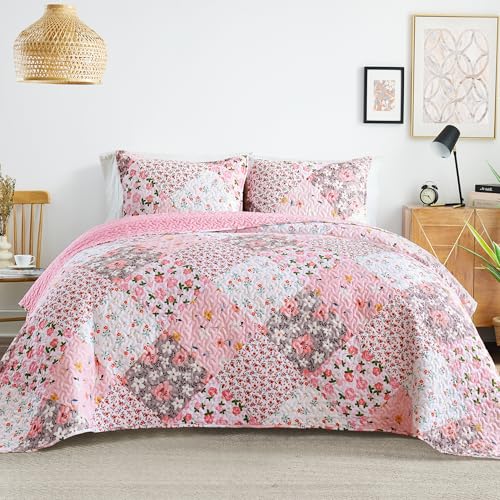
Plainly stated: the Whale Flotilla Patchwork Quilts Queen Size is not a paint. It is a finished lightweight quilt whose patchwork design is printed — the maker describes advanced digital printing producing the floral pattern — and it belongs in this guide because a large share of readers researching quilt paint want a colourful patchwork effect and are honestly indifferent between painting it and buying it. If that is you, this set delivers the look tonight: a pink floral patchwork face reversing to a bright solid, in a light microfiber set with two shams.
Strengths
- Printed patchwork design gives a vivid, perfectly consistent pattern no home painter could match for evenness.
- Reversible to a solid colour, so the bed can switch from patterned to plain.
- Lightweight and easy-care, per the maker, with no fading or pilling under its stated wash routine.
Trade-offs
- A print is not painting: no hand-made character, no custom palette, no design of your own.
- Pink floral styling is a strong commitment that narrows the rooms it suits.
- Microfiber construction is a different textile world from a painted cotton quilt.
| Color | Pink |
| Size | Full/Queen (96″x92″) |
| Weight | 2.57 Kilograms |
| Set contents | 1 bedspread (96″x92″) and 2 pillow shams (20″x26″) |
As a reference while you decide, this quilt is instructive: its printed pattern shows the regularity that printing gives and painting deliberately does not. A hand-painted quilt’s charm is its variation — the slightly darker leaf, the wobble in a line — and buyers who find that variation charming should paint; buyers who find it stressful should buy this and enjoy it without a moment’s guilt. It also serves households where a painted project would be painted by children on a deadline: the finished set covers the bed, and the painting can happen later, on a practice cloth, for pleasure rather than under pressure.
Best for: readers who want a colourful patchwork bed now, without a painting project / Not suited for: anyone whose point is the painting itself
Choose this set if the look is the goal. Skip it if making the design is the joy — go back to the paints above. Check on Amazon

Madison Park Patchwork Farmhouse Red/Black Queen Quilt Set
Our badge: Best Patchwork-Look Finished Alternative
The Madison Park Patchwork Farmhouse Red/Black Queen Quilt Set is likewise a finished quilt set, not a paint: a three-piece full/queen set with a reversible patchwork design in red and black farmhouse colours, diamond quilting, and cotton filling. It is the second honest shortcut in this guide, aimed at readers drawn to bold patchwork pattern who would rather buy a finished, washable version than paint or piece one.
Strengths
- Bold reversible patchwork design with piping border gives a strong farmhouse look instantly.
- Cotton filling offers breathable comfort closer to a handmade quilt’s character.
- Machine washable on a cold gentle cycle, per the maker.
Trade-offs
- Finished product: no creative input into pattern, palette, or scale.
- Red and black is a dominant palette that will organise the whole room around itself.
- Nothing about it teaches or enables painting — it replaces the project rather than supporting it.
| Color | Timber Red/Black 3 Piece |
| Size | Full/Queen |
| Dimensions | 90 x 90 x 0.25 inches |
| Weight | 6.39 pounds |
The maker lists the quilt at 90 by 90 inches with two standard shams. In a room it behaves like a statement quilt — the bed becomes the colour anchor — and its reversibility softens that commitment, since the flip side offers a calmer read on days when the bold face is too much. For a farmhouse or cabin bedroom that needs finishing before guests arrive, it is a complete answer. For a quilter mid-project, it is at most a placeholder on a spare bed while the real, painted work continues at its proper pace.
Best for: bold farmhouse bedrooms that need a finished patchwork look immediately / Not suited for: painters, custom-palette projects, or quiet neutral rooms
Choose this set if buying the look serves the room better than making it. Skip it if you came to paint — the four paints above are your real shortlist. Check on Amazon
Comparison Table
| Pick | Type | Hand after curing | Best techniques | Dark fabric coverage | Check price on Amazon |
|---|---|---|---|---|---|
| Tulip Soft Fabric Paint | Soft-finish opaque fabric paint | Soft, flexible | Stencils, handprints, motifs | With multiple coats | Check price on Amazon |
| Jacquard Textile Color | Professional textile paint | Soft when heat-set | Freehand, art quilts, detail | Strong | Check price on Amazon |
| DecoArt SoSoft | Soft fabric acrylic | Soft, no medium needed | Detail, lettering, labels | Moderate | Check price on Amazon |
| Jacquard Dye-Na-Flow | Dye-like transparent colour | Unchanged — no film | Washes, sun printing, backgrounds | None — needs light fabric | Check price on Amazon |
| Whale Flotilla Quilt Set (finished) | Printed patchwork quilt set | Finished quilt | Not applicable — finished product | Not applicable | Check price on Amazon |
| Madison Park Quilt Set (finished) | Patchwork quilt set, cotton fill | Finished quilt | Not applicable — finished product | Not applicable | Check price on Amazon |
How to Choose the Best Fabric Paint for Quilts
Decide Opaque or Transparent First
This single decision eliminates half the shelf. Opaque paints contain pigment that covers what is beneath, so they work on dark fabrics and give bold, flat colour; transparent and dye-like colours stain the fibres, so the fabric colour becomes part of every mix and dark grounds swallow them entirely. Paint a motif on a navy block: opaque family. Dye a dawn sky across white cotton: transparent family. Most painted quilts use both — a dyed ground with opaque details on top — which is why the shortlist above includes both families rather than crowning one.
Judge by Cured Hand, Not Wet Colour
Every paint looks wonderful wet in its pot. The quilt cares about the cured film: bend a dried, heat-set test piece double and crease it the way a fold creases, then wash it. If the colour cracks, flakes, or turns board-stiff, it will do the same across your quilt’s fold lines within a year. Soft-finish and professional textile paints exist precisely to pass this test, and generic craft acrylic without a medium fails it — which is why that shortcut, tempting as its price is, appears in this guide only as a mistake to avoid. Writers of painted labels face the same test in miniature and will find the permanence discussion in Best Permanent Fabric Markers For Quilts a useful cross-check.
Match the Paint to the Technique
Stencils want a paint thick enough not to creep under the edge — opaque families, applied with a nearly dry brush. Freehand brushwork wants flow and open time. Stamps want even, moderate body. Watercolour wants dye-like colour and wet fabric. Handprints want a non-toxic-when-dry, soft, opaque paint and a shallow tray. Choosing paint by technique rather than by colour chart prevents the classic disappointment of a beautiful colour behaving badly at the one job you bought it for.
Respect the Permanence Routine
Fabric paint permanence is a process, not a property: pre-wash without softener, paint, dry fully, heat-set as directed, wait before washing. Each skipped step subtracts wash life. Heat-setting in particular is where home results are won — a dry iron, a press cloth, the maker’s full recommended time, section by section, without rushing. If your household reality is that nobody will do this, choose the most forgiving paint family and lower your expectations honestly, rather than buying the professional paint and blaming it later.
Buy for the Whole Quilt, and Keep a Record
Colour batches vary. Buy enough of every colour for the entire project plus a test allowance, and write the colour names on the back of a test swatch kept with the quilt’s records. Future repairs — a worn block repainted, a matching label years later — depend on that record. Store paints sealed, cool, and frost-free, and stir rather than shake opaque paints to avoid bubbles that print as pinholes in flat areas.
Finally, budget honestly for the unglamorous companions: decent brushes in two or three sizes, a press cloth dedicated to heat-setting, painter’s tape or freezer paper for masking and barriers, and enough scrap of your actual quilt fabric to test every colour. These cost little, but they are the difference between paint that performs as its maker intended and paint blamed for failures that belonged to the setup. A quilter who owns the right paint and the wrong brush owns half a solution; the full kit, assembled once, serves every painted project that follows.
How Do You Paint on a Quilt Without Ruining Its Softness?
Technique decides softness as much as product choice. Work in thin coats and let the fabric drink each one; a single thick coat is a plastic sheet waiting to crack, while three thin coats read as deep colour and stay flexible. Keep the fabric flat and lightly tensioned — taped to a board or in a hoop for small areas — so paint cannot pool in wrinkles and dry as stiff ridges. Place a barrier under the work: freezer paper ironed lightly to the back, or a plastic sheet for work on an assembled quilt, so colour cannot strike through to the backing or the table. And paint before quilting where you can: quilting stitches pass through thin painted layers happily, but a heavy painted film fights the needle and can crack along stitch lines.
Sequence a painted quilt like a construction project. Pre-wash and iron the fabric. Paint the backgrounds first, then the mid-tones, then details, letting each stage dry so colours stay clean. Heat-set in the maker’s order — some families set best before layering, when iron access is easy — then assemble, quilt, and bind. Cure fully before the first wash; patience at this step is the cheapest permanence you will ever buy.
Problem: paint bleeds beyond the stencil edge — the brush was too wet or the paint too thin. Use a nearly dry brush, stipple vertically instead of stroking sideways, and choose a thicker opaque paint for stencil work.
Problem: the painted area dried stiff — coats were too thick, or the paint was a craft acrylic without medium. Sanding will not save it; repaint thin on the next block, and reserve the stiff block for a low-fold position like a wall-facing border, or remake it.
Problem: colour faded after the first wash — heat-setting was skipped or rushed, or the quilt was washed before full curing. Re-set what remains with a thorough press-cloth ironing; it will not restore lost pigment, but it protects the rest.
Problem: paint soaked through to the backing — no barrier layer, and too much liquid. Work drier, add the barrier, and for dye-like colours embrace that they are meant to penetrate — paint those pieces before assembly, always.
Problem: dried colour looks duller than the wet colour promised — normal for most families, and worse on unbleached fabric. Test swatches, dried and set, are the only honest colour chart; choose your palette from those, not from the pot.
Painted Quilts Through History: From Broderie Perse to Art Quilts
Paint on quilts is older than the craft-store aisle suggests. Nineteenth-century makers practised inkwork and tinted embroidery on signature quilts; album quilts carried inked names and dates that had to survive exactly the washing this guide worries about; and broderie perse arranged printed and tinted chintz motifs on plain grounds. The modern art-quilt movement simply industrialised the palette — professional textile paints gave makers the permanence the ink-workers wanted, with colour those makers could not have imagined. Knowing this lineage is practically useful: it explains why the permanence routine matters (the antiques that survive are the ones whose makers respected their medium) and why painted quilts are not a novelty to apologise for but a tradition to continue carefully. A handprint quilt made with a child today is the direct descendant of a signature quilt made at a kitchen table in 1850, and it deserves the same seriousness about materials.
The twentieth century added two chapters worth knowing. First, the stencil and block-print revival brought repeatable motifs to home quilts, which is why stencil behaviour — paint body, edge discipline, nearly-dry brushes — still defines so much of what quilters ask paint to do. Second, the studio art-quilt movement from the 1970s onward treated the quilt top as a canvas in earnest, and paint manufacturers answered with the professional textile colours in this guide: higher pigment, softer binders, published wash standards. Today’s buyer inherits both traditions at once, which is why a single shortlist can honestly include a family handprint paint and a professional artist paint without contradiction — they are tools from two branches of the same family tree, and most painted quilts draw on both branches in a single project.
Painting With Children, and Painting for Keepsakes
Family projects change the paint brief: sessions are short, hands are small, supervision is finite, and the quilt’s job is memory first and textile art second. Choose the soft opaque family, work on individual blocks rather than an assembled top, and set up shallow trays, aprons, and a strict drying zone where finished blocks cannot be stacked wet. Handprints, footprints, and potato-stamp motifs forgive everything; fine lettering forgives nothing, so let adults add names and dates afterwards with the detail paint or a permanent pen. Heat-set and cure with extra care on keepsakes, because these quilts get washed by grandchildren. And write the story down — who painted what, when, at what age — on a label or in the quilt’s records; in thirty years that provenance will matter more than any pigment choice in this guide. Seasonal sales, including those gathered under Black Friday Bedding Deals 2026, are a sensible time to stock a family paint palette before a planned holiday project rather than during it.
Common Buying Mistakes
Using Craft Acrylic Without a Fabric Medium
It is the cheapest paint in the shop and the most expensive mistake on a quilt: the film dries hard, cracks at folds, and can peel in sheets after washing. The consequence is a ruined block — or worse, a ruined top. The better move is a paint formulated for fabric, or acrylic properly converted with a textile medium and tested; on bedding, there is no third option.
Skipping the Test Swatch
Fabric, paint, and laundry form a system, and your exact system has never been tested until you test it. The consequence of skipping is discovering bleed, stiffness, or fade at quilt scale. The better move: paint, set, wash, and crease a swatch of the real fabric with the real paint, and keep it as your reference and your colour record.
Painting on Unwashed or Softener-Finished Fabric
Sizings and softener coat the fibres, so paint bonds to the coating and leaves with it in the wash. The consequence is a design that fades in patches shaped exactly like your wash cycle. The better move: pre-wash without softener, dry, iron, and paint on cloth that is truly clean cotton.
Buying Colours One Bottle at a Time
Mid-project restocks risk batch differences that show as a visible seam between old and new blocks. The consequence is a quilt that looks repaired from birth. The better move: calculate generously, buy the project at once, and keep the colour record for genuine future repairs.
Painting the Finished Quilt When Blocks Would Do
An assembled quilt is the hardest possible canvas: heavy, layered, and unforgiving of drips. The consequence is stress, bleed-through, and mistakes in the worst locations. The better move: paint at block stage whenever the design permits, and treat painting on a finished quilt as a specialist operation with barriers, masking, and small sessions — the same patience you would bring to the pen work in Best Fabric Pens For Quilts.
Final Recommendation
Most quilters should buy Tulip Soft first: it is the best fabric paint for quilts that will be lived with, because it stays soft, forgives beginner technique, and covers the techniques most quilt painting actually involves. Step up to Jacquard Textile Color when the quilt is art or heirloom and you will honour the heat-set process; reach for Dye-Na-Flow when the design lives in the cloth as a wash or a sun print; keep SoSoft on hand for the labels and details that finish a quilt’s story. Readers who conclude that the painted look is what they wanted — rather than the painting — can see it ready-made in the Whale Flotilla set: Check on Amazon. Everyone else: pre-wash, test, paint thin, heat-set, and let it cure. The quilt will thank you at every fold.
Frequently Asked Questions
Can you wash a painted quilt in a machine?
Yes — that is the point of choosing fabric paint and following its permanence routine. Wash gently in cool water, ideally with the quilt inside out or in a large mesh arrangement that reduces abrasion, and dry on low. Paints in this guide are selected for exactly this life; craft acrylic without medium is the family that fails it.
Do I really need to heat-set fabric paint on a quilt?
If the maker says so, yes. Heat-setting is what converts a dried film into a bonded, wash-fast finish on most opaque fabric paints. Skipping it is the single most common cause of early fading. Use a press cloth, work section by section at the maker’s temperature and timing, and treat the step as part of the painting, not an optional extra.
What paint works on dark quilt fabrics?
Opaque families: Tulip Soft in multiple thin coats, or Jacquard Textile Color for maximum pigment in fewer coats. Transparent and dye-like paints cannot cover dark grounds — the fabric colour wins. For a design that must sit on a dark block, some quilters first paint an opaque white or light underbase shape, let it cure, then paint the colour over it.
Is fabric paint safe for a baby quilt?
Choose paints whose makers state they are non-toxic when dry, apply them in thin fully cured coats, heat-set and wash the finished quilt before use, and keep heavily painted areas modest on items for the youngest babies. Comfort and common sense are the frame here; when in doubt, put the painted block where it is seen more than mouthed — a border or a label — and let plain cotton do the cuddling.
How do I stop paint cracking along quilt fold lines?
Prevention is threefold: a soft-finish or professional textile paint, thin coats instead of one thick one, and full curing plus heat-setting. Storage helps too — roll or loosely fold quilts and refold along different lines occasionally, so no painted crease becomes permanent. If cracking has begun, the honest repair is to repaint the area thinly after gentle washing, accepting a slight build-up of hand.
Can I mix fabric paint brands on one quilt?
Within a layer, mixing families can cause adhesion surprises; across separate blocks or clearly separated layers, it is generally workable — many quilts in this guide’s approach use a dyed background, opaque painted details, and pen lettering together. Test the exact combination on a swatch, washed, before committing. If you are stocking a mixed kit across a season, Black Friday Throw Pillow And Blanket Deals season often brings the textile and bedding extras together in one sale window.


