Disclosure: As an Amazon Associate, dailyhomedecorating.com earns from qualifying purchases. Links to Amazon on this page are affiliate links; they cost you nothing extra. Prices and availability change often, so check the current Amazon listing before you buy.
Anyone searching for the best lint remover for pet hair has already lost the first battle, and it was not with the lint remover — it was weeks earlier, at the moment hair was allowed to settle into a pile that was never going to give it back. Pet hair defeats households at the rug, not at the tool: it weaves into deep piles, felts into natural fibers, and mats along the edges where animals actually live, until no roller, brush, or glove — at any price, with any promise printed on its packaging — can pull it back out. The best lint remover for pet hair is therefore a system — the right removal technique, applied patiently and often, to rugs whose construction surrenders hair instead of hoarding it — and households that fix the rug half of the system find that even modest tools suddenly work like professional ones.
This guide does both halves honestly. It explains the lint-removal methods that genuinely work on rugs — rubber brushes, dampened gloves, squeegee-style tools, sticky rollers in their proper and limited place, and the vacuum as the heavy artillery — and it reviews six verified rugs ranked by hair release: how completely their piles give hair back to a tool instead of keeping it for themselves. If your hair problem is dog-led, Best Area Rugs For Pets covers the wider pet-rug strategy in full, and cat households will find their own specific shedding map in Best Rugs For Cats.

Where to Buy
Every rug in this guide is sold on Amazon, where you can check the current price and availability and confirm pile and construction details before you buy. Start with our top pick, the Loloi Layla Olive/Charcoal 7′-6″ x 9′-6″ Area Rug — Check on Amazon. The other five are the Lahome Insect 5×7 (Check on Amazon), the nuLOOM Blythe 5×7 (Check on Amazon), the SAFAVIEH Madison 8×10 (Check on Amazon), the Maples Rugs Reggie kitchen rug (Check on Amazon), and the DII Woven Cotton Throw Rug (Check on Amazon). Lint tools themselves are inexpensive consumables best bought after you know which pile you are fighting — the guide below explains why.
In this guide
Quick Picks
| Pick | Badge | Why it earns its place |
|---|---|---|
| Loloi Layla Olive/Charcoal 7′-6″ x 9′-6″ Area Rug | Best Overall | A printed flat pile that hair cannot weave into — every tool works on it, including a damp hand. |
| Lahome Insect 5×7 Area Rugs | Best Washable | Ultra-thin and machine washable: the wash cycle is the ultimate lint remover. |
| nuLOOM 5×7 Moroccan Blythe Area Rug | Best Short Pile | Sleek polypropylene pile that releases hair to brushes and vacuums without felting. |
| SAFAVIEH Madison Area Rug 8×10 | Best Large | Dense low pile at full size that keeps hair at the surface across a whole living room. |
| Maples Rugs Reggie Bohemian Floral Print Kitchen Rug | Best Small Zone | A small washable rug for the feeding and entry zones where hair concentrates. |
| DII Woven Cotton Throw Rug | Best Shake-Out | A light cotton throw rug that surrenders its hair to a good outdoor shake. |
Key Takeaways
- Hair removal is won or lost at the pile: flat, low, synthetic constructions release hair to almost any tool, while deep and natural piles keep it against every tool ever sold.
- Rubber tools — brushes, squeegees, dampened gloves — outperform sticky rollers on rugs by a wide margin, because they rake hair out of the pile instead of skimming the fraction that happens to be loose on top.
- The vacuum finishes what tools start; alternate tool passes and vacuum passes, section by section, for the deepest release a rug can give.
- Washable rugs end the argument periodically: the wash removes what no tool can reach, including the backing-level fraction where odor retires.
- Frequency beats intensity every time: hair removed on day one lifts easily, while hair left a week weaves itself into the pile and starts holding grit against the fibers.
- For the machine side of hair control, see Best Vacuums For Pet Hair On Carpet.
How These Picks Were Chosen
We ranked our verified pool by a single criterion with several faces: hair release. Face one is pile architecture — printed and ultra-low piles give hair no depth to colonize. Face two is fiber behavior — smooth synthetics let hair slide free, while textured naturals grip it. Face three is the reset option — washable constructions that periodically remove everything tools miss. Deep shag and jute were excluded from the picks and are discussed as the cautionary constructions, because recommending them in a hair-removal guide would be recommending the problem. Care and construction claims come from the makers’ published data in our verified pool; removal-method guidance reflects standard category practice.
The 6 Best Best Lint Remover for Pet Hair — Reviewed

Loloi Layla Olive/Charcoal 7′-6″ x 9′-6″ Area Rug
Our badge: Best Overall
The Loloi Layla Olive/Charcoal 7′-6″ x 9′-6″ Area Rug is the easiest rug in this pool to keep hair-free, for a structural reason: its pattern is printed on a pile of roughly an eighth of an inch, so pet hair lands on what is effectively a textile photograph and stays there, visible and removable. A rubber brush rakes it into lines, a dampened glove gathers it, a vacuum pass erases it — every tool in the lint arsenal works at full efficiency because none of the hair is ever below the surface.
Strengths
- Printed flat pile gives hair zero depth to weave into.
- All removal methods work: brush, glove, roller, and vacuum alike.
- Distressed pattern hides the hair you have not removed yet.
Trade-offs
- No plush comfort; it is a surface, not a cushion.
- Needs a pad for grip on hard floors.
- Spot-clean care for the stains hair tools cannot address.
| Color | Olive / Charcoal |
| Size | 7’6″ x 9’6″ (Rectangular) |
| Dimensions | 114 x 90 x 0.13 inches |
| Weight | 6.61 pounds |
The Layla also wins the interval test. In pet homes the question is never whether hair accumulates but how it looks and behaves between removals, and the olive-charcoal distressing camouflages a day’s shedding while the flat pile keeps that shedding honest — on the surface, where a thirty-second brush pass restores the room before guests arrive. Its lightness makes the monthly flip-and-clean routine realistic, which matters because the underside of a pet-zone rug is a hair archive most owners never open.
If hair is your household’s defining textile problem, this construction is the answer the tool aisle cannot sell you. Buy the rug that releases hair, and the modest tools you already own become the best lint removers you have ever used — a claim the rest of this guide keeps making because, pile by pile, it keeps being true. The vacuum technique that pairs with it lives in Best Vacuum For Rugs.
Best for: Heavy-shedding households that want hair removal to be a thirty-second task / Not suited for: Anyone who wants plush texture underfoot
Choose the Layla for total hair release; skip it for comfort-first rooms. Check on Amazon

Lahome Insect 5×7 Area Rugs
Our badge: Best Washable
The Lahome Insect 5×7 Area Rugs pair the second-best hair surface — an ultra-thin 0.19-inch pile that traps almost nothing — with the ultimate removal method: a washing machine. Day to day, hair wipes and vacuums off its surface and its TPE backing keeps it planted while you work; seasonally, or after a shedding blowout, the wash removes the embedded fraction that every tool leaves behind.
Strengths
- Machine washable reset for embedded hair and dander.
- Ultra-thin pile keeps daily hair on the surface for easy tool work.
- Non-slip backing holds the rug still during vigorous brushing.
Trade-offs
- Minimal cushion or sound dampening.
- Bold insect pattern is a specific taste.
- Creases on arrival need reverse-rolling and patience.
| Color | Green |
| Size | 5′ x 7′ (Rectangular) |
| Dimensions | 84 x 60 x 0.19 inches |
The Lahome’s hair strategy is layered, and the layers map onto how hair actually accumulates. The surface layer — today’s shedding — yields to any tool. The woven layer — hair worked in by traffic over weeks — yields to the wash. The underside layer yields to the flip that its manageable size makes realistic. A pet owner running all three layers on rhythm never meets the felted, grey, hair-armored rug that sends people searching for miracle tools in the first place.
Place it where the animal actually lives — the window seat’s floor, the bedside, the sunny nap rectangle — and let calmer rugs serve calmer zones. Zoning is the lint strategy that costs nothing and works every day.
Best for: Pet sleeping and lounging zones that need a washable reset / Not suited for: Rooms wanting plush comfort
Choose the Lahome for the washable hair answer; skip it for luxury feel. Check on Amazon

nuLOOM 5×7 Moroccan Blythe Area Rug
Our badge: Best Short Pile
The nuLOOM 5×7 Moroccan Blythe Area Rug shows what a conventional short pile can do when the fiber is right: power-loomed polypropylene with a sleek, medium-low profile that hair rests on rather than roots into. Rubber brushes pull it into satisfying ropes, the vacuum finishes cleanly, and the faded grey trellis hides the interim.
Strengths
- Smooth synthetic fibers release hair instead of felting it.
- Stain-resistant, high-traffic build suits pet zones.
- Light enough to shake out and flip for two-sided cleaning.
Trade-offs
- Medium pile holds slightly more hair than the flat picks.
- 5×7 coverage suits zones, not whole large rooms.
- Pad advisable to stop creep during brushing and vacuuming.
| Color | Blythe Grey |
| Size | 5′ x 7’5″ (Rectangular) |
| Dimensions | 84 x 60 inches |
| Weight | 8 pounds |
The Blythe is the realistic middle of this list: not printed-flat, not washable, just a well-made synthetic pile whose hair behavior is honest and manageable. Its two-sided cleanability deserves emphasis — at eight pounds, the flip routine that frees the underside archive is a one-person, two-minute job, and pet households that adopt it discover their “permanent” rug odor was largely an underside hair problem wearing a disguise.
In bedrooms and offices where a pet shares the space, this is the balanced pick: soft enough to live on, sleek enough to de-hair without a campaign.
Best for: Bedrooms, offices, and moderate-shedding homes / Not suited for: The heaviest shedding zones without a washable partner
Choose the Blythe for balanced hair manners; skip it if only a washable rug will do. Check on Amazon
SAFAVIEH Madison Area Rug 8×10
Our badge: Best Large
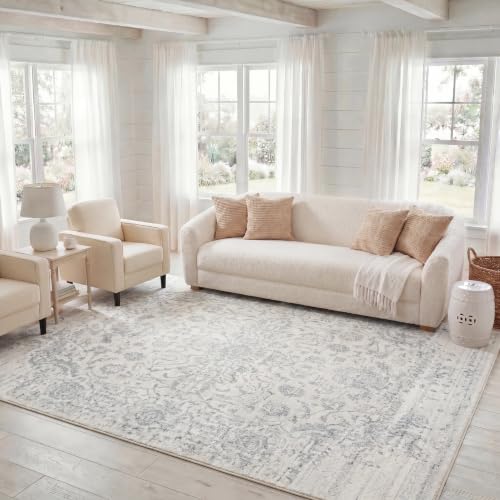
The SAFAVIEH Madison Area Rug 8×10 scales hair release to a full living room: a dense, low polypropylene pile that keeps shedding at the surface across 8×10, low-shedding fibers of its own so the tool is never fighting the rug itself, and a busy silver-and-ivory pattern that hides a day’s accumulation. Its maker positions it for homes with kids and pets, and hair behavior is a large part of why that positioning is credible.
Strengths
- Dense low pile keeps pet hair surface-level at full-room scale.
- Low-shedding construction adds no fiber of its own to the problem.
- Camouflage pattern manages appearances between removals.
Trade-offs
- Not washable; embedded hair relies on tool-and-vacuum discipline.
- Heavier rug; the flip routine is a two-person job.
- Traditional styling will not suit every room.
| Color | Silver/Ivory |
| Size | 8′ x 10′ (Rectangular) |
| Dimensions | 120 x 96 inches |
| Weight | 21.5 pounds |
At this scale, technique matters as much as construction: work the Madison in sections with a rubber brush to raise and rope the hair, vacuum each section before moving on, and finish with a full slow pass in the opposite direction. The density that makes the rug durable also means a rushed vacuum skims; the two-step rhythm is the price of a big, hair-honest rug, and it is measured in minutes, not the half-hours deep piles demand. The wider vacuum strategy for mixed pet homes is laid out in Best Vacuums For Rugs.
Best for: Large living rooms with shedding pets / Not suited for: Anyone wanting a washable full-size rug
Choose the Madison for scale with hair discipline; skip it if you need the wash reset. Check on Amazon
Maples Rugs Reggie Bohemian Floral Print Kitchen Rug
Our badge: Best Small Zone
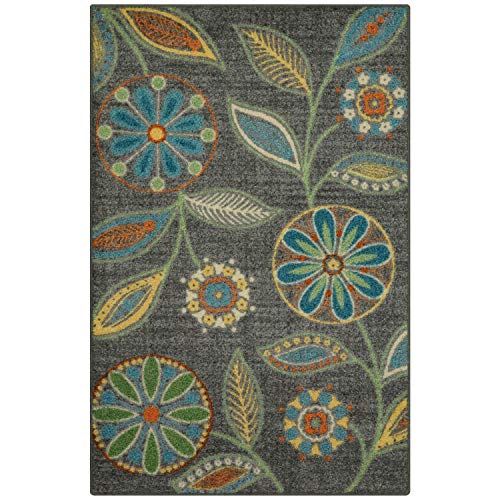
The Maples Rugs Reggie Bohemian Floral Print Kitchen Rug defends the zones where hair concentrates before it migrates: feeding stations, door-adjacent kitchens, and the floor beside the pet’s favorite perch. It is small, machine washable, stain resistant, and non-slip — a sacrificial, washable hair trap that protects the rest of the house’s textiles by being the easiest one to clean.
Strengths
- Machine washable at a size that washes without planning.
- Stain-resistant polyester pile built for kitchen and feeding zones.
- Skid-resistant backing keeps it in place under eager diners.
Trade-offs
- Accent size only.
- Low profile offers little cushion.
- Bold floral pattern is a style commitment for a small rug.
| Color | Dark Grey |
| Size | 2’6″ x 3’10” (Rectangular) |
| Weight | 2.93 pounds |
The zone strategy deserves its reputation: hair and mess obey a geography, entering at doors, pooling at feeding stations, and collecting where animals sleep. A washable rug at each pool, shaken daily and washed weekly, intercepts the majority of the household’s hair load before it ever reaches the big rugs. The Reggie is sized and priced for exactly that interception duty, and its dark grey floral hides the interval between washes with more grace than a utility mat would.
Best for: Feeding stations, entries, and pet-adjacent kitchen zones / Not suited for: Area coverage
Choose the Reggie as your hair interceptor; skip it as a room rug. Check on Amazon

DII Woven Cotton Throw Rug
Our badge: Best Shake-Out
The DII Woven Cotton Throw Rug closes the list with the oldest lint remover of all: gravity. At 2×3 and under two pounds, this handloomed cotton rug can be carried outside and shaken hard, and a woven cotton surface releases its hair load to a few sharp snaps in a way no large rug can be asked to. Between shakes, its flat weave gives brushes an easy surface.
Strengths
- Shake-out cleaning that needs no tool at all.
- Flat cotton weave brushes clean in seconds.
- Perfect scale for pet beds, crates, and favorite chairs’ floors.
Trade-offs
- Accent size only.
- Cotton grips hair slightly more than smooth synthetics between shakes.
- Pad or grip recommended; hand-dyed color can transfer.
| Color | Ombre Black |
| Size | 2′ x 3′ (Rectangular) |
| Dimensions | 36 x 24 x 0.25 inches |
| Weight | 1.68 pounds |
Use it as the rug under the pet’s own furniture — the bed, the crate threshold, the sunny spot — where hair density is highest and a daily shake is a realistic ritual. Small rugs in pet homes are not decoration; they are the first line of the hair system, and the DII’s natural hand and ombre looks let that line be a good-looking one.
Best for: Pet beds, crate zones, and small high-hair spots / Not suited for: Room coverage
Choose the DII for shake-out simplicity; skip it for area duty. Check on Amazon
Comparison Table
| Pick | Size | Hair-release style | Reset method | Check price on Amazon |
|---|---|---|---|---|
| Loloi Layla | 7’6″ x 9’6″ | Printed flat surface | Brush and vacuum | Check price on Amazon |
| Lahome Insect | 5′ x 7′ | Ultra-thin surface | Machine wash | Check price on Amazon |
| nuLOOM Blythe | 5′ x 7’5″ | Sleek short pile | Brush, vacuum, shake | Check price on Amazon |
| SAFAVIEH Madison | 8′ x 10′ | Dense low pile | Section brush plus vacuum | Check price on Amazon |
| Maples Reggie | 2’6″ x 3’10” | Small washable pile | Machine wash | Check price on Amazon |
| DII Cotton Throw | 2′ x 3′ | Flat cotton weave | Outdoor shake | Check price on Amazon |
How to Choose the Best Lint Removal Approach for Pet Hair
Match the tool to the pile, not the advertisement
Rubber-edged tools — brushes, brooms, and squeegee-style removers — work by raking and static, pulling hair into ropes that a vacuum or hand can collect; they excel on low and medium piles and are the correct first tool for almost every rug in this guide. Dampened rubber gloves do the same work by hand and shine on edges, stairs, and furniture-adjacent zones. Sticky rollers skim surfaces and are genuinely useful for clothing and upholstery, but on rugs they exhaust their sheets on the first square foot and never reach woven-in hair. Electric and vacuum solutions finish the job tools loosen. The hierarchy is consistent: rake, gather, vacuum, and reserve rollers for your coat on the way out the door.
Work in the right order and direction
Start dry and stay dry until the loose load is out; wetting a hairy rug first makes a paste that resists everything. Brush against the pile’s lay to lift, then with it to gather, vacuum each worked section before moving on, and finish with one slow full pass. Edges and the rug’s perimeter — where hair migrates and mats — deserve a dedicated hand-tool pass, because that border is where next month’s felted ridge is currently forming.
Set the interval by the animal, not the calendar
A double-coated dog in shedding season can reload a rug in two days; a short-haired cat may take two weeks. The rule is to remove hair while it is still a surface event: the moment a rug’s pattern starts to look muted by a hair film, you are already one session late. Short, frequent tool passes — two minutes with a rubber brush while the kettle boils — outperform the monthly archaeological dig on every metric, including the rug’s lifespan, since embedded hair holds grit against the fibers it surrounds.
Give the worst zones a washable rug
No tool regime fully redeems a rug that lives under a shedding animal’s bed or bowl. The professional answer is zoning: washable or shake-out rugs at the hair sources, hair-releasing constructions in the traffic lanes, and your best rugs in the rooms the animals merely visit. The picks above were chosen to staff exactly that map.
How to De-Hair a Rug Completely: The Full Protocol
Begin with the shake: any rug small enough goes outside for a hard shaking or a beating over a railing, which removes the loose fraction no tool should waste itself on. Then brush the whole surface with a rubber tool in short strokes against the pile, gathering the roped hair by hand as it forms. Vacuum slowly in two directions. Flip the rug and repeat a lighter version on the backing — the archive lives there — then vacuum the bare floor before the rug returns. For washable rugs, this protocol is the pre-wash; for others, it is the monthly deep standard, with quick brush-and-vacuum passes in between.
Problem: Hair ropes form but will not lift off the pile. — The surface is slightly too dry for static to help or the tool is worn. Lightly dampen the tool — not the rug — and work smaller sections.
Problem: The vacuum pushes hair ahead of it. — The pile is loaded beyond the machine’s solo ability. Brush first to rope the hair, then vacuum the ropes.
Problem: A felted hair mat has formed at the rug’s edge. — Work it patiently with a rubber tool in short strokes from the mat’s edge inward, vacuum frequently, and then shorten your interval so it never re-forms.
Problem: Hair returns within a day of a full clean. — The source is shedding faster than the rug is at fault. Add a washable zone rug at the source and a midweek two-minute brush pass.
Why Some Rugs Hoard Hair: The Constructions to Avoid
Deep shag is the champion hoarder: its long fibers give hair a forest to descend into, where it felts around the pile’s base beyond any tool’s reach, which is why the shag in our wider pool is absent from this pick list. Looped and heavily textured weaves snag hair mechanically. Natural fibers with scaly surfaces grip hair electrostatically and mechanically at once. None of these constructions is a bad rug — each is a bad rug for a shedding animal’s favorite room, and the distinction is the entire content of this guide. Choose the construction that surrenders, and every lint tool you own gets promoted.
Grooming the Source: The Cheapest Lint Remover Is a Brush on the Pet
Every hair removed from the animal is a hair that never enters the rug’s economy, and regular brushing of the pet — outdoors where possible — is the highest-leverage habit in this entire topic. It will not eliminate rug hair, and this guide makes no such promise, but households that brush the dog twice a week consistently report that rug sessions halve in frequency and effort. Pair it with paw wiping at the door during muddy seasons, washable covers on the pet’s own bed, and the zone rugs from this list, and the hair system becomes what it should be: a set of small, boring habits that keep the big rugs nearly effortless. The animal, for the record, usually approves of the arrangement.
Shedding Seasons: Planning for the Twice-Yearly Blowout
Most shedding animals run on a calendar their owners learn the hard way: the coat blowout, typically in spring and often again in autumn, when weeks of accumulated undercoat release in days and every textile in the house wears a grey film by breakfast. The households that survive blowouts gracefully plan for them like weather. Before the season turns, the washable rugs get their deep wash so they start empty; the zone rugs rotate so a clean reserve exists; the rubber brush takes up residence on the rug it serves rather than in a drawer; and the vacuum’s filter gets serviced, because a machine breathing through a clogged filter during the highest-load month of its year is a machine quietly failing at its one job.
During the blowout itself, the interval rule tightens: quick brush passes become daily, the pet’s own brushing moves outdoors and doubles, and expectations adjust — the goal is a rug that looks decent at a glance, not a rug that passes a white-glove inspection at the season’s peak. This is also the moment the zoning strategy proves itself, because the rooms behind closed doors and the rugs the animals do not lounge on stay presentable for guests while the pet zones run their sacrificial shift. When the season breaks, one full protocol — shake, rake, vacuum, flip, wash the washables — resets the whole house in an afternoon, and the contrast is the reward: owners consistently say the post-blowout reset is the most satisfying cleaning day of the year. The wider pet-rug map in Best Rugs For Pets shows how these seasonal tactics fit the year-round system.
Hair on Everything Else: Upholstery, Stairs, and Car Interiors
A household fighting rug hair is usually fighting the same war on three other fronts, and the techniques transfer with small adjustments. Upholstery wants the dampened glove above all: its combination of static and grip clears sofa arms and cushions in strokes, and it leaves no residue for fabrics to resent. Stairs want a hand tool and patience, worked tread by tread from the top down so debris travels one direction, with the vacuum’s hose attachment finishing each tread before you step onto it. Car interiors — the surprise front — want the rubber brush and the vacuum in alternation, because automotive carpet is a short, grippy pile that behaves like the world’s least forgiving rug; a pumice-style stone, used gently and only on durable auto textiles, is the specialist’s last resort there, never on home rugs.
The unifying principle is the one this guide opened with: hair yields to raking and static on surfaces that do not hoard it, and resists everything on surfaces that do. That is why the same household can win on its flat living-room rug and lose on its shag in the same afternoon with the same tools. Audit your textiles by that standard — which of them surrender, which hoard — and spend your replacement money on the hoarders, in the rooms where the animals actually live. It is a cheaper victory than any tool upgrade, and it compounds: every hoarding textile you retire makes every remaining session shorter.
Common Buying Mistakes
Buying stronger tools for a hoarding rug
No tool out-rakes a deep pile’s architecture. The better move is a hair-releasing construction in the pet’s zones.
Living on sticky rollers
Rollers skim rugs and bankrupt you in refills. The better move is a rubber brush for rugs and the roller for clothes.
Wetting the rug first
Water plus loose hair makes paste. The better move is dry removal first, always, with dampness reserved for the tool.
Cleaning monthly in a shedding home
Interval is the whole game. The better move is two-minute passes several times a week during shedding season.
Ignoring the underside
The backing holds an archive that migrates and smells. The better move is the monthly flip, sized to a rug you can handle.
The Two-Minute Habit: A Maintenance Rhythm That Actually Survives Real Life
Every system in this guide collapses into one behavioral insight: hair removal fails as an event and succeeds as a habit. The event model — let it build, then wage war monthly — guarantees that most of the month is spent with hair woven in, that the war itself is miserable, and that the rug ages under a permanent abrasive film. The habit model inverts all three: a rubber brush lives on or beside each pet-zone rug, a pass happens while something else is already happening — the kettle, the microwave, the dog’s dinner warming — and hair never gets the days it needs to become part of the rug. Two minutes, several times a week, is the entire cost, and it is paid in time that was previously spent standing still.
Make the habit easy to keep by removing its friction. One brush per zone, not one per house. A small hand vacuum or the main machine parked accessibly, not entombed in a closet. A washable zone rug in the wash rotation so the dirtiest textile is never waiting for a special occasion. And a household agreement that the pass belongs to whoever is standing there, which distributes two minutes so thinly that nobody experiences it as a chore at all. Households that build this rhythm stop shopping for miracle lint removers, because the miracle was never a product — it was the interval, and the interval was free.
Final Recommendation
Fix the surface first: the Loloi Layla Olive/Charcoal 7′-6″ x 9′-6″ Area Rug turns hair removal into a thirty-second brush pass because its printed pile gives hair nowhere to hide. Where a washable reset matters more, the runner-up is the Lahome Insect 5×7 (Check on Amazon). Add a rubber brush, a short interval, and zone rugs at the sources, and the best lint remover for pet hair will turn out to be the system, not a gadget.
Static, Humidity, and the Physics Nobody Mentions
Hair removal has a hidden variable that explains why the same routine works beautifully one month and sulkily the next: static electricity, which is governed by humidity. In dry winter air, hair clings to synthetic fibers with genuine determination, tools skate over it, and every pass seems to redistribute as much as it removes. The countermeasures are physical, not chemical: work the rug when the room’s air is less parched, use the dampened-tool technique — a rubber glove or brush barely moistened, which breaks the static bond on contact — and let the vacuum’s pass come immediately behind the tool’s, before the hair can re-settle and re-cling. Anti-static sprays exist, but on rugs they leave residues that attract soil, and this guide does not recommend trading a hair problem for a dirt magnet.
Summer humidity reverses the physics and brings its own footnote: hair releases more easily, but damp air plus a hair-loaded rug is an odor incubator, which is why the summer version of the system leans harder on washing and airing. The broader lesson is that hair management is environmental, not just mechanical. The households that seem effortlessly hair-free are usually running the same tools as everyone else in a slightly better-managed environment — brushed animals, zoned washables, tools at hand, intervals kept — and the seasons section earlier in this guide exists because that environment has a calendar. Respect the physics, adjust the dampness of your tools to the dryness of your air, and the mysterious bad weeks mostly explain themselves.
When the Rug Is the Problem: A Replacement Decision Framework
Sometimes the honest conclusion of a hair audit is that a beloved rug must move. The framework is simple and unsentimental. First, identify the hoarding construction in the pet’s primary room — the shag by the sofa, the textured weave under the dog bed. Second, ask whether the room or the rug matters more: if the animal’s life centers there, the rug graduates to a low-pet room — a guest room, a formal space, a bedroom with a closed door — where its hoarding goes untested and its beauty returns. Third, replace it in the pet room with a releasing construction from this list, sized generously, and notice within a week that the household’s entire hair workload has dropped by more than the replaced rug’s share, because the worst textile sets the pace and the mood for all the others.
Owners resist this framework because it feels like surrender, but it is the opposite: it is the recognition that rugs have jobs, that a shag’s job is barefoot luxury in a calm room, and that asking it to also be a dog’s lounge is a management failure, not a product failure. The households that adopt it end up with more beautiful rugs, not fewer — each one finally living in the room it was built for, and the pet rooms finally furnished with textiles that treat hair as a passing event rather than a permanent condition.
A Word for Multi-Pet and Foster Households
Households with several animals — and foster homes, whose population rotates and whose textiles absorb the difference — run the hair system at industrial scale and deserve advice scaled to match. The principles hold, but the zoning becomes architecture: washable rugs in every animal room without exception, a laundry rhythm that treats rug washing as a standing appointment rather than an event, tools duplicated at every station, and a deliberate indifference to pattern prestige in animal zones in favor of the camouflage that keeps a high-load room looking civilized between sessions. Foster households add one more rule: the incoming animal’s first-week shedding and stress accidents land on the most sacrificial textiles in the house, and the good rugs’ doors stay closed until the newcomer’s habits are known.
The encouraging truth at this scale is that systems beat effort. A multi-pet home with the right constructions and rhythms spends less weekly time on hair than a one-pet home fighting a shag and a monthly schedule, because the system removes hair at the easy moment, in the easy place, with the easy tool. Scale, in hair as in most housekeeping, punishes improvisation and rewards design — and the design in this guide costs nothing but decisions.
Frequently Asked Questions
What is the best lint remover for pet hair on rugs?
A rubber brush or squeegee-style tool, followed by a slow vacuum pass, outperforms every other method on rugs. But the deeper answer is the rug itself: flat, low, synthetic piles release hair to any tool, while deep piles defeat them all. Buy the tool for a few dollars and the rug for the room, in that order of cost and the reverse order of importance, and the question mostly answers itself for the life of the rug.
Do sticky lint rollers work on rugs?
Only on the surface fraction, and at a high cost in sheets. They are the right tool for clothing and upholstery touch-ups and the wrong primary tool for any rug with pile. Keep one by the door for your coat, by all means — just do not ask it to do a brush’s job across eighty square feet of carpet, because it will consume its refill roll, your patience, and the afternoon, in that order.
How do I get embedded pet hair out of a rug?
Rake it with a rubber tool in short strokes against the pile, gathering and vacuuming as you go, section by section. If the rug is washable, follow with a wash — the only method that reaches the backing-level fraction. Work in good light and at a low angle of sight if you can, because embedded hair is nearly invisible looking straight down and obvious raking across the surface, which is why so many rugs that “looked clean” surrender a second harvest the moment the technique changes.
Why does pet hair stick to some rugs more than others?
Pile depth, texture, and fiber surface. Long, looped, or scaly fibers give hair mechanical and static grip; smooth, low synthetics offer almost none. Construction, not luck, decides your cleaning life. The animal contributes too — long, fine undercoat hair weaves and felts far more aggressively than short, coarse guard hair — which is why two households with the same rug can honestly report opposite experiences of it.
How often should I de-hair my rugs?
As often as the surface film appears — twice a week in shedding season for heavy shedders, weekly otherwise — with a full protocol monthly. Short intervals keep every session small. Think of the film itself as the scheduling signal: the day you can see a grey cast over the pattern from standing height, the rug is asking, and answering that day costs two minutes while answering next week costs twenty.
Can vacuuming alone keep a rug hair-free?
On flat, hair-releasing piles, nearly. On anything deeper, the vacuum needs the brush’s help to raise hair first. The pair together is the system; either alone is half of it.
Are expensive electric lint removers worth it?
For upholstery and clothing, fabric shavers and electric removers have their place. On rugs, their small heads make them the slowest tool in the room, and none of them changes the underlying equation: a hoarding pile will defeat a premium device as surely as a cheap one. Spend first on the rug construction, then on a good rubber brush, and let the gadgets be last. The one electric exception is the vacuum itself, whose wide head and real suction make it the only powered tool scaled to a rug — which is why this guide treats it as the system’s finisher rather than as a lint gadget.
Does pet hair damage rugs?
Indirectly, yes. Hair itself is soft, but it traps grit against the pile and holds moisture and odor at the backing, and a rug cleaned rarely because its hair is discouraging wears faster than a rug cleaned often. The damage is done by the interval hair creates, which is why removing it little and often protects the rug as much as it pleases the eye.
What about guests with allergies visiting a pet home?
Run the full protocol on the rooms guests will use a full day ahead rather than an hour ahead, wash the washable zone rugs, and vacuum soft furnishings in the same session so the whole textile ecosystem is emptied at once. This is housekeeping, not a medical guarantee — sensitivity varies from guest to guest — but a freshly reset room is a materially different environment from a rug at the end of its interval, and hosts who time the reset to the visit are doing the one thing that reliably helps. Keep the animals’ own freshly washed bedding in the same weekly rotation too, since the pet’s bed is always the single densest hair source in any room it ever enters or sleeps in.


