Disclosure: As an Amazon Associate, dailyhomedecorating.com earns from qualifying purchases. Links to Amazon on this page are affiliate links; they cost you nothing extra. Prices and availability change often, so check the current Amazon listing before you buy.
Choosing the best material for outdoor rugs matters more than choosing the pattern, the color, or even the size, because outdoors a rug faces a combination no indoor floor covering ever meets: direct sun, standing rain, tracked grit, mildew pressure, and temperature swings that can crack a backing in a single season. The best material for outdoor rugs is the one whose fiber simply does not absorb water, does not feed mildew, and does not fade to a ghost of itself by August — and that short list is why polypropylene dominates patios and decks around the world. Get the material right and an outdoor rug is nearly carefree; get it wrong and even a beautiful rug becomes a soggy, curling chore.
This guide works on two levels. First, it explains the real material options — polypropylene, polyester, braided synthetics, natural jute and sisal, and rubber-backed utility constructions — with honest strengths and failure modes for each. Second, it reviews six verified rugs from our pool whose materials genuinely suit outdoor or indoor-outdoor life, ranked by how their fibers handle weather. If your rug will live on a wooden deck specifically, see Best Outdoor Rugs For Wood Decks; if it will sit over vinyl inside, Best Rugs For Vinyl Plank Flooring covers the backing questions that matter there.
Where to Buy
All six rugs are sold on Amazon, where you can check the current price and availability and confirm fiber content on the listing before you buy. Start with our top pick, the nuLOOM Wynn Ivory Solid Braided Indoor/Outdoor Area Rug — Check on Amazon. The other five are the Ottomanson Waterproof Runner (Check on Amazon), the SAFAVIEH Madison (Check on Amazon), the nuLOOM Moroccan Blythe (Check on Amazon), the Artistic Weavers Amodini (Check on Amazon), and the Tumble Lisa Washable Rug (Check on Amazon).
In this guide
Quick Picks
| Pick | Badge | Why it earns its place |
|---|---|---|
| nuLOOM Wynn Ivory Solid Braided Indoor/Outdoor Area Rug | Best Overall | A true indoor/outdoor braided construction you can hose down — the material benchmark here. |
| Ottomanson Waterproof Runner Rug 2’x6 | Best for Wet Zones | Waterproof, rubber-backed and low profile: built for rain paths, entries and utility corners. |
| SAFAVIEH Madison Area Rug 8×10 | Best Covered-Patio Style | Polypropylene fibers shrug off moisture under a roof while looking like an indoor rug. |
| nuLOOM 5×7 Moroccan Blythe Area Rug | Best Budget | 100% polypropylene in a smaller footprint for balconies and test-the-idea placements. |
| Artistic Weavers Amodini Vintage Oriental Area Rug | Best Large Format | Big polyester coverage for covered outdoor rooms where barefoot comfort matters. |
| Tumble Lisa Washable Area Rug | 9×12 Living Room Bedroom Area Rug | Best for Porches | Spillproof, washable polyester chenille for screened porches and three-season rooms. |
Key Takeaways
- Polypropylene is the default answer outdoors: it absorbs almost no water, resists mildew and fading, and hoses clean.
- Polyester feels softer and holds color beautifully, but it dries slower and suits covered spaces better than open rain.
- Natural fibers such as jute belong outdoors only under a roof, if at all — they absorb water and mildew in open weather.
- Backing matters as much as face fiber: open or braided constructions drain; solid rubber backings trap water underneath.
- Drainage and airflow under the rug protect the deck or patio surface as much as the rug itself.
- Every linked pick here was chosen for its material first and its pattern second — because a season outdoors will test the fiber a thousand times and the pattern only when guests happen to look down.
How These Picks Were Chosen
We started from the verified product pool for this topic and filtered by material before anything else. Rugs whose fibers are known to fail outdoors — deep plush piles that hold water for days, delicate flatweaves with no weather tolerance — were excluded even when they are excellent indoors. What remained were rugs built from polypropylene, polyester, braided indoor/outdoor constructions, and waterproof rubber-backed designs, plus one spillproof washable rug intended for covered porches rather than open decks. Within that set we ranked by how completely the construction sheds water, how the maker says it can be cleaned, and how honestly the listing describes indoor/outdoor use. We did not invent weather ratings; where a rug is a covered-space choice rather than an open-rain choice, the review says so plainly.
One honesty note: material guidance in the buying-guide sections is general category knowledge — how fibers behave in sun and rain — while every product-specific claim in the reviews comes from the verified pool data for that rug. That separation keeps the advice useful without pretending we lab-tested fade resistance. It also means the rankings here are deliberately conservative: a rug had to earn its outdoor placement from its stated construction and care instructions, not from a styled photograph of it sitting on a deck at golden hour, because plenty of indoor rugs photograph beautifully outdoors for exactly one afternoon before the first thunderstorm explains the difference between marketing and material science.
The 6 Best Material for Outdoor Rugs — Reviewed

nuLOOM Wynn Ivory Solid Braided Indoor/Outdoor Area Rug
Our badge: Best Overall
The nuLOOM Wynn Ivory Solid Braided Indoor/Outdoor Area Rug earns the lead because its construction answers the material question directly: a braided indoor/outdoor build with no absorbent pile to saturate, no dense backing to trap water against the deck, and a care routine the maker states in one line — hose it down outside and spot-treat mild stains. Braiding leaves tiny channels between the ropes of fiber, so rain passes through and air circulates, which is exactly what an outdoor rug needs to dry before mildew gets a foothold.
Strengths
- Genuine indoor/outdoor construction rather than an indoor rug pressed into service
- Hose-down cleaning removes grit, pollen and spills in minutes
- Braided texture hides tracked dirt between cleanings better than a flat print
Trade-offs
- Ivory shows muddy paw prints faster than a darker colorway would
- Braided texture is casual — it will not mimic a formal indoor oriental
- Like all outdoor rugs, it still needs lifting occasionally so the surface beneath can dry
| Color | Wynn Ivory |
| Size | 7’6″ x 9’6″ (Rectangular) |
In daily use this is the rug you stop worrying about. It anchors a patio seating group, survives a thunderstorm without being dragged inside, and shakes out or hoses off on a Saturday morning. The ivory tone brightens shaded decks where darker rugs disappear, and the braid’s slight cushion is kinder to bare feet than bare boards or concrete. Choose it as the default for uncovered and covered spaces alike; skip it only if your style demands a printed vintage pattern, in which case accept the covered-patio limits of the Madison below.
Best for: most patios and decks that need one dependable, weather-first rug / Not suited for: formal outdoor rooms that need a tailored, printed look
Choose this if you want the material question settled in one purchase. Check on Amazon

Ottomanson Waterproof Runner Rug 2’x6
Our badge: Best for Wet Zones
The Ottomanson Waterproof Runner Rug 2’x6 represents the other winning outdoor material strategy: waterproof face, rubber-style backing, low profile. Its scrape-rib polyester surface traps grit at the door line, the backing grips hard floors and concrete, and the whole runner can be swept, hosed and spot cleaned without ceremony. It is a utility material choice — the rug equivalent of a doormat that grew to runner length.
Strengths
- Waterproof build shrugs off rain, slush and spilled drinks
- Non-slip backing keeps it planted in busy door paths
- Low profile clears doors and resists curling at the edges
Trade-offs
- Runner dimensions only — it protects a path, not a seating area
- Industrial look suits entries and garages better than styled patios
- Solid backing traps moisture beneath, so lift it to dry the surface after storms
| Color | Black |
| Size | 2′ x 6′ (Runner) |
Place it where weather enters: the deck door, the side gate path, the garage-to-house threshold, under the grill station. In those zones its material honesty beats any pretty flatweave, because the job is stopping water and grit, not decorating. Pair it with a larger braided rug for the seating zone and you have a complete outdoor material system.
Best for: door paths, grill zones and any strip that takes direct rain / Not suited for: anchoring a full patio furniture arrangement
Choose it for the wettest square footage you own. Check on Amazon
SAFAVIEH Madison Area Rug 8×10
Our badge: Best Covered-Patio Style
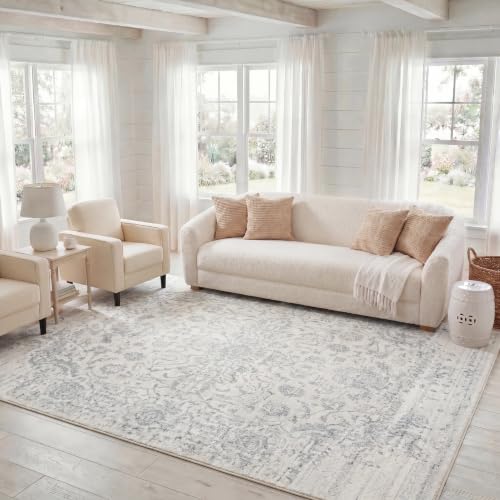
The SAFAVIEH Madison Area Rug 8×10 shows what polypropylene does for style outdoors: power-loomed synthetic fibers with a low 3/8-inch pile that looks like a vintage indoor medallion but behaves like a synthetic — low shedding, easy vacuuming, and fibers that do not drink rain the way wool or cotton would. Under a patio roof or pergola, where it takes humidity and blowing drizzle rather than direct downpours, it is a convincing outdoor-room rug.
Strengths
- Polypropylene fibers resist moisture and are easy to clean
- Low profile slides under outdoor furniture and clears doors
- Full indoor styling for covered spaces that feel like rooms
Trade-offs
- Not the pick for fully uncovered decks — standing rain will test its backing
- Silver and ivory palette shows outdoor dust between cleanings
- Needs a pad or dry surface beneath to prevent trapped damp
| Color | Silver/Ivory |
| Size | 8′ x 10′ (Rectangular) |
Think of the Madison as the bridge rug: it lets a covered patio read as an extension of the living room, which is how most households actually use that space. Vacuum it as you would indoors, blot spills promptly, and roll it up for the worst winter weeks if your climate freezes hard.
Best for: covered patios, pergolas and screened porches styled as rooms / Not suited for: open decks in heavy-rain climates
Choose it when looks matter and a roof does the heavy weather work. Check on Amazon

nuLOOM 5×7 Moroccan Blythe Area Rug
Our badge: Best Budget
The nuLOOM 5×7 Moroccan Blythe Area Rug is the low-commitment way to test outdoor material logic: 100% polypropylene, power-loomed in Turkey, in a 5×7 footprint that suits balconies, small decks and apartment patios. Polypropylene at this size dries fast simply because there is less of it, and the faded bohemian pattern forgives the dust and pollen that outdoor life deposits daily.
Strengths
- All-polypropylene construction — the right fiber, full stop
- Stain-resistant surface suits outdoor dining and plant corners
- Small size is easy to lift, shake, hose and dry
Trade-offs
- 5×7 covers a bistro set, not a full lounge arrangement
- Pattern is distinctly boho; traditional decks may prefer the Wynn
- Lightweight build can shift in wind without furniture anchoring it
| Color | Blythe Grey |
| Size | 5′ x 7’5″ (Rectangular) |
For renters and first balconies this is the sensible experiment: correct fiber, manageable size, pattern that hides the outdoors. If it proves itself for a season, scale up to the Wynn with confidence.
Best for: balconies, small decks and first outdoor rugs / Not suited for: large uncovered patios needing full coverage
Choose it to learn your space before committing to a big rug. Check on Amazon

Artistic Weavers Amodini Vintage Oriental Area Rug
Our badge: Best Large Format
The Artistic Weavers Amodini Vintage Oriental Area Rug brings polyester into the outdoor conversation at serious scale — an 8’10” x 13′ footprint with a medium pile that the maker positions for placement under patio furniture. Polyester’s outdoor profile is specific: excellent colorfastness and softness, slower drying than polypropylene. That makes the Amodini a covered-outdoor-room rug, where its size and vintage oriental styling transform a big patio into a destination.
Strengths
- Generous size anchors full outdoor seating and dining sets
- Polyester holds its navy and burnt orange tones in bright light
- Medium pile feels genuinely comfortable under bare feet
Trade-offs
- Polyester dries slower — keep it under cover, not in open rain
- Large size is heavy to move for deep cleaning when wet
- Medium pile traps more grit than a braid or flatweave
| Color | Navy/Burnt Orange |
| Size | 8’10” x 13′ (Rectangular) |
Use it where the roofline is generous and the entertaining is frequent. Vacuum grit out weekly — grit is sandpaper inside any pile — and the Amodini will hold its color and hand for seasons.
Best for: large covered patios and outdoor dining rooms / Not suited for: uncovered decks or rainy, humid sites without shelter
Choose it when scale and style lead and shelter is guaranteed. Check on Amazon

Tumble Lisa Washable Area Rug | 9×12 Living Room Bedroom Area Rug
Our badge: Best for Porches
The Tumble Lisa Washable Area Rug | 9×12 Living Room Bedroom Area Rug closes the list as the porch specialist: soft polyester chenille with a spillproof surface that beads liquids up for wiping, a complete cushioned non-slip pad included, and full machine washability when porch season leaves its marks. It is not an open-rain rug and we do not present it as one — it is the material answer for screened porches, sunrooms and three-season spaces where weather arrives as humidity and tracked dust rather than direct rain.
Strengths
- Spillproof surface buys time against drinks and plant-water overflows
- Machine washable — the deepest clean any rug here can get
- Included pad keeps corners flat and adds underfoot cushion
Trade-offs
- Polyester chenille is an indoor fiber at heart; keep it sheltered
- 9×12 needs a large-capacity wash routine per the maker’s guidance
- Fringe styling suits porches more than rugged open decks
| Color | Midnight |
| Size | 9×12′ |
On a screened porch the Tumble does what no braided rug can: it feels like an indoor rug, complete with vintage styling and fringe, while still surrendering its dirt to a washing machine. That trade — shelter required, comfort delivered — is the right one for enclosed outdoor living.
Best for: screened porches, sunrooms and three-season rooms / Not suited for: any placement that takes direct rain
Choose it when your outdoor space has walls, even screen ones. Check on Amazon
Comparison Table
| Pick | Material story | Size | Cleaning | Check price on Amazon |
|---|---|---|---|---|
| nuLOOM Wynn Braided | Braided indoor/outdoor | 7’6″ x 9’6″ | Hose down | Check price on Amazon |
| Ottomanson Runner | Waterproof, rubber-backed | 2′ x 6′ | Sweep, hose, spot clean | Check price on Amazon |
| SAFAVIEH Madison | Polypropylene, low pile | 8′ x 10′ | Vacuum, blot spills | Check price on Amazon |
| nuLOOM Blythe | 100% polypropylene | 5′ x 7’5″ | Vacuum, spot clean | Check price on Amazon |
| Artistic Weavers Amodini | Polyester, medium pile | 8’10” x 13′ | Vacuum, spot clean | Check price on Amazon |
| Tumble Lisa | Polyester chenille, spillproof | 9×12′ | Machine washable | Check price on Amazon |
How to Choose the Best Material for Outdoor Rugs
Start with water behavior, not looks
Ask one question of any fiber: what does it do when soaked? Polypropylene absorbs almost nothing, so it dries fast and starves mildew. Polyester absorbs a little and dries moderately. Cotton, wool and jute absorb a lot — outdoors that means days of damp, odor and fiber damage. Rank your shortlist by that single property and most bad purchases disappear.
Match material to exposure honestly
Surveys of your own space beat any product claim. A rug under a deep roof can be polyester or even a washable indoor construction. A rug at the roof’s drip line needs polypropylene. A rug in open rain needs polypropylene in a construction that drains — braid, flatweave or open weave — plus a plan to lift it after storms. Be honest about which zone you actually have; most disappointment comes from placing a covered-space rug in an open-rain spot, a mismatch we also flag in Best Outdoor Rugs For Wood Decks.
Weigh UV resistance and color
Solution-dyed synthetics carry color through the fiber, so sun fades them slowly and evenly. Dark colors show less pollen; mid-tones hide the most outdoor life overall. Natural fibers gray and weaken in strong sun. If your deck bakes all afternoon, fiber choice and mid-tone color together decide whether the rug looks good in year two.
Consider the surface underneath
Wood decks need airflow: trapped moisture under a solid-backed rug can stain or soften boards. Choose draining constructions and lift the rug monthly to let the deck dry. Concrete tolerates more, but alkaline moisture can still mark backings. Composite decking sits between the two. The rug material decision is always partly a deck-protection decision.
Factor cleaning reality
The best material is also the one you will actually clean. Hose-down braids and polypropylene flatweaves ask for ten minutes a month. Polyester piles ask for vacuuming grit out before it grinds fibers down. If your household will not do either, shrink the rug — a smaller correct rug beats a large neglected one every season.
How Do You Care for an Outdoor Rug Through the Season?
Shake or sweep weekly to remove grit before it works into the construction. Hose braided and polypropylene rugs monthly, or after any storm that leaves them gritty, and let them drape over a railing until fully dry before laying them flat again. Blot spills promptly; outdoor fibers resist staining best when spills do not bake in the sun. Every month or so, lift the rug completely and let both the rug’s underside and the deck surface dry in open air — this single habit prevents most mildew and deck-marking complaints. Readers comparing indoor care routines will find the same lift-and-dry logic indoors too, where backing and moisture matter just as much; and anyone timing an outdoor purchase around the sales calendar should check Black Friday Rug Deals 2026 before ordering.
Problem: the rug smells musty after rain — It stayed wet too long. Hose it, drape it in sun and moving air until bone dry, and check the deck beneath; repeat the lift-and-dry routine more often.
Problem: edges curl after storms — Water and heat cycling stresses the construction. Dry it flat weighted at the corners, and store it rolled rather than folded in the off-season.
Problem: green film appears on the underside — Algae is colonizing a damp, shaded contact layer. Clean both sides, dry fully, and improve airflow by choosing a draining construction or lifting weekly.
Problem: color looks washed out on one side — Uneven sun exposure. Rotate the rug a quarter turn monthly so fading evens out across the whole piece.
Polypropylene vs Polyester: The Two Synthetics, Honestly Compared
These two fibers decide most outdoor purchases, so the distinction deserves depth. Polypropylene is hydrophobic to its core: water sits on it rather than in it, mildew finds nothing to eat, and chlorine or salt air barely register. Its weaknesses are feel and heat — it is less soft than polyester and can soften near intense reflected heat sources. Polyester is the comfort fiber: softer hand, richer printed color, good fade behavior — but it holds more water and dries slower, which is why this guide steers it under roofs. Neither is “better” in the abstract; exposure decides. Open sky: polypropylene. Covered comfort: polyester earns its place. Households that split the difference — polypropylene for the open zone, polyester under the roof — consistently report the fewest regrets, a zoning approach that also works when you read Best Rugs For Living Room for the indoor half of an open-plan space.
What About Natural Fibers Outdoors?
Jute, sisal and seagrass tempt buyers with texture and a natural story, and under a deep covered porch a jute rug can serve a season or two as a textural layer. But honesty matters: plant fibers absorb water, swell, mildew and eventually rot in open weather, and no treatment changes that fundamental chemistry for long. If you love the look, place naturals where rain never reaches, accept a shorter service life, and keep them off bare wood that damp could mark. The braided synthetic in this guide’s top spot exists precisely to deliver similar texture without the moisture penalty. Treat natural outdoor rugs as decor with a lifespan, not as infrastructure, and you will enjoy them without resentment.
Common Buying Mistakes
Buying an indoor rug for an outdoor job
An indoor rug outdoors fails by water first and sun second. The consequence is a season of mildew and a landfill trip. Buy construction labeled and built for indoor/outdoor use, or accept the covered-only limits in writing — your own, before you order.
Ignoring the backing
A great face fiber over a water-trapping solid backing still rots the situation underneath. Match backing to surface: draining builds for wood, grip builds for door paths, and a monthly lift for everything.
Choosing white or near-white for open sky
Pollen, grit and mildew shadow make pale outdoor rugs look tired fast. The ivory Wynn succeeds because it hoses clean in minutes; a pale pile rug without that cleaning route is a mistake in the making.
Sizing for the furniture’s footprint only
Outdoor rugs need margin: chair legs should stay on the rug when pulled out, and a border of deck should frame the piece. Undersized outdoor rugs also blow and shift more in wind.
Storing it wet
Rolling a damp rug for winter guarantees a mildew unveiling in spring. Dry fully, roll face-out around a tube if you can, and store somewhere ventilated.
Choosing a Material by Climate
Climate rewrites the material rankings more than any brand difference does, so walk your own weather through the decision before you order. In hot, dry regions the enemy is ultraviolet light and heat: fibers spend ten hours a day under a hard sun, rain is rare, and drying is instant. There, polypropylene and polyester both survive, colorfastness becomes the deciding trait, and even a covered natural-fiber rug can serve because moisture almost never lingers. The failure mode to guard against is a pale rug glaring in full sun and a dark rug becoming too hot for bare feet by mid-afternoon; mid-tones solve both problems at once.
In humid subtropical and coastal climates the enemy reverses: moisture is constant, shade dries slowly, and mildew pressure never fully lifts. Here draining constructions are not a preference but a requirement, solid backings are a liability, and the lift-and-dry habit decides whether any rug survives its second summer. Salt air adds a quiet benefit to synthetics, which ignore it entirely, while metal-framed furniture nearby may not. If your porch stays damp into the afternoon most days, shrink the rug, choose the braid, and accept a plainer look as the price of a dry deck.
In four-season northern climates the rug faces freeze-thaw cycles, gritty meltwater and long storage. Polypropylene handles freezing without cracking the way some backings do, but the winning move is seasonal honesty: enjoy the rug from the last frost to the first hard freeze, then clean it, dry it completely, roll it and store it ventilated. Households that treat the outdoor rug as seasonal equipment, like patio cushions, consistently get three to five good years from a mid-range synthetic; households that abandon it under snow usually get one.
Desert Southwest decks add one more twist: reflected heat from pale concrete and stucco can be intense at ground level, and gritty wind-blown sand abrades fibers daily. Low, tight constructions shed that sand instead of holding it, and a weekly shake matters more there than any washing schedule. In the Pacific Northwest, the test is duration of damp rather than intensity of rain; airflow under the rug and a genuinely draining build matter more than any stain treatment. The pattern across all five climates is the same: name your dominant stress — sun, damp, freeze, grit or shade — and choose the material that treats that stress as a non-event.
Anatomy of an Outdoor Rug: Face, Construction and Backing
Buyers talk about material as if it were one thing, but an outdoor rug is three decisions stacked. The face fiber decides water absorption, fade behavior and feel. The construction — braided, flatwoven, power-loomed low pile, or cut pile — decides how water moves through the rug and how grit behaves inside it. The backing, or its absence, decides what happens at the hidden interface with your deck, which is where most outdoor rug damage, to rug and floor alike, actually occurs.
Braided constructions like the Wynn replace a backing with structure: the ropes themselves are the rug, water passes between them, and both sides dry. Flatweaves behave similarly when they are thin and synthetic. Power-loomed low piles add a woven foundation that slows drainage a little but adds stability and a more tailored look — the Madison’s trade. Cut piles and medium piles, like the Amodini, hold the most water and grit and therefore belong under roofs where rain arrives as weather’s rumor rather than its fact. Rubber-backed utility pieces invert the logic entirely: nothing passes through, which is perfect over a door threshold and wrong over bare wood for a whole season.
Reading a listing with this anatomy in mind takes ten seconds: fiber first, construction second, backing third, and then the maker’s own cleaning instructions, which quietly reveal how the rug expects to meet water. “Hose down” signals a rug built for weather. “Spot clean only” signals a rug that tolerates a porch. “Machine washable” signals an indoor construction that can visit a screened room. Let those phrases, rather than the styled photographs, tell you where each rug truly belongs, and cross-check your placement against Best Outdoor Rugs For Wood Decks if wood is underneath, since deck species and finish change how much trapped moisture matters.
A Season of Care, Month by Month
Spring setup sets the year’s tone. Unroll the rug on a clean, dry surface — sweeping the deck first matters, because grit sealed under a rug all season grinds both the backing and the finish. Let a stored rug breathe for a day; any storage odor in a synthetic dissipates outdoors quickly. Check edges and corners for winter damage, position furniture so legs sit fully on the rug, and note which corners take the drip line from the roof so you can watch them.
Summer is maintenance in small doses: a weekly shake or sweep, a monthly hose-down for draining constructions, prompt blotting of sunscreen, drink and grill spills before sun bakes them in, and a monthly lift to dry the interface. Rotate the rug once mid-season if one side takes most of the sun. None of this is heavy work; the households that fail with outdoor rugs fail by omission over months, not by any single storm.
Autumn asks for a decision based on climate, covered earlier: store it or winter it. Either way, the last warm dry weekend is for a full clean — hose, scrub any mildew shadow with a mild detergent solution, rinse, and dry draped in moving air until no cool dampness remains when you press a hand deep into the construction. Only then roll it, face out, ideally around a cardboard tube, and store it somewhere ventilated rather than sealed in plastic, which can trap the last invisible moisture against the fibers all winter. Come spring, the rug that was stored dry greets you clean; the one stored damp announces itself before you even unroll it.
One more habit ties the whole system together, indoors and out: the rug is part of a floor-care routine, not a substitute for one. Decks still need their finish maintained, patios still need sweeping, and entry paths still need a workhorse like the Ottomanson runner to stop grit at the boundary. Readers building that whole routine will find the indoor counterpart in Best Area Rugs For Hardwood Floors, where the same principles — right fiber, right backing, honest cleaning — protect a more delicate surface.
Sizing, Placement and Layering Outdoors
Material gets a rug through the weather; sizing and placement decide whether it works as a room. Under a dining set, the rug should extend at least two feet beyond the table on every side so rear chair legs stay on the rug when guests push back — outdoors this matters doubly, because a chair leg catching a rug edge on rough decking is how corners get torn and curled. Under a lounge grouping, front legs of every seat should rest on the rug, visually stitching the set into one island and physically anchoring the rug against wind. On a narrow balcony, a runner-format or 5×7 piece like the Blythe leaves a border of deck visible, which makes the space read larger and leaves a drainage margin at the railing where rain lands hardest.
Placement relative to water deserves a deliberate walk around your space during or just after rain. Note where the roof drip line falls, where sprinklers reach, which corner stays shaded and damp until noon, and where foot traffic enters from the yard carrying grit. Put the most draining construction across the wettest zone, keep cut-pile pieces out of the drip line entirely, and let the waterproof runner absorb the traffic path. This five-minute survey prevents the most common outdoor rug failure — a good rug in a bad square — more reliably than any upgrade in fiber.
Layering, fashionable indoors, needs caution outdoors. A rug over a rug traps a moisture sandwich that neither layer can dry, and on wood it can print a permanent damp outline. If you love a layered look, keep it to covered spaces, use a thin draining base, and separate the layers to dry after any wet week. Indoors the rules relax considerably — Best Area Rugs For Bedrooms shows how layering and softness take priority once weather leaves the equation — but outside, single-layer honesty wins.
What Outdoor Rug Materials Cost You in Effort
Every material charges rent in a different currency. Polypropylene braids charge almost none: a hose, a railing, a sunny hour. Polypropylene low piles charge a vacuuming habit, because grit hides in the pile and abrades it from inside. Polyester medium piles charge the most routine effort — frequent grit removal plus covered placement — and repay it in softness and color. Rubber-backed utility pieces charge a lifting habit, since their waterproof virtue becomes a vice if the interface underneath never dries. Natural fibers charge vigilance: the first mildew shadow must be met with sun and air the same week, not the same season.
None of these rents is unreasonable, but mismatches breed resentment: the household that hates maintenance and buys a polyester pile for an open deck will blame the rug by July. Choose the material whose rent your household will pay cheerfully, and the rug will look cared for because it is. That, more than any specification, is what separates the patios where outdoor rugs thrive for years from the ones where they are replaced every spring.
How Long Should an Outdoor Rug Last?
Set expectations by material and exposure, and you will judge your rug fairly instead of angrily. A draining polypropylene braid in open weather, lifted monthly and stored dry in harsh winters, should give three to five seasons of good looks, fading slowly and evenly rather than failing suddenly. A polypropylene low pile under a roof often lasts longer in appearance terms, because its stresses are gentler, though grit neglect can matte it early. Polyester under cover trades a little lifespan for softness and color richness. Natural fibers outdoors are one-to-two-season pieces even with care. Rubber-backed utility runners are the marathoners of the group in pure function, though their looks are utilitarian from day one.
End of life rarely arrives as a tear; it arrives as a rug that no longer dries fully, holds odor after cleaning, or has faded unevenly beyond what rotation can even out. When a synthetic reaches that point, a final deep hose-down and a demotion to the garage, workshop or under a potting bench extracts another year of honest service before recycling or disposal. Planning that cascade — patio to porch to utility — when you buy turns one purchase into several seasons of coverage across the property, and it is the quiet habit behind households whose outdoor spaces always look intentionally finished.
A Quick Material Reference to Keep
When you are standing in front of a listing, run this mental checklist. Fiber: polypropylene for open sky, polyester for covered comfort, naturals only under deep shelter. Construction: braided or flat for drainage, low pile for tailored covered spaces, medium pile only where rain cannot reach. Backing: absent or open for wood decks, grippy and waterproof only for door paths and concrete thresholds. Cleaning promise: hose-down beats spot-clean, which beats dry-clean logic, every time outdoors. Color: mid-tones hide pollen and dust; pale pieces must hose clean easily; dark pieces must not bake bare feet in your sun pattern. Size: two feet beyond dining tables, front legs on for lounge sets, a drainage margin at railings and drip lines. Care rent: name the weekly and monthly habits the material charges and confirm your household will pay them. Storage: a dry, ventilated roll for winter in cold climates. A rug that passes all eight checks is rarely a regretted purchase, and a rug that fails two or more will usually fail you in the field for exactly those reasons — the checklist is simply the whole guide compressed into the minute before you click.
Final Recommendation
For most households the answer is the nuLOOM Wynn Ivory Solid Braided Indoor/Outdoor Area Rug: the right construction, the easiest cleaning, and honest performance in open or covered sky. Add the Ottomanson runner at the door line — Check on Amazon — and your outdoor material system is complete. Choose the Madison or Amodini when a roof lets style lead, the Blythe when you are testing a small space, and the Tumble when your “outdoors” has screens and a ceiling fan.
Climate Matching: The Same Rug Is Not the Same Purchase in Phoenix and Portland
Materials guidance usually pretends weather is one thing, but outdoor rugs age by climate, and the smartest material choice in one region is merely adequate in another. In hot, high-UV climates, ultraviolet degradation is the primary enemy: fibers grow brittle, colors bleach unevenly where furniture shadows part of the rug, and backings can crack through heat cycling alone. There, solution-dyed synthetics and lighter, heat-reflecting colorways earn their keep, and rotating the rug a half-turn each season is not fussiness but lifespan arithmetic, because it evens the exposure that the sun will not.
In wet climates the enemy reverses: UV is a minor character and water management is the whole plot. Drainage, drying speed, and mildew resistance outrank every other specification, which is why braided and flat constructions beat piles, why rugs should be lifted and aired after long rain, and why storing a rug even slightly damp is the region’s cardinal sin. Humid-but-covered spaces — the screened porches of the Southeast, for instance — sit between the two regimes: rain rarely lands directly, but the air itself keeps fibers near moisture for months, so quick-drying synthetics still win and natural fibers still lose, just more slowly and with less warning.
Cold climates add the freeze-thaw test. Water held inside a construction expands as it freezes, prying at weaves and backings across a winter of nightly cycles; the rugs that survive northern decks are the ones that hold almost no water in the first place, or the ones their owners roll and store dry before the hard weather arrives. Snow load itself matters less than the melt week in spring, when a rug sits in cold water for days. Whatever your climate, the discipline is the same sentence with different emphasis: know which weather your rug will actually meet, choose the fiber that treats that weather as a non-event, and give the rug the two or three seasonal habits — rotation in sun country, lifting in rain country, dry storage in snow country — that let the material do its work.
Frequently Asked Questions
What is the single best material for outdoor rugs?
Polypropylene, for most exposures: it absorbs almost no water, resists mildew and fading, and cleans with a hose. Braided or flatwoven polypropylene constructions drain best of all.
Can I leave an outdoor rug out all winter?
In mild climates, a draining polypropylene rug can stay out with monthly lift-and-dry checks. In freeze-thaw or heavy-snow climates, cleaning, drying and rolling it for storage extends its life considerably.
Will an outdoor rug damage a wood deck?
Only if moisture stays trapped beneath it. Choose draining constructions, lift the rug regularly to dry the boards, and avoid solid rubber backings on bare wood for long periods.
Is polyester a bad outdoor rug material?
No — it is a covered-space material. It offers softness and strong color, but dries slower than polypropylene, so it belongs under roofs rather than in open rain.
How do I stop an outdoor rug blowing around?
Anchor it with furniture legs, choose a heavier braided construction, and use outdoor rug tape or a pad rated for exterior use on smooth surfaces.
Do outdoor rugs need a pad?
Not for cushion, but a breathable outdoor pad can improve airflow and grip on smooth concrete or composite. Never use a solid indoor pad outdoors; it traps the very water you are trying to shed.
Can I put an outdoor rug over grass or gravel?
Temporarily, for an event, yes — a braided synthetic will survive a weekend on grass and hose clean afterwards. As a season-long placement it is a poor idea: the ground beneath stays damp, the rug’s underside never dries, and both mildew and insects move in. For a permanent outdoor living zone, a rug wants a hard, draining surface — decking, pavers, concrete or a purpose-built gravel bed with a firm, level finish. If your only option is lawn, choose the smallest draining rug that serves the gathering, lift it after every use, and dry it draped before storing it; treated as event equipment rather than a fixture, it will last surprisingly well.


