Disclosure: As an Amazon Associate, dailyhomedecorating.com earns from qualifying purchases. Links to Amazon on this page are affiliate links; they cost you nothing extra. Prices and availability change often, so check the current Amazon listing before you buy.
Shopping for the best pillows for scoliosis means sorting honest engineering from label language, and this guide does the sorting for you. We compared the strongest verified options for this exact need – their construction, their adjustability, and the positions and people they genuinely suit – and ranked six picks below, each with its trade-offs stated plainly. If you only read one section, make it the Quick Picks table; if you read two, add the buying guide, because fit matters more than brand in this category.
Sleeping with scoliosis means sleeping with a spine whose curves are uniquely yours, which makes generic pillow advice nearly useless: the right setup depends on your curve pattern, your position, and where you actually feel strain by morning. Pillows here are comfort and positioning tools – full-length support for side sleeping, adjustable lofts you can tune to your own asymmetry, small supports placed where your body asks for them. Nothing in this guide treats or corrects a spinal curve; that is your care team’s territory, and their guidance outranks anything printed here.
We favored adjustability above all – fills and water levels you can tune asymmetrically – plus full-length and spot supports that let you build a setup around your own shape. Readers working through the wider topic often pair this guide with our coverage of Best Soft Pillows For Side Sleepers, which approaches the same sleep setup from a different angle.
Where to Buy
Every linked pick in this guide is sold on Amazon, where you can check the current price, availability and delivery options on the listing itself. We do not print prices here because they change too often to stay honest. Prose-only picks – included where our verified pool has a genuine gap for this topic – are covered in full below but carry no purchase link, and they are flagged as prose picks wherever they appear.
- Snuggle-Pedic Body Pillow for Adults (20 x 54) – Best Overall. Check on Amazon
- Coop Home Goods Eden Cool Adjustable Pillow (King) – Best Budget. Check on Amazon
- Layla Sleep Adjustable Fill Kapok Pillow (Queen, 2-Pack) – Best Premium. Check on Amazon
- Mediflow Fiber Water Pillow (Single Pack) – Best Knee-Level Alignment. Check on Amazon
- Contoured Knee Pillow (Prose-Only Pick) – Best Versatile. Prose-only pick: no purchase link (see review below).
- Lumbar Roll Pillow (Prose-Only Pick) – Best Lumbar Targeting. Prose-only pick: no purchase link (see review below).
In this guide
Quick Picks
| Pick | Badge | Why it earns its place |
|---|---|---|
| Snuggle-Pedic Body Pillow for Adults (20 x 54) | Best Overall | Full-length support for legs, belly and hips in one piece. |
| Coop Home Goods Eden Cool Adjustable Pillow (King) | Best Budget | Truly adjustable loft and firmness, with extra fill included. |
| Layla Sleep Adjustable Fill Kapok Pillow (Queen, 2-Pack) | Best Premium | Natural kapok blend is exceptionally airy and light. |
| Mediflow Fiber Water Pillow (Single Pack) | Best Knee-Level Alignment | Water base adjusts firmness precisely and responds as you move. |
| Contoured Knee Pillow (Prose-Only Pick) (prose pick) | Best Versatile | Keeps hips stacked and the top leg level. |
| Lumbar Roll Pillow (Prose-Only Pick) (prose pick) | Best Lumbar Targeting | Targets the lower back curve precisely. |
Key Takeaways
- Height fit matters more than firmness – measure your shoulder gap before buying
- Adjustable designs forgive wrong guesses; fixed contours reward right ones
- Judge any shaped pillow across two weeks of mornings, not one night
- The ridge goes under the neck and the dip under the head – setup is half the product
- Comfort framing only: persistent neck symptoms deserve professional assessment
How These Picks Were Chosen
We started from a verified product pool for this series – every linked pick below is a real, checkable listing with confirmed specifications – and scored candidates against the criteria that decide success for best pillows for scoliosis. Products that could not explain their benefit in mechanical terms, or whose verified details contradicted their marketing, were cut. Our wider research notes on adjacent sleep topics, including Best Cleaner For Patio Furniture Cushions, informed the criteria but never the rankings.
- Positioning value: Each pick had to do a specific mechanical job – level the pelvis, support the lumbar curve, hold the knees apart, or tilt the torso – and do it reliably until morning.
- Staying power: A positioning pillow that migrates is a decoration. Size, weight, shape and straps or contours that keep the pillow where you placed it all counted.
- Comfort honesty: We framed everything as comfort and positioning support, not treatment, and we favored picks whose makers do the same. Persistent back pain needs professional assessment.
- Bed practicality: Size in a real bed, case availability, washability and partner impact – a support you banish to the closet supports nothing.
We excluded ordinary head pillows with back-pain marketing but no positioning role, and anything promising to treat, cure or correct a back condition. Every pick below has a defined job in a sleep position, and the reviews state that job – and its limits – in plain language.
The 6 Best Pillows For Scoliosis – Reviewed
Snuggle-Pedic Body Pillow for Adults (20 x 54)
Our badge: Best Overall
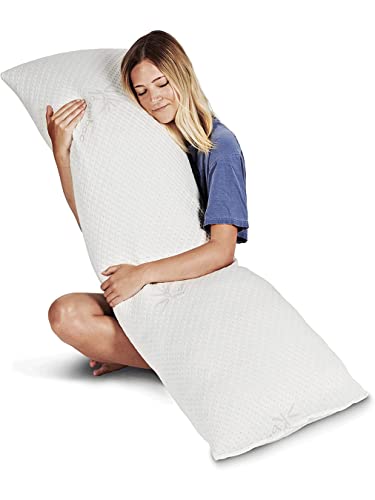
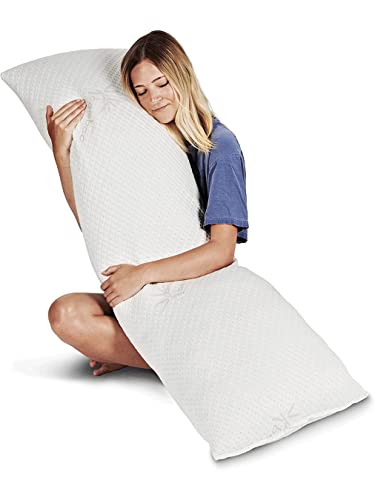
The Snuggle-Pedic Body Pillow for Adults (20 x 54) is a full-length body pillow filled with shredded memory foam and gel, in a breathable cover – made to support legs, belly and hips for side sleepers who want something to align against all night.
A body pillow changes side sleeping mechanically: hug the top and rest the upper leg over the length, and your hips and shoulders stop rolling toward the mattress. The shredded fill contours to your shape rather than pushing back like a solid foam block, and it can be fluffed and redistributed toward wherever you want more support – knees, belly, or chest. The breathable fill and cover help it sleep cooler than dense foam alternatives. It is made in the USA, hypoallergenic, and built to hold its shape over years rather than a season. The obvious cost is bed real estate: a 54-inch pillow is a commitment in a shared or smaller bed, and it needs a body pillow case and occasional full fluffing to stay even. For pregnancy, recovery, and habitual side sleeping, that trade is usually worth it – it replaces the pile of spare pillows people otherwise arrange and lose during the night.
Living with a body pillow is a routine as much as a product: a weekly full-length fluff keeps the shredded fill distributed, and rotating it end-for-end evens the wear where your knees do the most work. The length also makes it a genuine multi-tool – a backrest for reading when folded against the headboard, a barrier that keeps a restless sleeper on their side, a support for elevating legs after long days. In smaller beds, expect negotiation; in pregnancy and recovery, expect gratitude. A quality body pillow case with a zipper, rather than an envelope fold, keeps the whole arrangement together through the night.
What Snuggle-Pedic Body Pillow for Adults contributes to best pillows for scoliosis is mechanical, not magical: it holds a body part where flat bedding lets it drift, and it keeps holding it at 4 a.m. Judge it by your mornings after a week, not by the first night’s novelty.
The daily reality of Snuggle-Pedic Body Pillow for Adults is placement becoming habit: within a week, positioning it takes seconds and no thought, which is precisely when positioning tools start paying off – consistency beats intensity in this category. For best pillows for scoliosis, judge the pick by whether the habit sticks and whether mornings trend better across a fortnight, not by any single night’s novelty.
Strengths
- Full-length support for legs, belly and hips in one piece
- Shredded fill contours and can be redistributed where you need it
- Breathable, hypoallergenic, and made to hold its shape
Trade-offs
- Takes up significant space in a shared bed
- Needs a body-pillow case and regular fluffing
- Too much pillow for back-only or stomach-only sleepers
| Color | White |
| Size | Body Pillow |
| Dimensions | 16.4 x 8 x 8 inches |
| Weight | 4 pounds |
| Product Group | Home |
| Binding | Kitchen |
Best for: Side sleepers, pregnancy support, and anyone who builds a nest of spare pillows / Not suited for: Small beds, bed-sharers short on space, and stomach sleepers
Choose this pick if its strengths match your situation above; skip it if its trade-offs touch your deal-breakers. Check on Amazon

Coop Home Goods Eden Cool Adjustable Pillow (King)
Our badge: Best Budget
The Coop Home Goods Eden Cool Adjustable Pillow (King) is a fully adjustable pillow filled with a blend of gel-infused cross-cut memory foam and silky microfiber, shipped with an extra bag of fill so you can dial the loft up or down yourself.
Adjustability is the whole point here. Add fill for a firmer, loftier pillow or pull fill out for a plusher, lower one, and the feel changes in minutes rather than after a break-in week. The gel infusion in the foam helps air move through the fill, and the breathable Lulltra cover is removable and machine washable. A two-inch gusset edge helps the pillow keep its structure, so the fill stays distributed instead of migrating to the corners. The fill is virgin material rather than recycled scrap foam, and the pillow carries both GREENGUARD Gold and CertiPUR-US certification. In king size it gives restless sleepers room to move, and because the loft is yours to set, one pillow can serve a back sleeper one month and a side sleeper the next. Expect a short trial period of adding and removing handfuls of fill – that experimentation is the product working as intended.
Plan the first week as calibration, not judgment. Sleep two nights at the shipped fill level, then adjust in handfuls – most people overshoot softness first and add fill back. The king footprint gives combination sleepers room to sprawl a corner for side sleeping and flatten the center for back sleeping, effectively making one pillow behave like two zones. Keep the spare fill bag somewhere you will remember; the difference between a good month six and a flat month six is usually the top-up you meant to do. The washable cover keeps the whole system fresh, which matters more for a pillow you will own for years.
In a guide about best pillows for scoliosis, Coop Home Goods Eden Cool Adjustable Pillow represents the system piece many sleepers skip. Head pillows get the attention, but this is the support that stabilizes the position itself – the difference between a good angle and a held angle.
Consider also where Coop Home Goods Eden Cool Adjustable Pillow sits in your wider setup: it is one piece of a sleep system, and the picks here were chosen to cooperate with your existing head pillow and mattress. Change one piece at a time, a week apart, so the morning log can actually attribute improvements to causes.
Strengths
- Truly adjustable loft and firmness, with extra fill included
- Gel-infused fill and a breathable washable cover for a fresher feel
- GREENGUARD Gold and CertiPUR-US certified materials
Trade-offs
- King size is bulky and needs king cases; heavy at just over five pounds
- Finding your fill level takes a few nights of trial and error
- Shredded fill feels less uniform under the head than a solid pillow
| Color | Classic |
| Size | King |
| Dimensions | 6.49999999337 x 1.49999999847 x 8 inches |
| Weight | 5.16 pounds |
| Product Group | Home |
| Binding | Kitchen |
Best for: Combination sleepers and anyone who has never found a fixed-loft pillow that fits / Not suited for: Sleepers who want a pillow that is perfect the first night with zero setup
Choose this pick if its strengths match your situation above; skip it if its trade-offs touch your deal-breakers. Check on Amazon

Layla Sleep Adjustable Fill Kapok Pillow (Queen, 2-Pack)
Our badge: Best Premium
The Layla Sleep Adjustable Fill Kapok Pillow (Queen, 2-Pack) is a pair of adjustable pillows filled with airy natural kapok fibers blended with shredded memory foam, shipped overstuffed so you can remove fill until the loft is exactly yours.
Kapok is the differentiator: the hand-harvested fibers are extraordinarily light and airy – often called silky cotton – so air moves through the fill at a rate dense foams cannot match, while the shredded memory foam in the blend gives the pillow moldable support. Unzip the cover and remove fill by the handful to set anything from a low stomach-sleeper profile to a tall side-sleeper loft; because the fill is directly accessible, there are no preset layers limiting you. The feel lands in a rare middle: supportive enough to keep the head and neck aligned, gentle enough that it feels like resting on something soft rather than being held by something firm. The textured hexagon-stitched cover is removable and washable, with a touch of stretch that keeps the fabric pores open for airflow. Two pillows arrive in the pack. Loose fill is mildly messy to adjust – do it over the bed or a bin – and natural fibers reward occasional fluffing.
Kapok has a hand-feel people describe as closer to a hug than a hold, and the two-pack format means the guest bed or your partner gets the same tunable comfort. Because the fill is natural fiber blended with foam, the pillow benefits from a sunny airing now and then – an old-fashioned maintenance ritual that suits the material. Set the loft separately for each sleeper rather than matching them; the entire point of accessible fill is that two people sharing a bed model rarely share a shoulder width. The textured cover is pleasant enough that some owners skip a case entirely, which the washable design forgives.
For best pillows for scoliosis, Layla Sleep Adjustable Fill Kapok Pillow has a defined job in the sleep position – and it does that job without migrating, collapsing or demanding nightly negotiation. Positioning tools earn trust by being boringly reliable, and that is the standard applied here.
The daily reality of Layla Sleep Adjustable Fill Kapok Pillow is placement becoming habit: within a week, positioning it takes seconds and no thought, which is precisely when positioning tools start paying off – consistency beats intensity in this category. For best pillows for scoliosis, judge the pick by whether the habit sticks and whether mornings trend better across a fortnight, not by any single night’s novelty.
Strengths
- Natural kapok blend is exceptionally airy and light
- Fully adjustable loft, shipped overstuffed with accessible fill
- Supportive yet soft feel; washable textured cover; two-pack
Trade-offs
- Removing loose fill can be messy
- Needs regular fluffing to stay even
- Natural-fiber feel differs from classic down – a matter of taste
| Color | White |
| Size | 2 Pack Queen |
| Dimensions | 28 x 18 x 0.0393700787 inches |
| Product Group | Home |
| Binding | Kitchen |
Best for: Sleepers who want a natural, breathable fill they can tune themselves / Not suited for: Anyone who wants a set-it-and-forget-it solid pillow
Choose this pick if its strengths match your situation above; skip it if its trade-offs touch your deal-breakers. Check on Amazon

Mediflow Fiber Water Pillow (Single Pack)
Our badge: Best Knee-Level Alignment
The Mediflow Fiber Water Pillow (Single Pack) is a two-layer pillow with a plush fiber top over a responsive water base that you fill to your preferred firmness – the original water pillow, made in the USA.
The water base is a genuinely different support mechanism: it responds instantly as you move, so support stays continuous when you roll from back to side instead of resetting like foam or flattening like fiber. You control the firmness and height simply by how much water you add, which makes this one of the most precisely adjustable pillows in the pool without any loose fill to manage. The fiber top layer keeps the surface feeling like a normal, cushioned pillow rather than a waterbed. Mediflow backs the design with decades of iteration, and this waterbase approach has been examined in a clinical setting at Johns Hopkins – we frame that as comfort evidence, not a medical promise, and the pillow is popular with sleep professionals for its adjustability. Practical notes: a filled pillow is heavier to move and to flip, filling takes a few careful minutes, and you should check the water level seasonally. For sleepers who have tried foam, fiber and latex without success, water is a legitimately different answer.
Filling the Mediflow is a five-minute ritual with a measuring jug, and the level you choose becomes a record: note what worked, because seasonal tweaks – a little more in winter when you sink deeper into bedding – are normal. The water base also makes the pillow unusually stable on the bed; it does not migrate, scoot or end up on the floor, which restless sleepers’ partners appreciate. Keep it out of freezing conditions in storage, check the cap’s seal when you top up, and the system runs for years. For the chronically hard-to-fit, it remains the pool’s most genuinely different mechanism.
What Mediflow Fiber Water Pillow contributes to best pillows for scoliosis is mechanical, not magical: it holds a body part where flat bedding lets it drift, and it keeps holding it at 4 a.m. Judge it by your mornings after a week, not by the first night’s novelty.
Consider also where Mediflow Fiber Water Pillow sits in your wider setup: it is one piece of a sleep system, and the picks here were chosen to cooperate with your existing head pillow and mattress. Change one piece at a time, a week apart, so the morning log can actually attribute improvements to causes.
Strengths
- Water base adjusts firmness precisely and responds as you move
- Continuous support across back, side and stomach positions
- Plush fiber top keeps the surface feeling like a regular pillow
Trade-offs
- Heavy when filled; awkward to flip or travel with
- Filling and occasional top-ups take a little effort
- Unusual concept – some sleepers never warm to it
| Color | White |
| Size | Single Pack |
| Dimensions | 28 x 20 x 4.5 inches |
| Weight | 1.9 pounds |
| Product Group | Home |
| Binding | Kitchen |
Best for: Hard-to-fit sleepers who want precise, responsive adjustability / Not suited for: Anyone who wants the lightest, simplest pillow possible
Choose this pick if its strengths match your situation above; skip it if its trade-offs touch your deal-breakers. Check on Amazon
Contoured Knee Pillow (Prose-Only Pick)
Our badge: Best Versatile
A small hourglass-shaped pillow that sits between the knees, keeping the upper leg level so the hips stay stacked during side sleeping.
Prose-only pick: this type is not in our verified product pool for this series, so it is covered honestly without a purchase link, invented specifications or a spec box.
Side sleepers often blame the head pillow for discomfort that actually starts at the knees: when the top leg drops, the pelvis rotates and the lower back twists quietly all night. A contoured knee pillow holds the leg at hip height, and the hourglass shape plus, on some models, a strap keeps it in place through position changes. It is small, inexpensive, and easy to trial alongside your existing setup. Foam density matters – too soft collapses to nothing by midnight. It is a complement to a good head pillow, never a substitute for one.
A knee pillow is also the cheapest experiment in this entire guide series: one small purchase tests whether your discomfort is positional before you rebuild the whole bed. Keep it in the bed rather than the nightstand – a support that requires fetching is a support that gets skipped on tired nights.
In a guide about best pillows for scoliosis, This pillow represents the system piece many sleepers skip. Head pillows get the attention, but this is the support that stabilizes the position itself – the difference between a good angle and a held angle.
The daily reality of This pick is placement becoming habit: within a week, positioning it takes seconds and no thought, which is precisely when positioning tools start paying off – consistency beats intensity in this category. For best pillows for scoliosis, judge the pick by whether the habit sticks and whether mornings trend better across a fortnight, not by any single night’s novelty.
Strengths
- Keeps hips stacked and the top leg level
- Small, affordable and easy to trial
- Contoured shape stays in place better than a spare pillow
Trade-offs
- Only solves the knee-and-hip part of alignment
- Can slip out on restless nights without a strap
- Firm foam takes a few nights to get used to
Best for: Side sleepers whose discomfort starts at the hips and lower back / Not suited for: Back and stomach sleepers, who gain little from one
Choose this type if its strengths match your situation above; skip it if its trade-offs touch your deal-breakers. It is covered in prose only, so compare models carefully wherever you shop.
Lumbar Roll Pillow (Prose-Only Pick)
Our badge: Best Lumbar Targeting
A small, firm cylindrical or D-shaped roll designed to fill the curve of the lower back while lying or sitting up in bed.
Prose-only pick: this type is not in our verified product pool for this series, so it is covered honestly without a purchase link, invented specifications or a spec box.
A lumbar roll is a targeted tool, not a bed pillow: placed behind the small of the back while reading or under the knees while back sleeping, it supports the natural inward curve that flat surfaces let collapse. Rolls are inexpensive, portable between bed and chair, and easy to experiment with – if the position does not help, you have lost little. Choose a firm foam that holds its round shape under body weight, and a removable washable cover, since rolls live against pajamas and bedding nightly. It complements a main pillow rather than replacing one.
Rolls also moonlight as travel supports – car seats and long flights both flatten the lumbar curve the same way. If you trial one, commit to a full week in one position before moving it; the lower back adapts slowly, and a roll judged on night one is usually just a roll noticed on night one.
For best pillows for scoliosis, This pillow has a defined job in the sleep position – and it does that job without migrating, collapsing or demanding nightly negotiation. Positioning tools earn trust by being boringly reliable, and that is the standard applied here.
Consider also where This pick sits in your wider setup: it is one piece of a sleep system, and the picks here were chosen to cooperate with your existing head pillow and mattress. Change one piece at a time, a week apart, so the morning log can actually attribute improvements to causes.
Strengths
- Targets the lower back curve precisely
- Portable between bed, sofa and desk chair
- Low-cost way to test lumbar support
Trade-offs
- Supports one spot only – not a full sleep solution
- Too-firm rolls can feel like a lump at first
- Easy to misplace or knock off the bed
Best for: Back sleepers and bed readers who want focused lower back support / Not suited for: Anyone expecting a roll to fix a whole sleep setup alone
Choose this type if its strengths match your situation above; skip it if its trade-offs touch your deal-breakers. It is covered in prose only, so compare models carefully wherever you shop.
Comparison Table
Side by side, the six picks differ less in quality than in job description. Readers comparing across this series may also find our guide to Best Pillows For Neck Pain And Side Sleepers useful, since the two topics share several of the same products with different rankings.
| Pick | Badge | Size | Color | Weight | Check price on Amazon |
|---|---|---|---|---|---|
| Snuggle-Pedic Body Pillow for Adults (20 x 54) | Best Overall | Body Pillow | White | 4 pounds | Check price on Amazon |
| Coop Home Goods Eden Cool Adjustable Pillow (King) | Best Budget | King | Classic | 5.16 pounds | Check price on Amazon |
| Layla Sleep Adjustable Fill Kapok Pillow (Queen, 2-Pack) | Best Premium | 2 Pack Queen | White | See listing | Check price on Amazon |
| Mediflow Fiber Water Pillow (Single Pack) | Best Knee-Level Alignment | Single Pack | White | 1.9 pounds | Check price on Amazon |
| Contoured Knee Pillow (Prose-Only Pick) | Best Versatile | Varies by model | Varies by model | Varies by model | Check price on Amazon |
| Lumbar Roll Pillow (Prose-Only Pick) | Best Lumbar Targeting | Varies by model | Varies by model | Varies by model | Check price on Amazon |
How to Choose the Best Pillows For Scoliosis
The buying decisions below decide whether any pillow – including the six above – actually works for you. Work through them in order; each one narrows the field more honestly than brand or price tier does. Our guide to Best Pillows For Tmj covers a neighboring version of the same decision process.
Start With Your Sleep Position
Back sleepers need a moderate height with a dip for the head and a rise under the neck. Side sleepers need more height – enough to span the shoulder – plus an edge that does not push the shoulder forward. Stomach sleepers should go as low as possible or reconsider the position for their neck’s sake. Buy for the position you actually sleep in, not the one you intend to adopt, and if you split the night, prioritize the position you fall asleep in, since that is where you spend the deepest early hours.
Measure Your Shoulder Gap
For side sleeping, the target loft is roughly the distance from the side of your head to the tip of your shoulder, minus how much your shoulder sinks into the mattress. Narrow frames often land near four inches of effective loft; broad shoulders can need six or more. Soft mattresses shrink the gap because the shoulder sinks; firm mattresses keep it honest. Measuring beats guessing, and it explains why a pillow that transformed a friend’s sleep does nothing for you.
Understand Contour Versus Adjustable
A fixed contour is a bet on one geometry: wonderful when it matches you, useless when it does not. Adjustable designs – removable layers, add-or-remove fill, water levels – trade a little elegance for forgiveness, letting you close the last centimeter yourself. First-time shaped-pillow buyers, and anyone whose neck has rejected pillows before, should usually start adjustable. Committed contour fans who already know their height can buy fixed with confidence.
Give Any Shaped Pillow Two Weeks
Your neck has habits, and a new alignment can feel strange before it feels right. Judge a contour or adjustable pillow across ten to fourteen nights, changing only one variable at a time – height first, then position – and keep notes each morning. Discomfort that steadily decreases is adjustment; discomfort that grows, or any numbness or radiating symptoms, is a stop signal, not a perseverance test.
Plan Care Before You Buy
Foam cores generally cannot be washed, so a removable washable cover – and ideally a protector – is part of the support system, because a pillow you cannot keep clean gets replaced or endured. Shredded fills need fluffing; solid foams need airing. Match the maintenance to the effort you will honestly sustain, and check the return or trial terms before the first night, not after the fourteenth.
How to Set Up a Cervical Pillow Correctly
Placement is half the product. For a contour pillow, the higher ridge goes under your neck and the dip cradles your head – reversed, the same pillow feels like a doorstop. On your side, pull the pillow so its edge meets your shoulder, letting the shoulder rest against or into the pillow’s edge rather than on top of it; on your back, center the head in the cradle and check that your chin is neither tipped to your chest nor pointed at the ceiling.
Set the height before the first night if your pillow adjusts. Side sleepers start at the higher setting, back sleepers at the lower, and everyone changes one step at a time across nights rather than rebuilding the pillow hourly. A mirror or a partner’s eyes help: from the side, your ear, shoulder and hip should form a roughly straight line when side sleeping, and your forehead and chin should sit level when on your back. For a related setup walkthrough, see Black Friday Throw Pillow And Blanket Deals.
Protect the setup. Use a smooth, not-too-thick pillowcase so the contour’s shape reaches your neck instead of being bridged by fabric, keep a protector under it for foam cores you cannot wash, and fluff or redistribute adjustable fills weekly so the support you tuned stays tuned. Replace the pillow when the fill no longer recovers its shape after a night off – support materials age even when covers look new.
Back sleepers have the mirror-image issue: flat legs pull the pelvis and flatten the lumbar curve, and a pillow under the knees releases that pull. Both fixes are cheap, reversible experiments – try each for a week before concluding anything about your back.
Keep notes. Back comfort has good and bad weeks for reasons unrelated to pillows – activity, stress, sitting hours – and a simple morning log separates the pillow’s contribution from the noise. And keep perspective: pillows tune comfort at the margins of a condition that deserves professional guidance when it persists.
Budget honestly across the whole setup. A protector, a spare case and, for adjustable pillows, a storage bag for removed fill are part of the real cost, and they protect the main purchase. Readers who plan the full setup in one order consistently report fewer returns than readers who buy the pillow alone and improvise the rest – the accessories are where good pillows go to succeed or fail.
When a pillow in this guide tempts you, read its trade-offs list twice. Strengths are what you are buying; trade-offs are what you are agreeing to live with – the adjustment period, the care routine, the bed space, the fixed loft. Most pillow regret is not a bad product but an unread trade-off, and every pick here states its costs in plain language precisely so you can agree with your eyes open.
A final practical note on trialing any pillow in this guide: change one thing at a time, and give each change several nights. Sleep is noisy data – stress, room temperature, a late meal and a hard workout all move the needle – so a pillow judged on a single night is a pillow judged on noise. A week of mornings, briefly noted, is the smallest sample worth trusting, and it is the method behind every ranking on this page.
Pillowcases deserve more credit than they get. A thick or rough case can blunt a pillow’s designed feel, bridge over a contour, or trap heat against your face; a smooth, breathable case lets the pillow work as engineered. Whatever you buy from this guide, pair it with a case that matches its job – and keep a spare, because laundry day should never dictate your sleep setup.
Sizing is a quiet source of returns. Standard, queen and king pillows differ by inches that matter for fit in your cases and for how the pillow behaves on your bed; a pillow compressed by an undersized case sleeps firmer and taller than designed. Check your existing cases before ordering, and when in doubt match the pillow size to the bed size – queen pillows on a queen bed is the combination most bedding is designed around.
If you share a bed, treat pillow buying as a two-person decision even when the pillows differ. Partners wake each other with restless rearranging, and a pillow that one of you fights all night becomes both of your problems. Buying different pillows for each side is normal and sensible; buying matched trial periods – and keeping both sets of packaging until both verdicts are in – is the professional move.
Problem: The contour feels too high – Remove a layer or some fill, or rotate the pillow to its lower edge for a few nights while your neck adapts; height complaints are the most common and the most fixable.
Problem: You wake with the pillow pushed away – Your body is voting against the setup – usually height or firmness. Change one variable, and check that the pillow is not sliding on a satin case or an undersized pillow sham.
Problem: Your arm keeps going numb on your side – The shoulder is bearing weight it should not. Raise the loft slightly, use a design with arm space, or place a thin pillow under the forearm so the shoulder can relax.
Problem: The new-pillow smell lingers – Air foam pillows in a ventilated room for a day or two before first use, and wash the cover; certified low-odor foams fade fastest.
The Pelvis Is the Plot: Leg Position and the Sleeping Back
For side sleepers, the back’s nighttime story is written at the pelvis. When the top leg slides forward and down, the pelvis rotates, and the lower spine spends hours in a gentle twist. A pillow that keeps the top leg level – between the knees or along a body pillow – removes the twist at its source. It is unglamorous mechanics, and it is why leg support outperforms almost every head-pillow change for this audience.
Building a Sleep System Instead of Buying a Pillow
Back-aware sleepers get the best results from systems: a head pillow matched to position, a leg strategy, and a mattress that is not actively sabotaging both. The order of operations matters – fix the head pillow’s height first, add leg positioning second, and change one variable per week so you know what helped.
Common Buying Mistakes
Buying the tallest, firmest option ‘for maximum support’
Support is alignment, not altitude. An over-tall pillow cranks the neck sideways all night; match height to your frame and position instead.
Judging a shaped pillow on night one
Contours need an adjustment period. Decide across two weeks of mornings, adjusting one variable at a time, unless symptoms escalate – then stop.
Sleeping on a contour backwards
The ridge belongs under the neck, the dip under the head. Reversed placement is the most common setup error and the easiest to fix.
Stacking a second pillow ‘just in case’
Two pillows destroy the geometry one good pillow creates. If you need height, raise the pillow’s own setting rather than adding a wobbling layer.
Ignoring the mattress
A shoulder that sinks deep into a soft mattress needs less pillow; the same sleeper on a firm mattress needs more. Change one and you may need to re-tune the other.
Final Recommendation
Start with the Snuggle-Pedic Body Pillow for Adults (20 x 54): it is the pick we would buy first for best pillows for scoliosis, because it answers the topic’s central problem with the fewest compromises. If its trade-offs hit your deal-breakers, the runner-up is one click away – Check on Amazon – and the reviews above explain exactly who should choose which. If your neck has rejected pillows before, choose the most adjustable pick first – a pillow you can tune beats a pillow you must obey. Keep the packaging until two weeks of mornings have voted. For the neighboring question most readers ask next, see Best Cleaner For Patio Furniture Cushions.
Frequently Asked Questions
Where should I put a pillow for lower back comfort at night?
Back sleepers: under the knees, to release the pull that flattens the lumbar curve. Side sleepers: between the knees or along a body pillow, to keep the top leg level and the pelvis untwisted. Both are positioning comfort measures worth trialing for a week each.
Can a pillow fix my back pain?
No – and be wary of any product that says otherwise. Pillows can remove positioning aggravations and improve sleep comfort, which matters, but persistent or severe back pain needs professional assessment and a management plan beyond bedding.
Are body pillows actually useful, or just big?
Useful, mechanically: they give the top leg and arm a level place to rest, which stabilizes the pelvis and shoulders through the night. Their costs are space and heat, which is why shape choice – straight, C, J or U – matters.
Should I sleep without a pillow for my back?
For the head, almost never – the neck pays for that experiment. The productive changes are at the knees and hips. If you trial any no-pillow variation, keep it brief and stop if neck symptoms appear.
How firm should a positioning pillow be?
Firm enough to hold its working height under your legs or torso until morning. Knee and lumbar supports that collapse by midnight are the most common disappointment in this category – density is the feature.
When should I stop experimenting and see a professional?
Immediately for pain with numbness, weakness, bladder changes, fever, or after an injury – and promptly for pain that persists beyond a few weeks, keeps worsening, or disrupts most nights. Pillow experiments are for comfort, not for working around red flags.


