Where to buy
- Best overall: Nathan James Theo 5-Shelf Wall Mount Ladder Bookshelf, Walnut/Matte Black — Check on Amazon
- Best solid-wood frame: Nathan James Beacon 5-Tier Wall Mounted Bookshelf, Warm Pine — Check on Amazon
- Best for a dressing corner: Nathan James Beacon 3-Shelf Bookcase with Seagrass Cabinet — Check on Amazon
- Best long book wall: HDDFER 60 Inch 3-Tier Industrial Pipe Shelving — Check on Amazon
- Best for a dressing-room or laundry corner: SWOTCATER Stainless Steel Wall Shelf, 12 x 48 Inch — Check on Amazon
- Best DIY built-in look: LoftPaipes 5-Tier Industrial Pipe Shelf Brackets, Hardware Only — Check on Amazon
Disclosure: As an Amazon Associate, dailyhomedecorating.com earns from qualifying purchases. Links to Amazon on this page are affiliate links; they cost you nothing extra. Listing details such as price and availability change often, so check the current Amazon listing before you buy.
A bedroom is where a $500 shelf budget goes to be misunderstood. The money sounds like it should buy one magnificent piece of furniture — a tall, solid, heirloom bookcase that floats on the wall and swallows a library. Here is what the market actually sells, verified before we wrote a word of recommendation: there is no single wall shelf or wall-mounted unit on Amazon that we could confirm sells in the $400 to $500 band. Not one. The most expensive single unit we could confirm is a bookcase with hand-woven seagrass cabinet doors, priced below that band and varying by finish at national retailers — even its priciest color stops short of the band. Everything listed above that figure turned out to be two or three units photographed as one wall, a hardware kit photographed with boards the buyer supplies, or a trade list price no homeowner can actually pay. So this guide spends $500 the way a primary bedroom actually needs it spent: as a system. Five hundred dollars is one premium wall unit plus the long shelf run on the opposite wall, or a dressing-corner cabinet plus proper anchors, a stud finder and the installation hour that keeps 72 inches of furniture honest. The six picks below are the components worth building that system from.
Bedrooms also add a rule no other room imposes, and this guide treats it as non-negotiable: nothing heavy goes on the wall above a bed. A 72-inch wall-mounted bookcase is a wonderful thing beside a reading chair, flanking a dresser, or filling the dead wall opposite the foot of the bed. Mounted over a headboard, it is a loaded object suspended above sleeping people, and no anchor schedule makes that a good idea. Every tall pick below must be anchored into studs — anti-tip anchoring is the product, not an accessory — and every placement here keeps loaded shelves out of the bed’s sleeping zone entirely. Hold that rule and the rest of the bedroom math is pleasant: bedrooms are dry rooms, so the veneer and woven-fiber finishes that steam would destroy in a bathroom live long and look expensive here; loads are mostly books, folded textiles and objects you look at from a pillow; and one well-chosen wall unit can retire a floor-standing bookcase and hand the floor space back to the room.
Quick Picks
| Pick | Product | Why it earns its place | Price |
|---|---|---|---|
| Best overall | Nathan James Theo 5-Shelf Wall Mount Ladder Bookshelf, Walnut/Matte Black | The default premium bedroom wall shelf: five fixed shelves on a steel frame, 23.6 inches wide and about 72.5 inches tall — buy two and flank a dresser or a window. Read the spec field before the title: the shelves are engineered wood with a laminate face, not solid oak. Check the current price on Amazon, and compare it with the maker’s own store and other retailers before you buy. | Check on Amazon |
| Best solid-wood frame | Nathan James Beacon 5-Tier Wall Mounted Bookshelf, Warm Pine | A genuinely solid wood frame — rubberwood, wire-brushed — carrying veneer-faced shelves, with the most honest load rating in this guide: 15 pounds per shelf, 75 pounds total, printed by the maker itself. This sits toward the upper end of the open-shelf picks in this guide; check the current price on Amazon before you buy. | Check on Amazon |
| Best for a dressing corner | Nathan James Beacon 3-Shelf Bookcase with Seagrass Cabinet | The verified top of this market: three open shelves over a hand-woven seagrass-door cabinet, 32 inches wide, 14 inches deep and 72 inches tall. The push-latch cabinet hides everything a bedroom accumulates — chargers, medicines, jewelry boxes. Pricing varies by finish, so check the current price on Amazon for each color and buy the finish that makes sense when you look. | Check on Amazon |
| Best long book wall | HDDFER 60 Inch 3-Tier Industrial Pipe Shelving (LY-H3T60) | Three solid pine planks, 59.8 inches long, on a black pipe frame — boards, pipes and hardware all in the one box. Run it along the wall opposite the bed or above a low dresser, never over the headboard. Check the current price on Amazon before you buy. | Check on Amazon |
| Best for a dressing-room or laundry corner | SWOTCATER Stainless Steel Wall Shelf, 12 x 48 Inch (QJ-1248) | The one pick steam cannot hurt, which earns it a place where the bedroom meets the bathroom: a walk-in dressing room, an en-suite laundry corner, above a utility sink. In the sleeping room itself it reads as equipment, and this guide says so. Ignore the 320-pound headline; buy it for the material. | Check on Amazon |
| Best DIY built-in look | LoftPaipes 5-Tier Industrial Pipe Shelf Brackets, Hardware Only | Two 70-inch pipe uprights with fittings for five tiers — and no boards. Paint your own boards to match the bedroom trim and the result reads as built-in joinery. The listing states the omission in its size field; the styled photos do not. Your lumber decides the quality and the real total cost. | Check on Amazon |
How These Picks Were Chosen
Every pick had to clear the same bar: a real Amazon listing whose identity we could confirm from the listing’s own spec data — brand, model number and dimensions agreeing across at least two independent sources — and a clear position within this budget tier. Prices change often, so this guide does not print a static figure for any pick: for every product with an Amazon link, check the current price on Amazon, and for prose-only comparison products we describe their position in the tier qualitatively, without a printed price. Several well-known products failed the bar and were left out rather than priced from memory: a 60-inch TEN49 pipe shelf whose listing showed no current offer and whose “walnut” is a color, not a wood; a 73-inch Yusong bookcase whose price no source would state; and an NSF-certified Gridmann stainless shelf whose Amazon price we could not pin this session. A laminated Danya B. pipe shelf appears in the reviews as an honest contrast — sold at Target, without an Amazon link in this guide — because it shows the gap between pipe styling and actual pipe better than any product we could link.
On top of that general bar, the bedroom lens applied four filters of its own. First, safety geometry: any unit tall enough to hurt someone must anchor to the wall by design, and we discuss placement — beside, flanking, opposite — never above the sleeping zone of a bed or crib. Second, load realism: books are heavier than they look and folded linens lighter, so every maker’s load claim is translated into the same planning ladder used throughout this guide — roughly 15 to 20 pounds per shelf with uprights or brackets screwed into studs, 10 to 15 pounds per shelf on quality toggle bolts, and 5 to 10 pounds per shelf on the basic plastic drywall anchors most kits include. Third, materials from spec fields and manufacturer materials lists, never titles — in this category “oak wood” has resolved to laminate over engineered board, and “solid wood” to a solid frame wearing veneer shelves, and both facts change what a bedroom buyer should pay. Fourth, bedroom manners: doors that close quietly and depths matched to what bedrooms actually store — books, baskets, folded textiles, a plant, the objects you want to see last before sleep.
The 6 Best Wall Shelves for Bedrooms Under $500
Nathan James Theo 5-Shelf Wall Mount Ladder Bookshelf, Walnut/Matte Black
Who it suits: The primary-bedroom default. Theo’s narrow 23.6-inch footprint is made for the placements bedrooms actually offer: the dead strip of wall beside a reading chair, the gap between a dresser and the door, and — the classic move — a matched pair flanking a window or a low dresser, which is how the category’s own photography uses it. Buy it for books and ceramics, loaded like a bookcase rather than a storage bin rack.
What you actually get: One wall-mounted unit, 23.6 inches wide, 11.7 inches deep and about 72.5 inches tall, carrying five fixed shelves on a powder-coated steel frame. Fixed means fixed: the tier spacing does not adjust, so stand your tallest hardcover and your tallest vase against the spacing before you order. The frame anchors to the wall at the top, which is precisely what makes a six-foot ladder an acceptable object in a room where people sleep and children climb — it is a wall shelf by construction, not a leaning shelf that happens to touch plaster.
The materials, honestly: The title leans on wood, and the oak version’s title says “oak wood” outright. The manufacturer’s own materials list for the line reads: powder-coated steel, laminate, engineered wood — and the listing spec field for the oak build is blunter, naming MDF with oak-laminated shelves. So the walnut in Walnut/Matte Black is a walnut-toned laminate over an engineered board. In a bedroom that is a smaller sin than it sounds: laminate over MDF is flat, consistent and warp-free, and a bedroom is a dry, gentle room — no steam, no splashes, no cast-iron pans. What you are not getting is hardwood: the edges will not forgive standing water from an overwatered plant, and a chipped corner shows pale board instead of more walnut. Buy it as a well-made laminate shelf and it will look composed for years; buy it believing the title and the first chip will feel like a betrayal.
Load reality: Nathan James claims 50 pounds per shelf. Plan instead with this guide’s ladder: 15 to 20 pounds per shelf with the frame anchored into studs, 10 to 15 on quality toggles, 5 to 10 on basic drywall anchors — and if basic anchors are your only option, a 72-inch bookcase is the wrong purchase until you can reach a stud line. A full shelf of hardcovers is heavier than intuition says; paperbacks and mixed display sit comfortably inside the planning numbers.
Pros: The most finished-looking ladder shelf in its class; a real steel frame; a shallow 11.7-inch depth that keeps a bedroom’s walking lines clear; the maker sells singles, pairs and sets, so a second unit bought next year matches the first exactly. Honest limitation: Laminate-faced engineered shelves under a hardwood-flavored title, fixed shelf spacing, and a per-shelf load claim roughly double what we would plan around on anything but studs.
Choose it if you want the safe, good-looking default — singly for a reading corner, in a pair for a symmetrical wall. Skip it if you need adjustable shelves, genuine solid boards, or a unit for a steamy en-suite wall, where laminate edges lose slowly and permanently. On price: check the current price on Amazon, and compare it with the maker’s own store and other retailers before you buy.

Nathan James Beacon 5-Tier Wall Mounted Bookshelf, Warm Pine
Who it suits: The reader. If the Theo is the bedroom’s default, the Beacon is its reading corner perfected — a warmer, wider stance at 32 inches, a wire-brushed finish that suits a room built around rest, and a frame made of the material the Theo’s title only gestures at. Buy it for the corner with the good chair, the lamp and the stack of books in progress.
What you actually get: One wall-mounted bookcase, 32 inches wide, 12 inches deep and about 72.75 inches tall, with five shelves. The maker quotes roughly 75 minutes of assembly and backs the unit with a lifetime manufacturer warranty and a 100-day trial — terms the no-name end of this category does not offer. At this height the wall anchoring is not an accessory step; it is the product’s core safety system, and in a bedroom it is what stands between a bookcase and a tip-over hazard.
The materials, honestly: The title says “solid wood bookshelf,” and the spec fields tell the more precise story: the frame is solid wood — rubberwood, per the listing’s materials data — while the shelves are engineered wood finished with real wood veneer, wire-brushed for texture. That split is sound engineering, not a swindle: solid wood where the structure lives and the anchor screws bite, veneer-faced panels where a wide, flat, stable surface matters. A solid frame can be re-tightened over the years and holds screws the way furniture should; the veneer shelves are the wear surface, and a dropped hardcover will chip one to the core. Know which half of the title’s claim your money is buying — here, the honest half is the structural half.
Load reality: This maker prints the most honest number in the guide on its own listing: 75 pounds for the whole unit, 15 pounds per shelf. Set that beside the 50-pounds-per-shelf claim carried by its sibling above and you have the whole load-rating problem in one family — the figures are marketing temperatures, not measurements from a shared test. The Beacon’s number agrees with this guide’s planning ladder, so plan the same way: paperbacks, ceramics, plants and folded textiles, yes; a shelf of cookbooks or a vinyl collection, spread it across two shelves or step down to the pipe run reviewed below. In a bedroom, where loads run lighter than in a kitchen or office, 15 honest pounds per shelf is rarely a binding constraint.
Pros: A solid wood frame that anchors and ages like furniture; a load rating you can plan a room around without translation; warranty and trial terms that signal a serious maker. Honest limitation: Fifteen pounds per shelf is display-and-paperback territory, the veneer shelves chip at corners, and 32 inches is still narrow enough that the pair temptation applies to wide walls.
Choose it if the frame is what you are paying for and your bedroom shelves hold the lighter half of your library. Skip it if your books are heavy and many — that is the HDDFER’s job, next but one. On price: check the current price on Amazon for this Warm Pine build. Among this guide’s open-shelf picks it sits toward the upper end of the tier, so compare finishes and retailers before you buy.

Nathan James Beacon 3-Shelf Bookcase with Seagrass Cabinet
Who it suits: The dressing corner. Every primary bedroom accumulates objects that should be in the room but not on display — chargers and cables, medicines, jewelry boxes, the documents folder. This is the only pick that gives those things a door. Three open shelves above carry what you want to see; the cabinet below, fronted in hand-woven seagrass with push-latch doors, swallows the rest at 14 inches deep — the deepest storage in this guide, enough for folded linens, baskets and spare blankets.
What you actually get: One wall-mounted unit, 32 inches wide, 14 inches deep and 72 inches tall: three open shelves over a two-door cabinet. The push-latch doors deserve a bedroom-specific mention — no knobs to catch a sleeve on, no handles to rattle, and the doors close with a soft press rather than a click, which matters at 6 a.m. when someone else is still asleep. The unit secures to the wall to eliminate the tipping hazard, and at 72 inches tall with a loaded cabinet, that anchoring is a genuine safety feature rather than boilerplate.
The materials, honestly: Solid wood and real wood veneer per the listing’s own description — the same frame-and-veneer construction as the five-tier Beacon — with natural seagrass woven over the door fronts. The bedroom is the room this material was made for: dry air, no steam, no splashes, so the woven fiber that would suffer above a bathtub will look expensive here for years. Its honest limitations are different: seagrass does not wipe down like laminate, a snagged weave does not repair invisibly, and direct sun will fade it unevenly over seasons. Keep it out of the en-suite’s steam path and off the sun-blasted wall and it is the prettiest storage in this guide.
Load reality: The cabinet improves the physics — weight sits low, behind doors, close to the wall — but the open shelves obey the same planning ladder as everything else here: 15 to 20 pounds per shelf into studs, less on anything else, and the whole unit anchored, always. Do not let the furniture looks talk you out of the anchors; a loaded 72-inch cabinet that tips is the most dangerous object in this guide, and the wall it must never hang over is the bed’s.
Pros: The only pick mixing display with real closed storage; the deepest shelves here; push-latch doors that suit a sleeping room; a finish story that makes a bedroom wall look finished in one purchase. Honest limitation: The price swings by finish for the identical unit, seagrass rules out humid rooms and harsh sun, and 32 inches of cabinet fills faster than the photographs suggest.
Choose it if one styled dressing wall with hidden storage is the project. Skip it if you need maximum open shelving from a single unit — the five-tier Beacon gives two more open shelves. On price, this unit sits at the verified top of this category for a single unit: check the current price on Amazon for every finish, because the same bookcase varies by color, and do not pay a premium for the finish in the photograph without checking the others first.
HDDFER 60 Inch 3-Tier Industrial Pipe Shelving (LY-H3T60)
Who it suits: The bedroom with a real book habit and one long wall to give it. Five feet of shelving, three tiers high, belongs on the wall opposite the foot of the bed, above a low dresser, or along the wall a reading chair faces — the placements where a bedroom can use a working book wall. It does not belong over the headboard, and this guide will not pretend otherwise: the right wall for this unit is any wall except the one people sleep against.
What you actually get: One three-tier unit, 59.8 inches wide, 9.85 inches deep and 41.3 inches tall overall — and in this category the box contents matter as much as the dimensions. Boards, pipes and mounting hardware are all included, which is rarer than it should be; the kit reviewed last sells the frame alone. Note the depth: 9.85 inches takes paperbacks, most hardcovers in a single row, bottles and framed photos, and refuses storage bins, double-rowed books and deep baskets.
The materials, honestly: The brand’s copy for this line says real wood planks, and the spec data for the family lists pine — solid pine, stained in a rustic brown. Pine is soft: it will dent where a heavy bookend lands, take a ring from a water glass left by the reading chair, and across a 59.8-inch span it will show you exactly where the weight sits if the middle of a plank is loaded with encyclopedias. The pipe frame is the structural honesty of the design — loads travel to the wall flanges at the uprights — so the discipline is simple: heavy things near the uprights, light things mid-span. One more act of honesty: this listing family’s spec tables contain garbled fields we could not verify, so this guide quotes no board-thickness figure for this pick rather than inventing one.
Load reality: Plan per shelf, not per headline: 15 to 20 pounds per tier with the flanges screwed into studs, 10 to 15 on toggles, and treat the included drywall anchors as a suggestion to upgrade rather than a solution. At 60 inches wide the unit crosses studs on any standard wall, so use them. Three tiers at planning weight is a serious bedroom bookcase; three tiers at fantasy weight is a future repair that starts with something falling.
Pros: The most shelving for the budget in this guide by a wide margin; a complete kit with nothing else to buy before installation day; solid planks that can be sanded, re-stained and eventually replaced one at a time. Honest limitation: The shallow depth is a hard constraint, the pine finish is rustic in the genuine varies-from-plank sense, and the brand’s spec data is messy enough that we verified the dimensions and model from the listing twice before trusting them.
Choose it if the wall is long, the load is books, and the industrial note suits the room. Skip it if you need depth for bins or a refined, furniture-like finish. On price: check the current price on Amazon before you buy, and confirm the live listing for this exact model before relying on any figure.

SWOTCATER Stainless Steel Wall Shelf, 12 x 48 Inch (QJ-1248)
Who it suits: A specific and genuinely useful slice of bedrooms: the walk-in dressing room, the en-suite laundry corner, the wall above a utility sink where the bedroom suite meets water. If your suite includes a dressing area where towels, laundry supplies and grooming stock live within splashing distance of a sink or shower, this is the shelf that does not care. In the sleeping room itself, honesty requires the opposite advice — stainless reads as equipment, because it is equipment, and most bedrooms want furniture on their walls.
What you actually get: One single shelf, 48 inches long and 12 inches deep, on reversible brackets, sold through the brand’s own Amazon storefront. One shelf — so the honest comparison is not against the five-tier ladders above but against the cost of replacing a swollen, bubbled wooden shelf in a steamy corner every few years. The 12-inch depth is the deepest single shelf in this guide: a folded-towel stack, laundry baskets and appliances all fit where the 9.85-inch pipe run refuses them. The surface wipes clean, there is no coating to peel, and the material is the finish.
The materials, honestly: Stainless steel — and then the honesty has to cut against the marketing. The listing’s headline figure is a 320-pound weight capacity. No residential wall cashes that check. The steel, on a test rig with ideal fasteners into ideal structure, might survive it; your dressing-room wall is not a test rig, and what decides your real capacity is the same anchor ladder as every other pick: bolts into studs for genuinely heavy loads, toggles for medium duty, included screws into drywall for almost nothing you would put on a 48-inch shelf. Note also what the spec fields do not claim: no NSF certification and no steel gauge, where a competing Gridmann shelf markets both — a difference that matters to a business far more than to a home.
Load reality: Ignore 320. Plan a working load in the tens of pounds, distributed, heaviest items over the brackets, anchored into studs — and this shelf will feel indestructible for as long as you own the house. Concentrate a point load mid-span on drywall anchors and it will teach the same lesson as every other shelf in this guide, in a more expensive accent.
Pros: Immune to steam, splashes and cleaning sprays; wipes clean; the deepest single shelf here; a commercial format that ends the replace-the-bathroom-shelf cycle. Honest limitation: A single shelf in a premium position, a fantasy load rating, fingerprints and water spots that show and need a wipe, and a look that belongs in the suite’s working corners rather than over the dresser.
Choose it if the spot is wet, hot or wiped down daily. Skip it if the wall is a sleeping-room feature wall — every wooden pick above exists for that wall. Check the current price on Amazon for this listing before you buy.
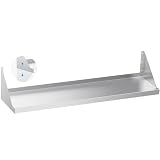
LoftPaipes 5-Tier Industrial Pipe Shelf Brackets, Hardware Only
Who it suits: The DIY buyer who wants the built-in look without the joiner’s invoice. Flank a bedroom window or a dressing desk with two pipe uprights, run boards you chose yourself — painted to match the room’s trim, or stained to match the floor — and the wall reads as cabinetry rather than as a kit. This is the one route in the guide to shelves that look original to the room, and it is priced like a project, not a product.
What you actually get: Pipes and fittings for two five-tier uprights, 70 inches tall, for boards 12 inches deep and up to 60 inches long — and nothing else. The listing’s size field states it plainly: “Not included planks.” The room photographs show stained, finished, styled shelving that exists only after your lumber-yard trip, your sanding and your finish. We include this pick with the trap fully lit because, understood properly, it is the most flexible product in the guide: species, thickness, length and finish are all yours to specify. Just never let the checkout price pretend to be the project price. The honest total is kit plus five boards plus finish plus anchors plus an afternoon.
The materials, honestly: The pipes are real — black iron pipe and fittings, the genuine article. The category’s imitation is worth naming for contrast: the Danya B. three-tier shelf sold at Target wears a pipe-look frame over laminated boards its own description calls an imitation aged wood finish. Here the honesty burden moves to your lumber decision, and thickness decides the result: a 60-inch span wants a full inch of board or better in pine or poplar to stay flat under books, and the roughly 11 inches between tiers caps your tallest objects, so lay the five tiers out against your actual books before anything is cut. Paint or seal every face of the board, edges twice — a finish that matches the bedroom trim is the entire point of this route.
Load reality: The spec field lists a 50-pound weight limit, and the maker’s own copy attaches the condition that matters: that figure assumes the frame is properly fastened into wood wall framing. Into studs, plan 15 to 20 pounds per tier across five tiers and the system is a serious bookcase. Into drywall anchors alone, the same kit is a hazard with good public relations. Of every pick here, this is the one where the planning numbers are not conservative decoration; they are the difference between the product working and not.
Pros: Real pipe; total choice of boards; exact lengths for odd bedroom walls; boards replaceable one at a time forever. Honest limitation: No boards, no finish, no instant gratification; your carpentry is the quality control; the true total cost is unknowable until the lumber is priced.
Choose it if you own a drill and opinions about wood. Skip it if the shelves need to be up this weekend — that is the HDDFER, same visual family, complete box. Check the current price on Amazon for the kit, and price the boards locally first, because they — not the kit — are the swing item in the total project cost.

Comparison Table
| Product | Size and build | Load reality | Best for | Link |
|---|---|---|---|---|
| Nathan James Theo 5-Shelf, Walnut/Matte Black | 23.6 x 11.7 in footprint, about 72.5 in tall, 5 fixed shelves; engineered wood, laminate face, steel frame | Maker claims 50 lb per shelf; plan 15–20 lb per shelf into studs | The default book wall; reading corners and pairs flanking a dresser | Check on Amazon |
| Nathan James Beacon 5-Tier, Warm Pine | 32 x 12 in, about 72.75 in tall, 5 shelves; solid rubberwood frame, veneer-faced shelves | Maker rates 15 lb per shelf, 75 lb total — the honest outlier | Real-wood frame, lighter loads, the reading corner | Check on Amazon |
| Nathan James Beacon 3-Shelf with Seagrass Cabinet | 32 x 14 in, 72 in tall, 3 shelves plus doored cabinet; solid wood, veneer, woven seagrass | Plan 15–20 lb per open shelf into studs; anchor the unit, always | A dressing corner with closed storage | Check on Amazon |
| HDDFER 60 Inch 3-Tier Pipe Shelving | 59.8 x 9.85 in, 41.3 in tall, 3 tiers; solid pine planks, pipe frame, all hardware included | Plan 15–20 lb per tier into studs; heavy items near the uprights | The long book wall opposite the bed; most shelving for the budget | Check on Amazon |
| SWOTCATER Stainless Steel Shelf 12 x 48 | 48 x 12 in, single shelf; stainless steel, reversible brackets | 320 lb headline is a lab figure; plan tens of pounds, anchored into studs | Dressing rooms, en-suite laundry corners — the suite’s wet spots | Check on Amazon |
| LoftPaipes 5-Tier Pipe Brackets, Hardware Only | 70 in tall uprights for boards up to 60 in long, 12 in deep; iron pipe and fittings, boards not included | Spec limit 50 lb, conditioned by the maker on fastening into wood framing | DIY built-in looks with buyer-chosen boards | Check on Amazon |
How to Choose a Bedroom Wall Shelf Under $500
Start with placement, because the bedroom rule comes first. Decide where the shelf may go before deciding which shelf to buy. Loaded shelving belongs beside the bed, flanking furniture, above a low dresser, or on the wall opposite the foot of the bed. It does not belong over a headboard, over a crib, or anywhere a falling book lands on a sleeping person. Once the wall is chosen, find its studs: a frame screwed into studs is a bookcase; the same product on drywall anchors is decor with ambitions.
Read the spec field for the material, never the title. In this category, “oak wood” in a title resolved, in the manufacturer’s own materials list, to engineered wood and laminate; “solid wood” resolved to a solid frame wearing veneer-faced shelves; “walnut” on an excluded competitor was a color name.
Tie every price to a length and a count. The classic trap is the photograph of a three-shelf arrangement priced as one shelf; its modern variant is the wall of three ladder bookcases priced as one unit, with the pair and the set of four hiding in the same listing family. Before comparing any two prices, write down what each box contains: how many units, how many boards, how many inches long, whether the boards exist at all.
Respect thickness and span. Sag is arithmetic, not opinion: a board’s stiffness rises with the cube of its thickness, so a plank a quarter thicker is roughly twice as stiff. Across spans of 48 to 60 inches, thin boards belong under decor, not books. If a listing will not state its board thickness in verifiable spec data, treat the span as display-only, load toward the supports, and keep the middle of long planks for light objects — paperbacks mid-span, atlases over the uprights.
Audit the hardware in the box. The cheapest upgrade in the category is a handful of quality toggle bolts and longer screws into studs, bought separately. At this budget, spending almost the whole budget on shelving and nothing on anchoring is the classic misallocation; the system approach below deliberately leaves part of the budget for the wall, and in a bedroom — where the consequence of failure is measured in more than money — that restraint is the point.
Bedroom Safety: The Non-Negotiables
Three rules govern every tall or heavy pick in this guide, and they outrank every style consideration in it. First: anchor into studs. A 72-inch wall unit — Theo, either Beacon — must have its frame screwed into studs, not toggles alone and never basic drywall anchors. If your wall cannot offer a stud where the frame needs one, choose a shorter, lighter pick or a different wall. Second: never over the bed. No loaded shelf, bookcase or cabinet hangs over a headboard, a pillow zone or a crib — not the 60-inch pipe run, not a five-tier ladder, not a single board. Third: load low, load close, recheck early. Weight belongs on the bottom shelves, tight to the wall, not stacked high where it multiplies tip-over leverage. And re-check every anchor after the first week: anchors that are going to creep announce it early as a slight forward tilt, visible from the pillow before it becomes anything worse.
The Verified Ceiling: What Happened When We Hunted for a $500 Bedroom Shelf
We went looking for the most expensive single wall shelf Amazon sells, and the honest result is that the $400-to-$500 band for a single unit is empty. The highest single-unit position in our research belongs to the seagrass-cabinet Beacon in this guide: its priciest finish, in white at Target, still stops short of that band, with its other finishes sitting lower at Target and at Home Depot. Below that the landscape steps down quickly: the five-tier Beacon sits lower in the tier, a deep 14-inch paulownia hanging bookshelf at a national home retailer sits in a similar upper part of the range below the band, then comes the long tail of more modestly positioned ladder shelves and pipe runs that make up the real market. On Amazon itself, the only routes into the top band are configurations, not shelves: the same ladder bookcase sold as a set of two or three — a purchasing format, not a product tier. Commercial stainless list figures can sit above this budget, but those are trade figures behind dealer channels, not a verifiable Amazon shelf, and a trade list figure should not be treated as a selling price. The room-by-room guides take the same evidence to the other spaces: Best Wall Shelves For Apartments Under $500, Best Wall Shelves For Modern Homes Under $500 and Best Wall Shelves For Small Rooms Under $500 each reach the same ceiling from their own angle, and the parent guide, Best Wall Shelves Under $500, lays out the full hunt.
What $500 Buys in a Bedroom: The System Math and the Saturation Point
Think of the combinations below as system builds within the $500 budget, not as single purchases — check the current price on Amazon for each component before ordering. The reading corner plus the book wall: the Beacon 5-Tier beside the HDDFER 60-inch pipe run, leaving part of the budget for toggle bolts, a stud finder and a level. The dressing corner plus the long wall: the seagrass-cabinet Beacon in light brown plus the same HDDFER run — closed storage, three display shelves and a long run of pipe shelving, still framed as one system within the budget. The symmetrical wall: two Theo units flanking a dresser or window, and even as a pair the wall lands well under the full budget, leaving room for anchors and a handyman’s hour. The split suite: the seagrass Beacon in black with a Theo — cabinet in the dressing corner, open shelves by the reading chair, one visual language.
Now notice what none of those builds does: none spends $500 on one wall position, because a bedroom position saturates first. One position — a reading corner, a dressing corner, one long run — is genuinely finished well below the top of this budget: the statement unit, its anchors, its installation. The honest shape of a $500 bedroom budget is therefore one saturated position plus a remainder, and the remainder is an allocation, not a leftover: the second wall’s run, the installer’s hour, the anchors done properly, or the same treatment carried into the guest room. And a word for the other bedrooms: for a child’s room, $500 is not a budget, it is a category error. A child’s shelving needs are a fraction of this tier — low, light, anchored, cheap enough to replace when tastes change. Spend a small part of this budget there, anchor it like it matters — in that room it matters most — and keep the rest for the room where you actually sleep. If your project is genuinely one modest wall, buy the single pick that fits it, keep the change, and let Best Wall Shelves Under $300 show you what the same money does at the tier where single units are the whole story.
Common Buying Mistakes
Mounting shelves over the bed. Loaded shelving over a sleeping person converts every anchor failure and bumped wall into a falling-object problem aimed at someone unconscious. The bed wall gets art and textiles; the library gets the other walls.
Believing the headline load rating. This guide’s six picks carry maker figures of 15 pounds per shelf, 50 pounds per shelf, 50 pounds per system and 320 pounds for one steel shelf. The anchor ladder — studs, toggles, included drywall anchors — is the only load table that transfers between products.
Buying the photograph instead of the box. A wall of three ladder bookcases, a three-shelf arrangement priced as one shelf, a hardware kit styled with boards it does not include: this category’s photography is a shell game, and the defense is boring and total — read the size field, the count field and the “what’s included” line before the price means anything.
Spending the whole budget on the shelf and nothing on the wall. At this tier the shelf is rarely the weak link; the anchor is. Buyers who regret a costly bookcase almost never regret its finish — they regret the Saturday it pulled out of drywall they knew was questionable, and in a bedroom the stakes of that Saturday are higher than in any other room. Leave money for toggles, longer screws, a stud finder or an installer, the way the system math above does.
Paying a finish premium without checking the other finishes. The seagrass Beacon’s finishes vary in price for the identical unit. Check the current price on Amazon for every finish before deciding which one you “prefer.”
Final Recommendation
For most primary bedrooms, build the system around the Theo: one unit — check the current price on Amazon — doubled when symmetry demands it, anchored into studs and placed anywhere except over the bed. If real wood in the structure matters, the Beacon 5-Tier is the upgrade that is actually an upgrade — check the current price on Amazon — a solid frame, the only load rating in the category we would plan a room around without translation, and a position that sits right at the saturation point of a single bedroom position. If the room has a dressing corner, the seagrass Beacon is the one purchase that finishes it. If the wall is long and the books are many, the HDDFER offers the most shelving for the budget in this guide — check the current price on Amazon. If the corner is wet, buy the SWOTCATER and never think about it again. And if you arrived hoping to spend $500 on one magnificent bedroom shelf, take the market’s verified verdict as a gift: it does not exist, and a bedroom does not need it to. One saturated position, honestly anchored, plus a remainder spent on the second wall or kept — that is what $500 buys in the room where you sleep.
Frequently Asked Questions
Can you really buy a single wall shelf for $500 on Amazon?
Not that we could verify. The most expensive single wall-mounted unit we could confirm is the seagrass-cabinet bookcase in this guide, positioned below the top band and varying by finish, and everything positioned above it turned out to be a multi-unit set, a hardware-only kit photographed with boards, or a trade list figure rather than a selling price. Treat $500 as a system budget — one statement unit, one working run, proper anchoring.
Is it safe to put shelves above a bed?
Loaded shelves: no. This guide’s rule is absolute — no bookcase, cabinet or loaded shelf hangs over a headboard, a pillow zone or a crib, because the people underneath are asleep and every anchor has a failure mode.
How much weight can a bedroom wall shelf actually hold?
Plan on roughly 15 to 20 pounds per shelf when brackets or frame uprights are screwed into studs, 10 to 15 pounds per shelf on quality toggle bolts, and 5 to 10 pounds per shelf on the basic drywall anchors included in most kits. Maker ratings above that range describe best-case test conditions, and the spread in this guide alone — 15 pounds per shelf from one maker, 320 pounds for a single shelf from another — shows why the anchor, not the headline, is the number to trust. Paperbacks and textiles sit comfortably in the planning band; hardcover runs belong low and over the supports.
Is “solid wood” in a shelf title ever true?
Sometimes — in the frame. In this guide’s research, the “solid wood” bookcase proved solid in its frame with veneer-faced engineered shelves, and the “oak wood” ladder shelf proved to be engineered wood with a laminate face per the manufacturer’s own materials list. The spec field and the maker’s materials list are where the truth is filed.
What does “hardware only” actually mean for the total cost?
It means the box contains the frame — pipes and fittings — and none of the boards in the photographs. Your real total is the kit plus boards from a lumber yard, priced by species, thickness and length, plus finish, plus anchors. Budget the boards first: at 60-inch spans in inch-thick pine or poplar, they are the swing cost of the project — and also the quality, which is why some buyers choose this route on purpose, painting the boards to match the bedroom trim for a built-in look no finished pick can offer.
Should I hire someone to install shelves at this size?
At 72 inches tall, on masonry, or anywhere near a bed — yes, and this tier’s budget has room for it: the system combinations above leave part of the budget unspent, which is the shape of an installer’s hour. For a straightforward stud-wall install of a single unit away from the sleeping zone, a competent DIYer with a stud finder, a level and the right anchors is fine.