Where to Buy
Short on time? These are the three wall mirrors under $300 we would check first in a modern home:
- BEAUTYPEAK 26×38 Arched Baroque Wall Mirror, Black — the ornate arch in this guide, included for eclectic-modern rooms and honestly flagged as the anti-minimalist of the six. Check on Amazon
- ISKM 48×32 LED Bathroom Mirror, Front and Back Lit — the fully specified lighted panel that turns a bathroom wall into a light source. Check on Amazon
- LOAAO 55×30 RGB LED Bathroom Mirror — the widest verified panel under the budget, for a full-width double vanity. Check on Amazon
See 3 more options:
Disclosure: As an Amazon Associate, dailyhomedecorating.com earns from qualifying purchases. Prices and availability change constantly, so this guide does not print static product prices — check the current price on Amazon for the exact size and configuration named, and check the live listing before you buy.
A mirror does different work in a modern home than in any other kind of room. In a traditional interior a mirror is furniture: it has a frame with opinions, it fills a wall the way a painting does, it is allowed to be an object. In a modern interior a mirror is closer to architecture. It is a plane of light and a piece of geometry — a circle, an arch, a frameless rectangle — and the less it calls attention to its own construction, the better it is doing its job. That difference in role changes what a $300 budget should buy, and it changes it more than most mirror guides admit.
Here is the short version of what this guide found, stated before the details because it decides everything else. For a modern home, the $300 tier offers exactly two honest routes. The first is a large backlit LED bathroom mirror — a frameless lighted panel at 48 to 55 inches that reads as a glowing wall rather than as a mirror with things attached to it. The second is one genuinely authored designer mirror: the Umbra Hubba, a 34-inch round from a real design house, with a thin metallic rim and proper hardware in the box. There is no respectable third route. The $200 to $300 band for a single passive mirror is nearly empty of verified products, and the ornate baroque arch that fills out this guide is here precisely so we can say, in print, that it works against a modern scheme rather than in it — useful only if your “modern” is actually an eclectic hybrid and you already know that about your room.
The checks behind those conclusions are the same ones we apply to every mirror, read through a modern lens. The headline size is always the outside frame size, never the glass size, and in modern rooms that ratio matters more than anywhere else, because a minimal interior exposes every centimeter of unnecessary frame. We verified real glass against the listings’ own specification fields, since acrylic panels wave and cheapen a clean wall. We also recorded stated weights and included hardware, because a modern installation should look effortless — nothing ruins that like a power cord dangling where a hardwired connection should disappear into the wall.
Quick Picks: The 6 Best Wall Mirrors Under $300 for Modern Homes
| Pick | Size (frame) | Type | Price | Best for |
|---|---|---|---|---|
| Umbra Hubba Round, 34 in, Titanium | 34 in diameter | Designer round, passive | Check price on Amazon | The one authored designer mirror in the tier — entryways, living rooms, primary baths |
| ISKM 48×32 LED Bathroom Mirror | 48 x 32 in | LED, front + back lit | Check price on Amazon | A backlit light wall over a 48 to 60 inch vanity |
| LOAAO 55×30 RGB LED Bathroom Mirror | 55 x 30 in | LED, RGB backlit + front lit | Check price on Amazon | The widest single panel that fits the budget |
| LOAAO 40×32 LED Bathroom Mirror | 40 x 32 in | LED, RGB backlit + front lit | Check price on Amazon | A compact double or generous single vanity that needs light |
| Brightify Arched Mirror, 24×36, Gold | 24 x 36 in | Thin-frame arched, passive | Check price on Amazon | A clean thin-frame arch — the modern shape at a mainstream price |
| BEAUTYPEAK 26×38 Arched Baroque, Black | 26 x 38 in | Ornate arched, passive | Check price on Amazon | Eclectic and transitional rooms only — read the review before buying it for a modern one |
All six picks carry “check price on Amazon” instead of a printed figure, and that is a deliberate policy, not missing research. Product prices change constantly, so this guide does not print static prices at all. Each review instead describes where the mirror sits within this budget tier, so you can judge the live number when you check the current price on Amazon.
How These Picks Were Chosen
We started from the same field of Amazon wall mirrors that could plausibly belong in a $300 guide — decorative arches and rounds, framed rectangles, and the large lighted bathroom mirrors that dominate the top of the category — and then applied two layers of checks: the verification layer every mirror in this project goes through, and a modern-design layer that most of the field failed.
Real glass, verified from the spec fields. A meaningful share of inexpensive “mirrors” are acrylic or mica panels: light, unbreakable, and visibly wavy at glancing angles. On a busy traditional wall that waviness can hide; on a flat modern wall, next to straight cabinet lines and large-format tile, it is the first thing a guest’s eye catches. Every pick below is a glass mirror according to its own listing specifications or manufacturer documentation. Where marketing copy and the specification table disagreed, we trusted the table.
Frame-to-glass ratio. The dimensions in a mirror’s title are the frame’s outside dimensions. A thin metal rim surrenders almost nothing; a wide ornate frame can consume several inches of glass in each direction. Modern rooms are where this ratio does its damage, because the whole point of the style is uninterrupted planes. Each review names the exact frame size and configuration and flags where the visible glass is meaningfully smaller.
One strong shape, honestly sourced. Modern interiors run on a short geometry vocabulary: the circle, the arch, the clean rectangle. We looked for mirrors that commit to one shape without decoration pasted onto it, and weighted authored design — a named design house, retail distribution beyond one marketplace, and hardware engineered for the product — over anonymous listings with similar silhouettes. That is why the Hubba leads this guide, and why the baroque arch is reviewed as a caution as much as a pick.
Light treated as architecture. Three picks are lighted bathroom mirrors. In a modern bathroom the mirror is often the room’s main light source, so we checked the real numbers — published lumens, CRI, wattage, color temperatures, dimming range — and treated colored light modes as a liability, not a feature. Architectural light is neutral and still; a mirror that cycles through rainbow backlighting is a gadget, and this guide scores it that way.
Weight, hardware and the invisible installation. A modern hang is supposed to disappear. We recorded the stated weight where the manufacturer publishes one — the Hubba at 12.9 pounds, the two big lighted mirrors at roughly 34 pounds each — noted which brackets and screws are included, and flagged where a listing is silent. For lighted mirrors we also checked plug-in versus hardwired, because a visible cord is a small failure a modern room keeps pointing at.
No static prices printed. This guide does not print product prices; every pick is marked “check price on Amazon” so the figure you act on is the live one for the exact configuration named. Nothing here carries an invented price, an invented specification, or a size we could not tie to the exact listing.
The Ceiling Check: Why This Tier Has Only Two Honest Answers
Before any styling advice, the market facts, because they constrain every modern room more than taste does. We audited where verified wall mirrors on Amazon actually sit within this budget, and the pattern is stark: mainstream decorative mirrors cluster at the entry end of the tier, designer passive mirrors from real brands sit in the middle of the budget, and the band between $200 and $300 for a single passive mirror is — as far as verified listings go — nearly empty. There is no hidden shelf of premium passive mirrors waiting near the top of the budget. There is a gap, and then there are lighted mirrors.
The lighted category is the only one that climbs into this tier in an orderly way, and you can watch it happen along one manufacturer’s size ladder: a 40×32 lighted mirror in the lower part of the tier, a 48×32 higher up it, and a 55×30 near the top of the budget — check the current price on Amazon for each size, because the live figure decides whether a given panel still fits. Then the ladder leaves the budget behind. The next size up in the same LOAAO RGB line, 60×36, normally lives above this tier and only visits it during promotions, and the larger 72×36 version sits well above the budget as well. So the top of the $300 budget is real, but it is exactly one product type at exactly one size.
Read that audit through a modern lens and the conclusion sharpens into a rule. A modern home should spend this budget on one of two things: a large backlit LED panel, where the money buys a wall of even, dimmable light with a sheet of glass in front of it — the most architectural object in the category — or the Hubba, where the money buys authored design, a disciplined rim and finish, and hardware that was engineered rather than bundled. Spending $200 to $300 hunting for a third option means paying scarcity prices for ordinary passive mirrors, or importing an ornate vintage shape that fights the room. Neither is a modern decision.
There is also a third way to hold the budget that suits modern homes particularly well: treat it as an allocation. The Hubba, positioned in the middle of this tier — check the current price on Amazon — hung perfectly level with its included hardware, leaves meaningful headroom in the budget for the lighting or the console it reflects. Modern rooms are edited rooms; a budget that ends with money unspent and one object exactly right is a success in this style, not a compromise.
The 6 Best Wall Mirrors Under $300 for Modern Homes, Reviewed
1. Umbra Hubba Round Wall Mirror, 34 Inch, Titanium — The Authored Designer Pick
Who it suits: A modern entryway, living room or primary bathroom where the mirror is meant to be a permanent piece of the room’s design — and a buyer who would rather own one object with a designer’s name behind it than three anonymous ones.
The Hubba is the only mirror in this guide that was designed in the sense modern furniture people mean the word. Umbra is a Canadian design house, the Hubba line is stocked by mainstream retailers as well as Amazon, and the 34-inch round in the metallic Titanium finish is the line’s centerpiece: a thin metallic rim around a clean circular glass, mounting hardware included in the box, and a stated weight of 12.9 pounds in Amazon’s own specification data — substantial enough to feel like a product, light enough for one secure fixing into a stud or a proper anchor. The Titanium finish matters for this lens: it is a cool, greyed metallic that sits comfortably next to matte black fixtures, brushed stainless and the desaturated palettes modern bathrooms and entryways actually use, where a warm brass would start a second conversation the room did not ask for.
For price context, check the current price on Amazon. The Hubba family is also stocked at Target, which confirms what this design is in the open market: an authored round mirror positioned in the middle of this budget tier, well above the entry-level marketplace arches in positioning and well under this guide’s ceiling. Judge the live Amazon figure against that mid-tier positioning.
This listing is also the guide’s standing lesson in reading specifications like a skeptic. Depending on which data field you read, this mirror is 34 inches (its title and its model number, 1012715-378) or 37 inches (a dimensions field), and one field names the frame material as brass on a mirror sold in a Titanium finish. Marketplace data is assembled sloppily even for good brands. Buy by the model number, measure on arrival, and keep the packaging until it is on the wall.
What stands out:
- A design-house frame and finish that hold up beside furniture-store mirrors costing far more.
- Mounting hardware included, and a published 12.9-pound weight that makes planning the fixing simple.
- At 34 inches the circle is large enough to anchor an entryway or sit over a 36-inch vanity without looking tentative.
- Documented and supported across multiple major retailers, not dependent on a single marketplace listing.
The honest limitation: Check the current price on Amazon before judging it, because this guide prints no static figure for it — click through and judge the live figure against the line’s usual mid-tier positioning elsewhere; if the live price has pushed toward the top of the budget or beyond it, the premium stops being defensible. And the brand premium is real even within its usual positioning: measured in inches of glass for the money, the mainstream picks below beat it easily. You are paying for authorship and finish, and in a modern room that is a legitimate thing to buy — as long as you know it is what you are buying.
Choose it if the mirror is a long-term design decision and a clean circle is the geometry your room is missing. Skip it if you want maximum glass for the money, or the live price has drifted far above the line’s usual mid-tier positioning.

2. ISKM 48×32 LED Bathroom Mirror, Front and Back Lit — The Light Wall
Who it suits: A modern primary bathroom with a 48 to 60 inch vanity, especially one being renovated — because this mirror can replace the separate vanity light fixture entirely, which is the single cleanest move available in a contemporary bathroom.
If the Hubba is the tier’s best object, the ISKM is its best surface. The format is the one modern bathrooms are converging on: a frameless lighted panel, front light for your face and a backlight that washes the wall behind it, so the mirror reads as a rectangle of light floating slightly off the wall rather than as a box with bulbs. The reason this particular model leads the lighted picks is documentation. Its manufacturer manual publishes a full engineering table for the 48×32: 13,611 lumens from 192 LEDs, CRI 90, three color temperatures (3000K, 4000K, 6000K), 100 watts, a 1.5-inch profile, and a weight of 15.4 kilograms — about 34 pounds. Dimming runs from 10 to 100 percent by long-press, the color temperature setting is remembered between uses, the anti-fog switches on with power, takes roughly ten minutes to become effective, and turns itself off after an hour. The manual even carries a three-year manufacturer warranty, a detail almost none of its marketplace rivals put in writing.
For a modern room, two of those specifications deserve translation. CRI 90 means the light renders skin and makeup colors close to truthfully — the difference between a grooming light and a decorative glow. And the three fixed color temperatures let you match the mirror to the rest of the home’s lighting and leave it there: 3000K if your house runs warm, 4000K for the neutral white most contemporary bathrooms are designed around. Set it once, and the memory function keeps the room’s light consistent.
On price, check the current price on Amazon, because this model’s positioning moves within the tier. When its live price sits in the lower-to-middle part of the budget, it is the best-value large lighted mirror we verified. When it has climbed toward the top of the tier, the argument softens, and the 55-inch LOAAO below becomes the more compelling comparison — so compare their live prices side by side before deciding.
What stands out:
- The most complete published specification in the guide — lumens, CRI, wattage, weight and warranty all documented.
- Front and back lighting together, so the panel can serve as the bathroom’s primary light source.
- Stepless dimming and color-temperature memory: set the room’s light once and it stays set.
- Shatterproof glass at a 48-inch width that properly serves a double vanity.
The honest limitation: At roughly 34 pounds and 48 inches wide, this is a planned installation, not a casual hang: two people, fixings into studs or rated anchors, and the plug-in versus hardwired decision made in advance — hardwired, with the junction hidden, is the installation this design deserves and the one that keeps a cord out of a clean room. The defogger is a timed heating function with a ten-minute warm-up, not an instant treatment. And its price positioning does move within the tier, so the live listing — not any figure printed elsewhere — is the one to judge.
Choose it if its live price sits comfortably within the budget when you check the current price on Amazon, and your vanity is 48 inches or wider. Skip it if its live price has climbed toward the top of the tier while the LOAAO 55-inch is positioned similarly — at that point the bigger panel is the rational buy.

3. LOAAO 55×30 RGB LED Bathroom Mirror — The Full-Width Panel
Who it suits: A wide double vanity, 55 to 60 inches, in a modern primary bathroom where one continuous lighted surface — no seam, no gap, no second fixture — is the design statement the room is built around.
This is the largest verified mirror in the guide and the only pick that spends the budget the way the headline implies: a 55×30 inch panel positioned at the top of this tier — check the current price on Amazon to confirm it still fits the budget. The format follows LOAAO’s flagship pattern — front lighting for grooming, a backlit halo for wall wash, anti-fog, dimming and memory, in a frameless-style panel that hangs horizontally across a wide vanity. In a modern bathroom, width is the luxury: a single 55-inch sheet of light and glass does what two 24-inch mirrors with a strip of painted wall between them cannot, and it is why this product type, alone in the category, genuinely reaches the top of the tier.
Its positioning tells the tier’s story in one line: this mirror sits at the very top of the budget when it fits it at all, and its live price can move above the budget — check the current price on Amazon before treating it as an under-$300 pick. Buy it in that spirit: when its live price is within the budget it is a wide, fully featured panel positioned at the ceiling of the tier, and when it has moved above the budget it belongs to a different comparison entirely. The ladder above it is a cliff rather than a slope — the larger versions of this same line sit well above this tier — so 55 inches is precisely where a $300 budget stops working.
One feature needs a modern-room warning rather than a celebration. The backlight on this model is RGB, with color modes. Architectural light is neutral and static; a bathroom that glows blue or cycles colors reads as a gadget demo and undermines the calm the panel creates. Own it by setting the backlight to a fixed neutral white that matches your color temperature, or turn the halo off. Buy it for its span and front light; treat the colors as a mode you will use twice.
What stands out:
- The widest single panel verified under the budget — a true double-vanity span with no center seam.
- Front light for tasks and a backlight that, kept neutral, gives the floating-panel look modern bathrooms want.
- Anti-fog, dimming and memory as standard equipment.
- Positioned at the top of this tier when its live price fits the budget — check price on Amazon to confirm before buying.
The honest limitation: Size is the limitation. A 55-inch lighted mirror is heavy, arrives in a large pallet-style box, and needs two people, secure studs and a settled power plan before it touches the wall — the manufacturer does not publish a weight for this size in the sources we checked, so plan the hang from the listing’s live data and treat it as a two-person job regardless. On a vanity narrower than about 55 inches it will overhang the furniture and look wrong no matter how good the light is. And its price crosses the $300 line in both directions over time, so the live listing is the final judge.
Choose it if your vanity is 55 to 60 inches and the live price is at or under $300. Skip it if your vanity is narrower — the ISKM or the 40-inch LOAAO will fit it and cost less — or if the price has drifted back above budget; its own history says it will come back down.

4. LOAAO 40×32 LED Bathroom Mirror — Lighted, at a Mainstream Price
Who it suits: A single or compact double vanity — roughly 36 to 48 inches — in a modern bathroom that needs real task light and a fog-free surface, at the point in the lighted ladder where the features arrive before the price runs away.
Positioned in the lower-to-middle part of this tier for the 40×32 inch size — check the current price on Amazon — this is where the lighted format starts making sense in a $300 guide. Like its bigger sibling, it pairs a front light — the half that actually illuminates your face — with a backlit halo, three color temperatures from warm to daylight, dimming, and a memory function that restores your last setting. LOAAO publishes unusually complete documentation for this mirror family: the 40×32 model is specified at 12,216 lumens with a CRI of 90, 75 watts, a 1.5-inch profile, and a weight of 15.48 kilograms — about 34 pounds. That weight deserves emphasis, because its tier positioning can make the mirror sound like a casual purchase and the object is not one: it is a two-person hang onto secure fixings, and it can be plugged in or hardwired depending on what your bathroom offers. In a modern room, hardwiring is the right answer whenever the wall allows it — the entire effect of a floating lighted panel depends on no cord being visible.
The backlight here is RGB, and the modern-homes verdict is the same as for the 55-inch model, only stronger, because at this size the mirror is more likely to be the room’s dominant object. A colored halo behind a 40-inch panel is not ambient design; it is a light show in a room that asked for calm. Set it to a static neutral matching your color temperature, or switch it off. Judged on its front light, defogger and glass, this is a strong modern pick; judged on its color modes, it is a party feature attached to a serious product.
What stands out:
- Front light plus backlight at a tier position where many rivals offer only one of the two.
- Published manufacturer specifications — lumens, CRI, wattage, weight — instead of adjectives.
- Anti-fog with automatic shutoff, dimming with memory, and both plug-in and hardwired power options.
- Tempered glass, sized correctly for a 36 to 48 inch vanity.
The honest limitation: The anti-fog heating works from the center of the glass outward, so after a long steamy shower the edges can stay misted while the middle clears — a limitation noted in independent coverage of this exact model and common across the category, because the heating element is a pad rather than a full-surface film. Run the defogger for a few minutes before you shower rather than after. Check the current price on Amazon before you rely on any figure for it, because its live positioning within the tier is what decides whether it remains the lower-cost lighted route in this guide.
Choose it if your vanity is 48 inches or under and you want light and defogging without stretching toward the top of the budget. Skip it if you need edge-to-edge defogging, or your vanity is a wide double — the 48-inch ISKM is the step up.

5. Brightify Arched Wall Mirror, 24×36, Gold — The Modern Shape, Mainstream Version
Who it suits: A modern or soft-modern bathroom, entryway or mantel where the design calls for an arch — the one curved shape the contemporary vocabulary fully accepts — executed with the thinnest possible frame and no ornament.
Brightify’s arch is the geometry lesson of this guide: a slim metal frame, a true semicircular top, and nothing else. Where the baroque arch below adds scrollwork, this one subtracts everything that is not the shape itself, and that restraint is exactly what makes it the modern arch. The 24×36 inch size is the standard single-sink vanity proportion, and because the frame is thin, the glass is nearly the full 24×36 — the best frame-to-glass ratio in this roundup. The maker specifies a silver-coated “HD” mirror glass and claims reflectivity above 90 percent; treat that percentage as a maker’s claim, since no industry test stands behind it, but the underlying point — real coated glass, not an acrylic panel — is the part the listing’s own details support, and it is the part that matters on a clean wall.
One finish note for this lens specifically. The verified configuration here is gold. A warm brushed gold can work in a modern room, but it is a decision, not a default: it pairs with warm metals and warmer palettes, and it will argue with a strictly monochrome black-and-chrome scheme. The same design is offered in black, which is the safer modern choice; if you buy the black version, you are buying a sibling configuration of the listing verified here, so check its live details with the same care.
One listing detail explains a whole genre of confused mirror reviews: this mirror ships with a protective film over the glass that must be peeled off before use. Left on, the film makes the reflection hazy and slightly wavy — precisely the symptoms people report when they believe they have received a plastic mirror. If any thin-frame arch looks “like acrylic” out of the box, check for the film first.
What stands out:
- The thin frame surrenders almost nothing — nearly the full 24×36 is usable glass.
- A pure arch silhouette that softens a room of right angles without adding a single ornament.
- Metal frame and real glass, a class above the polystyrene-frame arches at the bottom of the market.
- Equally at home over a vanity, a mantel or a console.
The honest limitation: Check the current price on Amazon when you click through — this guide prints no static figure for it. Expect a mainstream-arch positioning at the entry end of the tier, and judge its live price against the BEAUTYPEAK below, whose live price you should also check on Amazon. Also, 24 inches is a single-sink width; over a double vanity it will look lost, and no single 24×36 arch fixes that.
Choose it if you want the modern arch with maximum glass and minimum frame. Skip it if you need a printed price before clicking, or your vanity runs wider than about 30 inches per sink.
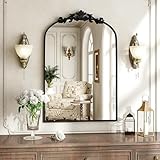
6. BEAUTYPEAK 26×38 Arched Baroque Wall Mirror, Black — Included to Be Argued With
Who it suits: Honestly? A vintage, traditional or deliberately eclectic room. It is in this guide because readers with hybrid taste — modern furniture, one antique gesture — keep arriving at this keyword, and they deserve a straight answer about the most popular ornate arch on Amazon rather than silence.
Start with what the mirror is, because on its own terms it is a good product. For the 26×38 inch black version — positioned at the entry end of this budget, so check the current price on Amazon — it delivers a deep, scrolled baroque frame, a rectangle with rounded, ornamented top corners, sold by BEAUTYPEAK’s own store, with the identical product also stocked at Target as cross-retailer confirmation that this is a real product line. At 38 inches tall it reads as furniture. In a room with carved wood, patterned textiles or a vintage mantel, it finishes the vignette by itself.
Now the modern-homes reading, without softening it: in a genuinely modern interior, this frame is not a neutral choice or a warm accent — it is a contradiction. Ornament is the thing modern design removed. A scrolled baroque profile over a flat-panel vanity or a low modern console does not create eclectic tension; it creates the impression that two different rooms were merged by accident. The black finish does not rescue it, because the problem is the silhouette, not the color. There is exactly one defensible modern use: a consciously eclectic scheme where the mirror is the single historical object in the room, everything else is disciplined, and the contrast is clearly the point. If that describes your room, this is a well-positioned way to do it. If not, the Brightify above gives you the same arch geometry in the modern language, and the Hubba gives you the authored version of a statement mirror.
The practical limitation compounds the aesthetic one. That 26×38 is frame size, and an ornate frame is wide, so the actual glass is noticeably smaller in both directions — the worst frame-to-glass ratio in this guide, in the style where that ratio matters most. The listing’s published detail is also thinner than we like; treat the product page as the final word on weight and hardware, and budget for proper anchors rather than assuming everything needed is in the box.
What stands out:
- The most dramatic silhouette in the roundup, positioned at the entry end of the budget.
- Genuinely large at 26×38 inches, with a presence designer lines usually place much higher in a tier.
- A passive mirror with no wiring or electronics — it can hang anywhere, in any room.
- Cross-retailer availability at Target confirms a real product line.
The honest limitation: For this guide’s lens, the style itself is the limitation, stated plainly: baroque ornament works against a modern scheme. Add the glass-size penalty of the wide frame and the thin published specifications, and the case for a modern buyer rests entirely on a deliberate eclectic plan.
Choose it if your room is eclectic by design and this mirror is its one historical gesture. Skip it if your home is modern in the disciplined sense — the Brightify arch or the Hubba round will serve the room instead of arguing with it.
Comparison Table
| Mirror | Frame size | Glass | Light | Weight | Price |
|---|---|---|---|---|---|
| Umbra Hubba Round, Titanium | 34 in diameter | Glass, metallic rim | None | 12.9 lb | Check price on Amazon |
| ISKM LED Bathroom Mirror | 48 x 32 in | Shatterproof glass | Front + back | About 34 lb (15.4 kg) | Check price on Amazon |
| LOAAO RGB LED Bathroom Mirror | 55 x 30 in | Tempered glass | Front + RGB back | Check listing — two-person hang | Check price on Amazon |
| LOAAO LED Bathroom Mirror | 40 x 32 in | Tempered glass | Front + RGB back | About 34 lb (15.48 kg) | Check price on Amazon |
| Brightify Arched, Gold | 24 x 36 in | Silver-coated glass, thin frame | None | Not published in sources checked | Check price on Amazon |
| BEAUTYPEAK Arched Baroque, Black | 26 x 38 in | Glass (frame size; glass smaller inside ornate frame) | None | Not published in sources checked | Check price on Amazon |
How to Choose the Right Wall Mirror for a Modern Home
Decide which of the two routes you are on. This guide’s ceiling check leaves a modern buyer with a binary choice, and making it early saves the most time. If the mirror’s job is grooming light in a bathroom, you are on the lighted route, and the budget maps onto the size ladder: 40-inch panels in the lower part of the tier, 48-inch panels higher up it, and 55-inch panels near the top — check the current price on Amazon for the size you need. If the mirror’s job is to complete a living space, you are on the designer route, and the Hubba is the benchmark everything else is compared against. The full base guide, Best Wall Mirror Under $300, works through the same tier without the design filter, if you want the unfiltered field before deciding.
Commit to one geometry per room. Modern rooms read mirrors as shapes on a wall: one circle, one arch, one rectangle. Two competing shapes in the same sightline — an arch over the vanity and a round over the tub — dissolve the discipline that makes the style work. Pick the shape the room’s architecture suggests: arches echo arched doorways and curved furniture, circles break up rooms built from right angles, and a frameless rectangle disappears into a grid of tile and cabinetry, sometimes the most modern outcome of all.
Measure the furniture, then subtract the frame. The headline size is the frame’s outside dimension. Over a vanity, a mirror a few inches narrower than the vanity on each side looks deliberate; wider than the vanity looks like an error. Then check the glass you will actually see — on the ornate BEAUTYPEAK the reflective area is meaningfully smaller than 26×38, while the thin-framed Brightify surrenders almost nothing. In compact modern bathrooms, our picks for the Best Wall Mirror For Small Rooms Under $300 apply the same proportion checks at tighter dimensions.
Treat light color as a fixed architectural decision. If you buy a lighted mirror, choose its color temperature the way you would choose the rest of the home’s lighting — because it is the rest of the home’s lighting. A 6000K daylight panel in a house lit at 3000K makes the bathroom feel like a different building; a mirror set to match, with its memory function holding the setting, disappears into the scheme. Prefer fixed neutral settings over color modes, and be suspicious of any mirror whose headline feature is the number of colors it can glow.
Plan the invisible installation. A modern hang shows nothing but the mirror. Note the stated weight, confirm what hardware is included, and decide the fixing before the mirror arrives: 12.9 pounds is one secure fixing into a stud or a rated anchor; roughly 34 pounds is two people, studs or load-rated anchors, and no improvisation. For lighted mirrors, settle plug-in versus hardwired at the same time — a hardwired connection hidden in the wall is the difference between a panel that floats and an appliance with a cord. Renters working under the same budget will find the no-drill and restoration side of these questions covered in our guide to the Best Wall Mirror For Apartments Under $300.
Interrogate the word “mirror.” Before buying anything, find the specification field that names the reflective material. Glass — float, tempered, silver-coated — is what you want. Acrylic, mica and “mirror-effect panel” are plastic: acceptable in a gym or a child’s room, visibly wavy on a flat modern wall. If the listing will not say what the surface is, that silence is your answer.
Match the frame to the room’s moisture and palette. In a bathroom, aluminum and stainless shrug off humidity that swells cheap wood-composite frames. In dry rooms the constraint is palette: cool metallics like the Hubba’s Titanium sit naturally with matte black and chrome, while warm golds and ornate blacks import a second design language. One accent is a choice; two is a theme you did not intend.
Common Buying Mistakes
Assuming $300 must be spent. The most expensive mistake in this category is believing a higher price automatically means a better passive mirror. In the upper part of this tier, passive mirrors stop getting better and start getting rarer — you are paying for brand, scarcity, or nothing at all. In a modern room especially, the edited outcome — the right mirror at an entry or mid-tier position, perfectly hung — beats the forced $300 object every time.
Buying ornament for a minimal room. A baroque or heavily carved frame in a disciplined modern interior does not read as eclectic by default; it reads as a mistake that happens to be large. Eclectic contrast works when it is singular and deliberate. If you cannot name the one historical gesture your room is making, do not let an ornate arch volunteer for the role.
Leaving the RGB on. Colored backlight modes are the fastest way to make a well-designed bathroom look like a gaming setup. The mirrors that offer them are good products with the colors off or locked to neutral white. Buy lighted mirrors for front light, defogging and span — if a listing leads with its color count, read that as a warning.
Mismatching color temperature. A mirror set to 6000K daylight surrounded by 2700K or 3000K room lighting creates a visible seam in the home’s light — faces look clinical in the mirror and warm everywhere else. Set the mirror to your home’s temperature and use the memory function to keep it there.
Buying the frame size and needing the glass size. A 26×38 ornate mirror can hold less glass than a 24×36 thin-frame one. Where the job is a full reflection — a dressing corner, a narrow entryway — compare reflective area, not headline dimensions.
Mistaking film for acrylic. Many glass mirrors ship under a protective film that makes the reflection look hazy and plastic-like. Peel it before judging or returning. The reverse mistake exists too: acrylic panels are sometimes sold with glass-sounding language, which is why the specification field outranks marketing copy.
Trusting a single spec field. The Hubba’s own data lists one mirror as both 34 and 37 inches, with a frame material that contradicts its finish. Marketplace specifications are assembled carelessly even for good brands. Cross-check the model number and measure on arrival.
Under-buying the mounting. The two large lighted mirrors in this guide weigh about 34 pounds each. Hanging one on whatever screws are in a kitchen drawer is how mirrors end up on bathroom floors. Use the included brackets as designed, hit studs or anchors rated for the load, and hang big mirrors with a second person.
Final Recommendation
For a modern home, this tier resolves into a short decision tree. If the room is a bathroom and the vanity is 48 inches or wider, the ISKM 48×32 — check the current price on Amazon and choose it when its live price sits comfortably within the budget — is the best modern object in the guide: a documented, dimmable light wall that can retire your vanity light fixture entirely. For a 55 to 60 inch double vanity, the LOAAO 55×30, positioned at the top of the tier, is the one true ceiling pick, bought for its span and front light with its color modes firmly ignored. For vanities under 48 inches, the LOAAO 40×32 covers the same ground at a lower tier position — check its current price on Amazon first.
If the room is a living space, the answer is the Umbra Hubba: the tier’s only authored designer mirror, bought at its usual mid-tier positioning — check the current price on Amazon — hung once and kept for years. The Brightify arch is the mainstream alternative when the room wants an arch and the budget wants change left over — a point our bedroom-focused companion, the Best Wall Mirror For Bedrooms Under $300 guide, develops for sleep spaces specifically. Whichever route you take, hold the modern discipline the whole way: one shape, real glass, neutral light, and nothing decorative that the room did not ask for.
And the baroque arch? Leave it to the rooms it belongs in, unless yours is deliberately eclectic. Finally, if the ceiling check has convinced you that your real budget is smaller than the headline — which for passive mirrors it honestly should be — our Best Wall Mirror Under $200 guide covers the tier where most verified value in this category lives. The best outcome this guide can give a modern home is not a $300 mirror. It is one exact shape, in real glass, lit neutrally or not at all, with money left over.
Frequently Asked Questions
What kind of mirror suits a modern home best?
One strong, simple geometry — a circle, a clean arch, or a frameless rectangle — in real glass with the thinnest frame the format allows. In bathrooms, a backlit LED panel is often the most modern answer of all, because it replaces both the mirror and the light fixture with a single plane of light. Ornate, carved or heavily profiled frames belong to traditional and eclectic schemes.
Is $300 a sensible budget for a modern wall mirror?
For a lighted bathroom mirror, yes — the size ladder genuinely reaches the top of the tier at 55 inches; check the current price on Amazon for the size you need. For a passive mirror, verified options cluster in the lower and middle parts of the budget, and the $200 to $300 band is nearly empty. Treat $300 as a ceiling, not a target: a designer mirror positioned in the middle of the tier, plus proper hanging, beats a forced purchase at the ceiling.
Are RGB backlit mirrors a good idea in a modern bathroom?
The mirrors themselves can be excellent; the color modes are the problem. Architectural light should be neutral and static, and a cycling colored halo undermines the calm geometry that makes a modern bathroom work. If you buy an RGB model — and the best large panels in this tier happen to be RGB models — set the backlight to a fixed neutral white that matches your color temperature, or turn it off, and judge the mirror on its front light, defogger and span.
What color temperature should a modern bathroom mirror use?
The one the rest of your home already uses. Most contemporary homes are lit around 3000K (warm) to 4000K (neutral). Set the mirror to match, and rely on its memory function to hold the setting — a mirror glowing at 6000K daylight in a 3000K house makes the bathroom feel like a different building and renders faces clinically.
Is the Umbra Hubba worth its premium over marketplace mirrors?
If the mirror is a long-term design piece, yes: you are paying for an authored design, a consistent finish, included hardware and retail support beyond a single listing — and its usual mid-tier positioning is still well inside this budget; check the current price on Amazon to confirm it still sits there. If the measure is inches of glass for the money, the mainstream picks win easily. Both statements are true; which one governs depends on whether the mirror is furniture or a finish material in your room.
Are the sizes in mirror listings the size of the glass?
No. Listed dimensions are the frame’s outside dimensions. Thin metal frames lose almost nothing; wide ornate frames can hide several inches of glass in each direction. If reflective area matters, compare glass size — and treat any listing that gives only one number as a frame measurement.
Do LED bathroom mirrors need an electrician?
Not always. The lighted mirrors in this guide can typically be plugged in or hardwired. Plug-in is a straightforward DIY hang; hardwiring into a bathroom circuit should follow local electrical code and is worth an electrician if you are not experienced. In a modern bathroom, hardwiring is usually the right call aesthetically, because it hides the connection entirely. Either way, look for a real safety listing such as ETL or UL in the product documentation.
Why does this guide not print prices?
Because product prices change constantly, and a static figure printed here could be wrong by the time you read it. Every pick is linked so you can check the current price on Amazon for the exact size and configuration named, and every review describes where its mirror sits within this budget tier, so you can judge whether the live number fits the position described.