Where to buy
Check the latest price, availability and delivery on Amazon. Orders are placed on Amazon. We may earn a commission from qualifying purchases.
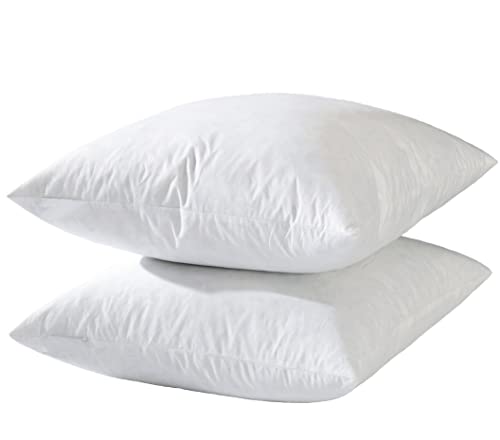
- Best overall: basic home 20×20 Down Feather Pillow Inserts, Set of 2 — Check on Amazon
- Pillowflex Synthetic Down Pillow Insert, 20×20 — Check on Amazon
- Utopia Bedding Throw Pillow Inserts 18×18, Set of 4 — Check on Amazon
See 3 more options from this guide
- Utopia Bedding Throw Pillow Inserts 18×18, Pack of 2 — Check on Amazon
- MIULEE Goose Feather Down Pillow Inserts 20×20, Set of 2 — no link: we could not verify a stable price for this listing from two independent sources, so we do not link or price it. Search the exact title on Amazon to find it.
- Topfinel Boucle Pillow Covers 18×18, Set of 4 (covers only) — no link, for the same reason: the listing’s price never appeared in any source we could check twice.
Read the full guide ↓
Disclosure: As an Amazon Associate, dailyhomedecorating.com earns from qualifying purchases. Links to Amazon on this page are affiliate links; they cost you nothing extra. Listing details such as price and availability change often, so check the current Amazon listing before you buy.
Throw pillows look like the simplest purchase in home decor — soft squares, how hard can it be — and they are quietly one of the easiest to get wrong, because the word “pillow” hides three different products. Some listings sell you a finished pillow with the insert inside. Some sell inserts only: plain white stuffed forms with no decorative cover at all. And a large share sell covers only, four attractive fabric squares with nothing inside them, which arrive flat in an envelope and disappoint anyone who did not read the listing to the end. Under $100, all three kinds compete side by side, at prices that overlap so completely that the same listing can be a bargain or a trap depending on which of the three it is. This guide separates them ruthlessly. Every pick below states exactly what it buys — insert, cover, or both, how many, and in what size — and every fill claim comes from the maker’s own specification fields rather than the adjectives in a listing title.
The honest shape of this budget is a choice, and it is worth naming before the picks: $100 buys either two genuinely good pillows — real feather-and-down inserts in decent covers — or one coordinated set of four to five pillows built on budget polyfill inserts and one good-looking cover set. It does not buy both at once, and any guide that implies otherwise is spending money you do not have. What the step up from $75 actually purchases is fill and fabric: real goose feather and down instead of polyester fiber, a premium down alternative with a proper cotton-blend shell instead of a nonwoven one, and textured cover fabrics like boucle instead of flat printed polyester. Below you will find a quick picks table, detailed notes on all six products, a comparison table, the professional rules for sizing and layering pillows on a sofa, an honest account of where the sensible stopping point sits, the mistakes shoppers make in this category specifically, and answers to the questions that come up again and again.
In this guide
Quick Picks
Short on time, or comparing several options at once? Each row below names a buyer type and the product that suits it. Two picks carry no link, deliberately: their prices could not be verified from two independent sources, and this guide does not print or link prices it cannot stand behind.
| Buyer type | Pick | Why it stands out | Link |
|---|---|---|---|
| Best overall | basic home 20×20 Down Feather Pillow Inserts, Set of 2 | Real goose feather and down in a 233-thread-count cotton shell with an inner liner — check price on Amazon | Check on Amazon |
| Best for the karate-chop look | MIULEE Goose Feather Down Pillow Inserts 20×20, Set of 2 | Spec-verified 95% goose feather / 5% down fill in a 100% cotton down-proof cover — the moldable, choppable fill | See review — no verified price |
| Best down alternative | Pillowflex Synthetic Down Pillow Insert, 20×20 | Premium synthetic down in a polyester-cotton shell, made in the USA, sized by the maker to fill 18×18 covers | Check on Amazon |
| Best for a whole sofa | Utopia Bedding Throw Pillow Inserts 18×18, Set of 4 | Four inserts at 500 g of virgin fiber fill each — the cheapest honest way to fill four covers at once | Check on Amazon |
| Best cover set | Topfinel Boucle Pillow Covers 18×18, Set of 4 | Boucle weave fronts with a linen-cotton back — four coordinated covers, inserts not included | See review — no verified price |
| Best budget pair | Utopia Bedding Throw Pillow Inserts 18×18, Pack of 2 | The same high-rebound virgin fiber fill as the set of four, in a two-pack for a single chair or a bed’s front row | Check on Amazon |
How These Picks Were Chosen
The first filter was the budget itself, applied honestly, and the second was verification. Every product below is a real Amazon listing. For four of the six, we verified the listing from two independent sources — the Amazon listing or its search pages plus a price tracker, registry or deal source — and those are the four that carry links in this guide; for current pricing, check price on Amazon on the listing itself. Two products earned their place on specifications alone but could not be pinned to a stable listing in the same way. Rather than guess, we include them without a link, and we say so where they appear.
We did not use these products ourselves. We read the maker listings and specification fields, and we treated those fields — not listing titles — as the truth. That distinction decides real money in this category. A cover sold as “linen” may spec out as a ramie-cotton blend or as plain polyester; an insert sold as “down” may be 95% feather with 5% down, which is a perfectly good product and a completely different one from a high-down insert. Where a maker publishes the feather-to-down ratio, we print it. Where a maker does not — one pick below does not — we say that too, because the absence is information: feather-rich blends are firmer and more structured, down-rich blends are softer and far more expensive, and a listing that hides the split is asking you not to ask.
The third filter was role coverage. A useful under-$100 guide has to answer the tier’s real question — two good pillows or a whole coordinated set — so the six picks deliberately span it: a real feather-and-down pair, a second feather-and-down pair with its ratio printed on the label, a premium down alternative for allergy households, a four-pack of budget inserts, a two-pack of the same, and one textured cover set to dress them. What we left out matters as well: several popular inserts and cover sets were excluded because their prices could not be pinned down either, and they are named in the research notes published alongside this guide rather than silently dropped.
The 6 Best Throw Pillows Under $100
basic home 20×20 Down Feather Pillow Inserts, Set of 2
Who it suits: Anyone who wants the real thing — genuine feather-and-down fill, with its moldable loft and natural weight — as an accessible entry point to real fill in this guide, and who is relaxed about the one detail the maker leaves vague.
Start with what you get, because in this category that sentence does the heavy lifting: two 20×20-inch pillow inserts, fill included, covers not included — check the current price on Amazon before you buy. The fill is goose feather and down — real animal fill, not a synthetic imitation — inside a 233-thread-count cotton shell with an inner liner whose stated job is to stop feather quills poking through, the classic annoyance of feather pillows. The high thread count is not decoration: feather shafts work their way through loose weaves, and a tight cotton shell plus a liner is the correct engineering answer, the same construction hotel pillows use. For the pair — check price on Amazon for the current figure — this is one of the most accessible routes in the guide to the two things polyfill cannot fake: the way a feather pillow molds around you when you lean on it, and the way it stays where you put it instead of springing back to a balloon shape.
Now the honesty. The listing’s specification fields say “goose feather and down” and stop there — the ratio is not published. That matters, because the ratio is the product: a 95% feather / 5% down insert is firm, structured and holds a styled shape, while a down-rich insert is softer, loftier and much more expensive. Independent reviewers who have handled this set describe it as extra-soft and yielding rather than crisp and choppable, which suggests a gentler fill than the feather-heavy MIULEE below — pleasant for leaning, less ideal if the sharp center crease of a styled “karate chop” is the look you are buying. Treat it as the soft, relaxed member of the feather family. The maker advises ordering inserts generously sized relative to your covers for a plump fill, and the care pattern is the usual feather one: refresh in a low-heat dryer, and if you wash them, dry them completely — damp feather fill is a mildew invitation. For two real feather pillows, few other listings in our research offered this combination of real fill and proper shell construction.
- Real goose feather and down fill — moldable, weighty, nothing like polyfill’s spring-back.
- 233-thread-count cotton shell with an inner liner specifically to prevent quill poke-through.
- Two 20×20 inserts with real fill — check price on Amazon for the current figure.
Honest limitation: The maker does not publish the feather-to-down ratio in the specification fields, and the feel is reported as extra-soft — if you want a firm, sharply choppable pillow, the MIULEE below states its 95/5 split and suits you better.
Choose it if you want real feather-and-down comfort for two hero pillows and a soft, relaxed shape is a feature. Skip it if you need to know the exact fill ratio before buying, or your covers are 18×18 and already full — these are 20-inch inserts and they fill firmly.

MIULEE Goose Feather Down Pillow Inserts 20×20, Set of 2
Who it suits: Stylists and sofa perfectionists — anyone whose reference photos all show that crisp crease down the center of the pillow, and who understands that only real feather-and-down fill holds it.
The karate chop is the most faked detail in home styling. Bloggers chop polyfill pillows for photographs and the crease springs out before the camera is put away, because polyester fiber is elastic and wants its original shape back. Feather-and-down fill is plastic rather than elastic: press a crease into it and it stays, which is why every genuinely choppable pillow on the market is filled with feathers, down, or both. This MIULEE set is the guide’s verified example. Its specification fields are unusually complete: fill of 95% goose feathers and 5% down, a cover of 100% cotton woven to be down-proof, two 20×20-inch inserts at a combined 5.3 pounds — real heft, roughly two and a half pounds of feather per pillow — and a listed firmness of soft, which in feather terms means moldable rather than mushy. Independent roundups of down inserts single this exact set out as the choppable one, and the spec sheet backs the claim: feather-rich fill is what holds a crease, and 95/5 is about as feather-rich as blends get.
Why, then, no price and no link? Because we could not verify one, and the reason is instructive. Every crawl of this Amazon listing shows promotion badges — limited-time deal flags, percentage-off coupons — and never a stable dollar figure, and the only numeric price attached to this exact product anywhere we looked was a resale listing on another marketplace, which is not an Amazon price and may not reflect one. A newer listing (it first appeared in June 2025) with churning promotional pricing is exactly the case where a printed price would be wrong by the time you read it. So the review stands on specifications, which are stable, and the price check is yours to make on the listing — position it as a premium pair, in the same territory as the other real-fill options in this guide rather than the polyfill ones. What you are paying for, whenever it settles, is the published ratio and the down-proof cotton: the two spec lines that separate a real feather insert from a bag of anonymous stuffing.
- Spec-verified 95% goose feather / 5% down fill — the feather-rich blend that holds a karate chop.
- 100% cotton down-proof cover, and a substantial 5.3 lb across the pair.
- The specification sheet is complete and checkable — ratio, cover fiber and weight all published.
Honest limitation: No verifiable price: this guide prints none and links none, so you must check the live listing yourself — and as a 95% feather product it will feel firmer and heavier than down-rich or synthetic pillows, with the occasional quill despite the down-proof weave.
Choose it if the styled, creased, designer-sofa look is the whole point and you want the fill ratio in writing. Skip it if you are feather-allergic, want a soft cloud rather than a moldable form, or need a firm price before you shop — the basic home pair above is verified and softer.
No Amazon link for this pick: its price could not be verified from two independent sources. Search the product title on Amazon to check the current listing.
Pillowflex Synthetic Down Pillow Insert, 20×20
Who it suits: Allergy households, vegans, and anyone who wants the down look — including a soft center crease — without feathers in the house, and is willing to pay a premium per pillow for the best synthetic version of it.
Note first what you get: one insert. A single 20×20-inch Pillowflex sits in a similar tier to the basic home pair, and the comparison explains the whole down-alternative market — check price on Amazon for the current figure. What the money buys is the most carefully made synthetic insert in this guide: a synthetic down fill — fine polyester fibers engineered to cluster and slide like down rather than spring like ordinary polyfill — inside a polyester-cotton blend shell, made in the USA in Palmetto, Georgia, by a company that has specialized in pillow inserts for decades. The maker’s sizing guidance is the professional trick built into the product: they recommend this 20×20 insert for an 18×18 cover, because an insert one to two inches larger than its cover fills the corners, stands up plump, and takes a soft chop crease instead of sagging. Follow that rule and a synthetic pillow gets closer to the styled look than any same-size insert can.
Set against the real thing, the trade is honest and narrow. Synthetic down molds better than standard polyfill and holds a gentle crease for a photograph or an evening, but it does not hold a chop like feather does — over days it relaxes back toward plump, where a feather pillow keeps the shape you gave it until you fluff it. In exchange you get everything feather cannot offer: no allergens, no quills, no animal products, no feather smell when the box first opens, and an insert you can wash without a drying marathon. Check the current price on Amazon before you buy. Two of these — one for each end of a sofa — make up the “two really good pillows” version of this budget for a household that cannot or will not use down, and it is a genuinely good version.
- Premium synthetic down fill that mimics down’s cluster and slide — the closest non-feather feel in the guide.
- Polyester-cotton blend shell; made in the USA by a specialist insert maker.
- Maker-recommended sizing: this 20×20 insert is the one they specify for 18×18 covers, for a full, styled fill.
Honest limitation: It is sold singly, so outfitting a pair means buying two separate inserts — and while it takes a soft crease, it will not hold a sharp karate chop the way real feather fill does.
Choose it if allergies, ethics or washability rule out feather and you still want a styled, plump pillow. Skip it if you need four or five pillows — as a premium single insert it takes a large share of the budget on its own; the Utopia sets below exist for that job.

Utopia Bedding Throw Pillow Inserts 18×18, Set of 4
Who it suits: Anyone dressing a whole sofa or a bed in one order — four covers to fill, a budget that has to cover covers too, and no illusions about what polyfill is and is not.
The value is the review: this set brings four 18×18-inch inserts in a single order, positioned at the budget end of this guide — check the current price on Amazon, as this set moves with promotions. Each insert carries 500 grams — about 1.1 pounds — of 100% virgin polyester fiber, which the maker notes is roughly 15% more fill than a standard insert, inside a 115 GSM brushed-fabric shell. “Virgin” is the spec word that matters in cheap inserts: it means new fiber rather than recycled regrind, and new fiberfill rebounds better and clumps later. Utopia’s own guidance repeats the professional sizing rule from the other direction — for a fuller look, pair these 18-inch inserts with covers one size smaller — which is the same advice as buying inserts a size up, seen from the other side.
What polyfill does well is exactly what a four-pillow set needs: it is light, it bounces back when a kid belly-flops on it, it does not care about humidity, and at this budget tier a worn insert in a few years is a small, easy replacement, not a loss. What it does not do is hold a chop, mold to a lean, or feel like anything other than a firm foam-adjacent puff — if your reference is a designer sofa with creased, slouchy pillows, these will read as cheerful and plump instead, which many living rooms honestly prefer. Care is the category’s simplest and its most annoying: the maker specifies spot cleaning only, because machine washing fiberfill this size tends to redistribute it into lumps. Treat the set as the engine of the “coordinated set” strategy: keeping the insert layer at the budget end leaves the larger share of the budget for the cover set that does the visual work — which is precisely the division of labor this tier rewards.
- Four inserts at 500 g of 100% virgin polyester fiber each — fuller than standard budget inserts.
- 115 GSM brushed-fabric shell; sewn construction, no zippers to fail.
- Budget-tier positioning for a full set of four — check price on Amazon for the current figure.
Honest limitation: Spot clean only, and polyfill will never hold a karate chop or a molded shape — these are plump, springy pillows, and in a room styled around slouchy feather pillows they will look noticeably perkier than the brief.
Choose it if you are filling three or more covers and the covers are where your money should show. Skip it if you only need two pillows and feel matters more than count — the basic home feather pair is the alternative when feel for two pillows matters more than count for four.

Topfinel Boucle Pillow Covers 18×18, Set of 4
Who it suits: Anyone whose inserts are fine but whose sofa looks flat and tired — this is the texture purchase, four coordinated covers that make existing pillows look like a styled set.
Read the listing’s own words first, because they are the most honest in this guide: pillow inserts not included. The price — whatever it is on the day you shop, and we will explain the missing figure in a moment — buys four 18×18-inch covers and nothing else. What the covers themselves offer is verified from the specification fields: a boucle weave front, boucle being the looped, nubby yarn that gives the fabric its pebbled, expensive-looking texture, with a linen-cotton back, so the pillow has a show side and a plainer, smoother side against the sofa. Boucle is the defining fabric of the current neutral-sofa look for a practical reason: texture reads as luxury in photographs and in person, without pattern, so four boucle covers in a warm beige-white sit comfortably over almost any existing sofa color and make mismatched older pillows underneath read as one deliberate set.
Why no price and no link: across every crawl and tracker we checked, this listing’s Amazon price simply never appeared — the page surfaces in search results with its specifications but no figure, and no independent source confirmed one either. The same brand’s boucle four-pack also appears at other major retailers, which tells you its general tier, but that is not a verified Amazon price and this guide does not print approximations as facts. Judge it on the listing when you get there, against a simple rule: position it within the mid-range band this category of textured cover sets usually occupies, and be cautious if it sits well above that territory. Two usage notes. Boucle’s loops can snag on jewelry, pet claws and rough handling, so it suits a styled sofa better than a dog’s favorite nap spot; and because the back is a different, smoother fabric, these are one-look pillows — flip them and the texture is gone, which matters if your household rotates pillows absent-mindedly. Paired with the Utopia set of four above, this is the coordinated-set strategy in its purest form: commodity inserts nobody sees, covers doing all the visual work.
- Boucle weave front — verified in the specification fields — with a smoother linen-cotton back.
- Four coordinated 18×18 covers: the fastest single purchase for making a sofa look deliberately styled.
- The listing states plainly that inserts are not included — budget inserts separately.
Honest limitation: Covers only, and we could not verify the Amazon price from two sources, so none is printed — you must judge the live figure yourself. Boucle loops also snag more easily than flat weaves, so it is not the fabric for heavy pet traffic.
Choose it if you already own inserts and want the modern neutral-texture look in one order. Skip it if you are starting from zero pillows — buy inserts first, or the envelope that arrives will be a flat disappointment.
No Amazon link for this pick: its price could not be verified from two independent sources. Search the product title on Amazon to check the current listing.
Utopia Bedding Throw Pillow Inserts 18×18, Pack of 2
Who it suits: The smallest honest job in the category — one armchair, a bed’s front pair, a reading nook — where two pillows are the whole project and every dollar past the inserts is a dollar for better covers.
This is the set of four’s sibling in a two-pack: the same insert family, 18×18 inches, filled with 100% virgin polyester fiber under a 115 GSM brushed-fabric shell — check price on Amazon for the current figure. It sits at the lowest-cost end of this guide. There is less to say about it than about any other pick, and that is its virtue: it is a commodity insert from the category’s highest-volume maker, with a long track record as a listing and no surprises in the specification fields. It arrives as a simple, sewn, ready-to-fluff form; pair it with 18×18 covers for a standard fill, or — applying the sizing rule once more — with 16×16 covers when you want the corners pushed out and the pillow standing up like it means it.
The reason to choose the pair over the set of four is not the trivial price difference; it is waste. Inserts bought beyond the covers you own become closet inventory, and two-packs exist because most accent chairs, benches and bed arrangements genuinely need exactly two. The reason to hesitate is the same as with its sibling: this is springy, cheerful polyfill, spot-clean practicality and all, and it will not pretend otherwise. In a small room the calculus often favors spending the savings on the visible layer — a point the small-space arrangements in Best Throw Pillows For Small Rooms Under $100 develop with room-by-room layouts — because in a compact space two well-covered pillows beat five mediocre ones competing for the same sofa. As a foundation purchase, though, this is one of the safest budget choices in the guide.
- Same 100% virgin fiber fill and 115 GSM brushed shell as the set of four, in a right-sized pair.
- The lowest-cost pick in the guide by tier — check price on Amazon.
- A long-established listing; a known quantity, not a new listing.
Honest limitation: All the polyfill caveats apply — no chop, no molding, a plump springy sit — and at two pillows it solves only small arrangements; a full sofa wants the set of four or a second pair.
Choose it if your project is exactly two pillows and the cover budget matters more. Skip it if you are filling a sofa — per-pillow pricing makes the set of four the better buy at three pillows and up.

Comparison Table
| Product | What you get | Fill / fabric | Price | Link |
|---|---|---|---|---|
| basic home Down Feather Inserts 20×20, Set of 2 | 2 inserts, no covers | Goose feather & down (ratio unpublished), 233TC cotton shell | Check price on Amazon | Check on Amazon |
| MIULEE Goose Feather Down Inserts 20×20, Set of 2 | 2 inserts, no covers | 95% goose feather / 5% down, 100% cotton down-proof cover | See review — check the live listing | — |
| Pillowflex Synthetic Down Insert 20×20 | 1 insert, no cover | Synthetic down, polyester-cotton shell | Check price on Amazon | Check on Amazon |
| Utopia Bedding Inserts 18×18, Set of 4 | 4 inserts, no covers | 100% virgin polyester fiber, 500 g each | Check price on Amazon | Check on Amazon |
| Topfinel Boucle Covers 18×18, Set of 4 | 4 covers, no inserts | Boucle front, linen-cotton back | See review — check the live listing | — |
| Utopia Bedding Inserts 18×18, Pack of 2 | 2 inserts, no covers | 100% virgin polyester fiber | Check price on Amazon | Check on Amazon |
How to Choose Throw Pillows Under $100
- Decide what you are buying before you look at prices. Insert, cover, or finished pillow — the three are sold side by side at overlapping prices, and every disappointment in this category starts with confusing them. If a listing’s photographs show a styled sofa, find the line in the specifications that says what is in the box.
- Size the insert one to two inches larger than the cover. A 20-inch insert in an 18-inch cover fills the corners, stands plump and takes a styled crease; a same-size insert leaves the corners empty and the pillow slouching. Makers in this guide say it themselves, from both directions. The exception is a cover with almost no give — a tight woven with a short zipper — where one inch up is the safer step.
- Read the fill ratio, not the fill adjective. “Down” on a label can mean 5% down and 95% feather. Feather-rich blends (around 95/5) are firm, structured and choppable; balanced blends are softer; genuinely down-rich inserts cost several times more and mostly live above this budget. If the ratio is not published, price the pillow as feather-rich and be pleasantly surprised, never the reverse.
- Match fill to the look you actually want. Chopped, creased, molded styling requires feather, down or a premium synthetic down. A plump, perky, kid-proof sofa is honestly better served by polyfill at a much lower tier. Foam inserts hold a crisp modern edge but feel like furniture, not comfort — none made this guide, because at under $100 the feather and fiber options serve more homes.
- Check the cover fabric in the specification fields, never the title. “Linen” covers on marketplaces are frequently ramie or polyester blends; the composition line in the specs is the truth. The verified fabrics in this guide are a boucle weave with a linen-cotton back and cotton insert shells — where a blend is what is sold, a good listing says so, and so should you expect it to.
- Look at the closure and the seams. On covers, a hidden zipper in a side seam is the standard worth having: it lets you remove and wash the cover and swap it seasonally. On inserts there is no closure — the shell is sewn shut — so shell quality is the whole game: tight weaves and high thread counts keep feather quills in and fiberfill from migrating.
- Plan care before the first spill. Feather inserts want fluffing, airing and a low-heat dryer refresh, and thorough drying if ever washed. Polyfill inserts in this guide are spot-clean only. Covers are the washable layer — which is the practical argument for the insert-plus-cover system over finished pillows in homes with children, pets or red wine.
- Count pillows by the seat, not by the photograph. A standard sofa takes three to five throw pillows before it tips from styled to storage. Buy inserts for the covers you own or are buying in the same order — an insert without a cover is closet clutter, and a cover without an insert is an envelope.
- Keep the packaging until the sofa votes. Pillow fullness only reveals itself in the actual covers, on the actual sofa, in evening light. Every pick here is easier to return boxed if the fill level misses.
Covers, Inserts and Sets: What Your Money Actually Buys
Because the whole category turns on it, here is the taxonomy in one place. An insert is the stuffed form — white or natural fabric, filled with feather, down alternative or fiber — and it is invisible in the finished room except through the shape it gives the cover. A cover is the decorative skin: the fabric, color, texture and zipper you actually see and touch. A finished pillow or set bundles the two, sometimes well, often with the cheapest insert the maker could sew in permanently — which is why stylists buy the layers separately, and why five of this guide’s six picks are single layers sold honestly as such. The separate-layers system costs a little more arithmetic and buys you everything that matters: the fill you chose, in the size-up that fills properly, inside a cover you can wash, replace and restyle without discarding the pillow inside it.
The bed is where the layers multiply, because a dressed bed stacks sleeping pillows, then large squares, then a front row of smaller or lumbar shapes — and each layer is an insert-and-cover decision of its own. The arrangements, sizes and budgets for that specific project are worked through in Best Throw Pillows For Bedrooms Under $100, which applies the same fill and sizing rules at bed scale. The living-room version of the same discipline is the formula below.
The Five-Pillow Sofa Formula
Professional stylists arrange sofa pillows in a structure so consistent it amounts to a formula, and it is worth more than any single product in this guide. For a standard three-seat sofa: five pillows — two large ones (20 to 22 inches) at the arms, two medium ones (18 inches) inside them, and one smaller or lumbar pillow at the center front. Layer the patterns in the classic ratio: one large-scale print, one small-scale print, one stripe, and solids to rest the eye, all pulled from one color family. The inserts do the quiet work: size the big pillows’ inserts up an inch or two so they stand, feather or synthetic-down in the pillows you style with a chop, polyfill where the kids land. Run the formula on this guide’s picks and the tier’s promise becomes concrete: a Utopia set of four plus a basic home feather pair is six inserts — the full five-pillow structure plus a spare — while still leaving room in the budget for the covers that carry the pattern story; check price on Amazon for each set before you order.
Scale the formula down, not out, for smaller seating. A loveseat takes three pillows; an apartment sofa takes three to four, slightly smaller, because five pillows on a short sofa is storage with better PR — the compact layouts in Best Throw Pillows For Apartments Under $100 work the same structure into small footprints. And the formula is style-agnostic: run it in boucle, linen-look solids and one stripe and it produces the calm, textured arrangement that Best Throw Pillows For Modern Homes Under $100 builds on for contemporary rooms, or run it in saturated velvet and a bold print and it goes maximalist without changing a single measurement.
What $100 Buys That $75 Doesn’t
Answer directly: at $75 — the tier covered in Best Throw Pillows Under $75 — you get the shapes. Polyfill inserts, flat-weave covers, a sofa that looks dressed. The step up in this tier buys the two things the cheaper tier cannot include: real fill and real fabric. Real fill means feather and down — the basic home pair puts genuine goose feather and down in a 233-thread-count cotton shell (check price on Amazon), and the MIULEE set publishes a 95/5 ratio with a down-proof cotton cover; no $75-tier insert molds, drapes or chops like these do, because polyester physically cannot. Real fabric means texture with a spec sheet behind it — a boucle weave, a linen-cotton back — instead of a printed photograph of texture on flat polyester. And it buys the premium middle: a US-made synthetic down insert that closes most of the gap to feather for households that cannot use feather.
The stopping point matters as much as the step up, so here it is plainly. Past $100, throw-pillow money buys down percentage and brand names, and both are poor value for a decorative object. The market makes the cliff visible: feather-rich 20×20 pairs sit at the accessible end of real-fill pricing, while a genuinely down-rich pair — half down, half feather — sells at other major retailers at a level that can exceed this entire guide’s budget for two inserts alone. That money buys softness you will feel in a sleeping pillow every night; in a throw pillow you lean on for an evening, the difference between 5% down and 50% down is real but small, and it is invisible in every photograph ever taken of your sofa. The sensible stopping point is exactly where this guide stops: feather-rich or premium synthetic inserts, one textured cover set, the five-pillow formula filled — and the rest of the decorating budget spent on something you will look at more than a pillow’s fill ratio.
Common Buying Mistakes
- Ordering covers and expecting pillows. The single most common failure in this category: the listing said covers only, the envelope arrives flat, and the sofa stays bare. Read for the words “inserts not included” — good listings, including one in this guide, state it outright.
- Buying the insert the same size as the cover. Same-size pairings leave empty corners and a slouching pillow. One to two inches up is the professional standard, and makers print it in their own guidance.
- Believing the word “down” without the ratio. A 95% feather insert and a 50% down insert are different products at different prices wearing the same adjective. The specification fields carry the ratio; if they do not, assume feather-rich.
- Trusting the fabric in the title. “Linen” that specs out as polyester, “velvet” that is a printed flat weave — the composition line is the only version of the fabric you are actually buying.
- Trying to chop a polyfill pillow. The crease springs out because fiberfill is elastic. If the styled look is the goal, the fill has to be feather, down or premium synthetic down — no technique fixes physics.
- Filling a sofa by the product photo. Styled photographs pile seven pillows on a sofa nobody sits on. Three to five is the livable range; the rest is storage you fluff.
- Washing what says spot clean. Fiberfill inserts washed against instructions come out lumpy, and feather inserts dried incompletely come out smelling. The washable layer in this system is the cover — that is what it is for.
- Spending the whole budget on inserts and nothing on covers — or the reverse. The look is the cover; the shape is the insert. A balanced split beats a perfect half.
- Ignoring the zipper. A cover without a removable closure cannot be washed or swapped, which quietly converts a washable system into a disposable one.
Final Recommendation
- Most buyers: basic home 20×20 Down Feather Pillow Inserts, Set of 2.
- The styled, chopped look: MIULEE Goose Feather Down Pillow Inserts 20×20, Set of 2 (check the live price — we could not verify one).
- Allergy-friendly and washable: Pillowflex Synthetic Down Pillow Insert, 20×20.
- A whole sofa at once: Utopia Bedding Throw Pillow Inserts 18×18, Set of 4.
- The texture upgrade: Topfinel Boucle Pillow Covers 18×18, Set of 4 (covers only; check the live price).
- Two pillows, minimum spend: Utopia Bedding Throw Pillow Inserts 18×18, Pack of 2.
Our top two are the basic home pair — real goose feather and down, a proper cotton shell with a poke-proof liner — check the current price on Amazon — and the Pillowflex, the premium synthetic for households where feather is not an option; between them they cover the “two really good pillows” answer to this budget completely. If your answer is the coordinated set instead, the Utopia four-pack plus a textured cover set builds the whole five-pillow formula with money left over, and that is an equally right answer — the wrong answer is only the muddled middle, premium prices paid for commodity fill because a listing’s adjectives went unchecked. Measure your covers, size the inserts up, read the ratio and the composition line, check the live price on anything we could not pin down, and order the layers separately like someone who intends to keep them.
Frequently Asked Questions
What is the difference between a throw pillow, an insert and a cover?
An insert is the stuffed inner form — the fill and its plain shell. A cover is the decorative outer skin that zips over it. A finished throw pillow is the two combined, often permanently. Listings in this category sell all three under the same “throw pillow” label, which is why the first step of any purchase is finding the line that says exactly what is in the box — five of this guide’s six picks are single layers, labeled as such.
Should the insert be bigger than the cover?
Yes — one to two inches larger in each dimension is the professional standard, and the makers in this guide recommend it themselves. A 20-inch insert in an 18-inch cover fills the corners, stands plump and holds a styled crease; a same-size insert leaves the corners empty. Go one inch up rather than two for stiff, tightly woven covers with short zippers.
What is the karate chop, and which pillows can do it?
It is the styling crease pressed into the top center of a pillow so it folds into two soft peaks. Only fills that stay where they are pressed can hold it: feather-and-down blends — feather-rich ones like the 95/5 MIULEE set in this guide hold it best — and, more softly and briefly, premium synthetic down like the Pillowflex. Standard polyester fiberfill springs back within minutes, because the fibers are elastic; no amount of technique changes that.
How many throw pillows should a sofa have?
Three to five for a standard three-seat sofa, arranged by the formula in this guide: two large at the arms, two medium inside them, one smaller or lumbar at the front. A loveseat or apartment sofa takes three. Beyond five, pillows stop decorating the sofa and start evicting the people — every additional pillow is one someone has to move before sitting down.
Are feather inserts worth it over polyfill at this budget?
For the two pillows you see and touch most, yes: feather molds to a lean, holds a styled shape, and has a weight and drape that fiberfill does not imitate, and in this guide a real feather pair sits at the accessible end of the tier, not far above commodity inserts in positioning. For a full set of four or five, the honest answer flips: budget polyfill sets fill the structure while keeping the overall spend in the same territory as a single premium pair, and the covers carry the look. Most sofas are best served by the mix.
How do I wash throw pillows and covers?
Wash the covers — that is the system’s design. Covers with hidden zippers come off and follow their fabric care labels. Inserts are the protected layer: the polyfill inserts in this guide are spot-clean only, and feather inserts should be aired and fluffed regularly, refreshed in a low-heat dryer, and if ever washed, dried completely before use. A damp feather insert put back in its cover is a mildew problem on a timer.