Where to buy
Check the latest price, availability and delivery on Amazon. Orders are placed on Amazon. We may earn a commission from qualifying purchases.
- Best overall: Govee COB Strip Light 2 Pro, 16.4 ft, RGBWWIC with Matter — Check on Amazon
- Philips Hue Solo Lightstrip, 33 ft, RGBWW with Hue App Control — Check on Amazon
- Govee LED Strip Light M1, 16.4 ft, RGBICW with Matter — Check on Amazon
- Nanoleaf Essentials Matter HD Lightstrip, 16.4 ft (5 m), Matter over Wi-Fi — Check on Amazon
See 2 more Amazon options
- TP-Link Tapo L930-5 Smart Light Strip, 16.4 ft, RGBWIC with HomeKit — Check on Amazon
- Govee COB LED Strip Light Pro, 16.4 ft, RGBICW with Matter — Check on Amazon
Read the full guide ↓
Disclosure: As an Amazon Associate, dailyhomedecorating.com earns from qualifying purchases. Links to Amazon on this page are affiliate links; they cost you nothing extra. Listing details such as price and availability change often, so check the current Amazon listing before you buy.
Begin with the fact that reorganises this entire budget: no smart light strip costs $500, and none comes close. We checked the flagship lines of Philips Hue, Govee, Nanoleaf and TP-Link looking for one, and the category’s ceiling is the Philips Hue Gradient Lightstrip Ambiance, an 80 inch base kit sold through Hue’s own store and first-party retail. Below it sit Govee’s flagship COB Strip Light 2 Pro, 16.4 ft, and Hue’s 33 ft Solo — both positioned at the top of their ranges, well below this tier’s ceiling. Check the current price on Amazon for each linked pick. That is the whole summit. So $500 in a modern home is not a product budget at all — it is an architecture budget, and modern homes are exactly where that distinction pays. An open-plan room is lit in layers, not by fixtures: a wash of light floating off a ceiling cove, a working line under the kitchen cabinets, a glow inside the display shelving and behind the media console. Three different jobs, three different strips — and in a modern interior they are all visible from the same sofa, in the same sightline, at the same moment. Spent as one coordinated system inside one ecosystem, $500 covers all three layers properly. Spent as three unrelated bargains from three different apps, it buys mismatched whites and a phone full of competing controls.
That is the lens for the six picks below. Each was verified for the exact length named, and the “What $500 Buys” section assembles them into three worked plans organised by layer rather than by room. Four honesty notes run through everything that follows. First, brightness: this category has no common measurement standard, so a lumen figure appears here only where a maker’s own specification states one, attributed every time — treat each as a maker’s claim, never a measurement. Second, ecosystem tolls are real and are counted in every plan: Hue strips do their best work behind a Hue Bridge, and the Hue HDMI sync box gets an honest hearing in this guide — unlike in a bedroom, a living room television is a legitimate use for one — followed by the reasoning that still keeps it out of a $500 plan, because the box, the strip it drives and the Bridge it needs together sit at the top of the category and leave no room for the other layers. Third, cutting is one-way on every strip here: a section trimmed at the cut marks cannot be reconnected and lit again. Fourth, and most specific to modern homes, white consistency is a buying discipline, not a product feature: the same nominal 3000K from two production batches — or two brands — will not match across a glass-walled room, so every run in a shared sightline gets bought in a single order, from a single ecosystem, and test-lit side by side before anything is stuck down. Add the standing warning that peel-and-stick adhesive is the weakest component of every strip sold — permanent cove runs belong in aluminum channel (sold in multi-packs of 1 m lengths) — and the tier’s honest shape is clear: the single $500 product does not exist, but the $500 lighting system very much does.
Quick Picks
Short on time, or comparing several options at once? Each row below names the layer or buyer type and the strip that suits it, with a link to the listing.
| Buyer type | Pick | Why it stands out | Link |
|---|---|---|---|
| Best overall | Govee COB Strip Light 2 Pro, 16.4 ft | A dotless COB line at a maker-claimed 1,344 LEDs per meter, with real warm and cool white channels — the material standard for any run in direct view — check price on Amazon, no hub | Check on Amazon |
| Best long run | Philips Hue Solo Lightstrip, 33 ft | One 33 ft run traces an open-plan ceiling cove or a whole run of cabinetry as a single zone; behind a Bridge it joins whole-home Hue scenes — check price on Amazon | Check on Amazon |
| Best layered-system value | Govee LED Strip Light M1, 16.4 ft | A real warm-white channel and Matter at a mid-tier position in this guide — check price on Amazon; buy two or three and light layer by layer | Check on Amazon |
| Best for Matter and Apple Home | Nanoleaf Essentials Matter HD Lightstrip, 16.4 ft (5 m) | Matter over Wi-Fi with tunable whites and a circadian mode — joins a standards-based home with no proprietary hub — check price on Amazon | Check on Amazon |
| Best budget | TP-Link Tapo L930-5, 16.4 ft | Segmented RGBWIC color with a real white channel and HomeKit support, no hub — the budget pick in this guide, check price on Amazon, for the layers nobody examines up close | Check on Amazon |
| Best dotless value | Govee COB LED Strip Light Pro, 16.4 ft | The original COB flagship: a maker-claimed 1,260 LEDs per meter and a warm-white channel — the lower-positioned COB option in this guide, check price on Amazon | Check on Amazon |
How These Picks Were Chosen
The first filter was verification, applied exactly as strictly here as in every guide in this series. A linked pick had to be pinned to a real Amazon listing confirmed from at least two independent sources for the exact configuration named — the maker’s own store, first-party retail and the listing itself. Two genuinely relevant products failed that test and are treated the way this series always treats them: in prose, with no link. The Hue Gradient Lightstrip Ambiance (80 inch) is the category’s ceiling product, sold through Hue’s own store and first-party retail — but its current US Amazon listing could not be pinned to the standard, so it appears inside the Hue plan below as a prose-only component, not a pick. The Hue Bridge, the Hue Motion Sensor and the HDMI sync box receive the same treatment: real products, described qualitatively by their position in the Hue range, discussed where the plans need them.
The second filter was modern-home fitness. In a modern interior, strips are not hidden by default — they are the visible architecture of the room’s evening state, washed across flat ceilings, reflected in floor-to-ceiling glass, and compared against each other across open sightlines. So the first question for every pick was whether its light reads as a continuous line or as a row of dots: two of the six are COB strips whose emitters sit under a continuous diffuser, and the guide says plainly which of the rest will show their diodes in a reflection. The second question was white. Cove washes, cabinet task light and display lighting are all white-light jobs for most of the hours they run, and white mixed from red, green and blue emitters looks cold and faintly blue next to a real white channel — so every pick here carries a dedicated white emitter set (RGBW, RGBWW, RGBICW or RGBWWIC in the makers’ shorthand), and the plain-RGB bulk reels that anchor cheaper guides were excluded no matter how they were positioned. The third question was system behaviour: does the strip join one ecosystem cleanly alongside the others, hold a white point consistently, and take commands from the platform the house already runs — because a modern home’s lighting is operated as scenes, not as six separate apps. Brightness and color-rendering figures are treated as maker claims throughout: the Govee COB 2 Pro publishes a maker CRI figure, attributed wherever it appears; the other makers publish none we could verify, so none is printed for them.
We did not use these strips ourselves. We read the maker listings, manuals, specification sheets and retailer listings, and compared what decides whether a layered system works: the footage in the box; whether white comes from a dedicated channel or from mixing color emitters; the control path (Bluetooth app, Wi-Fi app and voice, Matter, or a Zigbee bridge) and what each rung quietly leaves behind; the true system shape, counting every bridge a plan needs; and the maker’s own cutting terms, which on every pick here are one-way.
The 6 Best Smart Light Strips for Modern Homes Under $500
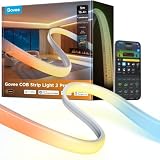
Govee COB Strip Light 2 Pro, 16.4 ft
Who it suits: Modern-home buyers planning a run that will be looked at — the cove edge, the media wall, the display shelving — who want that run to read as a single line of light in color and in honest white, with no hub to buy.
In a modern interior, this strip is the material standard everything else gets measured against. COB construction packs a maker-claimed 1,344 LEDs into every meter under a continuous diffuser, so there are no individual diodes to see, count, or catch doubled in a dark window wall after sunset — the failure mode that gives strip lighting its cheap reputation in exactly the rooms where it should look best. Run it along a cove lip or behind a floating shelf and the output is one unbroken band. The chips are RGBWWIC: segmented color control plus dedicated warm and cool white emitters, so white is produced by white diodes across a maker-claimed 1,000K to 10,000K range rather than approximated by mixing colors. That breadth matters in a layered room, where the cove layer might sit at a warm 2700K against a cooler task layer below — one strip family that can hold either end of the plan. Govee publishes a maker CRI figure of 92+ for its white: a claim, attributed as one, but a checkable specification in a category where most makers publish nothing. Govee also claims 540 lumens per meter, likewise a maker’s figure; at any plausible fraction of it, a cove run is ambient light, not task light. Control is the modern full set with no hub: Wi-Fi and Bluetooth, Matter, Alexa, Google Assistant and SmartThings, with the Govee app carrying the segmented scenes and a DaySync mode that walks the white temperature through the day. For the 16.4 ft kit, check the current price on Amazon before you buy.
The compromises are its premium position and finality. Sixteen feet is one feature run, not an open-plan perimeter: ringing a combined living-kitchen ceiling in COB 2 Pro would take three kits and most of this guide’s budget, which is why the plans below give it the run that gets looked at and hand the long, high, indirect runs to cheaper strips. Cutting follows the family rule with unusually fine marks — every 6.5 cm, per Govee — and the maker’s terms are explicit that once cut, the strip cannot be reconnected or extended, so a wrong measurement is a permanent one. The best of its effects live in Govee’s app rather than in the voice assistants, which handle the basics; and Govee’s own listed lifespan figure, 25,000 hours, is a maker number that sits below some rivals’ claims — printed here because the maker publishes it and buyers deserve to see it. None of that dethrones it for its brief: it is the best-looking light in this guide, and in a modern home the visible layer is where looks are the whole job.
- The smoothest light here: COB at a maker-claimed 1,344 LEDs per meter — no dots in direct view or in glass reflections.
- Real whites at both ends of the plan: dedicated warm and cool white channels across a maker-claimed 1,000K–10,000K, with a maker CRI figure of 92+.
- No hub, no toll: Matter, Wi-Fi, Alexa, Google and SmartThings out of the box; check price on Amazon for the 16.4 ft kit.
Honest limitation: As the flagship COB pick it is a feature strip, not a perimeter strip; cutting is one-way despite the fine 6.5 cm marks; and its headline brightness and CRI figures are the maker’s own claims, not independent measurements.
Choose it if one visible run — the cove, the media wall, the shelving — has to look like a built-in fixture from day one. Skip it if your runs are long and indirect, where its smoothness is wasted and the Solo or the M1 below cover far more footage for the same money.
Philips Hue Solo Lightstrip, 33 ft
Who it suits: Hue households — or buyers willing to become one — who need a single long run to trace modern architecture: a full ceiling cove, a wall of built-in cabinetry, or the whole open-plan perimeter, as one zone on one controller.
The Solo is Hue’s length play, and length is what modern floor plans consume. The 33 ft kit is one continuous strip: run it around a living-kitchen cove, down a run of floor-to-ceiling storage, or along the top of a window wall, and the entire gesture is a single zone that dims and warms as one — no seams between kits, no second controller, no point where one batch of strip meets another and the whites drift apart. Its light is the honest kind for architectural work: Hue builds the Solo on RGBWW emitters, so its whites come from dedicated white diodes across a warm-to-cool range, and Hue specifies the strip at up to 1,700 lumens. Read that figure the way this guide reads every Hue number — as the maker’s own claim — and read its footnote too: 1,700 lumens is the same total Hue claims for the 10 ft Solo so the extra length buys length, not brightness; spread over 33 ft this is gentle ambient light, which for cove and cabinet-top duty is precisely right. Where the Solo earns its place in a modern home is the ecosystem behind it. On Bluetooth out of the box it does basic app control; behind a Hue Bridge it gains the full Hue app — whole-home scenes that carry the cove layer together with every other Hue light you own, automations, and pairing with the Hue Motion Sensor so a hallway or pantry run lights itself as you pass. It is also the natural partner for the one Hue component this guide could not link, the Gradient Lightstrip Ambiance: the Solo does the long calm runs, the Gradient does the feature wall, and one Bridge runs both.
The compromises are the toll and the listing. The toll first: the strip’s own price is not its system price — add the Bridge, a separate Hue accessory, and the honest system grows before any second strip is added. Check the current price on Amazon for the strip, and check the Bridge separately where it is sold. The listing second: the Amazon page linked here is a family listing whose default view is the 10 ft kit, so select the 33 ft size and check the current price on Amazon before you buy. The strip itself shows one color along its whole length at a time — there are no segmented zones or gradients here — and it trims only at its marked intervals, one-way, like every pick in this guide. Judged as a component, though, it is the long, calm, scene-driven run the Hue plan below is built around.
- One run, one zone: 33 ft traces a full cove or a wall of cabinetry with no kit seams and no batch mismatch inside the run.
- Real white from RGBWW emitters, plus whole-home Hue scenes and native motion-sensor pairing behind a Bridge.
- The long-run Hue option in this guide: one 33 ft kit covering footage that would otherwise need several shorter strips — check price on Amazon.
Honest limitation: The Bridge that unlocks its system tricks is an extra purchase on top; the listing defaults to the 10 ft kit, so the 33 ft size must be selected and its current price checked on Amazon; and its maker-claimed 1,700 lumens is the same total as the 10 ft version — length, not brightness, is what the money buys.
Choose it if you are building the Hue system in the plans below and want the long architectural run done in one strip. Skip it if you have no intention of buying a Bridge — without one, the M1 and the Nanoleaf below deliver scenes and voice control for far less.

Govee LED Strip Light M1, 16.4 ft
Who it suits: System builders who would rather have three good layers than one perfect one — under-cabinet runs, media-console glow, a second cove — and want each layer independently controlled inside a single app.
The M1 is the conventional-strip overachiever, and in a modern home its superpower is repeatability. Its four-in-one RGBICW chips pack 60 LEDs into every meter — double the density of standard strips — with a dedicated warm-white emitter alongside the color ones, so the whites a kitchen worktop or a display shelf lives on are produced honestly, and colors blend along the line instead of separating into beads. It is Govee’s Matter strip: over Wi-Fi it joins Apple Home, Alexa, Google Home and SmartThings through the Matter standard, while the Govee Home app carries the scene library, the segmented DIY effects and the scheduling that let each layer run its own programme. The strip is 24V, mains-powered with the adapter included, trims at its marked points, and per its manual can be extended with Govee’s extension kits toward a 32.8 ft maximum. Its position is the argument: a mid-tier 16.4 ft kit — check price on Amazon — that sits well below the flagship COB picks in this guide, so three of these (cabinet layer, console layer, shelving layer, each its own zone) can form a layered system where a single flagship would cover only one layer, which is exactly how the layered plan below is built. Bought in a single order, the three kits also arrive from the same production run — the dye-lot discipline this guide keeps insisting on, satisfied almost by accident.
The compromises are the Matter caveat, the footage and the finality of cutting. The Matter caveat deserves plain words, because it applies across Govee’s range: over Matter, this strip behaves as a single-color strip — one color along its whole length, with brightness and white temperature adjustable — while the gradients, segments and effects that justify its place live only inside the Govee app. A buyer whose home runs strictly on Matter and who never opens vendor apps is paying for features they will not use. The footage is the second cost: 16.4 ft covers a cabinet run, a console wall or a shelving bank beautifully, and an open-plan perimeter not at all. And cutting is one-way — the manual is explicit that detached pieces cannot be reconnected, so measure twice. Govee publishes no CRI figure we could verify for the M1, so none is printed. Within its brief — the layer strip for buyers building a system — nothing else in the guide matches it as a repeatable layer strip.
- Dense and honest: 60 LEDs per meter of RGBICW chips with a real warm-white channel for task and ambient whites.
- Matter over Wi-Fi for Apple Home, Alexa, Google and SmartThings, with the full scene and scheduling library in Govee’s app.
- Mid-tier positioning — check price on Amazon — makes three separate layers practical where one flagship COB strip would cover only one.
Honest limitation: Over Matter it is a single-color strip — the segmented effects live only in Govee’s app; cut pieces cannot be reconnected; and 16.4 ft is one layer, not a room.
Choose it if you are lighting a modern room layer by layer and want each layer on its own zone and schedule. Skip it if the strip will sit in direct view at close range and dots would bother you: that is the COB 2 Pro’s job, as the premium flagship above.

Nanoleaf Essentials Matter HD Lightstrip, 16.4 ft (5 m)
Who it suits: Matter-first and Apple Home households building a modern interior on open standards, who want a name-brand strip with tunable whites that joins the platform they already run — no proprietary hub, no new bridge, no vendor lock-in.
Nanoleaf’s pitch is standards instead of ecosystems: a strip bought on an open standard can be joined later by any other maker’s lights without whites-and-apps fragmentation, because the platform — not the vendor — holds the scenes. This 5 m Smarter Kit, model NF085K03-5ALS on the listing, connects over Wi-Fi and Bluetooth and speaks Matter natively, so it joins Apple Home, Google Home, Alexa and SmartThings through whichever Matter controller the home already has. Its most modern-home feature sits in Nanoleaf’s own app: a Circadian Lighting mode that walks the strip’s white temperature through the day automatically — cool and bright over a morning kitchen, warm and dim across an evening living space — which suits open-plan rooms that change function between breakfast and midnight. The whites themselves are tunable across 2700K to 6500K per Nanoleaf’s specification, the strip carries the line’s animated multicolor scenes, and the kit’s in-line controller means basic on, off and brightness control works from the hardware itself. Its position undercuts every other name brand in this guide: a lower-tier name-brand kit for the full 16.4 ft — check price on Amazon.
The compromises are newness and paperwork. This Wi-Fi HD generation is the line’s newest, and its documentation is thinner than the Thread-based kit it succeeds: zone counts conflict between the listing’s own style naming and manuals for sibling models, so this guide prints no zone count for it rather than repeat a number two maker documents disagree on — what is certain is that animated scenes run through Nanoleaf’s app, while over Matter it behaves as a color-and-white strip like every Matter strip here. Nanoleaf’s brightness figures for the line are maker figures and vary by model, so none is printed for this kit either. The Matter setup itself, while hub-free, still needs a Matter controller in the home for ecosystem control — an Apple TV, HomePod, Echo or SmartThings hub — and buyers whose home lacks one are back to Bluetooth and the Nanoleaf app, which is fine for one room and limiting for a house. Within its brief — the standards-based layer for a platform household — it is the cheapest credible way in.
- Matter over Wi-Fi with no proprietary hub: joins Apple Home, Google Home, Alexa and SmartThings through the controller you already own.
- A circadian mode in Nanoleaf’s app walks white temperature through the day — open-plan rooms that change function get the right white on a standing setting.
- For 16.4 ft — check price on Amazon — the most accessible name-brand pick in this guide.
Honest limitation: The newest generation’s paperwork conflicts with itself — zone counts disagree between the listing and sibling manuals, so none is printed; Matter control needs a controller in the home; and its animated scenes live in Nanoleaf’s app, not in the voice assistants.
Choose it if your home already runs on Matter or Apple Home and you want each new layer to simply join it. Skip it if you want segmented gradient effects as the main event — that is Govee’s app-driven specialty, above.

TP-Link Tapo L930-5 Smart Light Strip, 16.4 ft
Who it suits: System builders with secondary layers to cover — the hallway run, the guest room, the study nook, the inside of a wardrobe wall — who want segmented color, a real white channel and HomeKit support in one no-hub kit, in a budget-tier kit that leaves the flagship picks for the layers that get stared at.
The L930-5 is the pick that embarrasses the tier ladder. TP-Link builds it as RGBWIC — segmented color across 50 addressable zones per the maker’s specification, plus a dedicated white emitter set, so its whites are real whites rather than a blue-leaning mix — and wraps the strip in a polyurethane coating that shrugs off dust and the occasional splash in a way bare strips cannot, a practical virtue in kitchen-adjacent and hallway duty. It runs on Wi-Fi with no hub of any kind, works with Apple HomeKit alongside Alexa and Google Assistant — HomeKit support in this budget tier is genuinely rare — and carries Tapo’s app scheduling, timers and sunrise/sunset automation and an Away mode. TP-Link specifies it at 1,000 lumens; that is a maker’s figure, and like every number in this category it should be read as one — what matters in a layered system is that it dims smoothly for evening duty and that its white channel looks like light rather than like a screen. Its position is the headline: the budget pick in this guide — check price on Amazon. Three of these sit well below a single flagship strip in overall positioning, which is why the third plan below spreads them across the rooms the flagship layers do not reach.
The compromises are polish and platform. Fifty zones is coarser segmentation than Govee’s app-driven strips produce, and the effects library is smaller; the strip is a 2.4 GHz Wi-Fi device, so homes with congested or band-steered networks can expect the usual pairing dance; and Tapo’s app, while competent, asks for a TP-Link account and offers none of the scene depth of Govee’s or the automation depth of Hue’s. One system warning belongs here rather than in the mistakes section, because the Tapo tempts exactly this error: its white, however honest, is TP-Link’s white — put a Tapo run and a Govee run in the same sightline and the two makers’ white points will not agree at any shared setting. The coating that protects it also makes it a strip to route in channel or clips rather than bend around tight abuse, and cutting follows the same one-way rule as every pick here. Judged as light for its tier with the system essentials intact — real white, scheduling, voice control, no hub — it is the best value in this guide by a wide margin.
- The full layer checklist in this budget tier: segmented RGBWIC color, a real white channel, scheduling and sunrise/sunset automation, no hub.
- HomeKit support alongside Alexa and Google — rare in this category, remarkable in this budget tier.
- The budget pick in this guide — check price on Amazon — with a wipe-clean coated strip.
Honest limitation: Coarser zones and a smaller effects library than Govee’s strips; 2.4 GHz Wi-Fi only; its white point is TP-Link’s own and will not match another maker’s run in the same sightline; and its 1,000-lumen figure is the maker’s own, like every brightness number in this category.
Choose it if you are covering the secondary layers of a modern home and want the essentials done properly. Skip it if the run shares a sightline with another brand’s strips — one ecosystem per view is the rule this guide keeps returning to.

Govee COB LED Strip Light Pro, 16.4 ft
Who it suits: Buyers who want the dotless COB look on a second visible run — the shelving bank after the cove has taken the flagship, the console wall in the second living space — as the more accessible COB option in this guide, and who are willing to check the current price on Amazon before buying.
This is the original COB flagship, the 2024 strip that started the category’s density race: COB construction at a maker-claimed 1,260 LEDs per meter, RGBICW chips with a dedicated warm-white emitter, Matter alongside Alexa and Google Assistant, and the full Govee app scene library. In a modern home it does the same visible-run job as its successor — one continuous band of light, honest warm whites for the evening layers, scheduled scenes for the morning — and for the 16.4 ft kit — check price on Amazon — it sits below the 2 Pro in the Govee range. Because it lives inside the same Govee ecosystem and app as the 2 Pro and the M1, it is the one second feature strip that raises no consistency problem: same maker, same white behaviour, same scenes — which is precisely why the layered plan below pairs the two COB generations. The differences from the successor are real but narrow: the 2 Pro’s silicone-sleeve diffusion is smoother still, its white range runs wider with both warm and cool white channels where this strip’s dedicated channel is warm white, and Govee publishes a CRI figure for the new model that it does not publish for this one. In direct view on a matte surface, most buyers would struggle to separate them; in a glossy reflection or at very low brightness, the newer strip’s extra diffusion earns its premium.
The compromises start with positioning, and this guide states it plainly: this model sits below its successor in the range — check the current price on Amazon and compare it with the 2 Pro before you buy; if the two are positioned the same when you check, the 2 Pro above is the better buy and this pick’s reason to exist is gone for the day. Govee publishes no CRI figure we could verify for it, so none is printed. It is also, unavoidably, yesterday’s flagship: the app support and Matter credentials are current, but buyers who keep strips for a decade should know the line has moved on. Within its terms — the COB look, the system essentials, and a step down from the flagship’s position — it remains the value route to a second dotless layer.
- Dotless COB light at a maker-claimed 1,260 LEDs per meter, with a dedicated warm-white channel and Matter.
- For 16.4 ft — check price on Amazon — the most accessible route in this guide to a continuous line of light.
- Same Govee app and white behaviour as the flagship picks: the one second feature strip that raises no consistency problem.
Honest limitation: Compare its current price on Amazon with the 2 Pro’s before you buy, and walk away to the 2 Pro if the two are positioned the same; its diffusion is a step behind its successor’s, and no CRI figure is published for it.
Choose it if you have checked the current price on Amazon, compared it with the 2 Pro, and the run is a matte surface in ordinary light. Skip it if the price has converged on the 2 Pro’s, or the strip will be reflected in glass or gloss finishes nightly.

Comparison Table
| Product | Format & length | Light & control | Best use | Link |
|---|---|---|---|---|
| Govee COB Strip Light 2 Pro | COB strip, 16.4 ft, maker-claimed 1,344 LEDs/m | Segmented RGBWWIC color with real warm and cool whites; Matter + Govee app, no hub | The visible layer — cove edge, media wall, display shelving | Check on Amazon |
| Philips Hue Solo Lightstrip | Standard strip, 33 ft, trims at marked intervals | Single-color RGBWW with real whites; Hue app via Bridge, Bluetooth basics | The long architectural run — full cove or cabinetry wall in one zone | Check on Amazon |
| Govee LED Strip Light M1 | Dense strip, 16.4 ft, 60 LEDs/m | Segmented RGBICW with real warm white; Matter + Govee app | Layer by layer — cabinets, console, shelving, each its own zone | Check on Amazon |
| Nanoleaf Essentials Matter HD Lightstrip | Standard strip, 16.4 ft (5 m) | Tunable whites 2700K–6500K and animated scenes; Matter over Wi-Fi + Nanoleaf app | Matter and Apple Home systems, circadian white through the day | Check on Amazon |
| TP-Link Tapo L930-5 | Coated strip, 16.4 ft, 50 zones per maker | Segmented RGBWIC with real white; Wi-Fi app, HomeKit, no hub | Secondary layers — hallway, guest room, study — on a budget | Check on Amazon |
| Govee COB LED Strip Light Pro | COB strip, 16.4 ft, maker-claimed 1,260 LEDs/m | Segmented RGBICW with warm-white channel; Matter + Govee app | The second visible run — dotless light as the accessible COB option | Check on Amazon |
How to Choose a Smart Light Strip for a Modern Home
Assign the layers before the strips. A modern room has four strip layers — the ceiling cove wash, the under-cabinet task line, the accent glow in shelving and behind the media console, and the secondary runs in hallways and spare rooms — and they reward different strips. Visible layers reward density (the COB picks); long indirect layers reward footage and scenes (the Solo); repeated working layers reward accessible positioning per zone (the M1, the Tapo). Buying one strip to do all four is how budgets die.
One ecosystem per sightline. This is the rule the whole guide hangs on. Two makers’ whites, both set to the same nominal temperature, will not match across an open-plan room — the emitters, the phosphors and the calibration all differ — and in a glass-walled space the mismatch is visible from everywhere. Pick the platform a sightline belongs to, and let every run inside it come from that platform. Different rooms can run different platforms; a single view cannot.
Buy every run in one order, and test before you stick. Within one brand, white point still drifts between production batches. So the runs that will share a view get ordered together, powered up side by side on the floor at the temperatures they will actually run — a warm evening setting and a neutral morning one — and only then installed. Keep any offcut and spare footage from that same batch: a run replaced two years later from a new batch is a mismatch waiting to happen. This dye-lot discipline costs nothing but forethought, and it is the difference between a system and a collection.
Apply the white test. Cove washes and cabinet light are white-light jobs. If a strip’s nameplate lacks a W — RGBW, RGBWW, RGBICW, RGBWWIC — its “white” is color emitters mixing toward a cold blue approximation, and it will look like a screen, not like daylight. Every pick in this guide passes the test; most strips in the lowest tiers do not, which is the honest core of the step down to Best Smart Light Strip Under $300.
Count the ecosystem toll before the strip. Hue’s scenes, automations and sensor pairing live behind the Bridge, a separate accessory purchase, so a Hue interior carries that extra cost before the first strip. Govee, Nanoleaf and Tapo charge no toll, but keep their best effects inside their own apps. Neither answer is wrong; budgeting as if the toll does not exist is.
Measure, then buy length — never the reverse. Cutting is one-way on every pick here. Buy the kit that covers your measured run with footage to spare, route permanent runs in aluminum channel rather than trusting adhesive to painted plaster, and treat any offcut as a spare from the same batch — not as the start of another layer.
What $500 Buys in a Modern Home — Three Honest Ways to Spend It
Plan one: the all-Hue interior, inside the $500 budget. The Solo 33 ft — check price on Amazon — takes the long architectural run — the cove, the cabinetry wall. The feature wall gets the strip this guide could not link: the Hue Gradient Lightstrip Ambiance 80 inch, the top-tier Hue strip sold through Hue’s own store and first-party retail — search for it by name there. Add the Bridge and the Motion Sensor for a self-lighting hallway, and the system fits under budget, with the most polished scenes and automations in the business, and every layer inside one ecosystem. One honest hearing before the alternative plans: the living room is the one room where the Hue HDMI sync box has a real job — washing the media wall in the colors of the film — so unlike a bedroom, this guide will not call it pointless. It will call it unaffordable here: the box is a premium Hue accessory, and the stack it needs — sync box, Gradient strip and Bridge — together exceed this budget before the cove, the cabinets or any other layer are considered. Sync is a phase-two purchase. Build the system first; add the box later, when it is the only thing left to buy.
Plan two: the Govee layered interior, inside the $500 budget. The COB 2 Pro — check price on Amazon — takes the visible feature layer; one M1 takes the under-cabinet layer; a second M1 takes the shelving or console layer. Together they form a system with no hub, no toll, and three independent zones in one app — check the current price on Amazon for each kit — and because all three kits are ordered together, they arrive from the same production run and the dye-lot rule is satisfied almost by accident. The budget left over is not a problem to solve; it is the channel, the spare footage and the next room’s first layer, already funded.
Plan three: spread it, or keep it. Three secondary rooms of Tapo L930-5 — the budget pick, check price on Amazon — give every spare space in the house real white, scheduling and voice control, positioned well below one flagship strip. A Matter-first household can take the same shape with Nanoleaf kits where platform purity matters more than effects. Or take the single best component, the COB 2 Pro — check price on Amazon — and keep much of the budget in your pocket: as Best Smart Light Strip For Modern Homes Under $300 shows, a complete and honest layered system exists at that level too, and the step down to Best Smart Light Strip For Modern Homes Under $200 still buys a real white channel and native scheduling. Buyers costing a whole apartment rather than one open-plan space will find the same system thinking applied room by room in Best Smart Light Strip For Bedrooms Under $500 and at small scale in Best Smart Light Strip For Small Rooms Under $500.
Common Buying Mistakes
- Mixing ecosystems inside one sightline. A Govee cove above a Hue cabinet run will show two different whites every evening, however carefully both are set. One platform per view; different rooms may differ, a single view may not.
- Buying the layers months apart. White point drifts between production batches. The second run of a pair bought next season is a mismatch with a receipt. Order the sightline together, test the whites side by side, and keep same-batch spares.
- Assuming TV sync fits the budget. The sync box is a premium accessory before the strip it drives or the Bridge it needs; the honest stack together exceeds this budget. It is a legitimate living-room upgrade — as a later phase, not inside this $500.
- Judging by the lumen headline. There is no common standard behind strip brightness figures; the Solo’s maker-claimed 1,700 lumens spread over 33 ft is gentler light than a short strip claiming the same total. Density, placement and layering decide how a modern room feels — not the biggest number on the box.
- Cutting first and measuring later. Every pick here cuts one-way. Test the run lit, at night, from the sofa it will be seen from, before anything is trimmed or stuck down.
- Trusting adhesive with architecture. Peel-and-stick backing lets go of painted coves and warm cabinet undersides on its own schedule. Permanent runs belong in aluminum channel — in multi-packs of 1 m lengths — with the strip’s own backing as a positioning aid, not the structure.
- Forgetting the Bridge in Hue math. A Hue strip plus its Bridge is a system starter, not a single purchase. Budget the toll or choose a toll-free platform.
Final Recommendation
Build the system, not the trophy — and build it as one system. For most modern homes: the Govee plan, ordered in a single basket — the COB 2 Pro on the layer that gets looked at, two M1s on the layers that do the work — check price on Amazon for each kit — every white from the same maker and the same batch. For Hue households: the Solo’s long run, the Gradient from Hue or first-party retail, the Bridge, and the motion sensor — inside the budget, with the sync box honestly deferred to a second phase. For everyone else: the Tapo across the secondary rooms, and keep the change. The $500 strip does not exist; the $500 interior — layered, consistent, and controlled as one — does, with money left over, which is the surest sign the budget was spent honestly.
Frequently Asked Questions
Is there really no smart light strip that costs $500?
None that we could verify from any major maker. The category’s ceiling is the Hue Gradient Lightstrip Ambiance, an 80 inch kit sold through Hue’s own store; below it sit Govee’s flagship COB 2 Pro and Hue’s 33 ft Solo, both top-tier strips positioned well below this budget. Marketplace listings positioned above those products are markups on the same strips, not more expensive products — which is why this guide treats $500 as a system budget and shows how to spend it by layer.
Why don’t the whites of my two strips match?
Because “3000K” is a target, not a guarantee. Each maker’s emitters and calibration land on a slightly different white, and the same maker’s white drifts between production batches. Across an open-plan sightline the difference is unmistakable. The fix is discipline, not settings: one ecosystem per sightline, every run bought in a single order, whites test-lit side by side before installation, and spares kept from the same batch.
Does TV sync fit inside a $500 budget?
Not alongside anything else. The Hue HDMI sync box is a premium accessory; add the Gradient strip it drives, sold through Hue and first-party retail, and the Bridge it requires, and the stack together exceeds the whole budget, for one wall. Sync is a genuine living-room feature, which is why this guide defers it rather than dismissing it: build the layered system first, and add sync as a second phase when it is the only purchase left.
Do I need a Hue Bridge for a modern-home system?
For basics, no — Hue strips pair over Bluetooth for app control in the room. For the things that make a Hue interior worth building, yes: whole-home scenes, automations, out-of-home control and pairing the motion sensor all live behind the Bridge. Budget for it as a separate accessory purchase, once, and it serves every Hue light you add afterward.
Can I cut a strip and rejoin the pieces later?
No. On every pick in this guide, cutting at the marked points is permanent: the detached piece cannot be reconnected and lit again, and several makers state the point explicitly in their own documentation. Buy footage to cover the run, test before you trim, and keep offcuts as same-batch spares rather than future layers.
Are smart strips bright enough to light an open-plan room?
As layered ambient and task light, yes — a cove wash plus a cabinet line plus accent glow changes how a room works from morning to midnight. As the room’s only light, no: strip output figures are maker claims with no common standard, the light is indirect by design, and jobs like cooking prep or reading still need real fixtures. A strip system is the layer modern rooms are missing; it complements the lighting, it does not replace it.