Where to buy
Check the latest price, availability and delivery on Amazon. Orders are placed on Amazon. We may earn a commission from qualifying purchases.
- Best overall for modern homes: Shiftshade 4-Pack Acrylic Mirror Tiles, 12 x 12 Inch, 2 mm Thick — Check on Amazon
- SAFEE MRROR 4-Pack Acrylic Mirror Tiles, 10 x 10 Inch — Check on Amazon
- JEOYOO 4-Pack Acrylic Mirror Tiles, 8 x 8 Inch (fails the modern test — read why before you buy) — Check on Amazon
- UNBREAKABL MIRO 4-Pack Acrylic Mirror Tiles, 12 x 12 Inch, 0.12 Inch Thick (check price) — Check on Amazon
See 2 more Amazon options
- Delma Glass Full Length Wall Mirror Tiles, 14 x 12 Inch, 4PCS (near-miss, just over budget — the only real glass, and the best minimalist result here) — check price on Amazon — Check on Amazon
- NC Unbreakable Acrylic Mirror, 12 x 12 Inch, 4 Pcs (over-budget reality check) — check price on Amazon — Check on Amazon
Read the full guide ↓
Disclosure: As an Amazon Associate, dailyhomedecorating.com earns from qualifying purchases. Links to Amazon on this page are affiliate links; they cost you nothing extra. Listing details such as price and availability change often, so check the current Amazon listing before you buy.
A modern home is the worst possible stage for a cheap mirror, and this guide will not pretend otherwise. Minimalist rooms are built on flat planes, clean lines and the absence of visual noise — which means every flaw a mirror has is on display. There is no busy wallpaper to hide a wavy reflection, no ornate frame to excuse a seam, no clutter to compete with a bent horizon line. A mirror in this budget tier in a traditional room is a compromise; in a modern room it is an argument you have with the wall every morning. So this guide judges the under-$15 options by a stricter test than price and height alone: can the thing read as one calm, flat, frameless plane of glass — the only mirror language a modern interior speaks — or does it announce itself as four plastic squares stuck to the wall? Some of what exists at this price passes that test better than you would expect. Most of it does not, and two of the six products below fail it outright. We will tell you which, and we will also tell you plainly when the right answer is to skip this tier entirely and move up to the next tier.
Start with the fact that governs everything under $15: there is no one-piece full length mirror at this price. Not framed, not frameless, not on sale. In our research, one-piece over-the-door glass mirrors sat in a higher tier altogether. What this budget buys is a kit — four flat tiles, stuck to a wall or a door in a vertical column. Five of the six kits in this guide are acrylic, a plastic that cannot shatter but also cannot hold a perfectly flat plane; the sixth is real glass and sits just over the line. The modern-home question is therefore narrower than the general one: given that you are buying tiles, which tiles come closest to disappearing into the architecture? The answer turns on three things — whether the column is a single unbroken width with no frame and no trim, whether the material holds its reflection steady at the distance a modern room forces you to stand back, and whether the seams can be made to read as an intentional grid line rather than an accident. Judged that way, the ranking below is not the ranking you would get for a dorm or a kids’ room, and one familiar budget favorite falls to the bottom of it.
Below you will find a quick picks table scored for modern rooms, the reasoning behind the list, detailed notes on all six products, a comparison table, a buying checklist built around the minimalist test, an honest account of what this budget cannot do in a design-led room, the mistakes that ruin the look, and answers to common questions. Readers working room by room may also want the general version of this budget in Best Full Length Mirror Under $15, the renter-focused picks in Best Full Length Mirror For Apartments Under $15, the dressing-corner angle in Best Full Length Mirror For Bedrooms Under $15, and the narrow-wall solutions in Best Full Length Mirror For Small Rooms Under $15.
Quick Picks
Short on time? Each row names the buyer and the product, with the modern-home verdict stated bluntly. Note the labels: only three picks sit inside the $15 budget, one is a check-price pick, one is a near-miss in real glass, and one is a deliberate over-budget reality check. Check the current price on Amazon for each pick before you buy, as listings move. In a modern room, the near-miss is arguably the headline — read its row before you sort by price.
| Buyer type | Pick | Why it stands out | Link |
|---|---|---|---|
| Best overall for modern homes (in budget) | Shiftshade 4-Pack Acrylic Mirror Tiles, 12 x 12 in, 2 mm | A true 48-inch frameless column — check price on Amazon — the cleanest single-width plane acrylic can make in this tier | Check on Amazon |
| Best minimalist result (near-miss, just over budget) | Delma Glass Full Length Wall Mirror Tiles, 14 x 12 in, 4PCS | Real float glass: the only reflection here that stays flat and calm across a room — just over budget; check the current price on Amazon | Check on Amazon |
| Best acrylic specification (check price) | UNBREAKABL MIRO 4-Pack Acrylic Mirror Tiles, 12 x 12 in, 0.12 in thick | 3 mm-class tiles — the stiffest acrylic here, and stiffness is what a modern wall demands; check price on Amazon | Check on Amazon |
| Best for a child’s modern room (in budget) | SAFEE MRROR 4-Pack Acrylic Mirror Tiles, 10 x 10 in | Shatterproof and in budget — check price on Amazon — but the 40-inch column is a partial mirror for adults, and modern rooms expose that | Check on Amazon |
| The format at its honest tier (over budget) | NC Unbreakable Acrylic Mirror, 12 x 12 in, 4 Pcs | The same 48-inch column positioned above this budget — check price on Amazon — included to show where the format sits when it is not discounted into this tier | Check on Amazon |
| Fails the modern test (in budget, with a warning) | JEOYOO 4-Pack Acrylic Mirror Tiles, 8 x 8 in | In budget — check price on Amazon — but four 8-inch tiles reach only 32 inches: a fragment, not a plane, and a modern wall shows it instantly | Check on Amazon |
How These Picks Were Chosen
The research method was the same one this series uses everywhere: we looked for anything a shopper could plausibly buy as a full length mirror for $15 or less, and checked each candidate for a verifiable Amazon listing, the tallest column its pieces can build, and its material. On top of those four filters, this guide applied a fifth that the other room guides do not: the minimalist test. A pick passes it if, installed carefully on a flat wall, it can plausibly read at a glance as a single frameless sheet — one width, no frame, no visible hardware, seams fine enough to pass as a deliberate grid, and a reflection that holds together from across the room. That fifth filter is why the order below differs from a general ranking. The cheapest set in the category fails it completely, and the only glass set — technically over budget — is the one product that passes it without qualification.
The budget labels are as strict as the aesthetic ones. Three picks sit inside the budget tier: the Shiftshade 12 x 12 four-pack, the SAFEE MRROR 10 x 10 four-pack, and the JEOYOO 8 x 8 four-pack — check price on Amazon for each before you buy. The Delma glass set sits just over the line, labeled a near-miss everywhere it appears. The NC set sits above this budget and is included only as an over-budget reality check. One pick, the UNBREAKABL MIRO 12 x 12 set, is labeled check-price, and it earns its place on specification — it is the thickest acrylic tile in the format — not on price.
One structural fact works in the modern buyer’s favor, and it deserves stating before the reviews: every pick here is frameless, so the listed size is the mirror size. The frame-versus-glass shell game that plagues framed mirrors — a generous frame dimension wrapped around a much smaller sheet of glass — does not exist in this category. What you measure is what reflects. That is also why tiles, for all their faults, are the only under-$15 format that can even attempt the modern look: a $15 framed mirror would bring a cheap molded frame into a room that has no tolerance for one, while a frameless column at least aims at the right idea. Whether any given set lands that idea depends on the material and the seams, which is what the reviews below are for. And if, reading them, you conclude the format itself is wrong for your room, the honest exit is named now rather than buried: our guide to the Best Full Length Mirror For Modern Homes Under $30 is where one-piece glass starts to become a realistic conversation.
The 6 Best Full Length Mirror Options for Modern Homes Around $15
Shiftshade 4-Pack Acrylic Mirror Tiles, 12 x 12 Inch, 2 mm Thick
Who it suits: Modern-home owners who need a full-height mirror now, at this budget, and are willing to install it with the care the look demands — on the flattest wall or door in the house.
This set leads the guide because it is the only verified in-budget product that can attempt the minimalist plane at full height. Four frameless acrylic tiles, each 12 x 12 inches, stack into a column 48 inches tall and 12 inches wide — the height of a standard door mirror and the practical minimum for an adult to see themselves head to toe. The geometry is the modern part: a single column, one tile wide, with no frame, no bevel trim and no hardware, is the closest thing to a slit of glass set into the wall that this budget can produce. Total reflective area is 576 square inches, and because there is no frame, every one of those inches is mirror. The thickness matters as much as the outline: at 2 mm, these tiles sit in the middle class of acrylic mirror, twice as stiff as the 1 mm films that ripple like foil, and that stiffness is what keeps the column’s reflection composed at the distances a modern room imposes. Check price on Amazon for the four-pack. The set mounts with adhesive pads, totals roughly two pounds, and cannot shatter.
The honest limitation is that “attempt” is doing real work in that description. Three horizontal seams cross the column, and in a modern interior a seam is never invisible — at best, aligned with a level and pressed perfectly flat, it reads as a fine grid line, the way a panel joint reads on a lacquered wall; at worst, it is a crack across your waist in the reflection. The material is the second caveat: acrylic is calm at arm’s length and increasingly soft at room distance, and open-plan modern rooms are precisely where you view a mirror from ten or fifteen feet away. The reflection also inherits your wall — any bow or orange-peel texture telegraphs straight through a 2 mm tile — and acrylic scratches more easily than glass and gathers dust through static. None of this disqualifies the set; it defines the installation standard. Choose the flattest surface you own, align obsessively, place a seam at thigh or shoulder height rather than eye level, and the result is a genuinely minimal mirror in this budget tier. Install it casually and the same set looks like exactly what it costs.
- The only verified in-budget set that reaches a true 48-inch column — one tile wide, frameless, no hardware showing.
- 2 mm acrylic: the workable stiffness class, flat enough to hold a composed reflection when the wall beneath is flat.
- Listed size is mirror size — 576 square inches of actual reflective surface, with nothing spent on a frame.
Honest limitation: Three seams cross the reflection and acrylic softens at distance — in a spare modern room both are visible, and no installation trick fully removes either.
Choose it if you want the minimalist column at a strict $15 and have a genuinely flat wall or door for it. Skip it if your room is large and open, so the mirror will mostly be viewed from across it — that is where acrylic’s softness shows most.

Delma Glass Full Length Wall Mirror Tiles, 14 x 12 Inch, 4PCS
Who it suits: Anyone whose standard is the reflection itself — who would rather be just over budget than look at a warped horizon line every day.
If the modern test has a winner, it is this set, and it is the only one that wins on material rather than on effort. The tiles are real float glass with frosted edges, and glass does the one thing no acrylic at any thickness fully does: it stays optically flat, so the reflection is the same at fifteen feet as at one. In a modern interior that difference is not subtle. Straight lines stay straight. The edge of a doorway does not bow as it crosses the mirror. Four tiles, each 14 x 12 inches, stack long-side vertical into a column 56 inches tall and 12 inches wide — taller than a standard door mirror, and the tallest option in this guide — or 48 inches tall and 14 wide stacked the other way. Total reflective area is 672 square inches, the most here, and the frosted edges soften the three seams to faint lines rather than hard joints. Its position is the near-miss: it sits just over the $15 line — check the current price on Amazon. Catch it inside the budget and it becomes the best pick in this guide without argument.
The limitations belong to glass itself, and a modern home feels them in specific ways. Glass breaks — a slammed door, a knock during installation, a child’s thrown toy — and broken mirror glass in a room with hard floors and bare feet is a serious hazard, so this set does not belong on a slamming door or at toddler height. It is also the heavy option, roughly five pounds across the four tiles, which makes surface preparation non-negotiable: the maker itself warns that the wall must be flat, clean and dry, because even a glass tile pressed over a bump will telegraph it, and a weak bond with five pounds of glass is a failure waiting for a date. Clean with alcohol, use every adhesive pad, respect the curing time. None of that changes the verdict for a dressing wall in an adult’s modern bedroom or entry: this is the only near-budget route to a reflection with nothing to apologize for, and the small overage is well worth weighing against the quality of the reflection.
- Real float glass — a flat, calm, scratch-resistant reflection at any distance, which is the entire modern requirement.
- Tallest column in the guide at 56 x 12 inches, 672 square inches of reflective area, frosted edges that soften the seams.
Honest limitation: Just over budget — check price on Amazon — and it is breakable, comparatively heavy glass — wrong for slamming doors and small children.
Choose it if the reflection’s quality is the point and a little budget flexibility exists. Skip it if the mirror must survive children, a gym corner or a hard-used door — glass is the wrong material there at any price.
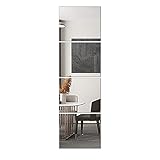
UNBREAKABL MIRO 4-Pack Acrylic Mirror Tiles, 12 x 12 Inch, 0.12 Inch Thick
Who it suits: Buyers who have accepted acrylic — for a door that slams, a household with children, a wall that cannot take glass’s weight — and want the version of it that behaves most like a rigid panel.
One number earns this set its place: 0.12 inch, roughly 3 mm, the stated thickness of these 12 x 12 inch tiles. That is about half again the Shiftshade’s 2 mm and three times the 1 mm film class, and in acrylic, thickness is destiny. A tile mirror’s waviness is mostly the tile flexing or taking the shape of the wall behind it; a 3 mm plate holds its own plane, bridges minor surface imperfections instead of copying them, and delivers the calmest reflection plastic can manage. For a modern room, where the whole complaint against acrylic is that it will not sit still optically, that stiffness is the single most valuable specification in the category. The set builds the same 48 x 12 inch column as the top pick, with the same 576 square inches of reflective area, and the brand aims it at exactly the rooms where glass is a liability — dorms, home gyms, children’s spaces, doors that get slammed. On specification, this is the best acrylic tile set in the guide.
So why is it not ranked first? Because its position in this budget cannot be assumed — check price on Amazon before you rely on it, and a modern-home recommendation should be clear about that. The 3 mm class, in short, often sits above this budget tier. The recommendation is therefore conditional and we state it as one: open the listing, and if the current price sits at $15 or under, this set preempts the Shiftshade on thickness alone. If it sits above budget, it belongs to the under-$30 conversation. Do not buy it on our enthusiasm for its specifications alone without checking the current price on Amazon.
- 0.12 inch (about 3 mm) acrylic — the thickest tiles here, and thickness is what keeps a plastic mirror flat and calm.
- Full 48 x 12 inch column and 576 square inches, identical coverage to the top pick.
- Built for the rooms where glass is a hazard: slamming doors, gyms, kids’ spaces.
Honest limitation: Position in this budget is not guaranteed — comparable 3 mm sets often sit above this tier, so check the current price on Amazon before counting it as a $15 product.
Choose it if the current price on Amazon is $15 or less when you check — then it is the best acrylic here. Skip it if it sits above budget; the 2 mm Shiftshade delivers the same size within this budget tier.

SAFEE MRROR 4-Pack Acrylic Mirror Tiles, 10 x 10 Inch
Who it suits: Parents furnishing a child’s room in a modern home, where the mirror must be unbreakable first and architectural second — plus shorter adults who need an outfit-check column on a door.
Children’s rooms are where modern design and acrylic tiles stop arguing. A mirror a child can fall against, throw a toy at or pull off the wall without injury is not a compromise in that room; it is the specification. This set is built for exactly that: four acrylic tiles, each 10 x 10 inches, that cannot shatter, weigh almost nothing, and mount with adhesive at whatever height a child needs. It sits in the lower part of this budget tier — check price on Amazon. Stacked, the tiles build a column 40 inches tall and 10 inches wide, or a 20 x 20 inch grid, for 400 square inches of reflective area. For a child, mounted low, 40 inches is honestly full length. The clean frameless format also suits a pared-back kids’ room better than any cartoon-framed alternative: four plain squares, nothing else.
For anyone else in a modern home, the limitations are decisive and we will not soften them. Forty inches is not full length for an average adult — it is a three-quarter mirror that shows an outfit from about the knees up at close range. Ten inches is a narrow slice of a column, too narrow for two people and tight even for one. In a modern interior, a partial mirror reads as exactly that: a fragment on the wall, an unfinished gesture, and the spareness of the room gives it nowhere to hide. The listing information we reviewed also does not clearly state a thickness, so treat the tiles as the standard thin class and mount them on the flattest surface available; the usual acrylic caveats — distance softness, scratch-prone surface, adhesive that wants smooth clean paint and dislikes steam — all apply. Buy this set for the room it was designed for and it is a fairly priced, sensible product. Buy it as the main mirror in an adult’s modern bedroom and the shortfall will disappoint you every morning.
- Four 10 x 10 inch tiles positioned in the lower part of this budget tier — check price on Amazon.
- Shatterproof and feather-light: the safe specification for a child’s room, with a clean frameless look.
- A genuine full-length column for children, and workable for shorter adults on a door.
Honest limitation: A 40-inch, 10-inch-wide column is a partial mirror for most adults — and a modern room makes a partial mirror look like a mistake rather than a bargain.
Choose it if the mirror is for a child, or a shorter adult’s door. Skip it if it is meant to be an adult’s main mirror — the Shiftshade’s 48-inch column sits in the same budget tier and gives you the extra height.

NC Unbreakable Acrylic Mirror, 12 x 12 Inch, 4 Pcs
Who it suits: Strictly, no one shopping under $15 — this set is here as the measuring stick, the same format as our top pick positioned above this budget, showing where the format sits outside this tier.
The product itself is respectable, and in one detail it is the most considered in the guide: the four 12 x 12 inch acrylic tiles have rounded corners. On a plain square tile a corner is the one sharp, finished-looking edge; rounding it softens the whole column’s outline and removes the only point that can catch a hand or a child’s forehead. The listing positions the set as a thick, bend-tested plexiglass mirror for gyms and children’s rooms, and the tiles stack to the familiar 48 x 12 inch column with 576 square inches of reflective area. Its position above budget is the point of the review: check price on Amazon. It sits noticeably above the Shiftshade set for a comparable column. For a modern room the comparison is worth stating carefully, because this is the set that tempts people into paying more for “better acrylic.” Better acrylic is still acrylic: the reflection softens at distance and the seams remain, and no thickness of plastic in this position closes the gap to the glass set above it in this guide.
We include the set, labeled plainly as an over-budget reality check, for two reasons. The first is calibration: listings move, and if the Shiftshade listing changes or disappears, this set shows where the format sits outside the budget tier and still sits below one-piece glass door mirrors in the next tier up. The second is a warning aimed squarely at modern buyers. Above this budget, the category sells you the same acrylic tiles with thicker stock and nicer corners; the jump that actually changes what you see in the mirror — glass — happens at the Delma set, which sits closer to this budget than this set does. Paying an over-budget position for plastic while glass sits closer to budget is the one genuinely hard-to-justify purchase in this guide, and it happens constantly because “unbreakable” reads as an upgrade. It is a property, not an upgrade. If your room has no children and no slamming doors, the glass is the stronger choice in a similar position; if it does have them, the Shiftshade sits in budget and is just as safe.
- Same 48 x 12 inch column and 576 square inches as the top pick, with rounded corners — a thoughtful safety detail.
- Positioned above this budget tier — check price on Amazon — as an anchor for where the format sits outside this tier.
- Thick, bend-tested plexiglass positioning for gyms and kids’ rooms.
Honest limitation: It sits over budget — and above the real-glass Delma set in tier position — while remaining acrylic, with acrylic’s distance softness and seams.
Choose it if the in-budget listings have moved or vanished and you need the format at its over-budget position — check price on Amazon first. Skip it if your cap is $15, or if no child or slamming door forces acrylic on you — glass sits closer to budget here.

JEOYOO 4-Pack Acrylic Mirror Tiles, 8 x 8 Inch
Who it suits: Almost no one reading this guide — and saying so is the review. This is the cheapest verified “full length mirror” in the category, included so that modern-home shoppers can see exactly what the lowest price buys and why it fails here.
The facts first. Four acrylic tiles, each 8 x 8 inches, positioned at the low end of this budget tier — check price on Amazon — and among the lowest-positioned entries in this guide. Now the arithmetic the title omits: four 8-inch tiles stack to a column 32 inches tall and 8 inches wide, or a 16 x 16 inch grid. Thirty-two inches is not a full length mirror for any adult. Optics requires a mirror spanning about half your height, perfectly placed, to show your whole body; 32 inches sits at the theoretical edge for someone around five foot four and fails in every real room, where placement is never perfect. Total reflective area is 256 square inches — less than half of what the Shiftshade provides — for a modest saving within the same tier. In a forgiving room, that might pass as a half-length mirror and a fair trade. A modern room is not forgiving. An 8-inch-wide, 32-inch-tall strip of seamed plastic on an otherwise empty wall does not read as minimal; it reads as a fragment, a sample, a thing awaiting the rest of itself. Minimalism is the discipline of few elements, each complete. This is an incomplete element, and the room will say so every day.
Strip away the modern objection and the product is ordinary category fare: acrylic with the standard distance softness, a thickness the listing does not clearly state, adhesive mounting with the standard paint and humidity caveats. It has legitimate uses — a child’s mirror, a narrow vanity column over a desk, a locker door, a low-end-of-tier experiment to learn whether you can live with tile seams before committing to a larger set. What it cannot do is the thing its title claims and the thing your search asked for. If the experiment is what you want, buy it as an experiment. If a full length mirror for a modern home is what you want, this set is not a cheaper version of it; it is a different, smaller product wearing the same words, and the modest saving will cost you the entire effect you were buying.
- Lowest-positioned pick in this tier — check price on Amazon — a low-cost way to test the tile format.
- Light, shatterproof acrylic that works as a child’s mirror or a narrow vanity column.
- Frameless and small enough to fit lockers, desk walls and other tight spots.
Honest limitation: Four 8-inch tiles reach only 32 inches — a half-length mirror for adults, and in a modern room a visibly incomplete fragment rather than a design element.
Choose it if you want a cheap format test or a child’s mirror. Skip it if an adult needs to see themselves head to toe — no arrangement of these tiles can do that.

Comparison Table
The table puts the six picks side by side on the specifications that decide a tile mirror in a modern room: material, tile size, the tallest column the set can build, total reflective area, thickness where a listing states it, and its position in or above this budget tier — check price on Amazon for every pick, including the ones whose position breaks or escapes the budget.
| Product | Material | Tile size | Tallest column | Total area | Thickness | Mounting | Price | Link |
|---|---|---|---|---|---|---|---|---|
| Shiftshade 4-Pack Acrylic Mirror Tiles | Acrylic | 12 x 12 in | 48 x 12 in | 576 sq in | 2 mm | Adhesive, wall or door | Check price on Amazon | Check on Amazon |
| Delma Glass Full Length Wall Mirror Tiles, 4PCS | Real float glass | 14 x 12 in | 56 x 12 in | 672 sq in | Thin float glass, frosted edges | Adhesive, flat wall or door | Check price on Amazon — near-miss, just over budget | Check on Amazon |
| UNBREAKABL MIRO 4-Pack Acrylic Mirror Tiles | Acrylic | 12 x 12 in | 48 x 12 in | 576 sq in | 0.12 in (about 3 mm) | Adhesive, wall or door | Check price on Amazon | Check on Amazon |
| SAFEE MRROR 4-Pack Acrylic Mirror Tiles | Acrylic | 10 x 10 in | 40 x 10 in | 400 sq in | Not clearly stated | Adhesive, wall or door | Check price on Amazon | Check on Amazon |
| NC Unbreakable Acrylic Mirror, 4 Pcs | Acrylic | 12 x 12 in | 48 x 12 in | 576 sq in | “Super thick” plexiglass (listing language) | Adhesive, wall or door | Check price on Amazon — over budget | Check on Amazon |
| JEOYOO 4-Pack Acrylic Mirror Tiles | Acrylic | 8 x 8 in | 32 x 8 in | 256 sq in | Not clearly stated | Adhesive, wall or door | Check price on Amazon | Check on Amazon |
How to Choose a Full Length Mirror for a Modern Home at This Price
Choosing well at this budget is mostly a matter of applying the minimalist test before the price test.
- Apply the plane test first. That requires a single-width column at full adult height, no frame, no trim, no visible hardware. In this guide, only the 48-inch columns and the 56-inch glass column are even candidates. A 40-inch or 32-inch strip fails the test before material is discussed, because a partial plane is not a plane.
- Do the height math yourself. Multiply tile size by tile count: four 12-inch tiles make 48 inches; four 10-inch tiles make 40; four 8-inch tiles make 32. The optical rule is that a flat mirror shows your whole body if it spans at least half your height and is placed exactly right — top edge midway between eye level and the top of your head. In real rooms, treat 48 inches as the adult floor and anything under 40 as a partial mirror regardless of marketing.
- Choose glass or acrylic by room, not by habit. Glass holds a true reflection at any distance and shrugs off scratches and cleaning — the dressing-mirror material, and in this guide it sits just over budget in tile form — check the current price on Amazon. Acrylic cannot shatter, weighs ounces and is safe on doors and around children, but flexes, softens at distance and scratches. The mistake is buying one while expecting the other.
- If you buy acrylic, buy thickness. Acrylic mirror comes in three practical classes: 1 mm films, which wrinkle and wave and should be avoided entirely; 2 mm tiles, the workable budget class; and 3 mm or 1/8-inch plates, the stiff class that comes closest to a calm reflection. Thickness is rarely in the title — find it in the specifications, and treat a listing that hides it as a 1–2 mm product.
- Plan the seams like panel joints. A four-tile column has three horizontal joints. In a modern room, a seam survives aesthetically only if it reads as deliberate: tiles aligned with a level, edges pressed fully flat, hairline gaps kept even, and the joints placed where they cross your reflection least — mid-thigh and shoulder height bother most people less than a line at eye level.
- Interrogate the wall before the mirror. Every pick here is adhesive-mounted; none hangs from hooks and none stands on legs. Adhesive wants flat, smooth, clean, dry surfaces, and thin tiles — even glass ones — telegraph bumps and texture into the reflection. Modern homes often have the flattest walls of any housing type, which is the one structural advantage this budget gets for free; heavy orange-peel texture, brick, wallpaper and steamy bathrooms all defeat both the bond and the look.
- Know when to skip the tier. If the mirror is a focal point — opposite the entry, beside a designer wardrobe, anywhere guests will judge the room by it — $15 tiles are the wrong purchase even at their best, because the seams and the material will be the story. One-piece glass starts in a higher tier. Spending in this tier now and then spending again in the next tier later is the most expensive route to the mirror you actually want.
Acrylic vs Glass: Why Modern Rooms Argue for Glass
Five of the six products in this guide are acrylic, and every one of their listings uses the word “mirror” exactly as the glass set does. Glass is rigid at any practical thickness, so its reflective surface sits on a plane that does not move; the image is identical at one foot and at fifteen. Acrylic is a plastic sheet, and at 1–2 mm it behaves partly like a sheet and partly like a stiff film — it follows the wall’s imperfections, flexes under mounting pressure, and returns the room with a gentle warp that grows with viewing distance. Acrylic makers admit the limit in their own fine print: one advises that the reflection is best within about half a meter and distorts beyond it. In most rooms that is a footnote. In a modern room it is the whole review, because modern rooms are where viewing distances are longest, sightlines are straightest, and the surrounding surfaces — flat paint, straight joinery, hard floors — give the eye a dozen true lines to compare the reflection against.
The countervailing virtues of acrylic are real and we do not dismiss them: it survives drops, slams and children; it weighs almost nothing; it can be arranged in grids and shapes glass cannot. A modern home with a toddler, a home gym or a hard-used door should buy acrylic without a moment’s regret, and the Shiftshade or the 3 mm UNBREAKABL MIRO will serve it well. But a modern dressing wall with no hazards is a glass use case, and the glass here is, remarkably, not even the highest-positioned option in this guide — the premium acrylic set sits above it. Check price on Amazon for both before you decide. Pick the material your room actually demands, then compare products inside it.
What $15 Cannot Buy a Modern Home
At $15 you cannot buy a one-piece full length mirror of any kind on Amazon — one-piece over-the-door glass mirrors sit in a higher tier — and a one-piece mirror is what most modern interiors actually specify. You cannot buy a leaning or standing mirror: legs, frames and easel backs are exactly the hardware this budget excludes. You cannot buy an arched or rounded full length mirror, the silhouettes that dominate contemporary interiors, which start several times higher. You cannot buy a seam-free reflection: every product here is four tiles, and four tiles means three joints. And you cannot buy a distortion-free acrylic reflection at room distance at any thickness — 3 mm narrows the gap to glass; it does not close it. What $15 can buy, bought knowingly, is a frameless column that approximates the modern idea honestly: full height, single width, carefully aligned, on a flat wall. In a secondary room, a child’s room, a gym corner or a first apartment furnished in a modern spirit, that approximation is genuinely good. On the wall your home is judged by, it is a placeholder — and placeholders are worth buying only when you know that is what they are.
Common Buying Mistakes
- Believing the words “full length” in a title. The phrase is unregulated: four 8-inch tiles wear it as confidently as a 60-inch door mirror. Multiply tile size by count, compare the result with half your height, and let the arithmetic overrule the headline.
- Judging by the grid photograph. Listing photos show tiles in wide grids that photograph like large mirrors. Your full-length installation is a narrow column with three seams. Picture the column on your wall — at your room’s viewing distance — not the grid on the product page.
- Assuming a mirror is glass. Most under-$15 mirrors are acrylic, and listings rarely volunteer the material in the title. If the words acrylic, plexiglass, shatterproof or unbreakable appear anywhere, it is plastic, with plastic’s distance softness. Shoppers who expected glass write most of this category’s one-star reviews.
- Paying premium money for plastic. The over-budget acrylic set in this guide sits above the real-glass set, which is only just over budget. “Unbreakable” is a property for hazardous rooms, not a quality tier; in a calm adult room it can leave you with a worse reflection at a higher tier position.
- Mounting on texture and blaming the tile. Orange-peel paint, matte finishes, wallpaper and bathroom humidity defeat adhesive and print themselves into the reflection. Prep with alcohol, use a level, press the full pad area, and respect curing time — and if your wall is heavily textured, no tile in this guide will look right on it.
- Placing a seam at eye level. Of the three joints in a column, the one at face height is the one you will see every day. Shift the column so the joints fall at thigh and shoulder, and align them with a level so they read as panel lines rather than cracks.
- Buying the placeholder for the focal wall. A tile column in this budget tier in a secondary room is a smart buy; the same column opposite your front door is a daily reminder of a compromise. Match the mirror’s ambition to the wall’s importance, and save toward one-piece glass for the walls that carry the room.
Final Recommendation
For a modern home, our recommendation splits by how much the budget can bend. If it can bend just a little — or if you can wait until it dips into budget — buy the Delma glass tile set — check price on Amazon: real float glass, the tallest column here at 56 inches, and the only reflection in this guide that a minimalist room will accept without qualification. If the budget is exactly $15 and immovable, buy the Shiftshade 12 x 12 inch acrylic four-pack — check price on Amazon — a true 48-inch frameless column in the workable 2 mm class — and install it like you mean it: flattest wall, level seams, joints at thigh and shoulder. Before ordering either, check the UNBREAKABL MIRO listing: if its 3 mm tiles sit at $15 or under that day — check the current price on Amazon — they preempt the Shiftshade as the acrylic pick. Choose the SAFEE MRROR set when the room belongs to a child, and do not buy the 8-inch JEOYOO set as an adult’s mirror at all. And if the wall in question is the one your home is judged by, take this guide’s recurring advice at face value: skip the tier, keep the budget, and put it toward the one-piece glass mirror in the next tier up that the room was always asking for — the full step-up path is laid out in Best Full Length Mirror For Modern Homes Under $30.
FAQ
Can a mirror in this budget actually look right in a modern home? A carefully installed one can come close. A frameless 48-inch column of tiles, aligned with a level on a flat wall with its seams placed away from eye level, reads as a minimal mirror plane — especially in glass. What it cannot do is match a one-piece mirror: three seams and, in acrylic, a reflection that softens across the room. In secondary rooms the approximation succeeds; on a focal wall, most modern homeowners eventually upgrade.
Why do mirror tiles look wavy in my room when they looked fine in the photos? Two reasons. Listing photos show wide grids viewed close, where acrylic is at its best; your column is viewed from across the room, where thin acrylic’s flex shows. And the tiles copy your wall: every bump and texture behind a 1–2 mm tile prints into the reflection. The fixes are a flatter surface, thicker tiles in the 3 mm class, full adhesive contact, and — decisively — glass, which stays flat at any distance.
Are the seams really that noticeable? They are three fine horizontal lines across the column, and their visibility depends on alignment and placement. Misaligned by a millimeter, they read as cracks. A seam at eye level is the one you will notice daily; place the column so the joints fall at thigh and shoulder height.
How tall does a mirror need to be to count as full length? Optics says a flat mirror shows your whole body if it spans at least half your height, perfectly placed. In practice the standard door mirror is 48 inches, and we treat that as the adult floor: a 40-inch column works for children and shorter adults, and a 32-inch column is a half-length mirror for any adult, whatever its listing claims.
Is acrylic ever the right choice in a modern home? Yes — in the rooms where safety outranks fidelity. A child’s modern bedroom, a home gym, a door that slams: acrylic cannot shatter, weighs almost nothing, and its frameless format suits the aesthetic. Choose the thickest tiles you can verify (3 mm class), mount them on the flattest surface you have, and accept the distance softness as the price of an unbreakable mirror.
Will adhesive tiles damage my walls? They can: the pads that hold securely can also pull paint and leave residue on removal. On the flat painted walls typical of modern homes the bond is strong, which cuts both ways. Test one tile in an inconspicuous spot, prefer a flat door where possible, and remove with heat and a slow peel. If the wall is a carefully finished focal surface, that risk alone may argue for a hung one-piece mirror instead.
When should I skip this budget entirely? When the mirror is a focal point, when the room is large and open so the mirror will be viewed from ten feet or more, or when you know seams will bother you. One-piece glass door mirrors start in a higher tier, and framed and arched designs start higher still. For those rooms, money spent on tiles in this tier can end up spent twice — once now, once on the replacement.