Where to buy
Check the latest price, availability and delivery on Amazon. Orders are placed on Amazon. We may earn a commission from qualifying purchases.
- Best for most small rooms: Amico 42 Inch Low Profile Ceiling Fan with Lights, Black — Check on Amazon
- VOLISUN 20 Inch Bladeless Ceiling Fan with Light, Black — Check on Amazon
- Ohniyou 52 Inch Low Profile Ceiling Fan with Lights, Silver — Check on Amazon
- VOLISUN 52 Inch Ceiling Fan with Lights, Flush Mount, Black — Check on Amazon
See 2 more Amazon options
- UME 52 Inch Ceiling Fan with Lights, Black/Wood Grain — Check on Amazon
- Kinyaras 52 Inch Low Profile Ceiling Fan with Light, 35W DC Motor — Check on Amazon
Read the full guide ↓
Disclosure: As an Amazon Associate, dailyhomedecorating.com earns from qualifying purchases. Links to Amazon on this page are affiliate links; they cost you nothing extra. Listing details such as price and availability change often, so check the current Amazon listing before you buy.
A small room changes the ceiling fan question completely, and it changes it in a direction most buying guides get backwards. In a big room the problem is reach: you need a fan wide enough and strong enough to stir four hundred square feet of air. In a small room — a 9-by-11 bedroom, a nursery, a home office carved out of a spare corner — the problem is the opposite. The air is close, the walls are close, the bed is close, and a standard 52-inch fan hung over all of it does not give you a gentle, adjustable breeze. It gives you two settings that matter: a gale that rattles the papers on the desk, and off. The fans that actually work in small rooms are the ones sized for them, and under $75 there are exactly two honest answers: a true 42-inch bladed fan, and a 20-inch enclosed fandelier for the rooms where even 42 inches of open blade is too much. Both are in this guide, and both are ranked at the top, because in a small room correct sizing is not a compromise — it is the whole product.
The four 52-inch fans that fill out the list are here with their caveats printed in the open rather than buried. They are good fans — several of them are the strongest picks in our general Best Ceiling Fan With Light Under $75 guide — and if your “small” room is really the large end of small, a 150-square-foot bedroom or a studio corner that opens into a bigger space, one of them may be exactly right. But each 52-inch review below states plainly what oversizing costs you in a genuinely small room: unusable low speeds, a downdraft that feels like weather, and blade tips closer to the walls than the 18 inches of clearance fan makers ask for. Two more honesty notes before the picks. Every CFM and decibel figure in this guide is a maker’s claim, not a Department of Energy tested rating — almost no fan under $75 carries the DOE label, and one claim in this list is flagged as not credible even by the deal trackers who follow it. And one pick, the Kinyaras, sits at the top of this budget band, so its review tells you to check the current price on Amazon and confirm it still fits the under-$75 budget before you rely on it.
Quick Picks
Short on time, or comparing several options at once? Each row below names the small-room situation and the fan that suits it, with a link to the listing.
| Buyer type | Pick | Why it stands out | Link |
|---|---|---|---|
| Best for most small rooms | Amico 42 Inch Low Profile Ceiling Fan with Lights, Black | The only true 42-inch fan here — six genuinely usable speeds in rooms up to about 100 square feet | Check on Amazon |
| Best for tiny rooms and bunk beds | VOLISUN 20 Inch Bladeless Ceiling Fan with Light, Black | An enclosed fan light with no exposed blades — safe over bunks and under the lowest ceilings | Check on Amazon |
| Best for the big end of small | Ohniyou 52 Inch Low Profile Ceiling Fan with Lights, Silver | The complete 52-inch package for a 150-square-foot room — check the current price on Amazon | Check on Amazon |
| Best stated airflow, 52-inch | VOLISUN 52 Inch Ceiling Fan with Lights, Flush Mount, Black | Maker-rated 3,557 CFM and a bright 22W LED at the value end of this band — if the room can take the span | Check on Amazon |
| Best wood-look, 52-inch | UME 52 Inch Ceiling Fan with Lights, Black/Wood Grain | Warm dual-finish blades and remote-only simplicity — check price on Amazon | Check on Amazon |
| Best spec at the top of the band | Kinyaras 52 Inch Low Profile Ceiling Fan with Light | A stated 35W DC motor and full controls — check the current price on Amazon to confirm it fits the budget | Check on Amazon |
How These Picks Were Chosen
Small-room suitability was the first filter, applied before price. A fan earns a top ranking here only if its size matches the rooms this guide is about: up to roughly 100 square feet, where industry sizing guidance puts 42-inch fans, plus the enclosed 20-inch format that serves the smallest and lowest rooms of all. The 52-inch fans were then admitted only with their oversize caveats attached, because a reader with a 150-square-foot room deserves to see them — clearly labeled — rather than not see them at all. Blade clearance did the rest of the sorting. Fan makers ask for at least 18 inches between a blade tip and the nearest wall; on the short axis of an 8-by-10 room, a centered 52-inch fan leaves 22 inches a side, which passes on paper, while the same fan in a 7-foot-wide room fails the rule outright. Clearance is not just a safety margin — air needs somewhere to go, and a fan churning against close walls delivers turbulence instead of breeze.
We did not install or test these fans ourselves. We read the maker listings and specification pages, compared blade spans, motor types, speed counts and light outputs, and favored listings complete enough to check: a stated diameter, a stated motor type, a named control method. Prices change often at this budget, so this guide does not print a fixed price for any pick: use the Amazon links to check the current price on Amazon before you buy, and confirm the total still fits the under-$75 budget. That discipline matters twice over here, because budget fans are coupon-driven products and a listing’s price can move between the day you research and the day you order.
Finally, the numbers. Every CFM airflow figure and every decibel figure in this guide is a maker’s claim. The US Department of Energy tests and labels ceiling fan airflow for the major brands; almost nothing under $75 carries that tested label, so claims here are quoted as claims, compared only within this guide, and in one case — a 5,471.5 CFM figure with a decimal point doing heavy marketing work — flagged as not credible at all. In a small room, fortunately, the numbers matter least: the room needs so little air moved that size, motor type and speed range predict your comfort far better than any printed airflow figure.
The 6 Best Ceiling Fans with Light for Small Rooms Under $75
Amico 42 Inch Low Profile Ceiling Fan with Lights, Black
Who it suits: Anyone whose room is genuinely small — a bedroom, nursery, home office or kitchen up to about 100 square feet — and who wants a real bladed ceiling fan that behaves like one at every speed, not just at the top of its range.
This is the fan this guide exists to point at. Forty-two inches is the size the industry specifies for rooms up to about 100 square feet, and in practice the difference is not the diameter, it is the speed range. A 52-inch fan in a 90-square-foot bedroom moves so much air per revolution that its lowest setting is already a stiff breeze and its upper settings are unusable; you end up living between one speed and off. The Amico’s smaller sweep softens every notch, so all six of its speeds are settings you might actually choose — a barely-there stir for sleeping, a middle range for working at a desk, a top end that still clears a stuffy room in minutes. The hardware underneath is the full modern budget formula: a reversible DC motor (reverse pushes warm air down in winter, which matters in small rooms that lose heat to one cold exterior wall), five dual-finish blades in black or walnut depending on which side faces down, an integrated LED that switches among three color temperatures and dims, and a remote with memory and timer functions, so the fan returns to your last setting from the wall switch and can shut itself off after you fall asleep.
Amico is also the closest thing this price tier has to an established name — the brand sells recessed lighting and electrical fixtures across Amazon in volume — and the listing adds one claim none of the other picks here make as clearly: a rating for indoor and covered outdoor use, which opens up covered porches and sunrooms as well as small bedrooms. The black version sits at the value end of this guide’s band — check price on Amazon to see the current figure before you order. On clearance, the math is comfortable: centered in a 9-by-11 room, the blade tips sit about 27 inches from the short walls and 36 from the long ones, well beyond the 18-inch minimum, so the fan breathes the way its designers assumed it would.
- A true 42-inch sweep sized for rooms up to about 100 square feet — every speed is usable, not just the lowest.
- Reversible DC motor, six speeds, remote with memory and timer, three-color dimmable LED.
- Rated by the maker for indoor and covered outdoor use — check price on Amazon.
Honest limitation: The same sizing honesty cuts the other way — a 42-inch fan cannot cool a 200-square-foot living room, and Amico’s whisper-quiet marketing (a 35-decibel-class claim) is a maker figure, not a laboratory rating, like every noise number in this guide.
Choose it if your room is under about 100 square feet and you want a bladed fan that fits it. Skip it if the room opens into a larger space or runs past roughly 150 square feet — the 52-inch fans below will serve it better.

VOLISUN 20 Inch Bladeless Ceiling Fan with Light, Black
Who it suits: The smallest and lowest rooms of all — bunk-bed rooms, nurseries, hallways, small kitchens — and anyone for whom exposed spinning blades are the problem: a tall teenager on a top bunk, a low ceiling, a changing table under the fixture.
Some small rooms cannot take a bladed fan at any size, and this is the product built for them. The VOLISUN fandelier hides seven small blades inside a 20-inch drum housing, so from below it reads as a modern flush-mount light fixture; air enters and leaves through the vents, circulating the room without anything exposed to reach, bump or fear. It offers six speeds, control by remote and smartphone app, a stepless dimmable LED that sweeps from 3000K warm to 6500K daylight, and a memory function that restores your last light setting when you use the wall switch. Most of the unit arrives pre-assembled, making it the easiest install in this guide, and the maker backs it with a three-year service promise — a meaningful detail at this price, where support is usually a shrug. It sits at the top of this guide’s price band — check the current price on Amazon — precisely because the enclosed format costs more to build than an open bladed fan.
The physics deserve one plain paragraph, because the word “fandelier” does quiet lying in this category. A 20-inch enclosed fan moves a fraction of the air a 52-inch open fan moves; it cannot cool a living room and does not pretend otherwise here. What it does in a small room is real: it takes the stuffiness out, evens the temperature between the floor and the bunk, and gives a nursery or a child’s bedroom gentle circulation with zero blade exposure and a housing nobody can reach into. Buy it as the best version of a ceiling light — one that also stirs the air — and it is excellent value. Buy it as a cooling fan for a big space and no speed setting will rescue it. For bedrooms being planned around the same small-footprint logic, Best Ceiling Fan With Light For Bedrooms Under $75 works through the bladed options room by room.
- Enclosed bladeless design — safe over bunk beds, in nurseries and under the lowest ceilings.
- Six speeds, remote and app control, stepless 3000K–6500K dimming with memory.
- Mostly pre-assembled install — check price on Amazon.
Honest limitation: Airflow is a fraction of a bladed fan’s — this is a light fixture that circulates air in small rooms, not a cooling fan for large ones, and it sits at the top of this guide’s price band.
Choose it if blades themselves are the obstacle, or the room is too small and low for anything with a sweep. Skip it if the room is a normal small bedroom with a normal ceiling — the Amico above moves far more air and sits lower in the band.

Ohniyou 52 Inch Low Profile Ceiling Fan with Lights, Silver
Who it suits: Owners of rooms at the big end of small — a 140-to-160-square-foot bedroom, a studio whose sleeping corner opens into the living space — who need a full-size fan and want the most complete one under $75.
Start the 52-inch section with the strongest all-round fan in this guide, and with its caveat stated as plainly as its virtues: in a room under about 100 square feet this fan is too much fan, and the rest of this review assumes your room is big enough to argue otherwise. The Ohniyou is a full 52-inch flush-mount fan with a DC motor — quieter than an old AC motor at low speed, frugal with power, and capable of six speeds instead of the traditional three — controlled by both a handheld remote and a smartphone app, with a dimmable integrated LED and a winter reverse that recirculates warm air in January. It carries Amazon’s Choice recognition in its category, which at this end of the market is a useful sign of an established seller who will still exist when you need a part. It sits comfortably inside this guide’s band — check the current price on Amazon before you order.
Now the oversize math, because it decides whether this pick is right for you. Centered on the short axis of a 10-foot-wide room, a 52-inch fan leaves 34 inches of clearance per side — comfortable. On the short axis of an 8-foot-wide room it leaves 22 inches, above the 18-inch minimum but close enough that the breeze pattern tightens; below that width, skip every 52-inch fan in this guide. The subtler cost is the speed range: a big sweep in a small volume means the lowest speeds already move plenty of air, so your six settings compress into two or three you will actually use, and the fan spends its life loafing — not harmful, just wasted range you paid for. The integrated LED is a panel rather than a bulb socket, so its eventual replacement comes from the seller, not a hardware shelf; every fan here shares that trade. If your room measures out at the top of small, none of this disqualifies the Ohniyou — it remains the default recommendation of this entire price tier.
- Full 52-inch span with a DC motor, six speeds and reverse for winter use.
- Remote and smartphone app control, with a dimmable integrated LED light.
- Sits inside the under-$75 band — check price on Amazon.
Honest limitation: In a room under about 100 square feet it is oversized — expect gale-or-nothing at the speeds that matter — and the integrated LED panel is not a standard bulb when replacement day comes.
Choose it if your “small” room is really 150 square feet or opens into a larger space. Skip it if the room is a true small bedroom — the Amico’s 42 inches will feel better proportioned.
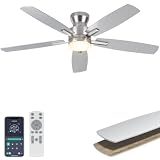
VOLISUN 52 Inch Ceiling Fan with Lights, Flush Mount, Black
Who it suits: Value hunters whose room sits at the upper edge of small — or whose small room runs hot, over a kitchen or under a roof — who want the strongest stated airflow and brightest stated light in this guide.
VOLISUN’s 52-inch fan is the specification-sheet pick. The listing states a DC motor driving a maker-rated 3,557 CFM of airflow — read that the way this guide reads all budget CFM, as a claim rather than a DOE-tested result, but a claim inside the plausible band for a 52-inch DC fan and stronger than most listings at this price bother to make. The light is a 22W dimmable LED, the brightest checkable specification in this guide, control is by remote and app, the motor reverses for winter, and the blades are dual-finish — black on one side, a wood tone on the other — so the fan can survive a redecoration by being flipped. It sits at the value end of the full-size fans here — check price on Amazon — and inside this guide’s under-$75 band.
For a small room, the honest reading of those numbers is double-edged. Strong stated airflow is the last thing a 90-square-foot bedroom needs at full speed — but a hot small room is a real category: the bedroom over the garage, the attic conversion, the west-facing box that bakes all afternoon. There, a fan that can blast the room cool at speed six for ten minutes, then idle at speed one, earns its span in a way it never would in a mild room. The clearance rule still applies without exception: keep 18 inches or more between blade tip and wall, which means a room at least about 8 feet wide on the fan’s short axis, and understand that the closer the walls, the more the breeze arrives as turbulence rather than flow. If two 52-inch fans are finalists for your larger small room, let this one’s light output and stated airflow break the tie — and if the room is small and mild, let the Amico win it instead.
- Maker-rated 3,557 CFM airflow — the strongest stated figure among the full-size fans here.
- 22W dimmable LED light, remote and app control, reversible DC motor.
- Dual-finish blades (black/wood) — check price on Amazon.
Honest limitation: The airflow figure is the maker’s claim, not a DOE-tested rating; and the span is simply wrong for rooms under about 100 square feet.
Choose it if your room is at the big end of small, or small but genuinely hot. Skip it if you want remote-only simplicity — the UME below takes that simpler route — or if the room is small and mild, where its strength is wasted.

UME 52 Inch Ceiling Fan with Lights, Black/Wood Grain
Who it suits: Buyers furnishing a larger small room — a farmhouse-style spare bedroom, a studio with warm tones — who want the simplest possible controls: a remote, nothing to pair, nothing to configure.
The UME’s case is straightforwardness. Its 52-inch blades wear a black and wood-grain dual finish that suits the transitional rooms budget fans usually end up in, the motor is a six-speed DC unit, and control is a handheld remote only — no app account, no Wi-Fi password typed into a ceiling. In a small room that doubles as a guest room, that simplicity is a genuine feature: anyone sleeping there can run the fan without a phone. It sits in the middle of this guide’s band — check price on Amazon to see the current figure before you order.
One number on this listing needs handling in the open, exactly as our main guide handles it. The maker claims 5,471.5 CFM of airflow — a figure with a suspicious decimal point, higher than the tested output of many premium 52-inch fans, and quoted here only to warn you off it; even the deal analysts who track this fan advise treating the claim cautiously, and no fan under $75 in this guide carries a DOE-tested airflow label to settle the question. Judge the UME on its verified facts — size, motor, speeds and finish — and it earns its place. The small-room caveat is the standard one for this section: 52 inches in a room under about 100 square feet buys you a compressed, blustery speed range, and blade tips need their 18 inches of clearance from the walls. Put it in a 150-square-foot room with wood tones to match and it is a contented fan; put it over a 9-by-10 bedroom and the Amico will make you happier.
- Black/wood-grain dual-finish blades — the warmest look in this guide.
- Six-speed DC motor with a simple handheld remote and no app to configure.
- Mid-band positioning in this guide — check price on Amazon.
Honest limitation: The maker’s 5,471.5 CFM airflow claim is not credible as a tested figure — treat it as marketing. There is no app control, and the span is oversized for genuinely small rooms.
Choose it if you want wood-look blades and remote-only simplicity in a larger small room. Skip it if app or voice control matters — the Ohniyou and VOLISUN 52 both offer it — or if the room is truly small.

Kinyaras 52 Inch Low Profile Ceiling Fan with Light
Who it suits: Feature-focused buyers with a room at the big end of small, who have checked the current price on Amazon and confirmed it still fits this budget — a check this review puts first instead of last.
The price check is the review’s first point, so here it is without decoration. The Kinyaras sits at the top of this guide’s band, so the rule for this pick is simple: check the current price on Amazon first, and confirm it still fits the under-$75 budget before you rely on it; if it has moved out of band when you shop, the Ohniyou above is the in-band alternative. What you get for that top-of-band position is one of the best specification sheets in this guide: a 52-inch flush-mount span, an explicitly stated 35W DC motor — a wattage most budget listings hide — six speeds, remote and app control with a memory function, and a three-color dimmable LED.
Two honest notes complete the picture. The listing publishes no CFM figure at all, which the trackers flag; in a category full of invented airflow numbers, silence is arguably more honest than invention, but it means you are comparing this fan on format and motor wattage rather than stated output — and, as this guide keeps repeating, no pick here carries a DOE-tested label anyway. The second note is the small-room one: this is a 52-inch fan, with the same oversize caveats as the three above it. In a room under about 100 square feet its six speeds compress into the same gale-or-gentle problem, and its blade tips need the same 18 inches from the walls. Its natural home is a 150-square-foot room whose owner has confirmed the current price still fits the budget — and readers whose rooms are bigger still, or whose price check puts it out of band, will find this fan waiting in its proper tier in Best Ceiling Fan With Light For Small Rooms Under $100.
- Explicit 35W DC motor, six speeds, remote and app control with memory.
- Three-color dimmable LED in a full 52-inch flush-mount format.
- Top-of-band positioning in this guide — check the current price on Amazon.
Honest limitation: It sits at the top of the band, so confirm the current price on Amazon still fits the under-$75 budget before ordering. The listing also publishes no airflow figure, and the span is wrong for rooms under about 100 square feet.
Choose it if the current price on Amazon still fits the budget when you shop and your room is at the big end of small — then it is arguably the best value here. Skip it if the price has moved out of band, or the room is genuinely small; the Amico answers both problems at once.

Comparison Table
| Product | Type | Best use | Link |
|---|---|---|---|
| Amico 42 Inch Low Profile Ceiling Fan, Black | 42″ flush mount, DC motor | The right size for bedrooms and offices up to ~100 sq ft | Check on Amazon |
| VOLISUN 20 Inch Bladeless Ceiling Fan, Black | 20″ enclosed fandelier | Bunk beds, nurseries and the lowest ceilings | Check on Amazon |
| Ohniyou 52 Inch Low Profile Ceiling Fan, Silver | 52″ flush mount, DC motor | The complete package for rooms around 150 sq ft | Check on Amazon |
| VOLISUN 52 Inch Ceiling Fan with Lights, Black | 52″ flush mount, DC motor | Strongest stated airflow and light, for hot larger small rooms | Check on Amazon |
| UME 52 Inch Ceiling Fan, Black/Wood Grain | 52″ flush mount, DC motor | Wood-look finish with remote-only simplicity | Check on Amazon |
| Kinyaras 52 Inch Low Profile Ceiling Fan | 52″ flush mount, 35W DC motor | Top specification at the top of the band | Check on Amazon |
Sizing a Fan for a Small Room: The Three Measurements That Matter
Square footage is the measurement everyone quotes, and for small rooms it is only the first of three. The industry convention is simple — 42-inch fans serve rooms up to about 100 square feet, 52-inch fans serve rooms from there to roughly 400 — but small rooms punish shoppers who stop at area, because two more measurements decide whether the fan actually works once it is up.
The second measurement is blade-to-wall clearance. Fan makers ask for at least 18 inches between a blade tip and the nearest wall, and the arithmetic is worth doing on your own room before ordering. A centered fan’s clearance on any axis is the room’s width on that axis, minus the fan’s diameter, divided by two. A 42-inch fan in a 9-foot-wide room leaves (108 − 42) ÷ 2 = 33 inches a side — generous. A 52-inch fan in the same room leaves 28 inches — still fine. Drop to a 7-foot-wide room and the 52-inch fan leaves 16 inches, under the minimum: the fan will churn air against the walls, feel turbulent at every speed, and should not be bought for that room at all, while the 42-inch still leaves a workable 21 inches. In the smallest rooms — a 6-foot-wide nursery nook — even 42 inches fails the rule, and that is exactly the case the 20-inch fandelier exists for. Clearance is also why “centered” matters: a fan mounted off-center to dodge a beam can pass on one side and fail on the other.
The third measurement is height. Building guidance wants fan blades at least 7 feet above the floor, and small rooms disproportionately have 8-foot ceilings — the exact height where a downrod fan becomes a head-clearance problem and a flush mount becomes mandatory. Every fan in this guide is a hugger for that reason, and the fandelier, with the shallowest profile here, is the safest of all under a low ceiling or over a bunk. Measure all three — area, width, height — and the shortlist usually writes itself: under 100 square feet with normal width, the Amico; a failed clearance or height test, the VOLISUN fandelier; 150 square feet with clearance to spare, any of the 52-inch fans with their caveats understood.
How to Choose a Ceiling Fan with Light for a Small Room Under $75
- Size down on purpose. Up to about 100 square feet, buy the 42-inch fan. Its gentler sweep makes all six speeds usable; a 52-inch fan in the same room gives you gale or nothing.
- Run the 18-inch clearance test. Subtract the fan’s diameter from the room’s width, halve the result, and do not buy if the answer is under 18 inches on any axis. It is the rule that quietly disqualifies most 52-inch fans from most small rooms.
- Insist on a DC motor. Every fan in this guide has one: quieter low speeds, six speeds instead of three, a winter reverse, and a fraction of an AC motor’s power draw — all worth more in a small room, where you sit closer to the fan.
- Measure the ceiling before the room. Blades belong at least 7 feet above the floor. On an 8-foot ceiling that means flush mount, full stop; under a bunk or a very low ceiling, it means the enclosed fandelier.
- Confirm the ceiling box before anything arrives. A fan must hang from an electrical box rated for fan support, not a standard light-fixture box. A listed fan brace kit is a small, non-optional fix if yours is not rated.
- Check the current price on Amazon. Prices at this budget move often, and coupons and checkout codes come and go. Confirm the current total still fits the under-$75 budget before counting yourself in budget.
- Treat CFM and decibels as claims. Almost no fan under $75 carries DOE-tested airflow figures or laboratory noise ratings — one claim in this guide exceeds 5,400 CFM and is flagged as not credible. In a small room, size and motor predict comfort better than any printed number.
- Decide how you will control it. Remote-only (the UME) is simplest for guests; remote plus app (most picks here) adds scheduling through a generic app. Never wire any of these fans to a wall dimmer — a plain on/off switch or the remote, only.
- Read the light specification, not the adjectives. Wattage and color-temperature range are checkable: a 22W LED (the VOLISUN 52) or a 3000K–6500K stepless range (the fandelier) are real claims; “super bright” is not.
- Plan for the LED panel’s old age. Integrated LED panels are not bulbs. Check that the seller offers replacement light kits, or accept that a dead panel years from now may mean a new fan.
What a Small Room Forgives — and What It Doesn’t
Small rooms forgive weak specifications, and it is worth understanding why, because it reverses the usual shopping logic. Airflow needs scale with volume: a 10-by-10 bedroom with an 8-foot ceiling holds 800 cubic feet of air, and even a modest fan turns that volume over quickly, which is why the fandelier’s gentle circulation registers as pleasant in a nursery and pointless in a living room. Noise forgives less than shoppers expect — you sleep and work closer to a small room’s fan, so motor hum carries — but DC motors at low speed are genuinely quiet, and a correctly sized fan spends its life at those low speeds. What a small room does not forgive is geometry. An oversized fan cannot be turned down past its own sweep: its lowest speed still moves a small room’s worth of air with every revolution, its downdraft lands on the bed or the desk because there is nowhere else for it to land, and its blade tips crowd the walls that the 18-inch rule exists to protect. Renters working through the same trade-offs against a lease will find the fuller discussion in Best Ceiling Fan With Light For Apartments Under $75, and anyone dressing a small room in a modern scheme should compare notes with Best Ceiling Fan With Light For Modern Homes Under $75 — the sizing rules are identical, only the finishes change.
Common Buying Mistakes
- Buying the 52-inch fan because it sits in the same price band as the 42-inch. Same band, wrong tool: in a small room the bigger fan’s speed range compresses into gale and off.
- Skipping the clearance math. A fan whose blade tips sit under 18 inches from a wall delivers turbulence, not breeze — measure the room’s short axis before ordering.
- Believing the CFM figure. Budget listings quote untested marketing numbers — one pick in this guide claims over 5,400 CFM — and small rooms need so little air that the number should never drive the choice.
- Counting a coupon price as the price. Codes expire and on-page coupons vanish, so a price you saw while researching may not be the price at checkout. Check the current price on Amazon.
- Buying a fandelier to cool a large room. A 20-inch enclosed fan is a light with circulation for small spaces; no speed setting changes its physics.
- Hanging a fan from a light-fixture box that is not rated for fan support — the one mistake in this category with a safety consequence.
- Ignoring the 7-foot blade rule over a bunk bed or under a low ceiling. Height, not diameter, is the binding constraint in the smallest rooms.
- Wiring the fan to a wall dimmer or a fan-speed wall control. These remote-receiver fans want a plain on/off switch; a dimmer upstream causes hum, flicker and dead receivers.
- Assuming the LED light is a bulb you can change. Integrated panels need a seller-supplied replacement kit; check availability before the panel, years from now, decides for you.
- Judging noise at speed six in a listing video. Small-room comfort is decided at speeds one to three, where every DC fan here is quiet — and where an oversized fan is already too strong.
Final Recommendation
- Most small rooms: Amico 42 Inch Low Profile Ceiling Fan with Lights, Black.
- Tiny rooms, bunks, lowest ceilings: VOLISUN 20 Inch Bladeless Ceiling Fan with Light, Black.
- The big end of small, complete package: Ohniyou 52 Inch Low Profile Ceiling Fan with Lights, Silver.
- Small but hot rooms, strongest stated specs: VOLISUN 52 Inch Ceiling Fan with Lights, Flush Mount, Black.
- Wood-look finish, simplest controls: UME 52 Inch Ceiling Fan with Lights, Black/Wood Grain.
- Best specification at the top of the band: Kinyaras 52 Inch Low Profile Ceiling Fan with Light.
Our top two are the Amico and the fandelier, because they are the two products in this guide actually designed for the rooms in its title. The Amico is the default: a real bladed fan, honestly sized, with every speed usable and a value-end position in this band. The VOLISUN fandelier is the answer when blades are the problem — over a bunk, under a low ceiling, in a nursery — bought with open eyes about its airflow. The four 52-inch fans are good fans wearing a warning label: choose the Ohniyou if your room measures out at 150 square feet, the VOLISUN 52 if that room also runs hot, the UME if you want wood tones and a remote with nothing to pair, and the Kinyaras if its current price still fits the budget on the day you shop. Measure the room’s area, its short-axis width and its ceiling height, check your ceiling box, check the current price on Amazon — and order the fan that matches the small room you actually have, not the bigger one the listings are optimized for.
Frequently Asked Questions
What size ceiling fan is right for a small room?
Up to about 100 square feet — a typical small bedroom, nursery or office — a 42-inch fan is the industry’s answer, and the Amico in this guide is built to exactly that size. From roughly 150 square feet upward, a 52-inch fan becomes reasonable. Between those numbers, let the clearance test decide: if a 52-inch fan’s blade tips would sit at least 18 inches from every wall and the room runs hot, the bigger fan can work; otherwise the 42-inch will feel better at every speed.
Can a fan be too big for a small room?
Yes, and it is the most common small-room mistake. An oversized fan cannot turn down past its own sweep — its lowest speed still moves a large volume of air per revolution — so a 52-inch fan in a 90-square-foot bedroom tends to offer a gale or nothing. It also crowds the walls: fan makers ask for 18 inches between blade tip and wall, and on the short axis of a narrow room a big fan can fail that rule outright, trading breeze for turbulence.
Is a bladeless fandelier a real ceiling fan?
It is a real product with an honest limitation. The VOLISUN 20-inch encloses seven small blades in a drum and circulates a small room’s air pleasantly — enough to take the stuffiness out of a nursery or bunk room — but it moves a fraction of the air an open 42- or 52-inch fan moves, and it cannot cool a large space. Buy it as a ceiling light that also stirs the air, in rooms where exposed blades are a safety or clearance problem, and it is excellent value.
Are the airflow (CFM) numbers on these fans true?
Treat them as maker claims, not measurements. Major brands publish airflow tested under a Department of Energy method; budget marketplace listings almost never do, and none of the six picks in this guide carries a verified DOE-tested label. The claims here range from plausible (a maker-rated 3,557 CFM) to not credible (a claimed 5,471.5 CFM, flagged in its review). In a small room the practical answer is reassuring: the room needs so little air moved that blade size, DC motor type and speed count predict comfort better than any printed figure.
How much clearance do fan blades need from walls and the floor?
Two numbers cover it. Horizontally, keep at least 18 inches between a blade tip and the nearest wall — compute it as (room width minus fan diameter) divided by two, on the room’s short axis. Vertically, blades should sit at least 7 feet above the floor, which on an 8-foot ceiling means a flush-mount fan and nothing else. Every pick in this guide is a flush mount for exactly that reason, and the enclosed fandelier is the safest option where height is tightest.
Can I install one of these fans myself?
If you are comfortable replacing a light fixture and your ceiling box is rated for fan support, yes — these flush-mount fans are designed for homeowner installation, and the fandelier arrives mostly pre-assembled. The non-negotiable is the box: a fan must hang from a fan-rated box or a joist-spanning brace kit, never from a plain light-fixture box. If the wiring is old, the box is a mystery, or the ceiling is awkward to reach, an electrician’s hour is money well spent.