Where to buy
Check the latest price, availability and delivery on Amazon. Orders are placed on Amazon. We may earn a commission from qualifying purchases.
- Best overall for small rooms: NICETOWN PRO 100% Blackout Pinch Pleat Curtains, Sage Green, 40″W x 84″L, 2 Panels — Check on Amazon
- Vision Home White Pinch Pleated Full Blackout Curtains, 40″W x 84″L, 2 Panels — Check on Amazon
- HPD Half Price Drapes Signature Velvet Blackout Curtain, Midnight Blue, 50″W x 84″L, 1 Panel — Check on Amazon
- Sun Zero Nordic Theater Grade Extreme 100% Blackout Curtain Pair, Gray, 52″W x 84″L, 2 Panels — Check on Amazon
See 2 more Amazon options
- Topfinel Full Blackout Linen Curtains, Birch, 52″W x 90″L, 2 Panels — Check on Amazon
- H.VERSAILTEX Blackout Curtains, Natural, 52″W x 96″L, 2 Panels — Check on Amazon
Read the full guide ↓
Disclosure: As an Amazon Associate, dailyhomedecorating.com earns from qualifying purchases. Links to Amazon on this page are affiliate links; they cost you nothing extra. Listing details such as price and availability change often, so check the current Amazon listing before you buy.
A small room changes the blackout curtain problem in two ways, and both of them work in your favor — if you spend this budget the way a small room wants it spent. The first is arithmetic: a small room usually has exactly one window, so the whole $100 lands on a single opening instead of being spread across a wall of glass. One window, one rod, one pair of panels, and the money left over for the ceiling track or wrap-around rod that seals the edges. The second is proportion. A small room’s window is usually a small window — 36 to 48 inches wide is typical — and the standard 52-inch panel pair that every budget guide prices is oversized for it: too much fabric, too much stack at the sides, too much visual weight on a short wall. This is the tier where the fixes for both problems appear. Narrow 40-inch panel pairs exist here. So do lined curtains in white and ivory that black out completely without turning the room’s only window into a black rectangle. And so do drops longer than 84 inches, which let you mount at the ceiling and run the fabric to the floor — the oldest trick for making a low ceiling read taller, and one a small room benefits from more than any other.
So this guide is organized around the small room’s real trade-offs. Every pick is a lined or genuinely blackout construction — the one woven exception is labeled as such — because at $100 there is no reason left to accept a curtain that merely darkens. But within that rule, the picks split by what your room can afford visually. The NICETOWN PRO and Vision Home pairs use their liners to make pale, tailored, pinch-pleated panels that keep a small room feeling like a room. The HPD velvet and the Sun Zero theater-grade pair deliver the heaviest darkness in the guide, and the reviews say plainly what that weight and darkness cost a small space. The Topfinel and H.VERSAILTEX pairs buy length — 90 and 96 inches of it — for the ceiling-to-floor treatment. Below you will find a quick picks table, detailed notes on all six products, a comparison table, a buying checklist written for small windows, an honest account of what this tier does and does not contain, the mistakes small-room shoppers make at this price, and answers to the questions that come up again and again.
Quick Picks
Short on time, or comparing several options at once? Check the current price on Amazon for each pick — prices on these listings change often.
| Buyer type | Pick | Why it stands out | Link |
|---|---|---|---|
| Best overall for small rooms | NICETOWN PRO 100% Blackout Pinch Pleat Curtains, Sage Green, 40″W x 84″L, 2 Panels | Narrow 40-inch panels sized for small windows, a real liner, and a tailored pinch pleat — check price on Amazon | Check on Amazon |
| Best for a brighter-feeling room | Vision Home White Pinch Pleated Full Blackout Curtains, 40″W x 84″L, 2 Panels | A white lined pair that blacks out without darkening the room’s palette — check price on Amazon | Check on Amazon |
| Best fabric quality | HPD Half Price Drapes Signature Velvet Blackout Curtain, Midnight Blue, 50″W x 84″L, 1 Panel | Hotel-grade velvet with a plush blackout lining — sold per panel, so one panel can cover a small window on its own | Check on Amazon |
| Best total darkness | Sun Zero Nordic Theater Grade Extreme 100% Blackout Curtain Pair, Gray, 52″W x 84″L, 2 Panels | The heaviest, darkest construction in the guide — check price on Amazon — with a weight warning attached | Check on Amazon |
| Best ceiling-to-floor value | Topfinel Full Blackout Linen Curtains, Birch, 52″W x 90″L, 2 Panels | A separate liner and a 90-inch drop for the ceiling-mount trick — check price on Amazon | Check on Amazon |
| Best long drop on a budget | H.VERSAILTEX Blackout Curtains, Natural, 52″W x 96″L, 2 Panels | 96 inches of drop for tall-ceiling small rooms — check price on Amazon — a woven blackout, honestly labeled | Check on Amazon |
How These Picks Were Chosen
The first filter was the budget, and this tier applies it less neatly than the ones below it — which is itself the most useful thing to know about shopping here. Under $40, blackout curtains are sold as pairs of 52 x 84 inch panels and prices compare cleanly. Between $40 and $100, the market fragments: the tailored end sells 40-inch-wide pairs made for smaller windows, the drapery end sells single 50-inch panels, and the long-drop end charges by the length. So every pick below was checked in the configuration named in its review — a pair of 40 x 84s, a single 50 x 84 panel, a pair of 52 x 90s — and every configuration named sits inside the $100 budget. Prices on these listings change often, so this guide points you to the live Amazon listing for the current figure rather than printing one that would go stale; where a listing’s price is known to swing, the review says so. A configuration that only fits the budget by quietly shrinking — one panel priced as if it covered a window — is called out wherever it appears.
We did not hang these curtains ourselves. What we weighted most heavily is the same thing we weight at every tier: construction you can point at. A separate liner or a coated backing blocks light regardless of face color. A woven fabric blocks it by density and dye, and its result changes with the colorway. In a small room that distinction stops being academic, because the face color is doing double duty — it is also the largest single block of color on the room’s shortest wall.
That is the structural divide this guide is built on: darkness you can afford visually, versus darkness that costs you the room. A lined curtain lets a small room stay pale — white, ivory, sage — and still go fully dark at noon, and it stacks into narrower, tidier folds when open. An unlined or heavily built curtain in a dark colorway will darken superbly and then spend the other sixteen hours of the day as a heavy dark mass on a wall that had little wall to spare. Neither answer is wrong; a small room used as a sleep cave or a media den may want exactly that mass. But the choice should be made deliberately, and the reviews below are written to make it easy. Readers whose small room is a bedroom first and everything else second should also see Best Blackout Curtains For Bedrooms Under $100, where this same budget is ranked purely for sleep.
The 6 Best Blackout Curtains for Small Rooms Under $100
NICETOWN PRO 100% Blackout Pinch Pleat Curtains, Sage Green, 40″W x 84″L, 2 Panels
Who it suits: Small-room owners with a standard small window — roughly 36 to 48 inches wide — who want a lined, genuinely blackout curtain that looks tailored rather than hung.
Start with the pick that understands the assignment. Each panel is 40 inches wide, so the pair carries 80 inches of fabric — gathered at the one-and-a-half to two times fullness a curtain needs, that is the correct amount for a window 40 to 53 inches wide, which is to say most small-room windows, with none of the excess bunching and wall-eating stack that a 104-inch pair piles onto a 40-inch window. The construction is the right one for the money: a linen-blend face — the listing’s fabric is a polyester-linen blend with a textured, natural hand — over a white blackout liner that NICETOWN rates at 100% light blocking, including in pale colorways like the sage green linked here. The header is the other half of the appeal. On hooks, on a slim rod or a ceiling track, the panel hangs in set pleats that read as drapery rather than as a curtain — a distinction that matters in a small room, where the window treatment is always in your field of vision.
One honest note on price, planted in the open as this guide’s rule requires: Amazon’s price for this configuration moves with colorways, so check the current price on Amazon before you buy. What the money buys is the combination the rest of this guide chases separately — narrow panels, a real liner, a tailored header — in one product. Two honest notes. The liner is the product, so it inherits the family weakness: wash cold and gentle, keep it out of a hot dryer, and do not iron the back. And the 40-inch width is a commitment as much as a feature — on a window wider than about 53 inches this pair will look starved and leak at the edges, and the fix is the 52-inch version of the same line, not wishful stretching. For the window it is sized for, it is the most complete small-room curtain under $100 that we found.
- 40-inch panels: the right fabric volume for 36–48 inch windows, with a slimmer stack when open.
- White blackout liner behind a linen-blend face — full darkness in a pale sage colorway.
- Three-way header: pinch pleat on hooks, back tab, or rod pocket, from one pleat tape.
Honest limitation: The pair is sized for genuinely small windows and will under-cover anything much over 53 inches wide; the liner wants cold, gentle care; and the price moves by colorway, so check the current price on Amazon before ordering.
Choose it if your small room has one standard small window and you want the tailored, lined answer in a single purchase. Skip it if your window is wide, or you open and close the curtains constantly and want grommets’ glide — take the Sun Zero below and accept its weight.

Vision Home White Pinch Pleated Full Blackout Curtains, 40″W x 84″L, 2 Panels
Who it suits: Anyone whose small room already feels short on light and space, and who needs blackout performance that does not spend the room’s brightness to get it.
This is the pick that answers the small room’s central fear: that a blackout curtain will make a small room smaller. The panels are 40 inches wide, the same small-window proportion as the NICETOWN PRO above, each with seven set pinch pleats, and the set arrives unusually complete: 18 hooks are included, the hems are weighted so the pleats fall straight instead of bellied, and the header works with hooks, back tabs, clip rings or a track. Hung from a ceiling-mounted track, a white pair like this is the closest a small room gets to the custom-drapery look at this price: a clean vertical plane that reads as wall, not as curtain.
Two honest complications, both disclosed rather than buried. The maker itself warns that the lining is grayish, and that a white panel can therefore read very slightly gray against a bright window — in practice it is the difference between a bright white and a soft one, but if your room’s scheme is a crisp blue-white, order expecting the softer read. The second is price behavior. This listing’s price is volatile: it usually sits in the same part of this tier as the other tailored pairs, but it has spiked far higher in the past. The rule for this pick is simple — check the current price on Amazon, buy it when the price is at its usual level, and do not chase it if you land on it during a spike; the NICETOWN PRO above is the same idea at a steadier price. Care follows the coated-lining rule that runs through this guide: cold and gentle, because the coating is the blackout, and heat is what coatings die of.
- White face, sewn-in blackout coated lining — full darkness that keeps the room’s palette bright.
- 40-inch pinch-pleat panels with weighted hems and 18 hooks included in the box.
- Four hanging options: hooks, back tabs, clip rings or a ceiling track.
Honest limitation: The grayish lining can make the white read slightly soft rather than crisp, and the listing’s price is volatile and has spiked well above its usual level in the past — check the current price on Amazon, and if you land on a spike, wait or take the NICETOWN PRO instead.
Choose it if your small room is short on light and you want blackout that behaves like a white wall treatment. Skip it if you need the price to be predictable, or your white scheme cannot tolerate a soft gray cast — take the NICETOWN PRO in sage instead.

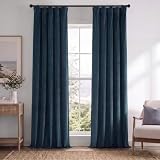
HPD Half Price Drapes Signature Velvet Blackout Curtain, Midnight Blue, 50″W x 84″L, 1 Panel
Who it suits: Owners of a small room with one narrow window who care about fabric quality more than about buying in pairs — and who understand exactly what “sold per panel” does to the math.
HPD is the one name in this guide that comes from the drapery trade rather than from Amazon, and its Signature line is built the way hotel drapery is built: a plush velvet face over a plush blackout lining, in a line the maker describes as a four-pass hotel blackout construction. The hand of the fabric is simply in a different class from the woven polyester that fills the rest of this category — heavier, softer, with a pile that catches light instead of reflecting it flatly. The configuration is where the small-room logic gets interesting. This curtain is sold as a single 50 x 84 inch panel — check the current price on Amazon — and a small room is the one place where a single panel is a complete answer rather than half of one: drawn to one side of a narrow window — or run as a single panel across a window under about 33 inches wide, gathered — one panel does the whole job at a single-panel price. If your window wants a pair, two panels still land inside this budget, and the review would be dishonest if it did not say that a pair’s money also buys the complete NICETOWN PRO pair above with money left for the rod.
The limitations are the ones velvet always brings, sharpened by small rooms. Midnight blue is a beautiful color and a consequential one: on the short wall of a small room, a drawn pair of deep-blue velvet is the room’s dominant visual event, and if the room already feels enclosed, a dark velvet will enclose it further — the lined-pale picks above exist precisely for that room. Velvet also wants the gentlest care in this guide, and its lining, like every lining here, is the layer heat damages. And a note in the open: this panel’s Amazon price has historically wandered, so check the current price on Amazon before the pair math in this review is applied to your window. Buy it for the fabric, in a room that can carry the color, and it is the quality pick of the tier.
- Hotel-style build: plush velvet face over a plush blackout lining, four-pass construction.
- Sold per panel — one panel genuinely covers a narrow small-room window.
- The heaviest, softest hand of any fabric in this guide.
Honest limitation: Per-panel pricing means a pair costs roughly double the single-panel figure — check the current price on Amazon; deep velvet colors can visually shrink a small room; and its price has historically wandered, so verify it live before buying.
Choose it if you have one narrow window and want the best fabric under $100 on it. Skip it if your room needs to feel bigger, not moodier — the pale lined pairs above are the right tool for that job.
Sun Zero Nordic Theater Grade Extreme 100% Blackout Curtain Pair, Gray, 52″W x 84″L, 2 Panels
Who it suits: Small rooms that are caves on purpose — a sleep-first box room, a nursery, a media den — where darkness outranks everything, including how the room feels at midday.
Sun Zero’s Nordic is the darkness ceiling of this guide. The construction is the brand’s theater-grade build — a heavy, multi-layer blackout weave — and Sun Zero claims third-party laboratory testing behind its 100% light-blocking figure, a claim we repeat as the maker’s claim about its own testing, while noting it is more substantiation than most of this category offers. The pair is the standard 52 x 84 inch configuration, grommet-hung, in gray — check the current price on Amazon — which makes it, remarkably, both the darkest pick here and one of the more affordable, and the obvious question is what the catch is. The catch is weight and presence. This is a stiff, heavy curtain that wants a properly anchored rod — screws into studs or real anchors, not the adhesive brackets a small-room renter reaches for — and it hangs in broad, deliberate folds rather than soft pleats. In a small room that physicality cuts both ways. Drawn, it is the closest thing to a wall of night in this guide, and its thermal and noise figures — maker claims, like everyone’s — are at least backed by genuine mass. Open, it stacks into a substantial column of fabric at each side of the window, and in a room where the window wall is eight feet wide, that stack is furniture whether you planned it or not.
The small-room advice for this pick is therefore about color and intent. Buy it if the room’s job is sleep or screen-watching and the cave feeling is the point. For a small room that must double as a living space in daylight, the lined pinch-pleat pairs above deliver nearly the same darkness with a fraction of the presence — which is why this superb curtain sits fourth in a small-rooms guide while it would top a pure-darkness one.
- Theater-grade construction with a maker-claimed third-party lab test behind the 100% figure.
- Standard 52 x 84 pair — the most darkness for the money in the guide.
- Real thermal and acoustic mass behind the maker’s insulation claims.
Honest limitation: Heavy and stiff — it needs a seriously anchored rod, stacks into a large column when open, and dark colorways will dominate a small room’s shortest wall.
Choose it if your small room is a sleep or media cave and total darkness is the brief. Skip it if the room must feel light and open in the daytime, or your rod is held by adhesive and hope.

Topfinel Full Blackout Linen Curtains, Birch, 52″W x 90″L, 2 Panels
Who it suits: Small rooms with low ceilings, where the curtain’s job is to make the wall read taller while it blacks out — without spending anywhere near the whole budget.
The trick this pick sells is six inches. A standard 84-inch drop, mounted at the ceiling of a room with an eight-foot ceiling, ends twelve inches short of the floor; a 90-inch drop ends six inches short, and a 96-inch drop — the pick below — kisses it. Those inches are the whole illusion: a curtain that runs unbroken from ceiling to near the floor draws the eye up a continuous vertical line, and the room reads taller than it is. Topfinel’s pair delivers the 90-inch version of the trick at the affordable end of this tier — check the current price on Amazon — with the construction this tier should have — a linen-textured face over a separate blackout liner, so the birch colorway linked here, a warm pale neutral, blocks fully rather than glowing at noon the way an unlined pale curtain does. The header is a three-in-one pleat system — hooks for pinch pleats, back tabs, or a rod pocket — which matters here because the ceiling trick works best on a track or a ceiling-mounted rod, and the hooks make that mounting easy. For renters, the same effect is available from a pair of Best Blackout Curtains For Apartments Under $100 mounted as high as the lease allows.
The honest notes are about proportion and care. Within those terms, this is the value pick of the tier: the ceiling-to-floor treatment, a real liner, a tailored header and a pale colorway, for less than half the budget — leaving the other half for the ceiling track that completes the illusion.
- 90-inch drop: ceiling-mount it and the unbroken vertical makes low ceilings read taller.
- Separate blackout liner behind a pale linen face — darkness without a dark wall.
- Three-in-one header (hooks, back tabs, rod pocket) on a complete pair.
Honest limitation: The extra length pools if your mount or ceiling is lower than planned — in a small room, measure for a hem that kisses the floor, never puddles.
Choose it if your small room’s problem is a low ceiling and you want the height trick with money left for a track. Skip it if your ceiling is genuinely tall — the 96-inch H.VERSAILTEX below is your length — or your window is narrow enough to want the 40-inch pairs at the top of this guide.

H.VERSAILTEX Blackout Curtains, Natural, 52″W x 96″L, 2 Panels
Who it suits: Small rooms with tall ceilings — the converted attic, the old-house box room — that need a full 96-inch ceiling-to-floor drop without spending the whole budget on fabric.
Every other pick in this guide tops out at 84 or 90 inches. This pair goes to 96, and — sitting at the affordable end of this guide, so check the current price on Amazon — it is the most affordable way we found to run a blackout curtain from a ceiling mount to the floor of a room with a nine-foot ceiling — or to mount at the ceiling of an eight-foot room and let the drop finish exactly at the floor with the rod at full height. The configuration is the standard pair of 52 x 96 inch panels, grommet-hung for easy daily sliding, in Natural, a pale warm neutral that keeps a small room’s palette light. H.VERSAILTEX is one of the category’s volume brands, and its listings are unusually specific about the fabric’s density and weave, which is part of why the brand recurs in these guides. Now the disclosure this pick is included with, stated before the praise rather than after it: this is the guide’s one woven blackout. There is no separate liner and no coated backing; the darkness comes from the density of the weave and the dye, the brand rates the line at 100%, and this guide’s standing position — stated at every tier — is that woven claims are the maker’s, that pale woven colorways are where woven blackouts are most likely to fall short of them, and that lined constructions are the ones whose darkness does not depend on color.
So the honest framing is a division of labor. If your small room needs verified, sealed, sleep-grade darkness, the lined picks above do that job at this same budget, and this pair’s 96 inches are not a substitute for their liners. Taken on those terms — length first, darkness very good rather than absolute, price at the affordable end of the guide — it earns its place as the sixth pick rather than as a warning.
- 96-inch drop: the budget route to a true ceiling-to-floor hang in tall small rooms.
- Grommet top slides easily — the practical choice for a curtain opened and closed daily.
- Pale Natural colorway keeps the room’s palette light; darker colorways darken harder.
Honest limitation: A woven blackout with no liner — the maker’s 100% rating is a claim this guide does not independently credit, and pale colorways are the risk case; buy it for length, not for sealed darkness.
Choose it if your small room is tall and the ceiling-to-floor line is the priority. Skip it if total darkness outranks architecture — every lined pick above it in this guide is darker where it counts.

Comparison Table
The table below puts the six picks side by side on the details that decide between them: construction, panel configuration, and the job each one does best in a small room. Check the current price on Amazon for the exact configuration named; two of the six — the Vision Home pair and the HPD panel — carry the price-volatility caveats spelled out in their reviews.
| Product | Construction | Best use | Link |
|---|---|---|---|
| NICETOWN PRO 100% Blackout Pinch Pleat Curtains, Sage Green, 40″W x 84″L, 2 Panels | Linen-blend face over a white blackout liner; pinch pleat, back tab or rod pocket from one pleat tape | Best overall for small rooms: the right panel width, a real liner and a tailored hang in one purchase | Check on Amazon |
| Vision Home White Pinch Pleated Full Blackout Curtains, 40″W x 84″L, 2 Panels | Recycled-blend face with a sewn-in blackout coated lining; weighted hems; 18 hooks included | Best for a brighter-feeling room: white drapery that blacks out like a dark one | Check on Amazon |
| HPD Half Price Drapes Signature Velvet Blackout Curtain, Midnight Blue, 50″W x 84″L, 1 Panel | Plush velvet over a plush blackout lining; four-pass hotel construction; sold per panel | Best fabric quality: one panel covers a narrow window; a pair still fits inside this budget | Check on Amazon |
| Sun Zero Nordic Theater Grade Extreme 100% Blackout Curtain Pair, Gray, 52″W x 84″L, 2 Panels | Heavy theater-grade multi-layer blackout weave; grommet top; maker claims third-party lab testing | Best total darkness for a small sleep or media cave that can carry the weight | Check on Amazon |
| Topfinel Full Blackout Linen Curtains, Birch, 52″W x 90″L, 2 Panels | Linen face over a separate blackout liner; three-in-one header with hooks, back tabs or rod pocket | Best ceiling-to-floor value: the 90-inch drop that makes low ceilings read taller | Check on Amazon |
| H.VERSAILTEX Blackout Curtains, Natural, 52″W x 96″L, 2 Panels | Dense woven blackout, no separate liner; grommet top | Best long drop on a budget: 96 inches for tall small rooms, with the woven caveat | Check on Amazon |
How to Choose Blackout Curtains for a Small Room
Buying for one small window is a different exercise from buying for a wall of glass: the fabric volume, the stack, the mounting and the color all matter more, because there is less room for each of them to hide in. Work through the points below before ordering.
- Match panel width to your window, not to the standard. A curtain needs roughly one and a half to two times the window’s width in fabric. For a 36–48 inch small-room window that is 54–96 inches of fabric — a pair of 40-inch panels (80 inches) lands in the middle of it. The default 52-inch pair (104 inches) over-fills a small window: bunchier folds, a wider stack, more wall gone.
- Spend the one-window dividend on the mount. A small room’s single window means the budget covers hardware too. A ceiling-mounted track or a rod that returns to the wall at both ends seals the top and side gaps where light actually enters — a bigger darkness upgrade than any fabric upgrade at this tier.
- Mount at the ceiling and buy the length to match. The height illusion needs an unbroken run from ceiling to floor: an 84-inch drop on an eight-foot ceiling must start at the ceiling and will end above the floor — acceptable — while 90- and 96-inch drops finish the line properly. Measure from the mount to the floor, not from the top of the frame.
- Let the liner do the darkening so the face can stay pale. In a small room the curtain is the largest color block on its wall. A lined white, ivory or sage panel gives full darkness and a bright room; an unlined dark panel gives darkness and a smaller-feeling room. Choose deliberately, per the room’s job.
- Count the stack. Open curtains live somewhere. Heavy or over-wide panels stack into columns that can cover a fifth of a small window’s glass and a real slice of its wall; pinch-pleat panels on hooks stack tightest, grommets broadest.
- Read the configuration before the price. This tier sells pairs of 40s, pairs of 52s and single 50-inch panels at similar sticker prices. A single panel and a complete pair at similar-looking sticker prices are different purchases; convert everything to the cost of covering your window before comparing.
- Match the header to your hand. Grommets slide easiest and suit a curtain opened daily. Pinch pleats on hooks look tailored and stack slim but move slower. In a small room you will operate this curtain at arm’s length every day — pick the motion you will not resent.
- Anchor for the heaviest case. Lined and theater-grade panels are heavy, and small-room windows often sit in walls with little framing around them. Screws into studs or proper hollow-wall anchors are part of the purchase, not an afterthought.
- Treat the percentage as a claim, the construction as the fact. There is no shared standard behind the numbers on these listings. A separate liner or coated backing is verifiable from the listing itself; a woven 100% claim is a promise. Buy the construction.
Why This Tier Looks Strange: Per-Panel Pricing and the $100 Ceiling
Shoppers arriving from the Best Blackout Curtains Under $40 guide — where every pick is a complete pair at a comparable price — often find this tier confusing, and the confusion is the market’s fault, not theirs. Between $40 and $100, three different pricing customs collide. Amazon-native brands keep selling pairs but narrow them: the 40-inch pair exists because it is the right product for small windows and apartments, and it is priced like the premium over the standard pair. Drapery-trade brands like HPD sell the way drapery has always been sold, per panel, so their sticker prices look half as expensive as they are. And the custom end — made-to-order panels from sellers like TWOPAGES, whose custom blackout-lined panels are priced per panel on Amazon at a level that already sits high in this tier before width and liner options — sits just over this budget entirely: a lined custom pair lands well past this guide’s $100 budget, and made-to-order means no returns if the color is wrong. That is the honest shape of the tier: $100 buys the best ready-made constructions, in configurations you must read carefully, and it does not buy custom. When a small room genuinely needs a non-standard width or a specific fabric, the step up is real rather than incremental — see Best Blackout Curtains For Small Rooms Under $300, where custom and semi-custom panels enter the guide.
The other thing $100 refuses to buy is worth naming, because it protects you from a common misread: it does not buy a meaningfully higher grade of darkness than the best of the tier below. A lined curtain at $40 and a lined curtain at $100 both block essentially all the light that hits the fabric. What the extra money buys here is everything around the darkness — panel widths cut for small windows, pinch pleats instead of grommets, velvet instead of flat polyester, 90 and 96 inches of drop instead of 84, hooks and weighted hems in the box. In a large room those are refinements. In a small room, where the curtain is proportionally the biggest object on its wall and its stack, color and hang are all inescapably visible, they are close to the whole product. That is the case for this tier, and it is a good one — as long as you spend it on the refinements your room actually needs, which for most small rooms means the tailored, lined, pale end of this guide rather than the heavy end. The tailored end is also where this budget overlaps with Best Blackout Curtains For Modern Homes Under $100: a pinch-pleated lined panel is the modern default, and small rooms benefit from its discipline twice over.
Will a Pair Fit Your Window? A Small-Room Sizing Walk-Through
Small rooms fail at curtain sizing in predictable ways, because the standard advice is written for standard windows. A typical small-room window is 36 to 48 inches wide and 48 to 60 inches tall, set in a wall that may be only eight or nine feet wide — which means the curtain, its rod and its stack are negotiating for space with the wall itself. A 40-inch window wants 60–80 inches of fabric: one pair of 40-inch panels is exactly right, a single 50-inch HPD panel drawn to one side is a deliberate one-sided look at 1.25 times fullness, and a pair of 52s at 104 inches is 2.6 times — more gather than the window needs, paid for in stack. Extend the rod or track 4 to 6 inches past the frame on each side if the wall allows it, so the open stack sits on wall rather than glass; on a truly tight wall, a ceiling track that runs wall to wall is the cleanest answer and the one that also seals the top gap.
For length, decide the illusion first and the number second. The small-room default should be ceiling to floor: measure from the ceiling (or from your track) to the floor, and choose the drop that ends within an inch of the floor — 84 inches only reaches if your mount sits lower, 90 and 96 inches are the drops that make standard ceilings work. One more small-room measurement that large-room guides skip: the distance from the window wall to the nearest furniture. Measure the stack into the room plan, not just the window into the wall.
Common Buying Mistakes
- Buying the standard 52-inch pair for a 36-inch window. The extra fabric does not add darkness; it adds bunch, stack and wall coverage. Small windows have their own panel width at this tier — buy it.
- Comparing a per-panel price to a per-pair price. A per-panel listing like the HPD panel and a per-pair listing like the NICETOWN pair are not rivals until both are converted to the cost of covering your window.
- Mounting at the frame in a low-ceilinged room. A rod at the frame chops the wall at its longest line. Ceiling-mounting is free height, and this budget finally includes the drops to exploit it.
- Choosing a dark colorway to get darkness. With a lined curtain, darkness comes from the liner. Choosing charcoal “to be safe” spends the room’s sense of space on something the construction already provides.
- Trusting the word velvet. Some velvet lines in this category are room-darkening only — HPD’s own Heritage Plush Velvet line is listed as room darkening, not blackout. Check the opacity line, not the fabric name.
- Ordering custom panels to solve a standard window. Made-to-order blackout panels are priced per panel, before options, at levels that put a lined pair past this budget — and they cannot be returned. A small standard window is the case ready-made panels exist for.
- Ignoring the stack in the floor plan. Open panels occupy wall and depth. In a small room, check where the stack lands against the bed, desk or door swing before choosing the heaviest construction.
- Hanging a heavy lined pair on adhesive brackets. Theater-grade and lined panels pull. The failure is not the curtain’s; anchor the rod into studs or use rated hollow-wall anchors.
- Buying a white woven curtain for darkness. Pale woven blackouts are the category’s weakest darkness case. If the face is white, the blackout must come from a liner or a coating — as it does in the Vision Home pick above.
- Washing the liner like a sheet. Hot water and hot tumble drying are what crack coatings and curl liners. Cold, gentle, line-dried keeps every construction in this guide alive.
Final Recommendation
If you read nothing else, read this. The small room’s advantage is concentration: one window, the whole budget, and a tier that finally sells curtains cut for it. Spend it on construction and proportion, in that order.
- Best overall for small rooms: NICETOWN PRO 100% Blackout Pinch Pleat Curtains, Sage Green, 40″W x 84″L, 2 Panels — narrow panels, a real liner, a tailored pleat — check price on Amazon.
- Best for a brighter-feeling room: Vision Home White Pinch Pleated Full Blackout Curtains, 40″W x 84″L, 2 Panels — white drapery with a coated blackout lining, hooks included — check the current price on Amazon, and buy when its volatile price is at its usual level.
- Best fabric quality: HPD Half Price Drapes Signature Velvet Blackout Curtain, Midnight Blue, 50″W x 84″L, 1 Panel — hotel velvet sold per panel; one panel for a narrow window, a pair still inside this budget.
- Best total darkness: Sun Zero Nordic Theater Grade Extreme 100% Blackout Curtain Pair, Gray, 52″W x 84″L, 2 Panels — the heaviest darkness in the guide, on a properly anchored rod — check price on Amazon.
- Best ceiling-to-floor value: Topfinel Full Blackout Linen Curtains, Birch, 52″W x 90″L, 2 Panels — a separate liner and the height-giving 90-inch drop — check price on Amazon.
- Best long drop on a budget: H.VERSAILTEX Blackout Curtains, Natural, 52″W x 96″L, 2 Panels — 96 inches at the affordable end of the guide, bought for length with the woven caveat understood — check price on Amazon.
For most small rooms the shortlist is the first two picks, and the choice between them is a choice of color and price behavior: the NICETOWN PRO in sage, with the steadier price behavior, or the Vision Home in white, bought when its price is at its usual level rather than in a spike. Either gives you the combination this tier exists to provide — a liner doing the darkening, a pale tailored face keeping the room’s light, and panels cut to a small window’s actual width. Add a ceiling-mounted track or a return rod with the money left over, hang the pair from ceiling to floor, and the room’s only window stops being its constraint and becomes its longest line. Start with the NICETOWN PRO if your window is the standard small size; start with the Topfinel if your ceiling is the problem the curtain has to solve.
Frequently Asked Questions
Are 40-inch curtain panels wide enough for a small window?
For the typical small-room window, yes — they are the correct size rather than a compromise. A pair of 40-inch panels carries 80 inches, which covers a window 40 to 53 inches wide at proper fullness. On a 36–48 inch window — the standard small-room range — that is exactly right, and the standard 52-inch pair’s extra fabric becomes excess bunch and stack. Past about 53 inches of window, move up to the 52-inch version of the same line rather than stretching the narrow pair.
How do I make a small room look taller with blackout curtains?
Mount the rod or track at the ceiling, not at the window frame, and run the curtain to within an inch of the floor. On an eight-foot ceiling that usually means a 90- or 96-inch drop — the Topfinel and H.VERSAILTEX pairs in this guide — because an 84-inch panel mounted at the ceiling stops short of the floor. Pale colors strengthen the effect, which is why the lined picks matter — they let the tall curtain stay pale.
Will blackout curtains make my small room feel smaller?
They can, and the mechanism is color and stack rather than darkness itself. A small room used purely for sleep may not care — the cave feeling is a feature there — but a small multi-use room should buy pale and lined.
Is one panel enough for a small window?
Sometimes, and this tier is where that answer becomes practical. A single 50-inch panel covers a window up to about 33 inches wide at proper fullness, and covers a wider narrow window at a flatter gather if it is drawn to one side as a deliberate one-panel treatment. That is how the HPD velvet pick works: one panel, one narrow window, complete. What one panel cannot do is part in the middle, so the look is asymmetric by design. If your window is wider than about 40 inches or you want a center opening, buy the pair — and convert the price before comparing, since per-panel and per-pair listings sit side by side at this tier.
Do white blackout curtains really block all the light?
A white curtain with a real blackout liner or a coated backing behind it does — the darkness is in the hidden layer, not the face, which is exactly why lined construction is the small room’s best tool. A white curtain that relies on its woven fabric alone is the weakest darkness case in the category, and the percentage on its listing should not be trusted to save it. The Vision Home pick in this guide is the lined kind: a white face over a sewn-in blackout coated lining. One maker-disclosed quirk: the lining is grayish, and the white can read very slightly soft against bright light — a cosmetic note, not a light leak.
Should I buy the $100 tier, or save money with the $40 tier?
Darkness alone does not justify the step up — the best lined pairs under $40 already block essentially everything that hits the fabric, and that guide is the right starting point if the window is a standard size and grommets are fine. This tier earns its money in a small room specifically: panels cut to 40 inches for small windows, pinch pleats and included hooks instead of grommets, drops of 90 and 96 inches for the ceiling-to-floor hang, and fabrics like HPD’s velvet. If two or more of those describe your room’s problem, the $100 tier is solving something real. If none do, the honest advice is to buy the cheaper lined pair and spend the difference on the ceiling track.
- Best Blackout Curtains Under $40
- Best Blackout Curtains For Small Rooms Under $300
- Best Blackout Curtains For Bedrooms Under $100
- Best Blackout Curtains For Apartments Under $100
- Best Blackout Curtains For Modern Homes Under $100