Where to buy
Check the latest price, availability and delivery on Amazon. Orders are placed on Amazon. We may earn a commission from qualifying purchases.
- Best overall: TWOPAGES Liz Linen Pinch Pleat Blackout Curtain, 52″W x 96″L (1 Panel), Beige White — Check on Amazon
- HPD Half Price Drapes Signature Plush Velvet Blackout Curtain, Extra Wide 100″W x 96″L (1 Panel), Library Taupe — Check on Amazon
- NICETOWN Full Blackout Curtains with Black Liner, 52″W x 84″L (2 Panels), Black — Check on Amazon
- Sun Zero Nordic Theater Grade Extreme 100% Blackout Curtain Pair, 52″W x 84″L (2 Panels), Gray — Check on Amazon
See 2 more Amazon options
- HPD Half Price Drapes Extra Wide Plush Velvet Blackout Curtain, 100″W x 96″L (1 Panel), Misty White — Check on Amazon
- Topfinel Full Blackout Linen Curtains, Pinch Pleat, 52″W x 90″L (2 Panels), Birch — Check on Amazon
Read the full guide ↓
Disclosure: As an Amazon Associate, dailyhomedecorating.com earns from qualifying purchases. Links to Amazon on this page are affiliate links; they cost you nothing extra. Listing details such as price and availability change often, so check the current Amazon listing before you buy.
A bedroom is the one room where a blackout curtain is not decoration that happens to block light — it is sleep equipment that happens to hang on a window. That changes how a $200 budget should be spent. In a living room, the premium money buys drape and presence, because guests see the curtain more than they test it. In a primary bedroom, the test happens at 6 a.m. in June, at noon if you work nights, and every time a streetlight or a neighbor’s security flood finds the gap you left at the top of the rod. So this guide spends the $200 differently from our wider roundups: the budget is a per-window budget for one primary bedroom window, it includes the hardware the curtain hangs from, and every pick is judged first on darkness at the pillow — the light that actually reaches the bed — and only then on how it looks at noon with the lights on.
Two honest warnings belong at the top, because $200 sits at an awkward height in this category. First, $200 does not buy a premium pair. The finest ready-made lined panel in this guide, the TWOPAGES Liz, sits at the very top of this budget for a single 52-inch panel — check the current price on Amazon — so a matched pair runs well over this budget before you have bought a single hook. At $200 per window your real choice is between one excellent panel drawn to one side, one extra-wide panel that covers the whole window alone, or a mid-priced pair with money left over for the ceiling track or wrap-around rod that does as much for darkness as the fabric does. Second, the ceiling for ready-made blackout curtains is lower than shoppers expect: in our checking for this series, the most premium ready-made configuration on Amazon in the United States was a single premium panel positioned near the top of this budget — the fuller picture is in Best Blackout Curtains Under $300 — and beyond that, the category belongs to custom drapery quoted per job. Nobody needs to spend $200 on fabric alone to make a bedroom dark. They need the right construction, hung the right way, and this guide is organized around exactly that.
Quick Picks
Short on time, or comparing several options at once? Each row below names a bedroom buyer type and the curtain that suits it, with a link to the listing. Check the price on Amazon for the exact size and panel count named in the row — at this tier, that detail is the whole ballgame.
| Buyer type | Pick | Why it stands out | Link |
|---|---|---|---|
| Best overall | TWOPAGES Liz Linen Pinch Pleat Blackout Curtain, 52″W x 96″L, 1 Panel | 350gsm linen-blend face, separate blackout lining, factory pinch pleats | Check on Amazon |
| Best for wide bedroom windows | HPD Signature Plush Velvet Blackout Curtain, 100″W x 96″L, 1 Panel | One 100-inch lined velvet panel — no center split for light to leak through | Check on Amazon |
| Best for day sleepers | NICETOWN Full Blackout Curtains with Black Liner, 52″W x 84″L, 2 Panels | A sewn-in black liner behind the face — the darkest construction in this guide | Check on Amazon |
| Best heavy-duty pair | Sun Zero Nordic Theater Grade Extreme Blackout Curtain Pair, 52″W x 84″L, 2 Panels | The maker states the fabric is third-party lab tested to block 100% of light | Check on Amazon |
| Best white blackout | HPD Extra Wide Plush Velvet Blackout Curtain, 100″W x 96″L, 1 Panel, Misty White | A lined white velvet that darkens like a dark color — rare at any price | Check on Amazon |
| Best value pair | Topfinel Full Blackout Linen Curtains, Pinch Pleat, 52″W x 90″L, 2 Panels | A lined, pinch-pleated pair that leaves most of the budget for a proper track | Check on Amazon |
How These Picks Were Chosen
The first filter was the budget, applied the way a bedroom buyer actually spends it: one window, complete. Every product below is a real Amazon listing positioned at or under $200 in the United States in the exact size and panel count this guide recommends — and because premium curtains are sold per panel while budget ones are sold per pair, we name the panel count in every heading, every table row and every review. A price without a size and a panel count is how curtain listings mislead, so check the current price on Amazon for the exact configuration named. Where a brand’s wider or longer configurations climb past the line, we say which configuration belongs here and what choosing a pair would mean for the budget.
The second filter was construction, judged by bedroom rules. A separate black layer blocks light regardless of the face color, which is why the cheapest pick in this guide is also its darkest. Picks that help you kill those leaks — a single wide panel with no center split, a pair wide enough to overlap generously, a header that can ride a ceiling track — scored accordingly, and the hardware conversation runs through the whole guide rather than sitting in a footnote.
We did not hang these curtains ourselves. We read the maker listings and specification pages, compared fabric weights in grams per square meter, lining constructions and size ranges, and cross-checked the identical products against major-retailer listings, all in November 2026. One discipline applies to every percentage in this guide: there is no shared measurement standard for blackout claims, so a maker’s “100%” is a maker’s claim, not a lab result you can compare across brands. Where a maker states its fabric was third-party laboratory tested, we report that as the maker’s statement. And where a maker’s claim and owner reports disagree — most often for white and ivory panels — the review says so plainly.
The 6 Best Blackout Curtains for Bedrooms Under $200
TWOPAGES Liz Linen Pinch Pleat Blackout Curtain, 52″W x 96″L (1 Panel), Beige White
Who it suits: Owners of a primary bedroom with one standard window who want the single best panel ready-made money buys under $200 — real linen texture, real pleats, real lining — and are happy to draw it to one side.
The Liz is the curtain the premium end of this category exists for. The face is a heavyweight 350gsm faux linen — 90 percent polyester, 10 percent linen in the maker’s specification — with the slubbed, slightly irregular texture that makes linen read as linen, and behind it hangs a separate blackout lining rather than a coating: the Amazon listing describes a 140gsm lining, and TWOPAGES’ current specification for the collection upgrades that liner to a 250gsm microfiber blackout layer. Either way, the architecture is the point. Two fabrics, each doing one job: the face provides the texture and the drape, the lining provides the darkness, and because they are separate, the panel falls in the soft, heavy folds that coated single-cloth curtains never quite manage. The pinch pleats are sewn in at the factory — ten pleats across a 52-inch panel — and the panel arrives with adjustable pin hooks, so it hangs from a ceiling track or a ringed pole with its waves already trained. This identical 52 x 96 panel is positioned at the premium end of the ready-made category — check the current price on Amazon for this exact size before you plan the rest of the window around it.
For a bedroom, that buys a specific and legitimate configuration: one panel, hung high on a track that runs four to six inches past the frame on the draw side, pulled across the whole window at night and stacked onto the wall by day. On a standard double-hung window up to about 48 inches wide, a single 52-inch pleated panel covers the glass with fullness to spare, and the one-sided draw eliminates the center split — the leak that lands directly on pillows in most bedrooms — entirely. Now the honest budget picture, because this guide promised it. The moment your window needs a symmetric pair, the Liz leaves this budget: two panels at this premium position run well over the line. Treat the Liz as the one-panel answer it is, and know that a single panel at this level also consumes most or all of the $200, leaving little or nothing for the track it deserves — panel plus proper hardware can push the honest total over budget. The second honesty item is color. Beige White and the other pale Liz shades block less light through the fabric itself than the dark shades do — owner reports for the light colors describe strong darkening rather than a cave effect, and the maker’s own figures for lined light colors run below the 100 percent headline. Hung with overlap at the sides and a return to the wall, the room still goes properly dark; hung flat and narrow inside the frame, a pale panel will glow at noon — which is exactly when a day sleeper is testing it.
- 350gsm linen-blend face with a separate blackout lining — the two-layer construction this price band is about.
- Factory pinch pleats with adjustable pin hooks included; hangs from ceiling tracks or ringed poles.
- One panel drawn to one side means no center split leaking light onto the bed.
Honest limitation: Sold per panel, and a pair costs well over this budget. Light colors darken strongly but are not the literal 100 percent blackout the headline claims.
Choose it if your bedroom has one standard window and you want it done properly, with drapery that looks made-to-measure. Skip it if you need a symmetric pair, or your window is wider than about 48 inches — the extra-wide HPD panel below covers more glass while sitting lower in the budget.

HPD Half Price Drapes Signature Plush Velvet Blackout Curtain, Extra Wide 100″W x 96″L (1 Panel), Library Taupe
Who it suits: Anyone whose bedroom window is wide — a picture window, a pair of double-hungs under one rod, a slider — and who wants it covered by one continuous, lined panel with no meeting point in the middle.
Width is the scarcest commodity in ready-made curtains, and the center split is the bedroom’s scarcest resource leak: two panels that meet over the middle of the bed’s headboard wall will find each other imperfectly, and the vertical line of light they leave is the one owners photograph and complain about. This panel abolishes the problem by being one piece of fabric: plush velvet 100 inches wide and 96 inches long, blackout-lined, covering in a single sweep what normally takes two panels and an overlap. The face is HPD’s signature plush velvet — a soft, matte pile with the depth of color that makes velvet look expensive in evening light — and the blackout lining behind it is rated by the maker to block 95 to 99.9 percent of light, the realistic top end for a lined rather than coated construction. Check the current price on Amazon for this exact panel — it sits in the middle of this budget, which means the widest, heaviest curtain in this guide is positioned below the standard-width linen panel above it, and leaves a meaningful share of the budget for the ceiling track it should hang from. That is the quiet secret of the extra-wide format: you are buying one panel instead of two, and the per-window math suddenly favors the premium product.
The fitting realities deserve the same honesty. A 100 x 96 lined velvet panel is heavy — several pounds of fabric — and it wants a sturdy rod or, better, a ceiling-mounted track, because a decorative pole with a long unsupported span will bow under it; in a bedroom the track has the second advantage of sitting flush to the ceiling, which kills the halo of light that spills over the top of a rod-mounted curtain at dawn. Velvet also gathers dust more visibly than linen, and lined velvet is a dry-clean-leaning product: the pile that makes it beautiful is the pile you should not agitate in a home washing machine. And a single panel draws to one side only, so the stack of gathered velvet at one edge of your window needs roughly a foot of wall to live on. If your window runs wall to wall with no stack room, a pair — the Topfinel below — fits the architecture better. For a wide bedroom window with room to stack, though, nothing in this guide looks or sleeps more like a hotel suite.
- A genuine 100-inch width in one panel: no center gap, no mismatched pair, no line of light over the bed.
- Plush velvet face with blackout lining, maker-rated at 95 to 99.9 percent light block.
- Sits comfortably inside the budget — check price on Amazon — and leaves budget for the ceiling track that completes the blackout.
Honest limitation: Heavy enough to demand a serious rod or track, draws to one side only, and the velvet pile wants gentle care rather than machine washing.
Choose it if one wide opening is the problem to solve and total darkness without a center leak is the goal. Skip it if you need a symmetric pair on a standard window, or your rod is a light decorative pole.

NICETOWN Full Blackout Curtains with Black Liner, 52″W x 84″L (2 Panels), Black
Who it suits: Day sleepers, night-shift workers, migraine sufferers and anyone whose bedroom faces a streetlight or an early sunrise — buyers for whom darkness is the whole purchase and looks are a distant second.
Here is the fact that reorganizes this entire guide: the darkest curtain in it is also one of the most affordable. The NICETOWN Full Blackout pair — two 52 x 84 panels in black, sold by NICETOWN itself; check the current price on Amazon — achieves its darkness the blunt, physical way. Each panel is two layers of 230gsm woven polyester with a black lining built in, 460gsm in total per the brand’s published construction, and a black layer behind the face fabric blocks light regardless of what color faces the room. That is why this construction, and not a coating or a weave, is the one sleep specialists keep landing on: coatings can crack, triple-weave tops out where its maker admits (NICETOWN’s own standard blackout line is rated 85 to 99 percent), but a black liner is simply opaque. The pair weighs just under five pounds — heavy for its price class, which is the liner announcing itself — and the 104 inches of combined width covers a standard bedroom window with the overlap that kills side leaks, while leaving most of this budget untouched. That remaining budget is not savings to pocket; it is the hardware fund. Spent on a ceiling track or a wrap-around rod and a set of side returns, it produces a darker bedroom than the premium panel above hung carelessly — a claim this guide makes deliberately, because it is the most useful sentence in it.
The honest limitations are about everything except darkness. The header is grommets — 1.6-inch rings that slide easily and leak a little light at the rod line unless the rod is mounted high and close to the ceiling, and that will always read as a budget curtain from across the room. The face fabric is a plain woven polyester with none of the linen texture or velvet pile of the premium picks; in black it is handsome enough, but nobody will mistake it for drapery. Care is the real cost: the lined construction is hand wash or dry clean only per the brand’s guidance, because the black liner can show water spots and does not love a machine. And the maker’s “100%” is, like every percentage in this category, a claim without a shared measurement standard behind it — what can be verified is the construction, and the construction is the right one. If your bedroom window is taller than 84 inches, the same line sells longer lengths that still sit well inside this budget; check the size selector rather than settling for a hem that stops above the sill and leaks under it.
- Black liner built into each panel: full blackout that does not depend on the face color.
- 460gsm total construction across two woven layers — a heavyweight build for such an affordable pair.
- An affordable pair — check price on Amazon — that leaves most of the $200 for the track or wrap rod that finishes the job.
Honest limitation: Grommet header, plain face fabric and hand-wash-only care — you are buying darkness, not drapery, and the rod line needs high, tight mounting to avoid a halo.
Choose it if you sleep days, or any glow at all wakes you, and the budget should go where darkness actually comes from. Skip it if the bedroom doubles as a styled space you show guests — the Liz or the HPD velvet will look the part this never tries to.
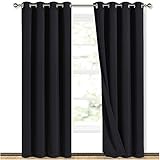
Sun Zero Nordic Theater Grade Extreme 100% Blackout Curtain Pair, 52″W x 84″L (2 Panels), Gray
Who it suits: Bedroom owners who want the heaviest, most over-built pair in the mid-price class — and who like that this maker, alone in the guide, states its blackout fabric was tested by a third-party laboratory.
Sun Zero’s Nordic line is the workhorse pick: two 52 x 84 grommet panels in gray — check the current price on Amazon — built around what the brand calls Theater Grade Extreme blackout technology. The claim attached to it is the strongest wording in this category — Sun Zero states the fabric is third-party laboratory tested to block 100 percent of outside light — and this guide reports it exactly as that: the maker’s statement about its own testing, in a category with no shared measurement standard that would let you compare it against anyone else’s number. What is independently visible is the build: these are dense, heavy panels that hang with real weight, and the same listing carries the brand’s claims of reducing outside noise by up to 45 percent and energy loss through windows by up to 50 percent — both maker figures, both plausible in direction for a heavy thermal panel and neither verified by us. For a bedroom on a busy street, the direction matters: mass is what muffles, and this pair has more of it than anything else in the lower part of this tier. The gray colorway linked here is also a considered bedroom choice — dark enough to forgive the edge leaks that pale colors advertise, light enough not to turn the room into a cave at noon.
The trade-offs are the familiar ones for this construction class. The header is grommets, with the same rod-line caveat as the NICETOWN: mount high, mount close, or accept a halo. The face is a smooth, plainly synthetic cloth — functional, slightly stiff in the fold, and unmistakably a blackout product rather than a decorative drape; if the bedroom’s look matters, these want a sheer or a decorative panel layered in front of them, which the leftover budget allows but the guide should not pretend is free. And heavy panels punish light hardware: Sun Zero’s own guidance and common sense both say to check the rod, because a sagging rod opens exactly the top gap a bedroom cannot afford. None of that dethrones the value case. For a modest share of the budget you get the guide’s most heavily built pair and a maker’s lab-tested claim, plus generous headroom for the track, the returns and the layering that turn a dark curtain into a dark room.
- Maker states the fabric is third-party lab tested to block 100% of light — the strongest claim wording in the guide.
- Dense, heavy panels; the brand also claims up to 45% noise reduction, a real bedroom benefit in kind if not in verified degree.
- A true pair at an affordable level in this tier — check price on Amazon — covering standard windows with overlap to spare.
Honest limitation: The lab-tested claim is the maker’s own statement, the grommet header can leak at the rod line, and the plain synthetic face looks like equipment, not décor.
Choose it if you want maximum build and mass in a pair, with budget left for hardware. Skip it if you want the curtain itself to be the room’s decoration — step up to the velvet or the Liz.

HPD Half Price Drapes Extra Wide Plush Velvet Blackout Curtain, 100″W x 96″L (1 Panel), Misty White
Who it suits: Sleepers who want a bright, white bedroom — a Scandinavian scheme, a small room that needs pale walls and paler textiles — without giving up real darkness to get it.
White blackout curtains are the category’s hardest problem, and it is worth understanding why before judging this pick. A white face fabric transmits light; that is what makes it white. Cheap white blackout curtains solve the problem with a grey or black coating that shows through the face and turns the whole panel a dingy pearl, or they simply fail and glow like a lampshade — and a glowing white panel above a bed is worse than a dark one, because it announces dawn to the whole room. HPD’s answer is the same architecture as the Library Taupe panel above — a plush velvet face with a proper blackout lining behind it — executed in Misty White, a soft white that keeps its color because the lining, not the face, is doing the darkening. Check the current price on Amazon for this ASIN — its positioning has varied more than most picks here, but it sits inside this budget with room for hardware, and as a wide panel it is one of the strongest value positions in the guide. One panel, 100 inches wide, covers a wide bedroom window in a single sweep of white velvet — no center split, which matters doubly for white, because a center leak on a white panel is the most visible leak there is.
The honest caveats mirror its taupe sibling, plus one of its own. The weight and one-sided draw are the same: bring a real rod or a track, and plan where the stack lives. The color-specific caveat is that even with a proper lining, a white panel at high noon will show more light at its edges and seams than a dark panel will, because any leak is visible against white and because the face itself passes a whisper of light the lining must catch. The fix is installation, not fabric: hang the rod four to six inches wider than the frame on each side, mount it close to the ceiling or use a track, and let the panel return to the wall or overlap a side wall if the room allows. Do that, and this is a genuinely dark white curtain. Skip it, and no white curtain at any price will save you — which is a truth about light, not about this product, and it is the sentence to remember if you are choosing between this panel in white and the same panel in a mid-tone.
- A true white velvet that darkens via its lining, so the face stays white instead of going grey.
- The same 100-inch extra-wide format as the taupe pick: one panel, no center split, for wide bedroom windows.
- Positioned inside the budget — check price on Amazon — with room left for hardware.
Honest limitation: White shows edge leaks more than any dark color, so the blackout result depends on generous width and high, wide hanging; heavy like all lined velvet.
Choose it if the bedroom’s design demands white and the sleep demands dark. Skip it if you cannot hang wider than the frame — a dark color will forgive what white will not.

Topfinel Full Blackout Linen Curtains, Pinch Pleat, 52″W x 90″L (2 Panels), Birch
Who it suits: Anyone running the two-panel strategy: a lined, pinch-pleated pair that looks like drapery, costs like a budget pick, and leaves the majority of the $200 for the ceiling track and installation that decide how dark the bedroom actually gets.
Every guide in this series needs its reality check, and this is the $200 bedroom tier’s: a pair of linen-look blackout curtains with a separate blackout liner, factory pinch pleats and a 3-in-1 header that also takes a rod pocket or back tabs, sold as two 52 x 90 panels at an affordable level in this tier — check the current price on Amazon — where the listing sits among the category’s best sellers. Read that against the top of this guide: the Topfinel pair is positioned far below one TWOPAGES panel, and the pair format is not a compromise in a bedroom — it is an advantage. Two panels overlap at the center by design, stack to both sides so the full window is usable glass by day, and hang symmetrically over a bed in the way every bedroom photograph promises. What does the Liz’s extra money buy that this does not? Fabric weight and refinement — the Topfinel’s linen-look face is a lighter cloth with a printed-on texture rather than the Liz’s 350gsm woven slub, the pleats are less deeply trained, and the color and size ranges are narrower. What it does not buy is darkness: a lined curtain at this affordable level blacks out a room on the same physics as a lined premium curtain, provided both are hung with the same overlap and the same attention to the edges.
The 90-inch length is the configuration to notice. It is the in-between size that suits 8-foot ceilings hung properly — rod or track near the ceiling, hem at the floor — where 84-inch curtains fall short and leak under the sill line, and 96-inch curtains puddle more than most people want on a bedroom floor that gets vacuumed around a bed. The same listing sells 84, 96, 100 and 102-inch pairs, all comfortably inside this budget, so the Topfinel is less a single pick than a system: hang this pair on the primary window, and the same listing can dress the guest room to match at the same affordable level. Its honest limitation is longevity of finish: lighter face fabrics show their price first in the drape — they hang well, but with a slightly stiffer hand than heavyweight linen — and the liner, while separate, is a lighter cloth than the premium picks’. For the price of one Liz panel you can hang this pair, buy the ceiling track, and still have change. In a bedroom, where the track is doing half the blackout work, that is frequently the correct trade — and the section after the comparison table makes the argument in full.
- A lined, pinch-pleated pair at an affordable level — check price on Amazon — the tier’s value benchmark and its two-panel standard-bearer.
- 90-inch length hits the 8-foot-ceiling sweet spot; longer pairs in the same listing stay inside this budget.
- 3-in-1 header (pinch pleat hooks, back tab, rod pocket) fits tracks, rings or a plain pole.
Honest limitation: The face fabric is a lighter linen-look cloth with a stiffer drape than the heavyweight picks, and the size and color range is narrower.
Choose it if you want a true pair, a tailored look, and most of the budget preserved for hardware and the rest of the room. Skip it if this window is the room’s statement piece and only the heaviest drape will do — that is what the TWOPAGES is for.

Comparison Table
| Product | Type | Best use | Link |
|---|---|---|---|
| TWOPAGES Liz Linen Pinch Pleat, 52″W x 96″L, 1 Panel | Linen-blend face, separate blackout lining | One standard bedroom window done to a custom standard | Check on Amazon |
| HPD Signature Plush Velvet, 100″W x 96″L, 1 Panel, Library Taupe | Velvet face, blackout lining, extra wide | Wide bedroom windows with no center light leak | Check on Amazon |
| NICETOWN Full Blackout with Black Liner, 52″W x 84″L, 2 Panels | Woven face, sewn-in black liner | Day sleepers who want total darkness above all | Check on Amazon |
| Sun Zero Nordic Theater Grade Pair, 52″W x 84″L, 2 Panels | Dense blackout weave, maker-stated lab testing | Street-facing bedrooms that want mass and muffling | Check on Amazon |
| HPD Extra Wide Plush Velvet, 100″W x 96″L, 1 Panel, Misty White | White velvet, blackout lining, extra wide | White bedrooms that still need to go dark | Check on Amazon |
| Topfinel Full Blackout Linen, 52″W x 90″L, 2 Panels | Linen-look face, separate blackout liner | A tailored pair with budget left for a ceiling track | Check on Amazon |
How to Choose Blackout Curtains for a Bedroom Under $200
- Budget the window, not the curtain. The $200 covers fabric plus whatever it hangs from. An affordable lined pair on a proper ceiling track will out-darken a premium panel on a sagging pole every single night, so decide the hardware spend first and let it discipline the fabric spend.
- Choose your blackout architecture. A sewn black liner (NICETOWN) is the darkest mechanism in this guide and ignores face color. A separate woven lining (TWOPAGES, HPD, Topfinel) drapes best and ages best. A dense proprietary weave with a maker’s lab-tested claim (Sun Zero) is the heavy-duty middle. Plain triple-weave without a liner is the budget mechanism — fine for a guest room, not what this budget is for.
- Decide one panel or two before you fall in love. One wide panel kills the center leak and suits wide windows and one-sided draws. A pair overlaps in the middle, stacks both sides and looks symmetric over a bed. The wrong format cannot be fixed by better fabric — see the panel-versus-pair section below.
- Buy width for the leaks, not the glass. Light escapes at the edges, not through lined fabric. Total curtain width should exceed the frame generously: hang the rod or track 4 to 6 inches beyond the frame on each side, and for pinch pleats remember the listed width is the finished, pleated width — the fabric is already gathered.
- Kill the halo. The brightest leak in most bedrooms is the line of light over the top of the rod. A ceiling-mounted track, or a rod mounted within a couple of inches of the ceiling, removes it; a wrap-around rod that returns the curtain to the wall removes the side leaks too. This is where the leftover budget earns its keep.
- Match the header to the hardware. Pinch pleat on hooks or rings gives the tailored waves in every inspiration photo and rides a track best. Back tab is the flat, modern second choice. Grommets slide beautifully and leak at the rod line — acceptable on a high-mounted rod, a problem on a low one.
- Be honest about color. Dark colors block more light through any construction. Pale colors can still black out a bedroom with a proper lining and generous overlap, but a white panel hung exactly to the frame will glow at the edges — the bedroom version of this trade is worked through in Best Blackout Curtains For Bedrooms Under $300.
- Check the care label against your life. Lined velvet leans dry-clean; the black-liner pair in this guide is hand wash only; coated and dense-weave panels hate heat. A curtain you are afraid to clean is a curtain that gets dusty above the bed and stays that way.
- Spend the remainder deliberately. If your pick leaves a meaningful share of the budget unspent, the best bedroom upgrades, in order, are: a ceiling track, side returns or a wrap rod, then a second window matched. The worst use is upgrading the fabric one tier for the same window — the room will not get measurably darker.
Darkness at the Pillow: Where Bedroom Blackout Actually Fails
Stand in a darkened bedroom at noon and look at the window, and you will learn more than any percentage on a listing can tell you. The fabric, if it is lined or black-backed, is a black rectangle. The failures are all around its edges, and they have a ranking. Third are the side gaps, where a curtain hung exactly to the frame stands off the wall and lets a blade of light down each side. Last and least is glow through the fabric itself, which only happens with unlined triple-weave and pale colors — the one failure money spent on fabric actually fixes.
Now notice what fixes the top three: not fabric. A ceiling track or a near-ceiling rod fixes the halo. Width beyond the frame and a return to the wall fix the sides. This is why this guide keeps steering the budget toward hardware, and why the same logic, applied to a whole apartment or a small room, fills out in Best Blackout Curtains For Apartments Under $200 and Best Blackout Curtains For Small Rooms Under $200. The fabric’s job is merely to be opaque, and opacity is the affordable part: the black-liner pair in this guide is as opaque as physics allows. Everything above opacity — the drape, the pleats, the velvet — is for the hours you are awake in the room. Both are legitimate things to buy. Just buy them knowingly, in that order.
One Panel or Two? When Two Mid-Priced Panels Beat One Premium Panel
The $200 bedroom budget forces the category’s most interesting argument, so let us have it honestly. The one-panel case: a single premium panel — the Liz, or the extra-wide HPD velvet positioned lower in this budget — has no center split, hangs in deeper and more even folds than any pair at the same total price, and covers a standard or wide window in one uninterrupted surface. If your window is up to about 48 inches wide and you are content to draw to one side, or up to about 90 inches wide with the extra-wide format, one panel is not a compromise; it is the technically better blackout and the better-looking object. The stack sits on one side, the pleats run unbroken, and there is nothing to misalign at 2 a.m.
The two-panel case wins in three situations, and bedrooms hit all three often. First, width: past about 90 inches of glass, no single ready-made panel in this budget covers with fullness, and a pair is the only format left. Third, and most quietly decisive, the overlap: a pair hung to cross by a few inches at the center can seal the split it creates, and a mid-priced pair like the Topfinel, overlapped on a ceiling track, will measure darker at the pillow than a single premium panel hung on a decorative rod with a halo over it. Format plus installation beats fabric tier. The honest summary: buy one premium panel when the window suits it and the drape is the point; buy two mid-priced panels and spend the difference on the track when coverage, symmetry or the seal is the point — and recognize that at $200, the second strategy is the one most bedrooms should choose. The modern-home version of this same allocation problem is taken up in Best Blackout Curtains For Modern Homes Under $200.
Common Buying Mistakes
- Spending the whole $200 on fabric and hanging it from the cheap rod that was already there — then blaming the curtain for the halo.
- Comparing a per-panel price against a per-pair price and concluding the panel is “only a bit more.” It is usually double.
- Buying exactly the frame’s width, then wondering why light pours around all four edges of a genuinely blackout fabric.
- Choosing a pair for a wide window without planning the center overlap, and sleeping next to a vertical line of light.
- Choosing white for an east-facing bedroom and blaming the curtain for physics: pale faces pass more light, and only lining, overlap and returns fix it.
- Believing the “100% blackout” headline for any construction without asking what the black layer is — a liner, a coating, or a hope.
- Machine-washing a black-liner or lined-velvet panel on a warm cycle, and destroying the layer the money bought.
- Measuring length from the top of the rod instead of the ring or hook, and ending up with a hem hovering two inches off the floor, leaking light underneath.
- Hanging a several-pound lined velvet panel on a light decorative pole with no center bracket, and watching it bow — and gap — by Christmas.
Final Recommendation
- Most buyers, one standard window done properly: TWOPAGES Liz Linen Pinch Pleat Blackout Curtain, 52″W x 96″L, 1 Panel.
- Wide bedroom windows, no center leak: HPD Signature Plush Velvet Blackout Curtain, 100″W x 96″L, 1 Panel, Library Taupe.
- Day sleepers and shift workers: NICETOWN Full Blackout Curtains with Black Liner, 52″W x 84″L, 2 Panels — plus the track the savings pay for.
- Street-facing bedrooms: Sun Zero Nordic Theater Grade Extreme Blackout Curtain Pair, 52″W x 84″L, 2 Panels.
- White without the glow: HPD Extra Wide Plush Velvet Blackout Curtain, 100″W x 96″L, 1 Panel, Misty White.
- A tailored pair with money left over: Topfinel Full Blackout Linen Curtains, Pinch Pleat, 52″W x 90″L, 2 Panels.
Our top two are the TWOPAGES Liz for a standard window and the HPD extra-wide velvet for a wide one, because between them they state this tier’s whole thesis: at $200 a window, the money is in the construction — a separate lining, a heavy face, sewn pleats, and enough width to kill the edge leaks — not in a darker coating. But the pick we would argue for at the pillow is the unfashionable one: if you sleep days, or light genuinely wakes you, buy the NICETOWN black-liner pair — check the current price on Amazon — and spend the rest of the budget on a ceiling track and a proper wide hang. It will be the darkest bedroom in this guide, and it will not be close. Whatever you choose, do the unglamorous parts: measure from the hook, widen the rod past the frame, weigh the hardware against the fabric, and check the current price on Amazon and the exact size-and-color configuration on the listing — with per-panel selling, the wrong configuration is an expensive mistake, and the right one is a room that finally stays dark until you say so.
Frequently Asked Questions
Is $200 really enough for proper blackout in a primary bedroom?
Yes — with room to spare, provided the money is split correctly. Opacity itself is the affordable part: a sewn black liner makes an affordable pair fully opaque. A $200 window split between a lined pair and a proper track will out-sleep a $200 window spent entirely on one panel hung badly.
One panel or a pair for a bedroom window?
It depends on width and on how you use the window. One panel — standard or extra-wide — has no center split, which is the leak nearest the pillow, and suits windows up to about 48 inches (standard panel) or 90 inches (extra-wide) when a one-sided draw is acceptable. The format decision matters more than the fabric decision.
I work nights. Which pick actually keeps a bedroom dark at noon?
The NICETOWN black-liner pair, hung on a ceiling track or a high, wide rod with returns — and it is not the expensive answer. The Sun Zero Nordic pair is the alternative if you also want mass against street noise. What will not work is any pale, unlined curtain, at any price, hung exactly to the frame.
Are the “100% blackout” claims real?
They are makers’ claims in a category with no shared measurement standard, so they cannot be compared across brands and we do not treat them as measurements. What can be compared is construction: a sewn black liner or a separate blackout lining is physically opaque, a coated lining is opaque until the coating ages, and an unlined triple-weave is not fully opaque whatever the headline says — NICETOWN rates its own standard line at 85 to 99 percent. Sun Zero additionally states its Nordic fabric was third-party laboratory tested; that is the maker’s statement about its testing, and it is the strongest wording in this guide, but it is still the maker’s statement.
Can white curtains really work in a bedroom?
Yes, with help. A white face passes more light than a dark one, so the lining has to do all the work — the HPD Misty White panel’s proper blackout lining is the right construction — and the installation has to do the rest: rod wider than the frame by 4 to 6 inches per side, mounted high, panel returning to the wall or overlapping at the center. Hung that way, a lined white curtain darkens a bedroom completely well enough for sleep. Hung exactly to the frame, no white curtain at any price will.
Should I spend leftover budget on a ceiling track?
Yes — it is the single best use of leftover money in this guide. In darkness-at-the-pillow terms, the track upgrade is worth more than moving one fabric tier up, which is why three of the six plans in this guide deliberately leave a meaningful share of the budget unspent on fabric. Buy the curtain, then buy the darkness around it.
- Best Blackout Curtains Under $300
- Best Blackout Curtains For Bedrooms Under $300
- Best Blackout Curtains For Apartments Under $200
- Best Blackout Curtains For Small Rooms Under $200
- Best Blackout Curtains For Modern Homes Under $200