Affiliate disclosure: As an Amazon Associate, DailyHomeDecorating.com earns from qualifying purchases. If you buy through links on this page, we may receive a commission at no extra cost to you.
Amazon content disclosure: The product names, ASINs, and images in the Amazon cards were verified through Amazon’s Creators API. Product availability and features can change. This is a specification-based guide, not independent sound testing.
The best window fans for a bedroom are the ones that fit securely, move enough air at a tolerable speed, and do not disrupt sleep with rattling, bright controls, or a strong draft. A fan can exhaust warm bedroom air, bring in cooler outdoor air, or switch between those directions. It cannot cool air below the outdoor temperature, and nighttime use makes outside conditions, traffic noise, insects, and window security part of the decision.
This guide focuses on sleep comfort: selecting a lower operating speed, setting up a clear air path, controlling display light, checking the screen and sash, and deciding when to turn the fan off. We do not assign a “quietest” winner because manufacturers do not publish comparable sound measurements for these models and a window frame can amplify vibration. If you are shopping for a student room, our college window fan guide focuses on dorm-size constraints. For automatic temperature triggers, see our separate thermostat window fan guide.
Bedroom window fan examples to compare
These Amazon ASINs and images were verified through Amazon’s Creators API. Vornado’s manufacturer materials describe the TRANSOM’s four speeds, remote, reversible airflow, low-profile frame, and auto-dimming controls; PORTAL has three speeds and a lower-profile body. Compare the exact revision, included remote, fit range, and return terms on the current listing.
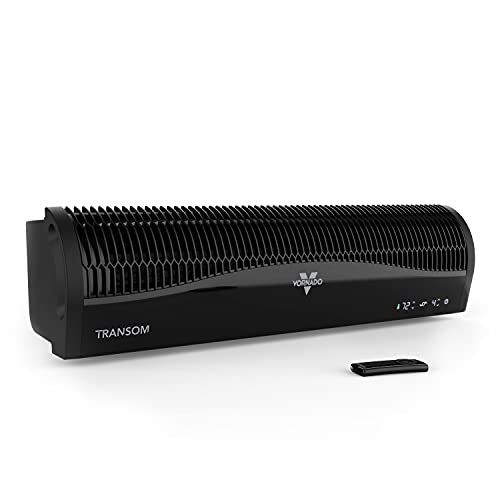
ASIN B08R6FCMD3. A low-profile reversible model with four speeds, remote, and an auto-dimming display. Check window measurements and installation orientation before choosing it for a bedroom. View this exact ASIN on Amazon

ASIN B0D7KNSYDT. A three-speed low-profile option with reversible fan/exhaust operation. It may suit a bedroom window where a shorter unit helps preserve the view; verify the horizontal-only fit requirements. View this exact ASIN on Amazon
What matters most when you sleep near a window fan
For sleep, evaluate sound, airflow strength, light, temperature, and security together. A fan that moves a lot of air on high may be too forceful or noisy for overnight use, while a low setting might provide enough gentle movement if the room already has a cool air source. Look for multiple speeds so you can test the lowest setting first rather than assuming the headline airflow figure represents bedtime use.
Listen for several types of sound: motor hum, blade noise, vibration against the sash, clicking as a mode changes, and outdoor sounds carried through the open window. A steady low hum may be acceptable to some sleepers and distracting to others. Because fan manufacturers rarely use the same decibel test distance, speed, or room, a single “quiet” label is not a reliable comparison between brands.
Check whether the display dims or turns off after a short time. Bright controls can be more noticeable in a dark bedroom than the fan’s motor. Some models dim automatically; others keep indicator lights lit or require a manual dimmer. A remote is useful if the fan is high in the frame, but verify that it can change the settings you want without requiring a walk to the window.
Sleep comfort is personal. Some people prefer a little air movement and steady background sound; others are sensitive to drafts, variable noise, or a cool stream across the face. Use a lower speed, adjust the direction, or position the bed outside the direct flow. Avoid assuming the fan will improve sleep for everyone just because it has a night mode or remote.
Choose intake or exhaust for the night
Intake mode draws outdoor air into the bedroom. It is useful when the outdoor air is clean and cooler than the room. To prevent the air from stagnating, leave a path for indoor air to escape through another window, an open doorway, or a separate exhaust point. The incoming stream should not come from a garage, driveway, smoking area, or another place with fumes.
Exhaust mode pushes bedroom air outside. This can help remove warm or stale air, but replacement air must enter from somewhere. If the door is tightly closed and there is no other opening, the fan may struggle to move air or create pressure differences. Open the door enough to create a safe path if that fits the household, or use a second window as an intake source.
A reversible fan can change direction as conditions change. Before bedtime, decide whether outdoor air is actually cooler and suitable. If outside air is warmer, humid, smoky, or dusty, ventilation can reduce comfort or bring unwanted particles into the room. A reversible switch helps with direction; it does not determine whether the outside air is safe or helpful.
Many two-fan designs can run one side in and another out, but single-unit modes differ. Some low-profile models switch the entire airflow chamber from direct fan to exhaust. Check the maker’s control descriptions. Do not assume “reversible” means both fans can be set independently or that the fan will automatically switch directions at a certain temperature.
Use outdoor temperature as a bedtime decision
A window fan moves outdoor air; it does not refrigerate it. If the room is warmer than the outside air, intake or exchange can help replace warm indoor air with cooler air. If the exterior is still hotter, humid, or stagnant, running the fan can pull that air into the room and increase the load on air conditioning. Check the forecast or a thermometer outside the window before setting it up for the night.
Outdoor temperature can change overnight. A fan that feels helpful at bedtime might become too cool later. If the unit has a timer, use it for an initial cooling period. If it has a thermostat, remember that the sensor is near the window and may read differently from the temperature at the bed. Our thermostat guide explains how local sensors and automatic cycling work.
Humidity matters as well. Warm, humid air can feel uncomfortable even if its temperature is close to the room’s. If you use a dehumidifier or air conditioner, an open window may work against it. Decide which system is doing the cooling and avoid running a fan in a way that constantly exchanges conditioned air for humid outdoor air.
Heat waves require additional caution. A window fan should not be treated as a substitute for effective cooling when outdoor temperatures remain high, particularly for infants, older adults, or anyone with a health condition affected by heat. Follow local public-health guidance and use an appropriate cooling option if the home remains dangerously warm.
Measure the window and secure the sash
Measure the clear width where the fan will sit, not the outside width of the window frame. Check the narrowest point between tracks, locks, trim, and any handle. Measure the opening height and depth to the screen or storm window. Compare all dimensions with the current manual, including the minimum opening and maximum width for the exact model.
Many low-profile fans are designed for horizontal installation in single-hung or double-hung windows. Some can fit certain slider windows, while casement windows may need a separate support panel or may not be supported. A product’s claim that it fits a range of widths does not establish that it fits every window style. Follow the manual’s orientation and mounting steps.
Secure the lower edge and close the sash onto the fan or its designated grabber as instructed. Use the supplied foam blocks or extension panels to fill side gaps. A loose fan can rattle against the frame, leak air around the sides, or fall. Do not rely on friction alone when the window is above ground level or exposed to wind.
Confirm how the fan affects window security. Some designs occupy the full opening and prevent the sash from closing behind them; others use a slim profile or modular inserts. If you need to lock the window, install a manufacturer-approved lock or support. Do not leave an unsecured opening while sleeping, especially on a ground floor or where children or pets can reach the window.
Screens, insects, pollen, and smoke
A screen can help keep insects out, and some manufacturer manuals recommend leaving it in place if the fan fits with the screen installed. The gap between screen and fan, however, can affect airflow or allow bugs around the edges. Check the manual and inspect the perimeter after installation. If the screen must be removed for clearance, decide whether another safe insect barrier is appropriate.
Ordinary window screens are not particle filters. They do not reliably block fine smoke, pollen, or dust. A thermostat or remote also cannot measure air quality. Check local air-quality notices before running an intake fan overnight; if outdoor air is smoky or highly polluted, close the window and use another cooling and filtration strategy.
Keep the fan grille and surrounding screen clean. Dust and lint can build up and reduce airflow. Unplug the unit before cleaning and follow the manufacturer’s maintenance instructions; some fans should not be disassembled by the user. Avoid spraying water or cleaner into the motor or electronics.
Consider outside noise as part of the screen and airflow decision. An open window may admit traffic, delivery, or neighborhood sounds that matter more than the fan itself. If the room faces a noisy street, a quieter fan motor may not solve the full sound problem. A lower setting and shorter timer may make the room more comfortable than continuous high-speed operation.
Noise: compare real settings, not marketing terms
Window fan sound depends on motor, blade design, speed, frame fit, wind, and the construction of the window. The same model can sound different in a loose sash than in a tight, padded opening. When comparing specifications, look for decibel measurements that identify the fan speed, distance, and test conditions. If those details are missing, treat a “quiet” description as a marketing phrase rather than a lab comparison.
Test each speed while awake. Start at the lowest setting, listen from the pillow, and check whether the noise changes when the fan switches from direct airflow to exhaust. Make sure the grille, panels, sash, and foam are not vibrating. A soft pad outside the motor housing may help reduce frame contact only if the manufacturer’s instructions permit it; never cover an intake, exhaust, control, or motor vent.
Airflow itself can make noise at the bed. A strong stream across curtains, blinds, or bedding may create rustling or a cold draft. Adjust the bed or curtain position, or reduce the fan speed. Do not allow curtains or bedding to cover the fan opening because blocked airflow can create a safety issue and reduce performance.
Noise preference is personal. If you use steady fan noise to mask occasional sounds, a predictable low-speed hum may be helpful. If sudden mode changes or automatic cycling wake you, use manual mode or a timer. Test the fan before relying on it for sleep, and verify that a power interruption will not restart it in an unexpected speed or direction.
Low-profile models versus twin-blade fans
A low-profile fan sits across the lower part of a window and can preserve more of the view than a taller twin-blade unit. It may have foam blocks that help seal the sides and bottom. For a bedroom, a smaller vertical profile can also leave more clearance for a blind or curtain, but the exact depth may still interfere with a screen or window lock.
Twin-fan designs commonly use two separate circular motors and can offer intake, exhaust, or exchange. The controls may be on the body, a remote, or both. A low-profile design may use a horizontal air chamber that switches between direct and exhaust modes. Neither style is automatically quieter; compare the low-speed setting and listen in your own room.
Window width determines which format fits. Vornado’s TRANSOM is specified for single- and double-hung openings in a particular width range and minimum height; the PORTAL has its own width range and horizontal-only installation. Those dimensions are model-specific. A twin fan that expands sideways may fit a narrower window, while a fixed low-profile body may need a longer opening.
Consider how you will reach the controls. A remote is helpful when the unit sits above the bed, but make sure its functions and receiver position suit your room. Some models include an auto-dimming display; others may have bright indicator lights. If a remote is misplaced, the fan’s control panel should still be accessible before bedtime.
Remote, timer, display, and thermostat at bedtime
A remote is most useful for adjusting power, direction, and speed from the bed. Confirm the included remote can do those things; some remotes only handle basic speed or timer functions. Check whether batteries are included and where the remote can be stored so it does not disappear in the bedding.
A timer can stop ventilation after the room cools or after a set number of hours. It may help if the outside temperature drops substantially later at night. A timer is different from a thermostat: a timer follows elapsed time, while a thermostat reacts to a nearby temperature sensor. If both are available, check the manual for how the controls interact.
A thermostat can cycle airflow automatically, but it does not know whether outside air is cooler, cleaner, or quieter. Use it only when the setpoint and outdoor conditions make automatic operation useful. Because the sensor sits in the fan, its reading may be influenced by incoming air. A separate bedside thermometer can help you understand the difference.
Display dimming matters in a dark room. The Vornado TRANSOM manufacturer guide describes auto-dimming controls that turn off nonessential lights after inactivity. If the fan you choose lacks that feature, check whether a display can be dimmed or whether a light cover is allowed. Do not cover ventilation openings or safety labels.
Bedroom layout and air replacement
Place the fan so air travels through the room rather than immediately circling back outside. If the fan exhausts, open a route for air to enter from the hall or another window. If it intakes, make sure the bedroom door or another opening allows warm indoor air to leave. A closed bedroom with one opening can limit the exchange.
Try to keep the bed out of the direct airflow if a cold stream wakes you or dries your eyes. Moving the fan to a different window or changing to exhaust mode may alter the path. Avoid pointing airflow toward an open interior doorway if it would disturb another sleeper or pull air from a kitchen or bathroom.
Where possible, use one window as a clean intake and another as an exhaust, with the room between them. Avoid creating a short loop where the intake pulls air directly from the nearby exhaust. A single reversible fan can still exchange room air, but the result depends on the building layout and wind pressure.
Keep the power cord away from walkways and bedding. Do not place it under a rug or where it can be pinched by the sash. If the outlet is loose or the cord is damaged, stop using the fan and follow manufacturer service guidance. Unplug it before moving or cleaning.
When not to run an intake fan
Turn off or avoid intake when outdoor air is hotter than the room, smoky, dusty, heavily scented, or otherwise unsuitable. Local air-quality resources can help identify smoke or particle alerts. A regular screen does not remove fine particles, and an automatic temperature function cannot detect them.
Do not operate the fan where rain can reach the motor or plug unless the exact product is rated and installed for those conditions. “Weather resistant” does not mean every part can be left exposed to rain. Follow the manual and keep the plug, cord, and outlet dry.
Think about home security and weather before sleeping with a window open. Secure the sash according to the manufacturer’s directions and use a suitable lock if available. Do not leave the fan unstable or rely on foam alone to hold it in an exposed opening. If the room is on an upper floor, consider wind gusts and whether the unit has a secure mounting system.
If the home has fuel-burning appliances, whole-room exhaust can affect pressure and ventilation in some conditions. Do not use a window fan as a substitute for required mechanical ventilation or combustion safety. Follow the appliance manuals and local code, and seek a qualified HVAC professional if you are unsure about the effect of exhaust fans in your home.
Common mistakes when buying for a bedroom
Do not choose solely by advertised maximum airflow. That rating is usually associated with a higher speed, while the bedroom setting may be low. Check speed choices, available noise information, and whether the controls make it easy to reduce airflow at night.
Do not assume “reversible” guarantees two independent motors or automatic temperature control. Confirm which direction modes the product supports and how the switch works. A model may alternate between direct and exhaust rather than run intake and exhaust simultaneously.
Do not skip window measurements. A fan that is too wide, too deep, or oriented incorrectly can fail to seal, block a sash, or interfere with the screen. Read the installation guide before ordering, especially for slider or casement windows.
Do not rely on a thermostat to assess the weather. The sensor measures temperature, not outdoor smoke, humidity, pollen, security, or rain. Check those conditions and use a timer or manual switch when appropriate.
Frequently asked questions
Are window fans good for bedrooms? They can help ventilate a bedroom when outdoor air is clean and cooler than indoor air. Noise, light, window security, and airflow direction determine whether a particular model works for sleep.
Should a bedroom window fan blow in or out at night? Use intake when bringing in suitable cooler outdoor air. Use exhaust when removing warm room air and there is a path for replacement air. Some models offer exchange mode. Try the setup while awake before leaving it on overnight.
Will a window fan make a bedroom cooler than outdoors? No. It moves outdoor air but does not refrigerate it. It can improve comfort when outdoor air is cooler or when moving air across occupants.
How can I reduce window-fan noise? Start at a lower speed, secure the sash and panels, prevent the frame from rattling, and avoid placing curtains or objects against the grille. Check manufacturer instructions before adding any padding.
Can I leave a window fan on while sleeping? Follow the manual and consider rain, outdoor air quality, security, temperature changes, and electrical condition. Use a timer if you want it to stop after a set time.
Do window screens filter pollen or smoke? Ordinary insect screens do not function as fine-particle filters. Check air-quality conditions before using intake mode if smoke, dust, or pollen is a concern.
Will the fan fit a sliding or casement window? It depends on the model. Some are designed only for horizontal installation in hung windows; other window types may require approved support or may not be supported. Use the exact model manual.
Is a remote worth it for the bedroom? It is useful if you want to change speed or direction without leaving bed. Verify which controls it operates and keep manual controls accessible.
Final bedroom window-fan checklist
Before ordering, record the clear window width, opening height, depth to the screen, sash type, screen clearance, minimum speed, noise information, display dimming, remote functions, reversible modes, timer behavior, cord route, and window-security method. Decide whether outdoor air is usually cooler at bedtime and whether the fan will have a clear intake or exhaust path. Check the return policy and exact model manual.
Vornado’s TRANSOM product information describes its profile, speed controls, auto-dimming, and fit. The PORTAL product page specifies another window format and speed setup. Vornado also maintains an owner’s guide library and a window-fan collection. Use the documentation for your exact model and revision.
Amazon disclaimer: As an Amazon Associate, DailyHomeDecorating.com earns from qualifying purchases. Product details and availability may change; verify the listing and manufacturer manual before ordering.