Affiliate disclosure: As an Amazon Associate, this site may earn from qualifying purchases. If you buy through links on this page, we may receive a commission at no extra cost to you.
The best above ground pool vacuums are the ones that match your pool’s liner, dimensions, debris, and cleaning routine. A lightweight cordless robot can maintain a broad, flat floor with little supervision; a rechargeable handheld unit can target sand around steps and ladders; a pump-powered vacuum may make sense if you already have compatible equipment. These options are not interchangeable. A product that works well in a small round pool may struggle in a larger oval pool, and a robot that covers a floor may leave the waterline and corners for you to brush. This guide explains the differences and how to compare them before buying. Product examples are based on published product information, not hands-on testing. Check the current listing and the manufacturer’s instructions for your exact model and pool.
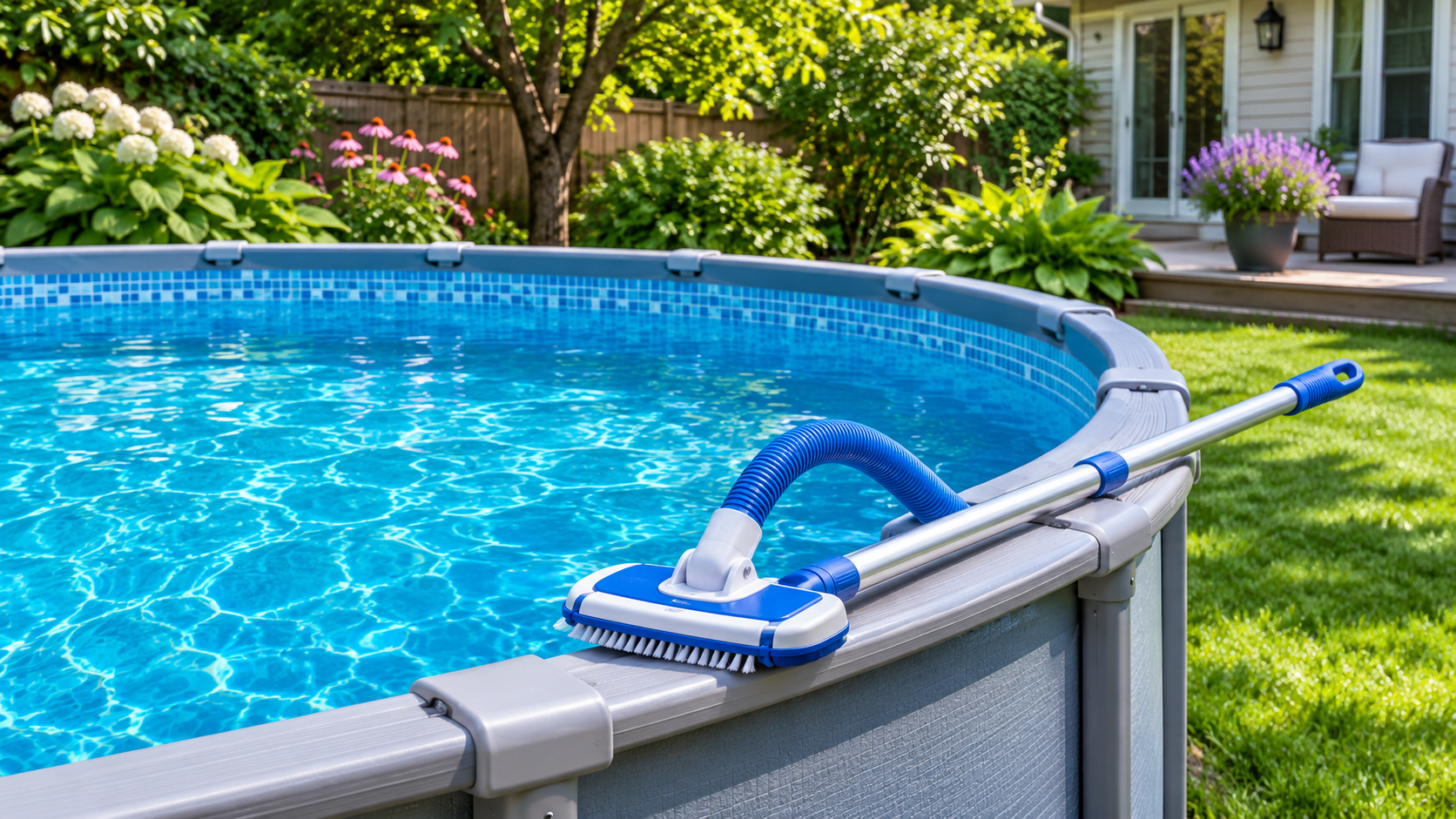
Start with the construction and dimensions of your pool
Above-ground pools range from small seasonal soft-sided models to large framed pools with broad floors, ladders, and more complex shapes. Before choosing a vacuum, identify the pool’s actual inside dimensions, floor layout, liner material, and any deep or sloped areas. A round pool is often measured by diameter, while an oval or rectangular pool needs its length and width. Compare those figures with the cleaner’s stated maximum pool size or area coverage, but treat the rating as a compatibility limit rather than a promise that every corner will be cleaned in every cycle.
Also note how the pool is supported. A frame can create narrow spaces around legs and connections where leaves collect. A ladder, return fitting, skimmer, or drain can interrupt a robot’s route. Inflatable ring pools can move or flex slightly as water shifts. If the manufacturer prohibits robotic cleaners or powered equipment for a particular pool type, follow that instruction. The pool maker’s manual should take priority over a general product claim on a marketplace listing.
Small pools may need only occasional spot cleaning. In that case, a handheld vacuum can be easier to store and retrieve than a larger robot. A family-size pool with regular use and tree debris may benefit from a floor-cleaning robot, provided its navigation and filter capacity suit the pool. For a large pool that needs wall or waterline scrubbing, check whether a model actually offers those functions; the words “automatic pool cleaner” alone do not confirm full-wall coverage.
Quick comparison: robot, handheld, or pump-connected vacuum?
Cordless robotic cleaners move across a defined pool area, collect debris in an onboard filter, and do not need you to guide every pass. They are convenient when the pool is within their rated dimensions and the floor is suitable for the robot’s traction and navigation. A cordless design removes a floating power cable but still requires safe charging and careful handling. Runtime, charge time, filter size, and retrieval method matter as much as the headline suction number.
Handheld rechargeable vacuums are controlled by the person cleaning. They are useful around steps, ladders, corners, and small dirt patches, especially when the whole pool does not need a machine cycle. The tradeoff is manual labor and usually a smaller collection basket. Many have a short included shaft or require an adapter for a longer pole, so check reach and accessory compatibility before purchase.
Manual vacuum heads connected to a pool’s circulation system use a hose, telescoping pole, and a connection to the skimmer or dedicated vacuum port. They may be affordable if the filter pump already provides suitable flow and the fittings match. They also require priming the hose, guiding the head, and monitoring the filtration system. Do not assume a vacuum head is a self-contained appliance or that the included hose fits your pool’s port.
Suction-side and pressure-side cleaners depend on pool plumbing and pump performance. These systems can be practical in a permanent installation that supports them, but may require a specific line, adapter, or booster pump. Before buying, confirm whether your pool’s pump and filter arrangement is compatible. Never modify plumbing or connect equipment in a way the pool or cleaner manufacturer does not approve.
Above-ground pool vacuum examples to compare
The following examples represent different approaches, including cordless robots designed for above-ground pools and rechargeable handheld models. They are not a ranked test result. Product names, supported surfaces, included accessories, availability, and warranties can change. Check that the exact model and accessories in the current listing match your pool and cleaning needs.

ASIN: B0H7H5PJDV

ASIN: B01BUE8XVC

ASIN: B0HJCWPNS7

ASIN: B07YF8MBS8

ASIN: B0BWY7ZDT2
What to look for in a cordless pool robot
For a cordless robot, start with pool size and route suitability. Manufacturer coverage numbers may be stated in maximum pool length, water surface area, or both. If your pool is close to the stated limit, allow for the shape and obstacles: a robot may travel less efficiently around a ladder, a sloped transition, or a tight curve than it does in a simple flat pool. A flat-floor robot is not automatically a wall-climbing cleaner. Confirm the coverage details for the precise model and do not assume that a sibling model has the same capabilities.
Runtime should be considered together with cycle behavior. A product that advertises a long cycle may move slowly or may need a second pass when leaves and grit are heavy. A smaller pool can often be maintained with less runtime than a broad pool, but the pump basket and filter basket still need to hold the debris from your yard. Ask whether the advertised runtime is measured under the same conditions you expect; water temperature, filter loading, and battery age may influence real-world time.
Look at the collection system. A removable top-load basket can be easier to access than a bottom hatch if you have to turn the cleaner over after each cycle. Fine mesh may retain silt better but can load quickly with leaves. A basket that handles larger debris may let finer particles pass. If the pool regularly collects pollen or dust, determine whether a fine filter is available and whether it is included or sold separately. The seller’s listing should not be treated as proof of filter compatibility when the model number differs.
For a vinyl liner, compare the cleaning mechanism with the pool maker’s guidance. Wheels, tracks, brushes, and the shape of a vacuum head all contact the surface differently. The fact that a cleaner is described as “for pools” is not enough to guarantee that it is recommended for every liner. Choose an appliance whose manual names your pool surface, and contact the manufacturer when the materials or setup are unclear. Avoid sharp edges, damaged wheels, or exposed fasteners near a liner.
Retrieval design matters for above-ground owners. A unit that parks near a wall or can be lifted with a provided hook may be easier to remove than one that stops in the center of the floor. Check the handle and lifting instructions, and do not pull a powered unit by its cable. A drained basket and rinsed filter are easier to handle than a clogged, waterlogged unit. If the robot is heavy for you, consider how it will be moved from pool to storage before choosing it.
When a handheld vacuum is the better choice
A handheld vacuum can be ideal when the pool is small, used occasionally, or has a few persistent debris zones. It can reach the area around steps and a ladder, where some robots change direction or leave particles behind. It is also easier to use for a quick spot clean after wind or a small spill of leaves. The practical question is whether you are comfortable guiding the head along the floor and emptying its debris chamber every time.
Check the diameter of the cleaning head and how it relates to your pool. A wide head can cover a flat floor faster but may be awkward around a tight corner or behind a ladder. A narrow head can target a small patch but may take longer in a large pool. Consider shaft length, included adapters, and whether the pole is included. A product page may show a telescoping pole in photos even when the listing sells the vacuum body only, so verify the package list.
Battery details deserve close attention. Compare runtime, charging time, battery type, and the stated cleaning capacity. Rechargeable batteries gradually lose capacity, and a long charging period can make an unscheduled clean inconvenient. Follow the manufacturer’s charging instructions and keep chargers and electrical connections away from splash zones. Do not use an underwater vacuum when its charge port, housing, or switch is damaged.
Handheld models also differ in how they trap debris. Some use a reusable screen or bag; others use a filter cartridge. A basket that is easy to open and rinse can make frequent spot cleaning less tedious. If your pool gets fine sand, confirm the filter rating or the manufacturer’s description of what it captures. A vacuum that is optimized for leaves might not retain fine particles efficiently, and fine debris can return to the water if the filter is poorly seated.
Match suction and filtration to the debris you see
Leaves, acorns, grass, sand, and fine dust behave differently. Large leaves can block a small inlet or fill a compact basket quickly. Sand and fine grit may pass through a coarse screen. Pollen can form a thin film that is more efficiently managed through brushing and filtration than by a single pass with a vacuum. Make a short list of the debris your pool actually collects before deciding which filter style is useful.
For leaf-heavy yards, check the inlet opening and debris basket volume. A robot with a small basket may need frequent pauses for cleaning. Some automatic machines are designed primarily for floor debris and do not skim the water surface, so floating leaves may need a skimmer net or a dedicated surface cleaner. Product photos can be misleading: verify the debris path and basket instructions in the manual.
For fine particles, check whether the vacuum has a fine-filter option and whether the pump or robot will capture rather than disperse them. Some particles are too small for a coarse net but can be captured by a suitable cartridge or a well-maintained filtration system. If a cloud forms when you vacuum, slow down, brush the floor first if the pool instructions recommend it, and verify that your filter is seated. A dirty filter can reduce flow and make a vacuum appear underpowered.
Organic debris can stain a liner if it sits in one spot. Vacuuming helps remove physical matter but does not replace water testing or sanitation. Use pool chemicals only according to their labels and the pool manufacturer’s guidance. Keep vacuums and electrical products away from chemical handling areas, and never mix cleaning products unless the instructions explicitly say it is safe.
Pool shape, floor slope, and liner considerations
A round pool may be straightforward for a small robot, but a larger round pool can still require careful coverage. Oval and rectangular pools have corners where debris settles, and a robot’s turning pattern can leave missed strips. If the floor has a shallow slope or an uneven transition, confirm that the cleaner is rated for that geometry. Product descriptions about “smart navigation” do not tell you how it performs in every pool shape.
Soft-sided and inflatable pools may have flexible floors that respond to foot pressure, water movement, or a suction head. A strong manual vacuum head can pull against a liner or distort a small structure if it is not intended for that use. Follow the pool owner’s manual. For a compact inflatable pool, a lightweight handheld cleaner or manual net may be safer and simpler than a heavy robot.
Above-ground pools often have a vinyl liner, but the construction and surface texture vary. An older or worn liner deserves extra care. Inspect the pool for tears, loose fittings, wrinkles, or exposed sharp components before running a cleaner. A damaged cleaner brush or wheel can worsen a small surface issue. If you notice unusual drag, scraping, or repeated catching, stop the machine and inspect it rather than letting it continue through a cycle.
Steps, ladders, and support legs are common obstructions. Some robots avoid them but do not clean behind or underneath them. A narrow handheld nozzle may reach these spots, provided the head and shaft do not contact or snag the liner. If you frequently find debris in the same corner, manual spot-cleaning after an automatic cycle may be the most efficient routine.
Should you use the pool pump or an independent robot?
A pump-connected vacuum can use equipment you already own, but flow and port compatibility are essential. Before purchase, check the pump’s recommended flow range, filter configuration, and the vacuum’s fitting requirements. A pool with a small cartridge filter may have different restrictions than a larger sand-filter system. A cleaner that needs more flow than the pump can provide may move poorly or affect circulation. Never operate the pump dry or outside its specified conditions.
When using a manual hose, fill the hose with water before connecting it, following the pool and vacuum instructions. Air in the hose can reduce suction and may interrupt circulation. Position the hose so it does not pull on a wall fitting or create a trip hazard around the pool. Keep swimmers out while the vacuuming equipment is being installed or removed, and never leave a hose or electrical cable where someone can become entangled.
An independent robot has its own motor and filter, so it can reduce dependence on the pool pump during its cleaning cycle. It still needs safe handling and regular maintenance. The power supply must be positioned as specified, the cable must not be routed through water or across a wet walking area, and any required GFCI protection must be in place. Cordless models avoid the poolside cable during cleaning but still have charging and storage requirements.
Calculate total cost rather than comparing only the purchase price. A pump-connected setup may require hoses, adapters, a booster pump, or replacement fittings. A robot may need filter cartridges, replacement tracks, a storage caddy, or battery replacement over time. A handheld cleaner may need a longer pole or replacement bag. Verify what is included and which parts are currently available for the exact model.
Safe setup and cleaning routine
Read the product manual before placing a vacuum in the pool. Confirm allowed water chemistry, operating depth, pool-surface compatibility, and any warnings about children or swimmers. For corded products, use the specified outlet protection and keep the power supply at the required distance from the water. Do not use an extension cord or substitute charger unless the manufacturer approves it. Remove swimmers and pets before running a machine.
For a robot, inspect the filter basket, wheels, cable or housing, and charging port before each use. Keep the charging station dry. Lower the machine according to its instructions rather than dropping it onto the liner or steps. After the cycle, retrieve it with the handle or hook, turn it off, and remove debris. Rinse the filter gently with clean water; avoid high pressure if the manual warns that it can damage the mesh.
For a handheld tool, confirm the vacuum head, pole connection, battery state, and debris chamber. If it has an automatic shutoff when not submerged, understand how it restarts and do not operate it outside the water unless the instructions allow it. Hold the unit and pole securely, move slowly near the liner, and empty the filter when suction weakens. Do not let children use a powered cleaner without direct adult supervision.
Vacuuming is one part of pool maintenance. Brush surfaces when appropriate, empty skimmer and pump baskets, maintain the filter, and test water chemistry on the schedule recommended by the pool manufacturer. If debris is excessive after a storm, remove large leaves with a net before running a vacuum; otherwise, a small filter may clog quickly. A simple maintenance log can help you see whether the vacuum is reducing cleaning time or merely shifting the work to filter rinsing.
How often should you vacuum an above-ground pool?
There is no single ideal schedule. Pool use, weather, trees, nearby construction, wind, and the efficiency of the cover and filter all affect debris load. A pool used daily may benefit from short, frequent cleaning cycles, while a covered pool used on weekends may only need spot vacuuming before swimming. Do not run the cleaner more often than its manual allows or leave it in water continuously if the manufacturer says to remove it after each cycle.
After a storm, remove sticks and large leaves with a skimmer net first. If heavy silt has settled, run the pool’s filtration system and vacuum slowly so you do not stir it back into suspension. Fine particles may need a finer filter or more than one pass. If the water is cloudy, discolored, or has an unusual smell, pause swimming and consult pool-care guidance rather than relying on the vacuum alone.
During storage, dry the vacuum as instructed, rinse removable filters, coil hoses loosely, and keep batteries within the recommended temperature range. Avoid storing a lithium battery in direct sun, near a heater, or in a freezing shed. Follow the manual for seasonal storage and charging; long-term battery care can affect the cleaner’s usable life.
Common mistakes to avoid
Buying by pool-size claim alone: a capacity rating does not guarantee that the robot can handle ladders, corners, steps, or a sloped floor. Confirm the pool shape and actual coverage mode.
Assuming every robot climbs walls: many cordless above-ground robots are designed for the floor. If walls matter, look for explicit wall-cleaning support for the exact model and surface.
Using a strong vacuum head on an unsupported liner: suction can pull at a soft surface, and a rough or damaged brush can scratch. Confirm suitability and stop if the head catches or drags.
Ignoring basket capacity: a full filter reduces flow and cleaning performance. Empty it as needed, especially after leaves or hair collect.
Confusing a pool pump with vacuum suction: a manual vacuum that connects to circulation requires the correct hose, port, and flow. Check the pump and filter instructions before connecting.
Leaving the vacuum in the pool between cycles: chemicals, sunlight, and water exposure may affect seals, brushes, and batteries. Follow storage directions rather than assuming the appliance is designed for permanent immersion.
Expecting a vacuum to sanitize water: a vacuum removes debris; it does not replace filtration, water testing, or chemical treatment. Keep each part of the maintenance routine in place.
How to choose the right option for your setup
Choose a cordless robot if your pool falls comfortably within its coverage rating, the floor is compatible, and you want repeated automatic floor cleaning. It is most useful when the filter can hold your usual debris and when retrieving, rinsing, and charging the unit fit your routine.
Choose a handheld rechargeable cleaner if you need spot cleaning, own a compact pool, or want to target steps and edges manually. It works best when you do not mind guiding the pole and emptying a smaller chamber. Verify the included pole length and the pool size the manufacturer supports.
Choose a pump-connected manual vacuum if you already have compatible circulation equipment and prefer a simple device with no battery. Confirm that the hose, vacuum plate, and pool connection match. The lower-cost head may be a poor value if you need several adapters or if the pump cannot support the required flow.
Choose a larger automatic cleaner only when it is specifically compatible with your pool’s size, floor, and system. A model designed for an in-ground pool may weigh more or require different circulation and storage than a small above-ground pool can support. Avoid buying a product simply because its list of features is longer.
Frequently asked questions
What is the best above ground pool vacuum for a vinyl liner?
Start with the pool maker’s approved cleaning methods and the vacuum manufacturer’s compatibility list. Many above-ground pools use vinyl, but not all liners have the same construction or condition. Choose a cleaner with a soft, liner-appropriate contact surface and avoid sharp wheels or aggressive brushes. If the product manual does not clearly mention vinyl liners or above-ground pools, ask the manufacturer before use.
Can a robotic vacuum clean the walls of an above-ground pool?
Some robots can climb walls, but many above-ground cordless models focus on the floor. Check the exact product’s coverage specification. A model that scrubs the floor does not necessarily clean the waterline, ladder, or walls. If wall brushing is needed, use a compatible manual brush or a model explicitly designed for that surface and pool construction.
Is a cordless pool vacuum powerful enough for leaves?
It depends on the inlet, filter basket, motor design, and the size and volume of leaves. Larger leaves can block a compact intake or fill a small basket quickly. Remove large debris with a net first, then use the vacuum for settled leaves and dirt. Verify the manual’s guidance for maximum debris size and filter cleaning.
Do above-ground pool vacuums need the pool pump?
Not all of them. Cordless robots and rechargeable handheld vacuums use their own batteries and onboard collection systems. Manual suction vacuums and some automatic cleaners connect to the pool’s pump or plumbing. The product description should clearly identify its power source and required connection.
Can I use an in-ground pool vacuum in an above-ground pool?
Only if the manufacturer says the model supports that pool and its surface. In-ground cleaners can have different weight, suction, wall-climbing, or pump requirements. A product that fits the pool chemically or physically may still be unsuitable for its liner or circulation system. Confirm exact compatibility before use.
How do I vacuum fine sand from the bottom?
Use a suitable fine filter and move slowly to avoid stirring particles into the water. If the vacuum connects to the pool pump, follow the pool manual’s vacuuming and filter instructions. Rinse or clean the filter when flow declines. If the sediment is very fine, the pool’s filtration or a compatible finer cartridge may be necessary.
Should the vacuum stay in the water after cleaning?
Follow the manufacturer’s instructions. Many cleaners should be removed, rinsed, and stored after the cycle. Leaving a robot in treated pool water can expose seals and parts to chemicals and sunlight beyond the intended use. Store batteries and chargers dry and within the specified temperature range.
What should I do if the vacuum leaves lines of dirt behind?
Check whether the filter is full or incorrectly seated, whether the head is clogged, and whether the model is compatible with the debris. A robot can also miss narrow edges or areas behind obstacles. Clean the filter, reposition the cleaner if the manual allows it, and use a handheld tool or brush for isolated missed spots.
Final thoughts
The best above ground pool vacuums balance pool compatibility, debris capacity, reach, and the effort you are willing to spend on each cleaning cycle. A cordless robot is convenient for a compatible floor and regular maintenance; a handheld unit is flexible for spot work; a pump-connected head can be economical when your circulation setup supports it. Compare the exact model number, not just the brand family, and confirm the product’s pool-size, surface, and coverage claims before ordering. Set up and maintain every cleaner according to its manual, and keep vacuuming as one part of a complete water-care routine.
Manufacturer references: Review the official Dolphin Nautilus AG specifications, Intex handheld vacuum specifications, and Maytronics’ above-ground pool cleaner information. Confirm current details on the exact model before purchase.
Compare pool vacuum types in our general pool vacuum guide. For related practical guides, see our Lawn & Garden ideas and Home & DIY advice.
Certain content that appears on this site comes from Amazon. This content is provided “as is” and is subject to change or removal at any time. Product examples and images are supplied through Amazon Creators API; confirm specifications and availability on the current listing.