Best Manual Pole Saws
The best manual pole saws help you make controlled pruning cuts from the ground without a motor, battery, fuel, or extension cord. The category includes two distinct tools: a pole-mounted pruning saw with a toothed blade that you pull or push through a branch, and a long-reach pole pruner with bypass jaws operated by a rope or lever. Some tools combine both. That difference matters because a saw blade is designed for branches too large or woody for lopper jaws, while the pruner head is meant for smaller, reachable stems within its stated cutting range.
This guide focuses on non-powered pole pruners and pole saws for home gardening and light tree maintenance. It explains fixed versus extendable shafts, blade styles, tooth direction, head angle, reach, handling, pruning limits, care, and overhead hazards. It does not cover gas, corded electric, or battery pole saws with driven chains. Those machines have different operating hazards and maintenance. This is a research-based buyer’s guide, not a hands-on product test: we did not compare current models in a yard, measure their cutting force or durability, or verify today’s prices. Always check the current product instructions for a specific model.
Manual pole tools can be useful when a branch is just beyond reach, but greater reach does not make a difficult branch safe to cut. A falling limb can strike the operator, snag, split, or change direction. If a branch is large, heavy, under tension, over a structure, near utility wires, or requires climbing, contact a qualified arborist. For lower branches, a hand saw or lopper may offer better control. See our guides to hand saws for gardening and battery chain saws for homeowners for adjacent tools, and our loppers guide for manageable branches that can be reached without a pole.
Affiliate disclosure: This article may include affiliate links. If you buy through one, DailyHomeDecorating.com may earn a commission at no extra cost to you. Choose tools based on the work, safe handling, and verifiable manufacturer instructions.
Amazon product examples to compare

ASIN: B0FH7PC7T8
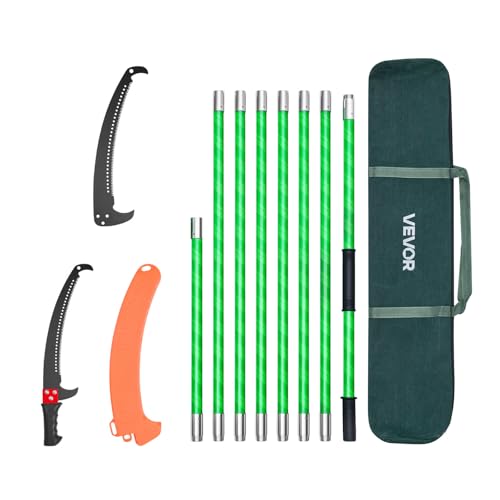
ASIN: B0FH7MRDSH

ASIN: B08CK5RSPD

ASIN: B0H9Y7CTTZ
Certain content that appears on this site comes from Amazon. This content is provided “as is” and is subject to change or removal at any time. Product examples and images are supplied through Amazon Creators API; confirm specifications and availability on the current listing.
Quick answer: choose the head first, then the pole
For larger woody branches within a manual saw’s capacity, start by comparing the blade’s length, curvature, tooth design, replacement availability, and the stability of its connection to the pole. For small live shoots, a rope-operated bypass pruner can make a cleaner, more controlled cut if the branch fits the jaw and the tool can be positioned safely. If you need both functions, a combination tool can save storage space, but inspect how each head locks and whether changing modes is straightforward.
Then decide between fixed and telescoping shafts. A fixed pole is simple and may feel more rigid, but its length is less adaptable and harder to store. An extendable pole adjusts to different tasks and can be compact for storage, but its locking sections add weight, flex, and inspection needs. Do not select by maximum reach alone. A fully extended pole can be harder to control, and the tool’s head can make the far end tiring to position. Your feet should stay on stable ground, and your head and body should remain outside the likely fall zone.
What counts as a manual pole saw?
Pole-mounted pruning saw
A pole saw has a curved or straight toothed blade mounted at the end of a long shaft. The user guides the blade into position and cuts with repeated strokes. The saw teeth may be designed for a particular pull or push stroke; follow the maker’s instructions rather than assuming that every blade cuts on the same motion. A hooked or toothed tip may help keep the blade in a kerf or clear small twigs, but details differ across models.
Rope-operated pole pruner
A pole pruner uses bypass-style jaws, often with a rope, pulley, lever, or internal linkage to close the cutting blade around a branch. It is for smaller stems than a pole saw blade is suited to. A clean bypass action slices one blade past another, while some designs use a cutting blade against an anvil. The tool’s rated branch capacity and proper placement are important; forcing the jaws around oversized wood can jam or damage the mechanism.
Combination pole saw and pruner
A combination model provides a pruning saw and a bypass pruner on one head or as interchangeable attachments. It can cover more tasks without requiring two long tools, but it may be bulkier. Look for a head layout that gives the saw clear access to the branch and lets the pruner rope move without snagging. Confirm that both heads are secure and that the instructions explain assembly and use for each mode.
How manual differs from powered pole saws
A manual pole saw does not have a powered chain or motor. That avoids engine, battery, or cord maintenance and removes some hazards associated with powered cutting systems. It does not eliminate risk: the pole creates leverage, the head is elevated, the cut can bind, and the branch can fall unpredictably. Powered pole saw manuals may include instructions that are not relevant to manual tools, so do not apply a powered model’s angles or procedures as if they were universal. Use the manual for the actual product in your hands.
Match the head to the branch and pruning task
Small shoots and live branches
For small branches that fit fully into the jaws, a pole pruner can offer a quick cut from the ground. It may be convenient for removing a few upright shoots or making a selected cut in a shrub or small tree canopy. Place the branch correctly in the cutting head and pull the rope smoothly. Jerking the rope can shake the pole and make the cut less controlled.
Woody branches larger than the jaw capacity
A saw blade may be better suited to a larger branch than the pruner mechanism can safely close around. The correct limit depends on the saw, wood species, dryness, branch condition, and access. A branch’s diameter alone does not determine whether it is safe: weight, angle, attachment, and tension matter. For large, heavy, cracked, or hanging limbs, use a professional rather than trying to increase leverage with the pole.
Deadwood and damaged branches
Dead branches can be brittle and may break before the saw completes the cut. They can also fall apart in sections or hang in neighboring branches. Do not stand beneath deadwood while trying to dislodge it. If the branch could fall unpredictably, is entangled, or is above a person, roof, fence, or utility, stop and have it assessed by a qualified tree-care professional.
Tree health and pruning purpose
Before cutting, know why the branch should be removed and where the proper pruning point lies. Random cuts can injure a tree or leave stubs that impair healing. A pole tool makes reach possible but can make it harder to see the branch collar and the exact cut angle from the ground. If the pruning objective is unclear, consult a local extension service or certified arborist. A clean cut in the wrong place is still a poor pruning decision.
Fixed and extendable shafts
Fixed-length poles
A fixed pole has fewer moving joints and may feel direct when held. It is often simpler to inspect and can be a good match when the needed reach and storage space are predictable. Its disadvantages are limited adjustability and the challenge of transporting or storing a long shaft. Confirm the assembled length and how the tool is carried before purchasing.
Telescoping poles
A telescoping shaft adjusts through nested sections. This can shorten the tool for storage or allow a shorter reach for a lower branch, where leverage is easier to manage. Each coupling and lock needs inspection. Loose sections can twist, slide, or flex under cutting force. Follow the manufacturer’s limit for how far each section may extend, and check that locks are engaged before raising the head.
Sectional poles
Some systems add or remove pole sections. This can provide modular length choices, but the joints must be fully connected and locked. A sectional design may be useful for transport and storage; the connection points can also be places where play develops. Confirm replacement-section availability and verify the manufacturer’s assembly instructions.
Pole material and stiffness
Pole shafts may use aluminum, fiberglass, wood, or composites, depending on model. Material affects weight, flex, durability, and electrical risk. Never assume a pole is insulated because it is made from fiberglass or another nonmetal material. Manual tools should be kept well away from overhead electrical lines, and local utility safety distances should be observed. If branches are near power lines, do not attempt the work yourself.
Reach, balance, and handling
Advertised reach can refer to the pole’s length or a claimed working height, and people have different heights and arm positions. Compare the manufacturer’s measurement method. A long pole held at a high angle can feel much longer and heavier than its listed weight suggests because the head is far from the hands. Reach that makes the tool difficult to guide is not useful reach.
Balance depends on the shaft, blade or pruner head, rope, and user’s stance. A lighter pole may reduce fatigue, but a very flexible shaft can make precise placement more difficult. The tool’s balance should let you lift and aim the head without excessive sway. If possible, handle the exact tool at its intended extension before buying. Do not make a purchase decision from a weight figure alone.
Check grip surfaces and rope position. Handles should permit a secure two-handed hold, and the rope should be reachable without wrapping it around the hand. Some rope systems use a pulley to reduce effort but may have more moving parts to maintain. Consider whether you can operate the cutting mechanism while keeping your feet planted and your upper body out of the branch’s fall path.
Long tools need a clear setup path. Look for overhead wires, adjacent branches, glass, vehicles, people, and obstacles around your feet. Ensure that the shaft can be positioned without contacting structures or sweeping across a bystander. A short repositioning break is better than holding a fully extended pole while fatigued.
Blade shape, teeth, and cutting direction
Blade length and curvature
A longer blade can span more of a branch, but it may be harder to place precisely in a tight canopy. A curved blade can help keep the saw engaged during a stroke; whether the curve suits your work depends on branch access and cutting direction. A short blade may offer control in dense branches. Consider likely branch diameters and how much room exists around them.
Tooth pattern and tooth direction
Tooth spacing, shape, and orientation influence how a hand saw clears material and which stroke cuts. Some pole-saw blades are designed to cut on the pull stroke; other designs may differ. Follow the manufacturer’s description and use a smooth motion. Do not force a blade in the noncutting direction or twist the pole to widen the kerf. Clean teeth help the blade track; clogged or damaged teeth should be cleaned or replaced as directed.
Replaceable blades
Replaceable blades can extend the life of a pole tool and make it easier to find the right blade for a particular task. Check availability, attachment method, and whether the fasteners can be serviced safely. A blade that is difficult to source may make a low-cost tool less practical over time. Always install the blade in the correct orientation and secure it according to the manual.
Pruner blade type
Bypass heads have two crossing blades and are generally intended to make a slicing cut on live wood within their capacity. Anvil-style designs use a blade that closes against a flat surface and may be intended for different tasks. Pole pruner styles and cutting capacities vary. Look at the actual mechanism and maker’s instructions instead of inferring suitability from a product photo.
Head angle, rope, and pruner mechanism
An adjustable head can help align the blade or jaws with a branch without tilting the entire pole as much. It can also add a lock that must be tightened and periodically checked. A fixed head may be simpler and more rigid, though it offers fewer approaches. Evaluate whether the head can be set while the tool is low and whether it remains secure during a cut.
With a rope-operated pruner, inspect the rope’s path, pulley or guide, return spring, and knot or grip. Rope should not snag on nearby twigs or get wrapped around the operator’s hand. The head should open and close smoothly without a branch in it. Practice the motion at ground level before raising the tool. If the blade does not return, do not reach up to free it while the head is overhead; lower the tool and diagnose the problem safely.
Combination heads can place the pruning jaws near the saw blade. Make sure the unused part of the head will not catch in neighboring branches. Secure the tool’s saw cover when carrying or storing it. If a head is detachable, keep the connection clean and follow the manual’s locking sequence every time it is assembled.
Branch size, pruning limits, and when to stop
Each tool has a stated or practical cutting capacity. Treat the maker’s limit as a ceiling under specified conditions, not as a promise that every branch of that diameter can be cut safely. Hard or dry wood, awkward angles, dense growth, poor access, and a worn blade can make a smaller branch difficult. Do not force a pruner jaw around an oversized branch or use body weight on a pole saw.
Three-cut pruning methods are often recommended for heavier limbs to reduce bark tearing and control weight, but a pole tool may make it difficult to position cuts accurately or handle the limb as it separates. If you cannot perform a proper pruning sequence from stable ground with clear footing and a safe drop zone, do not attempt it with a manual pole saw. Have an arborist perform the work.
Do not cut branches that are supporting another limb, under visible tension, split, hung up, or likely to spring. Do not attempt storm damage cleanup where branches may be loaded or entangled. Stay clear of electrical conductors and never assume that a branch is harmless because the tool is manual. A pole can conduct force, the blade can strike a wire, and a falling branch can bring lines down.
Pruning also has limits for tree health. Remove only what is necessary for the objective, and avoid topping or indiscriminate canopy reduction. Specific recommendations depend on species, season, tree condition, and local rules. University extension resources can explain sound pruning cuts, but a hazardous or high branch should be handled by a professional.
How to choose among the best manual pole saws
- Decide whether you need a saw, pruner, or combination. Match the head to branch size and pruning intent.
- Estimate practical working reach. Compare working height and shaft length, then consider how the far-end weight will feel.
- Choose fixed or adjustable length. Balance rigidity and simplicity against storage and reach flexibility.
- Inspect locks and joints. Telescoping and sectional models should have understandable, positive locking mechanisms.
- Compare blade geometry. Look at length, curvature, tooth orientation, replacement availability, and safe cover.
- Evaluate head access. Check whether the head can reach the branch angle and whether its position locks securely.
- Check the pruner mechanism. Review rope route, pulley, return action, stated capacity, and replacement parts.
- Consider balance and grip. Handle the tool if possible, preferably at more than one extension setting.
- Read instructions before purchase. Confirm assembly, maximum extension, maintenance, and safety warnings.
- Plan for safe use. Make sure there is a stable ground position, a clear drop zone, and no overhead wires.
A very long combination tool is not automatically the best value if the pole flexes too much to guide the blade or if the pruning head is too small for your common branches. A short, rigid pole can be more useful for controlled work close to a tree. Choose based on the branches you can safely manage, not on the tallest advertised reach.
Research method and sources
This guide draws on university extension pruning guidance, manufacturer safety documentation, and descriptions of manual pruning tools. It is not a product comparison based on field testing. We did not measure reach, pole stiffness, blade sharpness, pruning force, or durability, and we do not claim a model is the fastest or best performing. Model specifications and included parts can change; consult current manufacturer documentation.
The Colorado State University Extension guide to pruning cuts describes pole pruners as tools for small branches that cannot be reached from the ground and emphasizes suitable pruning methods. The Texas A&M AgriLife guide to proper pruning warns that material cut overhead can fall on the operator and discusses how pole saws and pruners fit into pruning work. These sources inform the task and hazard sections; tree-specific decisions should reflect local extension advice or an arborist’s assessment.
Virginia Tech Extension’s hand tools safety and care guide describes pruning-tool types and the need for training in pruning hazards and safe handling. Iowa State Extension’s guide to pruning equipment outlines which hand tools fit different pruning tasks. These help frame the distinction among pole pruners, loppers, and hand saws; they are not endorsements of specific products.
For a manufacturer safety reference, the STIHL pole-pruner safety manual concerns powered equipment, not manual saws. Its warnings about falling limbs and overhead work are relevant hazards to take seriously, but its operating angles and machine-specific instructions do not apply automatically to a non-powered tool. Use the instructions for the manual pole pruner you choose, and never work near power lines.
Safe setup and overhead-work habits
Inspect the area before raising the pole
Identify the branch, likely fall direction, nearby limbs, structures, people, and a clear retreat path. Move children, pets, and bystanders out of the work zone. Remove tripping hazards from the ground. If the limb could land on a roof, vehicle, fence, utility line, or person, hire a qualified arborist. A branch may fall in a direction that is not obvious from its weight or angle.
Keep your feet on stable ground
Do not climb a ladder, stand on a chair, or work from an unstable platform while using a long pole. Raising the pole changes balance and can pull the operator off position. Work only from a firm, level place with room to move away. If safe reach requires climbing, use a professional with the right equipment and training.
Stay out of the drop zone
Keep your body and head away from the line where the branch is expected to fall. Avoid standing directly underneath the cut. Do not pull a branch toward yourself with the pole. When possible, position the cut so the limb can descend into a clear area. Branches can snag and swing, so watch the canopy as well as the blade.
Make controlled cuts
Secure the pole with both hands and use smooth, measured strokes. Keep the blade away from your body and other people. Do not push or pull so hard that the shaft bows excessively or the head jumps from the branch. If the blade binds, stop and lower the pole before troubleshooting. Do not twist the shaft or yank a stuck saw while the branch is under load.
Respect electrical hazards
Never use a pole pruner near overhead electrical wires or lines. Do not assume a manual fiberglass or wood pole is insulated, and do not estimate a safe distance yourself. If a branch is near a line, contact the utility or an arborist trained for that hazard. A saw blade, pole, or falling branch can contact or bring down conductors.
Use suitable protective equipment
Wear eye protection, sturdy footwear, and gloves appropriate for handling a stationary tool and branch debris. Keep gloves away from moving rope pulleys or other mechanisms while operating. A helmet may be appropriate where overhead branches present a falling-object hazard, but protective equipment does not make an unsafe branch safe to cut. Follow the tool manual and local safety guidance.
Maintenance and storage
After use, clean sap and debris from the blade and head. Use cleaning products that the manufacturer permits. Dry the blade before storage and apply rust protection only if the manual recommends it. Inspect teeth for damage and sharpen or replace the blade according to maker instructions. A dull saw can require more force and can be harder to guide accurately.
Check pole sections for cracks, bends, corrosion, and loose fittings. On telescoping models, clean and inspect the sliding sections and locking collars. Confirm that each lock holds under gentle pressure before raising the tool. Examine rope for fraying, cuts, and knots; inspect pulleys and springs for wear. Replace worn components with compatible parts rather than improvising repairs.
Keep a blade cover installed during transport and storage. Store the pole where it cannot fall onto someone or bend under other equipment. Separate detachable heads and keep small fasteners together. Before the next pruning session, inspect the entire assembly, confirm all connections, and make sure the cutting head opens and closes freely at ground level.
Frequently asked questions
What is the difference between a manual pole saw and a pole pruner?
A manual pole saw uses a toothed blade to cut branches with strokes. A pole pruner uses jaws operated by a rope, lever, or linkage to snip smaller branches within its capacity. Some tools combine both functions. Check the exact head design and instructions.
Are manual pole saws safer than powered pole saws?
They avoid a motor-driven chain and the associated power system, but they are not risk-free. The elevated blade, pole leverage, falling branches, binding, and overhead electrical hazards remain. Safe work area, stable footing, correct technique, and knowing when to stop are essential.
Is a fixed or telescoping pole better?
A fixed shaft can be simple and rigid, while a telescoping pole adjusts to different reach needs and can store more compactly. Telescoping joints add locks that need inspection and may flex. Choose based on the actual height, storage space, and your ability to control the tool.
How long should a manual pole saw be?
Choose enough reach to access the intended branch from stable ground while keeping the head controllable. Manufacturer measurements may describe shaft length or working height differently. Maximum length is not automatically comfortable or safe. If the branch is beyond controlled reach, hire an arborist.
Can a manual pole saw cut thick branches?
Only within the tool’s intended capacity and when the branch can be cut safely. A saw blade can handle larger wood than a bypass pruner in many designs, but diameter is only one factor. Weight, tension, angle, access, and fall direction matter. Large or hazardous limbs should be left to professionals.
Do pole saw blades cut on the push or pull stroke?
It depends on the blade design. Some are intended to cut on the pull stroke; others may differ. Check the instructions and tooth orientation, then use the prescribed motion. Avoid forcing the blade in the wrong direction or twisting the pole.
Can I use a manual pole saw from a ladder?
Do not combine a long pole with an unstable climbing position. Using one from a ladder can make balance and control more difficult while placing you near falling branches. If you cannot reach safely while standing on firm ground, have a trained tree-care professional do the work.
How do I know when to hire an arborist?
Hire a qualified professional for large, heavy, dead, split, or tensioned limbs; branches near power lines or structures; limbs that are hung up; work that requires climbing; and any cut where the drop zone cannot be controlled. A manual tool does not make a hazardous tree task a suitable DIY project.
How should I maintain the blade?
Clean and dry it after use, inspect teeth, and follow the manufacturer’s sharpening or replacement instructions. Keep a cover on during storage. Do not use a damaged or loose blade, and confirm that the head attachment and pole locks are secure before every session.
How do I choose among the best manual pole saws?
Decide whether your branches call for a saw blade, bypass pruner, or both. Compare practical reach, pole stiffness, locks, head angle, blade design, rope mechanism, replacement parts, and safe handling. Read the exact manual and do not exceed the tool’s stated limits. The most suitable option is the one that lets you complete the intended ground-level pruning with control.
Final buying perspective
The best manual pole saws give you a practical way to reach selected branches from stable ground. A good match depends on the head, shaft, blade, reach, balance, and maintenance—not a single maximum-length claim. Decide what needs pruning, use a saw or pruner head suited to that branch, and choose a pole you can guide without strain. Inspect the locks and cutting components before each use, keep clear of overhead wires, and respect the drop zone. When the branch is heavy, unstable, difficult to see, or beyond controlled ground-level work, leave it to a qualified arborist.