Disclosure: As an Amazon Associate, dailyhomedecorating.com earns from qualifying purchases. Links on this page are affiliate links; they cost you nothing extra. Prices and availability change often, so check the current Amazon listing before you buy.
This string trimmer reviews is written for homeowners who want an honest, experience-led verdict before spending anything. A string trimmer looks simple, yet the difference between a satisfying tool and a garage-wall ornament comes down to balance, line feeding, power source and how honestly a model matches your ground. Below we work through what the tool is, how it behaves in real borders and edges, where it shines, where it frustrates, and which named models deserve a place on your shortlist.
Key Takeaways
Best for: owners of small to large gardens who want crisp edges, tidy fence lines and a finished look after mowing, and who will follow basic safety habits without exception. Not suited for: anyone expecting a trimmer to clear brush, saplings or dense scrub, which is heavier work than a line head is designed for. The short verdict of this string trimmer reviews: match the power source to your plot, respect the guard and eye protection, and the tool quickly becomes the most satisfying finisher in the shed.
A string trimmer is the finishing tool of the lawn. A mower handles the open ground, but it cannot reach the strip along a fence, the ring around a tree, the edge where grass creeps over a path, or the tufts that grow against steps and walls. A spinning length of flexible line does that work, slicing grass and light weeds cleanly where a blade would be clumsy or dangerous. Gardeners also call it a weed eater or a line trimmer, and whatever the name, its job is the same: the neat border that makes a mowed lawn look finished rather than merely cut.
Trimming changes with the seasons. Spring growth is soft, fast and wet, and rewards frequent light passes that keep edges from ever getting away from you. Summer brings tougher, drier stems and dust, when eye protection matters even more and line wears faster against hard ground. Autumn adds fallen leaves and seed heads that tangle in the head. A tool that copes gracefully across that range, with line and power suited to your worst month rather than your easiest, will never leave you mid-season wishing you had bought differently.
In this guide
What a String Trimmer Is and Where It Fits — String Trimmer Reviews Context
String trimmers come in three broad families, and the differences shape daily life more than any headline feature. Gas models offer long running and strong cutting for large or overgrown ground, at the cost of fumes, noise, fuel mixing and more maintenance. Battery models start at the press of a trigger, run quietly enough for early mornings, and ask little beyond charging and cleaning, with running time tied to the battery ecosystem you own. Corded electric models are light and always ready near an outdoor socket, but the cord limits reach and demands constant awareness so it is never cut.
Edging is where a trimmer earns its keep. Turning the head so the line spins vertically lets you cut a crisp groove along paths, drives and beds, throwing a clean line that separates lawn from border. Work slowly, let the line do the cutting, and walk the edge rather than reaching across it, so the groove stays even. A dedicated wheeled edger does this one job with more support, but a trimmer that converts for edging covers occasional paths perfectly well and saves storing a second machine for a task you may do only a few times each season.
Design, Build and Setup
Balance matters more than raw power for most gardens. A trimmer that feels nose-heavy will tire your forearms and shoulders long before the battery fades, while a well-balanced tool can be guided with the fingertips. Notice where the weight sits, how the handle adjusts to your height, and whether the shaft length lets you work standing upright rather than stooping. A curved shaft often suits shorter users and tight borders, while a straight shaft reaches under benches, shrubs and fences more easily and tends to suit taller users and heavier growth.
How the head feeds fresh line shapes the whole experience. Bump-feed heads release line when you tap them on the ground, which is simple and proven but interrupts your rhythm and can waste line if you bump carelessly. Automatic-feed heads release line as needed, which is effortless, though the mechanism can overfeed in some designs. Fixed-line heads use short pre-cut pieces that you swap by hand, removing feed problems entirely at the cost of stopping to reload. None is universally best; the right choice depends on whether you value flow, simplicity or freedom from feed tangles most.
Setup should take minutes, not an afternoon. Unbox, fit the guard exactly as the manual directs, because the guard is a safety part and never an optional accessory, then check that the head spins freely and the line is loaded correctly. Adjust the handle so your arms hang relaxed, set the shaft so you stand upright, and do a short practice pass on an unimportant corner before tackling the showpiece border by the front path.
The line itself is a working part, not a detail. Thicker line shrugs off tougher stems and lasts longer against masonry, while thinner line spins faster, cuts fine grass more cleanly and is gentler on delicate bark and edging. Twisted and shaped profiles can cut more quietly and efficiently than plain round line, though they can cost more and feed less smoothly in some heads. Whatever you choose, keep a spare spool or a length of fresh line ready, because old line grows brittle in storage and snaps constantly, turning a quick tidy into a stop-start frustration.
Performance in Real Use
Along Fences and Walls
Good technique is mostly rhythm. Hold the head level and slightly above the ground, swing it in smooth arcs, and let the tip of the line do the work, because only the outer end moves fast enough to cut cleanly. Work so debris is thrown away from paths, windows, cars and people, which usually means choosing your walking direction deliberately rather than wandering. Trim before you mow if the edges are long, so the mower can pick up the clippings, or after you mow if you prefer to judge the finished height against the cut lawn.
Different growth asks for different technique. Fine lawn grass at the border cuts cleanly with a light pass at moderate speed. Thick, wet or overgrown patches need patience: take shallow bites from the top down rather than plunging the head in, which wraps long stems around the shaft and stalls the head. Scalping, cutting so low that soil and crowns show, weakens the lawn edge and invites weeds, so aim to match the mowing height and leave the border looking like a continuation of the lawn, not a trench beside it.
Around Trees, Posts and Ornaments
Trimming around trees, posts and ornaments needs a gentle touch. The line that slices grass will also slice bark, and repeated wounds around a young tree can damage it badly over a season. Keep a mulch ring or a physical guard around valued trunks so the trimmer rarely needs to go close, approach slowly with the line barely kissing the grass, and finish the last inch by hand where the planting matters. The same care applies to fence paint, decking, irrigation heads and the bases of shrubs, all of which the line can scar in a moment of inattention.
Edging Paths and Drives
Edging is where a trimmer earns its keep. Turning the head so the line spins vertically lets you cut a crisp groove along paths, drives and beds, throwing a clean line that separates lawn from border. Work slowly, let the line do the cutting, and walk the edge rather than reaching across it, so the groove stays even. A dedicated wheeled edger does this one job with more support, but a trimmer that converts for edging covers occasional paths perfectly well and saves storing a second machine for a task you may do only a few times each season.
Overgrown Corners and Seasonal Growth
Different growth asks for different technique. Fine lawn grass at the border cuts cleanly with a light pass at moderate speed. Thick, wet or overgrown patches need patience: take shallow bites from the top down rather than plunging the head in, which wraps long stems around the shaft and stalls the head. Scalping, cutting so low that soil and crowns show, weakens the lawn edge and invites weeds, so aim to match the mowing height and leave the border looking like a continuation of the lawn, not a trench beside it.
Trimming changes with the seasons. Spring growth is soft, fast and wet, and rewards frequent light passes that keep edges from ever getting away from you. Summer brings tougher, drier stems and dust, when eye protection matters even more and line wears faster against hard ground. Autumn adds fallen leaves and seed heads that tangle in the head. A tool that copes gracefully across that range, with line and power suited to your worst month rather than your easiest, will never leave you mid-season wishing you had bought differently.
Strengths and Trade-Offs
Strengths
- Reaches every strip a mower cannot, turning a cut lawn into a finished lawn.
- Starts fast and works in short sessions, so edges can be tidied little and often.
- Versatile across trimming, edging and light weed control with one head and one tool.
Trade-offs
- Throws debris with real force, so eye protection, long trousers and closed shoes are non-negotiable.
- Line is a consumable that snaps, wears and needs replacing as a routine cost of ownership.
- The wrong power source for your plot, gas on a tiny lawn or a small battery on acres, frustrates every session.
How It Compares: Models Worth Shortlisting
The models below are discussed in prose only in this draft, positioned by tier rather than price, so you can match a name to your ground before checking any listing. Treat each as a starting point for the buying-guide checks that follow, not as a promise about any single configuration, since most names cover a small family of variants.

EGO Power+ String Trimmer
Positioning: premium battery pick. Prose-only in this draft — check the current listing before you buy.
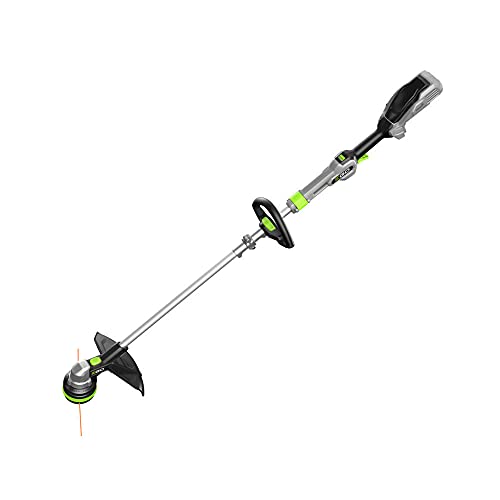
The EGO Power+ String Trimmer represents the premium end of cordless trimming, aimed at owners who want gas-like confidence without fuel, fumes or pull starting. In prose terms it suits larger suburban gardens, thick border growth and households already invested in a serious battery platform. Its appeal is composure: it feels built for owners who trim often and dislike compromise. The honest trade-off is that premium cordless tools ask premium commitment to their battery family, so it makes most sense when the same packs will power your mower, blower or hedge trimmer as well.
Balance matters more than raw power for most gardens. A trimmer that feels nose-heavy will tire your forearms and shoulders long before the battery fades, while a well-balanced tool can be guided with the fingertips. Notice where the weight sits, how the handle adjusts to your height, and whether the shaft length lets you work standing upright rather than stooping. A curved shaft often suits shorter users and tight borders, while a straight shaft reaches under benches, shrubs and fences more easily and tends to suit taller users and heavier growth.

Ryobi 40V String Trimmer
Positioning: mid-range battery pick. Prose-only in this draft — check the current listing before you buy.
The Ryobi 40V String Trimmer sits in the broad, practical middle of the cordless market, and that is its charm. It is aimed at typical family gardens: fence lines, paths, tree rings and the weekly tidy after mowing. Owners drawn to wide retail availability and a large family of compatible garden tools will find its ecosystem thinking reassuring. Its limitation is the mirror of its strength, in that a generalist tool rarely feels as refined as a premium specialist, but for steady weekly trimming it covers the brief without drama.
Balance matters more than raw power for most gardens. A trimmer that feels nose-heavy will tire your forearms and shoulders long before the battery fades, while a well-balanced tool can be guided with the fingertips. Notice where the weight sits, how the handle adjusts to your height, and whether the shaft length lets you work standing upright rather than stooping. A curved shaft often suits shorter users and tight borders, while a straight shaft reaches under benches, shrubs and fences more easily and tends to suit taller users and heavier growth.

WORX WG170 String Trimmer
Positioning: convertible trimming and edging pick. Prose-only in this draft — check the current listing before you buy.
The WORX WG170 String Trimmer is known for converting between trimming and wheeled edging, which makes it interesting for gardens where paths and drives dominate the finishing work. The wheeled edging posture takes the guesswork out of holding a vertical line freehand, and that support helps beginners produce straighter edges. It suits smaller to medium gardens and owners who value clever conversion over brute strength. Its trade-off is that convertible designs ask you to learn their mechanisms, and heavy rural growth is not their home ground.
Balance matters more than raw power for most gardens. A trimmer that feels nose-heavy will tire your forearms and shoulders long before the battery fades, while a well-balanced tool can be guided with the fingertips. Notice where the weight sits, how the handle adjusts to your height, and whether the shaft length lets you work standing upright rather than stooping. A curved shaft often suits shorter users and tight borders, while a straight shaft reaches under benches, shrubs and fences more easily and tends to suit taller users and heavier growth.

Greenworks String Trimmer
Positioning: accessible battery pick. Prose-only in this draft — check the current listing before you buy.
The Greenworks String Trimmer family appeals to owners who want straightforward cordless trimming without joining the heaviest professional platforms. It suits small to medium gardens, first-time cordless buyers and anyone who values light handling for borders and edges. In prose positioning it sits at the accessible end of the battery market, trading ultimate toughness for ease. The limitation to accept is that very thick, neglected growth will test lighter tools of any brand, so patient technique matters more than throttle if you choose this route.
Balance matters more than raw power for most gardens. A trimmer that feels nose-heavy will tire your forearms and shoulders long before the battery fades, while a well-balanced tool can be guided with the fingertips. Notice where the weight sits, how the handle adjusts to your height, and whether the shaft length lets you work standing upright rather than stooping. A curved shaft often suits shorter users and tight borders, while a straight shaft reaches under benches, shrubs and fences more easily and tends to suit taller users and heavier growth.
Who Should Buy It and Who Should Skip It
Think about who will actually use the tool. A trimmer shared between a tall adult and a shorter teenager needs an adjustable handle and manageable weight more than it needs maximum cutting width. Someone with limited grip strength or a bad back needs light weight, easy starting and a balance that does not fight them. A keen gardener clearing a large rural plot needs endurance and toughness instead. The best trimmer is not the most powerful one on the shelf; it is the one the real user can start, carry and control comfortably for the whole job.
The real cost of owning a trimmer is measured in more than money. There is the line you will keep replacing, the spools and occasional head parts, the batteries or fuel that power it, and the storage space along a garage wall. There is also the learning curve: the first sessions feel awkward, the line snaps, the edges wobble, and then, quite suddenly, the rhythm clicks and the job becomes quick and oddly satisfying. Weigh those costs honestly against the alternative of hand shears, a hired gardener, or a lawn edge that simply never looks finished.
Buy with confidence if you mow regularly and the unfinished edges bother you every single time. Skip, or choose a different tool first, if your real problem is brush, bramble or sapling growth, if nobody in the household will wear eye protection, or if your plot is so small that hand shears genuinely finish it in minutes. The checklist is simple: plot size, power source, battery family if cordless, comfort in the hands, and a safe place to store it.
Setup, Care and Maintenance Essentials
Safety comes before technique with this tool, every single time. Wear eye protection always, because the spinning line throws stones, grit and fragments of stem at surprising speed and distance. Wear long trousers and closed shoes, never sandals or shorts, so thrown debris meets fabric and leather rather than skin. Keep children, pets and bystanders well clear of the working area, and stop the moment anyone wanders close. Never remove or modify the guard, because it shields you from debris and sets the line length the head was designed for.
Build a short safety routine and repeat it until it is automatic. Before starting, walk the strip you plan to trim and pick up stones, wire, toys and hidden debris that the line could fling. Stop the motor fully before clearing tangled line or changing spools, and on cordless models remove the battery pack for any maintenance at all, so the head can never spin while your hands are near it. Let a gas engine cool before refuelling or storing it. These habits take seconds, and they are the difference between a routine chore and an avoidable injury.
Maintenance is light but not optional. After each session, stop the motor fully, remove the battery pack on cordless models, and clear the grass that packs around the head and guard, because a clogged guard cuts badly and throws debris unpredictably. Inspect the line, the spool and the guard for cracks, and wipe down the shaft before storing the tool dry and out of the weather. Gas models add fuel care and air-filter checks to that list. Ten unhurried minutes of care after a session prevents most of the failures owners blame on the tool.
Storage shapes how long a trimmer lasts and how willingly you use it. Hang it or stand it where the head stays clean and the shaft cannot be bent by things piled on top. Keep line somewhere cool and out of direct sun so it stays supple, and keep spare spools with the tool rather than in a forgotten drawer. Store battery packs partly charged in a dry place away from extremes of heat and cold, and keep fuel, for gas models, in a proper container away from living spaces and ignition sources.
Final Verdict
A good string trimmer is not the most powerful tool in the shed; it is the one that fits your ground, your strength and your habits so well that you actually use it weekly. Choose the power family first, then balance and line feeding, then the name. Follow the safety set without exception, keep the guard fitted, and the verdict of this string trimmer reviews is straightforward: for almost every lawn, a well-matched trimmer is worth its wall space many times over.
Noise and neighbours deserve a thought. Gas trimmers announce themselves across a whole street, while battery and corded models are markedly gentler, though none is silent, because the line itself whistles and sings against stems and edges. Early-morning trimming before the heat is kinder with a quiet tool, and kinder still if you save the loudest work for sociable hours. If your garden sits close to bedroom windows, a sleeping baby or a shift worker next door, the quieter families are not a luxury; they are how the chore stays neighbourly.
There is an environmental angle worth a calm look. Battery and corded tools produce no exhaust at the point of use and far less noise, which matters in dense neighbourhoods. Gas tools burn fuel for every session and need oil and filters that must be disposed of properly. Batteries carry their own footprint and eventually need recycling through proper channels rather than household waste. None of this decides the purchase alone, but for owners who trim often in a small community, the cleaner and quieter running is a genuine quality-of-life benefit for everyone within earshot.
Going Deeper: Field Notes That Change the Verdict
The sections below gather the practical details that owners discover across a season and that shorter guides leave out. Read them as the fine print of everything above: they rarely reverse a decision on their own, but they regularly refine one, and they are where the difference between a trimmer that suits a garden on paper and one that suits it in August is actually decided.
Brick, stone and concrete edges reward precision. The line can cut a beautiful groove against masonry, but grinding the head along the surface destroys line, wears the head and spatters grit everywhere. The skilled motion is a kiss, not a scrape: the tip of the line just meeting the growth at the base of the wall. Practised on an unseen corner first, that touch becomes second nature and your line consumption falls dramatically.
Wildflower margins and pollinator corners need a truce with the trimmer. Many gardeners now leave deliberate uncut patches for insects, and the trimmer’s role becomes defining the edge of the wildness rather than eliminating it: a crisp trimmed frame around a shaggy centre looks intentional and tidy while the ecology inside it thrives. That framing is, quietly, one of the best modern uses of the tool, turning a potential argument about neatness into a design feature.
Allotments and community plots add social dimensions to trimming. Shared paths, neighbouring plots and communal hours all argue for the quieter battery and corded families, for trimming at sociable times, and for clearing your clippings from shared paths as you go. A trimmer used considerately on a shared site earns goodwill; the same tool used at dawn on a Sunday, scattering debris across a neighbour’s seedlings, spends it quickly.
For rental properties and landlords, a trimmer is often the difference between a garden that photographs well at a viewing and one that looks neglected. A light, simple battery model that any tenant can start safely, stored with its charger and a spare spool, is usually worth more than a powerful machine that intimidates. Clear written guidance about eye protection, the guard and keeping children and pets inside during use protects both the property and the people in it.
Buying a trimmer as a gift is a thoughtful idea with one trap: fit. Weight, height and grip are personal, and a well-meant surprise can miss by enough to gather dust. If you gift one, gift the ecosystem the household already uses, include eye protection and a spare spool in the parcel, and keep the receipt visible rather than hidden, so an exchange for a better-fitting model feels like part of the present rather than a failure of it.
Second-hand trimmers deserve careful, specific checks rather than general optimism. Inspect the guard for cracks, because a damaged guard must be replaced before use and never simply removed. Check the head and eyelets for wear, ask why the tool is being sold, and treat any machine with a missing guard, a bypassed safety switch or a story about modifications as a firm walk-away. For battery models, the health of the included packs matters more than the shine of the shaft.
Accessories earn their place one by one. Proper eye protection is not an accessory but a requirement. Gloves improve grip and calm vibration. A shoulder strap or harness transforms long sessions on larger plots by moving weight from arms to torso. Spare spools and fresh line prevent the mid-job stop. Beyond that honest list, most add-ons are optional garnish, and money is usually better spent on the right tool and its consumables than on a basket of attachments for jobs your garden never presents.
A shoulder strap deserves a fuller word, because it changes who can trim. Fitted so the tool hangs balanced at working height with your arms relaxed, a strap lets smaller or older users manage a mid-weight trimmer comfortably, and lets anyone work longer with less fatigue. Fitted badly, it fights you. Spend the unglamorous minutes adjusting it at home, standing on the lawn in your trimming shoes, rather than discovering the discomfort halfway down a long fence.
Wet grass is the trimmer’s least favourite meal. It clumps around the head, smears rather than cuts, sticks to shoes and paths, and makes slopes treacherous. Where the schedule allows, trim when growth is dry, ideally later in the day after dew lifts. When wet work is unavoidable, take shallower bites, clean the head and guard more often, and accept a scruffier finish that a dry pass can perfect later. Patience in the wet prevents the wrapped, stalled head that ruins sessions.
Line can weld itself together inside a hot spool, a puzzling failure where feed stops even though line remains. Heat, pressure and age fuse the wraps, and the cure is unglamorous: stop the motor fully, remove the battery pack on a cordless model, open the spool, unwind and rewind the line evenly without stretching it, and replace line that has grown old and brittle. Even winding, without crossing and trapping the strands, prevents most feed mysteries before they start.
Spring start-up is a small ritual worth doing properly. Inspect the guard, head and shaft after winter storage, replace line that sat all winter growing brittle, clean the air paths on a gas engine or charge and check the packs on a cordless one, and make the season’s first session a gentle one on easy growth while you confirm everything feeds, spins and stops as it should. Ten minutes of spring honesty prevents the first warm Saturday being spent troubleshooting instead of trimming.
Winterising mirrors that ritual at the other end of the year. Clean the tool thoroughly, because packed grass holds moisture against metal and plastic all winter. Store it dry, hung or stood where the shaft stays straight. Keep line somewhere cool and dark, store battery packs partly charged away from frost, and handle any remaining fuel for a gas model according to its maker’s guidance rather than leaving it to stale in the tank until spring.
Troubleshooting follows a calm order. If cutting weakens, suspect the line first: too short, too old, too thin for the growth. If feeding fails, suspect the spool: tangled, welded or empty. If the head wraps with long stems, suspect technique: bites too deep into overgrowth. If a battery tool fades early, suspect the pack’s age and the thickness of the work before suspecting the motor. Most trimmer misery lives in the line and the spool, which is good news, because both are cheap, quick and entirely within the owner’s control.
Trimming around garden lighting, irrigation and cables demands a mental map before you start. Solar lights pull out or snap, irrigation heads crack, and shallow cables are exactly where the line wants to be. Mark or memorise their positions, slow down in those zones, and finish the last fraction by hand where the hardware is delicate. Replacing a season of garden fittings costs more, in money and temper, than the minutes saved by trimming blind.
For households with dogs, add one habit: check the strip for anything hidden in long grass before the line finds it. Toys, bones and worse lie invisible in growth, and the trimmer will announce them at speed. A thirty-second walk of the boundary, which the safety routine already asks for stones and wire, protects the dog, the tool and the operator’s shoes in a single pass, and it turns tidying the garden into a job done with attention rather than hope.
Dandelions and seeding weeds raise a timing point. Trimming a border full of ripe seed heads spreads tomorrow’s weeds across today’s lawn, so where a patch is about to seed, cut it before the heads mature or bag the clippings rather than scattering them. The trimmer is neutral in this; it simply does quickly whatever your timing decides. A gardener who thinks one week ahead finds the tool an ally in weed control rather than an unwitting distributor.
The finish of a trimming session is part of the craft. Sweep or blow clippings off paths before they stain or turn slippery, empty the grass packed under the guard while the motor is stopped and the battery is out, and stand back once to read the garden as a visitor would. That last look catches the missed tuft behind the bin and the wobbly section of edge, and fixing them now, while the tool is in your hands, is what separates a finished garden from an almost one.
Height of cut at the border is a quiet aesthetic decision. Matching the mower’s height makes the edge disappear into the lawn, which suits formal gardens. Leaving the border a fraction longer creates a soft, deliberate frame that suits cottage planting and wildflower margins. Either is right; what looks wrong is inconsistency, scalped patches beside long tufts, which is why a steady hand and a level head matter more than any setting printed on the tool.
Finally, remember that trimming skill compounds quietly. The owner who struggled in April is, by August, reading growth, choosing line, setting stance and judging edges without conscious thought, and the sessions have shortened as the results improved. That learning curve is part of what you buy with any trimmer, and it is why judging the tool, or yourself, on the first two sessions is the one evaluation every experienced owner would warn you against.
Working on a slope changes the safety picture and deserves its own moment of thought. Stand so the trimmer swings across the slope rather than up and down it, keep your footing deliberate on wet grass, and never trim above shoulder height, where control fades and debris falls toward you. If a bank is steep enough that you are thinking about footing more than cutting, that bank is telling you something: cut it in shorter sessions, from the most stable stance available, or leave it to a tool and a method designed for banks.
Gravel and loose-stone areas are the sternest test of trimmer discipline. The line treats a small stone as a projectile, so eye protection matters doubly there, bystanders must be further away, and a slower head speed with a lighter touch throws less material. Many owners simply accept slightly longer grass over gravel, trimming it rarely and carefully rather than weekly and briskly, and that compromise protects windows, cars, ankles and paintwork far better than any technique refinement.
Chain-link and wire fences eat line faster than almost any other boundary, because every contact is an abrasion event. Approach with the line tip only, accept that this boundary will always cost more line than a wooden fence or a wall, and consider a low physical barrier or a gravel strip along the fence base if the line bill annoys you. Wooden fences ask a different care: the line scuffs paint and soft timber, so a glancing touch at an angle preserves both the fence and your line.
Consider the humble practice strip. Every new owner should nominate one unseen stretch of boundary, behind the shed or along the back fence, as the permanent practice and warm-up zone. New line, a changed spool, a borrowed tool or the first session of spring all get proven there, where a wobble costs nothing, before the showpiece edges by the front path receive the same treatment with the rhythm already settled.
There is a quiet economics to spare spools. A pre-wound spare turns a line failure into a one-minute swap, while hand-winding mid-session, with grass on your gloves and daylight fading, is where tangles and bad moods are born. Owners who trim often keep the spare loaded and ready in the same box as the eye protection, so the safety gear and the solution to the commonest stoppage live together and are fetched together.
Hearing deserves a mention alongside sight. Even battery trimmers produce a sustained whine at close range, and gas models are plainly loud, so ear protection is a sensible habit for long sessions and a courtesy consideration for anyone working nearby. Comfort is cumulative: the owner who protects eyes and ears, wears the trousers and closed shoes, and takes the strap’s help finishes a long session fresher in every way that matters.
Judging a trimmer by its first charge or first tank is a beginner’s error this guide is keen to prevent. New line, new packs and a new operator all settle in across the first several sessions, and performance, comfort and consumption typically improve together as the three bed in. Keep brief mental notes across the first month rather than the first afternoon, and you will evaluate the tool you actually own instead of the stranger you met on day one.
Edges along a prized flower border ask for one extra courtesy: trim before deadheading and tidying the border itself, so fallen clippings can be gathered with the border work rather than left to rot on the mulch. Work from the path side where you can, keep the line out of the planting, and let the border’s own foliage overhang slightly; a hard, scalped line against flowers looks meaner than the soft fringe it replaced.
Where a lawn meets a pond, a pool or a children’s play area, slow the whole operation down and widen the clear zone. Water hides footing, play equipment hides small people until the last moment, and both deserve a trimmed perimeter done deliberately, at a chosen time, with the area confirmed empty. The finish in these zones matters less than the certainty, and no guide on this site will ever rank a tidy edge above a safe one.
Think, too, about who trims when you cannot. A household where a partner, a parent or an older teenager may pick up the tool benefits from the simpler, lighter end of the range and from the safety routine written down rather than assumed. A note on the shed wall, eye protection stored with the tool, and a spare spool in its box turn your private habits into a household system that survives your holidays.
The difference between trimming and scalping is mostly head height discipline. Fit your eye by trimming a short test strip and inspecting it at ground level: crowns visible and soil showing means too low, a ragged fringe means too high or too fast. Once your eye learns the correct picture, your hands reproduce it without thought, and that calibration, repeated each spring, is worth more than any guide line or accessory sold for the purpose.
Reading String Trimmer Reviews Against Your Own Space and Routine
A single review session can flatter or condemn a string trimmer unfairly, so this section slows the judgement down and looks at what only repeated, ordinary use tends to reveal. Run the string trimmer through your least favourite version of its job first, not the easiest demonstration: the awkward corner, the rushed weekday timing, the fuller load, the lower light, or whatever condition in your routine makes this category work hardest. Look at replacement parts and consumables for the string trimmer while you are still comparing, confirming that the pieces most likely to wear, clog, tear, fade or get lost can actually be obtained without replacing the whole product. If a problem with the string trimmer repeats in the same spot or the same stage of the job, treat the pattern as the clue — patterns point to setup, surface or technique, while random problems point more often to the individual unit.
Plan the storage home for the string trimmer before it arrives, naming the exact cupboard, corner, shelf, hook or stretch of floor, because a product without a home migrates around the house and slowly becomes the clutter it was bought to reduce. Test the string trimmer in the first week under deliberately ordinary conditions rather than saving it for a special occasion, so that any problem surfaces while returning, exchanging or adjusting your setup is still simple. Seasonal thinking helps more than expected: a string trimmer bought in one season will meet different light, humidity, mud, heat, guests and routines in another, so judge its size, storage and upkeep against the hardest season it will face. Use a simple decision checklist at the end: the string trimmer fits the measured space, suits the real frequency of the job, matches the household’s cleaning temperament, has obtainable parts, and has a named storage home — five yeses make a confident order.
Keep a short note of what you adjusted on the string trimmer during the first month, even just a line on your phone, since those notes turn vague impressions into a setup you can repeat, share or troubleshoot months later. Check the floor, wall, ground or surface the string trimmer will meet, since level, texture, moisture and finish decide more about everyday performance in garden & lawn settings than most shoppers expect when they are comparing listings on a screen. When something about the string trimmer disappoints, change one variable at a time — position, setting, timing, load, accessory or technique — and give the change a fair trial, because changing three things at once leaves you with a better or worse result and no idea why. Share the checklist result with anyone who shares the space, since a string trimmer chosen by one person and resented by another rarely survives, however sensible the purchase looked on paper.
For troubleshooting, start with the boring causes first: power, water, fit, blockage, alignment, a full container, a loose connection or a setting changed by the last person who used the string trimmer, because boring causes account for most apparent failures. Keep the packaging of a larger string trimmer until those first ordinary tests are done, flattened if space is tight, because re-boxing an awkward shape from scratch is the hidden difficulty inside many otherwise straightforward returns.
Frequently Asked Questions
Do I really need eye protection for a quick trim?
Yes, every time, even for a two-minute tidy. The line throws stones and grit at speed, and eyes are the one injury you cannot shrug off. Long trousers and closed shoes complete the basic set, children and pets stay well clear, and the guard stays on the tool exactly as designed. Quick jobs cause a surprising share of accidents precisely because the precautions felt skippable.
Should I choose gas or battery power?
Choose by ground and temperament. Gas suits large, rough or remote plots where running all day matters, and it brings fumes, noise and engine upkeep. Battery suits most homes: instant starting, quieter running and minimal maintenance, with running time set by the packs you own. Corded remains a fair choice for a tiny plot near a socket. There is no universal winner, only the match between your land, your storage and your patience.
How do I stop the line snapping so often?
Frequent snapping usually means old, brittle line, a head ground against concrete, or line too thin for the growth. Store line cool and shaded, let only the line tip touch hard edges, and step up a line grade for tough stems. Also check the eyelet and spool for wear, and remember that technique, a light kiss rather than a grind, saves more line than any product change.
Can a string trimmer replace an edger?
For most homes, yes. A trimmer turned so the line spins vertically cuts a clean edge along paths and drives, and convertible models add a wheel for support. A dedicated edger earns its storage space only when you maintain long, formal edges very frequently. For the typical mix of a drive, a path and a few beds, the trimmer you already own for borders does the edging job perfectly well.
How do I protect tree trunks while trimming?
Keep a mulch ring or physical guard around valued trunks so the head rarely needs to go close, slow right down near bark, and finish the last inch by hand on young or thin-barked trees. Line wounds look small, but repeated cuts around a trunk damage the living layer under the bark and can weaken a tree over seasons. Prevention with mulch is faster than repair, because bark does not truly repair at all.
What should I do before clearing a tangle or changing a spool?
Stop the motor fully and wait for the head to be completely still. On a cordless model, remove the battery pack before your hands go anywhere near the head, and on a gas model switch off and let hot parts cool. Never remove or modify the guard while you work on the head. This short pause is the single most valuable habit in trimmer ownership.
Related Guides
the single-focus string trimmer review
our string trimmer buying guide
string trimmer pros and cons in full
how to choose a string trimmer step by step
best cordless string trimmers compared


