Disclosure: As an Amazon Associate, dailyhomedecorating.com earns from qualifying purchases. Links on this page are affiliate links; they cost you nothing extra. Prices and availability change often, so check the current Amazon listing before you buy.
Every appliance category has a sales pitch and a reality, and portable air conditioner pros and cons are unusually far apart in the telling — enthusiasts describe freedom, detractors describe a noisy box that never cools. The truth, as this portable air conditioner pros and cons breakdown will show, is that both camps are describing the same machine in different rooms with different expectations. Read both sides honestly, weigh them against your housing situation, and the right decision usually becomes obvious.
Key Takeaways
- The headline pro: real compressor cooling with no installation, no permission and nothing permanent.
- The headline con: it is the least efficient, and one of the loudest, ways to cool a room — the compressor lives with you.
- Venting and sealing decide which side of the ledger your unit lands on; an unvented portable is a net heater.
- Dual-hose designs shrink the biggest con; nothing shrinks the noise con to zero.
Portable Air Conditioner Pros and Cons: The Quick Verdict
A portable air conditioner suits renters, room-by-room coolers, and anyone whose windows, lease or HOA forbid fixed units — people for whom the alternative is not a better air conditioner but no air conditioner. It does not suit buyers with good windows and permission who simply prefer the portable’s look, homeowners chasing whole-house cooling, or very light sleepers unwilling to pre-cool. With that frame set, here are the two sides in full.
In this guide
The Pros
Real cooling with zero installation
This is the pro that outweighs the entire cons list for the category’s core buyers. A portable delivers genuine refrigeration — cold, dried air produced by a compressor — while asking for nothing but a window to vent through and an outlet to plug into. No landlord approval, no contractor, no deposit at risk, no trace when you leave. In a rental market where window units are routinely banned, this single advantage is the difference between sleeping through a heatwave and enduring it.
It moves with your life
The machine is not married to one window. It can cool the bedroom all summer, rescue a home office during a hot project week, follow you to a new apartment in the autumn, and wait in a closet until needed again. Fixed cooling can never offer this, and for households whose needs shift — students, military families, anyone between homes — mobility is not a novelty feature but the reason the purchase keeps paying off year after year.
One room at a time is genuinely efficient behaviour
Cooling only the room you occupy, with its door closed, is a rational way to live in a hot climate, and portables are built exactly for it. Households that would otherwise run a whole central system to make one bedroom sleepable can point a portable at the actual problem. The machine-level efficiency caveat is real, but the system-level behaviour — conditioning a small, closed volume instead of an entire home — often wins the comparison that matters.
Dehumidification comes free with the cooling
Because cold coils condense moisture, every portable is also a working dehumidifier for its room, and in humid regions that drying is half the comfort. Rooms feel less sticky, bedding feels fresher, and the air stops carrying that heavy, swampy quality that fans merely redistribute. Owners in muggy climates consistently rate this as the benefit they underestimated before buying and would least give up afterwards.
Available tonight, not after an installation queue
When a heatwave arrives, fixed cooling involves quotes, bookings and waiting lists measured in weeks. A portable involves a purchase and an evening. That immediacy has real value when a central system fails in July, when a heat dome settles over your city, or when a family member who is heat-sensitive comes to stay. The category is the emergency service of home cooling, and emergencies are precisely when its compromises matter least.
No window is sacrificed to a permanent box
A window unit occupies its window completely for the season and changes the room’s light and the building’s look. A portable’s kit occupies part of a window, removes in minutes, and leaves the window fully usable on the mild days between heatwaves. For rooms where the window is the view, the light source and the evening breeze, that partial, reversible footprint is a quality-of-life advantage owners mention often.
The Cons
It is the least efficient way to refrigerate a room
The difference between single-hose and dual-hose designs decides how efficient a portable can be. A single-hose unit uses room air for everything: it blows some of it back into the room cold, and pushes the rest outside through its one hose. That exhausted air has to be replaced, so warm air from the rest of the home — and ultimately from outdoors — is constantly drawn in through door gaps and cracks. Engineers call this negative pressure, and it means a single-hose machine is always, to some degree, cooling a room while simultaneously inviting warm air into it. A dual-hose unit avoids most of that problem by drawing its intake air from outside through a second hose, so the air it exhausts is not air you already paid to cool. Dual-hose models cost more and their window kits take a little more care to fit, but in larger rooms and hotter climates the difference in real, sustained cooling is the difference between a machine that keeps up and one that runs all day and never quite arrives.
The compressor sleeps in your room
Noise honesty matters with portables because the compressor — the loudest part of any air conditioner — sits inside the room with you, a few feet from your bed or desk. A window unit puts that machinery partly outside the glass; a central system puts it outside the house. A portable cannot. Fan noise can be softened with lower speeds, and inverter models avoid the repeated clunk-and-surge of a compressor starting, but no portable is silent, and a machine working hard on a hot afternoon will be clearly audible in the room. If you are a light sleeper, plan around this rather than pretending it away: pre-cool the bedroom before bed so the unit can idle at low speed overnight, position the machine as far from the bed as the hose allows, and treat manufacturer quietness claims as relative comparisons within the category, not as a promise of hush.
Venting is mandatory, and bad venting quietly ruins everything
Venting is not optional, and this is the single most misunderstood fact about portable air conditioners. A portable unit is a real refrigeration machine, and refrigeration does not destroy heat — it moves it. The cold air blowing from the front of the unit is only half of the story; the heat pulled out of that air, plus the heat the compressor itself generates, has to leave your home through the exhaust hose and the window kit. Run a portable air conditioner without venting its hose outside and the machine becomes a net heater: the room briefly feels cooler in the narrow stream of air in front of the unit while the room as a whole steadily warms up. Every legitimate use of a portable air conditioner starts with the hose sealed into a window, a sliding door kit, or another proper vent path to the outdoors. If a listing or a friend suggests you can simply stand the unit in the middle of a room and enjoy air conditioning, that suggestion is wrong, and no model from any brand escapes the physics.
It claims floor space and part of a window
The unit is a substantial piece of furniture that must live near a window with clearance around it, all season. In a compact bedroom that footprint competes with the bed, the desk and the doorway swing, and the hose dictates where the machine can stand more firmly than your interior design does. Households that buy without measuring discover this con physically, the first evening, and it is the most common reason portables get returned by people who otherwise liked the cooling.
Capacity labels flatter the machines
Capacity labels on portable air conditioners need translating. Older packaging led with a BTU figure measured under test conditions that flattered portables, because the test did not fully account for the heat the machine itself adds to the room or the warm air a single hose pulls back in. The newer SACC rating — seasonally adjusted cooling capacity — was created to correct that, and it is calculated from the older figure with adjustments for exactly those portable-specific losses. The practical lesson is simple: a portable’s SACC number will look lower than the big number on the box, and the SACC number is the honest one to compare when you are matching a unit to a room. Compare SACC to SACC across models, treat the older headline figure as marketing context, and remember that even the honest rating assumes correct venting and a sealed window kit. A generously rated unit installed carelessly will cool worse than a modest unit installed well.
Water and filters need your attention
Cooling air wrings moisture out of it, and that water has to go somewhere. Most portables collect condensate in an internal tank or evaporate much of it into the exhaust stream, and in moderate conditions many owners rarely think about draining at all. In humid weather, though, evaporation can fall behind, and a full tank will stop the machine — usually at the least convenient hour. Some models offer a continuous drain option through a small hose to a floor drain or a low container, which is the set-and-forget answer for humid climates and for units that run overnight. Build the habit early: know where your model’s tank and drain port are, check them on the schedule the manual suggests, and never ignore a machine that starts cycling off unexpectedly in muggy weather, because a full condensate tank is the most common and most fixable cause.
Electrical demands are inflexible
Electrical safety with a portable air conditioner is simple and non-negotiable: plug the unit directly into a wall outlet, and never use an extension cord. These machines draw heavy, sustained current for hours at a time, and a light-duty extension cord under that load can overheat — this is a fire risk, not a technicality. Power strips and multi-outlet adapters are not a workaround; the rule is a direct connection to a properly rated outlet, ideally on a circuit that is not already carrying other heavy appliances. If the only outlet near the window is out of the hose’s reach, the correct fixes are to rearrange the room, choose a different window, or have an electrician add an outlet — not to reach for a cord. Check the outlet and plug periodically through the season; a plug that runs hot or a breaker that trips repeatedly is the machine telling you the circuit is not up to the job.
What the Trade-Offs Mean for You
For the renter, the ledger is not close: the pros describe the only real cooling available, and the cons describe its price. Accept the noise plan, seal the kit, and buy. For the homeowner with cooperative windows, the ledger flips — the portable’s great pro is worthless to you, because installation was never your problem, while its cons are paid in full. Buy the window unit. For the household cooling one room by choice, the ledger is genuinely balanced, and the deciding factors are run time and room size: long hours and larger rooms argue for dual-hose or fixed cooling; modest hours in a closed bedroom argue for the portable’s simplicity. The comparison in portable air conditioner vs air conditioner scores these contests criterion by criterion, and the portable air conditioner buying guide turns the verdict into a shortlist.
How Portables Compare With the Alternatives
| Option | Strength | Weakness |
|---|---|---|
| Portable air conditioner | No installation; moves anywhere | Least efficient; compressor noise in the room |
| Window air conditioner | Efficient, quieter, frees the floor | Needs a suitable window and permission; fixed in place |
| Fan only | Cheapest, silent-ish, tiny footprint | Cools people, not rooms; no help in a true heatwave |
Support acts matter too: blackout curtains that cut solar heat gain shrink the load on whichever cooler you choose, and tower fans for moving air without cooling can stretch a portable’s reach by circulating its output through the room.
How to Buy Smart
Matching the unit to the room is the decision buyers most often get wrong, usually by buying for the room they wish they had or by trusting the largest number on the box. Start with the room’s actual floor area, then adjust honestly for its conditions: a room with big west-facing windows, a kitchen’s worth of cooking heat, a gaming PC and two occupants, or a top-floor ceiling under a hot roof all carry a heavier heat load than a shaded, ground-floor bedroom of the same size. Undersized portables run constantly and never quite cool; oversized ones cost more, take more space, and can leave the air feeling clammy because they satisfy the thermostat before they have run long enough to dry the air properly. Measure the room, count its heat sources without flattering yourself, and choose the capacity — judged by the SACC rating — that matches that honest picture.
Decide your hose layout before your brand, your capacity by SACC before your colour, and your window and outlet plan before your delivery date. Then choose the tier your run time justifies: heavy daily use repays premium dual-hose and inverter designs, while occasional use is served honestly by the mid-range. Our portable air conditioner reviews compare the current field model by model, and the verdict piece — is a portable air conditioner worth it — pressure-tests the purchase itself.

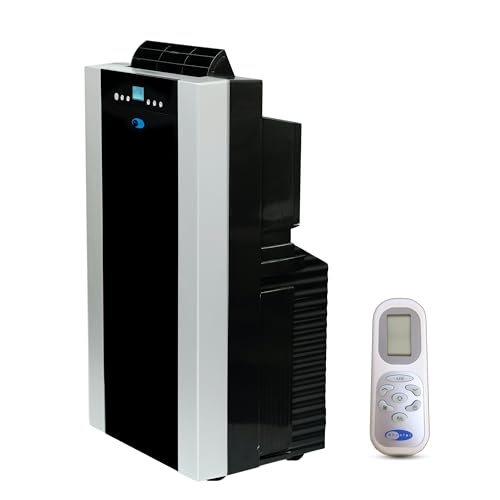
Whynter ARC-14S — premium dual-hose flagship
The Whynter ARC-14S is the reference point for buyers who want a portable unit that behaves as much like a real air conditioner as the format allows. Its dual-hose layout draws intake air from outdoors and pushes exhaust air back out, so it does not constantly pull warm air into the room through every crack and doorway the way single-hose designs do. In practice that means steadier cooling in larger bedrooms and living rooms, and less of the frustrating pattern where the air near the unit feels cold while the far side of the room never catches up.
Best for: larger bedrooms and living rooms where a window unit is banned or impossible, and for buyers who will run the machine daily all summer. Not suited for: anyone who needs near-silent sleep cooling, or a room with no workable window for the two-hose kit.
Positioning: this model is sold as a check-price-on-Amazon listing, and because prices move constantly we position it by tier rather than by a number — premium dual-hose flagship. Judge it against the room-matching and venting guidance in this article before judging it against other models.

BLACK+DECKER BPACT14 — popular mid-range single-hose workhorse
The BLACK+DECKER BPACT14 is one of the most commonly bought portables in its class, and its formula is simple: a full-size single-hose machine, familiar controls, a remote, and a window kit in the box, positioned in the middle of the market rather than at the premium end. It cools a typical bedroom honestly when it is sized and vented properly, and it dehumidifies as it runs, which matters in sticky climates. Like every single-hose unit it trades some efficiency for simplicity and price, and it asks for the usual discipline about sealing the window kit and managing condensate.
Best for: renters and first-time buyers cooling one ordinary bedroom on a sensible budget. Not suited for: large living rooms, or anyone expecting window-unit efficiency at a portable price.
Positioning: this model is sold as a check-price-on-Amazon listing, and because prices move constantly we position it by tier rather than by a number — popular mid-range single-hose workhorse. Judge it against the room-matching and venting guidance in this article before judging it against other models.
Setup and Care That Reduce the Cons
The window kit is where portable air conditioner performance is quietly won or lost. The kit’s job is to hold the exhaust hose in the window opening while sealing the rest of that opening against the outdoors. Every gap around the panels is a leak that lets hot outside air pour back into the room you are paying to cool, and on a windy day those leaks can undo a noticeable share of the machine’s work. Take the extra minutes during installation: fit the panels snugly, use the foam sealing strips supplied in the kit, and add weatherstripping or tape where panels meet the frame imperfectly. Keep the hose as short and straight as its length allows, because every tight bend strangles airflow and makes the machine work harder. A careful twenty-minute installation pays you back every single hour the unit runs, all summer long.
A careful first installation sets up the whole season. Choose the window first: it should be close enough to a suitable outlet that the unit can plug straight in, and positioned so the hose run is short. Fit the window kit panels, seal their edges, and connect the hose with gentle curves rather than kinks. Set the unit on a level floor with clear space around its air intakes — a machine pushed tight against a wall or buried behind curtains cannot breathe. Before you call the job done, run the unit for a full cooling cycle, check that the exhaust outside is genuinely hot, confirm no warm air is leaking back around the kit, and find the condensate drain so you know it before you need it. Finally, read the manual’s section on the filter: a washable filter that gets rinsed on schedule is the cheapest performance insurance a portable can have.
Portables ask for modest but real maintenance. The air filter collects dust steadily and should be rinsed or vacuumed on the rhythm the manual sets out — a clogged filter strangles airflow, cuts cooling, and makes the compressor work harder for less. The condensate system needs the checks described earlier, more often in humid spells. The exhaust hose and window kit deserve a look each time you reinstall: cracked panels and loose seals are efficiency leaks. At the end of the season, run the unit in fan or dry mode to dry its insides, drain it fully, clean the filter, and store it upright in a dry place with the hose detached and the cord loosely coiled. Owners who do these small things get a machine that starts the next summer at full strength; owners who skip them usually meet mould smells, weak airflow, and a unit that seems to have aged five years in one winter.
How you run a portable matters almost as much as which one you buy. Start cooling before the room is unbearable: a machine switched on in a room that is already heat-soaked faces hours of catch-up, while one started earlier holds the line with far less strain. Close the door of the room being cooled and treat the portable as a one-room appliance, because that is what it is. Use the thermostat rather than running the unit flat out and then switching it off, since steady moderation beats heroic blasts followed by warm rebounds. In humid weather, a dry or dehumidify mode can make a room feel dramatically better even before the temperature falls far, because clammy air feels hotter than dry air at the same reading. Small habits — curtains closed on the sunny side, the filter clean, the kit sealed — compound into the difference between a portable that earns its floor space and one that gets sold in September.
Bottom Line
The pros of a portable air conditioner are about freedom; the cons are about physics. If freedom is what your housing situation demands, the physics can be managed — with the right hose layout, an honest capacity match, a sealed kit and a noise plan — down to a level most owners happily accept. If freedom is not your constraint, the physics is a price you do not need to pay. That single distinction resolves nearly every argument about this category, including, probably, the one you are having about your own room right now.
The second-hand market for portables is large, and it deserves a caution. A used unit with a cracked hose, a missing window kit panel or a filter that has never been cleaned can look like a bargain and perform like a space heater with a fan. If you buy used, insist on seeing the machine run through a full cooling cycle, check that the exhaust air outside the hose is hot, confirm every kit panel is present, and clean the filter and tank before the first night in your home. Missing kit pieces are the most common hidden cost, and replacements are not always easy to match.
Pets and children change the placement maths a little. The exhaust hose gets warm, the unit is heavy enough that it should never be climbed on, and a curious toddler can find the intake grille fascinating. Set the machine where it cannot be tipped, keep the cord path tidy and out of walkways, and remember that a pet who sleeps in the cooled room will vote for the portable with their whole heart on hot nights. None of this is a reason to avoid the category; it is a reason to spend two minutes on placement rather than none.
Finally, keep expectations in their proper frame and the category will treat you well. A portable air conditioner is a compromise appliance: it trades some efficiency and some quiet for freedom from installation, permission and permanence. Judged as a window unit it will always look flawed. Judged as the only real cooling many homes are allowed to have — the machine that makes a rental bedroom sleepable through a heatwave, with no contractor, no bracket and no deposit at risk — it is one of the most useful appliances a household can own. Buy it for what it is, install it with care, and it will do its job.
Consider the shoulder seasons, when a portable earns quiet extra credit. Spring and autumn bring the odd hot week that does not justify opening up a whole fixed system, and rooms that overheat from sun or cooking even when the house overall is comfortable. A portable rolled out for those spells, then stored again, solves a problem that fixed cooling handles clumsily. Owners who think of the machine as a year-round tool with a summer peak, rather than a three-month appliance, consistently rate its value higher — the purchase spreads itself across more days of genuine usefulness.
Sound behaves differently in a furnished room than in the empty rooms of product videos, and this cuts in the portable’s favour. Soft furnishings, curtains, bedding and carpet absorb a share of the machine’s voice, and the steady character of the sound — closer to a large fan than to a rattling appliance, once the compressor has settled — is the kind the ear learns to file as background. None of this rescues a genuinely light sleeper sharing a small room with a hard-working unit, but many owners who braced for the worst report being pleasantly surprised by the third night.
There is a planning habit that separates satisfied owners from frustrated ones: they decide the machine’s home before it arrives. They know which window, which outlet, where the hose will run, where the condensate will drain, and where the unit will live in winter. The buyers who improvise on delivery day discover the awkward outlet, the too-narrow window and the blocked doorway all at once, and blame the category for their logistics. Two measurements and five minutes of thought, taken before ordering, are the cheapest upgrade in this entire article.
Energy behaviour deserves one more honest paragraph. A portable converts electricity into cooling less efficiently than fixed alternatives, and within the category the spread is real: dual-hose and inverter designs waste less of your money on physics. But behaviour still dominates equipment. A well-matched portable cooling one closed room for the hours it is occupied will use less energy in a week than a whole-home system conditioning empty rooms around the clock. Judge energy at the level of the household’s actual pattern, not only the machine’s rating plate, and the portable’s ledger often looks better than its reputation.
Temperature is only half of comfort, and the other half — humidity, air movement, radiant heat from sunlit walls — explains many confusing experiences with this category. A room can read cool on the thermostat and still feel oppressive if the air is saturated, or feel pleasant a degree warmer once the air is dry and moving. This is why the dehumidifying effect of a real compressor machine feels disproportionately good, why curtains that stop sunlight heating the wall change the evening, and why owners who manage the whole comfort picture get more from the same machine than owners who chase the thermostat number alone.
If two people in the household disagree about the purchase, the disagreement is usually about different rooms in their heads. One imagines the bedroom at midnight; the other imagines the living room at four in the afternoon. Both are right about their own picture. Settle it by naming the actual room, the actual hours and the actual sleeper, and most portable decisions resolve themselves — including the decision that the honest answer for that living room is a different kind of cooling altogether, with the portable assigned to the bedroom where it will be loved.
Storage is the unglamorous final chapter of every season, and it decides how the next season begins. A machine put away wet grows smells; a machine put away with a clogged filter starts the summer already behind; a window kit tossed loose into a garage loses the panel you will need in the first heatwave. The half hour of end-of-season care described in this article — dry it, drain it, clean it, coil it, keep the kit together — is the difference between a portable that serves for years and one that becomes a cautionary tale at a yard sale.
A word about buying timing, offered qualitatively because prices are for the listing page to tell you. Demand for portables spikes exactly when the heat arrives, and the models everyone wants sell through first. The buyer who shops in the mild weeks, measures calmly, and has the kit fitted before the first hot night pays less in every currency that matters — money, choice and misery. Heatwave purchases can still be right; emergencies are this category’s home turf. But when the calendar gives you the chance to prepare, preparation is the bargain.
Guests change the cooling equation in ways worth planning for. A spare room that is tolerable for storage all year becomes a bedroom during the exact weeks when family visits and heat peaks coincide. A portable is the only form of real cooling that can be assigned to a room for a fortnight and then recalled, which is why so many households report that the machine bought for one emergency became the household’s flexible reserve. If your home hosts people in summer, that flexibility belongs in the value column alongside everything else.
Last, a note on reading any review of this category, including this one. Judge every claim against the room it was made in. A verdict earned in a small shaded bedroom does not transfer to a loft; a complaint filed from an open-plan living room does not convict a machine in a closed study. The portable category is unusually honest in this way: its physics is fixed, its trade-offs are known, and the variable is always the fit between machine, room and owner. Get the fit right and the reviews you write afterwards tend to be kind.
One more practical consideration is placement within the room. The unit should sit on a level floor, close enough to the window that the hose stays relaxed, with its intake grilles unobstructed by furniture, curtains or laundry baskets. Airflow into the machine is as important as airflow out of it, and a portable wedged into a corner behind a sofa will underperform its rating no matter how impressive the packaging looked. Give it breathing room, keep the path from vent to where people sit reasonably open, and remember that cool air pools low and spreads slowly — a small fan across the room can help distribute what the portable produces.
Renters deserve a specific word, because portables exist largely for them. A window kit that slides into the frame and removes without screws or permanent alteration is usually acceptable where a window unit is banned, but check your lease language about window obstructions and anything visible from outside. Photograph the window before installation and keep the original screens and stops somewhere safe. When you move out, the kit comes away in minutes and the window returns to exactly its previous state, which is precisely why this category survives in buildings that forbid almost every other form of real cooling.
Humidity deserves its own moment in any honest discussion of cooling. A portable air conditioner dehumidifies as a side effect of cooling, because moisture condenses on its cold coils, and in a sticky climate that drying can change how a room feels as much as the temperature drop itself. Skin feels cooler when sweat evaporates, and dry air lets it evaporate. This is also why a room can feel comfortable at a modest temperature once the clamminess is gone, and why running a dry mode on a muggy but not scorching evening sometimes beats blasting full cooling. It is also, of course, why the condensate guidance elsewhere in this article matters.
Think about the hours you actually need cooling, because they shape the right choice more than the worst afternoon of the year does. Many households need a bedroom cooled from evening to morning and a home office cooled through work hours, and almost nothing else. A portable aimed at those two windows of life, moved rarely and run steadily, lives an easy and effective life. A household that expects one machine to chase the family from room to room all day will fight the hose, the weight and the warm-up time constantly, and should think harder about fixed cooling or a second unit rather than a bigger portable.
The second-hand market for portables is large, and it deserves a caution. A used unit with a cracked hose, a missing window kit panel or a filter that has never been cleaned can look like a bargain and perform like a space heater with a fan. If you buy used, insist on seeing the machine run through a full cooling cycle, check that the exhaust air outside the hose is hot, confirm every kit panel is present, and clean the filter and tank before the first night in your home. Missing kit pieces are the most common hidden cost, and replacements are not always easy to match.
Pets and children change the placement maths a little. The exhaust hose gets warm, the unit is heavy enough that it should never be climbed on, and a curious toddler can find the intake grille fascinating. Set the machine where it cannot be tipped, keep the cord path tidy and out of walkways, and remember that a pet who sleeps in the cooled room will vote for the portable with their whole heart on hot nights. None of this is a reason to avoid the category; it is a reason to spend two minutes on placement rather than none.
Finally, keep expectations in their proper frame and the category will treat you well. A portable air conditioner is a compromise appliance: it trades some efficiency and some quiet for freedom from installation, permission and permanence. Judged as a window unit it will always look flawed. Judged as the only real cooling many homes are allowed to have — the machine that makes a rental bedroom sleepable through a heatwave, with no contractor, no bracket and no deposit at risk — it is one of the most useful appliances a household can own. Buy it for what it is, install it with care, and it will do its job.
Consider the shoulder seasons, when a portable earns quiet extra credit. Spring and autumn bring the odd hot week that does not justify opening up a whole fixed system, and rooms that overheat from sun or cooking even when the house overall is comfortable. A portable rolled out for those spells, then stored again, solves a problem that fixed cooling handles clumsily. Owners who think of the machine as a year-round tool with a summer peak, rather than a three-month appliance, consistently rate its value higher — the purchase spreads itself across more days of genuine usefulness.
Sound behaves differently in a furnished room than in the empty rooms of product videos, and this cuts in the portable’s favour. Soft furnishings, curtains, bedding and carpet absorb a share of the machine’s voice, and the steady character of the sound — closer to a large fan than to a rattling appliance, once the compressor has settled — is the kind the ear learns to file as background. None of this rescues a genuinely light sleeper sharing a small room with a hard-working unit, but many owners who braced for the worst report being pleasantly surprised by the third night.
There is a planning habit that separates satisfied owners from frustrated ones: they decide the machine’s home before it arrives. They know which window, which outlet, where the hose will run, where the condensate will drain, and where the unit will live in winter. The buyers who improvise on delivery day discover the awkward outlet, the too-narrow window and the blocked doorway all at once, and blame the category for their logistics. Two measurements and five minutes of thought, taken before ordering, are the cheapest upgrade in this entire article.
Living With the Trade-Offs: How the Portable air conditioner Balance Plays Out Over a Season
A pros and cons list is a snapshot, but a portable air conditioner is a long-term housemate. Advantages that look decisive on paper can shrink once the seasons turn, and drawbacks that seem minor in a showroom can grow teeth in February or during a busy holiday week. The fairest way to weigh a portable air conditioner is to follow one full season of ordinary use and ask how each side of the ledger behaves when the weather, the light and the household routine all change. This section does exactly that, so the balance you act on reflects lived experience rather than first impressions.
When the Advantages Grow — and When They Fade
The strengths of a good portable air conditioner tend to compound quietly. A design that saves steps, stores more, or cleans easily gives that benefit back every single day, and over a season those small repayments add up to the real value of the purchase. By contrast, advantages based on novelty — an unusual finish, a fashionable shape, a feature you showed to guests twice — fade within weeks. When you re-read any pros list, sort each point into one of those two families: daily-compounding benefits deserve heavy weight, while novelty benefits deserve almost none, however attractive they looked at the point of ordering.
When the Drawbacks Bite Hardest
Weaknesses in a portable air conditioner rarely bite at random; they bite at predictable pressure points. Guests arriving, a seasonal deep clean, a heatwave, a power cut, a house move, or a child or pet entering a new stage will each stress a different limitation. Think through those moments for the portable air conditioner you are considering and ask whether the drawback is an occasional annoyance you can plan around or a recurring friction you will meet every week. An occasional annoyance is a fair price for a strong advantage elsewhere; a weekly friction almost never is, and it is the single most common reason owners replace a portable air conditioner long before it wears out.
Use these seasonal pressure tests to judge the trade-offs in any portable air conditioner:
- Picture the portable air conditioner during your busiest week of the year and decide whether its main drawback would matter more, less, or about the same.
- Picture it during the opposite season from now — high summer if it is winter, the dark months if it is spring — and re-check light, heat, moisture and ventilation around it.
- Ask who else in the household touches the portable air conditioner most, and weigh the cons from their height, strength and habits rather than your own.
- Separate the drawbacks you can fix with an accessory or a habit change from the ones built into the design itself.
- Give the portable air conditioner a simple verdict for each season rather than one verdict for the year, and only buy when it passes the seasons you care about most.
Leave a little capacity unused — in size, storage or power — because a portable air conditioner run permanently at its limit ages faster and annoys sooner than one with headroom. Notice which parts are replaceable and which are not; a portable air conditioner whose wear parts can be swapped cheaply often outlasts a sealed design twice its price in spirit, if not in years. Consider the portable air conditioner from the perspective of the person who cleans around it, because designs that trap dust, block access or demand special products quietly tax every week of ownership. Think about noise, light and heat as neighbours of the portable air conditioner, not afterthoughts, since a choice that performs well but disturbs the room around it rarely stays popular for long. Remember that guests experience your portable air conditioner without instructions, so anything that needs explaining, warning or demonstrating is worth simplifying before it is worth defending.
Judged across a season, most portable air conditioner choices become clearer, not harder. The right model is rarely the one with the longest pros list; it is the one whose drawbacks land in the moments you can tolerate and whose strengths land in the moments you repeat every day. Hold any candidate up against your own calendar before you commit, and the pros and cons stop being abstract and start being a forecast you can trust.
Frequently Asked Questions
Is a dual-hose portable air conditioner really better than a single-hose model?
In larger rooms and hotter weather, yes, and the reason is physics rather than marketing. A single-hose unit exhausts air it took from the room, which creates negative pressure that pulls warm air in from the rest of the home. A dual-hose unit draws its intake air from outdoors, so the cooled air in your room stays in your room. In a small, mild-climate bedroom a good single-hose model can still do an honest job, but dual-hose designs hold their cooling better as rooms and heat loads grow.
Does a portable air conditioner have to be vented out of a window?
Yes. Venting is mandatory, not an optional accessory step. The exhaust hose carries the heat removed from your room — plus the compressor’s own heat — to the outdoors. Without that path outside, the unit returns more heat to the room than it removes from the air stream, so the room warms up overall even though the air directly in front of the machine feels cool. Use the supplied window kit, a sliding-door kit, or another proper vent fitting, and seal around it so the heat you just expelled cannot leak straight back in.
How loud is a portable air conditioner, honestly?
Honestly: noticeable. The compressor lives inside the room with you, so a portable will always be louder in the space than a window unit whose machinery sits partly outside, and far louder than a central system. Fan-only and low settings are gentler, and inverter models avoid repeated compressor start-up surges, but no portable is silent. Light sleepers do best by pre-cooling the room before bed, running the unit on a lower overnight setting, and placing it as far from the bed as the hose reasonably allows.
What is the difference between SACC and the BTU number on the box?
The large BTU figure traditionally printed on portable air conditioner packaging comes from a test that did not fully count the heat the machine adds back into the room or the warm air a single hose draws in. SACC — seasonally adjusted cooling capacity — applies corrections for those real-world losses, so it comes out lower and describes what the unit can actually sustain in a real room. Compare models by SACC, and use it when matching a unit to your room’s size and heat load.
Can I run a portable air conditioner on an extension cord?
No. Portable air conditioners draw heavy current continuously for hours, and an extension cord under that sustained load can overheat and become a fire risk. Power strips and outlet multipliers are not a safe substitute either. Plug the unit directly into a wall outlet on a circuit that is not already loaded with other heavy appliances. If the outlet near your window is too far from where the unit must sit, rearrange the room or have an outlet added — never solve the problem with a cord.
Related Guides
Keep reading with these companion guides from the same cooling series and the wider home-comfort library: