Disclosure: As an Amazon Associate, dailyhomedecorating.com earns from qualifying purchases. Links on this page are affiliate links; they cost you nothing extra. Prices and availability change often, so check the current Amazon listing before you buy.
A living room rug buying guide should save you from the two expensive errors in this category — a rug that is too small and a fibre that cannot survive your household — and this one is organised to do exactly that. It walks through the types on the market, puts the leading lines side by side early, turns each specification into a plain question, and finishes with the setup and care habits that decide whether the rug still looks good in its third year. Everything here is tier-based and prose-first, so the reasoning stays useful whatever the current listings say.
Key Takeaways
- Size and fibre outrank pattern: decide those two first and the shortlist builds itself.
- Front legs of the seating on the rug is the layout rule that makes typical rooms work.
- Synthetics for forgiveness, wool for resilience and feel, flatweaves for texture and easy care.
- Every pick below needs a rug pad: grip, cushion, flat edges and floor protection.
- Judge the rug in your own light, on a taped outline, before committing to the full size.
Living Room Rug Buying Guide: What a Living Room Rug Does and the Main Types
Woven and Tufted Pile Rugs
Density matters as much as height. A dense low pile can outlast and out-feel a lofty, sparse one, because tightly packed fibres support each other and resist crushing. When you compare rugs in a store or in photos, look at how the surface behaves at the edge and in the pattern’s detail: crisp pattern definition usually signals a denser, flatter construction, while a soft-focus look suggests loft that will mat in the walkway between sofa and door.
Wool is the benchmark living room fibre for good reason. It is naturally resilient, so pile springs back after furniture is moved; it resists soiling better than most fibres because its surface scales shed dry dirt; and it feels warm and substantial underfoot in a way synthetics approximate but rarely match. The trade-offs are real: wool sits in the premium tier, it can shed loose fibres in its first months, and it dislikes harsh alkaline cleaners and aggressive scrubbing, so care needs a gentler hand.
Flatweave Rugs
Natural plant fibres such as jute, sisal, seagrass and cotton bring texture that woven colour cannot imitate. They suit relaxed, layered rooms and feel cool and dry underfoot. Their limits matter in a living room: jute and sisal absorb spills into the fibre, making spot cleaning genuinely difficult; they can feel coarse for floor-sitting households; and they dislike sustained damp. Cotton flatweaves are the friendliest of the group — lighter, softer, and in smaller sizes often washable — but they shift on hard floors and absolutely need a gripping pad beneath them.
Printed Low-Profile Rugs
Printed rugs carry their pattern on the surface of a low, smooth base, which is how they reproduce antique and vintage designs so convincingly at accessible tiers. The surface stays level under furniture, vacuums in both directions without fighting the head, and shows pattern crisply. What printing cannot reproduce is the depth and light-play of a real woven pile, so printed lines compete on design, practicality and price positioning rather than on heirloom feel — a trade many households, especially renters, are delighted to make.
Washable Rug Systems
Washable systems split the rug into a decorative top and a gripping base, so the part that receives the spill can be machine washed at home. For living rooms with toddlers, pets or enthusiastic hosting, that changes ownership from stain management to laundry. The compromises are a deliberately low profile — plushness is not the point — and the small ritual of re-laying the top squarely after each wash. Households without regular accidents may never use the feature they paid a mid-tier premium for.
In this guide
Top Picks at a Glance
| Pick | Badge | Tier | Best For |
|---|---|---|---|
| SAFAVIEH Adirondack Collection Area Rug | Best Overall | Entry to mid | Patterned anchor for busy family rooms |
| Ruggable Kamran Washable Rug | Best Washable | Mid | Spill-prone homes with kids or pets |
| nuLOOM Wynn Vintage Area Rug | Best Camouflage | Entry to mid | Hiding everyday life between vacuums |
| Loloi II Layla Area Rug | Best Soft Printed | Entry to mid | Vintage style on a smooth, level surface |
| SAFAVIEH Montauk Area Rug | Best Flatweave | Entry to mid | Relaxed natural texture, easy shake-out care |
| Loloi II Skye Area Rug | Best Statement | Entry to mid | Deep, moody pattern that carries a scheme |
Related reading on this site fills in the neighbouring decisions: how to choose a living room rug; how to clean living room rug; is a living room rug worth it; living room rug pros and cons. Each of those guides takes one part of the rug decision — size, fibre, pattern or care — and goes deeper than a single overview can.
How Big Does Your Living Room Rug Need to Be?
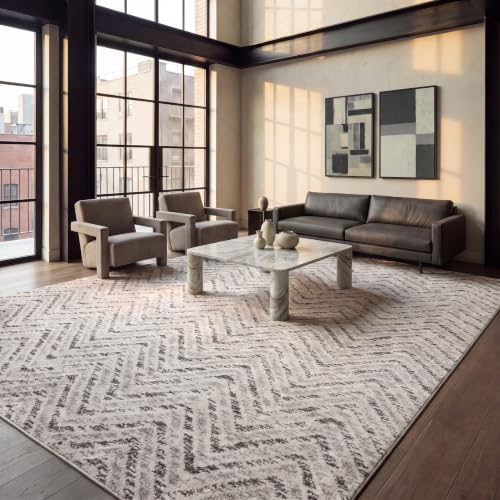
Size is the decision everything else hangs on, and the most common living room mistake is buying too small. A rug should unite the seating group, which in practice means the front legs of the sofa and armchairs sit on the rug, or — in a generous room — the whole furniture group sits on it with a border of floor showing around the edges. When only the coffee table touches the rug, the room reads as a collection of separate islands, and no pattern or material upgrade will fix that visual disconnect.
Measure before you shop, and measure the furniture arrangement rather than the room’s full footprint. Lay painter’s tape on the floor at the size you are considering and live with the outline for a day: walk the traffic paths, open every door, and check that the rug’s edge does not land exactly where feet pivot at the sofa’s side. Standard living room sizes exist because they match common sofa lengths, so a tape outline that lands between two standard sizes is a signal to size up, not down.
Leave a consistent border of bare floor between the rug and the walls — a hand’s width at minimum in a small room, more in a large one. A rug that nearly touches the skirting looks like wall-to-wall carpet that shrank, while a floating rug with an even frame of floor reads as a deliberate design choice. In open-plan spaces, the rug’s job is zoning: it should cover the conversation area fully and stop short of dining or workspace zones, so each area keeps its own boundary.
Which Fibre Fits the Way Your Household Lives?
Synthetic fibres — polypropylene, polyester and nylon families — dominate living room rugs because they solve the practical problems. They resist stains, tolerate family life, hold colour well in sunny rooms, and arrive at entry and mid tiers that wool cannot reach. Polypropylene is the stain-resisting workhorse for busy households; polyester brings softness and rich colour; nylon is the durable premium of the synthetics. Their weakness is pile recovery: heavy furniture dents recover slowly, and a flattened traffic lane in a cheap synthetic rarely bounces back.
Natural plant fibres such as jute, sisal, seagrass and cotton bring texture that woven colour cannot imitate. They suit relaxed, layered rooms and feel cool and dry underfoot. Their limits matter in a living room: jute and sisal absorb spills into the fibre, making spot cleaning genuinely difficult; they can feel coarse for floor-sitting households; and they dislike sustained damp. Cotton flatweaves are the friendliest of the group — lighter, softer, and in smaller sizes often washable — but they shift on hard floors and absolutely need a gripping pad beneath them.
Blends try to split the difference, pairing wool with a synthetic for durability, or cotton with polyester for softness plus stain resistance. A blend is only as good as its weakest behaviour, though: a wool blend still wants gentle cleaning, and a cotton blend still moves without a pad. Read the fibre content as a care instruction in disguise — it tells you how the rug will respond to a spilled drink, a muddy dog and a year of afternoon sun long before any marketing line does.
How Much Pile Do You Actually Want Underfoot?
Pile height quietly decides how a living room rug feels, cleans and ages. Low-pile and flatweave rugs let doors swing clear, chairs glide, and vacuum heads work efficiently; they show less traffic patterning and suit homes where the floor is a play surface. Medium pile adds the barefoot comfort most people picture, at the cost of trapping more grit at the base of the fibres. High, plush pile feels luxurious for the first month and then shows every footpath unless the household commits to serious, regular vacuuming.
Match pile to the room’s real traffic, not its photographed best. The route from hallway to sofa to kitchen is a motorway; the corner by the reading chair is a country lane. One rug has to serve both, which is why medium-density, low-to-medium pile is the living room default for most households — enough softness for floor time, flat enough for the vacuum and the coffee table, and resilient enough that the motorway does not wear a visible trench through the pattern by spring.
How Hard Should the Pattern Work?
Pattern is a practical tool disguised as a style choice. A mid-scale, all-over pattern with several colours woven or printed through it will hide crumbs, pet hair, lint and the faint grey of settled dust far longer than any solid. Vintage-look and distressed designs are popular in living rooms precisely because their built-in fading makes new wear invisible — a scuff or a slightly darker traffic path simply joins the design. Solids and very pale rugs show everything and demand a household that vacuums little and often.
Colour should be borrowed from the room, not matched to it exactly. Pull one tone from cushions or artwork for the rug’s main field and let its secondary colours stay quieter; a rug that perfectly matches the sofa disappears, while one that clashes with everything forces the room to be redecorated around it. Check the rug’s colours in your own light if you can — north-facing rooms cool every colour down, and warm evening lamplight will enrich reds and ambers while greying blues.
Scale the pattern to the room and the furniture. Large motifs need floor area to repeat without being chopped awkwardly by the sofa; small, dense patterns suit compact rooms and busy households. Borders deserve attention too: a bordered design frames a seating group beautifully when the whole border is visible, but if the sofa will cover three sides of it, an all-over pattern will look more intentional. When in doubt, choose the design whose pattern still makes sense with the middle hidden under a coffee table.
How to Prioritise by Use Case
Busy Family Room
Prioritise in this order: stain-resilient fibre, camouflage pattern, dense low-to-medium pile, gripping pad. Decorative subtlety comes last, because this room’s rug is equipment. The Adirondack and Wynn lines were built for exactly this ranking, and the washable Kamran joins them whenever spills are a weekly rather than monthly event.
Calm, Adult, Design-Led Room
Prioritise feel and design first: wool or a rich printed design, a palette borrowed from the art, and pile chosen for barefoot pleasure. With light traffic, the Montauk flatweave’s texture or the Skye’s deep pattern can lead, and the pad’s job shifts from armour to cushion. Care stays gentle because life in this room is gentle.
Rental or First Home
Prioritise versatility and reversibility: a size that will fit the next home too, a pattern that flatters many wall colours, a weight two people can roll and carry, and a pad that protects a landlord’s floor. Printed lines like Layla shine here — maximum finished-room effect, minimum commitment, nothing that cannot be lifted out cleanly when the lease ends.
The Picks in Detail
Each line below is described in prose — construction, character, tier positioning and the household it suits — with a plain verdict. No links or figures are attached while verification is pending, so use the reasoning, then check the current listing for the details that change.
nuLOOM Wynn Vintage Area Rug — Best For Vintage-Look Workhorse
The nuLOOM Wynn Vintage line is built around a deliberately faded, vintage-look pattern that hides everyday life unusually well. Crumbs, pet hair and the pale dust that settles on any busy floor blend into the mottled design instead of announcing themselves, which makes this line a forgiving choice for family rooms that never really stop moving. The surface is a low, dense synthetic weave that chair legs and coffee table feet glide over rather than catch on, and vacuum heads pass across it without bogging down.
Treat the Wynn as an entry-to-mid tier line in positioning: it aims at households that want a traditional look with modern, low-effort upkeep. It suits renters who need to soften hard floors without committing to a heirloom piece, and anyone whose seating gets rearranged often, because the rug is light enough to reposition without a struggle. It is not the line for shoppers chasing the deep, springy feel of a thick wool pile underfoot; its comfort comes from pairing it with a good pad, not from pile height.
Best for: households that want this line’s particular balance of pattern, care and comfort. Not suited for: rooms whose traffic or taste it was never designed to serve.

SAFAVIEH Adirondack Collection Area Rug — Best For Patterned All-Rounder
The SAFAVIEH Adirondack Collection is one of the most widely chosen patterned rug lines for living rooms because its designs borrow from classic Persian and transitional motifs, then soften them with a slightly distressed finish. That combination reads as intentional decor rather than a busy print, and it anchors a sofa grouping without fighting cushions, throws or artwork for attention. The synthetic fibres resist staining and are straightforward to vacuum, which is why the line keeps appearing in homes with children and dogs.
Position this collection in the entry-to-mid tier: dependable construction, broad size availability through the line, and patterns that forgive the scuffs of daily traffic. It suits open-plan rooms where the rug has to define the seating zone visually, and households that want pattern to do the camouflage work between deeper cleans. It is less suited to minimal, solid-colour schemes, where a tonal or flatweave design would sit quieter, and purists who want natural fibres only should look at the wool and flatweave lines in this cluster instead.
Best for: households that want this line’s particular balance of pattern, care and comfort. Not suited for: rooms whose traffic or taste it was never designed to serve.
Ruggable Kamran Washable Rug — Best For Washable Two-Piece System
The Ruggable Kamran line takes a different approach from every other pick here: it is a two-piece washable system, with a decorative top layer that detaches from a gripping underlayer so the top can go through a home washing machine. The Kamran pattern is a vintage-inspired medallion design that looks like a conventional woven rug once laid, which is the point — washability without the thin, mat-like appearance washable rugs used to have. For spill-prone rooms, that removability changes the whole care equation.
This is a mid-tier line in positioning, and the premium over a basic synthetic rug buys the system rather than thicker pile. It suits households with toddlers, pets that track in mud, or anyone who hosts often and dreads the red-sauce incident. Because the top layer is intentionally low-profile, doors clear it easily and chairs slide freely, but barefoot luxury seekers should pair it with realistic expectations: comfort is neat and practical rather than plush. Always let the top layer dry fully and lay it back over a rug pad arrangement that keeps edges flat and secure.
Best for: households that want this line’s particular balance of pattern, care and comfort. Not suited for: rooms whose traffic or taste it was never designed to serve.
Loloi II Layla Area Rug — Best For Printed Vintage Softness
The Loloi II Layla line is known for printed vintage patterns on a soft, low surface that feels gentler underfoot than most printed rugs. The designs reproduce the faded, collected-over-time look of antique textiles, with colour variation that makes a new rug feel settled into the room from the first day. Because the pattern is printed rather than woven in relief, the surface stays smooth, furniture sits level on it, and the vacuum passes cleanly in both directions.
Place the Layla in the entry-to-mid tier: it is a style-led line for rooms where the rug is the main pattern event. It suits renters, first-apartment furnishing, and anyone refreshing a room around existing neutral furniture, because the palette flatters beige, grey and warm wood tones alike. It is not the pick for a formal room that needs the depth and sheen of real wool, and heavy coffee tables should be lifted, never dragged, when you reposition them on its smooth surface. A rug pad underneath adds the cushion the low profile leaves out.
Best for: households that want this line’s particular balance of pattern, care and comfort. Not suited for: rooms whose traffic or taste it was never designed to serve.

SAFAVIEH Montauk Area Rug — Best For Flatweave Natural Texture
The SAFAVIEH Montauk line is a flatweave family built around cotton-rich, hand-woven texture and easy stripes, checks and simple geometrics. With almost no pile, it reads as relaxed and coastal or farmhouse in spirit, and it slides into layered looks beautifully — under a coffee table it stays out of the way, and chairs move across it without resistance. Flatweaves are also the easiest rugs to shake out and air, which keeps routine care light.
Position Montauk in the entry tier to mid tier depending on size, and judge it as a texture piece rather than a cushion. It suits low-traffic, adult living rooms, sunrooms and anyone who prefers natural-fibre character over stain armour. Because flatweaves can shift on hard floors, a rug pad is not optional here: it stops the rug creeping, keeps corners from curling into a trip hazard, and protects the floor beneath. Households with clawed pets may find a denser weave more forgiving of snags.
Best for: households that want this line’s particular balance of pattern, care and comfort. Not suited for: rooms whose traffic or taste it was never designed to serve.
Loloi II Skye Area Rug — Best For Moody Printed Statement
The Loloi II Skye line shares the printed construction approach of its Layla sibling but leans moodier: deeper, antique-inspired palettes with strong medallion and border work that can carry a whole room’s colour scheme. On the floor it behaves like a smooth, low printed rug — level under furniture, easy under a vacuum, and visually rich enough that plain sofas and simple curtains suddenly look deliberate. It is a decorator’s shortcut for rooms that feel unfinished.
Treat Skye as an entry-to-mid tier, style-first line. It suits living rooms that need one confident pattern, media rooms where deeper tones hide the evidence of snack nights, and renters who want impact without painting walls. It is less suited to bright, airy schemes built on pale solids, and like every low-profile rug it relies on a rug pad for underfoot softness and for keeping edges pinned flat and safe. Lift furniture with help when arranging it; dragging a loaded bookcase across any printed surface risks scuffing the design.
Best for: households that want this line’s particular balance of pattern, care and comfort. Not suited for: rooms whose traffic or taste it was never designed to serve.
Before you finalise anything, the companion pieces are worth a pass: best traditional area rugs; best non shedding area rugs; best kilim rugs; best turkish rugs. Together they cover the same living room from the choosing, cleaning and value angles, so the advice stays consistent instead of contradicting itself between pages.
First Setup and Care Essentials
A rug pad is not an accessory; it is half the product. The pad stops the rug sliding on hard floors, which is a safety issue before it is a convenience one — a rug that surges forward when a child lands on it or an older relative steps off the sofa is an accident being scheduled. Felt-and-rubber pads add cushion and grip together; thin rubberised mesh pads grip without height where door clearance is tight. Either way, the pad should be trimmed slightly smaller than the rug so its edge never peeks out.
Moving day discipline protects both the rug and the people. Roll the rug rather than folding it for any move longer than a few minutes, pile side out, and carry it with help if it is large — a big rug is heavier and more awkward than it looks, and dragging one end across the floor twists the weave. Furniture follows the same rule: lift pieces with a second person and set them down, rather than dragging legs across the surface, because a dragged leg can tear loops, scuff printed designs and gouge a groove into pile that no amount of steaming fully erases.
Vacuuming is the single highest-value care habit, and frequency beats intensity. Dry grit that settles to the base of the pile acts like sandpaper every time a foot twists on it, cutting fibres from inside the rug. A weekly vacuum of the whole surface, with extra passes over the traffic lanes, removes that grit before it does damage. Use suction-focused settings on delicate or looped constructions, go slowly enough for the airflow to lift debris, and empty the machine before it loses pull — a clogged vacuum polishes dirt rather than removing it.
Mistakes to Avoid
Buying the rug before measuring the room is the original sin of this category, and it usually produces a rug one size too small that the owner then spends years apologising for. The second sin is choosing by screen colour alone: displays flatter and shift tones, and a rug that looked warm grey online can arrive unmistakably blue. Wherever possible, order the smallest returnable size or a swatch first, live with it in the room’s real light for a day, and only then commit to the full footprint.
Skipping the pad to save money is a false economy that costs comfort, safety and rug life simultaneously. Ignoring fibre content is its cousin: a beautiful natural-fibre rug in a house with two muddy dogs is a cleaning contract nobody signed on purpose. And placing a rug by eye instead of by furniture — off-centre to the sofa, edges stranded in walkways — creates the daily low-grade irritation of straightening it, until the day someone catches a lifted corner with a toe and the irritation stops being low-grade.
The Floor Years: Children Growing Up on the Rug
For a household with young children, the living room rug is not decor; it is the floor of childhood — the surface for first steps, blanket forts, homework sprawls and a thousand small crashes. That role argues for specification over sentiment: dense, low, forgiving fibres, a pattern that camouflages the archaeology of snacks, and a pad that keeps the whole landscape from sliding when a running child lands on it at full commitment.
Safety habits scale with the children. Keep edges flat and check them weekly, because small feet find lifted corners before adults notice them; route the rug so its border is not the finish line of a hallway sprint; and keep cleaning products stored away after spot treatments, with the treated patch dry before play resumes. As children grow, the same rug absorbs desk chairs, gaming marathons and teenage gatherings without any change of specification — which is the quiet genius of buying for traffic early.
When the floor years end, a well-chosen rug simply changes jobs, from play surface to the calm centre of an adult room. The lines that survive the transition are the ones whose pattern was never childish and whose fibres were never precious. Buy the rug for the decade, and let the children borrow it for the first half.
When To Replace a Living Room Rug
Rugs rarely die in a single event; they fade by accumulation. The honest replacement signals are a traffic lane that no longer lifts after cleaning and rotation, backing that cracks or sheds dust when the rug is lifted, edges that will not stay flat despite a fresh pad, and odours that survive a professional clean. Any one of these means the rug’s structure, not its surface, has finished — and no amount of vacuuming negotiates with structure.
Cosmetic tiredness is different and cheaper to answer. A rug that is structurally sound but visually dull may need only a deep clean, a rotation, a better pad and a rearrangement of the furniture over its freshest area. Many rugs are replaced years early for the crime of a flattened lane that a season of rotation would have shared around the room. Diagnose before you shop: surface problems get care, structure problems get replaced.
When replacement day comes, let the old rug teach the new one’s specification. Note where it wore, where it stained, where its edges misbehaved and what its fibres could not forgive, then buy against that evidence. The second rug in a home is almost always better chosen than the first, because the first one spent years writing its review on the floor.
Allergy-Aware Housekeeping for Rug Owners
A rug holds what hard floors circulate: dust, pollen and pet dander settle into pile instead of drifting at ankle height with every footstep. Whether that makes a rug a friend or an enemy to an allergy household depends entirely on extraction — what the vacuum actually removes. A well-maintained rug, vacuumed slowly and often with a machine in good order, functions as a filter that gets emptied; a neglected rug is a reservoir that gets walked on.
Households managing sensitivities should vacuum more often than the standard weekly rhythm, empty or change the machine’s bag or bin outdoors where possible, and schedule the deeper clean on the calendar rather than on inspiration. Washable systems earn special consideration here, because a full machine wash resets the textile in a way surface cleaning cannot. Keep the treated rug fully dry before it returns to service; damp pile undoes the benefit quickly.
None of this overrides medical guidance for a specific household member, and where a clinician advises against large textiles, that advice wins over every comfort argument in this guide. The point is narrower: for the many households managing ordinary dust sensitivity, the variable is not rug or no rug — it is maintained or unmaintained, and maintenance is a choice the owner controls.
Unrolling, Airing and the First Week
A new rug arrives rolled tight, and its first week sets habits that last for years. Unroll it in the room, pile side up, and let it relax for a day before judging the fit — ripples from rolling usually settle under their own weight, helped by the pad going down first and furniture weight arriving gradually rather than all at once. Reverse-rolling a stubborn section gently, or weighing a lifted corner with books for a night, persuades most backings without any force.
New rugs often carry a faint manufacturing smell, strongest in synthetic lines fresh from their packaging. Air is the whole remedy: ventilate the room well for the first days, vacuum the surface to lift loose fibres, and let time do the rest. The smell fades as the rug breathes, and it fades faster in a room that is lived in and aired than in one kept shut. If any odour stays strong and chemical after a week of ventilation, that is a question for the seller, not something to mask with scented products.
Expect some shedding from cut-pile rugs in the early weeks, wool most noticeably. Loose surface fibres are a normal settling behaviour, not a defect, and they decline steadily with regular vacuuming. What should not happen is bare patches, backing showing through, or shedding that stays heavy for months — those are quality signals worth acting on while returns are still simple.
Living With the Rug Under a Coffee Table
The coffee table zone is where a living room rug works hardest and is seen closest. Feet land there, mugs set down there, board games and laptops colonise it, and the rug beneath takes the abrasion of table legs shifting a few millimetres with every lean. A denser pile or a smooth low profile both cope well; a sparse, lofty pile shows the table’s footprint as four permanent dents and a polished traffic sheen around it.
Position the table so its legs sit fully on the rug or fully off it — a leg half on the edge rocks, spills drinks and chews the rug’s border. When you need to move a loaded table, lift it with help and set it down; dragging a heavy table across pile or a printed surface is the single fastest way to scar a rug that vacuuming cannot undo. Felt pads under table legs spread the load and make small adjustments gentler.
Under-table cleaning deserves a routine of its own, because crumbs migrate there and stay invisible from standing height. Slide a vacuum crevice tool under the table weekly, lift the table fully on rotation day, and check for the ring marks and mystery spots that only appear at floor level. The centre of the rug ages at the speed of its least-cleaned square metre, and that square metre is almost always under the table.
Open-Plan Rooms and Zoning With One Rug
In an open-plan space the rug is a boundary that does not block light or movement, which makes it the most civilised zoning tool available. Size it to the conversation group alone, leave clear floor as the corridor between zones, and let the dining or work area keep its own uncovered identity. The moment one rug tries to serve two zones, it serves neither — edges land in walkways, chairs straddle borders, and the room reads as carpeted confusion.
Align the rug to the sofa and the room’s architecture together: parallel to the main wall or fireplace line, centred on the seating rather than on the floor’s full rectangle. In a long room, a rug placed across the width can shorten the visual tunnel; in a square room, a centred island with an even floor border calms the geometry. Tape the outline and view it from the doorway you actually enter by, because that first sightline is the one the zoning has to convince.
Sound zoning follows visual zoning. The rug absorbs the living zone’s noise — television, conversation, play — while the kitchen and hall stay bright and hard, and that contrast is part of what makes the seating feel like a destination. A pad with real cushion deepens the effect. Households that entertain will notice guests gathering on the rug instinctively; a well-zoned floor quietly organises a party.
Rugs and Underfloor Heating, Radiators and Sunlight
Underfloor heating and rugs coexist happily when the combination stays breathable: a rug and pad that are not excessively thick, so heat passes into the room rather than building up beneath the floor covering. Very dense, rubber-backed stacks can insulate more than the system expects. If your heating manufacturer gives guidance on floor coverings, follow it, and keep the pad choice in the same conversation as the rug choice rather than an afterthought.
Radiators and heaters ask for distance rather than worry. A rug edge should not crowd a portable heater or rest against a hot radiator, both because sustained heat stiffens and ages backings and because floor coverings and heat sources are poor neighbours on principle. Leave clear floor between rug and heater, never drape a damp rug over a radiator to dry it, and use airflow at room temperature for drying instead — slower, and entirely safe.
Sunlight is the slow variable. A rug in a sun-struck room will fade unevenly unless it is rotated, because the window side lives a different life from the sofa side. Twice-yearly rotation evens the exposure; curtains or blinds during the harshest hours protect both rug and furniture. Vintage-look and multi-tone patterns forgive fading gracefully, which is one more reason they dominate sunny living rooms.
The Reading Corner and the Second Rug Question
Many living rooms contain a second, smaller territory: the reading chair by the window, the child’s play corner, the spot where the dog actually sleeps regardless of plans. A small companion rug can serve that territory beautifully — softer, smaller, easier to lift and shake out — as long as it does not fight the main rug’s palette. Related colours at a different scale read as layering; unrelated patterns at similar scale read as clutter.
Keep companion rugs out of the through-routes and pin them on their own grip pads, because small rugs migrate more than large ones and a migrated small rug is a sliding hazard precisely where someone steps off a chair. If the corner belongs to an older reader, treat its rug with the same seriousness as the main one: low profile, flat edges, no spongy thickness to catch a rising foot.
Sometimes the honest answer is that the second territory should stay bare — a play corner on washable hard floor, a dog bed that goes in the machine. Rugs earn their places; a room where every zone is covered has no contrast left, and the main rug loses the definition that made it work. Choose the territories where softness changes behaviour, and rug those.
Furniture Dents, and What To Do About Them
Every rug under furniture collects dents, and the first thing to know is that dents are information, not damage: they show where weight lives. When furniture moves, many fibres recover substantially with time, humidity and gentle encouragement — a careful pass of steam held above the surface, never pressed into it, can coax pile upright, and fibres can be lifted with a soft brush or the edge of a spoon while damp. Test any moisture approach on a hidden patch first, as with any treatment.
Prevention beats revival. Felt pads and wide furniture cups spread a leg’s load across more fibres; rotating the rug moves the dent map before it sets permanently; and choosing dense pile in the first place gives weight something resilient to press on. Sparse pile under a heavy bookcase will keep its dents as souvenirs, which is a specification lesson rather than a cleaning failure.
When rearranging, treat the move as the rug’s maintenance day: lift every piece with help, vacuum the revealed surface and the floor beneath, inspect the pad, rotate the rug if its turn has come, and only then set the furniture down in its new positions. The room gets its new layout and the rug gets its twice-yearly care in the same hour of effort.
Buying Second-Hand and Inheriting Rugs
A used or inherited rug can be the best value in the category — quality wool especially outlives its first home by decades — but it arrives with unknowns. Inspect it in daylight on both sides: backing cracks, musty smells that survive airing, moth damage in wool, and edges that have been cut down all change what the rug is worth and whether it should enter a living room at all. A thorough professional clean before installation is money well spent on any rug whose history you do not know.
Measure an inherited rug against the seating group, not against sentiment. A rug that is too small for the room will look too small every day, whatever its story; layering it over a larger, quiet base rug is the classic rescue, with the heirloom centred under the coffee table where its pattern and meaning get the attention. Keep both layers on a pad and the combined height clear of doors and walkways.
If the rug carries real value — hand-knotted, antique, or simply beloved — treat cleaning conservatively: gentle vacuuming without aggressive beater action, professional advice before any wet cleaning, and no experimental solutions. The hidden-patch test rule applies double to dyes and fibres you cannot identify. Some rugs deserve a specialist the way some furniture deserves a restorer.
Before You Commit: A Hands-On Fit and Compatibility Check for Living Room Rug
This section exists to treat this as the final check before money changes hands, the point where a shortlist stops being a list of features and becomes a decision about one specific home. It adds a layer that a feature list cannot give you, grounded in the living room furniture context this living room rug will actually live in. Where this guide names examples such as nuLOOM Wynn Vintage Area Rug, SAFAVIEH Adirondack Collection Area Rug, Ruggable Kamran Washable Rug, use them as test cases for the checks below rather than as shortcuts past them.
It also helps to separate the problems a living room rug can solve from the problems it merely moves. If the underlying difficulty is space, the answer may be a smaller format or a different location rather than a more elaborate model. If the difficulty is time, look for the option that removes steps rather than the one that performs each step slightly better. If the difficulty is that several people want different things, a compromise design that everyone rates as good enough will usually outlast a specialist design that one person loves and everyone else avoids. Naming the real problem in one sentence, out loud, before you order, is a surprisingly powerful filter, and many shoppers find that the sentence itself points at a different living room rug than the one they started out researching.
Start with the unglamorous measurements. For a living room rug, the numbers that decide satisfaction are rarely the headline ones in a listing; they are doorway width, turning space on the stairs, floor clearance and the distance to the nearest table or lamp. Write the real dimensions of your space down, including the awkward constraints you normally work around without thinking, and hold every contender up against that sheet rather than against a showroom photograph. Then walk the route the living room rug will take on delivery day and during normal use. A choice that fits on paper but fights you every time it is moved, opened, cleaned or stored will lose its shine quickly, however strong its other qualities look in a comparison table.
Next, rehearse the week, not the ideal day. Picture the living room rug inside movie nights, reading sessions, guests staying longer than planned and children treating every edge as a climbing frame. Most disappointment comes from buying for the best-case scenario: the tidy version of the household, the motivated version of yourself, the weather or the guest list you hope for rather than the one you usually get. If the living room rug only makes sense when everything goes to plan, it is the wrong size, the wrong format or the wrong purchase for now. If it still looks useful on the tired, rushed, slightly chaotic version of the day, it has passed the most honest test there is, and the remaining questions are about detail rather than direction.
Frequently Asked Questions
How big should a living room rug be?
Big enough that the front legs of the sofa and armchairs sit on it, with an even border of floor showing around the seating group. Tape the outline on the floor before ordering and check door swings and walkways against it. If your measurements fall between two standard sizes, choose the larger one: a slightly generous rug looks deliberate, while a slightly small one looks like a mistake every single day you live with it.
Which rug material is easiest to live with?
For most households, a quality synthetic such as polypropylene is the easiest: it resists stains, vacuums cleanly and tolerates pets and children. Wool is the premium natural option, with better resilience and a richer feel, but it wants gentler cleaning and sheds a little at first. Natural plant fibres look wonderful and feel relaxed, yet they absorb spills and are the hardest to spot-clean, so they suit lower-traffic, adult rooms best.
What rug colours hide dirt best?
Mid-tone, multi-colour patterns hide everyday life best — especially vintage-look and distressed designs whose built-in fading makes wear invisible. Very pale rugs show every crumb and paw print, and very dark solids display pale lint and pet hair just as honestly. Borrow the rug’s main colour from something already in the room, keep the contrast moderate, and remember that a pattern doing camouflage work is a feature, not a compromise.
Should all the furniture legs be on the rug?
Not necessarily. All-legs-on is the grandest layout and suits large rooms with large rugs. Front-legs-on — front legs of sofa and chairs on the rug, back legs off — is the most practical rule for typical rooms: it unites the seating group, lets a moderately sized rug do the job, and pins the rug’s front edge safely under furniture weight. The layout to avoid is no-legs-on, where the rug floats untouched and reads as an afterthought.
How do I protect the floor under a rug?
Use a rug pad as a barrier between backing and floor finish, vacuum underneath the rug a few times a year so trapped grit cannot grind into the boards, and rotate the rug so sunlight and traffic even out. Lift furniture when moving it rather than dragging legs across rug or floor. If a spill soaks through, lift the rug and dry the floor promptly — moisture trapped under a rug is the one route to real floor damage in an otherwise safe setup.


