Disclosure: As an Amazon Associate, dailyhomedecorating.com earns from qualifying purchases. Links on this page are affiliate links; they cost you nothing extra. Prices and availability change often, so check the current Amazon listing before you buy.
This holiday wreath buying guide is written for one reader: the person standing in front of their own front door, picturing it dressed for the season, and wanting to get the choice right the first time. A holiday wreath looks like a simple purchase — a ring of greenery, perhaps some lights — yet the difference between a wreath that delights for a decade and one that disappoints by the second weekend is a handful of decisions about size, foliage, lighting, power and placement. This guide walks through each of them in the order you will actually face them, then puts five real wreaths under the same lens so you can see how the criteria play out in practice.
Key Takeaways
- Size first: measure the door or wall, then filter every candidate by the diameter that leaves a clear margin.
- Foliage quality is where the money shows — density and realistic tips matter more than extra ornaments.
- Pre-lit buys convenience and a tidy glow; unlit buys flexibility to restyle every year.
- Match indoor or outdoor rating to the real exposure of your spot, especially for battery packs.
- Storage decides lifespan: a wreath stored dry and uncrushed can serve for many seasons.
In this guide
Holiday Wreath Buying Guide: What a Holiday Wreath Does and the Main Types
A holiday wreath does a job no other decoration quite manages: it turns a flat, functional surface — a door, a wall, a window — into a deliberate seasonal welcome. Because it hangs at eye level and is usually the first decoration a visitor meets, a wreath carries more visual weight per inch than almost anything else in a holiday scheme. That is why the details that seem minor in a product photo, like tip density, symmetry and how the foliage catches light, matter so much in person. A good wreath frames the entrance; a poor one just occupies it, and the difference is obvious within seconds of walking up the path.
Fresh wreaths, cut from real evergreen branches, offer the scent and slight irregularity that many people associate with the season itself. Their limitation is time: a fresh wreath is a living decoration on a countdown, drying gradually indoors and faster near heat. Artificial wreaths trade that fragrance for consistency and reuse, arriving in the same shape every year and asking only for storage space in return. Neither choice is automatically better. The honest question is whether you value the ritual of a fresh wreath each season or the economy and predictability of keeping one good artificial wreath for many seasons.
Unlit artificial wreaths are the flexible middle ground. Without built-in lighting, the foliage, berries, pinecones and ribbon do all the work, and you can restyle the same base wreath year after year with different accents. Pre-lit wreaths build the lights into the branches, which saves the fiddly job of winding a separate strand and usually looks neater, because the bulbs sit where the maker intended. The trade-off is dependence: when lights are integrated, the lighting and the wreath succeed or fail together, so build quality matters more, not less, on a pre-lit design.
Fresh Evergreen Wreaths
Fresh wreaths, cut from real evergreen branches, offer the scent and slight irregularity that many people associate with the season itself. Their limitation is time: a fresh wreath is a living decoration on a countdown, drying gradually indoors and faster near heat. Artificial wreaths trade that fragrance for consistency and reuse, arriving in the same shape every year and asking only for storage space in return. Neither choice is automatically better. The honest question is whether you value the ritual of a fresh wreath each season or the economy and predictability of keeping one good artificial wreath for many seasons.
Artificial Unlit Wreaths
Unlit artificial wreaths are the flexible middle ground. Without built-in lighting, the foliage, berries, pinecones and ribbon do all the work, and you can restyle the same base wreath year after year with different accents. Pre-lit wreaths build the lights into the branches, which saves the fiddly job of winding a separate strand and usually looks neater, because the bulbs sit where the maker intended. The trade-off is dependence: when lights are integrated, the lighting and the wreath succeed or fail together, so build quality matters more, not less, on a pre-lit design.
Pre-Lit Artificial Wreaths
Lighting changes a wreath’s personality after dark. Warm-toned lights echo candlelight and suit traditional greenery, while brighter tones read crisper and more modern against pale doors and contemporary hardware. What matters most is distribution: bulbs should be spread through the foliage rather than ringing the edge, so the wreath glows instead of merely outlining itself. Step back to the street or the end of the hallway and judge the effect from there. A wreath that looks busy up close but balanced from a distance is doing its job properly.
Plug-in pre-lit wreaths suit permanent positions near an outlet — a porch with exterior power, a mantel with sockets in the hearth surround, a window above a sideboard. They remove battery changes from the season and tend to run happily for long evening stretches. Their constraint is the cord, which must be routed so it is neither pinched by a closing door nor stretched across a walkway. Whichever power route you choose, treat the lights as an appliance: inspect the cord and connections each year before hanging, and retire any set that arrives damaged rather than improvising a repair.
Decorated and Flocked Wreaths
Decorated and flocked wreaths arrive with a point of view already applied — snow-dusted tips, gilded leaves, clusters of berries or a full ornament load. They are the fastest route to a styled look and the riskiest to buy unseen, because decoration quality varies enormously and heavy ornament can look sparse or glued-on at close range. A lightly decorated wreath from a careful maker tends to age better than a maximal one, simply because there is less that can date, detach or overwhelm the greenery underneath. When in doubt, choose the wreath whose greenery you love; decoration can be added, but the base cannot be improved.
Styling a wreath is mostly editing. One strong idea — a velvet bow, a cluster of berries, a sweep of metallic leaves — reads as intentional, while five competing ideas read as clutter. Match the wreath’s mood to the room or the facade it joins: rustic textures and burlap tones suit a farmhouse entry, glossy ornaments and ribbon suit a formal door, and bare, sculptural greenery suits a modern one. When a wreath will be seen against glass, remember it has two audiences, and check how it looks from inside the room as well as from the street.
Top Picks at a Glance
| Wreath | Badge | Tier | Best for |
|---|---|---|---|
| National Tree Company Pre-Lit Wreath | Best Traditional Pre-Lit | mid-range | front doors that need one dependable, traditional wreath with the lighting already handled |
| Balsam Hill Wreath | Best Realistic Foliage | premium | living rooms, mantels and entryways where guests see the wreath at close range all season |
| Puleo International Pre-Lit Wreath | Best Full Classic Look | mid-range | traditional homes that want a generous, full-looking pre-lit wreath without chasing boutique styling |
| Nearly Natural Wreath | Best for Restyling | mid-range | stylists and DIY decorators who enjoy dressing a wreath themselves and reworking it each year |
| Best Choice Products Pre-Lit Christmas Wreath | Best Entry-Level Start | entry-level | first apartments, secondary doors and anyone testing whether a lit wreath suits their home |
Read the table as a map, not a ranking carved in stone. Each wreath below earns its badge for a different household, and the mini-reviews later in this guide explain the reasoning in full. If you are still deciding between lit and unlit, or fresh and artificial, the criteria sections that follow come first — settle those, and the table usually narrows itself to one obvious row. Readers who want the head-to-head treatment can also work through the comparative holiday wreath reviews roundup alongside this guide.
How Big Should Your Holiday Wreath Be?
Size is the quiet decision that shapes everything else. A wreath should leave a clear margin of door or wall visible around it, so the eye reads it as an accent rather than a covering. On a standard front door, a mid-sized wreath usually looks intentional, while an oversized one can crowd the handle, the knocker and the frame. Indoors the rules soften: a generous wreath over a mantel can anchor a whole room, and a smaller one layered over a mirror or window adds depth without bulk. Measure the surface first, then shop — guessing at scale is the most common and most avoidable wreath mistake.
A wreath also has to coexist with what is already on the door. Wreath hangers, knockers, letterboxes, smart doorbells and house numbers all compete for the same real estate. Check clearances before the season starts: the wreath should not cover the doorbell, foul the knocker or rub the frame every time the door opens. On double doors, a matched pair of smaller wreaths usually looks more deliberate than one large wreath centred awkwardly across the join. These are five-minute checks that separate a composed entrance from a decorated obstacle.
Which Foliage Material Suits Your Home?
Where money shows in a wreath is density and finish. Denser tip counts fill the silhouette so the frame and wiring disappear; better moulded tips hold a realistic shape instead of lying flat like ribbon; sturdier frames keep the circle true after years of hanging and storage. Where money hides is in the back of the wreath — the part nobody photographs — in the hanging loop, the wiring finish and how securely decorations are attached. If you can handle a wreath before buying, handle it: weight, fullness and the tidiness of the back tell you more than the front view in a styled photograph.
Unlit artificial wreaths are the flexible middle ground. Without built-in lighting, the foliage, berries, pinecones and ribbon do all the work, and you can restyle the same base wreath year after year with different accents. Pre-lit wreaths build the lights into the branches, which saves the fiddly job of winding a separate strand and usually looks neater, because the bulbs sit where the maker intended. The trade-off is dependence: when lights are integrated, the lighting and the wreath succeed or fail together, so build quality matters more, not less, on a pre-lit design.
Ribbon and removable accents are the cheapest refresh in holiday decorating. A wreath base that feels tired in its third year often just needs a new bow, a different cluster of picks or a change of ornament colour to feel current again. This is the structural advantage of buying good greenery first and decoration second: the expensive part, the foliage, stays constant while the inexpensive part, the styling, evolves with your taste. Keep a small box of spare picks and ribbon ends with the wreath in storage, and the refresh takes minutes rather than a shopping trip.
Pre-Lit or Unlit: Which Lighting Route Is Right?
Lighting changes a wreath’s personality after dark. Warm-toned lights echo candlelight and suit traditional greenery, while brighter tones read crisper and more modern against pale doors and contemporary hardware. What matters most is distribution: bulbs should be spread through the foliage rather than ringing the edge, so the wreath glows instead of merely outlining itself. Step back to the street or the end of the hallway and judge the effect from there. A wreath that looks busy up close but balanced from a distance is doing its job properly.
Battery-powered lights free a wreath from outlet geography. Doors, stair rails, mantels without nearby sockets and windows all become possible, and there are no cords to hide or trip over. The discipline required is simple: keep the battery pack somewhere reachable, switch the lights off when nobody is enjoying them, and never leave batteries sitting in a damp location unless the wreath and its light set are clearly rated for outdoor use. A timer setting, where offered, is the feature owners praise most, because it removes the nightly round of switching entirely.
Plug-in pre-lit wreaths suit permanent positions near an outlet — a porch with exterior power, a mantel with sockets in the hearth surround, a window above a sideboard. They remove battery changes from the season and tend to run happily for long evening stretches. Their constraint is the cord, which must be routed so it is neither pinched by a closing door nor stretched across a walkway. Whichever power route you choose, treat the lights as an appliance: inspect the cord and connections each year before hanging, and retire any set that arrives damaged rather than improvising a repair.
LED lights have changed the practical side of wreath lighting for the better. They run cool to the touch compared with older bulb styles, sip power gently, and tolerate being switched on for the whole evening without turning the wreath into a heat source. Cool-running lights are also kinder to the wreath itself, especially to flocked finishes and dried decorative elements that dislike warmth. Even so, common sense still applies: lights are for ambience, not for leaving unattended indefinitely, and switching off overnight is a habit worth keeping with any lit decoration.
Indoor, Covered Porch or Fully Exposed: Where Will It Hang?
Safety with a decorated wreath is mostly a matter of respecting three things: heat, weather and gravity. Keep any wreath — and a real, drying evergreen wreath above all — well away from open flames, candle arrangements, fireplaces in active use and portable heaters, because dry foliage and decorative materials can catch far more easily than they look capable of. Hang the wreath on a hook or hanger genuinely rated for its weight, seated firmly so a slamming door or a gust cannot work it loose. A wreath that falls can damage the door, the floor and itself, and the fall is almost always preventable at hanging time.
Outdoor wreaths live a harder life than indoor ones. Rain, condensation and freeze-thaw cycles test foliage, wiring and battery packs alike, so only hang a wreath outside — especially a lit or battery-powered one — when it is clearly described as suitable for outdoor or covered outdoor use. A covered porch is a kinder placement than an exposed wall, and bringing a borderline wreath inside during the worst weather extends its life noticeably. If a battery pack is not rated to sit out in the rain, it should not sit out in the rain; route it somewhere sheltered or choose a different wreath for that spot.
Real evergreen wreaths deserve one extra habit: check them as the season goes on. As cut foliage dries, it becomes more brittle and more flammable, and needles begin to drop. A fresh wreath that started the season soft and fragrant should be retired when it turns crisp and sheds freely, rather than being kept up out of habit near lamps or hearth decorations. Artificial wreaths skip that particular risk but reward the same yearly inspection — fluff the branches, check the light cord, confirm the hanging loop is sound, and fix small problems before they become December problems.
Battery or Plug-In Power?
Battery-powered lights free a wreath from outlet geography. Doors, stair rails, mantels without nearby sockets and windows all become possible, and there are no cords to hide or trip over. The discipline required is simple: keep the battery pack somewhere reachable, switch the lights off when nobody is enjoying them, and never leave batteries sitting in a damp location unless the wreath and its light set are clearly rated for outdoor use. A timer setting, where offered, is the feature owners praise most, because it removes the nightly round of switching entirely.
Plug-in pre-lit wreaths suit permanent positions near an outlet — a porch with exterior power, a mantel with sockets in the hearth surround, a window above a sideboard. They remove battery changes from the season and tend to run happily for long evening stretches. Their constraint is the cord, which must be routed so it is neither pinched by a closing door nor stretched across a walkway. Whichever power route you choose, treat the lights as an appliance: inspect the cord and connections each year before hanging, and retire any set that arrives damaged rather than improvising a repair.
Whichever route you choose, build the off-switch habit from day one: lit wreaths are for enjoyed hours, and switching off overnight is kinder to batteries, bills and the wreath itself. If reaching the switch is awkward, that is a genuine buying criterion — a timer or an accessible battery pack will be used, and an awkward one quietly will not. Small frictions decide whether a decoration gets loved or tolerated, and power access is the friction wreath owners mention most.
How to Prioritise by Use Case
The traditional front-door household
This home wants the classic picture: full green foliage, warm lights, a red bow, visible from the street and welcoming after dark. Prioritise a pre-lit wreath with generous density and a silhouette that holds up at distance, sized to leave a confident margin on the door. Battery power with a timer suits a door without an exterior outlet; plug-in suits a porch that has one. Storage space for a rigid wreath box is part of the deal, and this household usually has it, because the wreath is a fixture of their season rather than an experiment.
The small-space apartment decorator
Apartments reward wreaths that multitask. A mid-sized unlit or battery-lit wreath can move from the door to above a bookcase to the centre of a small dining table across the season, and it stores flat in a closet rather than demanding an attic. Realistic foliage matters more here because the wreath is seen at conversational distance, not from a street. This decorator should favour quality of greenery over diameter, and choose removable accents so one wreath can shift mood between a dinner party and a quiet weeknight.
The porch-first entertainer
For a home whose season happens on the porch and in the garden, the wreath is outdoor equipment first and decoration second. Outdoor suitability is non-negotiable, the hanging must shrug off weather and a busy door, and lights should be on a timer so the welcome is lit before the first guest arrives. A pair of wreaths — door and gate, or door and porch window — often works harder than one oversized piece. This buyer should inspect the battery housing and cord seals with the same seriousness they give the foliage.
The fresh-wreath loyalist
Some households would not trade the scent of real evergreen for any convenience, and for them the wreath decision is about sourcing and timing rather than storage. Buy fresh as late as practical, hang it away from heat sources, accept the needle drop as part of the season, and retire it promptly when it dries. A loyalist can still borrow one artificial-wreath habit: keep a good hanger and a ribbon you love from year to year, so the fresh wreath arrives to a ready-made welcome and the ritual stays easy.
The Five Picks in Detail

National Tree Company Pre-Lit Wreath
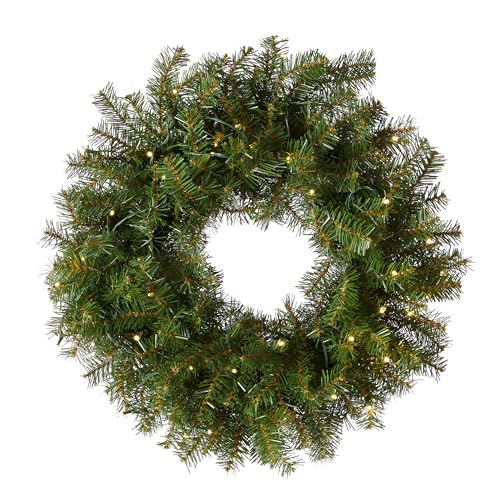
The National Tree Company Pre-Lit Wreath is a classic pre-lit evergreen wreath from a long-running holiday decor maker, built around dense mixed tips, warm built-in lights and a traditional profile that reads well from the street. It sits in the mid-range tier of this group, and that positioning shows in what it prioritises. Best for: front doors that need one dependable, traditional wreath with the lighting already handled. Not suited for: shoppers who want a heavily decorated, ornament-loaded statement piece out of the box. Hang it, step back to the street, and judge the glow from there; this is a wreath designed to be read at distance as much as at the doorstep. As with every pick in this guide, treat the listing as a living document: check the current Amazon listing for the present specification and availability before you buy, and check price on Amazon rather than relying on any number quoted second-hand, because seasonal listings change often.
Balsam Hill Wreath
The Balsam Hill Wreath is a premium wreath known for carefully shaped, lifelike foliage modelled on real evergreen branches, aimed at buyers who study a wreath up close and want it to pass at arm’s length. It sits in the premium tier of this group, and that positioning shows in what it prioritises. Best for: living rooms, mantels and entryways where guests see the wreath at close range all season. Not suited for: anyone decorating several doors on a tight seasonal budget. Run your fingers lightly over the tips before hanging; the moulded foliage is the entire point of this wreath, and it rewards a slow first fluff. As with every pick in this guide, treat the listing as a living document: check the current Amazon listing for the present specification and availability before you buy, and check price on Amazon rather than relying on any number quoted second-hand, because seasonal listings change often.

Puleo International Pre-Lit Wreath
The Puleo International Pre-Lit Wreath is a pre-lit wreath from a family-run holiday company with deep roots in seasonal decorating, favouring a full, traditional silhouette and straightforward, familiar construction. It sits in the mid-range tier of this group, and that positioning shows in what it prioritises. Best for: traditional homes that want a generous, full-looking pre-lit wreath without chasing boutique styling. Not suited for: minimalist spaces where a very full wreath would overwhelm a narrow door or small entry. Its fullness suits doors with presence — wider frames and deep porches give the silhouette room to breathe. As with every pick in this guide, treat the listing as a living document: check the current Amazon listing for the present specification and availability before you buy, and check price on Amazon rather than relying on any number quoted second-hand, because seasonal listings change often.

Nearly Natural Wreath
The Nearly Natural Wreath is an unlit decorative wreath from a maker specialising in realistic faux botanicals, designed to be styled with your own ribbon, picks and ornaments rather than arriving fully dressed. It sits in the mid-range tier of this group, and that positioning shows in what it prioritises. Best for: stylists and DIY decorators who enjoy dressing a wreath themselves and reworking it each year. Not suited for: anyone who wants built-in lights and a finished look straight out of the box. Buy it as a canvas: the first season, add one ribbon you love; the second, a cluster of picks; let it become yours gradually. As with every pick in this guide, treat the listing as a living document: check the current Amazon listing for the present specification and availability before you buy, and check price on Amazon rather than relying on any number quoted second-hand, because seasonal listings change often.

Best Choice Products Pre-Lit Christmas Wreath
The Best Choice Products Pre-Lit Christmas Wreath is an accessible pre-lit wreath that covers the basics — evergreen-look foliage, built-in lights and an easy hang-and-go setup — at the friendliest tier in this group. It sits in the entry-level tier of this group, and that positioning shows in what it prioritises. Best for: first apartments, secondary doors and anyone testing whether a lit wreath suits their home. Not suited for: buyers expecting heirloom density or foliage that convinces at very close range. It is the wreath to learn on — hang it, live with lit evenings for a season, and you will know exactly what your next wreath needs. As with every pick in this guide, treat the listing as a living document: check the current Amazon listing for the present specification and availability before you buy, and check price on Amazon rather than relying on any number quoted second-hand, because seasonal listings change often.
First Setup and Care Essentials
Storage decides whether an artificial wreath is a one-season purchase or a decade-long one. The enemies are crushing, damp and heat. A wreath stored under heavy boxes loses its shape; one stored in a damp space can pick up musty odours and, on natural decorative elements, even mould. The reliable method is unglamorous: let the wreath dry fully if it has been outdoors, brush off dust, store it in a rigid wreath box or a sturdy bag hung from a hook rather than stacked, and keep it somewhere cool and dry. Ten careful minutes in January buy you a wreath that needs ten minutes of fluffing the following December.
Fluffing is the ritual that separates a stored wreath from a displayed one. Branches compress in storage, and a wreath hung straight from the box looks flat and apologetic. Work around the circle by hand, lifting each tip outward and slightly forward, turning some left and some right so the silhouette fills in three dimensions. Check the wreath from the front at arm’s length as you go; gaps that are invisible from above glare from the front. It is the highest-value ten minutes in the whole wreath routine, and it is also the moment to spot loose ornaments or tired ribbon before guests do.
Cleaning an artificial wreath is a gentle job. A soft brush, a feather duster or a cool, low stream of air lifts the season’s dust without disturbing flocking or glued decoration. Avoid soaking a pre-lit wreath or spraying liquid cleaners across its wiring and battery pack; if a spot needs attention, a barely damp cloth on that area alone is the safer tool. Fresh wreaths ask for the opposite treatment — a mist of water on the foliage in the first days can slow drying slightly — but no amount of misting turns a cut wreath into a permanent one, so plan its farewell as part of its charm.
Real evergreen wreaths deserve one extra habit: check them as the season goes on. As cut foliage dries, it becomes more brittle and more flammable, and needles begin to drop. A fresh wreath that started the season soft and fragrant should be retired when it turns crisp and sheds freely, rather than being kept up out of habit near lamps or hearth decorations. Artificial wreaths skip that particular risk but reward the same yearly inspection — fluff the branches, check the light cord, confirm the hanging loop is sound, and fix small problems before they become December problems.
Mistakes to Avoid
The most common wreath mistake is buying by photograph instead of by measurement. Product images are styled, lit and cropped to flatter, and they carry no sense of your door’s proportions. The fix costs nothing: measure the door or wall, decide the diameter that leaves a comfortable margin, and filter every candidate by that size before looking at a single photograph. Shoppers who size first almost never return a wreath; shoppers who fall for a photograph first are the ones writing the disappointed comments about a wreath that looked enormous online and modest on the door.
Hanging is the second failure point. Improvised hooks, a nail meant for a picture frame, or an over-door hanger that does not fit the door’s thickness all end the same way: a wreath that slides, tilts or falls. Use a hanger designed for wreaths, check that the door still closes cleanly with it in place, and give the hung wreath a gentle shake test before calling it done. On glass doors and sidelights, suction and magnetic options exist but demand clean surfaces and honest weight limits. Two minutes of testing in November prevents a broken wreath in December.
Ignoring the indoor-outdoor distinction wastes more wreaths than any other error. An indoor wreath hung on an exposed door fades, rusts at its frame and sheds its flocking into the weather, while its lights — if it has them — were never built for rain. Match the wreath’s stated use to the actual exposure of your spot, remembering that a covered porch and an open wall are different climates. If your dream wreath is indoor-only, hang it inside and let it be seen through the glass; it will outlast several outdoor seasons that way.
Finally, many wreaths are retired early for a storage sin rather than a quality failure. They are stuffed into bags, stacked under decorations, left in damp garages or baked in hot attics, then blamed the following year for looking tired. A rigid container or a hanging storage bag, a cool dry spot and a few minutes of fluffing on the way out will rescue most of them. If you take one habit from this whole guide, take that one: the wreath you store well is the wreath that still looks new in year five.
For the decision in checklist form, the step-by-step guide on how to choose a holiday wreath turns this guide’s criteria into steps, and the honest answer to is a holiday wreath worth it tackles the value question head-on for anyone still hesitating.
More Wreath Judgement Calls Worth Making
One underappreciated detail is the wreath’s back. The back decides how the wreath hangs, whether it sits flat, and whether anything hard or sharp meets your door. A tidy back — wrapped frame, covered wire ends, a secure hanging loop — signals a maker who finished the job properly, and it protects painted and glass doors from the slow rub of a season’s worth of opening and closing. When comparing two similar wreaths, choose the one whose back you would trust against your own door; the front photographs are styled, but the back never lies.
Depth is the dimension photographs flatten. A wreath with real depth — tips at varied lengths, foliage layered forward — casts small shadows, moves slightly in a breeze and reads as a living thing rather than a green ring. Shallow wreaths can still work in tight spots, such as between a door and a storm door, where depth is a liability. Match depth to clearance: measure the gap if a storm door is involved, and let a full, deep wreath have the open air of a porch or a mantel where its profile can be appreciated.
Wreaths reward a household rhythm. Hang early enough to enjoy the whole season, light them when the household is actually home to see them, and build the small rituals — the evening switch-on, the doorstep check after a storm, the January fluff-and-store — into the season itself. Decorations that join the rhythm get used and loved; decorations that fight it get skipped. That is a practical argument for timers, reachable battery packs and hangers that make the wreath effortless to live with day after day.
If two wreaths are competing for your door, run the doorstep test in your head. Picture each one from the street in flat morning light and again at dusk with the house lit. Picture it against your actual door colour, next to your actual hardware, under your actual porch light. The wreath that wins both pictures is the right one, and it is rarely the one that merely photographed best in a studio. Context is the whole game with a piece of decor that exists to frame an entrance.
Neighbours and guests read a wreath as a sentence about the household: cared for, welcoming, settled for the season. That reading is why small maintenance matters — straightening a tilted wreath, replacing a tired bow, brushing off the dust of a dry week. None of it takes long, and all of it compounds. A wreath is a small decoration with an outsized voice, and treating it as the home’s seasonal handshake, rather than as one more box to unpack, is the mindset behind every recommendation in this guide.
For households decorating on a shared or rented door, reversibility is a feature. Over-door hangers, ribbon hangs and removable hooks keep the peace with landlords and leave no trace in January. Weight matters more on rental hardware, and a mid-sized wreath hung properly beats a heavy one hung hopefully. The same logic suits anyone who redecorates often: choose mounting that lets the wreath move rooms without tools, and the wreath becomes a flexible asset instead of a fixed installation.
Consider the wreath’s relationship with light that already exists. A porch light above the door, a lantern beside it, a lit window behind it — the wreath joins a lighting scheme rather than inventing one. Warm wreath lights beside a cool porch bulb can clash in a way neither shows alone, so match tones where you can. In daylight the same thinking applies to shadow: a wreath on a sunlit wall spends half the day in hard shadow and half in glare, and dense foliage handles both better than sparse, delicate decoration.
A wreath on a working door lives a mechanical life. It is swung, bumped by parcels, brushed by shoulders and occasionally caught by the very people it welcomes. That argues for secure attachment of every decorative element and for a hanging method that holds the wreath still rather than letting it swing and knock. Check the wreath after the first windy night and after the first busy weekend; early small corrections — a re-seated pick, a tightened hanger — are what separate a wreath that lasts the season from one that slowly sheds itself across the doorstep.
Households with pets and small children should give the wreath a placement interview. Low-hung wreaths within reach of curious hands and noses invite investigation, and small detachable decorations are the first casualties. Hang the main wreath at adult eye level, keep spare ornaments out of paw range, and consider a second, sturdier, simpler wreath for the playroom door where touching is part of the fun. None of this is about fear; it is about matching the decoration to the household that will actually live around it.
Before You Commit: A Hands-On Fit and Compatibility Check for Holiday Wreath
This section exists to treat this as the final check before money changes hands, the point where a shortlist stops being a list of features and becomes a decision about one specific home. It adds a layer that a feature list cannot give you, grounded in the seasonal & holiday context this holiday wreath will actually live in. Where this guide names examples such as Balsam Hill Wreath, Nearly Natural Wreath, use them as test cases for the checks below rather than as shortcuts past them.
Build a simple decision checklist and score it in writing. Five lines are enough: fit in the space, fit with the routine, ease of cleaning or upkeep, quality of the parts that move or wear, and how the holiday wreath will be stored or will look when it is not the centre of attention. Score each contender quickly, then look only at the lowest scores, because purchases are usually ruined by their weakest point rather than saved by their strongest. If two options tie, choose the one whose weakness is cheapest or easiest to live with. This sounds mechanical, and it is meant to: a written checklist is the best defence against the very human habit of falling for the last photograph you looked at.
Finally, plan the first fortnight. Decide where the holiday wreath will live from day one, what it replaces, what accessory or companion it needs straight away and what small job you will use to learn its habits while returning it is still simple. Keep the packaging until that learning period is over, note anything that surprises you, and deal with a mismatch early rather than adapting yourself around a poor fit for years. The households that end up happiest with a holiday wreath are rarely the ones that researched longest; they are the ones that checked fit honestly, bought for the ordinary week, and paid attention during the first days instead of assuming the decision ended at checkout.
One more angle is worth your time: the second-order costs. A holiday wreath changes what happens around it. It can demand a different cleaning product, a new storage habit, a moved piece of furniture, a rearranged cupboard or a standing arrangement with the people you live with. List those knock-on effects before you buy and decide whether you accept them as part of the deal. Sometimes the answer is an easy yes, and the holiday wreath earns its place by improving the whole routine around it. Sometimes the honest answer is that the supporting changes are the real project, and the purchase should wait until you are ready for them. Either answer is useful; the only bad outcome is discovering the knock-on effects by accident, one irritation at a time, after the decision can no longer be revisited.
It also helps to separate the problems a holiday wreath can solve from the problems it merely moves. If the underlying difficulty is space, the answer may be a smaller format or a different location rather than a more elaborate model. If the difficulty is time, look for the option that removes steps rather than the one that performs each step slightly better. If the difficulty is that several people want different things, a compromise design that everyone rates as good enough will usually outlast a specialist design that one person loves and everyone else avoids. Naming the real problem in one sentence, out loud, before you order, is a surprisingly powerful filter, and many shoppers find that the sentence itself points at a different holiday wreath than the one they started out researching.
Start with the unglamorous measurements. For a holiday wreath, the numbers that decide satisfaction are rarely the headline ones in a listing; they are storage space in the eleven months when the item is not on display, packaging that survives the loft, and setup time when the calendar is already crowded. Write the real dimensions of your space down, including the awkward constraints you normally work around without thinking, and hold every contender up against that sheet rather than against a showroom photograph. Then walk the route the holiday wreath will take on delivery day and during normal use.
Frequently Asked Questions
What size wreath should I buy for a front door?
Start with the door, not the catalogue. Measure the door’s width and choose a wreath that leaves a clear margin of door visible on both sides, so it reads as an accent rather than a covering. Standard doors usually suit a mid-sized wreath; wide or double doors can carry larger wreaths or a matched pair. Check the depth too, especially with a storm door, since a full wreath needs room to sit without being pressed flat against glass. When between sizes, the slightly smaller wreath usually looks more deliberate.
Can I hang a holiday wreath outside?
Yes, provided the wreath is described as suitable for outdoor or covered outdoor use. Exposure is the deciding factor: a covered porch is gentle, while an open wall takes rain, sun and freeze-thaw cycles directly. Lit and battery-powered wreaths need particular care outdoors, because battery packs and connections should only sit in the weather when they are rated for it. If your wreath is indoor-only, hang it inside a window or on an interior door instead, where it is still visible and far better protected.
Are pre-lit wreaths better than unlit wreaths?
Neither is better in general; they suit different decorators. A pre-lit wreath looks neater because the lights are placed by the maker, and it hangs in minutes with nothing to wind or arrange. An unlit wreath is more flexible — you can change the lighting, the ribbon and the whole mood each year, and there is no lighting system to age. Choose pre-lit for speed and a finished look, and unlit if you enjoy restyling or want the wreath to work in daylight-only spots where lights add nothing.
How should I store a wreath after the holidays?
Let the wreath dry completely if it has been outdoors, brush off dust with a soft brush, and store it somewhere cool, dry and uncrushed. A rigid wreath container is ideal; a sturdy bag hung from a hook is a good second choice. Avoid damp garages and hot attics, which encourage musty odours, mould on natural elements and tired, flattened foliage. Store removable bows and picks with the wreath so next year’s setup takes minutes. Good storage is the single biggest factor in how long a wreath keeps looking new.
Do battery-powered wreath lights last the whole season?
That depends on how many hours a day they run and the quality of the batteries, so treat any promise cautiously. The habits that stretch battery life are simple: switch lights off overnight and when the house is empty, or use a timer setting if the wreath offers one, and start the season with fresh batteries. Keep the battery pack somewhere you can reach without taking the wreath down. Owners who use a timer generally find a battery wreath perfectly practical; owners who leave lights burning around the clock find themselves changing batteries instead.
When is the best time to buy a holiday wreath?
Early in the season offers the widest choice of sizes and styles, which matters because the right size for your door is not negotiable. Promotions cluster at the season’s edges, but waiting carries the risk that your specification has sold through. A sensible approach is to fix your brief first — size, lit or unlit, indoor or outdoor, power source — and buy when a wreath matching it appears at a fair point in its range. Deciding the specification before the shopping prevents the common outcome of a bargain wreath that never quite suits the door.
Keep exploring this wreath cluster: a plain look at holiday wreath pros and cons; our in-depth holiday wreath review. Each companion piece takes one angle — criteria, comparisons, trade-offs or value — so together they cover the whole decision without repeating it.
Related Guides and Ideas
- holiday decor deals worth checking this season
- Christmas tree deals for the main room
- the best Christmas blankets for the sofa
Those companion reads cover the rest of the seasonal picture — the tree, the textiles and the tabletop touches — so the wreath you choose here lands in a home that feels coordinated rather than decorated by accident. Start with whichever piece your room is missing most.