Disclosure: As an Amazon Associate, dailyhomedecorating.com earns from qualifying purchases. Links on this page are affiliate links; they cost you nothing extra. Prices and availability change often, so check the current Amazon listing before you buy.
These garden tool set reviews take a different approach from a single-kit test: this garden tool set reviews roundup compares the main set styles side by side, in prose, so you can see which profile of kit suits your garden before you look at any individual listing. No scores, no invented figures, just the differences that actually change a season of gardening.
Key Takeaways
- Compare set profiles, not piece counts: traditional, tote-based, gift-ready and work-focused kits behave differently.
- Every profile shares the same core jobs; they differ in handles, storage and emphasis.
- The best profile is the one whose weaknesses fall on jobs you rarely do.
- All profiles demand the same care: clean, dry, locked shears, storage away from children.
In this guide
What Garden Tool Set Reviews Should Actually Compare
Start with the work itself when you think about garden tool sets. A garden rarely asks for one perfect tool; it asks for the right small tool, in the right order, on the right day. Digging when soil is sodden compacts it, weeding after a light rain is easier than weeding in a drought, and transplanting in the cool of the morning gives roots a gentler start than the same job at midday. A good set supports those rhythms instead of fighting them, because every piece is to hand, familiar in the grip, and clean enough to use without a preparatory hunt through the shed.
Comfort is not a luxury extra with garden tool sets; it is the difference between a finished bed and an abandoned one. Handles should fill the palm without forcing the fingers to claw, edges should meet soil without needing a second push from the other hand, and the whole kit should be light enough to carry to the far end of the garden without setting it down twice. Gardeners who work little and often, in short sessions, feel these details most, because friction at the start of a session is what turns good intentions into postponement.
Durability shows itself quietly with garden tool sets. It is the trowel that still runs straight after a season of levering in stony ground, the fork whose tines have not splayed, and the shears that still close cleanly after being wiped, dried and put away properly every time. None of that depends on exotic claims. It depends on sensible materials, joints that are not an afterthought, and owners who rinse soil off, dry blades, and store sharp tools with blades pointing down or locked, away from children, every single time.
Safety deserves plain language with garden tool sets. Pruning shears and trowels are sharp, pointed tools, and they belong out of reach of children, never loose in a pocket, never left blade-up in a bucket of soil where a hand will reach in blindly. Carry shears closed and locked, pass tools handle-first, and put every piece back in the tote when the session ends. That habit also protects the tools themselves, because a blade left in damp grass loses its edge and invites rust far faster than a blade that is cleaned and dried.
The Main Profiles in These Garden Tool Set Reviews

Fiskars Garden Tool Set — Best Overall
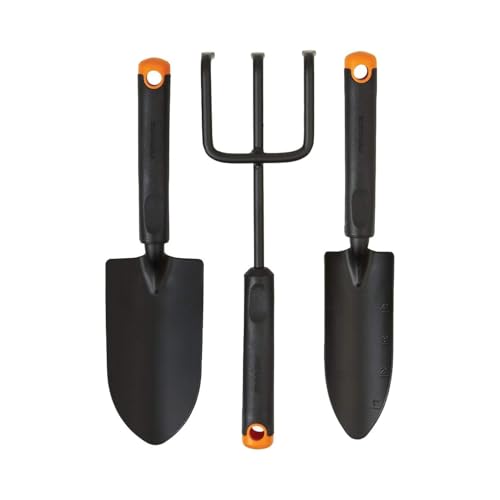
The Fiskars Garden Tool Set is a widely available starter-to-midrange set built around everyday planting, transplanting and weeding work. Treat it here as a prose-only recommendation: check the current listing carefully before you buy, confirm exactly which pieces are included, and compare the contents against the jobs described in this guide rather than against a headline piece count.
In daily use, judge the Fiskars Garden Tool Set by its core pieces first. The trowel should enter soil without flexing, the fork should loosen without twisting, and the shears should close cleanly and lock shut for safe storage. The tote or storage arrangement matters almost as much as any single tool, because a set that travels to the bed as one unit gets used as one unit, while a set scattered across shelves slowly stops being a set at all.
- Best for: gardeners whose work matches the best overall brief and who will use most pieces weekly in season
- Not suited for: gardeners who need only one specialist tool, or who work ground so heavy that individual professional-grade pieces make more sense
- Strengths: a coherent core of everyday tools, one storage home, and no need to assemble a kit piece by piece
- Trade-offs: one piece may not match your hand or soil as well as a hand-picked individual tool would

Spear & Jackson Garden Tool Set — Best Traditional Feel
The Spear & Jackson Garden Tool Set is a set in the classic hand-tool tradition, suited to gardeners who like familiar shapes and unhurried bed work. Treat it here as a prose-only recommendation: check the current listing carefully before you buy, confirm exactly which pieces are included, and compare the contents against the jobs described in this guide rather than against a headline piece count.
In daily use, judge the Spear & Jackson Garden Tool Set by its core pieces first. The trowel should enter soil without flexing, the fork should loosen without twisting, and the shears should close cleanly and lock shut for safe storage. The tote or storage arrangement matters almost as much as any single tool, because a set that travels to the bed as one unit gets used as one unit, while a set scattered across shelves slowly stops being a set at all.
- Best for: gardeners whose work matches the best traditional feel brief and who will use most pieces weekly in season
- Not suited for: gardeners who need only one specialist tool, or who work ground so heavy that individual professional-grade pieces make more sense
- Strengths: a coherent core of everyday tools, one storage home, and no need to assemble a kit piece by piece
- Trade-offs: one piece may not match your hand or soil as well as a hand-picked individual tool would
GREBSTK Garden Tool Set — Best for Gifting and Starting Out
The GREBSTK Garden Tool Set is a broad, tote-friendly collection aimed at new gardeners who want many pieces in one organised place. Treat it here as a prose-only recommendation: check the current listing carefully before you buy, confirm exactly which pieces are included, and compare the contents against the jobs described in this guide rather than against a headline piece count.
In daily use, judge the GREBSTK Garden Tool Set by its core pieces first. The trowel should enter soil without flexing, the fork should loosen without twisting, and the shears should close cleanly and lock shut for safe storage. The tote or storage arrangement matters almost as much as any single tool, because a set that travels to the bed as one unit gets used as one unit, while a set scattered across shelves slowly stops being a set at all.
- Best for: gardeners whose work matches the best for gifting and starting out brief and who will use most pieces weekly in season
- Not suited for: gardeners who need only one specialist tool, or who work ground so heavy that individual professional-grade pieces make more sense
- Strengths: a coherent core of everyday tools, one storage home, and no need to assemble a kit piece by piece
- Trade-offs: one piece may not match your hand or soil as well as a hand-picked individual tool would
WORKPRO Garden Tool Set — Best for Practical Storage
The WORKPRO Garden Tool Set is a work-focused set that appeals to gardeners who value a tidy bag, clear pockets and tools that are easy to carry between beds. Treat it here as a prose-only recommendation: check the current listing carefully before you buy, confirm exactly which pieces are included, and compare the contents against the jobs described in this guide rather than against a headline piece count.
In daily use, judge the WORKPRO Garden Tool Set by its core pieces first. The trowel should enter soil without flexing, the fork should loosen without twisting, and the shears should close cleanly and lock shut for safe storage. The tote or storage arrangement matters almost as much as any single tool, because a set that travels to the bed as one unit gets used as one unit, while a set scattered across shelves slowly stops being a set at all.
- Best for: gardeners whose work matches the best for practical storage brief and who will use most pieces weekly in season
- Not suited for: gardeners who need only one specialist tool, or who work ground so heavy that individual professional-grade pieces make more sense
- Strengths: a coherent core of everyday tools, one storage home, and no need to assemble a kit piece by piece
- Trade-offs: one piece may not match your hand or soil as well as a hand-picked individual tool would
Start with the work itself when you think about comparing garden tool sets. A garden rarely asks for one perfect tool; it asks for the right small tool, in the right order, on the right day. Digging when soil is sodden compacts it, weeding after a light rain is easier than weeding in a drought, and transplanting in the cool of the morning gives roots a gentler start than the same job at midday. A good set supports those rhythms instead of fighting them, because every piece is to hand, familiar in the grip, and clean enough to use without a preparatory hunt through the shed.
Comfort is not a luxury extra with comparing garden tool sets; it is the difference between a finished bed and an abandoned one. Handles should fill the palm without forcing the fingers to claw, edges should meet soil without needing a second push from the other hand, and the whole kit should be light enough to carry to the far end of the garden without setting it down twice. Gardeners who work little and often, in short sessions, feel these details most, because friction at the start of a session is what turns good intentions into postponement.
Durability shows itself quietly with comparing garden tool sets. It is the trowel that still runs straight after a season of levering in stony ground, the fork whose tines have not splayed, and the shears that still close cleanly after being wiped, dried and put away properly every time. None of that depends on exotic claims. It depends on sensible materials, joints that are not an afterthought, and owners who rinse soil off, dry blades, and store sharp tools with blades pointing down or locked, away from children, every single time.
Design, Build and Setup Across Profiles
Start with the work itself when you think about the design of garden tool sets. A garden rarely asks for one perfect tool; it asks for the right small tool, in the right order, on the right day. Digging when soil is sodden compacts it, weeding after a light rain is easier than weeding in a drought, and transplanting in the cool of the morning gives roots a gentler start than the same job at midday. A good set supports those rhythms instead of fighting them, because every piece is to hand, familiar in the grip, and clean enough to use without a preparatory hunt through the shed.
Comfort is not a luxury extra with the design of garden tool sets; it is the difference between a finished bed and an abandoned one. Handles should fill the palm without forcing the fingers to claw, edges should meet soil without needing a second push from the other hand, and the whole kit should be light enough to carry to the far end of the garden without setting it down twice. Gardeners who work little and often, in short sessions, feel these details most, because friction at the start of a session is what turns good intentions into postponement.
Durability shows itself quietly with the design of garden tool sets. It is the trowel that still runs straight after a season of levering in stony ground, the fork whose tines have not splayed, and the shears that still close cleanly after being wiped, dried and put away properly every time. None of that depends on exotic claims. It depends on sensible materials, joints that are not an afterthought, and owners who rinse soil off, dry blades, and store sharp tools with blades pointing down or locked, away from children, every single time.
In Clay Soil
Working in clay soil that holds together in heavy clumps after rain exposes profile differences quickly. Traditional shapes feel patient and precise, broad tote kits feel efficient, and work-focused sets feel brisk. None is universally best; each is best where its emphasis matches the ground, which is why honest reviews describe soil and jobs before they describe brands.
In Sandy Soil
Working in sandy soil that drains quickly and shifts easily under a blade exposes profile differences quickly. Traditional shapes feel patient and precise, broad tote kits feel efficient, and work-focused sets feel brisk. None is universally best; each is best where its emphasis matches the ground, which is why honest reviews describe soil and jobs before they describe brands.
In Loam
Working in loam that crumbles in the hand and rewards almost any well-shaped tool exposes profile differences quickly. Traditional shapes feel patient and precise, broad tote kits feel efficient, and work-focused sets feel brisk. None is universally best; each is best where its emphasis matches the ground, which is why honest reviews describe soil and jobs before they describe brands.
In Stony Ground In Older Borders Where Edges Meet Hidden Rubble
Working in stony ground in older borders where edges meet hidden rubble exposes profile differences quickly. Traditional shapes feel patient and precise, broad tote kits feel efficient, and work-focused sets feel brisk. None is universally best; each is best where its emphasis matches the ground, which is why honest reviews describe soil and jobs before they describe brands.
In Raised-Bed Mix
Working in raised-bed mix that is light, fibrous and easy to over-dig exposes profile differences quickly. Traditional shapes feel patient and precise, broad tote kits feel efficient, and work-focused sets feel brisk. None is universally best; each is best where its emphasis matches the ground, which is why honest reviews describe soil and jobs before they describe brands.
In Container Compost
Working in container compost that is soft but dries out fast in summer heat exposes profile differences quickly. Traditional shapes feel patient and precise, broad tote kits feel efficient, and work-focused sets feel brisk. None is universally best; each is best where its emphasis matches the ground, which is why honest reviews describe soil and jobs before they describe brands.
Performance in Real Use
A Morning of Planting
Speed, sequencing and how the tote keeps up with moving along a bed.
Start with the work itself when you think about using a garden tool set. A garden rarely asks for one perfect tool; it asks for the right small tool, in the right order, on the right day. Digging when soil is sodden compacts it, weeding after a light rain is easier than weeding in a drought, and transplanting in the cool of the morning gives roots a gentler start than the same job at midday. A good set supports those rhythms instead of fighting them, because every piece is to hand, familiar in the grip, and clean enough to use without a preparatory hunt through the shed.
Comfort is not a luxury extra with using a garden tool set; it is the difference between a finished bed and an abandoned one. Handles should fill the palm without forcing the fingers to claw, edges should meet soil without needing a second push from the other hand, and the whole kit should be light enough to carry to the far end of the garden without setting it down twice. Gardeners who work little and often, in short sessions, feel these details most, because friction at the start of a session is what turns good intentions into postponement.
An Hour of Weeding
Levering, loosening and gathering, and how hands feel at the end.
Start with the work itself when you think about using a garden tool set. A garden rarely asks for one perfect tool; it asks for the right small tool, in the right order, on the right day. Digging when soil is sodden compacts it, weeding after a light rain is easier than weeding in a drought, and transplanting in the cool of the morning gives roots a gentler start than the same job at midday. A good set supports those rhythms instead of fighting them, because every piece is to hand, familiar in the grip, and clean enough to use without a preparatory hunt through the shed.
Comfort is not a luxury extra with using a garden tool set; it is the difference between a finished bed and an abandoned one. Handles should fill the palm without forcing the fingers to claw, edges should meet soil without needing a second push from the other hand, and the whole kit should be light enough to carry to the far end of the garden without setting it down twice. Gardeners who work little and often, in short sessions, feel these details most, because friction at the start of a session is what turns good intentions into postponement.
Pruning and Tidying
Clean cuts, safe carrying with locked shears, and debris handling.
Start with the work itself when you think about using a garden tool set. A garden rarely asks for one perfect tool; it asks for the right small tool, in the right order, on the right day. Digging when soil is sodden compacts it, weeding after a light rain is easier than weeding in a drought, and transplanting in the cool of the morning gives roots a gentler start than the same job at midday. A good set supports those rhythms instead of fighting them, because every piece is to hand, familiar in the grip, and clean enough to use without a preparatory hunt through the shed.
Comfort is not a luxury extra with using a garden tool set; it is the difference between a finished bed and an abandoned one. Handles should fill the palm without forcing the fingers to claw, edges should meet soil without needing a second push from the other hand, and the whole kit should be light enough to carry to the far end of the garden without setting it down twice. Gardeners who work little and often, in short sessions, feel these details most, because friction at the start of a session is what turns good intentions into postponement.
Bulb Planting in Autumn
Depth control and digging stamina as the ground cools.
Start with the work itself when you think about using a garden tool set. A garden rarely asks for one perfect tool; it asks for the right small tool, in the right order, on the right day. Digging when soil is sodden compacts it, weeding after a light rain is easier than weeding in a drought, and transplanting in the cool of the morning gives roots a gentler start than the same job at midday. A good set supports those rhythms instead of fighting them, because every piece is to hand, familiar in the grip, and clean enough to use without a preparatory hunt through the shed.
Comfort is not a luxury extra with using a garden tool set; it is the difference between a finished bed and an abandoned one. Handles should fill the palm without forcing the fingers to claw, edges should meet soil without needing a second push from the other hand, and the whole kit should be light enough to carry to the far end of the garden without setting it down twice. Gardeners who work little and often, in short sessions, feel these details most, because friction at the start of a session is what turns good intentions into postponement.
Strengths and Trade-Offs
- Strength across profiles: complete core coverage from the first day of ownership
- Strength: storage systems that make completeness visible at a glance
- Strength: a profile for almost every common gardening style and household
- Trade-off: profiles generalise; your exact hand and soil may sit between two of them
- Trade-off: extras differ widely and are the easiest place for a set to pad its contents
- Trade-off: every profile still depends on the owner’s cleaning, drying and safe-storage habits
Who Each Profile Suits
The New Gardener With A Small Patio
You are learning plant names and tool names at the same time, working mostly in containers and one or two small beds, and you need tools that forgive mistakes.
Match this profile to the set profile above whose strengths cover its weekly jobs and whose trade-offs land on its rarest tasks. That matching exercise, done honestly, is worth more than any single recommendation, including the ones in this roundup.
The Raised-Bed Vegetable Grower
Your work is repetitive and seasonal: sowing, transplanting, weeding between rows, feeding, and harvesting in beds you tend several times a week.
Match this profile to the set profile above whose strengths cover its weekly jobs and whose trade-offs land on its rarest tasks. That matching exercise, done honestly, is worth more than any single recommendation, including the ones in this roundup.
The Flower-Border Gardener
Most of your time goes to deadheading, dividing perennials, planting bulbs and keeping edges tidy, so precision matters more than brute strength.
Match this profile to the set profile above whose strengths cover its weekly jobs and whose trade-offs land on its rarest tasks. That matching exercise, done honestly, is worth more than any single recommendation, including the ones in this roundup.
The Gardener With Stiff Or Tired Hands
Grip comfort, lighter weight and handles that do not twist in the palm decide whether a session ends pleasantly or early.
Match this profile to the set profile above whose strengths cover its weekly jobs and whose trade-offs land on its rarest tasks. That matching exercise, done honestly, is worth more than any single recommendation, including the ones in this roundup.
Start with the work itself when you think about garden tool sets. A garden rarely asks for one perfect tool; it asks for the right small tool, in the right order, on the right day. Digging when soil is sodden compacts it, weeding after a light rain is easier than weeding in a drought, and transplanting in the cool of the morning gives roots a gentler start than the same job at midday. A good set supports those rhythms instead of fighting them, because every piece is to hand, familiar in the grip, and clean enough to use without a preparatory hunt through the shed.
Comfort is not a luxury extra with garden tool sets; it is the difference between a finished bed and an abandoned one. Handles should fill the palm without forcing the fingers to claw, edges should meet soil without needing a second push from the other hand, and the whole kit should be light enough to carry to the far end of the garden without setting it down twice. Gardeners who work little and often, in short sessions, feel these details most, because friction at the start of a session is what turns good intentions into postponement.
Setup, Care and Maintenance Essentials
Whichever profile you choose, the closing ritual is identical: soil off, blades wiped and dried thoroughly, shears locked, tote stored dry and out of reach of children, sharp pieces pointing down or covered. Profiles differ in the garden; they do not differ in the shed.
Start with the work itself when you think about caring for garden tool sets. A garden rarely asks for one perfect tool; it asks for the right small tool, in the right order, on the right day. Digging when soil is sodden compacts it, weeding after a light rain is easier than weeding in a drought, and transplanting in the cool of the morning gives roots a gentler start than the same job at midday. A good set supports those rhythms instead of fighting them, because every piece is to hand, familiar in the grip, and clean enough to use without a preparatory hunt through the shed.
Comfort is not a luxury extra with caring for garden tool sets; it is the difference between a finished bed and an abandoned one. Handles should fill the palm without forcing the fingers to claw, edges should meet soil without needing a second push from the other hand, and the whole kit should be light enough to carry to the far end of the garden without setting it down twice. Gardeners who work little and often, in short sessions, feel these details most, because friction at the start of a session is what turns good intentions into postponement.
Final Verdict
Read garden tool set reviews for profile fit, not for winners. Choose the profile whose core, handles and storage match your soil, session length and storage reality, verify the exact contents on the current listing, and then commit to the simple care ritual that keeps any good set good.
A Season-by-Season Reality Check
Consider early spring, when soil is workable again but still cold, and beds need clearing, edging and the first careful planting. A session devoted to planting annuals in a border shows what a garden tool set really contributes: a trowel for holes, a transplanter for the seedlings themselves, and a fork to settle soil around roots. The gardener who works through this job with a complete set moves in a steady sequence, tool after tool, without returning to the shed or improvising with whatever is nearest. That sequence matters more than any single tool, because gardening jobs are chains, and a chain is only as smooth as its weakest link. Notice, too, how the session should end in early spring just as it ends in every season: soil knocked off over the bed, blades wiped and dried thoroughly so rust never gets a foothold, shears closed and locked, and the whole set stored with blades pointing down or covered, well out of reach of children. Repeated across the year, that pattern of complete work and careful closing is what separates a set that serves for years from a set that merely survives a summer, and it is the standard against which every claim in this article should be judged.
Consider late spring, when growth accelerates, seedlings queue for transplanting, and weeds discover every gap you leave. A session devoted to weeding a vegetable row shows what a garden tool set really contributes: the weeder for tap roots, the fork for loosening, and the cultivator to finish the surface cleanly. The gardener who works through this job with a complete set moves in a steady sequence, tool after tool, without returning to the shed or improvising with whatever is nearest. That sequence matters more than any single tool, because gardening jobs are chains, and a chain is only as smooth as its weakest link. Notice, too, how the session should end in late spring just as it ends in every season: soil knocked off over the bed, blades wiped and dried thoroughly so rust never gets a foothold, shears closed and locked, and the whole set stored with blades pointing down or covered, well out of reach of children. Repeated across the year, that pattern of complete work and careful closing is what separates a set that serves for years from a set that merely survives a summer, and it is the standard against which every claim in this article should be judged.
Consider midsummer, when heat shortens sessions, soil dries at the surface, and deadheading and weeding dominate the list. A session devoted to tidying a flower bed shows what a garden tool set really contributes: shears for deadheading, a hand rake for debris in corners, and the tote to carry clippings away. The gardener who works through this job with a complete set moves in a steady sequence, tool after tool, without returning to the shed or improvising with whatever is nearest. That sequence matters more than any single tool, because gardening jobs are chains, and a chain is only as smooth as its weakest link. Notice, too, how the session should end in midsummer just as it ends in every season: soil knocked off over the bed, blades wiped and dried thoroughly so rust never gets a foothold, shears closed and locked, and the whole set stored with blades pointing down or covered, well out of reach of children. Repeated across the year, that pattern of complete work and careful closing is what separates a set that serves for years from a set that merely survives a summer, and it is the standard against which every claim in this article should be judged.
Consider early autumn, when the ground is warm and cooperative, bulbs wait to go in, and perennials are ready to divide. A session devoted to potting on seedlings shows what a garden tool set really contributes: narrow tools, gentle handling, and depth control so young roots are never torn or buried too deep. The gardener who works through this job with a complete set moves in a steady sequence, tool after tool, without returning to the shed or improvising with whatever is nearest. That sequence matters more than any single tool, because gardening jobs are chains, and a chain is only as smooth as its weakest link. Notice, too, how the session should end in early autumn just as it ends in every season: soil knocked off over the bed, blades wiped and dried thoroughly so rust never gets a foothold, shears closed and locked, and the whole set stored with blades pointing down or covered, well out of reach of children. Repeated across the year, that pattern of complete work and careful closing is what separates a set that serves for years from a set that merely survives a summer, and it is the standard against which every claim in this article should be judged.
Consider late autumn, when clearing, tidying and putting beds to rest ask for steady, unhurried tool work. A session devoted to dividing a perennial clump shows what a garden tool set really contributes: patient levering, careful separation, and replanting at the same depth the plant enjoyed before. The gardener who works through this job with a complete set moves in a steady sequence, tool after tool, without returning to the shed or improvising with whatever is nearest. That sequence matters more than any single tool, because gardening jobs are chains, and a chain is only as smooth as its weakest link. Notice, too, how the session should end in late autumn just as it ends in every season: soil knocked off over the bed, blades wiped and dried thoroughly so rust never gets a foothold, shears closed and locked, and the whole set stored with blades pointing down or covered, well out of reach of children. Repeated across the year, that pattern of complete work and careful closing is what separates a set that serves for years from a set that merely survives a summer, and it is the standard against which every claim in this article should be judged.
Consider winter, when the garden rests, and the tools get their honest inspection, cleaning and minor repairs. A session devoted to planting bulbs in grass and borders shows what a garden tool set really contributes: consistent depth, minimal disturbance to neighbours, and a rhythm that keeps dozens of bulbs moving. The gardener who works through this job with a complete set moves in a steady sequence, tool after tool, without returning to the shed or improvising with whatever is nearest. That sequence matters more than any single tool, because gardening jobs are chains, and a chain is only as smooth as its weakest link. Notice, too, how the session should end in winter just as it ends in every season: soil knocked off over the bed, blades wiped and dried thoroughly so rust never gets a foothold, shears closed and locked, and the whole set stored with blades pointing down or covered, well out of reach of children. Repeated across the year, that pattern of complete work and careful closing is what separates a set that serves for years from a set that merely survives a summer, and it is the standard against which every claim in this article should be judged.
Consider early spring, when soil is workable again but still cold, and beds need clearing, edging and the first careful planting. A session devoted to weeding a vegetable row shows what a garden tool set really contributes: the weeder for tap roots, the fork for loosening, and the cultivator to finish the surface cleanly. The gardener who works through this job with a complete set moves in a steady sequence, tool after tool, without returning to the shed or improvising with whatever is nearest. That sequence matters more than any single tool, because gardening jobs are chains, and a chain is only as smooth as its weakest link. Notice, too, how the session should end in early spring just as it ends in every season: soil knocked off over the bed, blades wiped and dried thoroughly so rust never gets a foothold, shears closed and locked, and the whole set stored with blades pointing down or covered, well out of reach of children. Repeated across the year, that pattern of complete work and careful closing is what separates a set that serves for years from a set that merely survives a summer, and it is the standard against which every claim in this article should be judged.
Consider late spring, when growth accelerates, seedlings queue for transplanting, and weeds discover every gap you leave. A session devoted to weeding a vegetable row shows what a garden tool set really contributes: the weeder for tap roots, the fork for loosening, and the cultivator to finish the surface cleanly. The gardener who works through this job with a complete set moves in a steady sequence, tool after tool, without returning to the shed or improvising with whatever is nearest. That sequence matters more than any single tool, because gardening jobs are chains, and a chain is only as smooth as its weakest link. Notice, too, how the session should end in late spring just as it ends in every season: soil knocked off over the bed, blades wiped and dried thoroughly so rust never gets a foothold, shears closed and locked, and the whole set stored with blades pointing down or covered, well out of reach of children. Repeated across the year, that pattern of complete work and careful closing is what separates a set that serves for years from a set that merely survives a summer, and it is the standard against which every claim in this article should be judged.
Under the Surface: The Garden Tool Set Details That Decide Long-Term Satisfaction
Listings present a garden tool set at its best, so this section slows the assessment down and looks at the evidence an individual model offers: its construction, its finish, its listing detail and the checks you can run before and just after it arrives. The aim is a verdict based on inspection rather than impression.
Start With Your Space and Your Routine
The best garden tool set for a rented home may differ from the best for an owned one, because fixings, marks and alterations carry different consequences in each case. Start by writing down the job the garden tool set has to do in your home, in one plain sentence, before you look at another listing, because a clear job statement turns a long shortlist into a short one. Think about who else will use the garden tool set, how often, and in what way, because a choice that suits one person perfectly can frustrate everyone else in the household. A return is easiest when you have kept the packaging until you are sure, so give the garden tool set a fair trial period in its real position before you break down boxes and dispose of padding.
A closer look at any single garden tool set should start with the unglamorous evidence: the underside, the back, the inside and the fittings, because review photographs concentrate on the angles that flatter it most. Photograph the garden tool set as delivered, before assembly or first use, so that any later question about condition, parts or finish can be answered from evidence rather than memory. Apply the same checks to each shortlisted example, whether that is the Spear & Jackson Garden Tool Set; the WORKPRO Garden Tool Set; the Fiskars Garden Tool Set, because consistent testing is what makes the differences between models visible. Ask how the garden tool set will be cleaned on an ordinary week, with the products and time you actually have, not with a special routine you are unlikely to keep up.
When Small Problems Appear
Take a photograph of the space before you order and mark the intended position of the garden tool set on it, then revisit that photo whenever a listing tempts you toward a larger or different style. Where the garden tool set has moving parts, work them through their full range during your first checks, listening and feeling for roughness that a photograph cannot show. Beware of choosing a garden tool set for a rare occasion, such as a large gathering once a year, if that choice makes everyday use worse for the other fifty-one weeks. Plan where the packaging and any old item being replaced will go on delivery day, a small step that prevents a rushed, careless first setup of the new garden tool set.
Keep the care routine simple enough to repeat: a garden tool set that needs ten minutes of attention weekly will usually get it, while one that needs an hour monthly often gets none.
A Short Decision Checklist
- How the garden tool set will be cleaned in an ordinary week
- The material and finish, matched to light, moisture and wear in its spot
- Packaging kept until the garden tool set has passed its first trial in place
- Where the garden tool set and its accessories will be stored when not in use
- The one feature you will not compromise on
- What your current arrangement does badly that the garden tool set must fix
- Delivery path, from the door to the final position
- What your current arrangement does well that the garden tool set must not lose
Taken together, these checks take only a little time, yet they answer the questions that decide whether the garden tool set suits your home, your household and your routine, and they do so before money changes hands rather than after.
Frequently Asked Questions
How many pieces does a garden tool set really need?
Most home gardeners use a core of five to seven pieces constantly: a trowel, transplanter, fork, cultivator, weeder, shears and a way to carry them. Extra pieces help only when they cover a distinct job in your garden. Count the jobs you actually do each week, in beds, borders and pots, and judge any set against that list rather than against the largest number on a box.
How do I keep garden tools from rusting?
Clean soil off after every session, dry each tool thoroughly before putting it away, and store the set somewhere dry, off the floor. A light wipe on metal parts before long storage helps, and damp tools should never be sealed inside a bag overnight. Rust usually starts from stored moisture, not from honest work in wet soil, so the drying habit matters most.
Are garden tool sets safe around children?
The tools themselves include sharp and pointed pieces, especially pruning shears and trowels, so a set should always be stored out of reach of children, with shears closed and locked and blades pointing down or covered. Children should only handle garden tools with close adult supervision, age-appropriate tasks, and tools sized for them rather than adult shears or pointed transplanters.
What is the difference between a trowel and a transplanter?
A trowel is the general digging and scooping tool, wider and used for planting holes, compost and soil moving. A transplanter is narrower, often with depth marks, and is made for sliding seedlings and bulbs into precise holes without disturbing neighbouring roots. Both earn their place in a set because the jobs overlap less than they first appear to a new gardener.
Should handles be wood, metal or cushioned?
Each material suits different hands and habits. Wood feels warm and traditional and can be sanded smooth again. Metal handles prioritise strength for heavy soil. Cushioned grips help gardeners who work for long sessions or whose hands tire quickly. The honest test is a full session in your own soil, not a moment of squeezing a handle in a shop or looking at a photograph.
When should I replace a tool instead of repairing it?
Replace a piece when a blade is cracked, a neck bends under normal pressure, a handle is split, or shears no longer close cleanly after cleaning and adjustment. Small nicks can be filed, pivots can be tightened, and grips can be taped or replaced, but structural damage makes a tool unpredictable, and an unpredictable sharp tool is a safety problem rather than a saving.