Disclosure: As an Amazon Associate, dailyhomedecorating.com earns from qualifying purchases. Links on this page are affiliate links; they cost you nothing extra. Prices and availability change often, so check the current Amazon listing before you buy.
Asking is an expandable garden hose worth it is really asking whether a deliberate trade makes sense in your garden: daily lightness, tiny storage and quick setup, exchanged against a shorter service life and a small care routine you cannot skip. This article answers in that order. A short verdict first, then what you actually get, the real costs beyond money, the households it pays off for, the ones it does not, the alternatives that might serve you better, and a decision checklist you can run in two minutes at the end. No hype in either direction: the format has delighted and disappointed plenty of gardeners, and the difference was almost never luck.
Short Answer and Key Takeaways
Worth it if: your watering is mostly pots, borders and washing jobs near the house; a heavy hose genuinely discourages you; you have shaded, dry storage; and you will drain the hose after use without resenting it. Not worth it if: you need one hose to live outdoors for years, cross rough ground daily, or run sprinklers for hours. Everything below exists to help you decide which of those households is yours.
- Value is decided by handling: careful owners get several pleasant seasons; careless setups can fail in one.
- The hidden benefit is watering that actually happens, on time, because the tool is easy.
- The hidden cost is replacement rhythm: budget emotionally for a consumable, not a fixture.
In this guide
Is an Expandable Garden Hose Worth It: What You Actually Get
An expandable hose is built around a simple trick. Inside a woven fabric sleeve sits an elastic inner tube, usually latex or a similar stretchy material, attached to fittings at both ends. At rest, with no water inside, the tube is relaxed and the whole hose is short, soft and easy to gather. Open the tap and water pressure stretches the inner tube lengthwise, the fabric sleeve smooths out as it extends, and the hose reaches its working length. Close the tap and release the water, and the tube contracts again, squeezing the remaining water out through the open nozzle as it shortens. Everything people love and everything people find fragile about these hoses follows from that one mechanism.
Understanding the mechanism explains most ownership advice at a stroke. The hose only reaches full length under pressure, so the length printed on the box is the stretched length, not the length you carry to the tap. The inner tube does the work and takes the strain, so it is the part that eventually fails. The fabric sleeve is a protective skin rather than a pressure vessel, so dragging it over sharp edges, thorns and rough concrete wears the very layer that keeps the tube safe. And because the tube contracts as pressure falls, the hose behaves differently at the start and end of a session than a rigid hose does, shortening and lightening in your hands as it empties.
Hand-watering containers is the expandable hose’s home ground. Pots dry out faster than beds, they are usually clustered near the house where the tap also lives, and watering them is a daily, short, repetitive job where hose weight is felt most keenly. A hose that lives in a pot by the back door, lifts out in one hand and reaches every container without a wrestling match genuinely changes how pleasant that round feels, and plants benefit because a job that is pleasant gets done on time. The same logic covers small borders, herb planters, hanging baskets reached from below, and the quick evening top-up that keeps a new planting alive through a dry spell.
Sprinklers and larger lawn jobs are a more qualified fit. An expandable hose can feed a small sprinkler for a modest lawn, but the format’s flow and pressure behaviour, and the need to keep the hose extended and untangled for the whole session, make it less serene than a conventional hose for long, set-and-forget watering. Gardeners whose main job is moving a sprinkler around a big lawn for hours will usually be better served by a standard hose on a reel. Where the expandable design shines is the mixed garden: some pots, some beds, a small lawn patch, a car to rinse and a patio to wash down, all in one varied round.
Washing jobs deserve their own mention, because they are half the reason many households buy a hose at all. Rinsing muddy boots, washing the car on the drive, sluicing a patio, filling a paddling pool and cleaning garden furniture are all short, mobile tasks where dragging a heavy rubber coil is pure friction and a light expandable hose is a pleasure. The cautions still apply: keep the sleeve off sharp gravel where you can, do not leave the hose charged and closed in hot sun while you take a break, and remember that the water is for washing, not drinking, however tempting a sip looks mid-job.
The Real Costs Beyond Money
The habit that decides how long an expandable hose lives is what happens in the five minutes after watering ends. Turn off the tap, then open the nozzle and let the hose push its own water out as it contracts, walking the stream along the bed until the flow fades. A drained hose is a light hose, and a light hose stores easily: coil it loosely into a pot, a bucket or a wall basket, out of direct sun, and let it dry fully before it sits for any length of time. Storing an expandable hose wet and bunched invites mildew on the fabric cover and stress on the inner tube, while storing it drained and dry is the simplest protection against cracking, smells and early failure.
Winter and long gaps between uses deserve the same discipline, only more so. Before a hose is put away for the season, drain it completely, because water left inside any hose can freeze, expand and split the core, and the stretchy inner tube of an expandable model has less tolerance for that abuse than thick rubber does. Let the empty hose dry in open air, coil it without tight kinks, and keep it somewhere shaded and frost-free rather than on a sun-baked wall hook. None of this is difficult, but it is non-negotiable: almost every disappointed owner story begins with a hose that was left full, left in the sun, or left tangled in a corner.
Draining also protects the fittings and the tap. When a charged expandable hose sits in summer heat, the water inside warms and expands, and the elastic core keeps squeezing, so pressure sits on the connectors and on the nozzle seals for hours. Releasing that pressure after every session takes seconds and spares every joint in the system. Make it a rhythm rather than a chore: tap off, nozzle open, walk the water out, coil loosely, hang or pot the hose in shade. Owners who build that rhythm stop thinking about it within a fortnight, and their hoses quietly outlast those of neighbours who treat storage as an afterthought.
Value in this category is not really about the ticket; it is about cost per season of pleasant use, and that figure is decided mostly by handling. A carefully kept expandable hose that serves several seasons of daily container rounds has delivered enormous convenience for its class. The same hose left charged in the sun and dragged over gravel may not finish its first summer, and at that point it was expensive at any price. This is why worth-it questions about expandable hoses always turn into handling questions: the product is a partnership between a clever, delicate mechanism and an owner willing to spend five gentle minutes per session protecting it.
There is also a hidden value line that rarely appears in comparisons: watering that actually happens. Plants lost to a dry week because the heavy hose felt like too much trouble are a real cost of the conventional setup for some households, and containers in particular forgive nothing. If a lighter hose converts watering from a chore postponed into a round enjoyed, the plants, the gardener’s evenings and the look of the terrace all improve together. That benefit does not appear in any specification table, but experienced gardeners rate it highly, and it is the strongest argument the format has.
There are smaller costs worth naming plainly. The hose asks for route awareness every session, because the sleeve cannot be dragged thoughtlessly over the garden’s sharp places. It asks for household cooperation, because one careless user leaving it charged in the sun undoes a careful owner’s work. It asks for a second solution for the biggest jobs, since sprinklers and very long runs sit outside its best envelope. And it asks for acceptance at replacement time: when the core eventually tires, the correct response is a calm replacement, not a sense of betrayal. Households comfortable with those terms find the costs trivial; households that are not should read them as the answer.
Who It Pays Off For
Profiles clarify this category faster than specifications do. The container gardener with twenty pots, a small terrace and a tap by the door is the natural owner: daily short sessions, light loads, easy storage, and a hose that disappears into a pot between uses. The allotment or large-garden gardener with long runs, rough ground and sprinkler marathons is the natural sceptic, better served by rubber for the heavy work. Between them sits the typical suburban household with beds, a modest lawn and a car to wash, and for that household the honest answer is that an expandable hose handles most of the week beautifully, provided it is drained, shaded and not dragged over the roughest ground.
Physical comfort is a legitimate profile factor and should not be treated as a soft one. A heavy conventional hose is a real barrier for gardeners with sore shoulders, weak grip or limited strength, and a watering job that hurts is a watering job that gets skipped, to the plants’ cost. For those gardeners the expandable format is not a novelty but an enabling tool, and its shorter service life is a fair price for seasons of watering that actually happen. The same applies to anyone storing a hose in a small flat’s balcony cupboard or carrying it through the house to a front garden with no rear tap.
Who Should Skip It
The comparison every buyer is really making is against the traditional rubber hose, so it should be made honestly. A good rubber hose is heavy, awkward to coil and miserable to drag around corners, but it is also famously durable: it tolerates being left out, driven over occasionally, dragged across rough ground and repaired with simple fittings, and it can serve for many years. An expandable hose reverses nearly every term of that bargain. It is dramatically lighter and stores in a fraction of the space, yet its inner tube and fabric cover are consumable parts by comparison, and shorter service life is the known weakness of the whole category. Buyers who accept that trade with open eyes tend to be happy; buyers who expect rubber-hose longevity from a fabric-and-latex design tend to feel cheated.
There is no universal winner between the two formats, only a better match for a given garden and gardener. Small gardens, balconies, patios and anyone who waters pots and borders by hand feel the expandable hose at its best, because the weight saving is felt on every single outing. Large plots, rough surfaces, frequent sprinkler sessions and households that leave a hose permanently out in all weathers play to rubber’s strengths instead. Many experienced gardeners end up owning both: the heavy hose lives on the reel for big jobs, and the expandable hose handles the daily round of containers and beds. That mixed answer is unfashionable in review writing, but it is what real gardens actually look like.
Cost thinking belongs in the same honest frame, without naming figures. An expandable hose should be budgeted as a convenience item with a service life measured in seasons of careful use, while a quality rubber hose is closer to a long-term fixture. If replacing a hose every few seasons would genuinely irritate you, weight that irritation heavily in the decision, because no amount of lightness compensates for a purchase that feels like a subscription. If, on the other hand, a heavy hose currently means watering happens less often than your plants need, the expandable format can pay for itself in thriving containers alone.
Add three specific skip profiles to that general picture. Gardeners who water almost entirely by sprinkler will pay for convenience they never use. Households with no shaded or indoor storage at all will watch sun and weather consume the hose. And anyone buying a hose as a shared utility for a rental, a workplace or a community garden — places where no single owner owns the routine — should choose the tool that tolerates anonymous handling, which is a conventional hose. Skipping is not a judgement on the product; it is the checklist working as intended.
Strengths and Trade-Offs of Owning One
- Strengths: watering becomes light, quick and genuinely pleasant; storage shrinks to a pot or basket; plants get watered on time.
- Trade-offs: lifespan in seasons; a non-negotiable drain-and-dry routine; vulnerability to pressure, heat and sharp routes.
The outer sleeve is the hose’s armour and its Achilles heel at the same time. Woven fabric protects the elastic core from sunlight, scuffs and small punctures, and denser, tougher weaves generally survive driveways and patio edges better than thin, silky ones. What no fabric sleeve survives gracefully is being dragged repeatedly over sharp stone, thorn stems, rose prunings left on the path, or the corner of a metal raised bed. The experienced owner’s trick is route discipline: carry the gathered hose to the bed rather than hauling it across the garden, lift it over obstacles instead of pulling it around them, and keep it off hot paving where possible. Two minutes of carrying saves the sleeve months of abrasion.
Fabric care is mostly about dryness and shade. A sleeve that is put away damp, session after session, will eventually smell musty and can develop mildew spots, especially in humid climates or in a closed storage box. The fix costs nothing: let the hose dry before it is stored for more than a day, store it in a ventilated pot or basket rather than a sealed container, and keep it out of prolonged direct sun, which fades and weakens woven fibres over a season. None of this requires products or effort beyond a habit, but it is the difference between a sleeve that looks tired by midsummer and one that starts its second spring in decent shape.
Alternatives to Consider
Alternatives deserve a fair hearing in any guide to this category. The traditional rubber hose remains the durability benchmark and the right answer for rough, large or permanently plumbed gardens. A lightweight conventional hose in modern materials splits the difference, staying in one piece and tolerating more abuse than an expandable core while weighing less than old rubber. A simple coil or spiral hose suits tiny patios where reach is short and storage is everything. And for gardeners whose real burden is carrying water to containers, a good watering can or a drip system on a timer may remove the hose question entirely for most days, leaving any hose as an occasional tool rather than a daily one.
Drip irrigation in particular pairs interestingly with expandable hoses rather than simply competing with them. A drip system handles the scheduled, root-level watering of beds and pots, while the hose handles everything irregular: new plantings, washing, filling and the beds the drip lines do not reach. Many gardens run exactly that combination, and readers planning a fuller watering setup will find the two topics worth reading together. The expandable hose decision then becomes smaller and easier, because the hose no longer has to be the garden’s entire watering strategy, only its flexible helper.
If the verdict is leaning yes, these three prose-only profiles show the styles owners most often settle on: the durability-leaning build, the famous compact name and the mainstream all-rounder. The fuller selection method is in how to choose an expandable garden hose, and the field survey is at best expandable garden hoses.

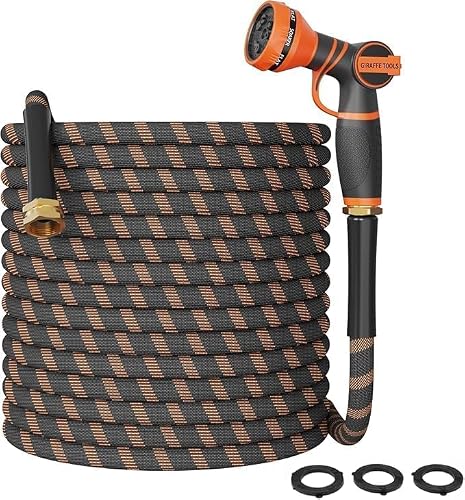
Giraffe Tools Expandable Garden Hose
The Giraffe Tools is a garden-tool brand whose expandable hoses are typically positioned around hybrid materials and sturdier fittings, aimed at buyers worried about durability. Treat it here as a prose-only profile rather than a linked recommendation: check the current listing for the exact configuration on offer, because lengths, nozzle bundles and fitting materials vary between versions and sellers, and the version matters more than the badge. In use, expect the standard expandable experience described throughout this guide: light in the hand, quick to deploy, happiest on smooth routes and short-to-medium runs, and dependent for its lifespan on being drained, dried and kept out of harsh sun. Judge it against your own route and habits rather than against an idealised hose, and it will either fit your garden clearly or rule itself out honestly, which is all a profile like this can fairly do.
Pocket Hose Expandable Garden Hose
The Pocket Hose is one of the best-known names in the category, sold as a compact, lightweight hose that expands under pressure and packs away into a very small space. Treat it here as a prose-only profile rather than a linked recommendation: check the current listing for the exact configuration on offer, because lengths, nozzle bundles and fitting materials vary between versions and sellers, and the version matters more than the badge. In use, expect the standard expandable experience described throughout this guide: light in the hand, quick to deploy, happiest on smooth routes and short-to-medium runs, and dependent for its lifespan on being drained, dried and kept out of harsh sun. Judge it against your own route and habits rather than against an idealised hose, and it will either fit your garden clearly or rule itself out honestly, which is all a profile like this can fairly do.

Flexi Hose Expandable Garden Hose
The Flexi Hose is a widely sold expandable model built around a stretchy inner core and woven outer sleeve, commonly offered in several lengths and usually bundled with a spray nozzle. Treat it here as a prose-only profile rather than a linked recommendation: check the current listing for the exact configuration on offer, because lengths, nozzle bundles and fitting materials vary between versions and sellers, and the version matters more than the badge. In use, expect the standard expandable experience described throughout this guide: light in the hand, quick to deploy, happiest on smooth routes and short-to-medium runs, and dependent for its lifespan on being drained, dried and kept out of harsh sun. Judge it against your own route and habits rather than against an idealised hose, and it will either fit your garden clearly or rule itself out honestly, which is all a profile like this can fairly do.
How to Get the Most Value If You Buy
Experienced owners develop small rituals that keep these hoses alive. Open the tap gradually rather than snapping it fully on, so the core stretches progressively instead of being shocked. Let the hose extend along its route before you start pulling it sideways around corners. When you finish a section, ease off rather than letting the contracting hose whip fittings against paving. Keep a spare washer or two in the same pot the hose lives in, so a tap-end drip is a thirty-second fix rather than a reason to abandon the session. And inspect the sleeve occasionally as you coil: small snags caught early can be kept away from rough routes before they become tears.
If the hose will feed from a tap that also serves other tools, a simple routine helps: expandable hose sessions start with a check that the nozzle is open or ready, so pressure never builds against a closed end while you walk to the far bed. Gardeners who water at dawn or dusk, when the sun is off the hose and the garden takes up water best, also remove the heat factor from the hose’s life entirely. Small things, all of them, but expandable hoses are a product where small things are the whole story: the design has little margin to give, so the owner’s habits supply the margin instead.
Maintenance for an expandable hose is refreshingly short as lists go. Drain after use, dry before storage, coil loosely, keep out of prolonged sun, keep off sharp and thorny routes, check washers when drips appear, and bring the hose indoors or into a frost-free spot before hard winter weather. There are no filters to change in the hose itself, no lubrication schedule and no servicing ritual. If a nozzle is fitted, its small inlet filter benefits from an occasional rinse, and a hose that has been used with liquid feed through a dilutor should be flushed with plain water before storage so residues do not sit in the core. That is the whole programme, and its brevity is part of the product’s appeal.
When something does go wrong, diagnosis is usually simple. A drip at the tap is almost always a washer or a cross-threaded connector. A loss of extension suggests the core has tired or the supply pressure has changed. A visible bulge or a sleeve worn through at one spot points to local damage from a sharp route or a pressure incident, and a hose with a damaged core should be retired rather than trusted, because a core that has failed once will fail again at the worst moment, usually mid-session with the tap far away. Keep the replacement decision calm and prompt; limping on with a bulging hose helps nobody.
One safety point belongs near the front of any honest discussion of garden hoses, and it matters more with expandable models than with almost any other watering tool: do not drink directly from a garden hose, and do not fill drinking glasses, water bottles or pet bowls straight from the nozzle as a habit. Garden hose materials, including the inner tubes and outer fabrics used in expandable designs, are not made or certified to drinking-water standards. Water that sits inside a warm hose between uses can also pick up tastes and residues from those materials. Use the hose for plants, washing and outdoor cleaning, and take drinking water from the kitchen tap instead.
Gardeners sometimes ask whether a quick sip on a hot afternoon really matters, and the sensible answer follows general guidance rather than alarm: hose water is for the garden, not for people. The inner core of an expandable hose is chosen for stretch and recovery, not for contact with drinking water, and the fittings are garden fittings rather than food-grade plumbing. Children in particular love drinking from a hose in summer, so it is worth setting the household rule early and kindly: the hose fills watering cans, paddling pools get filled and then emptied, and drinks come from indoors. That single habit removes the one genuine health question these products raise.
The Decision Checklist
- Is most of my watering pots, borders and washing near the house? Yes favours buying.
- Can I store the hose drained, dry and shaded every time? Yes is close to essential.
- Is my route mostly smooth, or am I willing to carry the hose over rough stretches? Yes favours buying.
- Will everyone who uses it follow the routine? Yes favours buying.
- Am I comfortable replacing a hose after some seasons of service? Yes favours buying.
- Do I mainly need long sprinkler sessions or a permanent outdoor hose? Yes favours skipping.
Four or more answers favouring buying, with the storage answer among them, is a confident yes. Any answer that reveals the hose will live charged, sun-baked or dragged over thorns is a confident no, whatever the other answers say. Gardeners in the genuine middle often resolve it by pairing tools: expandable for the daily round, conventional for the heavy work, and scheduled beds handed to the drip irrigation kit buying guide. Round out the evidence with expandable garden hose reviews, best watering cans for the smallest jobs, and best garden hoses for the conventional benchmark.
Deeper Notes From the Garden
Every expandable hose has a pressure limit, and honest writing about the category has to treat that limit qualitatively rather than with invented numbers. Domestic tap pressure varies from house to house and street to street, and a hose that behaves perfectly on one supply can be stressed on another, especially if a nozzle is left closed against a running tap or a booster pump feeds the line. The practical reading is simple: expandable cores are elastic by design, elasticity is what makes them convenient, and elasticity is also what sets a ceiling on how much sustained pressure the tube should be asked to hold. Open the tap gently, avoid leaving a charged hose baking in full sun, and never use one of these hoses with pressure-boosting equipment it was not sold for.
Burst stories in this category almost always share a plot: the hose was left pressurised, often in heat, often kinked or trapped underfoot, until the inner tube gave way at its weakest point. That is not a reason to fear the format; it is a reason to use it as designed. Water should be flowing or released, not stored under pressure inside a stretchy tube. If your household supply is known to run strong, or a previous hose has failed at the tap end, a traditional rubber hose tolerates that environment more forgivingly, and choosing one is not a defeat but a correct match of tool to conditions.
Fittings decide more real-world satisfaction than fabric patterns do. The connectors at each end are handled every session, threaded onto taps and nozzles, and asked to seal under pressure while being pulled at angles. Solid-feeling metal fittings, commonly brass in better models, generally inspire more confidence than thin plastic ones, which can crack if dropped on paving or overtightened by strong hands. Whatever the material, the habits matter as much as the hardware: thread connectors on straight, tighten by hand rather than with tools, replace the small rubber washer when a drip appears at the tap, and avoid yanking the hose sideways to test how strong the joint feels. Most leaks in this category are born at the ends, not in the middle.
A spray nozzle or gun is usually bundled or bought alongside, and it deserves a moment of the choosing effort. The nozzle is the part you actually hold, squeeze and adjust for an entire session, so its comfort and its spray patterns shape the experience more than the hose colour ever will. Look for a grip that suits your hand, settings that cover a gentle shower for seedlings through to a jet for rinsing paving, and a lock or a comfortable trigger if long watering rounds are your norm. Keep the nozzle’s filter washer clean, because grit caught there is a common and entirely fixable cause of disappointing spray.
Choosing length is the decision buyers most often get backwards, because the number on the box describes a hose under pressure, fully stretched, on a cooperative day. In the garden, corners, beds, pots and furniture all consume length, and a hose that must stretch to its absolute limit to reach the far bed will spend its life under maximum strain, which is exactly the life-shortening condition the format dislikes. The calmer rule is to measure the real route from tap to farthest plant, following the path the hose will actually travel rather than a straight line, and then choose the next size up. A little slack in use is comfort; permanent full extension is a slow form of damage.
Very long is not automatically better, either. A longer hose holds more water, takes longer to fill and drain, and gives you more fabric to coil, store and keep out of the sun. Gardeners with one tap and a genuinely large plot may need that length and accept the handling cost, but gardeners watering a terrace, a small lawn and a row of pots usually find a mid-length hose covers everything with far less fuss. Think in routes rather than in garden size: where the tap sits, which beds are watered daily, which are reached weekly, and whether a second shorter hose or a watering can serves the far corner more sensibly.
The classic mistakes with expandable hoses are so consistent that they read like a script. Buying by headline length and discovering the hose only reaches the far bed at full, straining stretch. Leaving the hose charged with the nozzle closed, in full sun, while lunch happens. Dragging the sleeve across gravel, thorns and the sharp corner of a raised bed. Storing it wet, tangled and forgotten in a corner of the shed. Running it from a pressure-boosting setup it was never meant for. And judging the whole category by a first failure that one of those habits caused. Every item on that list is avoidable with information rather than money, which is why guides like this one spend so long on habits.
Close behind the handling mistakes come buying mistakes. Choosing the thinnest, lightest model for a rough driveway garden. Ignoring the fittings because the fabric looked attractive. Assuming every expandable hose behaves the same when construction varies widely between brands. Forgetting to check what the tap end needs, so the new hose arrives and cannot connect without an adapter the household does not own. And buying a second identical hose after the first failed from mistreatment, without changing the mistreatment. The category rewards a thoughtful first purchase and gentle handling far more than it rewards spending in either direction.
More Practical Notes
Muddy dogs, bikes and boots form the unglamorous third of hose work, and the format handles it cheerfully. A quick deploy, a rinse at the back door, a drain and a coil away: the whole episode takes minutes, and because it takes minutes it actually happens, keeping mud out of the house and salt off the bike. Keep the jet setting for these jobs and away from plant stems, rinse the nozzle’s filter if the spray weakens after a gritty session, and remember that the dog’s drinking water, like everyone else’s, comes from the indoor tap.
Finally, a word about second hoses, because many households end up there. The second purchase is usually smarter than the first: the gardener now knows their route, their storage and their habits, and chooses length, fittings and build level from experience rather than from listings. Some buy the same again as a known quantity; some step up to a tougher build for a rougher route; some add a short hose for the front garden while the original serves the back. Treat the first hose as tuition as well as equipment, and the category’s economics look considerably kinder.
Tap compatibility is a quiet detail that decides whether a new hose delights on day one or waits a week for an adapter. Outdoor taps differ in thread and style between regions and house ages, and some are fitted with backflow devices or quick connectors from an earlier hose. Before ordering, look at your actual tap, note what is already attached to it, and plan for the connection the new hose will meet. Keep any adapter the household already relies on in the same storage pot as the hose, because a connector that lives elsewhere is a connector that will be missing on the first hot evening of the year.
Nozzle patterns deserve more respect than they usually get in hose discussions. A gentle shower waters seedlings and freshly sown beds without blasting soil away; a soft cone suits containers; a flat fan rinses paving; and a jet, used sparingly and never at close range on plants, shifts mud from boots and tools. The right pattern at the right moment is the difference between watering and weather-making, and gardeners who learn their nozzle properly find they use less water for better results. Practise the patterns on paving first, where the feedback is instant and nothing green is at risk.
Water conservation and expandable hoses get along well when the gardener is paying attention. Because the hose is light and pleasant, watering tends to be targeted: pot by pot, bed by bed, with the nozzle in hand and the flow under direct control, rather than a sprinkler broadcasting over paths and fences. Water early or late in the day so less is lost to evaporation, direct the flow at soil level rather than over foliage where possible, and let the hose’s convenience serve precision. A tool that makes careful watering easy is, indirectly, a water-saving tool.
Storage containers are an underrated part of the system. A simple terracotta or plastic pot by the back door, a wall basket in the shade, or a lidded box on the balcony gives the drained hose a home that keeps it dry, coiled and out of the sun. Ventilation matters: a container that traps damp against the sleeve invites the mustiness the care routine works to avoid. Size the container generously, because a hose crammed into too small a pot gets the tight bends and kinks that shorten its life. The container is cheap; the habit it enables is the valuable part.
Seasonal rhythm shapes hose life more than any single incident. Spring asks for inspection: uncoil the hose, check the sleeve for winter damage, run water through it and confirm the fittings seal before the busy season starts. Summer asks for shade discipline and the draining routine under maximum temptation to skip both. Autumn asks for one thorough clean, a full drain and a decision about indoor storage before the first hard frost. Winter asks only that the hose be left alone in its dry, frost-free place. Owners who think in seasons stop being surprised by their hoses.
Raised beds and expandable hoses are natural partners with one sharp caveat. The beds concentrate planting at a comfortable height, the hose reaches them easily, and hand-watering at soil level suits the deep, targeted soaking raised beds prefer. The caveat is the bed’s edge: timber corners, metal cladding and protruding screws are exactly the surfaces that wear sleeves. Approach raised beds from a consistent side, lift the hose over the edge rather than hauling it across, and check the route for hardware once at the start of the season. That single route habit protects the hose all summer.
Hanging baskets and window boxes make their own case for the format. They dry faster than any other planting, they sit high, and watering them with cans involves ladders, spills and repeated trips. A light hose with a gentle shower pattern, used from below or from a step, turns the basket round into a calm job, provided the gardener minds the contracting hose on the way down and keeps the sleeve off rough wall render. Baskets watered reliably are also baskets that actually thrive, which is the visible dividend of the whole arrangement by midsummer.
The Break-Even Question in Real Life: When an Expandable Garden Hose Pays Its Way
This section exists to ask the break-even question honestly, counting not just the purchase but the space, upkeep and attention the item will claim for as long as it is owned. It adds a layer that a feature list cannot give you, grounded in the garden & lawn context this expandable garden hose will actually live in. Where this guide names examples such as Giraffe Tools Expandable Garden Hose, Pocket Hose Expandable Garden Hose, Flexi Hose Expandable Garden Hose, use them as test cases for the checks below rather than as shortcuts past them.
Finally, plan the first fortnight. Decide where the expandable garden hose will live from day one, what it replaces, what accessory or companion it needs straight away and what small job you will use to learn its habits while returning it is still simple. Keep the packaging until that learning period is over, note anything that surprises you, and deal with a mismatch early rather than adapting yourself around a poor fit for years. The households that end up happiest with a expandable garden hose are rarely the ones that researched longest; they are the ones that checked fit honestly, bought for the ordinary week, and paid attention during the first days instead of assuming the decision ended at checkout.
One more angle is worth your time: the second-order costs. A expandable garden hose changes what happens around it. It can demand a different cleaning product, a new storage habit, a moved piece of furniture, a rearranged cupboard or a standing arrangement with the people you live with. List those knock-on effects before you buy and decide whether you accept them as part of the deal. Sometimes the answer is an easy yes, and the expandable garden hose earns its place by improving the whole routine around it. Sometimes the honest answer is that the supporting changes are the real project, and the purchase should wait until you are ready for them. Either answer is useful; the only bad outcome is discovering the knock-on effects by accident, one irritation at a time, after the decision can no longer be revisited.
It also helps to separate the problems a expandable garden hose can solve from the problems it merely moves. If the underlying difficulty is space, the answer may be a smaller format or a different location rather than a more elaborate model. If the difficulty is time, look for the option that removes steps rather than the one that performs each step slightly better. If the difficulty is that several people want different things, a compromise design that everyone rates as good enough will usually outlast a specialist design that one person loves and everyone else avoids. Naming the real problem in one sentence, out loud, before you order, is a surprisingly powerful filter, and many shoppers find that the sentence itself points at a different expandable garden hose than the one they started out researching.
Start with the unglamorous measurements. For a expandable garden hose, the numbers that decide satisfaction are rarely the headline ones in a listing; they are gate width, path slope, storage in a shed that is already full and how far the work really is from the nearest tap or socket. Write the real dimensions of your space down, including the awkward constraints you normally work around without thinking, and hold every contender up against that sheet rather than against a showroom photograph. Then walk the route the expandable garden hose will take on delivery day and during normal use. A choice that fits on paper but fights you every time it is moved, opened, cleaned or stored will lose its shine quickly, however strong its other qualities look in a comparison table.
Frequently Asked Questions
Is an expandable garden hose worth it for a small garden?
Usually yes, and small gardens are its strongest case. Runs are short, routes are typically smooth, storage space is precious and watering is frequent and close to the tap — exactly the conditions where lightness and compactness shine and the durability trade matters least. A small-garden owner who drains and stores the hose properly can expect several seasons of genuinely pleasanter watering, which is the whole value proposition working as designed.
How long does an expandable hose need to last to be worth it?
Think in seasons of daily convenience rather than in a single threshold. If the hose serves several seasons of container rounds and washing jobs, most owners judge it clearly worthwhile; if handling or storage cuts that to a single summer, most judge it a poor buy at any price. Since handling is largely yours to control, the worth-it question and the will-I-follow-the-routine question are really the same question asked twice.
Is it worth buying a premium expandable hose over a basic one?
Spending on sturdier fittings, denser sleeves and more substantial construction is generally the spend owners feel, because those parts decide daily satisfaction and delay the common failures. Spending on extravagant claims buys nothing, and no price removes the format’s core trade-offs. The balanced route is a solidly built model, handled well — construction and habits together, not either one alone, produce the good outcome.
Is an expandable hose worth it for watering a lawn?
For a small lawn patch watered by hand or with a small sprinkler occasionally, it can be. For lawn-led households running sprinklers long and often, it is usually not: a conventional hose on a reel is steadier, tougher and better matched to static, extended sessions. Be honest about the proportion of your watering that is lawn, because that proportion, more than garden size, decides this version of the question.
What is the main hidden cost of owning one?
The routine. Draining after every session, drying before storage, keeping the hose shaded and off sharp routes, and replacing it when the core tires are the real ongoing costs, all paid in attention rather than money. Households that find the routine easy — many gardeners fold it into the watering round itself — experience the hose as nearly costless. Households that know they will skip it should count that honesty as the answer and buy rubber.
Can an expandable hose and a regular hose both be worth owning?
Yes, and this is the arrangement many experienced gardeners settle into. The expandable hose handles the frequent, light, near-the-house work where its convenience compounds daily; the conventional hose handles sprinklers, rough routes and permanent outdoor duty where durability compounds yearly. Each tool is then used inside its strengths, neither is asked to be the other, and the worth-it question dissolves into a division of labour that simply works.


