Disclosure: As an Amazon Associate, dailyhomedecorating.com earns from qualifying purchases. Links on this page are affiliate links; they cost you nothing extra. Prices and availability change often, so check the current Amazon listing before you buy.
This airtight food storage containers buying guide exists because the category looks simple and is not. Every set promises freshness, yet sets differ enormously in how their lids seal, which foods they suit, how they stack, and how long the mechanism survives daily use. Choose well and you buy a pantry system that quietly works for years; choose on looks alone and you inherit a drawer of almost-right lids and cereal that still goes soft. The next few thousand words break the decision into the parts that actually matter, then walk through the leading sets and the households each one fits.
A quick orientation before the detail. Airtight containers earn their name from a gasket, a soft ring of silicone or rubber compressed between lid and rim, and everything else about a container, its clips, latches, hinges or button, exists to keep that compression even. Dry goods are the home turf of this category: flour, rice, pasta, cereal, sugar, snacks and coffee. Some sets extend confidently into fridge, freezer and lunchbox duty; many pantry specialists do not, and confusing the two groups is the single most common buying mistake in this category.
Key Takeaways
- The gasket is the product: lid mechanisms matter only as the means of compressing it evenly.
- Match the set to your dominant use first, dry pantry, wet fridge food, or both, before comparing brands.
- Measure shelf height, depth and your largest staple bags before ordering any bundle.
- Fast lids win on high-turnover shelves; locking lids win wherever liquids are involved.
- Uniform footprints and shared lids are what make a pantry stay organised after week one.
Airtight Food Storage Containers Buying Guide: What a Set Actually Does
An airtight container limits the exchange of air between its contents and the kitchen. That one act slows nearly every way dry food declines: oxygen can no longer freely oxidise the fats in nuts, wholegrain flour and coffee; humidity can no longer soften crackers and cereal or cake flour and sugar; aromas stay in the food instead of perfuming the cupboard; and pantry pests, which usually arrive inside a purchased bag, cannot spread from one staple to the next. The container is therefore less a box than a boundary, and the quality of that boundary is set by the seal.
What a set does not do is equally important for a realistic purchase. It does not vacuum-seal, it does not rescue food that was already stale, and it does not cancel heat or time. It buys weeks to months of extra good life for dry staples, keeps a pantry visibly stocked and auditable, and turns a cupboard of torn bags into a system you can shop against. Households that cook from staples feel that difference daily; households that store little will feel it less, which is why this guide keeps returning to how your kitchen actually runs.
In this guide
The Main Types of Airtight Food Storage Containers
Push-Button Canisters
Push-button sets seal when you press the lid’s central button, driving the gasket outward or downward in one motion. They are the fastest serious seal to use, work one-handed, and look clean enough for open shelving. Their natural home is the dry pantry, especially a baker’s pantry, and their natural limit is liquid: the seal is built for freshness, not transport. If your mental picture of success is a flour canister you can open mid-recipe with a scoop already in your other hand, this is your type.
Locking and Latched Containers
Locking lids use latches or hinges on two or four sides to clamp the gasket down with real force. That force buys the category’s most trustworthy seals, including with liquids, which is why locking sets are the default recommendation for leftovers, meal prep, freezing and lunch bags. The cost is speed and size: each opening takes two hands and a few seconds, and the hardware widens the footprint. Many households run locking containers as their wet-food fleet even when the dry pantry belongs to a faster system.
Clip-Lid Containers
Clip lids press a gasketed lid down with clips on each side. They sit between flip-tops and full locking systems in both sealing force and effort, and their simplicity is the point: no mechanism to learn, easy for children, easy to replace. Clip sets tend to offer the broadest size ranges at friendly prices, which makes them the pragmatic choice for covering an entire family pantry in one purchase. Their clips are the wear point over years, and their seal, while genuinely airtight for dry goods, is not the one to trust with soup in a bag.
Flip-Top Pantry Bundles
Flip-top bundles sell uniformity: many same-footprint canisters, a thumb-press lid, and often labels and a measuring cup in the box. They are dry-goods specialists, and for a first full pantry reset they are unbeatable theatre and genuinely useful storage at once, transforming a shelf in an afternoon. The seal is a freshness seal, the lids prefer gentle treatment, and the sizes are chosen by the bundle rather than by you, so shelf measurements matter more with this type than any other.
Top Picks at a Glance
The table below is a map, not a ranking carved in stone. Each set is the right answer for a recognisable household, and the mini-reviews that follow this guide’s criteria sections explain the fit in full. Tiers are described in words rather than prices, because prices move; check price on Amazon for any set you shortlist.
| Set | Badge | Tier | Seal style | Best home |
|---|---|---|---|---|
| OXO Good Grips POP Container Set | Best for Bakers | Premium tier | Push-button gasket | Dry pantry, baking staples |
| Rubbermaid Brilliance Pantry Set | Best All-Rounder | Mid-to-premium tier | Latched gasket, liquid-tight | Pantry, fridge, freezer, transport |
| LocknLock Easy Essentials Set | Best Locking Seal | Mid tier | Four-hinge gasket | Mixed wet and dry storage |
| Sistema Klip It Plus Set | Best Family Value | Entry-to-mid tier | Four-clip gasket | Whole-pantry coverage |
| Vtopmart Airtight Food Storage Containers Set | Best Pantry Reset Bundle | Entry tier | Flip-top gasket | Dry goods, first system |
| Chef’s Path Airtight Food Storage Containers Set | Best for Tall Items | Entry-to-mid tier | Flip-top gasket | Spaghetti, cereal, flour |
How Strong Does the Seal Need to Be?
Seal strength is not a single ladder from bad to good; it is a match between force and food. Dry staples need the air exchange limited, and every mechanism in this guide achieves that when the gasket is healthy. Liquids need more: the seal must resist sloshing, tilting and the pressure of being carried, which is locking-lid territory. A useful home test for any container you already own is to seal in a little water, tilt it over the sink, and watch the rim; for dry-goods canisters, the equivalent test is whether the lid lifts the body when you lift the lid, a rough sign the gasket is gripping.
Remember also that seals age. Gaskets stiffen, clips loosen, and a set that was airtight in year one may merely be covered in year four. Brands that sell replacement gaskets and lids extend a set’s honest life considerably, and that support is worth weighing alongside the initial purchase, particularly for premium systems you intend to keep. Our deeper look at the trade-offs on both sides lives in the companion piece, airtight food storage containers pros and cons, which weighs the daily benefits against the real annoyances without salesmanship.
How Much Capacity Do You Need?
Capacity planning starts from your shopping, not from a product page. Note the largest bag you buy of flour, rice, sugar and cereal, and choose canisters that swallow that bag whole with slight headroom. A set that leaves a third of the flour bag behind has failed at its main job. Then work downward: medium canisters for pasta, oats and secondary grains; small ones for cocoa, cornflour, nuts and seeds; and the smallest for leaveners, which lose potency fastest and deserve a dated, sealed home of their own.
Beware the two sizing illusions. The first is volume quoted without shape: a tall narrow canister and a short wide one of equal volume behave completely differently on a shelf and at pouring time. The second is the bundle photograph, which shows every container filled on a deep, tall shelf that may not resemble yours. Measure, sketch the row, and let the sketch veto the bundle if it must. The step-by-step version of this thinking is laid out in how to choose airtight food storage containers, which turns these criteria into an ordered method.
Which Material Suits Your Kitchen?
Most pantry systems are food-grade plastic, and for dry goods that is a rational default: light on high shelves, resistant to drops, clear enough to audit stock at a glance, and affordable in full sets. Glass is the connoisseur’s alternative, inert and stain-proof, but heavier, breakable and usually sold as fridge and oven ware rather than as a modular pantry system; the head-to-head in airtight food storage containers vs glass food storage containers works through that comparison properly. Within plastics, look for bodies that stay clear after washing, lids whose parts you can rinse and dry fully, and a brand whose sizes remain stable so the set can grow.
How to Prioritise by Use Case
The Weekly Baker
Prioritise mouth width, one-handed lids and a genuinely large flour canister. You will open these containers mid-task, with messy hands, more than any other user, so speed and pour control outrank liquid sealing. A push-button or good clip system, a scoop that lives with the flour, and a dedicated sealed home for brown sugar will transform your baking more than any other single purchase in this category.
The Meal Prepper
Prioritise the seal and the fridge. Your containers carry liquids, stack under weight and cycle through the freezer, so a latched or locking set with shared lid sizes is the backbone. Pantry canisters still help for the dry ingredients behind the prep, grains, lentils and spices, but they are the supporting cast. Buy for the wet job first and let the dry system be simpler.
The Family Pantry Reset
Prioritise coverage, uniformity and lids the whole household will actually close. A broad clip-lid range or a uniform flip-top bundle, labelled on day one, beats an exquisite half-set that leaves half the staples in bags. Include the children in the brief: if the youngest cannot open the cereal canister, the system will be defeated by breakfast within a week. Our verdict on whether the whole project repays its cost is examined in are airtight food storage containers worth it.
The Small-Kitchen Minimalist
Prioritise footprints and restraint. Choose one system whose sizes divide your shelf cleanly, stack two high at most, and nest when empty. In a small kitchen every container must itself be stored, so a tight fleet of versatile sizes outperforms a sprawling collection. The organisation habits in best storage baskets for shelves and closets pair well with a sealed system when shelf space is the scarcest resource in the home.
The Sets in Detail

OXO Good Grips POP Container Set
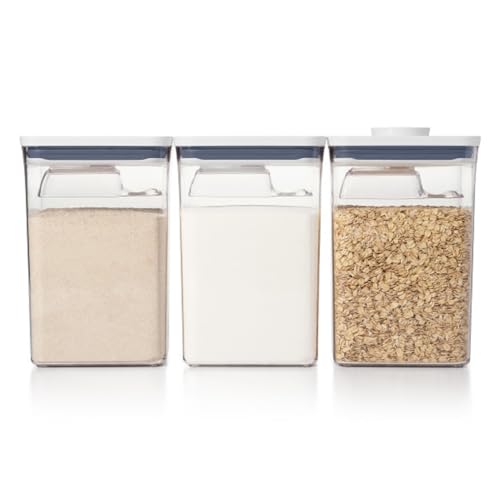
The OXO Good Grips POP line is the set most pantry organisers reach for when looks matter as much as sealing. The lid seals with a single push of the central button, which drives a silicone gasket down against the rim, and the same button doubles as a handle for lifting the lid clear. In daily use that one-handed operation is the real advantage: you can open a flour canister while your other hand holds a scoop, and the lid goes back on with a press rather than a wrestle. The bodies are clear, the corners are rounded for pouring, and the lids are designed so containers stack into a flat, stable grid instead of a leaning tower.
Where the POP system earns its keep is the ecosystem around it. Scoops that clip under the lid, levelers for flour, and brown-sugar savers all exist because the range has been stable for years, so a set bought today still matches accessories bought later. The trade-offs are equally clear. The lids are not meant to be submerged for long soaks, the gasket needs a proper dry before reassembly, and the push-button seal is a freshness seal rather than a liquid-tight one, so this is a dry-goods specialist, not a soup carrier. Treat it as pantry furniture for flour, sugar, rice, pasta and cereal and it is hard to fault; ask it to do fridge and lunchbox duty as well and other sets do that wider job better.
Strengths
- One-handed push-button opening and closing
- Flat lids stack into a stable, tidy grid
- Large accessory ecosystem that stays compatible over time
Trade-offs
- Freshness seal is not designed for liquids
- Lids need full drying before reassembly
- Premium tier pricing for full-pantry coverage
Best for: readers who want a premium tier system with a clear job to do. Not suited for: anyone expecting one container to be perfect at every task in the kitchen.

Rubbermaid Brilliance Pantry Set
Rubbermaid Brilliance is the workhorse answer to the question of one set that can do pantry, fridge and freezer without apology. The lids latch on both sides and seal with a silicone gasket, and the seal is genuinely liquid-tight, so a container of stock or marinated chicken can travel in a bag without the slow leak that ruins trust in a storage system. The bodies are crystal clear and notably stain resistant, which matters for tomato sauces, turmeric-heavy curries and beet salads that cloud lesser plastics within a few uses. Vents under the latches let you microwave with the lid ajar rather than fully removed, cutting splatter without extra dishes.
As a pantry system, Brilliance brings a modular footprint: the containers share lid sizes across several capacities, so you are not hunting through a drawer of near-miss lids. The latches do add width, and the chunkier lid profile means a Brilliance row takes slightly more shelf depth than a slim push-button set. The lids also have more moving parts to rinse after a greasy meal-prep session. None of that undermines the central proposition: if your containers must move between dry goods, leftovers, freezer portions and a lunch bag, this is the most forgiving single system to own, and its clarity keeps fridge audits quick.
Strengths
- Liquid-tight latched seal suits fridge, freezer and transport
- Clear bodies resist staining from sauces and spices
- Shared lid sizes across capacities simplify storage
Trade-offs
- Latched lids take more shelf width and height
- Hinges need rinsing after greasy foods
- Costs more than basic clip-lid sets
Best for: readers who want a mid-to-premium tier system with a clear job to do. Not suited for: anyone expecting one container to be perfect at every task in the kitchen.

LocknLock Easy Essentials Set
LocknLock built its reputation on the four-hinge locking lid, and the Easy Essentials line carries that design into everyday pantry and fridge service. Each lid locks on four sides over a silicone gasket, producing a seal that handles liquids with confidence and keeps dry goods genuinely fresh. The four-hinge system has a long track record, replacement pieces circulate widely, and the containers nest when empty, which matters more than it sounds in a small kitchen where the container drawer is prime real estate.
Four hinges are also the friction point: each lid takes a few seconds longer to open and close than a flip-top, and the hinge tabs add width, so the densest possible pantry grid belongs to slimmer designs. The lids are also the part to wash carefully after oily foods. In exchange you get one of the most trustworthy seals in mainstream food storage, equally at home with flour, soup, cut fruit and a freezer portion of bolognese. For households that want one locking system everywhere rather than specialists per zone, LocknLock remains the benchmark the imitators are measured against.
Strengths
- Four-hinge locking seal handles liquids confidently
- One system covers pantry, fridge and freezer
- Empty containers nest to save drawer space
Trade-offs
- Hinges are slower than flip-top or push-button lids
- Hinge tabs widen the footprint
- Crevices need rinsing after oily foods
Best for: readers who want a mid tier system with a clear job to do. Not suited for: anyone expecting one container to be perfect at every task in the kitchen.

Sistema Klip It Plus Set
Sistema Klip It Plus is the practical, no-drama option: four clips snap the lid down onto a gasket, the bodies are sturdy, and the range covers everything from small herb portions to large cereal keepers. The clip system is easy to understand, easy to teach to children and housemates, and forgiving of being tossed into a dishwasher basket. Sistema has sold versions of this design for years, which means replacement lids and add-on sizes are easy to find, and the modular footprints stack in predictable columns in both pantry and fridge.
The seal is a freshness seal with real grip, but the clips do not deliver the same liquid security as a fully latched premium lid, so soups travel better in a screw-top or latch-lock container. The clips themselves are the wear point: after years of daily use a clip can loosen, and the honest fix is replacing the lid rather than fighting it. Within its lane, though, Klip It Plus is excellent value discipline. It keeps dry goods fresh, handles leftovers competently, survives family use, and lets you build a big, consistent system without the premium-tier bill that fancier mechanisms bring.
Strengths
- Four-clip lids are simple for the whole household
- Broad size range with modular, stackable footprints
- Strong value for covering a whole pantry
Trade-offs
- Clip seal is not the best choice for transporting liquids
- Clips are the long-term wear point
- Functional styling rather than display styling
Best for: readers who want a entry-to-mid tier system with a clear job to do. Not suited for: anyone expecting one container to be perfect at every task in the kitchen.

Vtopmart Airtight Food Storage Containers Set
The Vtopmart set is the bundle that made uniform pantry systems affordable at scale: multiple same-footprint canisters with flip-top lids, sold with labels and a measuring cup in many configurations. The lids open with a thumb press on the front edge, which is fast for cereal, oats, rice and snack refills, and because every container in the bundle shares a footprint, a shelf of them lines up with the satisfying regularity that makes a pantry feel finished. For a first full pantry reset, that uniformity is the entire appeal: buy the bundle, decant everything, label it, and the cupboard transforms in one afternoon.
The trade-offs arrive with time and liquids. Flip-top seals are freshness seals; they keep dry goods well but are not the lids to trust with stock or dressings. The lids reward gentle washing, and the sheer number of containers means you should measure your shelves before ordering, because a bundle that does not match your shelf heights creates a second storage problem. Used as intended, for dry pantry staples in a high-turnover kitchen, Vtopmart delivers the organised look and the pest-resistant, air-limiting storage that motivates the purchase, at the friendliest entry cost in this group.
Strengths
- Uniform footprints make a full pantry reset fast
- Flip-top lids are quick for daily dry-goods access
- Bundles often include labels and a measuring cup
Trade-offs
- Freshness seal only, not for liquids
- Lids last longest with gentle hand washing
- Fixed bundle sizes require shelf measuring first
Best for: readers who want a entry tier system with a clear job to do. Not suited for: anyone expecting one container to be perfect at every task in the kitchen.
Chef’s Path Airtight Food Storage Containers Set
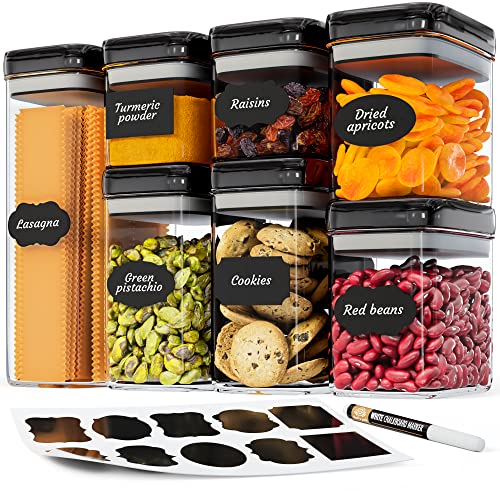
Chef’s Path sells the same organised-pantry promise as the big bundle brands, with an emphasis on taller canisters for spaghetti, cereal and flour, plus the small touches that make a set feel complete on day one: chalkboard-style labels, a marker and measuring cups in many bundles. The lids use a flip-top mechanism with a silicone sealing ring, and the bodies are clear enough to read contents and levels at a glance. For households whose pantry pain is specifically tall items tipping out of torn boxes, the height range in these bundles is the differentiator.
As with every flip-top system, the seal is about freshness for dry goods, not about carrying liquids, and the lids should be kept out of long dishwasher exposure if you want the hinges to stay tight. The brand’s bundles vary, so read the size list carefully and match it against your actual shelf dimensions rather than the photograph. Judged on its intended job, decanting a dry-goods pantry into a labelled, uniform, pest-resistant system, Chef’s Path is a capable and good-looking option that undercuts the premium canister brands while covering the same shelves.
Strengths
- Tall canisters suit spaghetti, cereal and flour
- Labels and measuring extras included in many bundles
- Clear bodies make stock levels obvious
Trade-offs
- Dry-goods freshness seal, not for liquids
- Bundle contents vary, so sizes need checking
- Flip-top hinges prefer gentle washing
Best for: readers who want a entry-to-mid tier system with a clear job to do. Not suited for: anyone expecting one container to be perfect at every task in the kitchen.
First Setup and Care Essentials
Wash and fully dry every container before its first fill, and decant onto a clean, dry scoop. Set up the pantry in one pass if you can: empty each staple completely rather than topping up, label with the product and the month it was decanted, and copy any expiry date from the packaging you are discarding. Keep the heaviest canisters low, the daily ones at the front, and leave one medium container unassigned for the orphan item that always appears. From then on, the maintenance rhythm is light: gaskets rinsed and dried every few weeks, lids air-dried rather than sealed away damp, and a monthly glance at levels while you cook.
The same discipline scales beyond the pantry. The households that keep a sealed system tidy tend to apply the same labelled, visible logic elsewhere, from best under-bed storage options to best vacuum storage bags for seasonal textiles. Visibility plus a boundary, a lid, a bag, a label, is the whole philosophy; the containers are simply where it pays fastest.
Mistakes to Avoid
Four mistakes account for most disappointment in this category. Buying a dry-goods set for liquid duty, and then blaming the seal. Buying a bundle before measuring a shelf. Topping up containers indefinitely so the oldest food never surfaces. And mixing three half-systems so no lids match and the decanting habit dies of friction. Every one of them is avoidable at the ordering stage with the checks in this guide, which is why the guide spends more words on fit than on brands. When you are ready to compare individual sets head-to-head, the hands-on assessments in airtight food storage containers review and the broader sweep in airtight food storage containers reviews continue from here.
Before You Commit: A Hands-On Fit and Compatibility Check for Airtight Food Storage Containers
This section exists to treat this as the final check before money changes hands, the point where a shortlist stops being a list of features and becomes a decision about one specific home. It adds a layer that a feature list cannot give you, grounded in the food storage & organization context this airtight food storage containers will actually live in. Where this guide names examples such as OXO Good Grips POP Container Set, Rubbermaid Brilliance Pantry Set, LocknLock Easy Essentials Set, use them as test cases for the checks below rather than as shortcuts past them.
Consider the edge cases that sit just outside normal use, because a airtight food storage containers will meet all of them eventually. The unusually large load, the unusually small task, the day you are in a hurry, the day something else in the room is broken and this has to cover for it. Versatility is not about a long feature list; it is about behaving predictably when conditions are imperfect. Where a design offers settings, modes, attachments or configurations, ask what each one is actually for in your home, and be suspicious of flexibility you cannot attach to a real occasion. One well-judged configuration used weekly beats five clever ones used once, and the honest airtight food storage containers for your home is the one whose strengths line up with your most frequent edge case, not your rarest.
Build a simple decision checklist and score it in writing. Five lines are enough: fit in the space, fit with the routine, ease of cleaning or upkeep, quality of the parts that move or wear, and how the airtight food storage containers will be stored or will look when it is not the centre of attention. Score each contender quickly, then look only at the lowest scores, because purchases are usually ruined by their weakest point rather than saved by their strongest. If two options tie, choose the one whose weakness is cheapest or easiest to live with. This sounds mechanical, and it is meant to: a written checklist is the best defence against the very human habit of falling for the last photograph you looked at.
Finally, plan the first fortnight. Decide where the airtight food storage containers will live from day one, what it replaces, what accessory or companion it needs straight away and what small job you will use to learn its habits while returning it is still simple. Keep the packaging until that learning period is over, note anything that surprises you, and deal with a mismatch early rather than adapting yourself around a poor fit for years. The households that end up happiest with a airtight food storage containers are rarely the ones that researched longest; they are the ones that checked fit honestly, bought for the ordinary week, and paid attention during the first days instead of assuming the decision ended at checkout.
One more angle is worth your time: the second-order costs. A airtight food storage containers changes what happens around it. It can demand a different cleaning product, a new storage habit, a moved piece of furniture, a rearranged cupboard or a standing arrangement with the people you live with. List those knock-on effects before you buy and decide whether you accept them as part of the deal. Sometimes the answer is an easy yes, and the airtight food storage containers earns its place by improving the whole routine around it. Sometimes the honest answer is that the supporting changes are the real project, and the purchase should wait until you are ready for them. Either answer is useful; the only bad outcome is discovering the knock-on effects by accident, one irritation at a time, after the decision can no longer be revisited.
Frequently Asked Questions
What makes a food storage container truly airtight?
A compressible gasket is what makes the difference. Clips, latches, hinges or a push button press a silicone or rubber ring between the lid and the rim, filling the tiny gaps that hard plastic alone leaves open. That compression sharply limits air exchange, which slows oxidation, moisture transfer and aroma loss, and blocks pantry pests. A lid that merely sits on top, however neatly, is a cover, not a seal, and foods stored under it stale at nearly the same rate as in an opened bag.
Are plastic airtight containers safe for everyday food storage?
Food-grade plastics sold for food storage by established brands are made for exactly this contact, and dry pantry goods are the gentlest duty in the kitchen: room temperature, no reheating in the container, no long contact with hot or acidic food. If you prefer to minimise plastic for wet, hot or reheated food, use glass for leftovers and reheating and keep plastic for the dry pantry, which is the hybrid arrangement many households settle on. Whichever material you choose, retire containers whose bodies are cracked or deeply scored.
How many containers does a typical pantry need?
Count your staples rather than guessing. Most households decant somewhere between eight and fifteen dry goods: one or two flours, sugar and brown sugar, rice, a couple of pasta shapes, oats or cereal, a grain or lentil, nuts or seeds, coffee, and small items like cocoa and cornflour. That translates to one large canister per bulk staple, mediums for the weekly items and smalls for the potent little things. Buy a system whose sizes you can add to later, because the count always grows by two.
Can airtight containers go in the freezer?
Locking, gasketed containers designed for wet food usually can, with headroom left for expansion as food freezes. Pantry canisters are a different matter: flip-top and push-button lids are generally dry-storage designs, and their bodies may not be freezer-rated. Check the specific set’s guidance rather than assuming, and never press a dry-goods canister into freezer service because it happens to fit. A small dedicated fleet of freezer-safe locking containers is the reliable arrangement.
Why did my cereal still go soft in a sealed container?
Three causes cover nearly every case. The gasket may be dirty, mis-seated or worn, so the seal is nominal rather than real; remove it, wash it, dry it fully and reseat it. The cereal may have been sealed while the container held humid air from a recent wash that had not fully dried. Or the food itself may have been near the end of its life when decanted. A healthy seal slows staling dramatically but cannot reverse it, which is why decanting fresh shopping promptly matters.
Is it better to buy a set or individual containers?
A set is better value and guarantees shared footprints and, often, shared lids, which is what keeps a pantry orderly. Individual containers make sense when your staples have unusual shapes, very tall pasta, very wide flour bags, or when you are extending a system you already own. The common failure mode is the reverse of both: several partial sets from different brands that stack badly and match nothing. Commit to one system’s geometry for the pantry, even if a second system handles your fridge.
Related Guides
- airtight food storage containers pros and cons
- airtight food storage containers review
- airtight food storage containers reviews
- airtight food storage containers vs glass food storage containers
- are airtight food storage containers worth it
- how to choose airtight food storage containers
- best storage baskets for shelves and closets
- best under-bed storage options
- best vacuum storage bags
How an Airtight Seal Actually Works
An airtight seal does not create a vacuum, and it does not need to. What it does is sharply limit the exchange of air between the inside of the container and the room, and with that exchange goes most of what makes stored food decline. Oxygen drives oxidation in fats, which is why nuts, wholegrain flours and coffee turn rancid in a half-open bag but stay sweet for far longer in a sealed canister. Moisture moves the other way: dry goods like crackers, cereal and brown sugar pull humidity from kitchen air, while flour and rice can cake or stale as their moisture balance shifts. A gasketed lid interrupts both flows at once.
The gasket is the working part. Silicone or rubber is compressed between lid and rim, filling the microscopic gaps that hard plastic alone cannot close, and the lid mechanism, whether clips, latches, hinges or a push button, exists mainly to keep that compression even. This is why a lid that rocks, a gasket that has gone stiff, or a rim with a crack quietly turns an airtight container into an ordinary box. It is also why seals should be tested rather than assumed: a container that cannot hold its lid under a gentle lift by the lid alone is telling you the gasket is no longer doing its job.
Pantry Pests and Why Sealed Containers Stop Them
The most persuasive argument for airtight storage is not freshness but containment. Pantry moths and weevils typically arrive inside a purchased bag of flour, grain or pet food, not through your walls, and in paper or thin plastic packaging they spread from product to product until half the cupboard is infested. A rigid container with a real gasket breaks that chain in both directions: an infested product cannot seed the shelf, and clean products cannot be reached. Experienced bakers decant flour on arrival for exactly this reason, treating the container as quarantine as much as storage.
Sealing also removes the smells that attract pests in the first place. An open bag of rice or dog kibble advertises itself; a gasketed canister is close to odour-neutral from the outside. If you ever do find webbing or larvae in one container, the system pays for itself in that moment: you discard one sealed unit instead of stripping and treating an entire pantry. Freezing a new bag of flour for a few days before decanting is a belt-and-braces habit many bakers adopt, but the container is the structural defence that works every day without thought.
Sizing a Set to What You Actually Store
More pantry regret comes from wrong sizes than from wrong brands. The working method is unglamorous: list what you decant, weigh or measure the largest bag you buy of each, and match container capacity to that bag with a little headroom. Flour is the classic trap, because a standard large bag needs a genuinely big canister, and a set whose largest container falls short leaves you with a canister plus the original bag, which defeats the exercise. Tall items set their own requirement: spaghetti and lasagne sheets need height that many uniform bundles split across two sizes.
Depth matters as much as volume. A container wider than your shelf is deep will overhang or force a sideways layout that wastes the row behind it, and a canister too tall for the shelf simply exiles itself to a counter. Measure shelf height, depth and the gap between shelves before ordering any bundle, and sketch the row you intend. It takes ten minutes and prevents the most common return in this category. Finally, leave one flexible size unassigned; every pantry develops an orphan item, from couscous to cornmeal, that needs a home the plan did not foresee.
Stacking, Footprints and the Geometry of a Tidy Shelf
A pantry looks organised when containers share footprints, and chaotic when they do not, almost regardless of brand. Shared footprints let containers stack in stable columns and line up in rows with no wedge-shaped gaps, and flat lids turn the top of each container into the base of the next. Round canisters have a nostalgic charm but waste the corners of every shelf and resist stacking; square and rectangular bodies use the full geometry of a cupboard. This is the quiet reason uniform bundles photograph so well: the order comes from the geometry, not the styling.
Stacking has limits worth respecting. Two high is a working stack; three high becomes a demolition risk every time you reach for the bottom one, especially with heavy flour or rice. Heavy staples belong on the lowest shelf or the bottom of any stack, both for safety and because a full flour canister is an awkward lift from above shoulder height. Lids that nest or lock slightly into the base below add real stability. When in doubt, favour a wider, shorter container over a taller twin of the same volume: it stacks better, pours better and fits more real shelves.
Labels, Dates and the Discipline of Knowing What You Have
A clear container tells you what a food is and roughly how much is left; it does not tell you when it went in, and that gap is where waste creeps back. The settled habit is minimal: a label with the product name and the month and year it was decanted, plus the expiry date copied from the original packaging when there is one. Chalkboard labels, erasable markers on smooth plastic, and simple masking tape all work; the medium matters less than the consistency. Labels also rescue lookalike staples, since plain flour, self-raising flour and bread flour are visually identical and behave very differently in a recipe.
Rotation completes the system. When a staple runs low, the refill goes in only after the container is emptied and quickly washed, or the fresh bag is poured on top only when the remainder is small and the same product. Topping up indefinitely buries the oldest food at the bottom forever. A monthly glance while cooking, checking levels and dates, turns the pantry from a cupboard of surprises into a stock list you can shop against, which is where sealed storage quietly starts saving money as well as freshness.
What Airtight Storage Can and Cannot Do for Freshness
Airtight storage slows staling; it does not stop time. Crackers soften because they trade moisture with the air, and a good seal slows that trade to a crawl. Coffee and spices fade because their aromatic compounds oxidise and evaporate, and limiting air exchange keeps more of both in the food. Wholegrain flours and nuts carry fragile fats that oxygen turns rancid, which is why they benefit most dramatically from a sealed canister, and why many bakers keep wholegrain flour in the freezer in its sealed container for the longest life of all.
The limits deserve equal clarity. A sealed container cannot revive food that was stale when it went in, cannot protect against heat, which is why the pantry should be cool and away from the oven wall, and cannot substitute for buying sensible quantities of slow-moving items. Light also degrades some foods, though a closed cupboard solves that for most households. Used with realistic expectations, a good seal typically stretches the good life of dry staples from days in an open bag to weeks or months in a canister, and that difference is the entire economic case for owning a set.
The Baker’s Pantry: Flours, Sugars and Leaveners
Baking staples are the strongest case for airtight storage because they are hygroscopic, pest-prone and used in precise mixtures. Flour cakes and compacts as it trades moisture with the air, and a compacted cup measures heavier than a fresh one, quietly skewing recipes. Brown sugar is the famous casualty: left to dry air it sets into a brick, while a well-sealed canister keeps it scoopable for months. Baking soda and baking powder lose potency as they absorb moisture and odours, and both are cheap insurance to keep sealed and dated.
A baker’s layout usually runs one large canister for the main flour, a medium for sugar, smaller ones for brown sugar, cocoa and cornflour, and small sealed jars for leaveners and salt. Wide mouths matter here more than anywhere, because a measuring cup should enter the container rather than the container visiting the cup. Levelers and scoops that live inside or under the lid remove the last friction from the system. If you bake weekly, this cluster alone justifies a quality set; if you bake twice a year, it is where a modest set earns its shelf space anyway.
The Honest Economics: Where the Money Goes and What It Buys
Airtight containers ask for money up front and repay it in avoided waste, which makes the maths household-specific. The clearest savings come from bulk staples that survive to the last scoop, snacks that stay crisp instead of being replaced half-eaten, and the pantry infestation that never happens. Against that, set the real costs: the purchase itself, the shelf space the system occupies, and the small ongoing effort of decanting and washing. Households that cook from staples daily sit deep in profit; households that mostly buy ready food may never recoup a premium set, and a modest one serves them better.
Spending more buys specific things, not magic: better gaskets that seal longer, mechanisms that stay smooth for years, clearer and tougher bodies, and size ranges that stay consistent so you can add pieces later. Spending less buys adequate seals and simpler lids that may need replacing sooner. The value mistake at both ends is mismatch: a premium wall of canisters for a household that eats out, or a bargain set worked so hard its lids fail within the year. Match the tier to the turnover of your pantry and the economics take care of themselves.
Fridge and Freezer Duty: Where Pantry Sets Reach Their Limit
Dry-goods canisters and fridge containers look alike and behave differently. In the fridge, a container faces liquids, condensation and frequent stacking under weight; in the freezer it faces expansion as food freezes, brittle cold and the need to leave headroom. Locking, gasketed containers designed for wet food handle all of this, which is why the versatile sets in this category earn their place. Flip-top and push-button pantry lids, by contrast, are usually rated for dry storage: their seals can weep with liquids, and their bodies may not be freezer-rated at all.
The practical division of labour in most kitchens is therefore simple. Pantry canisters stay in the pantry, where their speed and stackability shine. A separate, smaller fleet of locking containers handles leftovers, meal prep and freezing, chosen in sizes that match portions rather than ingredient bags. Trying to make one fleet do both jobs usually means owning the wrong compromise twice. Check any container’s stated freezer and microwave guidance before pressing it into service, and leave expansion headroom in anything you freeze, because even the best seal cannot negotiate with physics.


