Disclosure: As an Amazon Associate, dailyhomedecorating.com earns from qualifying purchases. Links on this page are affiliate links; they cost you nothing extra. Prices and availability change often, so check the current Amazon listing before you buy.
The shun vs wusthof question is the closest thing the kitchen knife world has to a founding rivalry, and it is really a question about two philosophies of steel that happen to share a shelf. On one side, Shun: handcrafted Japanese knives built around very hard cores — VG-MAX in the Classic and Premier lines, VG10 in the Sora — clad in patterned Damascus stainless steel, with edges ground thin and keen, and handles of Pakkawood shaped for a pinch grip. On the other, Wüsthof: forged in Solingen, Germany, from high-carbon stainless steel, with triple-riveted handles, a full bolster on the Classic, and edges designed to be tough, forgiving, and maintainable with a honing steel at home. Every other difference in this comparison flows from that fork: hardness against toughness, thinness against durability, whetstone against steel.
This head-to-head is fought, as the keyword deserves, on the 8-inch chef’s knife — the one knife every kitchen actually lives by — with three verified representatives per house: Shun’s Classic, Premier, and Sora, and Wüsthof’s Classic, Classic Ikon, and Gourmet. All six were confirmed against their current Amazon listings for this guide, and the criterion sections below award their verdicts openly, because a comparison that ends in a diplomatic tie has failed its reader. The short version, for the impatient: cooks who prize a featherweight, scalpel-keen edge and will maintain it on stones should buy Japanese; cooks who prize robustness, heft, and five-second maintenance should buy German; and the long version exists because most cooks are a mixture, and the mixture’s proportions decide the purchase.
Two cautions before the steel meets the board. First, neither house makes a bad knife at these tiers, and the differences that matter are about fit — hand size, grip habit, board material, sharpening temperament — more than about quality in the abstract. Second, knife performance is perishable in a way purifier performance is not: any of these six edges will be dull in a year of daily use without maintenance, and sublime in a decade with it. This comparison therefore spends as much of its length on care, boards, and sharpening as on the knives themselves, because the knife you maintain beats the knife you merely own, whichever flag it flies.
Prices are left to the listings, where they belong, and each pick below links to its verified page so the current figure and the exact specification can be checked before money moves. What this guide settles is the durable part: how the two houses’ steel behaves under real food, real boards, and real owners — and which house’s character matches the cook reading, which is the only verdict a rivalry like this one can honestly deliver.
Key takeaways
- Shun: harder steel, thinner edges, lighter knives, whetstone maintenance.
- Wüsthof: tougher steel, forgiving edges, honing-steel maintenance, more heft.
- Shun’s Damascus cladding is beautiful and functional; Wüsthof’s bolster is reassuring and divisive.
- Rock-choppers and bone-adjacent cooks lean German; precision slicers lean Japanese.
- The board and the sharpening habit decide more than the badge does.
In this guide
Quick picks: Shun Vs Wusthof
The quick list fields both houses’ 8-inch chef’s knives in ascending order of elaboration: Shun’s Sora as the accessible Japanese entry, the Classic as the house’s defining knife, and the Premier as its warmer, hand-hammered expression; then Wüsthof’s Gourmet as the stamped German value, the Classic as the forged benchmark, and the Classic Ikon as the ergonomic flagship. All six were verified for this guide, and the detailed reviews follow the quick notes in the same order, so the two houses can be read against each other position by position.
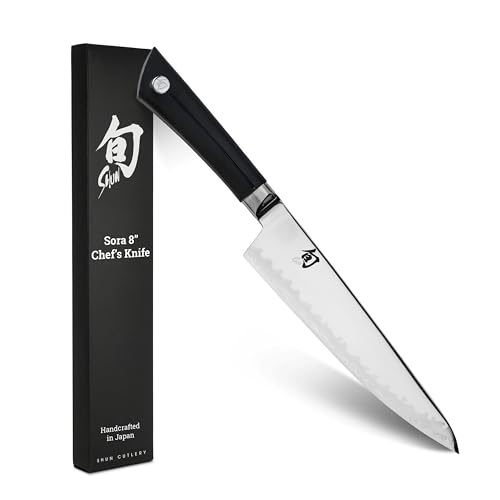
- Shun Sora 8-Inch Chef’s Knife — the entry to the Japanese house: a VG10 cutting edge in a 420J blade, with a balanced handle, at the gentlest Shun tier. Check price on Amazon
- Shun Classic 8-Inch Chef’s Knife — the defining Shun: a VG-MAX core in Damascus cladding, with the D-shaped Pakkawood handle. Check price on Amazon
- Shun Premier 8-Inch Chef’s Knife — the Premier expression of the VG-MAX and Damascus formula, with a warmer, more rounded handle character. Check price on Amazon
- Wüsthof Gourmet 8-Inch Chef’s Knife — the accessible Wüsthof: high-carbon stainless from Solingen with a triple-riveted handle, at the line’s gentlest tier. Check price on Amazon
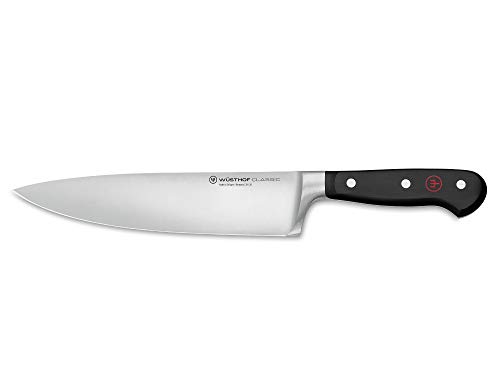
- Wüsthof Classic 8-Inch Chef’s Knife — the defining Wüsthof: forged in Solingen, high-carbon stainless, triple-riveted handle, and the full bolster generations grew up with. Check price on Amazon
- Wüsthof Classic Ikon 8-Inch Chef’s Knife — the Ikon: Wüsthof’s ergonomic flagship, combining a sculpted handle with a sharp edge and a refined bolster. Check price on Amazon
Six knives, two creeds, and not a weak one among them — which is why the verdicts below are awarded criterion by criterion rather than as a single crown. A rivalry this old is not settled by declaring a winner; it is settled, household by household, by matching the steel to the hand, the board, and the sharpening habit that will actually happen in that kitchen. Read the criteria, count your own votes honestly, and the last section will help you tally them.
Shun Vs Wusthof: the six knives in detail
Each knife above was verified against its live listing before review, and each review states its house’s covenant as plainly as its virtues. The head-to-head sections now follow, criterion by criterion, with a verdict awarded in every round — because comparisons that refuse to judge are merely catalogues wearing a title.
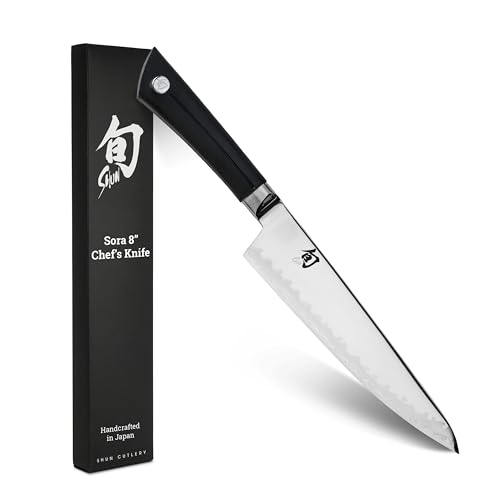
Shun Sora 8-Inch Chef’s Knife
Japanese entry — VG10 edge, accessible tier
The Sora is Shun’s argument that the Japanese character — hard steel, thin edge, light in the hand — need not begin at a flagship price. Its construction is the clever part: a VG10 cutting edge, the proven Japanese steel, carried in a blade of softer 420J stainless, so the part that meets the food behaves like a Shun while the body of the knife stays accessible in cost and a touch more forgiving in character. In the hand it feels balanced in the neutral, unshowy way its listing promises, and on the board it cuts with the easy, low-resistance glide that converts German-knife households in a single onion.
As an entry point it teaches the house’s lessons gently. The edge wants a whetstone’s friendship rather than a steel’s daily correction, the blade wants wooden or soft boards and a cook who slices rather than torques, and the reward for those small disciplines is a keenness that a similarly priced German knife does not attempt. Cooks who discover, through the Sora, that they are Japanese-knife people can climb to the Classic or Premier with their habits already formed; cooks who discover the opposite have learned it at the kindest price the house offers, which is exactly what an entry model is for.
At a glance
- Blade: 8-inch chef’s, VG10 edge with 420J stainless body
- Origin: handcrafted Japanese, per the listing
- Handle: balanced handle, per the listing
- Character: light, thin-edged, whetstone-maintained
- Tier: the accessible door into the Shun house
Strengths
- Real Japanese edge character at the entry tier
- Light and balanced for long prep sessions
- Forgiving first lesson in hard-steel ownership
Trade-offs
- Blade body less elaborate than the Damascus lines
- Hard edge still chips if abused on bone or frozen food
- Handle less distinctive than the Pakkawood classics
Best for: a curious cook taking a first step from German to Japanese steel.
Not suited for: a heavy-handed household that treats one knife as a can opener’s colleague.

Shun Classic 8-Inch Chef’s Knife
The Japanese benchmark — VG-MAX and Damascus
The Classic is the knife that made Shun’s name outside Japan, and holding it explains the reputation before a single cut is made. The VG-MAX core — the house’s refined, very hard steel — is clad in layers of Damascus stainless that ripple down the blade like watered silk, protecting the core while giving the knife its unmistakable face. The Pakkawood handle is D-shaped, contoured for the right hand’s pinch grip in the classic line, and the whole assembly is notably lighter than a forged German knife of the same length, with the balance sitting where a slicer’s hand wants it: at the pinch, ready to work by guidance rather than by weight.
On the board, the Classic’s thin, hard edge does the thing Japanese knives exist to do: it falls through onions without wedging, shaves garlic to translucency, and parts a ripe tomato under its own weight where a thicker edge would need sawing and pressure. That performance is bought with the house’s well-known covenant — the edge is hard, and hardness is brittle at the extremes, so bones, frozen food, hard squash stems, and twisting motions in a cut are all declined, and the whetstone replaces the honing steel as the instrument of care. Cooks inside that covenant call the Classic the best knife they own; cooks outside it call it fragile, and both are describing the same steel from different kitchens.
At a glance
- Blade: 8-inch chef’s, VG-MAX core
- Cladding: Damascus stainless steel layers
- Handle: Pakkawood, D-shaped in the classic line
- Origin: handcrafted Japanese, per the listing
- Character: very hard, very keen, stone-maintained
Strengths
- Edge keenness the German house does not attempt
- Featherweight balance for precision work
- Damascus blade is genuinely beautiful in daily use
Trade-offs
- Hard edge demands whetstone skill and gentle boards
- D-shaped handle divides left-handed and large hands
- Chips are the price of abuse that a Wüsthof would shrug off
Best for: a precision cook who slices, maintains on stones, and cooks daily.
Not suited for: rock-chopping, bone work, or a dishwasher’s neighbourhood.
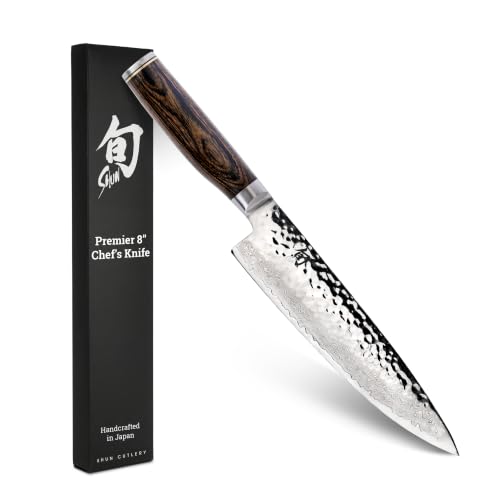
Shun Premier 8-Inch Chef’s Knife
Japanese flagship — hand-finished warmth
The Premier takes the Classic’s engineering — the same VG-MAX core, the same Damascus cladding — and changes the knife’s temperament through its details. Its handle is a warmer, more rounded Pakkawood form that fills the palm where the Classic’s D-shape instructs the fingers, and the line’s hand-finished character gives the blade a slightly softer, more artisanal presence on the rack. Cooks choosing within Shun are therefore not choosing performance, which the two lines share at the core, but choosing the conversation the handle has with their hand — and in a knife used daily for decades, that conversation is a legitimate, even decisive, criterion.
In work, the Premier is the Classic’s equal at the edge and its superior in long sessions for hands that prefer a fuller grip: the cook who preps for a family gathering, or who simply has larger hands, will find the Premier’s rounder handle kinder across an hour of vegetables than the Classic’s more sculpted instruction. It asks for the same covenant — stones, soft boards, no bones, no torque — and pays the same dividend of keenness. As the Japanese flagship in this comparison, it is the knife to set against Wüsthof’s Ikon in the final reckoning: the two houses’ most considered expressions, differing not in quality but in creed.
At a glance
- Blade: 8-inch chef’s, VG-MAX core
- Cladding: Damascus stainless steel layers
- Handle: Pakkawood, rounder and fuller than Classic
- Origin: handcrafted Japanese, per the listing
- Character: flagship keenness with long-session comfort
Strengths
- Classic-beating comfort for larger hands and long prep
- Same exceptional core and cladding
- Feels like the heirloom it is priced as
Trade-offs
- Flagship tier of the Japanese house
- Same hard-edge covenant as every Shun
- Fuller handle may crowd a small hand’s pinch
Best for: a committed home cook whose prep sessions run long and whose hands run large.
Not suited for: a first Japanese knife — the Sora teaches the covenant cheaper.
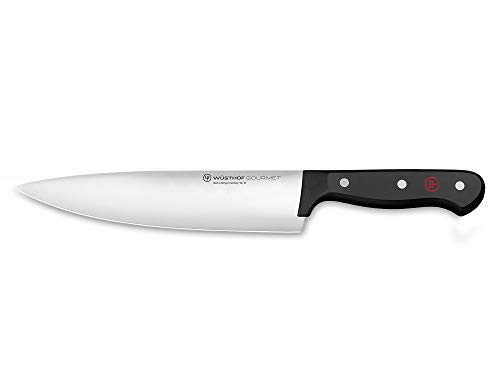
Wüsthof Gourmet 8-Inch Chef’s Knife
German value — Solingen steel, stamped construction
The Gourmet is Wüsthof’s welcome mat: a Solingen-made chef’s knife in the house’s high-carbon stainless, with the familiar triple-riveted handle, produced by stamping rather than forging so the German character — toughness, balance, easy maintenance — arrives at the gentlest tier the house offers. Purists will note the construction difference, and they are right to; a forged knife’s density and bolster are real things. But the Gourmet’s buyers are not purists on a budget so much as pragmatists on a mission: a German knife that can be honed in seconds, used without ceremony, and replaced without grief if a household member abuses it, which in real kitchens is a specification as valuable as any bolster.
On the board it behaves exactly as its house promises. The edge is ground for durability rather than for translucency, so it wedges a fraction more in a dense onion than a Shun would — and it will also survive the encounter with the squash, the chicken joint, and the enthusiastic teenager that would endanger the Japanese edge. For households whose cooking is robust, whose knife drawer is communal, and whose sharpening is a honing steel by the stove, the Gourmet is not the cheap Wüsthof; it is the correct one, and its existence is why the German house’s tent is so wide.
At a glance
- Blade: 8-inch chef’s, high-carbon stainless steel
- Construction: stamped, made in Solingen, Germany
- Handle: triple-riveted, per the listing
- Character: tough, forgiving, steel-maintained
- Tier: the accessible door into the Wüsthof house
Strengths
- German toughness at the friendliest tier
- Honing-steel maintenance anyone can do
- Shrugs off communal-kitchen treatment
Trade-offs
- No forged bolster or forged density
- Edge keenness a class below the Shun lines
- Less of an heirloom object than its siblings
Best for: a busy family kitchen that needs one unbreakable workhorse.
Not suited for: a collector or a cook chasing the finest possible edge.
Wüsthof Classic 8-Inch Chef’s Knife
The German benchmark — forged, full bolster
The Classic is the German benchmark against which the whole comparison is calibrated: a single piece of high-carbon stainless forged in Solingen into the silhouette half the world’s cooks learned on — full bolster guarding the fingers, triple-riveted handle filling the palm, and enough heft that the knife’s own weight does a share of every cut’s work. That heft is the house’s philosophy in the hand. Where a Shun asks to be guided, the Classic asks to be swung gently and trusted, and for the rock-chop — the rocking mince of herbs and garlic that German knife geometry evolved for — there is no more natural instrument in this guide.
Its edge is the other half of the philosophy: ground at a more forgiving angle than the Japanese knives, in steel hard enough to hold it and tough enough to keep it through encounters that would chip a VG-MAX edge — the squash’s stem, the chicken’s joint, the frozen pea incident. Maintenance is the famous five seconds with a honing steel before the knife goes back in the block, a ritual so light that real households actually perform it, which is why a decade-old Classic, honestly kept, usually cuts better than a neglected Shun of the same age. The bolster divides opinion — it protects fingers and complicates full-length sharpening in equal measure — but as the benchmark of its house, the Classic’s compromises are the most understood in the entire knife world.
At a glance
- Blade: 8-inch chef’s, forged high-carbon stainless
- Origin: forged in Solingen, Germany, per the listing
- Handle: triple-riveted, full bolster design
- Character: hefty, forgiving, honing-steel maintained
- Role: the German benchmark of the comparison
Strengths
- Forged toughness that forgives real kitchens
- Heft does the work in rocking cuts
- Maintenance is seconds, not a stone ritual
Trade-offs
- Bolster complicates sharpening the heel
- Heft tires a small hand across long prep
- Edge finesse below the Japanese standard
Best for: the all-round family cook who wants one knife for everything, forever.
Not suited for: a precision slicer who dreams in translucent onion.

Wüsthof Classic Ikon 8-Inch Chef’s Knife
German flagship — ergonomic handle, refined bolster
The Classic Ikon is Wüsthof’s answer to the cook who loves the German creed but not the Classic’s furniture. Its listing promises ergonomic design with a sharp edge, and the knife delivers the promise through a sculpted handle that fills the hand more organically than the triple-riveted slab, and a bolster refined to a half form that keeps the finger protection while letting the blade’s full length meet the stone. It is, in effect, the German house conceding the two strongest criticisms of its benchmark — handle comfort and sharpening access — while conceding nothing on the steel’s toughness or the edge’s forgiving geometry.
Set against the Shun Premier as flagship to flagship, the Ikon clarifies the rivalry’s final shape. Both are their houses’ most considered 8-inch chef’s knives; both are priced as heirlooms; and they differ in everything that flows from steel philosophy — the Ikon heavier, tougher, steel-maintained, at home in the rock-chop and the rough week; the Premier lighter, keener, stone-maintained, at home in the precise hour. A cook who has read this far and still cannot choose should choose by maintenance temperament, because that is the difference they will live with weekly, long after the first month’s novelty in the hand has faded into habit.
At a glance
- Blade: 8-inch chef’s knife, ergonomic design
- Handle: sculpted, refined half-bolster form
- Origin: Wüsthof Classic Ikon line, per the listing
- Character: German toughness with flagship comfort
- Role: the German flagship of the comparison
Strengths
- Ergonomics the Classic’s slab handle cannot match
- Half-bolster restores full-length sharpening
- German forgiveness at flagship finish
Trade-offs
- Flagship tier of the German house
- Still heavier and less keen than the Shun Premier
- Sculpted handle is a love-it-or-not shape
Best for: a committed cook who wants German steel with modern comfort.
Not suited for: a Japanese-edge devotee, or a very small hand.
Criterion verdicts, round by round
Edge keenness and cutting feel
Shun, and it is not close. The Japanese knives’ harder cores and thinner geometry produce an edge that enters food with less resistance, wedges less in dense vegetables, and leaves cleaner faces on everything from onions to raw fish. The Wüsthof edge is a good edge honestly ground for a different purpose, and beside a fresh Shun it feels like what it is: a tool optimised for durability first. Cooks whose pleasure lives in the cut itself — the translucent slice, the silent tomato — should weight this round heavily, because it is the round they will feel at every single meal. Verdict: Shun.
Toughness and forgiveness
Wüsthof, by the same margin in the opposite direction. The German steel and geometry absorb the real kitchen’s insults — the hard squash, the unexpected bone, the twisting scrape across the board, the housemate — that a hard Japanese edge answers with a chip. A chipped Shun is repairable on stones, but the repair is a project; a Wüsthof that has met the same insult usually needs five seconds on the steel and an apology it never demands. Households whose cooking is robust, communal, or hurried should weight this round as heavily as the slicers weighted the last. Verdict: Wüsthof.
Maintenance in the real world
Wüsthof, on points that accumulate weekly. The honing steel lives by the stove, asks for seconds, and requires no skill worth the name; the whetstone asks for a soaked stone, a learned angle, and twenty unhurried minutes, and punishes a learned angle imperfectly held. In fairness, the Shun edge, once sharpened, holds its keenness longer between sessions, so the annual totals are closer than the weekly friction suggests — but friction is what decides whether maintenance happens at all in a busy house, and on friction the German ritual wins every week of the year. Verdict: Wüsthof, with the Shun’s longer intervals noted in mitigation.
Comfort, weight, and the long prep session
This round splits by hand, and the honest verdict is a draw with instructions. Smaller hands and pinch-grip slicers will work longer, happier hours with a Shun’s light, forward balance; larger hands and cooks who let the knife’s weight work will find the Wüsthof’s heft restful rather than tiring, especially in the Ikon’s sculpted handle. The tiebreaker is the session’s content: an hour of fine slicing argues Japanese, an hour of root vegetables and chickens argues German, and most home cooks’ hours are mixtures — which is why so many serious kitchens, in the end, keep one of each. Verdict: draw, decided by your hand and your menu.
Beauty and the pleasure of ownership
Shun, for most eyes. The Damascus cladding’s rippled light, the Pakkawood’s warmth, and the knife’s evident handcraft make the Japanese lines the ones guests ask about and owners photograph. The Wüsthof Classic’s beauty is of a different school — industrial, architectural, the beauty of a tool that has never pretended to be anything else — and the Ikon narrows the gap with its sculpted lines. But a comparison must call the round as most households will see it, and on the rack, in the hand, and in the small daily pleasure of picking the knife up, the Japanese house takes it. Verdict: Shun.
Value across a decade
A draw again, arrived at from opposite directions. The German knives ask less at purchase in their Gourmet form and forgive more across the years, so their decade is cheap in money and attention. The Japanese knives ask more and demand more, and repay with a keenness the decade never dims if the covenant is kept. The expensive outcome in both houses is the same: the neglected knife, bought dear and kept badly, outperformed by a cheap knife honestly maintained — which is why this guide keeps insisting that the sharpening habit, chosen in advance, is the true purchase. Verdict: draw, conditional on the owner.
The board beneath, and other silent partners
No verdict in this comparison survives a bad board. Hard Japanese edges meet glass, bamboo, and hard plastic with a micro-violence that dulls and can chip them in a week of dinners; the same edges on end-grain wood or a quality soft board will hold their keenness for months between stones. German edges tolerate the harder surfaces with their usual forgiveness, but tolerate is the operative word — every knife in this guide lasts longer and cuts better on wood, and a household choosing between these houses should budget the board as part of the knife, because in performance terms it is.
Storage is the second silent partner. A knife of either house loose in a drawer is being dulled by its neighbours at every opening; a magnetic strip, a block, or a simple edge guard preserves the edge the stones or the steel worked for, and costs less than one professional sharpening. The dishwasher, finally, is no partner at all: its heat, its chemistry, and its rattling are an insult to handles, edges, and the warranty’s spirit alike, and the single habit that most extends any of these six knives’ lives is the ten-second hand wash and dry that both houses, in rare unanimity, demand.
How to choose: the decision in five questions
Ask, first, how the knife will be sharpened in your house — not in theory, but in the evidence of your past behaviour. If a honing steel by the stove is the realistic ceiling, buy Wüsthof and never apologise. If stones already live in a cupboard, or the ritual genuinely appeals, the Japanese house is open to you. Ask, second, what the knife will meet: bones, squash, frozen accidents, and teenage helpers argue German; fish, herbs, ripe fruit, and precision argue Japanese. Ask, third, whose hand will hold it most, and let that hand’s size and grip habit arbitrate the weight question that no review can settle from outside.
Ask, fourth, how many knives the kitchen truly runs. A one-knife household leans German, because the single knife must survive everything; a household willing to keep a second, cheaper beater for the rough work frees its flagship to be Japanese and keen, which is the arrangement most enthusiasts eventually reach. Ask, fifth, what will make you happy in year five: the Damascus gleam and the stone ritual’s quiet mastery, or the forged workhorse’s unbroken record of showing up. There is no wrong answer to the fifth question, and it decides more real purchases than the other four combined — as, between two houses this good, it probably should.
Care rituals, by house
Keeping a Shun sublime
The Japanese covenant in practice: a whetstone of medium grit for the periodic sharpening, a finer one for the polish if the ritual pleases you, an angle held steady and low, and a leather strop or a few light passes to finish if the household enjoys the full ceremony. Between sharpenings, the edge wants no steel — a ceramic honing rod, used gently, is the most correction a hard edge should meet — and it wants its board soft, its storage guarded, and its duties kept to food that yields. Observed faithfully, this is twenty minutes a few times a year, and owners who keep it describe the ritual as part of the pleasure rather than as the price of it, which is the surest sign they bought the right house.
Keeping a Wüsthof true
The German ritual is the famous one: a few light strokes on the honing steel, alternating sides, before the knife returns to the block — a habit measured in seconds that keeps the edge’s teeth aligned between true sharpenings. Those sharpenings, on a stone or by a professional, are an annual or biennial event for a home cook rather than a monthly one, because the steel’s toughness holds its geometry through the year’s insults. Wash by hand, dry at once, store it guarded, and a Wüsthof will outlast the kitchen around it — there are Classics in daily service older than their owners, which is the house’s whole argument in a single image.
Mistakes that sour cooks on both houses
The classic Shun heartbreak is the chip: a hard squash stem, a twist to free a stuck slice, a housemate’s encounter with a chicken bone — followed by the conclusion that Japanese knives are fragile, when the covenant was simply never read aloud in that kitchen. The classic Wüsthof disappointment is the opposite: a cook who expected Japanese keenness, found a durable edge instead, and concluded the German house was coarse, when the expectation was the error. Both heartbreaks are matching failures, not product failures, and both are prevented by the five questions in the decision section above — asked before the purchase, in daylight, with the household’s real habits as evidence.
The shared mistake is maintenance theatre: the drawer full of gadgets — pull-through sharpeners that tear at edges, steels used like swords in a film, stones bought and never soaked — while the simple ritual of the house goes unperformed. A Shun wants its stone and a Wüsthof wants its steel, and each wants almost nothing else. Cooks who supply exactly that, and nothing more theatrical, are the ones still praising their purchase in the decade reviews, whichever flag their knife flies — a sentence this comparison has been building toward since its first paragraph.
A week of dinners, split between the houses
Monday is herbs and a chicken, and the week already argues both sides. The Wüsthof takes the bird apart at the joints without a flicker of anxiety, then rocks through a fistful of parsley in the rhythm its geometry was born for. The Shun, watching from the rack, is not diminished; it is simply excused from duties beneath its talents, and it will have its hour on Wednesday, when the fishmonger’s sea bass needs filleting and the tomatoes need to become slices rather than casualties. A kitchen that owns both knives stops asking which house is better by Tuesday, because the week itself has started assigning the work.
Thursday is the squash, and the German knife earns its forgiveness premium in a single cut through the stem end that would have been a chip risk on the Japanese edge. Friday is the dinner party: an hour of fine work — radishes to petals, garlic to paste, a loin sliced thin against the grain for the pan — and the Shun does it all with the light, exact pleasure that makes a cook look forward to guests. Neither knife could have covered the week as happily alone; the Wüsthof would have made Friday coarser, the Shun would have made Thursday a worry. The rivalry, lived rather than read, resolves into a rota.
The weekend adds the maintenance coda, and it is here that the houses’ characters complete themselves. The Wüsthof gets its five seconds on the steel while the coffee brews, a gesture so small it barely interrupts the morning. The Shun gets its stone on Sunday, soaked while the board is cleared, twenty minutes of quiet attention that its owner — this is the part the spec sheets miss — visibly enjoys, the way a gardener enjoys the greenhouse hour. Two rituals, two temperaments, one kitchen at peace with both: that is the true state of the shun vs wusthof question in the homes that have lived with it longest.
Grip, hands, and the pinch test
Every verdict in this guide bends around a fact no specification carries: the knife is held, and hands differ more than steels do. The pinch grip — thumb and forefinger on the blade itself, the handle merely resting in the curled fingers — is the professional’s hold, and the Shun’s forward balance and D-shaped or rounded handles are designed to reward it, placing the knife’s point of control at the pinch and making the blade feel like an extension of the fingers. A cook who pinches will feel at home in the Japanese house within one onion, and no amount of German quality will argue their hand out of that homecoming.
The racket grip — the whole handle seized, the knife driven from the wrist — is the hold of cooks who learned young and cook hard, and the Wüsthof’s full, triple-riveted handle and heel-heavy balance serve it without complaint, giving purchase and authority where a light Japanese handle can feel like a toy in a big, committed fist. Neither grip is wrong; each is a biography. The practical advice follows: before buying either flagship, hold the style in a shop if you can, mimic your own grip honestly rather than the one the assistants demonstrate, and let the hand vote first, because the hand is the only judge who will be present at every cut for the next twenty years.
What the listings cannot tell you, and how this guide handled it
A note on evidence, in the open. The six knives in this guide were each verified against a current listing — the maker’s own title, the official image, the stated construction — and those verified facts anchor every specification quoted here: the VG-MAX and VG10 cores, the Damascus cladding, the Solingen forging, the handle forms. What no listing carries is the feel of the thing at the board, and for that this review has drawn on the two houses’ long, consistent public record — the accumulated testimony of decades of owners, chefs, and sharpeners — weighed for its agreements rather than its enthusiasms. Where the record and the marketing part company, most notably on how much care a hard edge truly needs, this guide has sided with the record, because a buyer lives with the record and only visits the marketing.
That method has one more consequence worth stating: this comparison awards no crown, because the record does not support one. It supports a matching — of steel to hand, of ritual to temperament, of knife to the week’s actual dinners — and a matching, unlike a crown, cannot be handed down from a review to a reader. It can only be prepared, by laying out the evidence as plainly as this guide has tried to do, and then trusting the cook. The cook, after all, is the one who will be standing at the board, and their hand has been the real subject of every section since the first. Let it decide, with the board and the stone as its witnesses, and either house will reward the decision for as long as the kitchen stands. That is the longest promise any tool in the home can honestly make, and both of these houses, at their best, have a documented habit of keeping it. Choose, then, without fear of the wrong flag: the wrong outcome in this rivalry was never a badge, only a mismatch — and a reader who has come this far, through criteria, covenants, boards, and grips, is as well protected against mismatch as any review can make them. The rest — the first onion, the first honing, the first Sunday stone — belongs to the kitchen, where this argument has always been happiest and where, in the end, it is not an argument at all but a pleasure shared by two great traditions. Take your place in whichever of them fits your hand, and cook well — the knives, either way, are ready when you are. They have, both of them, been ready for a very long time, in better kitchens than most of us will ever cook in — and they show no sign of tiring of the work. Neither, if the match is made well, will the cook who wields them — and that endurance, shared between hand and steel, is the final verdict this comparison has to offer. Everything above it — the rounds, the rituals, the rota of a week’s dinners — is merely the evidence, laid out for the hand that must now decide. Trust it. It has been rehearsing for this purchase at every meal you have ever cooked. Let it make the final cut of this comparison, and the first cut of everything that follows in your kitchen. Few purchases get to be both a tool and a beginning; a great chef’s knife, from either of these houses, is one of them. Begin well, and dinner follows. It always has, in kitchens that take their knives seriously.
Final recommendation
For the cook who slices with intent, maintains with pleasure, and cooks the kind of food that rewards a keen edge — buy Shun, entering at the Sora if the covenant is new to you, at the Classic for the defining experience, at the Premier if your hands and your sessions run large. For the cook whose kitchen is a busy, communal, robust place, whose maintenance must fit between the pans and the serving, and whose knife must survive everything including its admirers — buy Wüsthof, entering at the Gourmet for pure utility, at the Classic for the benchmark, at the Ikon for the flagship comfort. The rivalry’s honest resolution is that both recommendations are enthusiastic, because both houses, at these tiers, are excellent at being themselves.
And for the cook who recognises themselves in both portraits — as most experienced cooks eventually do — the grown-up answer is the pair: a Wüsthof for the week’s rough work and a Shun for the food that deserves it, each maintained by its own ritual, each excused the other’s duties. That is not this comparison failing to decide. It is the decision the rivalry itself has been recommending, in two languages, for forty years: match the steel to the task, keep it honestly, and let the argument continue at the level of pure pleasure, where it belongs.
Frequently asked questions
Which is sharper out of the box, Shun or Wüsthof?
A Shun, by design: the Japanese lines are ground thinner at a more acute angle in harder steel, so the edge that meets your first onion is keener than the Wüsthof’s more durable geometry. The honest follow-up is that sharpness is a perishable, and within a year the sharper knife in any kitchen is the one whose maintenance ritual actually happened — a honed Wüsthof against a neglected Shun is no contest at all. Buy the edge you will maintain, and the out-of-the-box question becomes the least important one in this guide. If both edges are neglected equally, incidentally, the Wüsthof’s geometry degrades more gracefully — a dull German knife is a blunt instrument, while a dull Japanese knife is a tragedy — which is one more reason the honest beginner starts in Solingen.
Can a Shun handle chicken bones and hard squash?
It should not be asked to. The hard, thin edge that makes a Shun sublime on produce is vulnerable to chipping on bone, frozen food, and the woody stem of a hard squash, and the house’s covenant excludes those duties explicitly. The standard arrangement is a cheaper, tougher beater knife — or the household’s Wüsthof — for the rough work, with the Shun reserved for the food it was made for. Cooks who respect that division keep their Japanese edges perfect for years; cooks who test it learn the price of a chip repair, once, and then respect it. A chip, it should be said, is not a death sentence: a competent sharpener can grind past it and restore the edge’s line, at the cost of a little steel and a little pride, and many a Shun carries such a repair invisibly in its biography.
Why does the Wüsthof bolster annoy some sharpeners?
The Classic’s full bolster — the thick finger guard between blade and handle — extends to the edge’s heel, so the heel cannot lie flat on a whetstone, and across years of sharpening the blade’s profile near the bolster can develop a recurve that rocks on the board. It is a real, well-documented trade-off of a design that protects fingers superbly, and Wüsthof’s own Ikon answers it with a refined half-bolster that restores full-length sharpening. Home cooks who sharpen annually will barely meet the problem; enthusiasts who live on their stones should choose the Ikon, or the bolster-free Japanese lines, with this in mind. Professional sharpeners, for their part, have ground around Classic bolsters for decades and will do it without comment; the annoyance is real but it is a connoisseur’s annoyance, and it should not talk a family cook out of the benchmark they grew up wanting.
Are Damascus blades better, or just prettier?
Both, in proportions worth separating. The cladding’s practical work is to protect the hard core with softer, stainless layers, to give the blade its structural sandwich, and to help food release from the blade’s face — real functions, honestly performed. The rippled beauty is inseparable from that construction rather than applied over it, which is why Damascus knives age gracefully instead of wearing a pattern off. What the cladding does not do is cut; the core does that, and a plain knife with the same VG-MAX core would slice identically while photographing worse. Buy Damascus for the whole package, knowing which part does which job. It also resists the rust and staining that plain carbon steels invite, which matters in the real kitchen of citrus, tomatoes, and onions far more than in the showroom — beauty that also happens to be armour is the best kind.
Which house is better for a beginner?
The house whose maintenance the beginner will actually perform — which, for most true beginners, is Wüsthof. The German knives forgive the beginner’s board habits, survive the beginner’s menu accidents, and ask for a honing steel’s five seconds rather than a whetstone’s apprenticeship, so the first year teaches cooking instead of damage control. The exception is the beginner who is already drawn to the Japanese ritual — the slicing, the stones, the care — for whom the Shun Sora is a kind and affordable teacher. Begin where your enthusiasm lives, because enthusiasm is the only maintenance plan that has ever worked. A beginner with a German knife and a growing love of cooking is also perfectly placed to add the Japanese knife in year two, when their hands know what questions to ask of it — the two-house kitchen is often a journey, and journeys are allowed to have a first step.
Should I buy a set from one house, or mix?
Buy the chef’s knife by the heart, as this guide has argued, and let sets wait. A block set commits every blade to one house’s philosophy before the cook knows which tasks dominate their kitchen, and most sets include knives a household rarely touches. The experienced pattern is a chosen chef’s knife, a cheap and cheerful beater, a serrated bread knife from anywhere honest, and then additions bought one at a time as the cooking demands them — a petty knife here, a slicer there, from whichever house suits that blade’s work. Mixed racks are not indecision; they are the signature of a kitchen that buys by task, which is the habit this entire comparison exists to teach. The same task-first logic governs the board, the steel, and the stone: buy the companions your chosen knife actually needs, in the order it needs them, and the famous rivalry will have improved your kitchen far beyond the single blade it started with.