Disclosure: As an Amazon Associate, dailyhomedecorating.com earns from qualifying purchases. Links on this page are affiliate links; they cost you nothing extra. Prices and availability change often, so check the current Amazon listing before you buy.
Bookmark this meat temperature guide and the guessing ends tonight: poultry is safe at 165°F, ground beef belongs at 160°F, whole cuts of beef and pork rest happily at 145°F with a pause before carving, and fish gives up its translucency around 145°F. Those four numbers, measured in the thickest part of the meat with a thermometer you trust, settle most of the arguments that happen beside stoves and grills. Everything below explains where the numbers come from, which cuts bend them, how resting changes them, and which thermometers make checking them a habit instead of a ceremony.
The chart: safe temperatures by meat
| Food | Target internal temperature | Rest | Notes |
|---|---|---|---|
| Chicken and turkey, whole or pieces | 165°F | Brief rest helps juices settle | Check the thickest part of the thigh and breast |
| Ground chicken or turkey | 165°F | Serve promptly | No pink shortcuts with ground poultry |
| Ground beef, pork, lamb, veal | 160°F | A few minutes | Grinding mixes surface bacteria through the meat |
| Beef steaks and roasts | 145°F for safety guidance; rarer by preference below that | At least 3 minutes, longer for roasts | Intact muscle is sterile inside; the surface carries the risk |
| Pork chops, loin, tenderloin | 145°F | At least 3 minutes | Modern guidance ended the era of grey, dried pork |
| Lamb chops and roasts | 145°F for guidance; pinker by preference | Rest well for roasts | Ground lamb follows the 160°F rule |
| Fish and shellfish | 145°F, or flesh opaque and flaking | Minimal | Tuna and salmon are often served cooler by choice |
| Ham, fresh or smoked raw | 145°F | At least 3 minutes | Fully cooked ham reheats to 140°F |
| Leftovers and casseroles | 165°F | None | Reheat once, thoroughly, and refrigerate promptly |
| Hot-held cooked food | Keep at 140°F or above | Not applicable | The danger zone sits between 40°F and 140°F |
Those figures follow United States food-safety guidance, which is written for the cautious end of the kitchen — hospitals, schools, and anyone cooking for people whose health cannot gamble. Home cooks routinely serve intact beef and lamb below 145°F for rare and medium-rare results, accepting a small, informed risk that grinding would make unacceptable. This guide will keep repeating that distinction, because it is the whole science in one sentence: whole muscle and ground meat are different foods wearing similar clothes.
In this guide
Why temperature, not colour, time, or juice folklore
Every older doneness test fails under examination. Meat colour misleads in both directions — ground beef can brown fully while still undercooked inside, and can stay stubbornly pink at safe temperatures when certain gases or ingredients tint it. Clear juices lie about poultry that was frozen, and firmness tests compare your steak to your own thumb, an instrument calibrated by nobody. Cooking time per pound collapses the moment ovens vary, pans differ, or a roast starts fridge-cold instead of room-warm. Temperature survives all of it, because it measures the thing itself: how hot the centre of the food actually became, which is what kills bacteria and sets texture.
The bacteria in question live mostly on surfaces. A steak’s interior is essentially sterile, which is why searing the outside and serving the middle rare is a rational act. Grinding drags the surface through the interior, distributing contamination everywhere, which is why burgers demand the higher, thorough figure. Poultry carries its risks more pervasively and its texture forgives thorough cooking less dramatically than folklore claims, so its single high number simplifies life: 165°F, everywhere, every time, measured where the meat is thickest.
The thermometers that make this guide usable
A chart nobody can measure is a poster, not a tool. Five verified thermometers follow, spanning the instant-read flagships a serious cook uses daily and the wireless probes that watch a smoker so the cook does not have to. Each was confirmed through this site’s API records with its exact listing title and official image before inclusion.

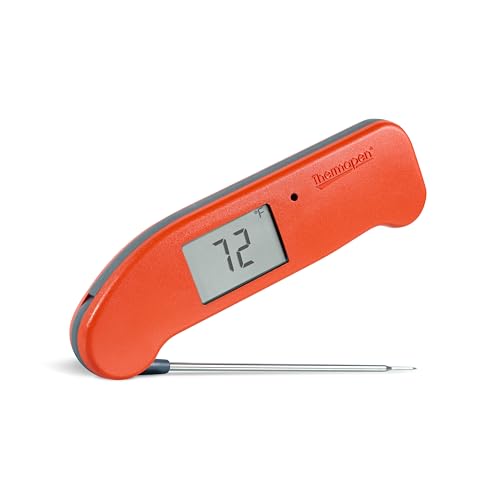
ThermoWorks Thermapen ONE — the instant-read benchmark
Badge: Best for cooks who check everything, quickly
- Instant-read folding probe format
- Listing describes it as the maker’s flagship recommendation
- Cayenne Pepper Red finish on this listing
- Built for grill, oven, and stovetop checking
The Thermapen family built its reputation on the two qualities this guide depends on: speed and trust. A reading that arrives in about a second, at the exact spot the probe tip occupies, turns temperature checking from an event into a glance — and glances get repeated, which is how food actually becomes safe and steaks actually land at the requested doneness. The folding probe stores safely in a drawer, wakes on opening, and survives the greasy choreography of a grill session better than thermometers with cables to melt.
Its honest cost is that it only measures when a human stands there measuring. Long smokes, overnight roasts, and a cook who also hosts the party will want a leave-in partner from further down this list. As the single thermometer in a kitchen that cooks mostly fast food — steaks, chops, chicken pieces, burgers, fish — nothing here outclasses it.
Strengths
- Speed makes frequent checking effortless
- Probe accuracy supports confident rare-to-safe decisions
- Folding design stores and travels safely
Trade-offs
- Premium positioning among instant-read tools
- No remote monitoring for long cooks
- One spot reading at a time, by hand
Best for: the household’s primary thermometer, used daily. / Not suited for: unattended smoking or roasting sessions.
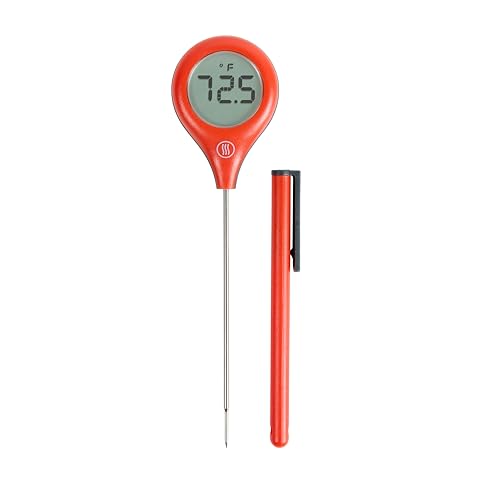
ThermoWorks ThermoPop 2 — the value instant-read
Badge: Best for a second thermometer or a first serious one
- Instant-read format with a rotating display concept
- Listing positions it as the maker’s best value
- Cayenne Pepper Red finish on this listing
- Suits kitchens, grills, and candy work alike
Not every kitchen needs the flagship, and ThermoWorks knows it — the ThermoPop line exists to put trustworthy readings into aprons that balk at flagship prices. The experience differs in polish rather than in honesty: readings arrive quickly, the display orients for the hand holding it, and the whole tool shrugs off the drawer chaos that kills delicate instruments. For households buying two thermometers — one for the kitchen, one that lives at the grill and will inevitably be left in the rain once — this is the sensible unit to multiply.
It also makes an unusually good gift for a cook who judges doneness by vibes, because it converts sceptics without lecturing them. One evening of checking chicken thighs against the chart tends to retire the cut-it-and-look method permanently.
Strengths
- Trustworthy readings without flagship commitment
- Compact enough for an apron pocket
- Forgiving of rough household handling
Trade-offs
- Fewer refinements than the Thermapen line
- Still a handheld, attended instrument
- Display smaller than the flagship’s
Best for: first serious thermometer buyers and second-unit duty. / Not suited for: cooks wanting the fastest possible professional tool.
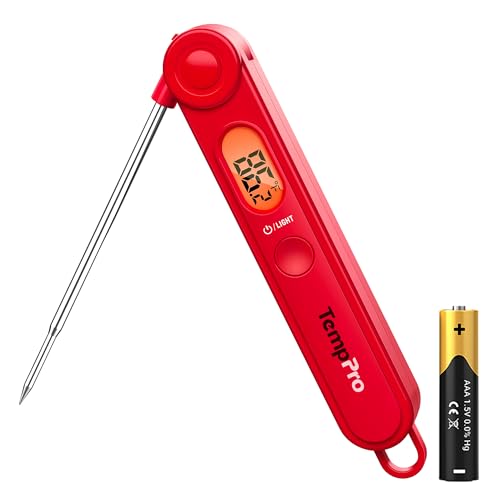
TempPro TempSwift — one-second readings for busy grills
Badge: Best for high-volume family grilling
- Listing claims a one-second reading speed
- Backlit display for evening cooking
- Described as NSF certified on the listing
- Named for grill, smoker, barbecue, frying, and turkey work
When twelve burgers, six chicken thighs, and a tray of sausages all approach doneness in the same five minutes, thermometer speed stops being a luxury. The TempSwift’s pitch is exactly that moment: a backlit, fast-reading probe that moves across a crowded grill without the cook losing the thread of everything else. The backlight earns its place more often than expected, because grilling seasons and daylight saving conspire to finish cooks in the dusk.
Certification language on the listing adds a measure of confidence for buyers who cook for crowds — church suppers, scout evenings, the street’s summer party — where one undercooked batch becomes a story told for years. Treat any thermometer as a tool to be checked occasionally against ice water, whatever its pedigree, and this one will serve a busy household faithfully.
Strengths
- Reading speed suits crowded grills
- Backlight helps at dusk and in smokers
- Broad stated range of kitchen duties
Trade-offs
- Less refined feel than the ThermoWorks pair
- Handheld only; no leave-in monitoring
- Brand cachet lower among thermometer obsessives
Best for: family grill masters cooking in batches. / Not suited for: precision candy work or unattended cooks.

MEATER SE — the wireless probe for smokers and roasts
Badge: Best for low-and-slow cooks who host while cooking
- Fully wireless probe, no cables to route
- Listing states 165 ft Bluetooth range
- Dual sensors track meat and ambient temperature
- Guided cook system through the companion app
- Dishwasher safe per the listing
The wireless probe answers the one question an instant-read cannot: what is happening inside the meat right now, with the lid closed and the cook indoors making drinks? Dual sensing is the clever part — one end reads the meat, the other reads the cooker’s ambient temperature, and the app estimates the road ahead, including the rest. For brisket, pork shoulder, and the holiday turkey, that foresight converts an anxious day of lid-lifting into a supervised, mostly peaceful process.
Wireless freedom carries wireless caveats. Range shrinks through walls and metal, the probe’s meat end must be inserted past its safety line to protect its electronics, and very thin cuts give it nothing to hold. It complements an instant-read rather than replacing one: the probe conducts the long symphony, the Thermapen still checks the steaks on Friday.
Strengths
- Truly untethered monitoring for long cooks
- Ambient sensing improves time estimates
- App guidance helps first-time smokers
Trade-offs
- Range depends on walls and cooker materials
- Unsuitable for thin cuts and quick sears
- App dependence for full value
Best for: smokers, roasters, and rotisserie cooks. / Not suited for: weeknight steaks or thermometer minimalists.

MEATER Plus — wireless monitoring with a repeater base
Badge: Best for larger homes and garden cooking setups
- Wireless smart probe in a walnut-finish charger
- Listing states 165 ft Bluetooth range
- Charger base extends the connection story
- Aimed at grill and oven cooking
The Plus variant addresses the standard wireless complaint — distance — by making its charging base part of the relay, a small wooden block that sits nearer the cooker and passes readings onward. In a garden where the smoker lives at the far fence and the kitchen at the house, that relay is the difference between a graph that updates and a graph that gives up. The walnut finish is not a cooking feature, yet tools left visible on counters get used more, and this one was designed to be left visible.
Choose between the two MEATERs by geography rather than ambition. A compact flat with the grill on a balcony will never test the base’s relay; a house with a garden smoker and thick walls will test it weekly. Both share the family’s guided-cook app and the same insertion discipline, so the household’s learning transfers if a second probe joins later.
Strengths
- Relay base suits spread-out cooking setups
- Counter-worthy design encourages regular use
- Same guided system as its sibling
Trade-offs
- Costs more than the base wireless model
- Still bound by Bluetooth physics eventually
- Overkill for balcony grills beside the kitchen
Best for: garden smokers and larger homes. / Not suited for: small flats or cooks who hate apps on principle.
How to take a temperature properly
Step 1: Find the thermal centre
Insert the probe into the thickest part of the meat, aiming for the centre of the mass, away from bone, gristle, and fat seams. Bone conducts heat differently and will flatter or frighten the reading depending on its mood; fat reads hotter than the lean beside it. For a chicken, that means the inner thigh near the joint without touching it, plus a confirming check in the breast’s thick end. For a burger, slide the probe in from the side so its tip lands in the middle of the patty rather than skewering down through it.
Step 2: Wait for the number to stop climbing
Even a one-second thermometer needs the cook to watch the display settle, because a probe thrust from room temperature into hot meat reports its journey as well as its destination. Hold steady, watch the climb slow, and take the plateau as the reading. On thick roasts, check a second spot an inch away; disagreement between neighbours usually means the probe found a fat seam or the meat’s geometry is tricking one of the placements.
Step 3: Measure before you expect doneness
Thermometers prevent overshooting only when consulted early. Check a steak a few degrees before the target, a roast ten degrees before, and poultry while there is still time to move pieces around the grill’s hot and cool zones. Cooks who measure only at the expected finish line discover their results; cooks who measure on the approach control them.
Step 4: Respect carryover and the rest
Meat continues cooking after it leaves the heat, its centre rising several degrees while the surface cools — a large roast can climb the better part of ten degrees during a long rest. Pull whole cuts a few degrees early and let the rest carry them home, tenting loosely and keeping them away from a cold draught. Ground meats and poultry, whose targets are safety lines rather than texture preferences, should reach their full number in the pan or be rested only briefly once they have.
Step 5: Keep the instrument honest
Test any thermometer in a glass of crushed ice and water, where it should read at or very near 32°F once settled. Recheck after drops, dishwasher accidents involving models that forbid them, and battery changes. Clean the probe after every use — it has been inside raw meat, and it will be inside cooked meat next — and store it dry, because a thermometer in a damp drawer is a rumour waiting to happen.
Cut by cut: applying the chart in a real kitchen
Steaks live by preference inside a safety frame. Intact beef seared properly on both sides can be served rare at temperatures well below the guidance figure, a choice adults make knowingly; the same cut ground into a burger inherits the 160°F rule without negotiation. Rib roasts and other celebration joints reward a probe left in place or checked at intervals, pulled early, and rested long — the rest is not dead time but the mechanism by which juices redistribute and the centre finishes gently.
Pork’s modern chapter deserves emphasis, because generations overcooked it against an older fear. At 145°F with a three-minute rest, a chop stays blushing and juicy while meeting current guidance; the dried, grey pork of memory was cooked twenty degrees past necessity. Tenderloin, being lean and cylindrical, is the cut most rescued by a thermometer, since its window between raw-hearted and chalky is only a few degrees wide.
Poultry divides into the whole bird problem and the pieces problem. Pieces are easy: measure each, move them around the heat, serve as they arrive. A whole bird is a geometry puzzle — breast drying while thighs lag — solved by checking both locations, resting generously, and considering spatchcocking next time so the puzzle has fewer pieces. Ground poultry allows no artistry at all: 165°F, through and through, in meatballs, burgers, and sausages alike.
Fish asks for a lighter touch and a different eye. The 145°F guidance produces fully cooked, opaque fish; many cooks prefer salmon and tuna well below it, a preference choice for healthy adults rather than a safety recommendation. The practical household rule is to cook fish to the moment its flakes separate under gentle pressure and its centre turns from glassy to silky, then serve immediately, because fish carries over fast and forgives waiting least of all proteins. Readers cooking for pregnancy, age, or fragile health should hold the guidance figure without apology.
Lamb follows beef’s logic with a stronger flavour dividend for restraint: chops and racks reward pink centres, legs reward patience and a long rest, and ground lamb in kebabs or burgers takes the ground-meat number. Game meats, where households cook them, generally follow their domestic cousins’ rules with extra lean-ness demanding extra vigilance against overshooting.
Common mistakes around meat temperatures
The gravest is trusting a single reading in a single spot, especially in irregular pieces like a bone-in chicken breast or a roast tied unevenly. Second comes thermometer theatre — owning a good instrument and leaving it in the drawer while cutting a chicken open to inspect its juices, a test this guide has already retired. Third is measuring through the pan’s perspective: probing from above into a thin cut until the tip touches hot metal and reports the pan instead of the dinner.
Fourth, cooks forget that stuffing changes poultry entirely; a stuffed bird’s centre of risk is the stuffing itself, which must reach 165°F even if the meat around it got there earlier. Fifth is the cold-start error, timing a roast from a chart while ignoring that it entered the oven straight from a deep fridge. Sixth is carving too soon, pouring the rest’s juices onto the board and blaming the temperature chart for dry meat that was, in truth, merely impatient meat.
A note for households that also cook from meal kits and boxes
Portioned proteins from any delivery service arrive thinner and more uniform than butcher cuts, which makes them cook faster and overshoot sooner. The thermometer habit matters more there, not less: a kit chicken breast can travel from perfect to parched inside two distracted minutes. Readers of our Martha and Marley Spoon subscription review will find the same advice wearing an apron — check the protein, trust the probe, and let the recipe card handle everything except the number.
Final word from the Meat Temperature Guide
Print the chart, tape it inside a cupboard door, and buy the thermometer that matches the way the household actually cooks — an instant-read for the weeknight majority, a wireless probe for the smoking minority, ideally one of each across a year of birthdays. Then cook with the calm of a person who measures: poultry at its number, burgers at theirs, pork rescued from its grey past, and steaks exactly as pink as the people at the table asked for. Temperature is the smallest skill in cooking and the one that improves the most dinners per minute spent learning it.
Preference temperatures for whole cuts, honestly labelled
Safety guidance and serving preference are different conversations, and a useful guide keeps them in separate rooms. For intact beef and lamb, many adults choose rare centres in the neighbourhood of 120–125°F, medium-rare around 130–135°F, medium near 135–145°F, and well-done beyond the guidance line entirely. Those are preference figures with a risk conversation attached, not safety endorsements, and they apply only to whole muscle with a properly seared exterior. Restaurants in many jurisdictions print their own warnings about undercooked meat; the home cook’s version of that warning is simply knowing which guests should be served the guidance temperatures without being asked — children, pregnant diners, older relatives, and anyone whose immune system is having a difficult year.
Veal follows beef’s pattern with a milder flavour penalty for cooking through. Duck breast is the poultry exception that proves cooks love a rule to bend: it is widely served pink like a steak, a chef’s convention that home cooks should adopt knowingly rather than accidentally, and never extend to duck legs, which need thorough cooking to become tender anyway. The chart at the top of this guide remains the safe harbour; preference is the open sea, and sailors should know which water they are in.
The holiday bird, in depth
More thermometers are bought in the week before a roasted-turkey holiday than in any other week of the year, and more are misunderstood in its final hour. The bird’s breast and thigh finish at different times by design of anatomy, not by failure of the cook. Check the thigh first, since it decides the schedule; if the breast threatens to overshoot while the thigh lags, shield the breast with foil and give the dark meat its minutes. Resting a large bird for half an hour is not a delay but the final cooking stage, during which the centre equalises and carving stops flooding the board.
Stuffing cooked inside the bird must itself reach 165°F at its centre, a fact that has reorganised many family traditions toward baking the dressing separately — where it also, not coincidentally, develops the crisp top everybody fights over. Gravy made from the pan juices should be brought to a proper boil. Leftovers need shallow containers, prompt refrigeration, and a plan, because a holiday bird reheated vaguely on day four is how a triumph becomes a cautionary tale told at the next holiday.
Smoking and barbecue temperatures
Low-and-slow cooking plays by texture rules layered over safety rules. Brisket and pork shoulder pass through the same safety temperatures as any beef or pork early in the cook, then continue for hours until collagen surrenders — often somewhere in the 195–205°F region, judged as much by probe tenderness as by the number. The thermometer’s role changes mid-cook from safety officer to texture scout: when the probe slides into the flat of a brisket with the resistance of warm butter, the meat is done, whatever the display says within a few degrees.
The stall — that long plateau where a shoulder’s temperature refuses to climb — is evaporation, not malfunction, and it is where wireless probes earn their price by reporting the plateau calmly while the cook resists opening the lid. Ribs resist single-number cooking almost entirely and are judged by bend and bite; sausages, being ground meat in a casing, return to strict rule-following at the ground-meat figure for their contents. A smoker’s thermometer kit therefore pairs a leave-in probe for the big cuts with an instant-read for everything else, exactly the division of labour the picks above describe.
The danger zone and the clock
Between 40°F and 140°F, bacteria in perishable food multiply at their happiest pace, and time in that band is the variable home cooks most often ignore. The working rules are simple enough to memorise: refrigerate cooked meat within two hours, within one hour on a very hot day; marinate in the fridge, never on the counter; thaw in the refrigerator, cold water changed regularly, or the microwave — never on the worktop through a warm afternoon. Cooked meat held for a party belongs above 140°F in a low oven or slow cooker, or below 40°F on ice, and the grey middle is where buffets go wrong.
Cooling large quantities deserves its own sentence, because a deep pot of stew in a fridge cools so slowly at its centre that it can spend the night in the danger zone while feeling cold at the edges. Shallow containers, an ice bath for the pot, and prompt portioning are the unglamorous correct answers. Reheating then returns the food to 165°F, once, decisively.
Choosing a thermometer: the buying guide inside the guide
Buy speed first if the household grills thin food often; buy wireless if it smokes thick food ever. Display readability matters at arm’s length in bright sun and in dusk, backlight matters for evening cooks, and a probe thin enough not to tear delicate fish is worth more than a specification nobody will use. Water resistance decides whether the tool survives its first dropped-in-the-sink moment, and warranty length tells the truth about a maker’s confidence more plainly than its advertising does.
Budget honestly across a year of cooking. A household that roasts a large joint monthly and grills weekly will extract more value from one excellent instant-read than from three novelty gadgets combined, because temperature is a measurement, not a hobby. Add the wireless probe when the first brisket enters the household’s ambitions. Add a second instant-read when two cooks share a kitchen and keep stealing each other’s — domestic peace is a legitimate specification.
Sous vide, air fryers, and other modern detours
Immersion cooking rewrites the chart’s grammar, because time at temperature can substitute for peak temperature in ways a pan cannot imitate. A chicken breast held at a lower temperature for a sufficiently long, validated period can reach the same safety as a brief visit to 165°F, and precision-cooker manufacturers publish those time-and-temperature tables for exactly that reason. The rule for home cooks is to follow the equipment’s validated guidance precisely rather than improvising reductions, because the safety lives in the combination, not in either number alone. Searing after the bath is for flavour and appearance; the bath did the cooking.
Air fryers are small convection ovens with enthusiastic marketing, and the chart applies to them unchanged — with the caveat that their speed and their small cavities make overshooting easy, especially with the thin, uniform cuts that meal kits and supermarkets favour. Check earlier than instinct suggests. Slow cookers ask for patience and a full vessel, and their low settings are designed to carry food through the danger zone at a safe pace provided the meat was not frozen solid at the start and the lid stays on. Pressure cookers forgive almost everything except impatience, and their contents should still be checked when a recipe’s timing came from a different altitude or a different model.
Altitude, ovens, and other honest complications
Water boils cooler in the mountains, which matters for boiling-water thermometer checks and for any cooking method capped by water’s temperature; roasting and grilling are less affected, though thin mountain air dries surfaces faster and can change timing. Ovens lie individually — a dial that says one number and a cavity that holds another twenty degrees away is common enough that an oven thermometer, checked against the chart’s logic, pays for itself in rescued roasts. Convection fans speed surface cooking and can shave the expected time meaningfully, which is one more reason the probe, not the clock, gives the verdict.
Frozen starts deserve a rule of their own: cooking from frozen is legitimate for many cuts in an oven or pressure cooker, at roughly half again the expected time, and illegitimate in a slow cooker, where the centre lingers too long in the danger zone. Whatever the start, the finish is the same number on the same chart — the chart is admirably indifferent to how the meat began its journey.
Teaching the household to cook by number
The last obstacle is social, not technical. Somebody at every table learned cooking from a parent who cut, poked, and pronounced, and a thermometer can feel like an accusation against that inheritance. The conversion that works is demonstration, not debate: cook two chicken breasts, one by folklore and one by probe, and let the juicier one argue. Teenagers, incidentally, adopt thermometers instantly, because a number on a display resembles every other interface in their lives; grandparents adopt them after the pork chop revelation described earlier. Within a season, most households stop discussing the tool entirely, which is the fate of all good tools — it becomes simply how dinner is known to be done.
Eggs, reheated rice, and the chart’s neighbours
A temperature guide for meat attracts questions about everything adjacent, so three neighbours deserve their numbers. Egg dishes — quiches, frittatas, baked casseroles — are cooked until their centres set and reach around 160°F, which is also the neighbourhood where a custard stops being sauce. Cooked rice, though no meat at all, belongs in this guide’s safety conversation because it is the classic leftover hazard: cool it quickly, refrigerate it promptly, reheat it steaming hot once, and never let it ride through a second day of ambiguity. Sauces and gravies containing meat drippings should return to a full boil when reheated, both for safety and because a gravy that has not boiled has not finished becoming gravy.
A worked evening: the chart in action
Watch the numbers run a real dinner. Pork chops enter a hot pan; the probe says the centre is ten degrees shy, so they stay, undisturbed, while the cook resists the ancient urge to press them flat. At the target minus a breath, they leave the pan to rest under foil, and the same pan builds a sauce from the browned residue. Chicken wings for a starter were checked in batches earlier — the thickest of each group standing for its siblings — and are holding warm above the safe line. A salad waits, because salads can. When the chops are carved, the centre blushes exactly as the modern guidance promises, and nobody at the table mentions temperature at all, which is the chart’s favourite review: silence, and second helpings.
Contrast the same dinner without numbers, because most readers have cooked it: chops cut open to check, losing their juices to the board; wings served in hopeful batches; a cook too occupied with doubt to sit down. The thermometer did not make the first dinner more technical. It made it calmer, which in a home kitchen is the same thing as better.
Storing this knowledge where cooking happens
Information kept in a bookmark folder helps nobody at the grill. Print the chart small and tape it inside the cupboard nearest the stove, or write the four household numbers — poultry, ground, whole cuts, fish — on the thermometer’s storage case in marker. Households that cook outdoors should duplicate the chart at the grill, because the walk indoors to check a number is the walk during which a steak overshoots. Knowledge, like a probe, only counts at the point of use.
When the numbers and the meat disagree
Occasionally a reading says done while the meat looks raw, or the reverse, and the cook must arbitrate. Trust the probe’s placement first: reposition into a different part of the thickest mass, confirm the tip is not touching bone or resting in a fat pocket, and take the lower of two honest readings as the verdict for safety and the higher as the warning for texture. Persistent weirdness — a thermometer that reads boiling water twenty degrees low — is an instrument problem, solved by the ice-point test described earlier, not by cooking everything longer out of suspicion. Suspicion is a seasoning; it should never be the recipe.
Colour has one legitimate supporting role: it reports the surface. A pale chicken skin beside a correct internal reading means the cooking method lacked browning heat, a quality complaint to fix with a hotter finish, not a safety complaint to fix with more time. A deeply browned burger beside a low reading means the opposite. Read colour for craft, temperature for truth, and dinner improves on both axes at once.
Children, guests, and cooking for people who cannot choose
A household’s risk decisions are its own until the table includes people who did not make them. The standing rule in this guide’s kitchen is simple: preference temperatures are for the adults who ordered them, and guidance temperatures are the default for everyone else — the school friend staying for dinner, the elderly neighbour, the cousin whose pregnancy was announced last week. Nobody has ever sent back a chicken breast for being safely cooked, and the cook’s conscience is also an ingredient. When in doubt, cook to the chart, season generously, and let the rare-steak conversation happen among consenting adults on another evening.
A brief defence of the three-minute rest
The rest written into the guidance for whole cuts is not a courtesy pause; it is part of the safety calculation, because the meat’s interior continues to hold and even gain temperature while its juices, driven toward the centre by cooking, relax back toward the edges. Carving inside that window spills the evidence onto the board and serves meat that is simultaneously less juicy and less finished than the same cut three minutes later. Small cuts need only those few minutes; roasts scale upward, and a large joint can rest half an hour under loose foil while remaining gloriously warm. Cooks in a hurry should remember that the rest is also when sauces finish, vegetables get their final toss, and the table gets called — the pause was designed into dinner long before thermometers explained it.
Marinades, brines, and what they do not do
A marinade flavours the surface it touches and, despite heroic claims, penetrates only a few millimetres into a thick cut; it does not sterilise anything, and marinade that has hosted raw meat must be boiled before it can return as a sauce or discarded without nostalgia. Dry brining with salt is the home cook’s more effective friend, seasoning deeply over a day in the fridge while drying the surface for a better sear — and it changes nothing about the target numbers, which wait at the end of every technique unchanged. Sugar-heavy rubs and glazes brown early and can fake the appearance of doneness on a grill, which is precisely why the probe, immune to appearances, must give the verdict on anything glazed.
One final habit completes the system, and it costs nothing: write the result down. A note on the recipe — this oven, this thickness, pulled at this number, rested this long, verdict from the table — converts one good dinner into a repeatable one. Professional kitchens call it a log; home cooks can call it the margin of the cookbook. Three entries in, patterns emerge that no general guide can supply, because they describe your stove, your pans, and your people’s preferences. The chart starts the education. The margin notes finish it.
And when a new cut arrives from a market experiment — a tomahawk for an anniversary, a whole fish for a Friday, a cut whose name the butcher had to spell — the method travels even when experience does not: identify whether it is whole or ground, find its family on the chart, probe its thickest point, rest it like it matters. That four-step calm is the entire guide in a coat pocket, ready for any meat the future puts in front of the household.
The thermometer drawer: organising the small tools
Every kitchen that adopts this guide ends up owning the same small parliament of instruments: the instant-read that rules the week, perhaps a wireless probe for the smoker, an oven thermometer that keeps the dial honest, and a fridge thermometer that most households buy only after one warm-fridge incident teaches them the cold chain is also measured in numbers. Keep them together, batteries fresh, probes cleaned, and the ice-point test pencilled onto the drawer’s inside. An instrument that can be found in five seconds gets used; an instrument in the wrong drawer is a rumour. That, more than any brand comparison in this guide, is the difference between kitchens that cook by temperature and kitchens that merely own the equipment for it.
Consider, as a closing exercise, the humble sausage — ground meat, a casing, a dozen regional loyalties — because it tests every rule at once. It must reach the ground-meat figure for its contents, it browns early enough to lie about its centre, it punishes a clumsy probe by bursting, and it rewards a gentle side-inserted reading with a snap and a juicy interior. A cook who can bring a sausage to its number without splitting it, using a probe slid in from the end like a thermometer into a patient, has internalised this entire guide. The chart on the cupboard door will still be there for reference. It just will not be consulted as often, because the hand has learned what the numbers feel like — which was always the destination: judgement, informed by measurement, until measurement becomes judgement.
None of this requires a laboratory temperament. It requires one tool, four memorised numbers, and the willingness to check before the moment of no return. Households that adopt even that much will notice the change within a week: fewer apologies at the table, fewer leftovers nobody claims, and a cook who has stopped hovering, because certainty is a form of leisure. Keep the chart where the cooking happens, keep the probe where the hand expects it, and let dinner be done when the number says so — no earlier out of nerves, no later out of habit.
There is a small pleasure, rarely mentioned, in cooking this way: the probe turns doneness into something that can be taught, handed over, and repeated by whoever cooks next. A partner, a teenager, a parent visiting for the weekend — anyone can be told the number and trusted with the roast, because the knowledge no longer lives exclusively in one cook’s fingertips. Recipes scale, households share the work, and the chart on the cupboard door becomes the family’s common language for the oldest question in the kitchen. Is it done? It is done when it reads done, and everyone can read.
Keep one more distinction filed with the chart, for the day a recipe contradicts it: recipes written for texture sometimes call for numbers below guidance on whole cuts, and recipes written for institutions never do. Neither is an error. The cook’s job is to know which kind of instruction is on the page, who is eating, and where the household’s own line sits — then to cook there deliberately, probe in hand, rather than drifting across lines nobody drew. Deliberate is the difference between a preference and an accident.
And if the household cooks meat only rarely — a Sunday roast, a holiday bird, the occasional grill when friends visit — the argument for the probe grows stronger, not weaker, because infrequent cooks have no folklore worth trusting. The regular cook’s fingertips carry a thousand dinners of calibration; the occasional cook has enthusiasm and a chart, and the chart is enough. Buy the thermometer before the expensive joint, not after its first ambiguous outing, and the rare big cook becomes the household’s most reliable performance.
Finally, a reassurance for cooks who fear the probe will make them timid: the opposite happens in practice. Cooks who measure stop fearing both directions — they serve the blushing pork chop and the properly rare steak in the same week, because each was a decision rather than a hope. Confidence in a kitchen is rarely loud. It looks like a person checking a number, nodding once, and calling everyone to the table.
That nod is worth practising on ordinary food first — Tuesday’s chicken thighs, not the anniversary rib roast — because habits built on cheap cuts survive contact with expensive ones. Ten weeknight checks will teach placement, patience, and the look of a settling display better than any paragraph here, and by the time the celebration joint arrives, the hand holding the probe will already know its business.
Bring the same patience to teaching children who cook: let them take readings, announce numbers, and learn that food safety is a measurement rather than a mystery adults perform. A young cook who has probed a hundred chicken thighs owns a skill for life, and a household that hands over the thermometer hands over trust in its most edible form.
Frequently asked questions
Is pink pork safe to eat now?
Yes, when it has reached 145°F and rested for at least three minutes, per current guidance. The blush that remains at that temperature is a protein pigment, not rawness, and the texture difference from old-fashioned overcooked pork is dramatic. Ground pork is a separate matter and follows the 160°F ground-meat rule in patties and sausages.
Why can a steak be rare but a burger cannot?
Bacteria of concern live on the meat’s surface. Searing a steak cooks exactly that surface while the sterile interior stays pink, which is a rational, long-practised risk for healthy adults. Grinding distributes the surface throughout the burger, so the interior must reach the full ground-meat temperature to achieve the same safety the steak’s sear provided.
Where exactly do I check a whole chicken?
Check two places: the thickest part of the inner thigh, angled toward the body without touching bone, and the thickest part of the breast. Both should read 165°F. Juices and leg-wiggle tests can support the verdict, but the probe decides — especially for large birds whose breast and thigh finish minutes apart.
Does resting meat really change its temperature?
It does, through carryover cooking: heat from the hotter exterior migrates inward, raising the centre several degrees while the surface cools. Large roasts climb most, thin steaks least. Plan for it by removing whole cuts slightly early, and never use expected carryover as an excuse to undercook poultry or ground meat below their safety figures.
What temperature should leftovers reach when reheated?
Guidance says 165°F throughout, reached once, with leftovers refrigerated promptly after the first meal and reheated within a few days. Soups and sauces should return to a full simmer; solid pieces need a probe check in their centre, because microwaves heat unevenly and a steaming edge can hide a cool middle.
How do I know my thermometer itself is accurate?
Stir it into a glass packed with crushed ice and a little water; once settled it should read at or extremely near 32°F. A boiling-water check works too, adjusting for altitude. A thermometer that misses the ice point by more than a couple of degrees should be recalibrated if its design allows, or replaced — every number in this guide is only as good as the instrument reporting it. Grillers may also enjoy grill tool sets worth owning for the rest of the kit.
Related guides
the meal-kit review that leans on this chart
brushes that keep a grill ready