Amazon product examples to compare

ASIN: B0C9QCCBVWView on Amazon

ASIN: B000X05G1AView on Amazon

ASIN: B0GD7MQLHPView on Amazon
Certain content that appears on this site comes from Amazon. This content is provided “as is” and is subject to change or removal at any time. Product examples and images are supplied through Amazon Creators API; check the current listing for specifications and availability.
As an Amazon Associate, DailyHomeDecorating.com earns from qualifying purchases.
A submersible pump does its work underwater. The motor is sealed inside a watertight housing, the pump sits in the water it needs to move, and it pushes water up and out through a discharge hose or pipe. That simple idea covers a wide family: the sump pump guarding a basement, the utility pump draining a flooded floor, the well pump supplying a house from far underground, and the pond pump circulating water through a filter all day. They share a principle, but they are not interchangeable.
That is why shopping for the best submersible pumps should start with the job, not with a horsepower number. A pump that empties a basement pit beautifully may be useless at the bottom of a deep well, where pressure matters more than raw flow. A utility pump that clears a water heater pan in minutes is not designed to spend its life cycling on and off in a sump pit.
Because many submersible pumps protect a home from water damage, this guide also treats reliability and safety as buying criteria, not fine print. Without rankings or invented test results, it focuses on the decisions that determine whether a pump will perform in your pit, your well, your pond, or your flooded room — so you can shortlist the right type first and compare real models second.
In this guide
What to Look for First
Four specifications decide most submersible pump choices: how much water the pump moves, how high and how hard it can push that water, how much power it uses and delivers, and what it is made of. Read them in the context of your job and they become straightforward.
Flow Rate
Flow rate is the volume of water a pump moves in a given time, usually gallons per hour or gallons per minute. What flow you need depends entirely on the task. Draining a flooded area is a race against incoming water, so higher flow shortens the job. A sump pump must move water faster than a storm delivers it to the pit.
As with all pumps, the rating on the box is a maximum under ideal conditions — typically at little or no lift. The flow you get falls as the pump pushes water higher, through longer hoses, and around bends. For occasional utility draining on a flat floor, that gap hardly matters.
Head Height and Pressure
Head height is the vertical distance a pump can lift water, measured from the water’s surface to the point of discharge. Every submersible pump has a maximum head at which its flow falls to zero; well before that point, its useful flow has already faded.
Head also explains why categories cannot swap jobs. A high-flow utility or sump pump typically produces modest pressure and lifts water a limited height — ample for a basement discharge, hopeless for a deep well. A submersible well pump is a long, narrow, multistage design built to generate the pressure needed to raise water tens or hundreds of feet and then push it through a home’s plumbing. When a job involves significant lift or household water pressure, pressure capability, not headline flow, is the specification that counts.
Power and Motor Considerations
Horsepower and wattage give a rough sense of a pump’s capability, but they are poor tools for comparing across categories, because a well pump and a utility pump use power to do different things — one builds pressure, the other moves volume. Use power as a sanity check within a category, and rely on flow-at-head for the real comparison.
Practical power questions matter more. Does the pump run on standard household current, or does it need a dedicated circuit? How long is the cord, and is it long enough to reach a protected outlet without an extension cord in standing water?
Materials and Build Quality
A submersible pump lives in water that may be clean, gritty, or frankly dirty, depending on the job. Housing and impeller materials should match that reality. Cast iron offers weight, durability, and heat dissipation and is common in serious sump pumps, though it can corrode over long service. Stainless steel resists corrosion well and appears in well pumps and higher-end sump and utility models.
Check the seal design and shaft material where information is available, because seal failure is what lets water into the motor and ends a submersible pump’s life.
Types of Submersible Pumps Explained
This is the heart of the buying decision. The label on the box matters less than the job the pump was engineered for, so learn the categories before comparing any specifications.
Sump Pumps
A sump pump sits in a pit in a basement or crawl space and switches on automatically as water rises, discharging it outside away from the foundation. It is a guardian product: it may run rarely, but when it runs, it must work. Sump pumps are built for automatic cycling, moderate lift to clear the foundation wall, and reliability over years of standby.
Utility Pumps
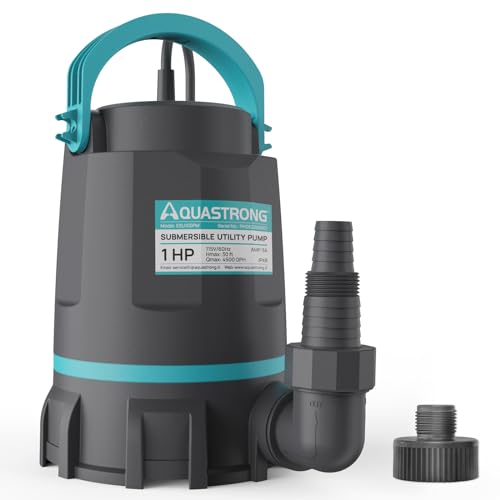
Utility pumps — sometimes called puddle, transfer, or portable submersible pumps — are the general-purpose movers. People use them to drain water heaters, flooded floors, window wells, boats, pool covers, and shallow standing water wherever it collects. Many are manual, switched on and off by plugging and unplugging them, though automatic versions exist.
Well Pumps
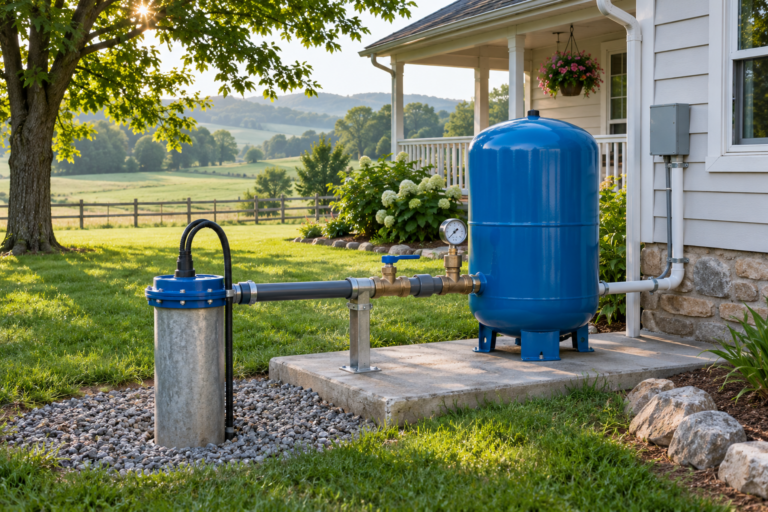
A submersible well pump is installed deep inside a well casing and supplies pressurized water to a home or irrigation system. It is long and narrow to fit the casing, multistage to build pressure, and designed for years of submerged service because pulling it up for repair is a significant job. Sizing a well pump involves the well’s depth, its recovery rate, the height to the pressure tank, and household demand — a calculation where professional advice is genuinely valuable.
Pond and Fountain Pumps
Pond pumps are submersible pumps optimized for continuous duty: they run around the clock moving water through filters and over waterfalls, so energy efficiency, quiet operation, and fish-safe, guarded intakes matter more than burst flow. Fountain pumps are their smaller decorative cousins.
Sewage and Effluent Pumps
Where water contains sewage or significant solids, as in a basement bathroom ejector pit, a dedicated sewage or effluent pump is required. These are built to pass larger solids without clogging and to work with sealed pits and vented plumbing under code.
Key Features That Actually Matter
Float Switches and Automatic Operation
How a pump turns on is as important as how it pumps. A tethered float switch rises with the water and switches the pump on, then lets it run until the level falls; it needs room in the pit to swing freely and can hang up on pit walls or pipes if space is tight. A vertical float switch travels up and down a fixed rod, suiting narrower pits, and must also move without obstruction. Electronic and sensor-based switches have no moving float and can fit tight spaces, but depend on clean sensing surfaces.
Check Valves and Discharge Fittings
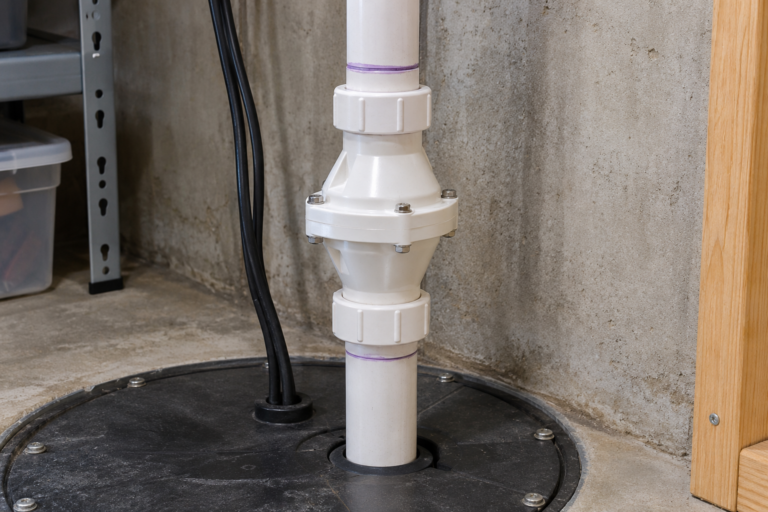
In any system that lifts water out of a pit, a check valve in the discharge line stops the column of water from flowing back when the pump stops, which would otherwise refill the pit and make the pump cycle again immediately.
Dry-Run and Overheating Protection
A submersible pump is cooled by the water around it and, in many designs, lubricated in ways that assume submersion. Running dry or half-exposed can overheat and damage it quickly. Some pumps include thermal overload protection that shuts the motor down before damage and resets after cooling.
Intake Screens and Solids Handling
Intake design decides what the pump tolerates. Fine screens protect impellers in clean water and clog fast in dirty water. Open, solids-handling designs pass debris but need filters downstream if the water is going anywhere sensitive. Many utility pumps have a removable base or screen for cleaning.
Cord Length and Portability
A long, intact cord gives placement freedom and keeps the plug out of the wet zone. Handles, weight, and a stable base matter for utility pumps that move from job to job and must sit flat on a flooded floor without tipping.
How to Choose by Use Case
Basement Flood Protection
Buy a true sump pump, sized so its flow at your discharge height comfortably exceeds the inflow you have observed, with a switch type that fits your pit. Add a check valve, test the system before storm season, and seriously consider a battery backup if your area loses power in storms or the basement is finished.
Temporary Drainage and Cleanup
For flooded floors, pool covers, and water heater work, a utility pump is the right tool. Prioritize flow at low lift, a hose connection you already own, a stable base, and the ability to draw water down low. Stay with the pump while it runs, move it as the water shallows, and stop before it runs dry.
Private Wells
Treat a well pump as a system component, not an appliance swap. Match the new pump to the well depth, casing size, pressure requirements, and electrical supply of the existing system, and weigh professional sizing and installation seriously — the labor of pulling a deep pump dwarfs small savings from a mismatched purchase. Reliability and correct pressure delivery outrank every other feature here.
Ponds and Water Features
Choose a continuous-duty pond pump, sized by pond volume and waterfall height, with a guarded intake and the best energy efficiency you can find at your required flow, because it will run every hour of the year.
Safety Around Water and Electricity
Submersible pumps combine electricity, water, and often a stressful situation — a flood, a storm, a rising pit. That combination demands calm, non-negotiable habits.
Use GFCI Protection
Connect the pump only to a ground-fault circuit interrupter protected outlet or circuit — a GFCI outlet, a GFCI breaker, or the equivalent protective device your local code requires. A GFCI cuts power quickly if current leaks through water or a person, and around pumps it is essential, not optional. Test GFCI devices regularly with their test buttons.
Disconnect Power Before Handling the Pump
Unplug the pump or switch off its circuit before reaching into a pit, pond, or flooded area to reposition, unclog, or inspect it, and before opening any part of it. Never stand in standing water while plugging in, unplugging, or handling a pump or its connections, and keep plugs and connections dry and out of the water at all times.
Respect the Situation
Floodwater can be contaminated and can hide hazards, from submerged outlets to displaced pit covers. Wear suitable footwear and gloves, wash after cleanup work, and leave any job involving sewage, electrical panel exposure, or well systems to professionals where code or safety requires it.
Installation Tips That Prevent Problems
For a sump installation, set the pump on a flat, stable base in a clean pit, slightly raised on bricks or a stand if the pit collects silt, so the intake stays clear. Fit the check valve in the discharge line in the orientation the manufacturer specifies, confirm the float moves through its full travel without touching the pit wall, pipes, or the pump itself, and route discharge water well away from the foundation so it does not simply return.
For utility use, place the pump at the lowest point of the water on a flat surface, attach the discharge hose before starting, route the hose to a drain or outside area that can accept the water, and secure it so the hose’s movement does not tip the pump. Keep the intake clear of leaves and silt as the level drops, and stay nearby for the whole job.
Whatever the type, do a deliberate first test. Fill the pit or area with water, watch the pump switch on at the right level, confirm flow at the discharge end, listen for grinding or rattling, and watch the pump switch off cleanly without the pit refilling from backflow.
Care and Maintenance
The defining fact of submersible pump care is that standby pumps fail quietly. A sump pump can sit for months with a stuck float or a clogged intake, revealing nothing until the night it is needed. Test automatic pumps several times a year: pour water into the pit until the float triggers, confirm strong discharge, and let the pump clear the pit and switch off. Clear debris from the pit at the same time, and check that the discharge line outside is unobstructed.
At an annual service, disconnect the power, lift the pump out, and clean the intake screen and impeller area with a soft brush. Inspect the cord along its full length, check fittings and the check valve, and confirm the pit cover fits. Utility pumps need a rinse and a clean intake after dirty jobs, then dry storage with the cord loosely coiled and unstrained. Pond pumps need the more frequent intake and impeller cleaning their continuous duty demands.
Common Mistakes to Avoid
The most common mistake is buying by category confusion: a utility pump installed as a sump pump, a sump pump expected to feed a well system, a pond feature run on a pump with no continuous-duty rating. The second is sizing by maximum flow while ignoring head, which guarantees disappointment wherever water must climb.
Installation mistakes repeat just as reliably: no check valve, so the pit refills after every cycle; discharge routed to a spot where water returns to the foundation; cords run through standing water to unprotected outlets; and extension cords pressed into permanent service near water. In use, running a pump dry, leaving a manual utility pump unattended, and ignoring a new noise or a weaker discharge until failure completes the picture.
Sizing a pump with real numbers, not guesses
Most disappointing pump purchases trace back to sizing by horsepower alone. Horsepower is the least informative number on the box, because two pumps with the same motor rating can move very different volumes once lift, hose length, and friction enter the picture. Work instead from the job’s two real figures: how many gallons you need to move, and the total dynamic head the pump must work against. Total dynamic head is the vertical lift from the water surface to the discharge point, plus the friction loss in the hose or pipe, plus a small allowance for fittings and any check valve. A long run of corrugated hose can add the equivalent of several extra feet of lift, which is why a pump that looks strong on a short test can feel weak at the far end of a garden hose run to the street.
Use the manufacturer’s performance curve rather than the headline flow rate. The big number on the packaging is almost always the flow at zero or minimal lift; the curve shows what remains at your actual head height. Find your lift on the curve and read across to the delivered flow, then ask whether that flow empties your pit, pool cover, or flooded corner in a time you can live with. For a basement sump pit, the relevant comparison is against inflow during a storm: the pump must outpace the water arriving at the worst moment, not merely empty a quiet pit on a dry day. Oversizing slightly is sensible for flood protection, but gross oversizing a sump pump causes short cycling — frequent starts that wear the switch and motor — so match the pit size and switch type to the pump’s output.
Matching pump types to the water you actually have
Clean-water and solids-handling pumps are built for different worlds, and using one in the other’s world shortens its life. A utility pump with a fine intake screen is the right tool for pool covers, window wells, and flooded floors where the water is mostly clean. The moment the water carries leaves, silt, grit, or construction debris, that fine screen becomes a clogging schedule and the impeller wears quickly. Sewage and effluent pumps pass larger solids by design, with impellers that either grind or move material through wide passages, and they belong in ejector pits and septic applications where a clean-water pump would jam. Between those poles sit drainage pumps for ponds and water features, where the water is dirty but the solids are soft.
Well pumps are their own discipline. A submersible well pump works under constant pressure-system demands, sized to the well’s depth, recovery rate, and the household’s peak draw, and it runs for years without being seen. Choosing one from flow-at-surface numbers is a category error; the pump must deliver household pressure at the bottom of what may be a very deep column of water. If your job is a well, treat the sections of this guide about curves and head as the starting point and confirm the final selection against the well’s documented depth and yield, ideally with the driller’s or a pump installer’s figures in hand.
Switches, alarms, and the value of being warned
More basement water damage is caused by switch failures than by pump failures. A tethered float switch needs room to swing and can hang up on the pit wall, a cord, or the discharge pipe; a vertical float switch works in narrower pits but must be kept free of debris; electronic switches have no moving float at all and suit tight installations, though they depend on clean sensing surfaces. Whichever type you choose, test it by filling the pit with a hose until the pump starts, and watch a full cycle: start level, stop level, and no hesitation or chatter. Repeat the test a few times a year; it takes minutes and it is the cheapest insurance in the whole system.
A high-water alarm is the other inexpensive layer of protection. A simple battery-backed alarm that sounds when water rises above the pump’s normal start level converts a silent failure into a problem you hear about while there is still time to act. Water-powered and battery backup pumps extend that protection to power outages, which is precisely when sump demand peaks during storms. A backup does not need to match the main pump’s full capacity; it needs to hold the line until power returns or you can respond. Households that have flooded once rarely need convincing on this point, and the cost of the alarm and backup together is usually a small fraction of one cleanup.
Discharge plumbing that does not sabotage the pump
The discharge line is part of the pump system, and poor plumbing quietly taxes every cycle. Fit a check valve close to the pump so the water column in the vertical pipe does not drain back into the pit and get pumped twice, but drill the small relief hole the manufacturer specifies between the pump and the check valve on sump installations so an air lock cannot form. Route the discharge to a point where the water will not return to the foundation, pond against the house, or freeze shut in winter climates; an ice-plugged discharge line can deadhead a pump during the exact storm it was bought for. Where the line exits the house, keep the joint accessible, because that union is where you will separate the pump for service.
Pipe diameter matters more than most buyers realize. Undersizing the discharge to save a little money adds friction on every run and can cut delivered flow dramatically at higher lifts. Follow the pump outlet size as a minimum, and if the run is long, consider stepping up a size for the horizontal portion. Support long horizontal runs so they do not sag into low spots that trap water, and avoid sharp elbows where a sweep fitting would do; every fitting is a small tax on flow, paid on every cycle for the life of the installation.
Seasonal and situational playbooks
Spring brings the classic jobs: draining pool covers without letting the debris soup on top reach the pool, emptying waterlogged garden beds and low spots before planting, and clearing window wells after heavy rain. A utility pump with a low intake that can draw water down to a shallow depth earns its keep here, and working slowly at the end — moving the pump to the lowest corner and letting it sip — removes far more water than stopping when the bulk is gone. For hot tubs and stock tanks, confirm the pump’s materials tolerate the sanitizers in the water, and rinse the pump in clean water afterward so seals do not sit in chemical concentrate.
Construction and renovation work is harder on pumps than homeowners expect. Water from cutting, washing down, or a burst temporary line carries grit that acts like liquid sandpaper on impellers and seals. If the job is dirty, choose a pump rated for it, keep the intake off the bottom where sediment concentrates, and budget the pump as a consumable for the project rather than expecting a decade of service afterward. For ponds, plan the pump around continuous-duty rating and energy draw, because a pump that runs all day, every day, multiplies small inefficiencies into real electricity costs over a season; a slightly more efficient model can pay for its difference in a single summer of fountain or waterfall duty.
Troubleshooting the symptoms owners actually report
When a pump hums but does not move water, think air lock, clogged intake, or a discharge problem before you think motor failure. Lift the pump, clear the screen, confirm the relief hole is open, and check that the discharge is not blocked or frozen. When a pump runs but delivers weakly, measure at the discharge: a worn impeller, a partially clogged line, or a lift that grew because someone rerouted the hose uphill can all explain it. When a pump cycles rapidly, look for a check valve that is missing or stuck open, a pit too small for the pump’s capacity, or inflow arriving faster than expected from a new source such as a rerouted downspout.
A pump that trips the breaker deserves respect and a stop: water and electricity faults are not a trial-and-error combination. Unplug it, inspect the cord for damage, and if the cause is not obvious, replace or have it serviced rather than resetting and hoping. GFCI protection should be treated as non-negotiable for any submersible pump people will handle, and a pump with a damaged cord jacket should leave service immediately. Finally, keep the paperwork: model, serial, purchase date, and the performance curve. The day the pump fails during a storm is the wrong day to discover you do not know what size it was, and a like-for-like replacement sized from the curve can be ordered in one phone call.
Questions worth asking before you buy
How long can a submersible pump sit unused?
Months of storage are fine if the pump is stored clean and dry, but seals can take a set and floats can stick after long stillness. Before returning a stored pump to service, submerge it in a bucket or tub, run it briefly, and operate the switch through a few cycles. For a sump pump that protects a basement, that bucket test at the start of the wet season is the difference between a verified safeguard and an assumption.
Does cord length change performance?
The cord does not change the pump’s hydraulics, but it changes where you can safely place it. A longer cord lets the pump reach the lowest point of a pit or pond without an extension cord near water, which is both a safety and a reliability win. Never use a damaged cord, and avoid running a pump for long periods on a light-duty extension cord, which can starve the motor of voltage and overheat it.
What is the single most useful accessory?
For sump duty, the high-water alarm; for utility duty, a proper discharge hose sized to the pump outlet with a secure clamp, because improvised hose connections are where most flow and most patience are lost. A spare check valve on the shelf also earns its space: it is a small, inexpensive part whose failure can imitate a pump failure at the worst possible moment.
Energy, noise, and the neighbors
A pump that runs occasionally can be chosen on capability alone, but a pump that runs for hours — pond circulation, waterfall features, long drainage jobs — should also be chosen on what it costs to run and what it sounds like doing it. Compare the watt draw at your expected duty point rather than the motor’s peak rating, and remember that a pump working against less head than necessary wastes energy on every cycle, which is another reason to keep discharge runs short, smooth, and correctly sized. Noise travels through water and plumbing surprisingly well: a sump pump’s thump at the end of a cycle is usually the check valve closing, and quieter valve designs or a slightly different valve position can soften it. Utility pumps used indoors for a flooded room are loud mostly because the room is; outdoors, vibration transmitted through a hard surface is the usual complaint, and a rubber mat under the pump or a discharge hose that is not pulled drum-tight reduces it more than any specification on the box.
When to repair and when to replace
Submersible pumps live sealed lives, and most are not designed for economical internal repair by the owner. Replaceable items are the external ones: switches on some models, cords rarely, intake screens, check valves, and fittings. When the motor itself weakens, the seal fails and oil or water crosses where it should not, or the impeller housing is worn by grit, replacement is usually the honest answer — especially for a sump pump, where a doubtful unit is worse than none because it creates false confidence. Keep the failed pump’s curve and specifications when you shop for its successor, size the replacement from the job’s head and inflow rather than from the old pump’s label alone, and consider whether the failure teaches you something: a pump that died young on gritty water wants a solids-tolerant successor, and a pump that short-cycled itself to death wants a smaller output or a larger pit, not an identical twin.
Case studies: four jobs and the pump each one wants
Abstract specifications become clearer against real jobs. Consider first the homeowner whose basement pit takes on water in every heavy rain. The job is intermittent, urgent, and measured in inflow at the worst hour; the answer is a sump pump sized from the performance curve to outpace that inflow at the pit’s actual lift, with a switch suited to the pit’s width, a check valve fitted correctly, and — because storms and outages travel together — an alarm and ideally a backup. The pump will run rarely and must work perfectly when called, so reliability features outrank raw flow, and the twice-yearly bucket test matters more than any specification.
Second, the pool owner draining a cover each spring and lowering the water level each autumn. The water is dirty at the edges but not solid-laden; the lift is modest; the volumes are large and the owner is standing there watching. A utility pump with strong flow at low head, a low intake that finishes the job to a shallow film, and a discharge hose sized generously is the right tool, and it will earn secondary employment on flooded patios and window wells for years. Third, the pond keeper whose waterfall runs all season: continuous duty, energy cost, and quiet operation dominate, and the correct pump is the efficient one whose curve crosses the waterfall’s height and desired flow at an economical wattage — a specification exercise, not a horsepower contest. Fourth, the renovator whose basement excavation keeps filling with silty water: solids tolerance and a tolerance for abuse dominate, the intake must be kept off the bottom, and the pump should be bought with the honest expectation that the project may consume it. Four jobs, four different right answers, and in each case the deciding questions were the job’s questions — inflow, lift, duty, and dirt — rather than the box’s biggest number.
Understanding the ratings and terms on the box
A few terms repay precise understanding. Flow is quoted in gallons per hour or per minute, and the two are confused often enough to ruin purchases; multiply or divide by sixty deliberately and write the figure down in one unit before comparing models. Head, shut-off head, and maximum lift all describe the height at which flow falls to zero — a pump working anywhere near that height is delivering a trickle, so your working lift should sit comfortably inside the curve, not at its edge. Solids handling is quoted as a diameter, and it describes what passes through the pump, not what the intake screen admits; a pump can be rated for solids its own screen will not let in, which is a design for straining rather than passing, and the distinction matters in dirty water. Duty cycle language — continuous, intermittent, or a stated on-off pattern — is a thermal promise, and a pump run beyond its duty in a hot, shallow pool of water will protect itself by stopping, usually mid-job. Finally, ingress ratings and cord specifications tell you whether the pump is meant to be fully submerged indefinitely or only while working; a pump left living in a pond or pit should carry the rating for that life, not merely survive it for a season.
Reading the box this way takes five minutes and converts the purchase from a comparison of adjectives into a comparison of numbers that describe your actual job. Bring your job’s numbers written down — lift, distance, volume, dirt — and let the curves and ratings argue among themselves.
Keeping records and spares like an owner, not a gambler
Submersible pumps fail at inconvenient moments by profession, and the difference between an inconvenience and a flood is usually preparation done in calm weather. Keep a one-page record where the household can find it: the pump’s model and serial, its purchase date, the size of its discharge and check valve, the pit’s or system’s lift figure you sized it from, and the name of the supplier who had it in stock. Photograph the installation before it is buttoned up, because the photograph answers questions — which way the check valve faces, where the relief hole sits, how the float is tethered — that memory will not answer under pressure at midnight. Stock the short list of spares that fit your exact installation: a check valve, hose clamps, a length of discharge hose or pipe with its fittings, and, for a sump installation protecting a finished basement, a tested spare pump or at minimum a utility pump that can be dropped in as a stopgap. Test the backup arrangement once, in daylight, by simulating the swap; a backup plan that has never been performed is a hypothesis, and storm night is a poor laboratory.
What good ownership looks like across a pump’s life
Across a decade, the well-owned pump has a recognizable biography. It was sized from measured figures and installed with a correct check valve, a sensible discharge route, and GFCI protection. It is exercised and inspected on a seasonal rhythm — the sump pump tested before the wet season, the utility pump rinsed and run briefly before storage, the pond pump cleaned at the intervals its water demands. Its small parts are replaced at the first sign of wear rather than after failure, because its owner learned that switches, valves, and screens are consumables with long intervals. Its paperwork survives, so its replacement — when the motor finally weakens or the seals finally weep — is chosen in an afternoon from the record rather than in a panic from a flooded floor. None of this requires expertise beyond what this guide contains. It requires only the decision to treat a machine that works invisibly as if it matters, which, on the one night a decade when it matters most, it entirely does.
Submersible pumps and insurance, inspections, and disclosure
A working sump system has a paper life as well as a mechanical one. Home insurers and home buyers both look more kindly on a basement protected by a maintained, documented system — pump, check valve, alarm, and where fitted, a backup — than on a pit with an anonymous pump of unknown age. When you install or replace a pump, keep the invoice and the record sheet described earlier with your home documents, and note the installation in whatever maintenance log you keep for the house. If your basement has flooded in the past, be straightforward with your insurer about the mitigation you have put in place; a verified, alarmed, backed-up system is a materially different risk from the one that flooded, and some policies recognize the difference. When selling, the same documentation answers the buyer’s inspection questions before they become negotiation points: the pump’s age, its service history, and the alarm’s presence are small facts that carry reassuring weight. None of this requires anything beyond the ownership habits this guide already recommends — it simply means the habits, recorded, keep paying after the pump itself is forgotten.
A note on pumps, warranties, and keeping the receipt
Pump warranties turn on documentation more often than on defects. Keep the receipt and record the installation date, because many warranties run from purchase or installation and the difference matters at the boundary. Register the product if the maker offers it, photograph the rating plate before the pump goes into a pit or pond where the label will become unreadable, and keep the manual’s performance curve with the record sheet. If a pump fails early, the owner with documents has a claim; the owner with a story has a negotiation. It is a small administrative discipline, entirely in keeping with the ownership pattern this guide recommends, and it costs one folder.
The pump owner’s closing thought
A submersible pump is bought for the worst day, not the average one — the storm night, the burst pipe, the spring flood, the waterfall’s opening morning. Choose it from your job’s measured figures, install it as a system rather than an appliance, test it while the weather is kind, and it will repay that care on the single occasion when nothing else can substitute for it. That reliability, purchased in advance and maintained in calm, is the entire product; everything else is plumbing.
Frequently Asked Questions
What is the difference between a sump pump and a utility pump?
A sump pump is an automatic, permanently installed guardian for a basement pit, built to switch itself on and off for years. A utility pump is a portable, often manual tool for temporary draining jobs such as flooded floors and pool covers.
How do I know what size submersible pump I need?
Start with the job and the lift. Estimate how much water you must move and how high it must go, then compare pumps by the flow they deliver at that head height, using a published flow-versus-head chart where available. For wells and sewage systems, sizing follows system requirements and code, and professional input is strongly recommended.
Can a submersible pump run continuously?
Only if it is rated for continuous duty, as pond pumps typically are. Sump pumps are built for intermittent automatic cycling, and most utility pumps expect supervision and rest. Check the duty rating in the manual for any pump you intend to run for long periods, and never let any submersible pump run dry.
Why does my sump pump keep cycling on and off?
Short cycling usually means discharged water is flowing back into the pit because a check valve is missing or failed, the pit is small relative to inflow, or the float’s on-off range is too narrow or obstructed. Disconnect power, inspect the check valve and float movement, and clear the pit before assuming the pump itself is at fault.
What should I do if my submersible pump stops working?
Disconnect the power first. Then check the obvious: the outlet and GFCI, the float or switch for obstruction, the intake for clogging, and the discharge for blockage. Clean and test as the manual describes.
Do I need a backup sump pump?
If a flooded basement would cause serious damage, or your area loses power during storms, a backup — commonly battery-powered — is a wise investment, because a main pump cannot run without electricity. Pair it with a high-water alarm and regular testing, and the system protects you through the failures a single pump cannot.
Submersible Utility Pumps to Compare
- Little Giant Next Gen 5-MSP (item 505712): A 1/6-hp manual utility pump rated up to 1,500 gallons per hour at one foot of head. Amazon exact-model search · Manufacturer specs.
- Liberty Pumps 260-2: A 1/6-hp clear-water utility pump for transfers, pool covers, and flooded areas, pumping down to about 1/8 inch. Amazon model search · Manufacturer specs.
Match water quality, lift, voltage, and duty cycle.
Conclusion
The best submersible pumps are the ones matched precisely to the job below the water: a sump pump with a switch that suits its pit and a backup for the night the power fails, a utility pump ready for temporary drainage and used with supervision, a well pump sized as part of a pressurized system, or a pond pump built and rated to run every hour of the year. Judge them by flow at your real head height, by materials suited to your water, and by the switch and safety features that decide whether they work unattended.