Where to buy
Check the latest price, availability and delivery on Amazon. Orders are placed on Amazon. We may earn a commission from qualifying purchases.
- Best overall for small patios: Weber Lumin Compact Portable Electric Grill — Check on Amazon
- Best gas for tiny patios: Everdure CUBE Proflame 360 Portable Propane Gas Grill
- Best folding full-feature gas: Napoleon TravelQ PRO285X Portable Propane Gas Grill with Scissor Cart
- Best for patios with a storage corner: Weber Traveler Portable Gas Grill
- Best value tabletop electric: Weber Q 1400 Portable Electric Grill
- Best charcoal where permitted: Kamado Joe Joe Jr. 13.5-inch Portable Ceramic Charcoal Grill (KJ13RH)
Read the full guide ↓
Disclosure: As an Amazon Associate, dailyhomedecorating.com earns from qualifying purchases. Links to Amazon on this page are affiliate links; they cost you nothing extra. Listing details such as price and availability change often, so check the current Amazon listing before you buy.
The best portable grill for small patios under $700 is chosen by a tape measure before it is chosen by a spec sheet. On a small patio, every object pays rent: the grill competes with the chair you sit in, the table you eat at, the plants, the door swing and the storage box — and a grill that wins the cooking contest but loses the floor-plan contest will be resented daily and used rarely. The six picks below were therefore ranked on two axes at once: how well they cook, and how honestly they fit — footprint in use, footprint stored, the clearance they need from walls and railings, and whether their fuel can legally and practically live in a small outdoor space at all.
The list leads with the format small patios reward most: compact electrics and tabletops. The Weber Lumin Compact brings genuine searing heat in the smallest quality footprint here, with no fuel storage and no ash. The Everdure CUBE Proflame answers for gas lovers with a hooded tabletop the size of hand luggage. The folding-cart gas grills — Napoleon’s flat-folding PRO285X and Weber’s upright-storing Traveler — serve patios that have one storage corner to give. The Q 1400 is the cupboard-friendly value electric, and the Kamado Joe Joe Jr. closes the list for the small patios where charcoal is permitted and a stand-sized footprint is available. Every linked pick was verified by brand and model, screened against recall records, and assessed with small-space realities — neighbours above and beside, floor protection, and sink-based cleaning — kept in view throughout.
In this guide
Quick Picks: Best portable grill for small patios under $700
Short on time, or comparing several options at once? Each row below names a buyer type and the grill that suits it, with a link to the listing where one is available.
| Buyer type | Pick | Why it stands out | Link |
|---|---|---|---|
| Best overall for small patios | Weber Lumin Compact Portable Electric Grill | High-heat electric searing in the smallest quality footprint, with no fuel to store | Check on Amazon |
| Best gas for tiny patios | Everdure CUBE Proflame 360 Portable Propane Gas Grill | A hooded tabletop gas grill the size of a carry-on, for patios measured in single square metres | Check on Amazon |
| Best folding full-feature gas | Napoleon TravelQ PRO285X Portable Propane Gas Grill with Scissor Cart | Two burners and cast iron on a scissor cart that folds flat against a wall | Check on Amazon |
| Best for patios with a storage corner | Weber Traveler Portable Gas Grill | Full-size cooking that folds upright into a patio corner or storage box footprint | Check on Amazon |
| Best value tabletop electric | Weber Q 1400 Portable Electric Grill | The proven, light electric tabletop that lives in a cupboard between cooks | Check on Amazon |
| Best charcoal where permitted | Kamado Joe Joe Jr. 13.5-inch Portable Ceramic Charcoal Grill (KJ13RH) | Ceramic kamado cooking on a stand footprint smaller than a side table — where charcoal is allowed | Check on Amazon |
How These Picks Were Chosen
The first filter was measured fit. Each pick’s working footprint — including the clearance its maker requires from walls, railings and overhangs — had to be plausible on a genuinely small patio, and its stored footprint had to fit a balcony cupboard, a storage box, a wall lean or a single corner. Grills that are ‘portable’ only in the sense that a determined adult can lift them, while living at full size forever, failed this filter regardless of cooking quality.
The second filter was small-space citizenship: fuel that can be stored legally and safely in tight quarters (no fuel at all beats small canisters; charcoal appears only with an explicit permission caveat), smoke and drip behaviour that respects close neighbours and the ceiling of the balcony below, and cleaning that works at a kitchen sink rather than demanding a yard and a hose. The third filter was the series standard — real cooking substance, verified listings, recall screening, and bristle-free cleaning guidance only, because wire-bristle brushes are a recalled ingestion hazard that no patio size excuses.
The Picks in Detail: Best portable grill for small patios under $700
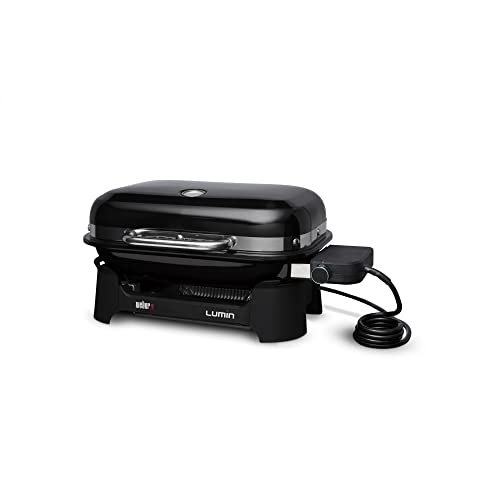
Weber Lumin Compact Portable Electric Grill — Best overall for small patios
The Lumin Compact is what happens when a serious grill maker designs for the tape measure first. It keeps the Lumin family’s defining trick — electric heat that genuinely sears, past the temperatures that turn other electrics into steamers — in a body that fits the small patio’s arithmetic: a modest tabletop footprint, a light carry from cupboard to patio, and clearances a small space can actually provide. Closed-lid roasting works properly, warm-up is weeknight-fast, and the drip tray empties into a bag at the kitchen bin.
Its citizenship is impeccable for tight quarters: no fuel to store, no ash, cooking smoke only, and a plug as its entire supply chain — provided an outdoor outlet is within reach, which is the one infrastructure question to settle before buying. The cooking area suits one to four servings per round; couples and small families will call that perfect, entertainers will call it batching. On a small patio, though, the grill that fits is the grill that gets used, and the Compact’s whole design argues it will be used constantly.
Who it suits: Small-patio households of one to four who want real searing with zero fuel storage and minimal footprint.
Pros:
- Genuine high-heat electric searing in a compact body
- No fuel, no ash: ideal small-space citizenship
- Light to move between cupboard and patio
- Tray cleanup needs no hose or yard
Honest limitation: Needs an outdoor outlet; area suits up to four servings per round.
Choose it if your patio is truly small and your household is one or two, cooking often. Skip it if you lack an outdoor outlet, or you regularly cook for five-plus at once.
Check on Amazon — check price on Amazon for the current listing, configuration and delivery options.
Everdure CUBE Proflame 360 Portable Propane Gas Grill — Best gas for tiny patios
The CUBE Proflame 360 is the gas answer to the same arithmetic: a hooded tabletop grill with a footprint comparable to a carry-on case, a single stainless burner under a cast-iron grate, and a roasting hood with a thermometer that makes closed-lid cooking — chicken portions, sausages, roast vegetables — a design feature rather than an improvisation. It lifts one-handed from storage box to patio table, lights instantly, and asks for nothing but a small propane canister and a heat-proof surface to stand on.
For the small patio that hosts two chairs and a determined cook, it is close to ideal: dinner for one to three, cooked tidily, with the grill back in its box before dessert. Its limits are the honest ones of scale — a single modest burner, no cart, thick steaks needing patience — and gas’s legal footnote: on rented patios and balconies, check that propane is permitted before the canister, not after. Where it is, the CUBE Proflame is the most patio-shaped gas grill in this guide.
Who it suits: Gas loyalists on tiny patios cooking for one to three, with a storage box as the grill’s home.
Pros:
- Carry-on footprint; one-hand portability
- Roasting hood with thermometer for closed-lid cooking
- Instant gas light and cast-iron grate
- Stores in a box or cupboard between cooks
Honest limitation: Single modest burner and no stand; propane permission must be checked for rented spaces.
Choose it if your patio fits a table and two chairs and no more, and gas is permitted. Skip it if you cook for four-plus routinely — the folding-cart picks hold more food.
Check on Amazon — check price on Amazon for the current listing, configuration and delivery options.
Napoleon TravelQ PRO285X Portable Propane Gas Grill with Scissor Cart — Best folding full-feature gas
The PRO285X earns its small-patio place with a single measurement: folded thickness. The scissor cart collapses flat, so the grill leans against a wall, slides behind a storage box, or hangs in a utility cupboard — then opens into a full-height, two-burner gas grill with about 285 square inches of cast-iron Wave grates. No other pick here converts between ‘full grill’ and ‘barely there’ as completely, and on a small patio that conversion is the whole game: cooking capacity when you cook, floor when you do not.
The two burners give the small patio a big-grill skill — a searing side and a gentle side — which matters more, not less, when the grate is your only cooking surface. Wind resistance and a lid thermometer keep it composed in the gusty corners small patios tend to be. It is premium-priced and its deployment, while quick, is a small ritual; households that grill twice a week will find the ritual trivial against the floor it returns to them daily.
Who it suits: Small patios with one wall or cupboard for flat storage, whose cooks want full two-zone gas capability.
Pros:
- Folds completely flat: the storage champion among full grills
- Two burners for genuine two-zone cooking
- Cast-iron Wave grates sear at steakhouse level
- Full standing height in use
Honest limitation: Premium price, and folding is a small ritual at every session.
Choose it if you have flat storage but no floor to spare, and you cook mixed loads. Skip it if you want a grill that lives permanently set up — a tabletop pick deploys faster.
Check on Amazon — check price on Amazon for the current listing, configuration and delivery options.
Weber Traveler Portable Gas Grill — Best for patios with a storage corner
The Traveler’s small-patio case rests on its stored shape: folded, it stands upright like a suitcase in a corner, occupying a sliver of floor while offering, open, the largest cooking area in this guide at about 320 square inches. For the small patio that occasionally hosts — the household of two whose space must seat six twice a month — that is a compelling trade: everyday footprint near zero, party capacity on demand, rolled out and back in minutes.
Daily life with it on a small patio requires the corner to exist and the route to be clear; a folded Traveler still needs its sliver, and its one-hand fold is easy only when the patio’s furniture plan leaves the roll path open. The single burner asks for sequencing at party scale. But judged as space mathematics — cooking area per stored square foot — nothing else in the guide is close, and small-patio owners who entertain will feel that ratio every time the guests arrive and every time they leave.
Who it suits: Small patios with an upright storage corner whose owners entertain beyond their everyday headcount.
Pros:
- Largest grate here, stored upright in a sliver
- One-hand fold; rolls rather than carries
- Full-height cooking with a useful side table
- Canister or full-tank flexibility
Honest limitation: Needs its storage corner and a clear roll path; single heat zone.
Choose it if your patio must be a living space daily and a cookout space monthly. Skip it if you have no upright corner to give — the Napoleon’s flat fold or a tabletop fits better.
Check on Amazon — check price on Amazon for the current listing, configuration and delivery options.
Weber Q 1400 Portable Electric Grill — Best value tabletop electric
The Q 1400 is the small patio’s value elder: a light, compact electric tabletop with 1,560 watts, porcelain-enamelled cast-iron grates and a removable catch pan, from the family that defined electric portables. It lives in a cupboard, deploys onto any sturdy heat-proof table in a minute, grills evenly and predictably for two to four, and cleans at the sink with split grates that were designed by someone who had clearly washed them.
It concedes headline heat to the Lumin Compact — its sear is respectable rather than fierce — and it offers no smoke or steam theatre. What it offers instead is the lowest-friction ownership in this guide: the least money, the least weight, the least storage, and a decade of proven manners. For a first small-patio grill, or a second grill for a household whose main cooking happens elsewhere, it is the pick that never becomes a problem.
Who it suits: Value-focused small-patio cooks and first-time owners wanting the simplest cupboard-to-patio routine.
Pros:
- Lightest, simplest ownership here; cupboard storage
- Proven electric platform with cast-iron grates
- Sink-friendly split grates and removable catch pan
- The value pick of this guide
Honest limitation: Searing is respectable, not fierce; no extra cooking functions.
Choose it if simplicity and value outrank maximum heat in your kitchen arithmetic. Skip it if you want the strongest electric sear — the Lumin Compact is built for that.
Check on Amazon — check price on Amazon for the current listing, configuration and delivery options.
Kamado Joe Joe Jr. 13.5-inch Portable Ceramic Charcoal Grill (KJ13RH) — Best charcoal where permitted
The Joe Jr. closes the list with a condition stated upfront: charcoal belongs on a small patio only where it is explicitly permitted — many leases and local codes ban open-flame cooking on balconies and tight patios entirely, and this guide does not argue with them. Where charcoal is allowed — a ground-floor patio, a house-owned terrace — the Joe Jr. offers something no electric can: a true ceramic kamado on a stand footprint smaller than a side table, sipping charcoal, holding smoke temperatures for hours, and searing at fire temperatures.
Its small-space costs are the charcoal constants: lighting time, ash that must cool fully and go to a lidded metal container, smoke that close neighbours will notice, and a ceramic body whose weight makes its small footprint a parked footprint rather than a moved one. For the permitted small patio whose cook prizes flavour over convenience, it remains the most rewarding square foot in this guide — and for everyone else, the five picks above exist precisely because this one’s conditions are real.
Who it suits: Ground-floor and house-owned small patios where charcoal is explicitly permitted, and flavour outranks convenience.
Pros:
- True kamado performance on a side-table footprint
- Ceramic fuel economy and temperature stability
- Searing and smoking in one compact body
- Stand, deflector and ash tool included
Honest limitation: Charcoal is banned on many small patios and balconies; ash, smoke and weight demand commitment.
Choose it if your space is yours, charcoal is permitted, and cooking is a hobby, not just dinner. Skip it if you rent, or neighbours are close above — the electric picks are your guide.
Check on Amazon — check price on Amazon for the current listing, configuration and delivery options.
Comparison Table
| Grill | Fuel | Best for | Link |
|---|---|---|---|
| Weber Lumin Compact Portable Electric Grill | Electric | Best overall for small patios | Check on Amazon |
| Everdure CUBE Proflame 360 Portable Propane Gas Grill | Propane | Best gas for tiny patios | Check on Amazon |
| Napoleon TravelQ PRO285X Portable Propane Gas Grill with Scissor Cart | Propane | Best folding full-feature gas | Check on Amazon |
| Weber Traveler Portable Gas Grill | Propane | Best for patios with a storage corner | Check on Amazon |
| Weber Q 1400 Portable Electric Grill | Electric | Best value tabletop electric | Check on Amazon |
| Kamado Joe Joe Jr. 13.5-inch Portable Ceramic Charcoal Grill (KJ13RH) | Charcoal (ceramic kamado) | Best charcoal where permitted | Check on Amazon |
How to Choose: Best portable grill for small patios under $700
Measure three footprints before shopping: the grill in use including its required clearances, the grill stored, and the route between the two. On small patios the stored footprint is usually the deciding one — flat against a wall (Napoleon), upright in a corner (Traveler), in a box or cupboard (CUBE Proflame, Q 1400, Lumin Compact), or parked on its stand (Joe Jr., where permitted). Tape the shapes on the floor, live with the tape for a day, and let the patio vote.
Fuel on a small patio is a neighbours-and-rules question before it is a flavour question. Electric needs an outdoor outlet and is the default for rented and upstairs spaces. Gas needs permission and a legal, shaded spot for canisters. Charcoal needs explicit permission, ash infrastructure and smoke-tolerant neighbours. Pellet grills, excellent elsewhere in this series, mostly fail the small-patio test on footprint and power-plus-storage combined — which is why none appears here, an omission that is itself a recommendation about fit.
Finally, plan the small systems: a heat-proof mat under the grill to protect the floor and your deposit, a lidded bin for cooled waste, drip discipline so the ceiling or boards below stay clean, and bristle-free cleaning tools that work at a sink. On a small patio, the grill is a household system at miniature scale — the picks above succeed because their systems are small too.
Fire Safety Every Portable Grill Owner Should Follow
Small spaces concentrate every grill hazard. Keep the maker’s clearances from walls, railings, overhangs and stored items — where a manual is silent, roughly three feet is the working minimum, and on a small patio that may mean the grill dictates the furniture plan while it is lit or cooling, which is correct. Set it only on a stable, heat-resistant surface that protects the floor: never on wooden boards unprotected, never on a plastic table, never under a low ceiling or enclosed roof, where carbon monoxide and smoke collect — every grill here, electrics included, is an outdoor appliance.
Fuel storage shrinks with the patio but its rules do not. Propane canisters live shaded, upright and outdoors, never in indoor cupboards or stairwells. Charcoal, where permitted, lives dry and sealed; its ash cools fully in the closed grill and transfers to a lidded metal container kept away from the building — never into patio planters, plastic bins or household rubbish while warm. Electric cords route out of walkways and away from water, plugged directly into a suitable outdoor outlet.
Clean with bristle-free tools only — coiled-wire brushes, wooden scrapers, nylon on cool grates, foil in tongs on hot ones — because wire-bristle brushes shed bristles that have caused serious injuries and mass recalls, and a small patio’s food is eaten two steps from the grate. Empty drip trays before they overflow onto the floor or the balcony below, keep children and pets out of the hot zone (on a small patio, that may mean indoors during cooking), and never leave a lit or cooling grill unattended.
Common Mistakes With Portable Grills at This Tier
The small-patio mistake that outranks all others is buying the in-use footprint and forgetting the stored one: a grill that cooks beautifully and lives terribly will be sold within a year. Second is its twin — buying for the party of twelve that happens annually and tripping over the capacity at the other 364 breakfasts. Small patios reward the grill sized to the household’s ordinary week, with batch cooking accepted for the rare crowd.
Third: ignoring the neighbours in three dimensions — smoke rises to the balcony above, drips fall to the one below, and sound carries in a courtyard. The electrics and tidy tabletops in this guide lead the ranking partly because they are good citizens. Fourth: floor neglect. One season of drips and heat on unprotected boards or tiles costs more than every accessory in this guide combined; the mat goes down before the first cook, not after the first stain.
Fifth: treating clearance as a suggestion because space is tight. Clearances are the one specification a small patio may not negotiate; if a grill cannot have its clearances in your space, the correct conclusion is a smaller grill — several excellent ones are listed above — never a tighter squeeze.
Final Recommendation
For most small patios, the Weber Lumin Compact is the recommendation: real searing, no fuel, a footprint that respects the floor plan. Gas loyalists should take the Everdure CUBE Proflame for tiny spaces or the flat-folding Napoleon PRO285X for full capability; entertainers with a storage corner, the Weber Traveler; value seekers, the Q 1400; and the permitted, flavour-first few, the Kamado Joe Joe Jr. Measure first, and the grill you choose will fit your patio as well as it cooks on it.
Start with the Weber Lumin Compact Portable Electric Grill if it matches your space and fuel rules — check price on Amazon before you buy.
Designing the Small Patio Around the Grill
A small patio works when its furniture plan admits what the space actually is: a room with several jobs and one floor. Start with the fixed points — the door swing, the storage, the seating you will not give up — and let the grill claim what remains, with its clearances drawn honestly into the plan. For many small patios the winning layout is a cooking corner: a heat-proof mat defining the station, the grill deployed onto it from its cupboard, box or flat fold, and the seating arranged to face the cook rather than the wall, so grilling stays social in a space too small for a separate cooking zone. When the session ends, the corner returns to floor, and the patio’s other jobs resume. That rhythm — deploy, cook, restore — is the small-patio pattern every pick in this guide was chosen to serve.
Vertical thinking rescues small floors. The Napoleon’s flat fold and the Traveler’s upright stance are vertical storage strategies; a wall-mounted shelf for tools, a hook rail for the bristle-free brush and tongs, and a lidded bin that doubles as a side table all move the grill’s ecosystem off the floor. Plants, the small patio’s other tenants, should be planned around heat honestly: nothing leafy within the clearance zone, nothing resinous or dry above the grill, and the herbs you cook with placed close enough to snip but far enough to stay un-singed. Light matters too — a small patio grill session at dusk needs the cook to see doneness, so a simple outdoor light aimed at the station is worth more than any accessory sold for the grill itself.
Neighbours are part of the design whether you invite them or not. Smoke rises, drips fall, and conversation carries in shared air; the small-patio cook who positions the grill away from the boundary, cooks at sociable hours, keeps the tray clean enough that old grease never becomes the evening’s perfume, and occasionally sends a plate over the fence, is designing for the only approval that ultimately matters. The picks at the top of this guide — quiet electrics and tidy tabletops — lead the ranking partly because they make this citizenship easy rather than heroic.
Small Patio, Four Seasons: Using the Space All Year
Spring on a small patio is setup season: check the outlet or the gas connections, inspect the mat, clean the storage box, and give the grill its burn-in or first gentle cooks while the furniture plan is still negotiable. It is the moment to discover that the chair blocks the fold, the planter crowds the clearance, the cord crosses the walkway — discoveries that are free in April and expensive in July. Summer is the patio’s high season and the grill’s: quick electric and gas sessions that do not heat the kitchen, vegetables and fish that suit hot weather, and the discipline of shade — a small patio’s grill corner can become an oven by afternoon, and both cook and grill perform better in the morning and evening slots.
Autumn suits the folding carts and the kamado, where permitted: heartier food, longer sessions, guests in jumpers around a warm corner. It is also cleaning season — a deep clean with bristle-free tools, grease systems emptied, gaskets and hoses inspected — because a small patio offers no out-of-sight corner where a neglected grill can hide its condition. Winter divides small-patio owners honestly. For many, the grill’s smallness pays its final dividend: it stores indoors, in a cupboard, taking no weather at all, while the patio rests. For the devoted, a compact electric or kamado on a still winter day cooks a small, perfect meal for a household that has the patio entirely to itself. Either way, the grill that fit the floor plan in spring is still fitting it in December — which, on a small patio, is the definition of the right purchase.
Two Small Patios, Two Right Answers
Consider first the upstairs balcony of a rented flat: nine square metres, a lease that bans open flame, one outdoor outlet, a couple who cook outdoors twice a week and host two friends monthly. Every constraint in that sentence points the same way. The Lumin Compact fits the floor with its clearances intact, plugs into the outlet that exists, stores in the hall cupboard, makes no ash for a lease to object to and no smoke worth a neighbour’s text — and it sears well enough that the couple stops apologising for ‘balcony food’ within a month. The folding gas grills, excellent machines, are wrong here three times over: fuel, storage route and permission. The Q 1400 runs it close on value, and if the budget were the binding constraint it would win; with a $700 tier available, the Compact’s extra heat is the better decade-long buy.
Now the ground-floor terrace of a small house: privately owned, charcoal permitted, a storage box in the corner, a cook who reads about smoking the way other people read about travel. The constraints point opposite. The Kamado Joe Joe Jr. parks on its stand in the corner the box does not need, cooks with a depth no electric can imitate, and turns the terrace into the household’s favourite room. Its ash lives in a lidded metal container, its smoke is managed with the neighbours in mind, and its weight is irrelevant because it moves twice a year. The electrics, excellent machines, would be a compromise purchased against the household’s actual desire. Two small patios, two opposite right answers — the method is the constant: read the rules, measure the floor, count the mouths, and let those three facts, in that order, choose the grill.
The True Cost of Small: What the $700 Tier Buys on a Small Patio
Small-patio shoppers sometimes suspect the premium tier is wasted on them — that a small space deserves a small spend. The arithmetic runs the other way. On a small patio the grill is not one appliance among many; it is the patio’s cooking capacity entire, used at close quarters, stored in the household’s scarcest space, and judged daily by whether it earns its footprint. The tier buys the things that decide that judgement: searing heat in electric form (the Lumin family’s whole achievement), folding mechanisms that survive years of weekly conversion rather than a season of it, cast-iron grates instead of thin chrome, lids that roast rather than merely cover, and build quality that keeps a cupboard-stored appliance from becoming a cupboard-smelling one. It also buys the system around the grill — mat, bin, tools, cover where relevant — inside the same budget conversation, which on a small patio is not a luxury but the mechanism by which the grill stays welcome. A cheap grill on a small patio is not a saving; it is a recurring negotiation. The picks in this guide were chosen to end the negotiation.
Renting With a Grill: Deposits, Inspections and Leaving No Trace
For renters, a small-patio grill is also a financial instrument: it must never cost a deposit. The risks are mundane and entirely manageable — heat marks on boards or tiles, grease in the grout or on the ceiling below, smoke film on siding, and a storage arrangement that reads as clutter at inspection. The countermeasures are this guide’s recurring liturgy, gathered here as a renter’s checklist: a rated mat under the grill from the first cook, not the fifth; drip trays emptied on schedule; the grill and its fuel stored inside its cupboard, box or cover rather than sprawled; cords and canisters never creating a trip or storage violation; and the patio returned, at lease end, to a condition indistinguishable from a non-grilling tenancy. Every pick at the top of this ranking was chosen partly because it makes that checklist easy — electrics leave almost no trace at all, and the tidy tabletops nearly none.
Inspections deserve a sentence of their own. A grill that is permitted, clean and properly stored is an unremarkable household object at inspection; a grill that is scorched around, greasy beneath and accompanied by a scorched railing is a conversation. Keep the written permission from management with your lease papers, keep the manual’s clearance page bookmarked, and keep the station tidy enough that the question answers itself. Renters who do this keep both their deposits and their grilling — and landlords, it turns out, rarely object to tenants whose outdoor cooking is visibly careful. The grill you choose either helps you look careful or makes you work to look it; on a rented small patio, choose the helper.
When the Patio Is Also the Office, the Gym and the Garden
The modern small patio is the hardest-working room in the home: morning coffee office, lunchtime stretch space, herb garden, reading chair, and — a few evenings a week — grill station. That multiplicity is the final argument for the ranking in this guide. A grill for such a space must be judged by its absence as much as its presence: how completely it disappears (cupboard, box, flat fold, upright corner), how little infrastructure it demands while gone (no fuel store sprawling, no ash container colonising the corner), and how fast it converts when dinner calls. The Lumin Compact and the tabletops convert in minutes and vanish entirely; the folding carts convert nearly as fast and vanish nearly as completely; even the parked kamado, where permitted, earns its permanent footprint by doubling as the patio’s hearth and focal point.
The practical advice that follows is to schedule the patio like the shared room it is. Grill on the evenings the space is not the gym; store the grill before the morning it is the office; let the herbs live at the station’s edge, close enough to cook with, far enough to thrive. Households that treat the small patio as a timetable rather than a territory find that a quality portable does not shrink the space at all — it adds a kitchen to the rotation. That is the real promise of this tier on a small patio: not a smaller compromise, but a room that gains a function and loses nothing.
Small Patio, Big Flavour: Technique Notes for Compact Grills
Compact grills reward technique tuned to their physics, and small-patio cooks who learn it eat out of proportion to their square footage. Concentration is the compact grate’s gift: a small, hot cooking area sears with an intensity big grills dilute, so work in smaller batches with drier surfaces and let each round cook undisturbed rather than crowding the grate into a steam bath. Use the lid as an ingredient — compact cavities roast efficiently, and a closed lid with a resting rack or a foil tray turns a tiny grill into a tiny oven for finishing, melting and holding. Sequence by thermal mass: dense items first onto a fully preheated grate, delicate items in the residual heat as the session coasts, and breads and desserts in the final warmth that a big grill would waste.
Flavour layering matters more, not less, at small scale: a marinade with time to work, a rub applied the night before, a finishing butter or sauce at the table — these carry a compact grill’s output to the level its hardware promises. And keep the grate scrupulously clean with your bristle-free tools, because a small grate has no clean corner to retreat to; yesterday’s residue is in every bite until it is removed. The small patio’s constraint is real, but it is a constraint of area, not of quality — and every pick in this guide was chosen because, in practised hands, it proves exactly that.
One Last Measurement: The Cook’s Own Space
Every footprint discussion in this guide has measured the grill; the final measurement is the cook. A small-patio station must leave room for a human to stand, turn, set down a tray and step back from the heat — a working triangle of roughly an arm’s length on the grill’s open side, kept clear of chairs, planters and the door’s swing while cooking happens. If a pick you love leaves the cook pressed against the railing with a hot tray and nowhere to set it, the patio has voted, whatever the spec sheet said: choose the smaller pick, rearrange the furniture, or move the station to the patio’s other corner and measure again. The grills at the top of this ranking earned their places partly by respecting this last footprint — the one shaped like you.
The Small Patio Pantry: Storing Food-Side Essentials Outdoors
A small patio works best when the grill’s supporting cast lives where it is used, in miniature. A single lidded box — the same box that may store the grill itself — can hold the whole outdoor pantry: the bristle-free brush and scraper, tongs and spatula, the instant-read thermometer, a roll of foil, a small bottle of high-heat oil, and the seasoning pair your household actually uses rather than the twelve it owns. Kept together, the box turns setup into one trip and teardown into one return, which on a small patio is the difference between grilling on a whim and grilling by appointment. Keep nothing perishable in it, keep fuel out of it entirely — canisters live by their own shaded, ventilated rules — and audit it each season for the rusty, the melted and the mysteriously duplicated. Small spaces reward systems that fit in one box; this is the grill’s.
Related Guides
Comparing across budgets and patio setups? These guides on this site cover the neighbouring tiers and spaces: Best Portable Grill Under $700 · Best Portable Grill For Small Patios Under $500 · Best Portable Grill For Apartments Under $700 · Best Portable Grill Under $300 · Best Fire Pit For Small Patios Under $700.
FAQ
What is the best grill type for a small patio?
Compact electrics and tabletops usually win: they store in cupboards, need no fuel storage, and clean at a sink. The Lumin Compact, Q 1400 and Everdure CUBE Proflame in this guide are built to that brief.
How much clearance does a patio grill need?
Follow the maker’s stated clearances; where none are stated, treat roughly three feet from walls, railings and combustibles as a minimum. If your patio cannot provide a grill’s clearances, choose a smaller grill — never squeeze.
Can I grill on a small balcony?
Only within your lease and local fire code: open-flame devices are commonly prohibited on balconies, while electric grills are often permitted. Read the rules first — the apartment guide in this series covers them in detail.
Folding cart or tabletop for a small patio?
Choose by stored shape: flat wall storage suits the Napoleon’s scissor cart, an upright corner suits the Traveler, and a cupboard or box suits the tabletops. Measure the stored footprint, not just the cooking one.
How do I protect my patio floor from a grill?
Use a rated heat-resistant grill mat, keep drip trays emptied, and never set a hot grill directly on wooden boards or delicate tiles. Prevention costs a mat; cure costs a deposit.
Is charcoal ever right for a small patio?
Only where explicitly permitted — typically ground-floor, house-owned spaces — with ash handled in a lidded metal container and smoke-tolerant neighbours. Otherwise the electric and gas picks here are the answer.