Where to buy
Check the latest price, availability and delivery on Amazon. Orders are placed on Amazon. We may earn a commission from qualifying purchases.
- Best overall for small patios: Weber Traveler Compact Portable Gas Grill — Check on Amazon
- Weber Lumin Compact Portable Electric Grill, Black — Check on Amazon
- Kamado Joe Joe Jr 13.5-inch Portable Ceramic Charcoal Grill — Check on Amazon
- Char-Griller AKORN Jr. Portable Kamado Charcoal Grill — Check on Amazon
- Broil King Porta-Chef 120 Portable Propane Grill (Model 950654) — Check on Amazon
- Weber Q 1200N Portable Propane Gas Grill — Check on Amazon
Read the full guide ↓
Disclosure: As an Amazon Associate, dailyhomedecorating.com earns from qualifying purchases. Links to Amazon on this page are affiliate links; they cost you nothing extra. Listing details such as price and availability change often, so check the current Amazon listing before you buy.
A small patio rewrites the grill-buying maths completely, and the best portable grill for small patios under $500 is the one that respects a simple truth: on a small patio, the grill’s footprint is rent. Every square foot the grill occupies — while cooking, while cooling, and while stored for the other six days of the week — is a square foot the chairs, the plants and the people cannot use. That is why this guide judges its six picks on a different scorecard from the base and backyard editions: folded and stored dimensions count as much as grate size, vertical and tabletop designs beat sprawling carts, and the winning grill is the one that disappears gracefully when dinner is over. Five hundred dollars, spent with that discipline, buys a genuinely premium small-space setup — because the small-patio category’s best products sit comfortably inside this budget, leaving room for the stand, the cover, the storage box and the bristle-free cleaning kit that make a compact arrangement work.
Start with the honest constraints, because a small patio has three that no product can repeal. The first is space itself: measure not just where the grill stands, but the working room around it — you need to stand, turn with a hot tray, and keep the required clearance from railings, siding, fences and furniture, and on a very small patio that arithmetic can rule out a cart grill entirely in favour of a tabletop on a sturdy stand. The second constraint is rules: many small patios belong to apartments, condos and townhomes, where leases, HOAs and fire codes restrict fuels — charcoal and propane are commonly prohibited on balconies and within set distances of the building, and the apartment edition of this guide covers that legal map in full. If your small patio is a ground-level, house-attached space with no such restrictions, the full menu below is open to you; if it is a condo balcony by another name, start with the electric pick and the rules check. The third constraint is smoke: on a small patio the cook, the diners and the neighbours’ windows are all within a few metres of the grate, so smoke management — lids kept down, grease kept clean, fuel chosen with the neighbours in mind — is a design criterion, not an afterthought.
The six picks below span gas, electric and charcoal, and they were chosen to cover the real shapes of small-patio life: a folding gas cart scaled down for tight spaces, an electric grill built explicitly for small patios and balconies, two kamados — one ceramic, one insulated steel — that stack their cooking vertically in a corner, a compact single-burner gas tabletop from a premium maker, and the classic small Q that has anchored tiny patios for years. Each review reports the space evidence that matters — cooking footprint, storage form, weight — alongside the cooking itself, and each is honest about the household size it truly serves. Small patios cook for two to four people beautifully; a guide that pretended otherwise would sell you a grill that hosts a crowd and exiles the furniture. Readers furnishing the rest of a compact patio will find the storage half of the puzzle in Best Deck Box For Small Patios Under $500, because on a small patio the grill and its storage are one decision.
In this guide
Quick Picks
Short on time, or comparing several options at once? Each row below names a small-patio situation and the product that suits it, with a link to the listing.
| Buyer type | Pick | Why it stands out | Link |
|---|---|---|---|
| Best overall for small patios | Weber Traveler Compact | The Traveler’s folding-cart idea scaled down — real gas grilling that folds away against the wall | Check on Amazon |
| Best electric / rule-safe | Weber Lumin Compact | High-heat electric grilling with smoke, steam and warm modes, made for small patios and balconies | Check on Amazon |
| Best charcoal flavour | Kamado Joe Joe Jr | Genuine ceramic searing and smoking in a vertical corner footprint | Check on Amazon |
| Best light kamado | Char-Griller AKORN Jr. | Insulated-steel kamado cooking at 155 sq in — far lighter than ceramic, with a locking lid | Check on Amazon |
| Best compact gas tabletop | Broil King Porta-Chef 120 | A premium single-burner tabletop with cast-iron cooking and detachable legs | Check on Amazon |
| Best classic small gas | Weber Q 1200N | The proven Q formula refreshed — 10,000 BTU, cast-iron grates, electronic ignition | Check on Amazon |
How These Picks Were Chosen
Verification followed the series standard: every linked pick was searched by brand and model through Amazon’s own product data, the returned listing title was matched to the exact product, and the ASIN was taken from that verified response. We checked the U.S. Consumer Product Safety Commission’s recall records for every model considered, and anything under an active recall was excluded without being named as a pick — a screen that removed a well-known brand’s grill line from consideration entirely this season after its 2026 recall, and that is also why all cleaning advice here specifies bristle-free tools, following the very large 2026 wire-bristle brush recalls. In a category full of “compact” claims, we also treated dimensions as claims to be checked rather than copy to be repeated: headline cooking areas were read against manufacturer specifications, and storage claims were judged by the product’s actual folded or tabletop form.
The small-patio lens then applied its own filters. Footprint honesty came first: a pick had to cook in a corner, on a table or on a folding cart that genuinely flattens — no sprawling side-table designs that quietly double the occupied area. Storage came second: the grill must live somewhere kind when idle — folded against a wall, on a shelf, under a cover in the corner — because a small patio has no spare metre for a permanent monument. Third came the rules test: at least one pick had to serve the restricted-fuel patio, which is why a high-heat electric grill is ranked as a first-class citizen here rather than an apology. Fourth, smoke and grease discipline: lids that seal, grease systems that contain, and designs that clean without a garden hose and a yard. Finally, household realism: every pick serves two to four people well, and the reviews say so plainly, because the most common small-patio mistake is buying crowd capacity that evicts the patio’s furniture. Shoppers whose patios come with balcony-style restrictions should read this guide alongside Best Portable Grill For Apartments Under $500, and those with a smaller allowance will find the entry tier in Best Portable Grill For Small Patios Under $300.
Budget framing differs here, too, and honestly so. The small-patio premium products cluster in the middle and upper-middle of this tier rather than at its ceiling — compact flagships simply cost less than their full-size siblings — so a $500 envelope usually covers the grill plus its enabling kit: a stand or cart where the design needs one, a fitted cover, a compact deck box for fuel and tools, and bristle-free cleaning gear. We flag, in each review, what the complete setup looks like, because on a small patio the kit is not an accessory to the decision — the kit is what makes the decision work. As everywhere in this series, no static prices or fixed ratings are printed: check the current price on Amazon for the pick you choose, and let the leftover budget do the useful work described above.
Best Portable Grill for Small Patios Under $500: The 6 Picks
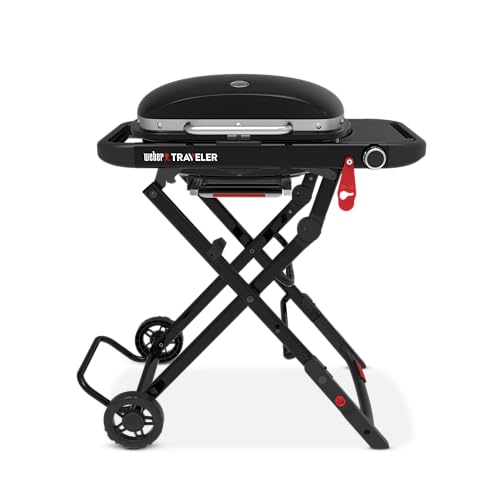
Weber Traveler Compact Portable Gas Grill
Who it suits: Small-patio households that want real gas grilling — burgers, steaks, a whole chicken — without surrendering the patio to a permanent cart.
The Traveler Compact takes the design that tops our base guide and scales it to the small-patio brief: a folding cart grill with porcelain-enameled cast-iron grates and a single strong burner, in a narrower, lighter package that opens to comfortable cooking height and collapses flat to stand against a wall, slide beside the storage box, or ride in the car. That fold is the whole argument. A fixed cart grill on a small patio is a daily tax on every other use of the space; the Compact charges rent only while it cooks. At the grate, the cooking is recognisably Weber — even heat, proper sear marks, a lid that holds roasting temperatures, and ignition that simply works — sized for the two-to-four-person dinners a small patio actually hosts. It runs on disposable propane cylinders, which suit a space with no room to store a large tank, and its wheels make the trip from storage corner to cooking corner a one-handed errand.
The honest limits are capacity and zones. The grate is roughly three-quarters of the full Traveler’s, so a six-person cookout becomes waves; and one burner means one heat zone, so mixed menus need sequencing. It is also a cart, which means it needs its folded parking spot planned — measure the wall run or corner it will live in before ordering. For the small patio that grills weekly and entertains occasionally, it is the most complete answer in this guide.
- Folding cart design: full cooking height when open, flat against the wall when stored.
- Cast-iron grates and a strong single burner — real searing, not camping-grill compromise.
- Cylinder fuel suits patios with no tank storage; wheels make repositioning effortless.
Honest limitation: Cooks for two to four per batch, with a single heat zone, and needs a planned parking spot when folded.
Choose it if you want the full gas-grill experience that disappears after dinner. Skip it if your patio’s rules ban propane — the Lumin Compact below is your headline pick — or you need charcoal flavor.
Weber Lumin Compact Portable Electric Grill, Black
Who it suits: Condo, townhome and apartment-adjacent patios where flame is restricted — and any small-patio cook who wants high-heat grilling with zero fuel storage.
The Lumin Compact is the pick that turns a rules problem into a non-issue. It is an electric grill Weber designed explicitly for small spaces such as city patios and balconies, with a high-heat element the maker rates to about 600°F — hot enough for a genuine sear — and a multifunction design that can also smoke with wood chips, steam, and keep food warm using the maker’s accessory kit. On a small patio its virtues stack up quickly: no propane tank to store, no charcoal bag or ash bucket, no open flame for a lease or fire code to object to (though electric still needs the building’s permission where rules apply — the apartment guide covers that check), and a compact body that stores in a closet or a deck box between cooks. The cast-iron grates mark food like a grill should, and the grease system is a managed tray rather than a hope.
Its boundaries are power and batch size. It needs an outdoor outlet within cord reach — plan the patio layout around that fact — and it cooks for one to three people per batch, recovering heat more slowly than gas if the lid is lifted often. Within those bounds it is the easiest grill in this guide to live with: plug in, preheat, grill, wipe down, put away.
- High-heat electric design rated to about 600°F, with smoke, steam and warm functions.
- No fuel storage at all — the tidiest footprint in this guide, closet-storable.
- Built and marketed specifically for small patios and balconies, with cast-iron grates.
Honest limitation: Needs an outlet, cooks in small batches, and loses heat faster than gas when the lid is opened repeatedly.
Choose it if flame is restricted or you want the lowest-fuss small-patio grill. Skip it if you have no outdoor outlet or you regularly cook for four or more at once.
Kamado Joe Joe Jr 13.5-inch Portable Ceramic Charcoal Grill
Who it suits: Small-patio charcoal devotees cooking for two to four, in a space where open flame is permitted and a sheltered corner can be the grill’s permanent home.
The Joe Jr’s small-patio logic is verticality: a 13.5-inch grate stacked inside a ceramic body on a stand occupies a corner’s footprint while delivering cooking no flat grill of that size can match. Thick ceramic walls hold a low smoking temperature for hours on a small load of lump charcoal, then climb to steakhouse heat for the sear — and the sealed, low-airflow design keeps food moist in a way thin metal never does. The heat deflector for indirect cooking and the ash tool are in the box, and the fuel efficiency suits a patio with no room for a charcoal store: one modest bag lasts a season of small cooks. For the couple whose Friday ritual is two perfect steaks or a small brisket, this corner kamado is the highest-quality cooking in this guide.
The cautions are the kamado’s own. It weighs north of 70 pounds on its stand and ceramic breaks if dropped, so its corner is chosen once, on a stable, heat-resistant base with real clearance from fences, siding and furniture — and then it stays there. Charcoal also produces the most smoke of any pick here at lighting time, which on a small patio means thinking about the neighbours’ windows and your own seating; light it early, let the smoke settle to clean heat before food goes on, and the problem mostly solves itself. Ash must cool fully and go to a metal container, as the safety section details.
- Genuine ceramic heat: stable low-and-slow and fierce searing in a corner footprint.
- Heat deflector, ash tool and stand included; sips lump charcoal.
- The best cooking quality per square foot in this guide.
Honest limitation: Heavy, fragile to move, sized for two to four, and the smokiest pick at startup — a permanent corner is a commitment.
Choose it if flavor tops your list and a permitted corner exists. Skip it if your patio rules restrict charcoal or the grill must move for every cook.
Char-Griller AKORN Jr. Portable Kamado Charcoal Grill
Who it suits: Small-patio cooks who want the kamado style — insulated, efficient, high-heat charcoal cooking — in a lighter body that can move between a corner, a table and the car.
The AKORN Jr. swaps ceramic for triple-wall insulated steel, and that single material change rewrites the small-patio trade-offs. The cooking space is 155 square inches over cast-iron grates, the insulated body holds temperatures with kamado-like efficiency, and the locking lid makes the whole unit genuinely transportable — it is dramatically lighter than the ceramic Joe Jr, so the patio corner is a preference rather than a life sentence, and the same grill can ride to a picnic or a friend’s yard. For a small household learning kamado cooking — dampers, two-zone fires, the patience of stabilising a temperature — it teaches the same lessons at a friendlier weight and a position in this tier that leaves most of the budget for the patio kit around it.
Steel is not ceramic: the insulation is excellent but the heat-soak and the decades-long lifespan of a ceramic body are not part of the deal, and painted steel exteriors need their cover and their seasonal wipe-down to stay ahead of weather. It also shares every charcoal rule — permitted space, clearance, ash discipline, startup smoke — with the Joe Jr. Bought as the movable kamado for a small patio, it is the value pick of the charcoal pair.
- Kamado-style insulated cooking at 155 sq in, with cast-iron grates and a locking lid.
- Far lighter than ceramic — the kamado you can actually relocate or take along.
- Tier-friendly positioning leaves budget for cover, stand and storage.
Honest limitation: Insulated steel will not match ceramic’s heat retention or lifespan, and it needs weather care a ceramic body shrugs off.
Choose it if you want kamado cooking that still moves. Skip it if you want the buy-once ceramic instrument and have the permanent corner for it.
Broil King Porta-Chef 120 Portable Propane Grill (Model 950654)
Who it suits: Small-patio gas cooks who prefer a tabletop format — the grill on a sturdy stand or patio table, stored on a shelf — with premium single-burner cooking for two to four.
The Porta-Chef 120 is the compact sibling of the 320 in our other guides, built on the same principles at patio scale: a single stainless burner under cast-iron cooking grids, Broil King’s Flav-R-Wave vapourising system for even heat and flavor, and a body on detachable legs that works as a tabletop or a low stand grill and packs down for storage. In small-patio terms it offers a different storage story from the folding cart: no cart footprint at all, just a self-contained unit that lives on a shelf or in a deck box and comes out when dinner calls. The cooking quality is the brand’s usual step above the camping class — even heat, real sear, a lid that roasts — and the single-burner simplicity means one knob, one zone, no ceremony for a weeknight cook for two.
One burner is one zone, and the grate serves two to four rather than a gathering; it also expects a propane supply planned for its size — cylinders for occasional use, or a tank if the patio has a corner for one. Buyers whose patios are really entertaining spaces in miniature should step up to the Traveler Compact’s cart and grate; buyers whose patios are quiet two-person retreats will find this the right-sized premium answer.
- Premium single-burner tabletop with cast-iron grids and a vapourising heat system.
- Detachable legs and a shelf-storable body — no cart footprint at all.
- Simple, even, weeknight-friendly gas cooking for two to four.
Honest limitation: Single zone and small-batch capacity; needs a stand or sturdy table and a planned fuel supply.
Choose it if tabletop storage suits your patio best. Skip it if you want a self-standing cart or multi-zone cooking.
Weber Q 1200N Portable Propane Gas Grill
Who it suits: Small-patio traditionalists who want the proven Q formula — cast-aluminum body, cast-iron grates — in its current, refreshed small form, on a table or the line’s portable cart.
The Q has anchored small patios for years because its priorities match the setting: a cast-aluminum body that ignores weather, porcelain-enameled cast-iron grates that sear properly, and a compact lid line that tucks into a corner. The current 1200N generation updates the formula with a 10,000 BTU burner and electronic ignition, keeping the roughly 189-square-inch grate that has always been the Q’s honest size — dinner for two to four, cooked well. Grease falls to a removable catch pan, which on a small patio is a cleanliness feature as much as a cooking one, and the ecosystem around the Q — covers, carts, griddles, replacement parts — is the deepest of any pick here, which matters for a grill expected to serve for years in a space where it is always visible.
It is a single-burner, single-zone grill, and its heat recovery after lid lifts is leisurely compared with the Traveler Compact’s stronger burner; the cart, if you want one, is a separate purchase to budget for. None of that has stopped the Q design from being the default small-space answer for a long time, and the refreshed model’s ignition and burner keep it there.
- The proven Q design, refreshed: 10,000 BTU, electronic ignition, cast-iron grates.
- Cast-aluminum body and a removable grease pan — clean, weatherproof patio living.
- The deepest accessory and parts ecosystem of any pick here.
Honest limitation: One heat zone, a separate cart purchase if you want it standing, and gentler heat recovery than the Traveler Compact.
Choose it if you want the classic small-patio grill with the longest support tail. Skip it if folding-cart storage or maximum burner strength matters more.
Comparison Table
| Product | Fuel / form | Best use | Link |
|---|---|---|---|
| Weber Traveler Compact | Propane, folding cart | Full gas grilling that folds flat against the wall | Check on Amazon |
| Weber Lumin Compact | Electric, compact | Rule-safe high-heat grilling with no fuel storage | Check on Amazon |
| Kamado Joe Joe Jr | Charcoal, ceramic | Corner kamado for searing and smoking, two to four people | Check on Amazon |
| Char-Griller AKORN Jr. | Charcoal, insulated steel | The movable kamado — lighter, locking lid, 155 sq in | Check on Amazon |
| Broil King Porta-Chef 120 | Propane, tabletop | Premium single-burner cooking, shelf storage | Check on Amazon |
| Weber Q 1200N | Propane, tabletop/cart | The classic small-patio gas grill, refreshed | Check on Amazon |
How to Choose a Portable Grill for a Small Patio Under $500
- Measure three states, not one. The grill cooking, the grill cooling, and the grill stored. A pick that fails the third measurement will colonise your patio; folded dimensions and shelf size are specifications, not details.
- Check the rules of your specific patio. House patios are usually free; condo, townhome and apartment patios often restrict charcoal and propane by lease, HOA rule or fire code — the International Fire Code’s balcony provisions are the common model. Confirm before choosing a fuel, and remember electric usually still needs permission.
- Count the household, honestly. Two to four people is the small-patio sweet spot every pick here serves. If your reality is six, buy the Traveler Compact and accept waves — do not buy a crowd grill that evicts the furniture.
- Plan the working triangle. Grill, a landing surface for trays, and your seat should fit together with the cook able to turn safely. A folding side table often matters more than another burner.
- Give smoke an exit strategy. Position the grill so smoke rises away from seating and windows, keep lids down while cooking, and keep grease systems clean — on a small patio, yesterday’s grease is today’s smoke.
- Budget the storage with the grill. A compact deck box for fuel, tools and the cover turns a small patio from cluttered to composed, and this tier usually leaves the money for it. Treat grill plus storage as one purchase.
- Match the form to the habit. Weekly cooks want the fastest setup — folding cart or plug-in electric. Weekend ritualists can afford charcoal’s ceremony. The grill that matches your rhythm is the grill that gets used.
- Verify the exact model. Compact lines are revised and renamed often; confirm the listing matches the maker’s current specification, and check the current price on Amazon before totalling the setup.
Small-Patio Fire Safety: Close Quarters, Full Rules
Small patios shrink every safety margin, so the rules tighten rather than relax. Place the grill on a stable, heat-resistant surface — a concrete or paver area, or a non-combustible grill pad on decking — with generous clearance from railings, siding, fences, curtains, stored items and anything combustible, and never use any fuel-burning grill in an enclosed or semi-enclosed space: carbon monoxide is colourless and odourless, and a covered patio corner with walls on two sides is closer to “enclosed” than it feels. Keep the grill attended at all times, keep children and pets out of the working triangle, and let the unit cool completely before it is folded, moved or stored — on a small patio, the cooling grill is still occupying the room, so plan the evening so it cools where it cooked, safely out of the traffic path. Charcoal ash gets the full discipline: cool completely, a full day as the habit, then into a lidded metal container stored away from the building — never a plastic deck box, never a bin against the siding. Propane cylinders store upright, outdoors and shaded, never inside the home; electric cords stay short, untangled and out of walkways. Clean grates with bristle-free tools only — coil brushes, nylon on cool grates, wooden scrapers — because wire-bristle brushes were recalled in very large numbers in 2026 after detached bristles caused serious injuries. Finally, know the nearest extinguisher and keep it reachable: on a small patio there is no such thing as a small fire that stays small. To extend the patio’s season once the grill is stored, see Best Patio Heater For Small Patios Under $500 — chosen with the same close-quarters discipline.
Common Buying Mistakes
- Measuring the grill’s cooking footprint and forgetting its stored footprint — the mistake that turns a small patio into a grill room.
- Buying crowd capacity for a two-person patio and losing the seating to the grill that hosts four times a year.
- Ignoring lease, HOA or fire-code fuel rules until the grill is assembled — the apartment edition of this guide exists because this mistake is so common.
- Placing a charcoal grill in the corner nearest the seating, then eating every dinner inside its startup smoke.
- Storing propane cylinders or a charcoal bag inside the home for tidiness; both belong outdoors, correctly kept.
- Skipping the deck box and letting fuel, tools and cover colonise the patio floor one item at a time.
- Cleaning with a wire-bristle brush; the 2026 recalls are the permanent reason every recommendation here is bristle-free.
- Folding and storing a grill that is still warm because the patio needed clearing — burns and melted storage boxes are the usual tuition for that lesson.
- Choosing a tabletop grill without a table plan: a wobbling stand under a hot grill is a safety problem, not a style one.
- Judging the patio by its emptiest day — the grill must coexist with the chairs, the plants and the people on the fullest day, which is the only configuration that actually matters.
Final Recommendation
- Most small patios: Weber Traveler Compact — real gas grilling that folds away.
- Restricted-fuel patios: Weber Lumin Compact.
- Flavor-first corners: Kamado Joe Joe Jr.
- Kamado cooking that still moves: Char-Griller AKORN Jr.
- Tabletop premium: Broil King Porta-Chef 120.
- The classic: Weber Q 1200N.
A small patio does not ask you to grill less — it asks you to grill deliberately: the right fuel for your rules, the right size for your household, and a storage plan that gives the space back when dinner ends. The picks above each answer that brief a different way, and every one of them leaves a small patio more capable, not more crowded. If you take one idea from this guide, take the measurement habit: the household that measures its cooking space, its working space and its storage space before ordering almost never returns a grill, and almost always ends up cooking outside more than it expected — which, on a small patio that finally works, is the whole point of the purchase.
Designing the Small-Patio Grill Corner: A Layout That Actually Works
The picks above perform best inside a layout, and a small patio rewards ten minutes of planning more than any single product upgrade. Start with the corner farthest from the seating and the door — smoke and heat should rise at the patio’s edge, not through its social centre — and check that corner against the non-negotiables: a stable, heat-resistant surface, clearance from the fence, siding and railing, and, for the powered picks, an outdoor outlet within honest cord reach. Next, give the cook a landing zone: a folding side table or a sturdy stool beside the grill that holds the raw tray on one side and receives the cooked tray on the other, because the small-patio accident pattern is a cook holding a hot tray with nowhere to put it. Then place storage within two steps: the deck box with fuel, tools, gloves and the cover, so setup and teardown are a single short routine rather than a scavenger hunt through the home. Finally, walk the path a guest would take — if reaching a chair means squeezing past the hot grill, the layout is wrong, and rotating the station ninety degrees usually fixes it.
Two seasonal habits keep the corner working. In spring, leak-check gas connections with soapy water, clean the grease system before the first cook rather than after the first smoke complaint, and confirm the stored grill survived winter dry — especially any electric or kamado stored under a cover. In autumn, do the deep clean while the weather still makes it pleasant: ash out and into the metal container, grates cleaned with bristle-free tools and dried, the cover inspected, and fuel stored by the rules — cylinders upright and outdoors, charcoal dry and sealed, nothing flammable parked against the house. A small patio maintained on that rhythm never accumulates the clutter that makes compact outdoor cooking feel cramped, and the grill corner stays what it was designed to be: the hardest-working two square metres of the home.
It is worth saying plainly what this layout philosophy does to the budget. The corner, the landing table and the storage box are not decorations added after the real purchase; together with the grill they are the product, and this tier’s pricing usually lets a household buy all of it — a premium compact grill, its stand or cart where needed, the box, the cover and the cleaning kit — inside the $500 envelope with room to spare. A flagship grill standing alone on an unplanned patio is the worse purchase by every measure that matters at dinner time. Buy the corner, not just the grill, and a small patio becomes the room of the house everyone asks to eat in.
Frequently Asked Questions
How much of the $500 budget should go to the grill itself?
On a small patio, plan for the grill to take the larger share and the enabling kit — stand or cart where the design needs one, cover, compact storage and bristle-free cleaning tools — to take the rest, and be suspicious of any plan where the grill consumes everything. The compact premium models in this guide mostly sit below the tier’s ceiling, which is exactly what makes the complete-corner approach possible: a Traveler Compact or Lumin Compact bought with its storage and cover will serve a small patio better than any grill bought bare at the full $500. Check the current price on Amazon for your pick, price the kit beside it honestly, and let the total — not the headline — be the number you hold against the budget.
What is the best grill type for a small patio?
It depends on your rules and your household. For an unrestricted house patio, a folding gas cart like the Traveler Compact gives the most cooking with the least stored footprint. Where flame is restricted — many condo and apartment patios — a high-heat electric like the Lumin Compact is the compliant answer and a genuinely good grill. Charcoal kamados suit flavor-first cooks with a permitted permanent corner. Start with the rules, then the storage, then the fuel preference, in that order.
Tabletop or folding cart — which suits a small patio better?
It depends where each form spends its idle week. A folding cart like the Traveler Compact stands flat against a wall and arrives at cooking height on its own legs, which suits patios with a spare wall run and no shelf space. A tabletop like the Porta-Chef 120 or the Q 1200N stores on a shelf or in a deck box and cooks on a sturdy table or stand, which suits patios with storage but no wall run. Measure your idle space first — the stored form is the one you will see six days a week — and let that measurement, rather than cooking specifications that are close between these picks, make the decision.
Can I put a charcoal grill on a small patio?
Only where it is permitted and placed with discipline: many leases, HOAs and local fire codes prohibit charcoal on balconies and near multi-unit buildings, and even where allowed, a charcoal grill needs a stable, heat-resistant base, real clearance from fences, siding and furniture, and a metal container routine for fully cooled ash. If any of those conditions fail, choose gas where permitted or electric — the kamado’s flavor is not worth a violation or a fence fire.
How much space does a small-patio grill really need?
Plan for the grill’s footprint plus a working margin on the cooking side — room to stand, open the lid fully and turn with a hot tray — plus the required clearance from anything combustible, plus its stored footprint for the rest of the week. For the picks in this guide, that usually means a corner or wall run of modest size rather than a dedicated zone, which is precisely why folding, tabletop and vertical kamado forms dominate the shortlist.
Is an electric grill worth it on a small patio?
Yes — and not only when rules force the choice. A high-heat electric like the Lumin Compact needs no fuel storage, starts instantly, stores in a closet or deck box, and sears at temperatures its maker rates around 600°F. Its costs are an outlet within reach and smaller batches. For one-to-three-person households on tight patios, it is often the most-used grill in this guide, because the easiest grill to live with is the one that gets fired up on a Tuesday.
Can a small patio handle a kamado grill?
Yes, if the corner is right and the rules allow charcoal. A kamado’s vertical form is naturally patio-friendly — the Joe Jr cooks a 13.5-inch grate from a corner footprint, and the AKORN Jr does the same job in a lighter, movable body. The conditions are a stable, heat-resistant base, real clearance from fences, siding and furniture, a metal container for fully cooled ash, and a plan for startup smoke that respects nearby windows. Meet those four and a kamado gives a small patio the biggest cooking quality per square foot in this guide; miss any one and a folding gas or electric pick is the wiser buy.
Where should I store a grill on a small patio?
Folded against a wall, on a shelf, or in a compact deck box or storage corner under its cover — always fully cool, with the grease tray emptied and, for gas models, the fuel disconnected and stored upright outdoors. Never store a grill indoors while warm, and never store propane cylinders inside the home. The storage plan should be decided before purchase: the right grill is the one whose stored form you have already measured a home for.
What should I clean a small-patio grill with?
Bristle-free tools only: coil brushes, nylon brushes on cool grates, wooden scrapers or pumice-style cleaners, followed by a wipe-down. Wire-bristle brushes were recalled in very large numbers in 2026 because loose bristles lodge in grates and food and have caused serious ingestion injuries. On a small patio the cleanup standard matters doubly, because the grill stores where people live — a clean, cool, emptied grill is the only kind that belongs in a deck box or closet.


