Where to buy
Check the latest price, availability and delivery on Amazon. Orders are placed on Amazon. We may earn a commission from qualifying purchases.
- Best overall for a small patio: Cuisinart Grillster Portable Gas Grill (CGG-059A) — Check on Amazon
- Char-Broil Grill2Go X200 Portable Gas Grill — Check on Amazon
- Cuisinart 2-in-1 Portable Outdoor Electric Grill (CEG-115) — Check on Amazon
- George Foreman Indoor/Outdoor Electric Grill with Stand — Check on Amazon
- Weber Go-Anywhere Portable Charcoal Grill — Check on Amazon
Benchmark pick, currently priced above this guide’s ceiling when we checked: the Weber Q 1200N is the compact premium grill this category is judged against, and it is reviewed below in prose. Its current price sits above the under-$200 ceiling, so it carries no purchase link here — check price on Amazon if you want to watch for it inside the budget.
Read the full guide ↓
Disclosure: As an Amazon Associate, dailyhomedecorating.com earns from qualifying purchases. Links to Amazon on this page are affiliate links; they cost you nothing extra. Listing details such as price and availability change often, so check the current Amazon listing before you buy.
The best portable grill for small patios under $200 has to pass a test no other grill in this series faces: it must earn its floor space twice — once while it is cooking, and again every day it is not. A small patio is a zero-sum room. The grill competes with the chair you sit in, the table you eat at, the plants, the storage box and the simple ability to walk to the railing without turning sideways. A grill that cooks beautifully but lives as a permanent obstacle will be resented by October; a grill that folds, latches, stands in a corner or disappears into a cupboard gets used for years. So this guide ranks by a patio-specific order of virtues: stored footprint and setup footprint first, cooking performance for one to four people second, and the heat-and-safety discipline that tight quarters demand throughout — because on a small patio, the grill is always closer to the wall, the railing, the furniture and the cook than anyone designing it imagined.
Six grills make the case in different ways. The Cuisinart Grillster leads: a roughly 13-pound briefcase grill that cooks far above its size and stores like a book. The Char-Broil Grill2Go X200 is the durable step up, still compact, with infrared-style heat for small-batch cooking. Two electrics — the Cuisinart CEG-115 and the George Foreman Indoor/Outdoor — solve the patios where flame is impractical or prohibited, with the CEG-115 standing or sitting on a table and the Foreman bringing the largest electric cooking surface in a lift-off-stand format. The Weber Go-Anywhere is the charcoal option for small patios where charcoal is genuinely welcome, its rectangular body being the most space-efficient firebox shape there is. And the Weber Q 1200N appears in prose as the premium benchmark, currently priced above the ceiling, included so small-patio shoppers can judge the stretch with clear eyes. Every pick was checked against the CPSC recall database before inclusion. The safety rules for tight spaces are woven through everything below: a stable heat-resistant surface — never a plastic table — real clearance from walls, railings, siding and anything combustible even when space tempts you to cheat it, no combustion grill under a low cover or indoors because of carbon monoxide, charcoal ash cooled completely and sealed in metal, and bristle-free cleaning tools only, because wire-bristle brushes have been recalled in the tens of millions in 2026.
In this guide
Quick Picks
Short on time, or comparing several options at once? Each row below names a small-patio situation and the grill that suits it, with a link to the listing where one is offered.
| Small-patio situation | Pick | Why it stands out | Link |
|---|---|---|---|
| Best overall | Cuisinart Grillster Portable Gas Grill (CGG-059A) | About 13 lb, briefcase body, high heat — cooks like a grill, stores like a book | Check on Amazon |
| Most durable compact | Char-Broil Grill2Go X200 Portable Gas Grill | Cast-aluminium latching body and TRU-Infrared heat in a still-small footprint | Check on Amazon |
| Best electric for tight spaces | Cuisinart 2-in-1 Portable Outdoor Electric Grill (CEG-115) | Up to 550°F from an outlet; stand or tabletop, so it fits the patio you have | Check on Amazon |
| Most electric cooking space | George Foreman Indoor/Outdoor Electric Grill with Stand | 240 sq. in. on a removable stand that breaks down for storage — check price on Amazon | Check on Amazon |
| Best charcoal for small patios | Weber Go-Anywhere Portable Charcoal Grill | Rectangular firebox, lid-locking legs — the most space-efficient charcoal shape | Check on Amazon |
| Premium benchmark above the ceiling | Weber Q 1200N Portable Gas Grill | Cast-iron grates and benchmark build — prose-only at its current price; check price on Amazon | Prose-only |
How These Picks Were Chosen
Small-patio criteria came first and were applied strictly. Stored size was measured by how a grill actually lives — latched briefcase, folded legs, lift-off stand — not by its cooking dimensions, because the patio pays for the stored shape 350 days a year. Setup footprint came next: the space the grill occupies while cooking, including the room the cook needs to stand and the clearance the heat demands. Cooking performance was then judged at small-patio scale — meals for one to four — where a modest grate used well beats a large grate used rarely. The standard gates of this series applied in full: every linked pick was confirmed through an Amazon Creators API cross-check as a real, orderable listing at or under the $200 ceiling when checked; the one benchmark whose checked price sat above the ceiling, the Weber Q 1200N, is prose-only rather than linked against the budget; every model passed a CPSC recall check, with exclusion the automatic consequence of any recall; specifications are stated only where the manufacturer or the verified listing states them; and star ratings and review counts are used nowhere, because they change constantly and measure listing history, not patio fit. One more filter deserves naming: every pick here can be operated by one person, alone, including carrying, setup and storage — because a small patio rarely has room for a two-person grill operation.
The Best Portable Grill for Small Patios Under $200: Full Reviews
1. Cuisinart Grillster Portable Gas Grill (CGG-059A) — Best Overall for Small Patios
Who it suits: The small-patio cook for one to three people who wants real grilled food without surrendering the patio to the grill. If your outdoor space is measured in a handful of steps, start — and probably finish — here.
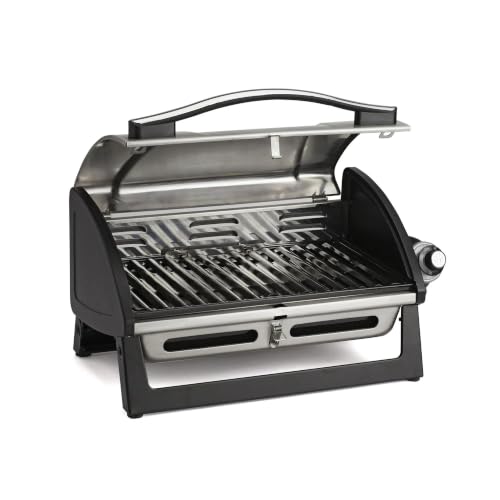
The Grillster’s virtues are all about proportion. The body is a latching briefcase of about 13 pounds that carries by its handle and stores upright in a cupboard, a storage box or the sliver of space beside the patio door. Open it and the specification surprises: an 8,000 BTU stainless burner under 146 sq. in. of grate, rated to reach 600°F — properly searing heat that most grills this size never approach, which is why food from the Grillster tastes grilled rather than warmed. Push-button ignition lights it in a second; it runs on a one-pound propane cylinder that screws on and off in moments; and the grate lifts out and goes in the dishwasher, which on a small patio — where the grill may live within sight of the kitchen — keeps ownership tidy in a way hose-down grills never are. For a couple’s dinner of chops, skewers and vegetables, cooked in two quick waves, it is genuinely all the grill the space needs.
Tight quarters sharpen its one discipline: placement. A grill this small invites being set on whatever is near — a side table, a storage box, a railing shelf — and the rule is absolute: stable, level, heat-resistant, with clearance from the wall and anything combustible, and never on plastic. A small heat-resistant grill mat or board creates its station on a suitable table and catches the drips that would otherwise mark a small patio’s limited floor. Observe that, and the Grillster is the easiest grill in this guide to live with: out in a minute, away in five, and no patio sacrificed.
Pros: Smallest stored footprint here; about 13 lb; high searing heat for its size; dishwasher-safe grate; push-button ignition. Honest limitation: 146 sq. in. cooks for one to three, not a gathering; no thermometer or second zone; its small size tempts unsafe placement on unsuitable surfaces — resist.
Choose it if space is your scarcest resource and your table seats two or three. Skip it if you regularly cook for four or more — the X200’s extra area, or a larger guide pick, will serve you better.
2. Char-Broil Grill2Go X200 Portable Gas Grill — Most Durable Compact
Who it suits: Small-patio cooks who want one compact grill to last — the buy-it-once option whose cast body shrugs off years of being moved between its cooking spot and its storage corner.
The X200 is bigger than the Grillster in every dimension and still honestly compact: a cast-aluminium body with a latching lid, housing 200 sq. in. of cooking area over Char-Broil’s TRU-Infrared system. That emitter-plate design is well suited to small patios for a subtle reason: it suppresses flare-ups, and on a small patio a flare-up is not just a cooking event, it is a proximity event — flames leaping beside a railing or a chair. The X200’s heat is even, contained and predictable, searing through the plate rather than flaming around the food, which makes it the calmest gas grill here to cook beside in a tight space. One-pound cylinders connect directly, with no hose trailing across a small floor to trip over or store.
Storage is a latching box that stands in a corner or slides into a storage bench, heavier than the Grillster but still a one-person carry across the patio. The emitter plate asks for periodic cleaning — a soak and a bristle-free brush on the cooled plate — which is the maintenance price of the infrared system, and a fair one. For a patio that hosts three or four at a small table, this is the compact grill with headroom: enough grate for a family load in one batch, enough build to do it for years.
Pros: Tough cast-aluminium latching body; even, flare-resistant heat suited to tight spaces; 200 sq. in. grate; no hose to store. Honest limitation: Heavier and larger than the Grillster; emitter plate needs cleaning; single heat zone.
Choose it if you want the compact grill that lasts and cooks for up to four. Skip it if minimum stored size is everything — that is the Grillster’s crown.
3. Cuisinart 2-in-1 Portable Outdoor Electric Grill (CEG-115) — Best Electric for Tight Spaces
Who it suits: Patios where flame is the problem — condo and townhouse patios under community rules, covered-adjacent spaces where a gas grill’s heat plume has nowhere good to go, and any small patio whose only sensible fuel is the outdoor outlet already on the wall.
The CEG-115’s “2-in-1” format is a small-patio idea executed well: the grill cooks on its included stand at standing height, or lifts off to work as a tabletop unit, so the same appliance fits a patio with floor space for a stand and a patio with only a table. Its heat headline is real: Cuisinart rates it to reach 550°F from a standard outlet, spread across 240 sq. in. of nonstick cooking surface — the largest cooking area in this guide, electric or gas, which on a small patio feels like a magic trick. There is no fuel to store, no cylinder to find room for, no charcoal bag colonising the storage box; the grill’s entire logistics are a cord and an outlet, used exactly as the manufacturer directs. For communities whose rules restrict open flame — a common clause in patio-home and condominium documents, worth checking before any purchase in this guide — an electric like this is frequently the only grill that complies, and it complies while cooking like a grill rather than an apology.
The trade-offs are the electric family’s usual ones, sharpened by scale: at full heat the draw is serious, so the outlet circuit matters and extension-cord improvisation is out; rain ends the session, since electric grills are fair-weather appliances; and the sear, while the best of the electrics here thanks to that 550°F ceiling, still differs from gas-over-cast-iron. None of that diminishes its small-patio logic. On the patios it suits, it is not the compromise pick — it is the only pick that fits the rules and the space at once.
Pros: Up to 550°F; largest cooking area here at 240 sq. in.; stand or tabletop format; no fuel storage; flame-free for rule-bound patios. Honest limitation: Needs a proper outlet and dry weather; high current draw at full heat; nonstick surface wants gentle, bristle-free care.
Choose it if your patio’s rules or layout rule out flame. Skip it if you have no suitable outdoor outlet, or charcoal and gas are welcome and preferred.
4. George Foreman Indoor/Outdoor Electric Grill with Stand — Most Electric Cooking Space, Easiest Storage Story
Who it suits: Small-patio households that cook for three or four and want electric simplicity with a family-sized surface — and a grill that breaks down so completely that storage stops being a negotiation.
The Foreman’s round grill offers about 240 sq. in. of cooking surface — matching the CEG-115 — heated electrically with five heat settings, on a stand from which the grill lifts off. That lift-off design is its small-patio genius: cooking happens at standing height on the stand, and storage happens as a compact grill body in a cupboard or storage box with the stand broken down beside it, rather than as a full-height appliance permanently parked in the patio’s best corner. The sloped cooking plate drains fat into a drip tray as food cooks, which on a small patio is a cleanliness feature as much as a cooking one — grease on a tiny floor is grease you will step in — and the nonstick surface wipes clean in the kitchen sink’s orbit rather than demanding an outdoor deep-clean.
Against the CEG-115, the comparison is character: the Cuisinart is the hotter, more grill-like sear and the more flexible stand/tabletop format; the Foreman is the simpler, larger-feeling family cooker with the easier storage breakdown and the gentler learning curve — a dial with five settings and food that is hard to ruin. Both are flame-free, fuel-free and carbon-monoxide-free, and both remain subject to whatever your community’s documents say about grills, which you should read before either arrives. On a small patio with an outlet and a storage cupboard, the Foreman is the set-and-forget answer.
Pros: 240 sq. in. of cooking space; lift-off grill and break-down stand store compactly; sloped plate drains fat to a tray; five simple heat settings. Honest limitation: Gentler sear than the CEG-115; round shape uses patio corners poorly while assembled; nonstick care rules apply.
Choose it if family-sized electric cooking and easy storage top your list. Skip it if searing performance is the priority — the CEG-115 runs hotter.
5. Weber Go-Anywhere Portable Charcoal Grill — Best Charcoal for Small Patios
Who it suits: Small-patio cooks on ground-level patios and in communities where charcoal is welcome, who want real fire flavour in the least possible space — and who accept charcoal’s duties as the price.
Shape is destiny on a small patio, and the Go-Anywhere’s rectangular suitcase form is the most patio-efficient firebox made: no round kettle wasting its corners, no legs splaying into the walkway. Its 160 sq. in. of grate cooks a couple’s or small family’s load; its legs pivot to lock the lid, so the whole grill stores upright on a shelf or in a storage box like a toolbox; its two-piece grate allows coal-tending mid-cook; and its lid and base dampers give the cook genuine control over the fire. The flavour case needs no repeating here — charcoal’s dry, fierce heat and smoke are why it survives every convenience technology — but on a small patio the Weber delivers that flavour in the only footprint that makes sense.
The duties, in tight quarters, deserve their clearest statement in this guide. Charcoal on a small patio is a ground-level, open-air, attended activity: the grill sits on a non-combustible surface with real clearance from railings, siding, fencing and furniture — and if your patio cannot provide that clearance honestly, your patio cannot host charcoal, whatever its size on paper. Smoke rises into whatever is above, so overhangs and upper balconies are part of the calculation, and community rules part of the permission. Ash cools in the closed grill for a full day, then lives in a lidded metal container outdoors — a container that itself needs a safe spot in your limited space, which is a genuine planning item, not a footnote. Never under a cover, never in a garage, never indoors: carbon monoxide. Patio cooks who can meet those terms get the best flavour-per-square-foot in this guide; those who cannot should take the electrics above without regret.
Pros: Most space-efficient charcoal shape; real charcoal sear and flavour; lid-locking storage; damper control. Honest limitation: Clearance, smoke and ash duties are hardest to satisfy in tight quarters; start-up and cool-down time; prohibited outright in many communities.
Choose it if your patio is ground-level, rule-permitted and clearable. Skip it if any of those three conditions fails — the electrics and small gas picks exist for your patio instead.
6. Weber Q 1200N Portable Gas Grill — Premium Benchmark Above the Ceiling (Prose-Only)
Who it suits: The small-patio shopper wondering whether the famous compact Weber justifies waiting, stretching or hunting a sale — this review gives the honest measure of it.
The Q 1200N packages a 10,000 BTU burner and porcelain-enamelled cast-iron cooking grates in a cast-aluminium tabletop body with electronic ignition and a lid thermometer. For a small patio its appeal is density of quality: the cast-iron grates sear with authority, the body feels like a decade-long appliance, and the whole unit sits on a table or its maker’s stand in a footprint comparable to the X200’s class. If any gas grill could be called the small patio’s aspirational standard, this is it — the grill the linked picks are silently compared against whenever a shopper reads their specifications.
It is prose-only because, when its current Amazon price was cross-checked through the Creators API during the writing of this guide, it sat clearly above the $200 ceiling. A guide titled “under $200” does not link a grill priced over it and keep a straight face. If you find the Q 1200N inside the budget on promotion, it competes head-on with the X200 for the durable-compact crown and arguably takes it on grate quality. At its checked price, the in-budget truth is that the Grillster cooks hotter per pound carried, the X200 matches its all-weather toughness, and the electrics beat it on the patios where flame is unwelcome. Check price on Amazon, and let the number — not the badge — make the call.
Pros: Cast-iron grates; benchmark build, ignition and support; compact tabletop footprint. Honest limitation: Currently priced above this guide’s ceiling, hence no purchase link; single burner; stand is a separate purchase.
Choose it if a sale brings it into budget. Skip it if the ceiling is firm — every linked pick above respects it today.
Comparison Table
| Grill | Fuel | Cooking area | Stored form | Small-patio strength | Watch out for |
|---|---|---|---|---|---|
| Cuisinart Grillster CGG-059A | Propane | 146 sq. in. | Latching briefcase, about 13 lb | Smallest footprint, high heat | Cooks for one to three |
| Char-Broil Grill2Go X200 | Propane | 200 sq. in. | Latching cast-aluminium box | Durable, flare-resistant | Emitter plate cleaning |
| Cuisinart CEG-115 | Electric | 240 sq. in. | Stand or tabletop unit | 550°F, flame-free, most area | Outlet and dry weather needed |
| George Foreman Indoor/Outdoor | Electric | 240 sq. in. | Lift-off grill, break-down stand | Family size, easiest storage | Gentler sear; round shape |
| Weber Go-Anywhere | Charcoal | 160 sq. in. | Lid-locked rectangular box | Space-efficient charcoal flavour | Clearance, smoke and ash duties |
| Weber Q 1200N (prose-only) | Propane | Compact single-burner grate | Tabletop body | Premium grates and build | Currently above the $200 ceiling |
On a small patio, read the stored-form column before the cooking-area column — the reverse of every other guide in this series, and deliberately so. The grill you can put away is the grill your patio can afford; the cooking areas here are all honestly sized for the one-to-four-person meals a small patio hosts.
How to Choose the Best Portable Grill for Small Patios Under $200
Measure twice: the cooking footprint and the stored footprint. Before buying, tape out both rectangles on your patio floor. The cooking footprint must include the grill, the cook’s standing room, and honest clearance from walls, railings and furniture — if the taped shape crowds any of those, the grill is too big for your patio whatever its grate size promises. The stored footprint must name its actual home: cupboard, storage box, corner, shelf. A grill with no named home becomes patio furniture by default, and small patios cannot afford default furniture.
Let your patio’s rules choose the fuel shortlist. Condominium, townhouse and rental patio rules frequently restrict or ban charcoal, sometimes restrict gas, and occasionally ban grills entirely; ground-level private patios are freer but still benefit from a glance at local fire guidance, which treats open-flame cooking near combustible construction cautiously everywhere. Read your documents first. If flame is out, this guide’s electrics are your whole shortlist and both are strong. If flame is in, the Grillster, X200 and Go-Anywhere divide the choice by size, durability and flavour.
Build the station, however small. Even the tiniest patio grill needs its square of discipline: a stable, level, heat-resistant surface — a metal or stone-topped table, or a suitable table protected by a heat-resistant grill mat — never a plastic table or a railing shelf; clearance on all sides from anything combustible, with the grill’s back never pushed against siding to “save space”; and a clear rule that the lit grill is attended, always. Keep the cylinder, when gas is the fuel, upright and shaded beside the grill rather than stored in the sun-baked storage box, and give the whole station open sky above it: low covers, balconies overhead and enclosed corners are where heat, smoke and carbon monoxide collect, and none of them belong over a grill.
Match the grate to your real table. Small patios host small tables: one to four people covers nearly every meal. The Grillster’s 146 sq. in. is a genuine two-person grill that stretches to three with forgiving food; the X200 and the two 240 sq. in. electrics feed four without relays. Buying beyond your table buys storage pain, not better dinners — the recurring theme of this guide, because on a small patio the constraint is never the cooking, it is the living around the cooking.
Think vertically, carefully. Small patios reward vertical thinking everywhere except the grill itself. Utensils hang on hooks, the cylinder stands in a shaded corner crate, the cleaning kit lives in a caddy on the storage box — but the grill cooks at a stable, reachable height on its table or stand, never perched on a railing, a wall cap or a stack of anything. The one vertical idea that genuinely helps the grill is its storage: the latched Grillster and Go-Anywhere stand upright against a wall or in a cupboard like books, and the electrics’ stands break down flat. A patio that stores its grill vertically cooks with a grill that seems to take no space at all, which is the entire ambition of this guide in one sentence.
Plan the cleaning corner. A small patio has no hose-down zone, so prefer grills whose mess comes indoors in pieces: the Grillster’s dishwasher-safe grate, the electrics’ wipe-clean plates, the X200’s removable emitter plate for a soak. All of them clean with bristle-free tools — the 2026 wire-bristle brush recalls, tens of millions of units after bristles were swallowed and caused serious harm, apply in small spaces exactly as in large ones. Empty grease trays when cool, every few cooks, because on a small patio an overflowing tray is on your floor, your mat and your shoes within the hour.
Small Patio Layouts That Actually Work
The corner station. The most common successful layout puts the grill station in the patio’s least useful corner — the one too tight for a chair — on a compact grill table or stand with a heat-resistant mat, with the cook standing in the patio’s natural walkway edge rather than its centre. The Grillster and X200 were born for this layout: their cooking footprints are small, their storage homes are the cupboard or box beside the station, and the corner’s two walls are managed by the clearance discipline described throughout this guide — the grill sits forward of the corner, never wedged into it, with air on every side. Seating takes the open side of the patio, dining happens at the small table, and the space reads as a room with a kitchen corner rather than a grill with chairs around it.
The tabletop rotation. Patios too small for a dedicated station can run the grill on the dining table itself — before the meal, not during it. The electrics suit this best: the CEG-115 in tabletop mode or the Foreman’s lifted-off grill cooks the food on the table, then cools, wipes clean and stores away, and the same table is set for eating. The discipline is sequencing and cooling: the grill must be fully cool and put away before the table becomes a table, and a heat-resistant mat under it during cooking is non-negotiable. Done well, this layout gives a genuinely tiny patio a full grill menu with zero permanent footprint — the strongest argument in this guide for the lift-off and tabletop formats.
The storage-bench patio. Where a lidded storage bench already holds the cushions, make it the grill’s home too — if, and only if, the grill stores cool, clean and latched, with its cylinder removed and stored separately and correctly, never inside the bench with it. The Go-Anywhere and Grillster both fit this life: out of the bench, onto their station, back into the bench after cooling. The bench layout fails when it becomes an excuse to store a warm grill “just for an hour” — the hour is when stored heat meets cushion foam — so the rule is the same as everywhere in this guide, stated once more because small spaces forgive nothing: cool completely, then store.
Common Mistakes on Small Patios
Cheating the clearance to fit the grill. The defining small-patio sin. A grill pushed against siding, a railing or a fence “just for tonight” is how small patios have big fires. If the clearance does not fit, the grill does not cook — choose a smaller pick or an electric, and keep the rule absolute.
Setting a tabletop grill on a plastic table. Radiated heat from a tabletop grill can soften and melt plastic furniture, and a tipping grill on a wobbling table is worse. Heat-resistant, stable, level — every time, without exception for “quick” cooks.
Buying for the party instead of the patio. A large grill bought for two gatherings a year taxes the other 363 days. Cook the big party in waves on a compact grill, or add the second-grill strategy from our entertaining guide, and let the patio stay livable.
Storing the grill assembled “temporarily” all year. Temporary becomes permanent, the patio shrinks, and the grill weathers. The picks here fold, latch or break down for a reason — use the feature weekly, not just in winter.
Ignoring what is above the grill. Heat and smoke rise into balconies, eaves and covers. A small patio under a low overhang is an electric patio, whatever the floor space allows.
Keeping the wire-bristle brush because it is small. Recalled hazards do not shrink with the patio. Bristle-free cleaning — coil, wood, nylon on a cool grate — is the whole rule.
Final Recommendation
For most small patios, the Grillster is the answer: it cooks with a heat that embarrasses larger grills, carries like a briefcase, cleans in the dishwasher, and stores in spaces that are not really spaces — a cupboard shelf, the end of a storage bench, the sliver beside the door. It respects the fundamental truth of small-patio life, which is that the best grill is not the one with the most features but the one whose presence the patio can absorb without rearranging itself around the appliance. Every other pick in this guide is the right answer to a more specific version of the same problem. Patios that cook for four should step to the X200’s durable 200 square inches; patios ruled by documents or outlets should choose between the CEG-115’s hotter sear and the Foreman’s family-sized ease, both flame-free. The Go-Anywhere earns its place only where charcoal is permitted, clearable and honestly manageable — and there, it is unbeatable flavour per square foot. The Q 1200N remains the benchmark to watch for a sale. Tighter budgets are covered by our Best Portable Grill For Small Patios Under $100 guide and bigger ambitions by the Best Portable Grill For Small Patios Under $300 guide; seating for the same tight footprint is covered in our guides to the Best Adirondack Chair For Small Patios Under $200 and Best Camping Chair For Small Patios Under $200, and dedicated charcoal options for permitted patios in the Best Charcoal Grill For Small Patios Under $200 guide.
FAQ
How long does a one-pound cylinder last on a small patio grill?
For the small single-burner grills in this guide, roughly an hour to an hour and a half of high-heat cooking per cylinder, and several typical meals at the medium settings most cooking actually uses. Small-patio cooks benefit from the format: a cylinder is itself small to store, a spare fits in the cleaning caddy, and there is no large tank demanding its own corner of a space that has no corners to spare. Store spares upright and shaded, swap only with the grill off, and check the connection with soapy water if you ever smell gas.
What is the smallest grill that still cooks properly?
The Grillster is the honest floor: 146 sq. in. of grate over a burner rated to reach 600°F, in a body of about 13 pounds. It cooks for one to three people with real searing heat. Smaller novelty grills exist, but they tend to steam food rather than grill it; below this size, an electric contact grill indoors is usually the better meal.
Can I put a tabletop grill on my patio table?
Only if the table is stable, level and heat-resistant — metal or stone — or protected by a proper heat-resistant grill mat, and never if it is plastic. Keep clearance from railings, walls and furniture on every side, attend the grill while it cooks, and let it cool fully on the spot before it is moved or stored. This single habit — the right surface, every time, without a “just this once” exception for a quick cook — is what separates small patios that grill safely for years from the ones that feature in cautionary tales told by landlords, insurers and neighbours.
Are electric grills a good idea for a small patio?
Often the best idea: no flame, no fuel storage, no carbon monoxide, and the two electrics here offer the largest cooking areas in this guide. They need a proper outdoor outlet used as the manufacturer directs, dry weather, and — like every grill — a check of any community rules that apply to your patio. Where flame is restricted, they are usually the only compliant route to grilled food.
How much clearance does a small patio grill need?
More than feels convenient, which is the point: keep the grill well away from walls, siding, railings, fencing, furniture and anything combustible on every side, with open sky above it and extra room on windy days. Manufacturers state minimum clearances in their manuals — treat those as floors, not targets. If your patio cannot provide them for a gas or charcoal grill, that is the patio telling you to buy an electric.
What is the best first meal to learn a new small patio grill with?
Something forgiving and quick: sausages, chicken thighs or thick vegetable skewers, cooked lid-down while you learn where your grill’s hot centre sits and how its control responds. Save the expensive steak for the second cook, when the grill’s personality is known and the patio station — surface, clearance, tools, lighting — has already proven itself once.
Do I need a cover for a small patio grill?
If the grill stores outdoors, yes — a fitted cover keeps rain, dust and pollen out of the burner and hinges, and on a small patio it also keeps the stored grill looking like furniture rather than equipment, which matters when the storage corner is always in view. If the grill stores indoors in a cupboard or box, a cover is optional; a clean, dry, latched grill keeps perfectly well without one. Either way, cover or store only a grill that is completely cool and clean — covering a warm or greasy grill traps moisture against the metal and undoes the point of both.
Where do I store a grill on a small patio?
In its folded or latched form, in a named home: a lidded storage box or bench, a hall cupboard just inside the door, or a sheltered corner under a fitted cover. Cool and clean before storage, grease tray emptied, cylinder removed and stored upright in shade per local guidance. The picks in this guide were chosen so that home genuinely exists in a small space.
How do I manage wind and heat on a small patio?
Wind is the small patio’s hidden variable: it bends flames, steals heat from the grate, and carries sparks, smoke and cooking smells directly into the seating area or the neighbours’ windows. Position the grill so its lid and body shelter the burner from the prevailing breeze — most portables cook noticeably better with the wind at their back — and cook lid-down, which stabilises temperature and contains smoke. On genuinely gusty days, the honest options are the electrics, which wind cannot blow out, or postponement; a gas flame blown out while the valve stays open is a gas leak with a timer on it, which is why attended cooking is a rule and not a suggestion. Heat management follows the same theme: small grills have small thermal mass, so preheat with the lid closed, cook in uncrowded batches, and let the grate recover between loads rather than piling food onto a cooling surface.
Can two people cook together on a small patio?
Not shoulder to shoulder — and they should not try. The workable pattern is one cook and one runner: the cook owns the grill station and its clearance zone, the runner ferries food, plates and drinks between kitchen and patio, and nobody crosses behind the cook with a tray while the grill is open and hot. It sounds formal; in practice it is simply how small-space cooking stops being a collision sport, and it has the side benefit of making the cook feel hosted rather than stationed, since everything they need arrives by hand.
Is charcoal ever a good idea on a small patio?
Yes — on a ground-level patio, where community rules permit it, where a non-combustible surface and honest clearance exist, and where the cook will run the full ash routine: complete cooling in the closed grill for a full day, then a lidded metal container outdoors. The Go-Anywhere’s rectangular body is built for exactly that patio. Where any condition fails, charcoal is the wrong fuel for the space, and the gas and electric picks here will feed you better and safer.