Where to buy
Check the latest price, availability and delivery on Amazon. Orders are placed on Amazon. We may earn a commission from qualifying purchases.
- Best overall for backyards: Aoxun 10×12 Outdoor Retractable Pergola with Adjustable Canopy, Gray — Check on Amazon
- Best fixed shade cover: Jolydale 10’x12′ Outdoor Pergola, Metal with Shade Cover — Check on Amazon
- Best arched design: ABCCANOPY Arched Pergola 10’x12′ with Retractable Sun Shade — Check on Amazon
- Best wide retractable: Outsunny 12′ x 10′ Outdoor Retractable Pergola Canopy, Beige — Check on Amazon
- Best heavy-fabric 10×10: Aoxun 10×10 Retractable Pergola, 250GSM Extended Canopy — Check on Amazon
- Best aluminium for open yards: PURPLE LEAF Outdoor Pergola 10′ x 10′ Retractable Canopy, Aluminum, Beige — Check on Amazon
Read the full guide ↓
Disclosure: As an Amazon Associate, dailyhomedecorating.com earns from qualifying purchases. Links to Amazon on this page are affiliate links; they cost you nothing extra. Listing details such as price and availability change often, so check the current Amazon listing before you buy.
Shopping for the best pergola for backyards under $300 is a different exercise from shopping for a patio, and the difference is the ground. A patio pergola bolts to a slab that already exists; a backyard pergola usually stands on grass, gravel or a patch of earth you have chosen for it, exposed to the full weather of an open yard, far from the shelter of the house wall. That changes what matters. Footings replace anchors as the central question. Wind arrives unbroken by buildings, so fabric discipline and frame stiffness count double. Size runs larger, because the whole point of a backyard structure is to create a destination — a shaded room out on the lawn for dining, lounging or the grill — rather than to roof an existing slab. And placement becomes a design decision with consequences: sun path, tree cover, sprinkler arcs, septic lines, setbacks and the view from the kitchen window all get a vote.
The six kits in this guide were re-ranked from the verified under-$300 field specifically through that backyard lens. Larger footprints lead, because a 10-by-10 marooned in a big yard looks and feels lost while a 10-by-12 or 12-by-10 makes a room. Retractable canopies lead, because open yards are windy yards and the ability to strip fabric fast is a survival trait. Frame materials are judged for ground contact and weather exposure, not just looks. Every pick was cross-checked against Amazon’s own catalogue data during research, matched to a live listing inside this tier, and confirmed as a complete kit — posts, frame and canopy. If your structure will actually live on a slab or deck, our base guide to the Best Pergola Under $300 ranks the same market for hard surfaces, and if the backyard plan is really about hosting, the companion guide to the Best Pergola For Outdoor Entertaining Under $300 re-sorts these kits by party logic.
There is one more backyard truth that shapes the rankings below, and it is about time rather than weather. A patio pergola is finished the day it is bolted down; a backyard pergola is the start of a small landscape project. In its first season it will look slightly stark — new metal on open lawn always does. In its second, with climbers halfway up the posts, a floor beneath it and the planting around it filled in, it becomes the yard’s organising feature, the place every gathering migrates to and every garden path seems to lead. Buy for that second season. The kits ranked highest here are the ones whose frames, footprints and replacement-canopy support will still be serving when the structure has grown into the garden — and whose honest limitations, stated plainly in each review, will not ambush you on the way there.
In this guide
Quick Picks
In a hurry? This table matches each verified kit to the backyard job it does best.
| Buyer type | Pick | Why it stands out | Link |
|---|---|---|---|
| Best overall for backyards | Aoxun 10×12 Retractable Pergola, Gray | The extra two feet a lawn destination needs, with a sliding canopy for windy sites | Check on Amazon |
| Best fixed shade cover | Jolydale 10’x12′ Pergola with Shade Cover | A simpler, draped shade-cover design for owners who set shade in spring and strike it in fall | Check on Amazon |
| Best arched design | ABCCANOPY Arched Pergola 10’x12′ | A curved, garden-forward silhouette with a retractable shade — the prettiest shape in the tier | Check on Amazon |
| Best wide retractable | Outsunny 12′ x 10′ Retractable Pergola, Beige | The widest sliding-canopy kit here, from the tier’s volume brand | Check on Amazon |
| Best heavy-fabric 10×10 | Aoxun 10×10, 250GSM Extended Canopy | A heavier-weight extended canopy on the proven Aoxun frame for smaller yards | Check on Amazon |
| Best aluminium for open yards | PURPLE LEAF 10′ x 10′ Aluminum, Beige | Rust-proof frame and yarn-dyed canopy for exposed sites — at the tier ceiling | Check on Amazon |
How These Picks Were Chosen
The method matched our other under-$300 pergola guides, with backyard-specific filters layered on top. Verification came first: each kit was cross-checked against Amazon’s own catalogue data, matching title, size and configuration to a live listing within the tier; unverifiable kits were dropped, not linked on hope. Completeness came second: posts, frame and canopy in one box, with no replacement covers or bracket kits masquerading as pergolas. Then the backyard ranking began. Footprint came first — in an open yard, presence is function, so 10-by-12 and 12-by-10 kits outranked squares except where a heavier canopy or aluminium frame compensated. Ground strategy came second: we favoured kits whose post feet accept proper ground anchoring — helical anchors or concrete footings — over designs meant only to bolt to slabs. Wind behaviour came third: retractable canopies that can be stripped in minutes outranked fixed covers, and fixed-cover kits are labelled with that duty wherever they appear. We also weighed canopy fabric weight where listings state it, since fabric is the component open-yard weather eats first, and we screened the field against public recall notices — the recent widely reported gazebo recalls concerned warehouse-club hardtop pavilions, a different product class, and nothing here is a recalled product.
A note on honesty about tier ceilings: the PURPLE LEAF in this guide, like its grey sibling in our base guide, sits right at the top of the under-$300 frame. We include it because aluminium genuinely is the right answer for exposed, sprinkler-watered, fertiliser-adjacent backyard life, but we flag its position every time, and you should check the live listing price on the day you buy. Everything else here sat comfortably inside the tier when verified. Prices are never printed in this guide because they move; the links are the price check.
The Best Pergola for Backyards Under $300: Full Reviews
Aoxun 10×12 Outdoor Retractable Pergola, Gray — best overall for backyards
Who it suits: Backyard owners creating a primary outdoor room — dining for six, a lounge set, or a grill-and-prep station — on lawn, gravel or a new paver pad, who want the safest all-round kit in the tier at a larger size.
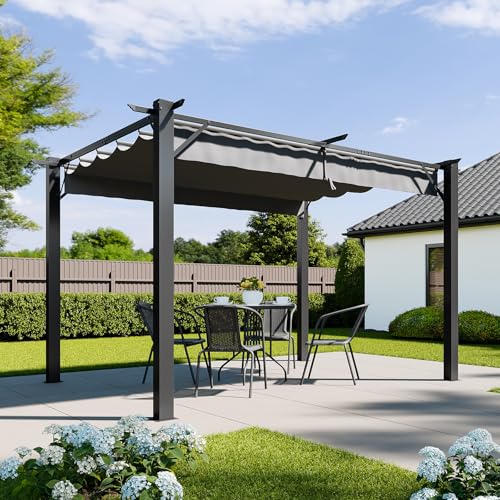
This is the 10-by-12 sibling of the Aoxun 10-by-10 that leads our base guide, and the extra two feet are exactly what a backyard asks for. The formula is the same proven one: a powder-coated metal free-standing frame and a PA-coated fabric canopy that slides to open or close the roof, positioned by the listing as UV- and water-resistant. On a patio, 10-by-10 is a roof; in a backyard, 10-by-12 is a room — a six-seat dining set fits with chairs pulled out and a serving table along one side, or a sofa set and fire-table arrangement reads as a destination rather than an apology. The grey colourway suits lawn settings well, disappearing against planting better than black and showing pollen less than beige. The sliding canopy earns its keep doubly in an open yard: half-open for morning coffee in full sun, closed against the midday blaze, and stripped to one end in the two minutes before a summer storm crosses the fence.
Pros: The right footprint for a backyard destination at a mid-tier position. Sliding canopy suits exposed, changeable sites. The Aoxun family’s scale means replacement canopies and parts are easy to source in later seasons. Grey finish is forgiving of pollen and dust between cleanings. Works equally on footings in lawn or bolted to a new pad.
Honest limitation: Powder-coated metal in a sprinkler’s arc will need its chips touched up or rust will start at the feet — the highest-maintenance placement in this guide. The canopy is water-resistant, not a rain roof, and must never hold pooled water or snow. And a 10-by-12 of fabric in an unsheltered yard is a serious sail: footings are not optional, and the included ground stakes alone are not a footing strategy.
Choose it if you want the default backyard answer. Skip it if your yard is small enough that 10-by-12 overwhelms it — the heavy-fabric 10-by-10 below fits tighter spaces. Check on Amazon
Jolydale 10’x12′ Outdoor Pergola with Shade Cover — best fixed shade cover
Who it suits: Set-and-season owners: gardeners who want a shaded room over a dining set or potting area from spring to fall, are happy to install the cover once and remove it once, and prefer a simpler mechanism over a sliding one.
The Jolydale takes the other canopy philosophy from the Aoxun: instead of a sliding roof, it carries an upgraded shade cover over its metal 10-by-12 frame — a draped, fitted fabric top in the classic pergola style. There is a real case for this design in a backyard. With no sliding track, there is nothing to jam with the grit, pollen and leaf litter that open yards deposit on everything; the cover’s drape sheds debris and reads softer and more garden-like than a taut sliding panel. The 10-by-12 plan matches the Aoxun’s room-making footprint, and the metal frame keeps the kit at a friendly position in the tier. For a structure that will stand over a vegetable garden’s potting bench, a hammock corner, or a dining set that eats at the same hour each day, the set-once cover is not a compromise — it is the appropriate technology.
Pros: No moving canopy parts to jam or maintain — the simplest ownership in this guide after the entry kits. Full 10×12 room at an accessible tier position. Draped cover suits garden aesthetics and sheds leaves better than flat taut panels. Metal frame assembles without aligning a sliding track. A good match for dining sets used at predictable hours.
Honest limitation: A fixed cover cannot chase the sun or open for stargazing, and your storm plan is complete removal — a longer job than sliding a canopy aside, and one you must actually do, because a fixed cover in a gale loads the whole frame. Shade angle is fixed by the sun’s path, so placement and orientation need more thought at install time (see the placement section below). Replacement covers are less standardised than the big families’ sliding canopies.
Choose it if your shade hours are predictable and you value simplicity. Skip it if your site is windy or your schedule is spontaneous — the retractable kits forgive both. Check on Amazon
ABCCANOPY Arched Pergola 10’x12′ with Retractable Sun Shade — best arched design
Who it suits: Garden-first homeowners for whom the pergola is as much a planted feature as a roof — the structure at the end of a path, over a bench, or framing a view — and who find flat industrial frames visually harsh against planting.
ABCCANOPY built its name on canopies, and its pergola entry is the design outlier of this tier: an arched frame, where the roof beams curve rather than run flat, carrying a retractable sun shade across a 10-by-12 plan. The arch is not merely decorative. A curved profile sheds leaves and light rain more willingly than a flat span, gives the structure a softer, tunnel-like interior that suits climbing plants beautifully — train a grape, jasmine or climbing rose over it and the backyard gains the one thing flat kits cannot fake, which is a green ceiling — and it photographs like a garden feature rather than patio equipment. The retractable shade keeps the practical box ticked: fabric that moves is fabric that survives. In dark grey, the frame recedes against foliage exactly as a garden structure should.
Pros: The most garden-appropriate silhouette in the tier, at a mid-tier position. Arch sheds debris and light rain better than flat spans. Retractable shade preserves storm flexibility. Superb support structure for climbing plants. Full 10×12 footprint makes a real room, not just an accent.
Honest limitation: The arch that sheds debris also complicates the canopy mechanics — check the listing’s description of how the shade travels the curve, and expect the sliding to be less slick than on flat-track rivals. ABCCANOPY’s pergola line is smaller than the volume families, so long-term parts support is a step less certain. And the curved top reduces the flat area where you might hang lights or a heater compared with beam-style frames.
Choose it if the pergola is a garden feature first. Skip it if you want maximum hanging space and the deepest parts ecosystem — the Aoxun leads there. Check on Amazon
Outsunny 12′ x 10′ Outdoor Retractable Pergola Canopy, Beige — best wide retractable
Who it suits: Owners of wide, shallow backyard zones — the strip along the back fence, the terrace above a retaining wall, the side yard — where a 12-foot width fits the land’s shape better than a squarer plan, and buyers who want a sliding canopy from a high-volume brand at an easy tier position.
Outsunny’s retractable entry flips the usual rectangle: twelve feet wide by ten deep, with a sliding fabric canopy on a metal frame, in a warm beige. Width is an underrated dimension in backyards. A 12-foot span covers a six-seat dining set lengthwise with room for a serving cart, or a sectional’s full run, while the 10-foot depth keeps the structure’s feet out of the flower beds. The retractable canopy — the feature this guide keeps insisting on for open yards — lets the wide roof open for evening sky and close against afternoon sun raking across an exposed lawn. Beige is the right colour for sun-belt yards, reflecting heat and blending with gravel, pale pavers and dry planting. As the tier’s volume brand, Outsunny’s assembly documentation and spare-part trail are well-trodden, which matters for a structure this size.
Pros: The widest retractable plan in this guide at an accessible position in the tier. Sliding canopy manages the big fabric area in changing weather. Beige colourway suits hot, bright yards and pale hardscaping. Volume brand means instructions, videos and spares are easy to find. Rectangular plan fits fence-line and terrace placements that squares waste.
Honest limitation: Twelve feet of span asks the most of the frame: keep the structure square at assembly, anchor all four feet properly, and expect to re-tension hardware seasonally. The canopy fabric is a light, fair-weather material — water-resistant, not waterproof — and the beige shows storm splashes and leaf stains more than grey. In a fully exposed yard this is the kit most dependent on your storm discipline.
Choose it if your land is wide and shallow. Skip it if your site is a wind corridor — a squarer, stiffer plan will behave better. Check on Amazon
Aoxun 10×10 Retractable Pergola, 250GSM Extended Canopy — best heavy-fabric 10×10
Who it suits: Owners of smaller backyards — townhouse lawns, cottage gardens, the grass square behind a duplex — where 10-by-12 would swallow the green, and who would rather put the money into a heavier canopy fabric than into extra feet.
This Aoxun variant keeps the family’s powder-coated alloy-and-metal frame and sliding-canopy design in the standard 10-by-10 plan, but upgrades the roof: an extended canopy in a heavier 250GSM fabric weight, per the listing. Fabric weight is the spec backyard buyers should learn to read, because the canopy is where open-yard weather does its damage — UV thins it, wind worries its seams, and a heavier weave simply has more material to give before it fails. The “extended” cut also matters at this size: extra drape over the frame’s edges throws shade a little beyond the posts at low sun angles, which is when a backyard dining set is actually used. Everything else is the known Aoxun proposition — sliding shade for storm flexibility, a large current product family behind it, and an honest mid-tier position.
Pros: Heavier 250GSM canopy fabric should outlast the tier’s standard covers. Extended cut improves low-angle shade over the seating. Proven Aoxun frame and sliding mechanism with strong replacement-part support. The right size for smaller lawns where 10×12 dominates. Sliding canopy preserves the storm drill.
Honest limitation: Heavier fabric is still fabric: water-resistant rather than waterproof, no snow load, and off before storms. The 10-by-10 plan seats four comfortably, six tightly — do not buy it for a six-seat set and hope. Powder coating needs its annual chip check, especially at the feet where mowers and strimmers strike.
Choose it if your yard is compact and fabric longevity is the priority. Skip it if you regularly seat six — step up to the 10-by-12 Aoxun at the top of this guide. Check on Amazon
PURPLE LEAF Outdoor Pergola 10′ x 10′ Retractable Canopy, Aluminum, Beige — best aluminium for open yards
Who it suits: Backyard owners in humid, coastal or heavily irrigated settings who intend the structure to stand for years, and who accept a ceiling-tier spend in exchange for never thinking about rust.
The beige sibling of the grey PURPLE LEAF in our base guide brings the same substance: an all-aluminium frame with thick posts, a sliding retractable canopy in yarn-dyed fabric, and the strongest support ecosystem in the budget category. In a backyard, aluminium’s case strengthens. The structure stands in sprinkler arcs, morning dew and fertiliser drift; its feet sit in damp soil air at the lawn’s edge; nobody is wiping it down. Steel kits survive that life with maintenance; aluminium simply ignores it. The beige yarn-dyed canopy suits bright yards and holds its colour through summers that chalk lesser fabrics. As flagged in our method section, this kit sits right at the tier ceiling — verify the live price when you shop — but for an exposed site it is the one pick here whose frame you will never repaint, and that has real value priced in seasons rather than dollars.
Pros: Aluminium frame is immune to the rust cycle that claims coated steel in damp yards. Thick posts give the steadiest feel in this guide once footed. Yarn-dyed canopy resists fading in high-UV regions. Beige suits sun-belt and pale-garden palettes. The category’s best long-term parts and replacement-canopy support.
Honest limitation: Ceiling money buys frame, not roof: the canopy remains a fabric cover with fabric’s storm and snow rules. The 10-by-10 footprint is the smallest room in this guide, so big-yard owners should weigh the larger mid-tier kits. And if the listing has drifted above the tier on the day, judge it against the next band — our Best Pergola For Backyards Under $500 guide maps that step up.
Choose it if your yard is wet, coastal or sprinkler-soaked and the structure is a keeper. Skip it if budget headroom matters more than rust immunity — the Aoxun 10×12 gives you more room for less commitment. Check on Amazon
Comparison Table
| Pick | Size | Frame | Canopy | Best for |
|---|---|---|---|---|
| Aoxun 10×12 Retractable, Gray | 10 x 12 ft | Powder-coated metal | Sliding, PA-coated | Best overall backyard room |
| Jolydale 10’x12′ Shade Cover | 10 x 12 ft | Metal | Fixed upgraded shade cover | Set-and-season simplicity |
| ABCCANOPY Arched 10’x12′ | 10 x 12 ft | Metal, arched | Retractable shade | Garden feature with vines |
| Outsunny 12′ x 10′ Retractable | 12 x 10 ft | Metal | Sliding canopy | Wide, shallow yards |
| Aoxun 10×10 250GSM | 10 x 10 ft | Powder-coated alloy/metal | Sliding, 250GSM extended | Smaller yards, heavier fabric |
| PURPLE LEAF 10′ x 10′ Beige | 10 x 10 ft | Aluminium, thick posts | Sliding, yarn-dyed | Wet/coastal yards (tier ceiling) |
Placing a Pergola in a Backyard: Site, Sun and Rules
Follow the sun across your own yard. Backyard shade is a placement problem before it is a product problem. Watch where your yard’s natural shade already falls at the hours you entertain — a pergola that duplicates the oak tree’s afternoon shadow wastes its canopy, while one placed in the yard’s stubborn sun trap creates the only comfortable seat on the property. For dining, western exposure is the classic trap: a pergola sited for noon shade can be a glare box at seven in the evening, when low sun slides under the canopy edge. Orient the long side to block the west where you can, and remember a retractable canopy cannot help against horizontal sun — that is a curtain panel’s or a hedge’s job.
Respect what is under the grass. Before any footing is dug, locate the invisible yard: sprinkler lines and heads (a pergola foot through a lateral line is a wet, expensive afternoon), septic tanks and fields where applicable, low-voltage lighting runs, and the utility easements that often cross back fences — call the free utility-marking service before digging footings, as you would for any post hole. Keep the structure clear of sprinkler arcs where possible; a canopy under daily irrigation ages in dog years, and feet standing in spray zones corrode first.
Give the structure a floor, even a simple one. Chairs on bare lawn under a pergola will rut the grass, wobble, and track mud. A simple paver pad, a gravel bed with edging, or even a deck-tile platform under the footprint transforms the room’s usability and keeps feet and furniture dry after rain. If a full pad is out of scope this season, large pavers under each furniture leg and the grill are a workable interim. Plan drainage so the pad sheds water away from the feet rather than ponding around them.
Footings are the backyard anchor. On grass there is no slab to bolt to, so the choices are concrete: small poured footings with post bases set in them (the durable answer), helical ground anchors screwed deep into undisturbed soil (the reversible answer, good in most soils), or — not an answer at all — the short stakes in the box, which are positioning aids for calm patios, not storm protection for an open yard. Dig footings below your local frost line where winters freeze, keep post bases slightly above grade so feet do not sit in water, and let concrete cure before loading the frame.
Check setbacks and the HOA before you dig. Backyard structures live closer to property lines than patio ones, and setback rules — commonly a few feet from rear and side lines for accessory structures — plus height limits are the rules most likely to bite. HOAs frequently regulate backyard structures’ visibility, colour and placement even where the city does not require a permit. Freestanding and unattached keeps most kits in the lightest regulatory category, but “usually fine” is not a permit: a short check of your municipal code and covenants is part of the project, not an optional extra.
How to Choose a Backyard Pergola
Start with the room you are furnishing, not the kit you are browsing: six diners need the 10-by-12 class, four diners or a lounge pair fit 10-by-10, and a wide fence-line terrace may want the 12-by-10’s proportions. Then be honest about your canopy temperament — if you will not perform a storm drill, choose the fixed cover and a sheltered site, or accept a shorter fabric life; if you enjoy operating your outdoor room, the sliding canopies repay you weekly. Match frame to environment: aluminium where water is a daily fact, coated metal elsewhere with a touch-up habit. Decide the floor and footings before ordering, because they are half the project’s cost in effort even when small in money. Finally, plant the long game: a backyard pergola improves every year as climbers cover it and the garden grows around it, so buy the frame you will still like in five summers — which is the entire argument for the PURPLE LEAF at the ceiling and the Aoxun family beneath it. For enclosed alternatives that trade the open pergola feel for a fuller roof, compare the backyard picks in our guide to the Best Gazebo For Backyards Under $300, and for tight spaces where the yard is really a patio, the compact rankings in Best Pergola For Small Patios Under $300 apply instead.
Sizing a Backyard Pergola: A Quick Field Guide
Before ordering, run the string test: lay out the kit’s footprint on the lawn with garden hose or string, place the actual furniture inside it, and sit down. The surprises are always the same. Chair pull-out space eats a foot on every dining side. A grill needs its own clearance from posts and canopy — heat and fabric are enemies, and most makers want the grill outside the canopy’s drip line or under its highest, most open section. Walkways matter: a pergola that forces guests to thread between a post and a flower bed will be cursed at every gathering. Height matters too: budget kits stand roughly seven and a half to eight feet at the canopy, which feels generous on a patio but modest in an open yard — another reason the larger footprints rank first here, since presence in a landscape comes from area more than altitude. Finally, look back at the house: the pergola will be in your kitchen window’s view for years, so its colour and silhouette deserve the same deliberation as its dimensions.
Common Buying Mistakes
Trusting the included stakes on lawn. They locate the feet; they do not anchor the structure. Open-yard wind on a 120-square-foot canopy will extract short stakes like tent pegs. Footings or helical anchors, always.
Placing the pergola where the yard is empty, not where the sun is wrong. Empty corners are often empty because they are pleasant already. Site the structure in the sun trap, oriented against the western glare.
Forgetting the sprinkler system. Feet in spray zones corrode, canopies under daily irrigation mildew, and a footing through a lateral line floods the project. Map the irrigation before you dig or place.
Sinking posts straight into soil. Metal feet buried or standing in soil moisture rot and rust from the bottom up. Use post bases on footings, slightly raised, so the frame’s most vulnerable point stays dry.
Ignoring setbacks until the neighbour complains. A pergola at the fence line that violates setback or HOA rules is a removal project. Measure from the property line, not the fence’s face, and check the rules first.
Leaving fabric up through leaf-fall and winter. Wet leaves, then snow, are the two loads these canopies cannot carry. The backyard season ends when the cover comes off — build that weekend into your autumn routine.
A Backyard Pergola Year: From First Cookout to First Frost
It helps to imagine the structure’s calendar before you buy it, because backyard pergolas earn their keep across a rhythm, not a single summer weekend. In spring the frame goes up or is re-inspected: bolts re-torqued after frost heave, feet checked for the tilt that softened soil leaves behind, canopy washed and mounted once the pollen peak passes. The first cookouts reveal the placement truths no plan survives unchanged — the chair that sits in glare at six o’clock, the grill smoke that pools under a closed canopy — and a retractable roof earns its premium in these weeks, letting you tune shade daily while you learn the yard’s new geometry. High summer is the pergola’s working season: dining moves outside wholesale, the canopy lives closed through the brutal hours and open on fine evenings, and your only real duties are the storm drill and a monthly hose-down. This is also when climbers do their visible work, softening posts and stitching the structure into the garden.
Autumn is where backyard ownership is decided. The canopy must come off before leaf-fall turns it into a compost shelf and long before any snow can load it; that single weekend of discipline is the difference between a five-year structure and a one-season regret. Clean and dry the fabric before it is stored, photograph the frame’s joints for next spring’s comparison, and take the opportunity to touch up coating chips while the metal is bare and dry. Winter, for most owners, is a bare frame standing in a quiet garden — harmless in mild climates, and in snow country a reason to have chosen a kit whose canopy and, if needed, whose frame store compactly. Owners who picture this calendar honestly tend to buy exactly the kits ranked at the top of this guide: retractable where weather is lively, aluminium where water is constant, and always anchored as if the August thunderstorm were already on the radar.
What the Kit Price Does Not Include: The Backyard Budget Beyond the Box
The kit is the headline cost, not the project cost, and backyard projects have a predictable tail. Footings come first: bags of concrete and post bases for four feet, or a set of helical ground anchors, are modest in money and non-negotiable in function. The floor comes second: even a simple gravel bed with steel edging, or pavers under the furniture zone, is the difference between a room and a mud patch, and it is the spend owners most often wish they had made on day one. Third is the small hardware of outdoor life — the outdoor-rated string lights, a curtain panel for the western side, furniture glides that keep chair feet off damp ground. None of this changes which kit to buy, but it argues for the mid-tier kits over the ceiling where the total project matters: the Aoxun and Outsunny leave room in a household budget for the ground works that decide whether the structure succeeds, while the PURPLE LEAF concentrates the spend in the frame itself. Plan the whole project, then choose the kit that fits inside it.
Pergola vs Gazebo vs Shade Sail in a Backyard
Backyards are where the three shade structures diverge most clearly, because there is room for all of them and budget for only one. The pergola is the social architect: an open frame that declares a room on the lawn, carries lights and climbers, and opens its roof to the sky — the right choice when the yard’s social life is the point. The gazebo is the shelter: a fuller, usually peaked roof that sheds rain and feels enclosed, better for all-weather sitting and for hot tubs or reading corners that want a sense of walls; the backyard-sized versions are ranked in the gazebo guide linked earlier in this article. The shade sail is the minimalist: pure tensioned fabric between the house, trees or poles, shading a pool edge or a play area with zero structure to maintain and zero room-defining presence. In a big yard the honest answer is sometimes sequential — a sail over the pool this year, a pergola room when the patio furniture graduates — but if one structure must do the backyard’s main job, the pergola’s blend of presence, openness and retractable shade is why it anchors this guide.
Final Recommendation
For most backyards, the Aoxun 10×12 is the right first structure: the room-making footprint, a sliding canopy for an exposed site, and a product family that will sell you a replacement cover in year three. Choose the Jolydale if your shade hours are fixed and you prefer a cover with no moving parts, the ABCCANOPY if the pergola is a planted garden feature, and the Outsunny 12-by-10 if your land runs wide along the fence. In a smaller yard, the Aoxun 250GSM 10-by-10 trades footprint for a heavier canopy, and in a wet or coastal yard the PURPLE LEAF’s aluminium — at the tier ceiling — is the keeper’s choice. Whatever you choose, spend your effort below ground first: footings, a simple floor, and a legal site will decide whether the kit becomes the backyard’s favourite room — the place the whole household drifts to on every fine evening.
Frequently Asked Questions
Can I put a pergola directly on grass?
You can stand it there, but you should not leave it that way. Feet on soil stay damp, sink unevenly and corrode, and chairs on grass rut and wobble. At minimum, set each post on a paver or footing and give the seating area a simple paver, gravel or deck-tile floor. The structure will feel twice as expensive and last far longer.
How do I anchor a pergola in a backyard without a slab?
Use poured concrete footings with post bases, or long helical ground anchors screwed into undisturbed soil — both are real anchoring. The short stakes included with budget kits are not sufficient for an open yard. Keep post bases slightly above grade, and re-check hardware after the first heavy rain.
How far from the fence or property line should a pergola be?
Many municipalities require accessory structures to sit a few feet inside rear and side property lines, and HOAs may add their own rules, but the exact distances are local. Measure from the surveyed property line rather than the fence, and check your municipal code and covenants before digging footings.
Will a backyard pergola survive storms and winter?
The anchored frame, with the canopy removed, tolerates ordinary winter in mild climates; in snow country, disassembly or a frame-only stance with zero fabric is the safe play, since no kit here carries a snow load. In storm season the rule is simple: fabric off or fully retracted before high wind arrives. The structure’s survival is a habit, not a specification.
What grows well on a backyard pergola?
Fast, forgiving climbers suit budget frames: jasmine, clematis, climbing roses, grape and hops all cover a structure within a few seasons. Keep growth off the canopy’s sliding path, prune before vines add serious wind-catching mass, and remember that a fully planted pergola is a bigger sail — one more reason the storm drill matters.
Is a pergola or a gazebo better for a backyard?
A pergola gives an open, airy room with a movable canopy and suits dining and lounging under fair skies. A gazebo’s fuller, peaked roof sheds rain better and feels more enclosed and private. Yards that host in all weathers lean gazebo; yards that live for summer evenings lean pergola. Both are compared within this tier in the guides linked above.
Can a backyard pergola hold a swing, hammock or hanging chairs?
Not on the frames in this tier. Budget metal posts and beams are engineered for the canopy’s loads and modest wind, not for the dynamic, concentrated load of swinging people. Hang swings and hammocks from trees, dedicated stands or structures engineered for them, and keep the pergola’s hanging budget to lights, plants and light curtains.
How do I keep mosquitoes and low sun out of a backyard pergola?
With add-ons the open design invites: curtain panels on the western side for evening glare, and mesh curtain sets — sold for common pergola sizes — for insect hours. Both add wind-catching area, so treat a curtained pergola as a bigger sail in your storm decisions, and choose panels you can tie back or remove quickly.
Should the pergola match my house or my garden?
In a backyard, match the garden. The structure will be seen against planting far more than against siding, so greens, beiges and warm greys settle in better than stark black for most yards, and an arched or plant-covered frame disappears fastest of all. Save the architectural contrast for patio structures that actually touch the house. When in doubt, photograph your yard at the hour you use it most and hold the listing photos against that light — the right finish is the one that disappears into your own picture.