Where to buy
Check the latest price, availability and delivery on Amazon. Orders are placed on Amazon. We may earn a commission from qualifying purchases.
- Best overall: CROWN SHADES 10′ x 10′ Pop Up Canopy with One Push Setup — Check on Amazon
- Outsunny 10′ x 10′ Steel Lean-To Pergola (model 84C-038 family) — prose-only pick, see the review below for why
- BOJAVOM Pergola Shade Cover Replacement Canopy Top for 10′ x 13′ Frames — Check on Amazon
- Amagenix 16′ x 20′ Rectangle Sun Shade Sail — Check on Amazon
- Heavy Duty Metal Garden Arch with Enlarged Base, 55″ W x 87″ H — Check on Amazon
- JEAREY 10′ x 10′ Pop Up Canopy Tent — Check on Amazon
Read the full guide ↓
Disclosure: As an Amazon Associate, dailyhomedecorating.com earns from qualifying purchases. Links to Amazon on this page are affiliate links; they cost you nothing extra. Listing details such as price and availability change often, so check the current Amazon listing before you buy.
Here is the truth about the best pergola under $150, stated plainly before anything tries to sell you something: a complete, freestanding, four-post pergola kit from a reputable brand does not exist at this price. The entry point for genuine framed pergolas — the Outsunny and Aosom steel kits, the lean-to models that mount against a house wall — sits right around this tier’s ceiling and usually a little above it, and the mainstream freestanding kits most people picture live in the $200s and up. We know, because this guide’s research started by looking for the real thing and pricing every candidate. What $150 does buy, and buys well, is everything around that missing kit: the strongest pop-up canopies, the largest shade sails, serious replacement tops for frames already standing in thousands of yards, and one genuine lean-to pergola that hovers at the edge of the budget and earns an honest prose-only mention. This guide ranks all of it, labels every pick with what it truly is, and tells you exactly where the real pergolas begin if you decide to stretch.
The reason the gap exists is materials arithmetic, not marketing. A pergola is mostly metal by weight — four posts, two beams, a roof’s worth of framing — plus the hardware to keep it upright in wind. At 2026 metal prices, a safe, durable version of that bill of materials cannot be manufactured, shipped across an ocean in a very large box, and retailed under $150 with any margin for the seller. The products that claim otherwise in listing titles are, on inspection, canopy tops without frames, bracket sets without lumber, or structures whose “steel” is tubing so thin it dents in the box. We excluded all of them. What remains is a genuinely useful shortlist: instant framed shade that folds (the pop-ups), maximum-coverage shade that flies (the sail), shade that restores what you own (the replacement top and the arch), and the one framed exception worth knowing about.
A note on how to use the labels in this guide. Every pick carries a “what it really is” line, and the comparison table repeats it, because at this tier the single most expensive mistake is a category error — expecting permanence from event equipment, or rain shelter from a sun sail, or a structure from a fabric top. Read those lines as the product’s contract. Everything recommended here keeps its contract faithfully; the disappointments in this market come almost entirely from buyers signing a contract they did not read.
So the practical question this guide answers
is not “which pergola” but “which route to a shaded, structured outdoor room does $150 serve best.” If you need a roof-shaped space this weekend with zero installation, it is a premium pop-up canopy — and the best of them, the CROWN SHADES below, is a genuinely well-engineered object. If you have anchor points and want the most shade per dollar by a factor of three, it is the big sail. If a frame already stands in your yard wearing dead fabric, it is a replacement top, and the transformation is startling. And if only a real pergola will do, read the Outsunny entry closely: it is the honest benchmark of where framed pergolas begin, close enough to this tier that a small stretch or a sale price closes the gap. Gardeners, meanwhile, get the arch — the one pick here that appreciates with age.
In this guide
Quick Picks
Short on time, or comparing several options at once? Each row below names a buyer type and the product that suits it, with a link to the listing where one applies.
| Buyer type | Pick | What it really is | Why it stands out | Link |
|---|---|---|---|---|
| Best overall | CROWN SHADES 10′ x 10′ Pop Up Canopy, One Push Setup | Pop-up canopy — not a pergola | The best-engineered instant framed shade in the tier; patented centre-lock setup — check price on Amazon | Check on Amazon |
| Closest to a real pergola | Outsunny 10′ x 10′ Steel Lean-To Pergola | A genuine lean-to pergola kit | Powder-coated steel frame and canopy that mounts to a wall; priced at/above this tier’s edge — prose-only, see review | Prose-only |
| Best for existing frames | BOJAVOM Pergola Canopy Replacement Top, 10′ x 13′ | Accessory — top only, not a pergola | Restores a whole 10×13 pergola’s shade and looks for accessory money — check price on Amazon | Check on Amazon |
| Best coverage per dollar | Amagenix 16′ x 20′ Rectangle Sun Shade Sail | Shade alternative — not a pergola | Three times the shaded area of a 10×10 structure, at well under the tier — check price on Amazon | Check on Amazon |
| Best permanent garden structure | Heavy Duty Metal Garden Arch, 55″ W x 87″ H | Arbor — not a pergola | A substantial steel arch with an enlarged base for climbing-plant shade — check price on Amazon | Check on Amazon |
| Best value pop-up | JEAREY 10′ x 10′ Pop Up Canopy Tent | Pop-up canopy — not a pergola | One-push setup, wheeled bag, sandbags and stakes included, well under tier — check price on Amazon | Check on Amazon |
How These Picks Were Chosen
We began this guide the way a buyer would: by hunting for a complete pergola kit under $150 and verifying each candidate’s contents against its listing. The hunt’s result shapes the guide — no freestanding kit passed, one wall-mounted lean-to kit sits at the tier’s edge, and everything else that honestly serves the intent is a canopy, sail, arbor or accessory. Every linked product’s name, size and ASIN was cross-checked against Amazon’s catalogue data through the Creators API on 2026-11-20, and we linked only items whose API listing title matched the product described. The API session was rate-limited partway through this batch’s research, so the Outsunny pick — included as the tier’s genuine-pergola benchmark — is presented prose-only and was verified against retailer listings and published specifications instead; the sources file records exactly which picks carry which verification status.
Ranking within the shortlist weighed four things. First, structural honesty: does the product do the job its name claims, at the size claimed, from materials that survive a season? The pop-ups here were chosen for frame engineering (centre-lock mechanisms, real wheeled bags, included ballast) rather than headline size. Second, shaded area per dollar, where the sail wins by an order of magnitude and earns its place despite offering no structure. Third, restoration value: with so many 10×13 frames already installed nationally, a correct replacement top converts this entire budget into a like-new pergola, which no new product at $150 can match. Fourth, longevity habits — every pick is something a household can store, maintain or grow for years rather than landfill after one summer. We also screened these product categories against recall listings and excluded anything we would not stand under.
Best Pergola Under $150: The 6 Honest Options
1. CROWN SHADES 10′ x 10′ Pop Up Canopy with One Push Setup — Best Overall
What it really is: a pop-up canopy — not a pergola. Who it suits: anyone who wants a framed, roofed, four-legged shade structure at this budget without installation, permits or permanence — for a patio, a lawn, a driveway or a market stall.
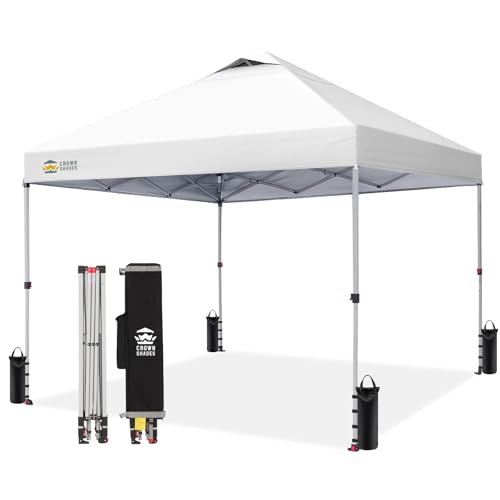
If the pergola you pictured is “a structure with legs and a roof that I can stand under,” this is the closest honest object under $150, and it is a good one. CROWN SHADES built its name on the CenterLok mechanism: a patented central hub that lets one person push the frame open and lock it from the middle, rather than wrestling each corner in turn. The 10-by-10 footprint has straight legs, so the full hundred square feet is usable to the edges — a dining table for six, a lounge set, a serving line. The top is a silver-coated fabric that reflects a meaningful share of the sun’s heat before it becomes your problem, and the kit travels in a STO-N-Go cover bag that acknowledges the product’s real life: up for the occasion, away in the garage after.
What separates this from the gas-station canopies that give the category its reputation is the accumulation of sane details: a frame that opens without pinched fingers or a second pair of hands, height adjustment that behaves, and a top that fits the frame it ships with. Used as directed — ballasted on every leg, every time, and struck before serious weather — a canopy of this grade serves for years of weekends. It is also the only pick in this guide that gives a renter, an HOA-governed patio or a borrowed garden a fully structured space with literally zero installation footprint.
Pros: genuine one-person setup in minutes; full usable footprint; quality frame engineering at the top of the pop-up class; packs into a bag for storage or transport. Honest limitation: it is not a pergola and does not pretend to be one — it has a seasonal fabric top, no permanent presence, and the standing rule of its category applies with full force: unweighted legs in a gust turn a canopy into a kite with a grudge, so ballast is mandatory and storm storage is part of ownership.
Choose it if you want structure, shade and zero installation at this budget. Skip it if you want a permanent fixture that lives outside all year — that product begins above this tier. Check on Amazon
2. Outsunny 10′ x 10′ Steel Lean-To Pergola — The Genuine Pergola at the Tier’s Edge (Prose-Only)
What it really is: an actual pergola — a wall-mounted lean-to kit with a powder-coated steel frame and a fabric canopy (the 84C-038 family). Who it suits: homeowners with a patio against a house wall who want a real, permanent framed structure and can stretch slightly beyond $150 or catch it on offer.
This entry is the guide’s benchmark, included without a purchase link so we can describe it with complete candour. The Outsunny lean-to is the form genuine pergolas take at their cheapest: instead of four freestanding posts, it stands on two and borrows the house wall for the other side, which is precisely how it approaches this budget while using real powder-coated steel and a proper 180gsm PA-coated polyester canopy with drainage grommets. Published dimensions run about 117 by 117 inches with a sloped height around 78 to 98.5 inches — a true 10-by-10 shaded room against the wall, with the slope shedding rain away from the house. Retail pricing for this model family straddles the $150 line depending on seller and season, which is why it appears here as a benchmark rather than a linked pick: on the day you shop, it may sit a little under or a little over the tier, and either way it is the reference point for what “a real pergola” costs.
As a structure it asks what pergolas ask: a free afternoon, a drill, wall fixings into real structure, and ground stakes or bolts at the feet. In return it gives what no other pick here can — permanence. It is simply there, every day, defining the patio, carrying lights and curtains, asking nothing per use. Its limits are the category’s limits at this price: the canopy is a seasonal fabric that should come off for winter and storms, the steel is powder-coated rather than galvanised, and the lean-to form only works where a suitable wall exists. But if your search for a pergola under $150 was really a search for the cheapest real pergola, this is the answer the research kept returning to — and the Best Pergola Under $300 guide is where its freestanding siblings live.
Pros: a genuine framed pergola with real steel and a sloped, draining canopy; permanent, zero per-use effort; the benchmark price point for the whole category. Honest limitation: pricing straddles this tier rather than sitting inside it, it requires a suitable wall and permanent fixings, and the fabric top is a consumable on a multi-year cycle.
Choose it if only a real pergola will do and a small stretch is possible. Skip it if you rent, lack a wall, or need the full budget to stay under $150 today — the CROWN SHADES above is your structure instead.
3. BOJAVOM Pergola Shade Cover Replacement Canopy Top, 10′ x 13′ — Best for Existing Frames
What it really is: an accessory — a canopy top only, not a pergola, and no frame is included. Who it suits: owners of a 10′ x 13′ six-bar pergola frame — one of the most common sizes sold by big-box and online retailers — whose original top has faded, torn or sagged.
Run the arithmetic the way this guide’s research did: a household with a sound 10×13 frame and a dead top does not need a new structure at all. It needs this — a replacement canopy cut at 116 inches wide by 135 inches long for six-bar 10×13 frames, in beige — and an afternoon. The restored result is, functionally, a new pergola: full shade density again (aged tops leak light and heat long before they tear visibly), even colour, no mid-storm seam anxiety. No other purchase in this tier converts $150 into that much working structure, because the expensive part — the frame — is already standing in the yard.
The discipline is fit. Replacement tops are cut for specific frame geometries, and six-bar 10×13 frames vary between brands in bar spacing and corner radius. Measure your frame’s outside dimensions, count its bars, compare against the listing’s stated compatibility, and fit the top on a quiet day so a mismatch is a return, not a crisis. While the frame is bare, tighten every bolt and treat any rust — the new top will make the structure look new, and five minutes of maintenance makes that impression honest.
Pros: the highest-value transformation in the guide for frame owners; correct cut for a very common frame size; fast, tool-light fitting. Honest limitation: fabric only — worthless without the matching frame — and fit tolerance is unforgiving, so measuring is mandatory. Like all fabric tops, it lasts longest stored off the frame through winter and severe storms.
Choose it if your frame is sound and only the top has failed. Skip it if you own no frame, or a different size — search by your exact frame dimensions and model instead. Check on Amazon
4. Amagenix 16′ x 20′ Rectangle Sun Shade Sail — Best Coverage Per Dollar
What it really is: a shade alternative — not a pergola. Who it suits: owners with real anchor points — house wall, set posts, mature trees — who want the maximum shaded area this budget can produce, over a lawn, deck or large patio.
The maths is unanswerable. Sixteen by twenty feet of HDPE sail, rated by its maker at 95% UV block, shades a long dining table, a lounge set, or both in sequence — an area no framed product at three times the price attempts. The fabric is a breathable knit, so heat rises through it rather than collecting at head height, and the curved edges allow proper tensioning, which is what keeps a big sail quiet and still instead of flapping itself to death. It is the pick for buyers whose priority is shade itself: the party, the play area, the pool edge, the garden work zone.
The sail’s price is low because you supply the structure, and this guide will not pretend otherwise: four trustworthy anchors, a stainless hardware kit with turnbuckles, one corner mounted high for runoff, and an hour of honest work. Do it once and the sail clips on in minutes for years. Fail to do it — tie it to a fence panel, leave a corner slack — and the same sail becomes the neighbourhood’s cautionary tale. The product is superb; the installation is the product. Buyers who know their anchors are real should not hesitate; buyers who cannot name four strong points should buy the CROWN SHADES and its legs instead.
Pros: unmatched shaded area per dollar; breathable, cooler than coated roofs; removes in minutes for storms and winter; scales from dining to play space. Honest limitation: zero structure — nothing to stand under in rain (light mist passes through the knit) and nothing without anchors. Its performance is exactly your installation’s performance.
Choose it if area is the priority and anchors exist. Skip it if you need a self-supporting structure or rain shelter. Check on Amazon
5. Heavy Duty Metal Garden Arch with Enlarged Base, 55″ W x 87″ H — Best Permanent Garden Structure
What it really is: an arbor — not a pergola. Who it suits: gardeners who want a real, standing, permanent structure in this budget and are happy for its shade to arrive as climbing plants rather than fabric.
Most arches in the budget aisle are jewellery — light tube that flexes in the hand. This one is specified like a structure: a heavy-duty metal frame 55 inches wide and 87 inches tall with an enlarged base for stability, proportions that span a real garden path or frame a bench with headroom to spare. Planted with a vigorous climber — a climbing rose, jasmine, clematis, or a fast annual for the first season — it becomes the one genuinely permanent shaded nook this budget can create: a green tunnel of a thing that smells good, photographs beautifully and improves every year it stands.
Its role in a pergola-hunter’s shortlist is the long game. Fabric products shade today and fade on a schedule; an arch planted this spring is a shaded seat next summer and a landmark in five years. The enlarged base matters more than it sounds: a planted arch carries real wind load once foliage fills it — a sail you grow — and the cheap arches’ failure mode is a slow lean ending in a storm-day collapse. Set this one’s feet properly in soil or substantial planters, train the plants up both sides rather than one, and it will outlast every other pick in this guide. While the climbers grow, a strip of shade cloth over the top bridges the first season without spoiling the look.
Pros: a true permanent structure at accessory money; substantial frame and base; shade and beauty compound yearly; suits paths, gates and bench nooks. Honest limitation: shade arrives on a plant’s timetable — a season or more — and coverage is a nook for two, not a room for eight. It also needs soil or serious planters; it is not a patio-slab product.
Choose it if you garden and can wait a season for shade. Skip it if you need covered space this month — the canopy and sail above are instant. Check on Amazon
6. JEAREY 10′ x 10′ Pop Up Canopy Tent — Best Value Pop-Up
What it really is: a pop-up canopy — not a pergola. Who it suits: buyers who like the CROWN SHADES concept but would rather keep more of the tier in their pocket — for frequent, casual use at home, the beach, markets and sports sidelines.
The JEAREY follows the modern one-push pattern: a centre-lock frame that opens with a single push, a silver-coated top, and — the detail that decides whether a pop-up is a pleasure or a chore — a wheeled carry bag, four sandbags and eight stakes in the box. That inclusion list matters. A canopy without ballast is a hazard awaiting a gust, and a canopy without wheels is a two-person carry; this one arrives with its safety kit and its transport solved, at a price that leaves room in the tier for the extras (lights, a sidewall, a rug) that turn a canopy into a room.
Set against the CROWN SHADES, the trade is refinement for value: the flagship’s mechanism and finish are a step up, and frequent users who set up weekly may feel that difference across years. For the household that hosts monthly, tailgates occasionally and camps twice a year, the JEAREY’s proposition — same footprint, same one-push idea, complete accessory kit, meaningfully less money — is the rational one. The ownership rules are identical for both: ballast every leg, every time; down before storms; dry before storage.
Pros: complete kit including wheeled bag, sandbags and stakes; one-push centre-lock setup; strong value well inside the tier. Honest limitation: a step below the flagship in frame refinement, and subject to the category law — it is event equipment, not a season-long fixture, and unweighted use is how canopies get wrecked and neighbours get annoyed.
Choose it if you want the pop-up route at the best value. Skip it if you will set up weekly for years and prefer to buy the flagship mechanism once. Check on Amazon
Comparison Table
| Pick | True type | Structure? | Coverage | Permanence | Best use |
|---|---|---|---|---|---|
| CROWN SHADES 10′ x 10′ | Pop-up canopy | Yes — folding frame | 100 sq ft | Event-by-event | Instant structured shade anywhere |
| Outsunny Lean-To Pergola | Genuine pergola kit | Yes — steel, wall-mounted | ~10′ x 10′ | Permanent | The real pergola, at the tier’s edge |
| BOJAVOM 10′ x 13′ Top | Accessory — top only | Uses your frame | 130 sq ft frame area | As your frame | Restoring an owned pergola |
| Amagenix 16′ x 20′ Sail | Shade alternative | No | Very large | Seasonal, removable | Maximum shade per dollar |
| Heavy Duty Garden Arch | Arbor | Yes — planted | A nook for two | Permanent | Garden structure that grows |
| JEAREY 10′ x 10′ | Pop-up canopy | Yes — folding frame | 100 sq ft | Event-by-event | Value pop-up with full kit |
How to Choose at $150: Pergola, Canopy, Sail or Restoration?
Decide what “structure” means in your sentence. Buyers use one word — pergola — for four different wants. If the want is permanence (a fixture that defines the patio daily), the only honest answers at this money are the lean-to benchmark above or saving toward the Best Pergola Under $300 tier where freestanding kits begin. If the want is a roofed space on demand, a premium pop-up delivers it today with no installation. If the want is shade itself, the sail delivers three times the area. And if a structure already stands in your yard, restoration beats every new purchase on value. Naming the want correctly is worth more than any single product choice in this guide.
Count the total cost of the route, not the item. The sail’s fabric is the cheapest line here, but its true cost adds a hardware kit and possibly two set posts. The pop-ups are complete in the box — the JEAREY even includes its ballast — so their ticket price is their real price. The replacement top is complete only if your frame is sound; a frame needing bolts, feet or rust treatment adds a little. The lean-to needs wall fixings and tools. Honest totals often reorder the ranking, and they are the numbers that decide whether a route truly fits $150.
Think about what the shade is for at hour level. A structure bought for Sunday lunches lives a different life from one bought for daily morning coffee or a children’s afternoon play zone. Pop-ups excel at scheduled events and store between them; sails excel at all-day, every-day cover over a fixed spot; the lean-to excels at becoming invisible infrastructure you never think about again. Buyers routinely over-weight the photograph and under-weight the calendar. Write down the five occasions you most want shade for, with their hours, and the right category usually selects itself from this guide’s shortlist before price is even discussed.
Match the product to your weather, not your hopes.
Every fabric product in this guide has a wind plan and a winter plan, and the plans are part of the purchase. In a storm-prone region, favour what comes down fastest (sail on quick-release hardware, pop-up in its bag) or what is genuinely fixed (the lean-to, the arch). In a mild, dry climate, permanence gets easier and the lean-to’s case strengthens. Rain divides the list too: pop-up roofs shed showers; sails mist through; tops vary. Choose for the sky you have — and if your space is a yard rather than a patio, the Best Pergola For Backyards Under $150 guide applies the same budget to lawns and garden ground.
Small spaces change the answer. On a small patio, a 10×10 pop-up’s legs consume the entire floor it shades, which is why our Best Pergola For Small Patios Under $150 guide leans on sails, cloth and wall-mounted options instead. Measure your space before falling for any footprint in this guide — including the pergola benchmark, whose lean-to form needs a suitable wall more than it needs floor.
Pergola vs Gazebo vs Pop-Up Canopy vs Shade Sail: The Honest Field Guide
These four words are used interchangeably in listings and mean different things; at $150 the differences decide what arrives. A pergola is a permanent open structure — posts and beams with an open, slatted or fabric-covered top — designed to define a space and carry plants or a canopy; it is fixed, it is furniture-grade, and at this budget it exists only in lean-to form. A gazebo is a freestanding roofed structure, usually with a proper pitched roof, often round or hexagonal in its classic form and square in its modern big-box form; the Best Gazebo Under $150 guide covers that family, whose cheapest members also cluster at this tier’s edge. A pop-up canopy is event equipment: a folding frame and fabric roof engineered for minutes-fast setup and bag storage, superb at its job and not designed for permanent exposure. A shade sail is tensioned fabric and nothing else — the shade without the structure — while an arbor is a small permanent frame for plants, and a replacement top is a component, not a product category at all. When a listing under $150 uses the word “pergola,” check which of these six things is actually in the box. That single habit will save you more money than any comparison table, including this one. Shoppers whose real need is a movable spot of shade over one chair or table should also weigh the Best Patio Umbrella Under $150 options, which solve a smaller problem completely rather than a larger one partially.
What $150 Actually Buys Across the Shade Market: A Price Ladder
It helps to see this tier in context, because the shade market’s ladder explains every recommendation in this guide. At the bottom, under $50, live the pure fabrics: shade sails in domestic sizes, shade cloth by the sheet, and the first replacement tops for small frames — shade with no structure whatsoever, excellent value where anchors exist. The $50-to-$100 band adds the largest sails, entry pop-up canopies with complete accessory kits, substantial garden arches and the better replacement tops: this is where a household with any existing infrastructure — a wall, a frame, a garden — can finish a complete shaded space. The $100-to-$150 band, this guide’s home, is where structure begins: premium pop-up canopies with genuinely engineered frames, the largest replacement tops, and — at its very ceiling — the first real pergola in lean-to form. Above the tier, the $200s bring freestanding steel pergola kits and hardtop grill gazebos; the $300s and $400s bring aluminium frames, retractable canopies that feel like appliances, and louvered roofs at their cheapest.
Two conclusions fall out of the ladder. First, $150 is a hinge point, not a plateau: it is the last budget at which fabric-and-frame improvisation beats buying a structure, and the first at which a structure — borrowed-wall division of labour and all — becomes real. Buyers who sense they will want the permanent thing within a year should treat this tier as a deposit on information: one season under a premium pop-up teaches you exactly where shade is wanted, at what hours, over which furniture, and that knowledge makes the eventual pergola purchase precise instead of hopeful. Second, the ladder’s rungs reward existing assets disproportionately. A frame, a wall, a pair of set posts or a mature garden each convert $150 into far more finished space than the same money buys on a bare plot. Before shopping for products, inventory your assets; the best purchase in this tier is usually the one that completes something you already own.
Anchoring, Ballast and Wind: The Safety Section Every Shade Guide Owes You
Outdoor shade products fail in one way more than all others combined: they meet wind they were not secured against. The physics are unforgiving — a 10-by-10 canopy roof is a hundred square feet of wing, and a tensioned sail is a wing under load by design. The rules that keep the picks in this guide safe are few and absolute. Pop-up canopies: ballast on every leg at every setup, using the included sandbags filled properly or dedicated weights, plus stakes where the ground allows; a canopy that “stayed fine last time” unweighted was lucky, not safe. Sails: anchors fixed into structure — studs, masonry, set posts — never into fence panels, fascia or gutters, and tension even so no corner can pump in a gust. Lean-to pergolas: wall fixings into real structure and feet staked or bolted as the manual directs. Arches: feet buried or in planters heavy enough to matter once foliage turns the frame into a sail of leaves.
And the second rule, equal to the first: everything fabric has a forecast threshold. Check the weather before a gathering, not during it. If gusts beyond a fresh breeze are predicted, the sail comes down (quick-release hardware makes this a two-minute job), the canopy goes back in its bag, and the party moves to whatever fixed cover exists. Manufacturers design these products for fair-weather shade; the households that get years from them are the ones that respect the design envelope. None of this is a reason to avoid the tier — it is the operating manual that makes the tier’s economics work, and it applies with equal force to the $600 structures in the tiers above.
Common Buying Mistakes
Trusting a “pergola” title without reading the box contents. Under $150 the word routinely labels tops, brackets and sails. If posts and beams are not itemised, they are not included.
Buying the cheapest framed kit you can find anyway. The sub-tier framed kits that do exist use tubing that dents, flexes and rusts at the joints within a season. A good pop-up or sail is a better product than a bad pergola in every measurable way.
Leaving a pop-up canopy standing for the season. Event equipment ages in weeks under permanent exposure and meets its end in the first real storm. Up for the occasion, bagged after — that rhythm is what makes the category economical.
Skipping ballast because the day is calm. Gusts are, by definition, not scheduled. Sandbags or weights on every leg, every setup, no exceptions — this is the safety rule of the entire category.
Ignoring the return window on a first-of-category purchase. If you have never owned a sail or a pop-up, buy from a listing with a painless returns policy and test-fit promptly; category surprises are normal the first time and cheap to fix in week one.
Ordering a replacement top by approximate size.
“About 10 by 13” is not a fit. Measure the frame, count the bars, match the stated compatibility exactly, or expect a return.
Final Recommendation
Most buyers should take the CROWN SHADES: it is the strongest structure-shaped answer this budget has — engineered, instant, portable and complete — check price on Amazon. Take the JEAREY if you want the same idea at better value, the Amagenix sail if shaded area is your true currency and your anchors are real, and the BOJAVOM top if a frame already stands in your yard waiting for exactly this. Gardeners playing the long game get the arch. And if this guide’s research has clarified that nothing but a genuine pergola will satisfy you, you now know the honest price of one: the Outsunny lean-to at this tier’s edge, or the freestanding kits in the next tier up — with the Best Pergola Under $75 guide marking the tier below, where the same honesty applies with even fewer illusions.
Frequently Asked Questions
Can I buy a real pergola for under $150? A freestanding four-post kit from a reputable brand: no — those begin in the low $200s and up. A wall-mounted lean-to pergola: just about — the Outsunny steel lean-to family prices around this tier’s edge depending on seller and season, which is why it appears in this guide as a prose-only benchmark. Everything else honestly available under $150 is a canopy, sail, arbor or accessory, and this guide labels it as such.
Why are some “pergolas” on Amazon listed under $150 then? Because listing titles are marketing, not specifications. On inspection those products are canopy tops without frames, bracket kits without lumber, or ultra-light structures with tubing too thin to survive a season. The box contents — not the title — tell you what you are buying.
Is a pop-up canopy a good pergola substitute? For shade and structure on demand, yes — it is the best substitute at this budget, provided you use it as event equipment: ballasted every time, struck before storms, stored dry. It will not give you permanence, a fixture’s looks, or anything to hang a swing from.
How long will a budget pop-up canopy or sail last? Used and stored as directed, years of weekends. The killers are permanent exposure, unweighted gusts and damp storage. The fabrics are UV-stabilised but not immortal; treat the top as a multi-season consumable and the frame as the durable part, and the economics work out well.
Do I need a permit for a lean-to pergola? Rules vary by jurisdiction and HOA. Temporary canopies and sails rarely need anything; a wall-fixed structure sometimes falls under local rules for attached structures, and HOAs may regulate it as an architectural change. A quick check with your local authority or HOA before drilling is cheaper than any dispute after.
Can I build a DIY pergola for under $150 with bracket kits and lumber? It is the most common workaround buyers propose, and the arithmetic is tight but instructive. A set of 4×4 pergola brackets alone consumes a large share of the tier; the lumber for four posts and a beam set — even in standard pine — consumes most of the rest, before fixings, footings and any shade fabric at all. The result, if it fits, is a small frame with no roof, built from the least weather-resistant lumber, by a first-time builder. Some handy buyers genuinely enjoy that project and accept its compromises; for most, the premium pop-up or the lean-to benchmark delivers a better structure for the same total once every cost is counted honestly.
What is the cheapest route to a shaded 10×13 area?
If you own the frame: the replacement top, by a wide margin. If you own anchor points: a large sail. If you own neither: no honest route covers 10×13 with structure at this price — a 10×10 premium pop-up is the closest complete answer, and the remaining strip is what the next tier is for.