Where to buy
Check the latest price, availability and delivery on Amazon. Orders are placed on Amazon. We may earn a commission from qualifying purchases.
- Best overall: Pit Boss 440 Mahogany Series Wood Pellet Grill & Smoker (PB440D2) — Check on Amazon
- Best hopper capacity: Z Grills ZPG-450A Wood Pellet Grill & Smoker — Check on Amazon
- Best tabletop: Pit Boss PB150PPG Table Top Wood Pellet Grill — Check on Amazon
- Best compact portable: Z Grills 200A Table Top Wood Pellet Grill & Smoker — Check on Amazon
- ASMOKE AS350 Portable Wood Pellet Grill & Smoker — check price on Amazon (listed in this guide as a prose-only pick; see the review below)
- Camp Chef Pursuit 20 Portable Pellet Grill (PPG20) — a stretch reference that usually sells above this budget; see the review below for why it is here
Read the full guide ↓
Disclosure: As an Amazon Associate, dailyhomedecorating.com earns from qualifying purchases. Links to Amazon on this page are affiliate links; they cost you nothing extra. Listing details such as price and availability change often, so check the current Amazon listing before you buy.
Finding the best pellet grill under $300 used to mean choosing between a toy and a compromise, but that is no longer the honest picture. Three hundred dollars is the first budget at which real, full-size pellet grills appear: auger-fed firepots, digital controllers that hold a set temperature, porcelain-coated grates measured in hundreds of square inches, and hoppers big enough to cook a pork shoulder without a mid-cook refill panic. Below this tier you are mostly buying accessories and fuel; at this tier you are buying an actual outdoor cooker that can smoke ribs on Saturday and grill burgers on Tuesday. This guide covers the six models that matter at the budget, four of them verified with live Amazon listings at the time of writing, and two included deliberately as prose-only references so you can see exactly where the ceiling of the budget sits and what one step up would buy you.
That honesty about the tier matters, because the under-$300 pellet market has a specific shape. The full-size grills here are entry-level machines from Pit Boss and Z Grills — brands that built their names on undercutting the premium names — and they make their price by simplifying: smaller hoppers than the mid-range, basic digital controllers instead of Wi-Fi boards, thinner steel than a flagship. None of that stops them cooking well. What it changes is how you should shop. At this budget you are not picking the grill with the most features; you are picking the grill whose compromises land where you will never notice them. A five-pound hopper is invisible if you grill weeknight chicken. It is a genuine problem if your plan is an overnight brisket. The reviews below are written around that idea: every pick is matched to the cook it suits, with the limitation stated plainly, so the right choice is usually obvious by the time you reach the comparison table.
One more thing before the picks, because it applies to every pellet grill in this guide and every budget above it: a pellet grill is a real fire in a steel box, fed by an electric auger, and it has to live outdoors with clearance around it. Keep any pellet grill well away from siding, railings, eaves and anything else that can burn, on a level, heat-proof surface — never on a wooden deck directly under a roof overhang without clearance, and never in a garage or enclosed porch. Let ash cool completely before you handle it, and store cooled ash in a metal container with a lid, away from the house. Never leave a running pellet grill completely unattended for hours, and never let pellets get wet and swell in the hopper. Each review below repeats the safety points that matter most for that style of grill, and there is a full fire-safety section after the reviews. If you are still deciding whether the budget itself is right, our guide to the Best Pellet Grill Under $200 shows what the tier below actually buys, and the Best Pellet Grill Under $500 guide shows what the next step up adds.
In this guide
Quick Picks
Short on time, or comparing several options at once? Each row below names a buyer type and the product that suits it, with a link to the listing where one is available.
| Buyer type | Pick | Why it stands out | Link |
|---|---|---|---|
| Best overall under $300 | Pit Boss 440 Mahogany Series (PB440D2) | 518 sq in of cooking space, Flame Broiler direct-flame searing, and a full-size cart format at the top of this budget | Check on Amazon |
| Best for long smokes | Z Grills ZPG-450A | A 15 lb hopper — three times the Pit Boss 440’s — with PID control and a meat probe included | Check on Amazon |
| Best tabletop | Pit Boss PB150PPG Table Top | 256 sq in and a Flame Broiler in a locking-lid portable that rides to the campsite or tailgate | Check on Amazon |
| Best compact portable | Z Grills 200A Table Top | 202 sq in with an unusually generous 8 lb hopper for its size, in a 25-inch-wide footprint | Check on Amazon |
| Best ash-cleaning design | ASMOKE AS350 Portable | 256 sq in, a 180–500°F range and ASMOKE’s ASCA ash-collection system — prose-only in this guide | Check price on Amazon |
| Best stretch reference | Camp Chef Pursuit 20 (PPG20) | 501 sq in and folding legs, but it usually sells above this budget — included so you can judge the step up | Check price on Amazon |
How we chose the best pellet grill under $300
Every pick in this guide had to pass the same filters. First, it had to be a genuine pellet grill — an auger, a firepot, a controller and a cooking chamber — not a smoker tube, a pellet accessory or an electric grill with a smoke tray. Second, it had to be a current model from a maker with a real warranty and a parts trail, because a pellet grill is a machine with moving parts and a control board, and a no-name import with no support is a bad buy at any price. Third, the specifications quoted in each review — cooking area, hopper capacity, temperature range, dimensions, warranty — were checked against the manufacturer’s published data or the current Amazon listing, and each linked pick’s Amazon listing was cross-checked before the link was added. Where a model’s street price habitually sits above the $300 line, the pick is presented prose-only as a reference rather than linked as if it were inside the budget.
Within those filters, we weighted the things that decide whether a budget pellet grill is still enjoyable in year two. Temperature control came first: a controller that swings wildly makes brisket stressful and chicken rubbery, so PID-style control scored heavily. Hopper capacity came second, because it sets the longest cook you can run without refilling, and at this tier hoppers range from four pounds to fifteen — a bigger spread than the cooking areas. Cooking area came third, judged by the main grate rather than the headline number, since the upper rack on most of these grills is a warming shelf more than a second cooking zone. Finally, we looked at the honest weaknesses owners run into — pellet cleanout, ash handling, cover fit, controller simplicity — and put them in the reviews rather than the marketing copy. Fire safety was a pass/fail gate throughout: every pick is a listed, manual-documented appliance with published clearances, and we checked each model against the CPSC recall database before including it.
The best pellet grill under $300: full reviews
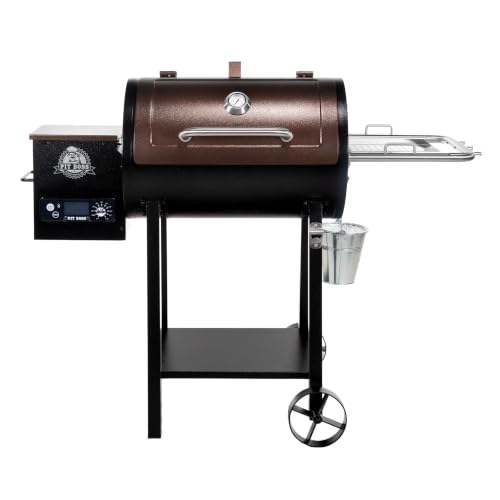
Pit Boss 440 Mahogany Series Wood Pellet Grill & Smoker (PB440D2) — best overall
Who it suits: The household buying its first full-size pellet grill, cooking for four to six people, and wanting one machine that can smoke low and slow on weekends and genuinely sear a steak on a weeknight. If your mental picture of a pellet grill is a barrel on a cart with a hopper on the side, this is that grill at the lowest price we would recommend.
The 440 Mahogany Series — model PB440D2 — is the largest cooker in this guide that honestly lives at the budget. Pit Boss rates it at 518 square inches of total cooking space, split between a 373-square-inch main grate and a 145-square-inch upper rack, all porcelain-coated steel. That main grate is the working number: it takes a whole packer-style brisket flat with room to breathe, two racks of ribs laid flat, or a family load of burgers without shuffling. The temperature range runs from 180°F for gentle smoke up to 500°F, and the signature Pit Boss feature is on board: the Flame Broiler lever slides the heat shield open so the firepot’s flame reaches the grate directly, which Pit Boss rates for searing up to 1,000°F at the flame. No other grill in this guide sears like it, and for steak-and-burger households that matters more than any app.
The control board is Pit Boss’s LED digital controller — set a temperature, and the auger and fan hold it. It is not a PID board with Wi-Fi, and it does not pretend to be; what you get is simple, legible, and easy to run with greasy hands. A meat probe is included. The hopper holds five pounds of pellets, which is the grill’s defining compromise and the reason the Z Grills below exists in this guide. Five pounds is plenty for ribs, chicken, chops and any cook up to roughly four or five hours at moderate temperatures. It is not an overnight brisket hopper unless you set an alarm. The mahogany-look finish over the steel barrel is the other visible economy — it looks handsome out of the box, and like all painted steel it wants a cover and a dry corner to stay that way.
Pros:
- Largest in-budget cooking area here: 518 sq in total, 373 sq in on the main grate
- Flame Broiler direct-flame searing — a real steak feature the rest of this guide lacks
- Simple LED digital control with a meat probe included; nothing to pair, update or troubleshoot
- Full-size cart with wheels, a side shelf and a five-year Pit Boss warranty behind it
Honest limitation: The five-pound hopper is small for the size of the barrel. Long, low cooks need a refill midway, and there is no quick-cleanout door, so changing pellet flavors means scooping or running the hopper down. Plan cooks around it, or look at the ZPG-450A.
Choose it if you want the most cooking space and the best sear this budget buys, and your long cooks are ribs-length rather than brisket-length. Skip it if overnight, unattended-length smoking is your main plan — the hopper will make you participate. On safety: the manual calls for a minimum of 12 inches of clearance from combustible construction on the sides and back, and more is better where you have it; keep it on a level, heat-proof surface, out from under eaves, and let ash cool fully before the grease tray and firepot get cleaned into a lidded metal can.
Check on Amazon — check price on Amazon, since this model moves in and out of the budget with seasonal pricing.
Z Grills ZPG-450A Wood Pellet Grill & Smoker — best for long smokes
Who it suits: The low-and-slow cook. If your idea of a Saturday is a pork shoulder that goes on at breakfast and comes off at dinner, and your fear is a hopper running dry at hour seven, the 450A is the pick in this guide built around your cook.
The ZPG-450A’s headline is its hopper: fifteen pounds, three times the Pit Boss 440’s capacity, hanging over a 459-square-inch cooking chamber (a 324-square-inch main grate plus an upper warming rack). Fifteen pounds of pellets is a genuinely long cook — a full shoulder or a small brisket at smoking temperatures without opening the hopper, and that changes how the grill feels to own. You fill it, set it, and the machine’s job is to leave you alone. The current version runs Z Grills’ PID V3.0 controller, which cycles the auger to hold the set temperature more tightly than a simple timer board, across a 180°F to 450°F range. A meat probe is included, and the newer revision adds dual probe ports on the controller, which is the sort of detail usually missing at this price.
The rest of the package is sensibly judged. The front shelf folds, the side shelf gives you a landing spot for a tray, the grates are porcelain-coated, and the whole grill stands on a cart with two large wheels — useful, because at roughly 85 pounds assembled this is not a grill you carry, it is a grill you roll to its corner and park. Z Grills backs it with a three-year warranty. What the 450A does not do is sear with direct flame: its heat tops out at 450°F with an indirect diffuser between firepot and food, so steaks get good grill-roasted flavor but not the charred crust the Pit Boss’s Flame Broiler produces. It is a smoker-grill in that order.
Pros:
- 15 lb hopper — the long-cook champion of this guide by a wide margin
- PID V3.0 controller holds set temperatures steadily across 180–450°F
- 459 sq in of cooking space with folding front shelf and a meat probe in the box
- Three-year warranty and a mature model line with easy parts availability
Honest limitation: No direct-flame searing and a 450°F ceiling, so it will not replace a hot grill for steaks. The hopper also has no purge or cleanout chute, so swapping pellet flavors means scooping from the top. Some owners of budget Z Grills models report controller and auger issues over time; the warranty is the backstop, and registering the grill matters.
Choose it if smoking is the main event and you want the longest unattended cooks this budget allows. Skip it if high-heat searing is a weekly ritual, or if you need Wi-Fi control — there is none here. Safety notes for this one: the big hopper invites long cooks, which makes the basics non-negotiable — keep the grill in the open with clear space around and above it, check the firepot and grease path before long cooks so ash and grease never build up, and keep pellets bone dry in a sealed bin, because swollen pellets jam augers and a jammed, smoldering hopper is a fire problem, not just a dinner problem.
Check on Amazon — check price on Amazon and confirm which controller revision the current listing describes before ordering.
Pit Boss PB150PPG Table Top Wood Pellet Grill — best tabletop
Who it suits: Campers, tailgaters, RV travelers and anyone whose “grill space” is a picnic table, a truck bed or a small slab — buyers who want real pellet flavor in a unit one person can load into a car.
The PB150PPG takes the full-size Pit Boss formula and shrinks it honestly. You get 256 square inches of porcelain-coated cooking space, a digital controller running 180°F to 500°F, one meat probe, and — the party trick — the same Flame Broiler direct-flame system as the big 440, rated for searing up to 1,000°F at the flame. Almost no other tabletop pellet grill sears; most top out as gentle smokers. This one grills a steak properly and then, lid down and temperature dropped, smokes a rack of ribs. The hopper holds seven pounds per the current Amazon listing — a strong number for the class, enough for several hours of smoking — and the lid locks and the legs fold into a carry format that weighs about 43 pounds. That is not light, but it is one-person portable in a way no cart grill is.
Portability has a physics cost, and here it is grate size. 256 square inches is one rack of ribs cut in half, a small chicken, six to eight burgers — dinner for two to four, cooked in one batch, or dinner for more in sequence. The two-level cooking some listings describe is really a main grate with modest headroom; tall food like a beer-can chicken is a squeeze. The small chamber also swings temperature faster in wind and cold than a heavy barrel does, so winter smoking takes more patience and more pellets. None of that is a defect; it is the definition of the category, and within the category this is the most complete package at the budget.
Pros:
- Flame Broiler direct-flame searing — unique among the tabletops here
- 256 sq in, 180–500°F digital control and a meat probe in a locking-lid portable
- Seven-pound hopper beats most tabletop rivals for cook time between refills
- Five-year Pit Boss warranty, unusual support for a portable
Honest limitation: One-batch capacity is dinner for two to four, and the compact chamber is more sensitive to wind and cold than a full-size barrel. It also still needs a household outlet or an inverter — “portable” means movable, not cordless.
Choose it if the grill travels — campsite, tailgate, boat dock, RV bay — or if your home cooking space is genuinely a table. Skip it if it will live in one place and feed six; buy the 440 instead. Safety: a tabletop grill concentrates the same fire into a smaller box, so the surface rules matter doubly — set it only on a stable, heat-proof, non-combustible surface (never a plastic folding table), keep clearance on all sides including above, and let it cool completely and empty cooled ash before it goes back into a vehicle or storage bin.
Check on Amazon — check price on Amazon; this model is frequently the first in the guide to dip well under the budget during sales.
Z Grills 200A Table Top Wood Pellet Grill & Smoker — best compact portable
Who it suits: The space-first buyer: a small household, a compact patio corner, an RV storage bay — anyone who wants the smallest full-featured pellet grill in this guide and cooks for two to four.
The 200A (the Cruiser 200A in Z Grills’ portable line) is built around a 25-by-20-by-13-inch body with 202 square inches of cooking area, and its spec sheet has one number that jumps out: an eight-pound hopper. Eight pounds in a tabletop is exceptional — most portables carry four to five — and it converts directly into roughly ten hours of low-and-slow cooking between refills, which makes this little grill a legitimate smoker rather than a novelty. The PID controller holds 180°F to 450°F, the current version adds an LCD readout and meat probes, and small-space thinking shows in the furniture: a front folding rack, a removable side rack with utensil hooks, and a footprint that stores on a shelf. Z Grills covers it for three years.
Against the Pit Boss tabletop, the trade is clear. The 200A holds more pellets and runs longer unattended; the Pit Boss runs hotter (500°F versus 450°F) and sears over direct flame, which the Z Grills does not. The 200A’s grate is also the smallest in the guide: 202 square inches means a rack of ribs gets trimmed, and a packer brisket is not happening — this is a grill for chops, chicken pieces, sausages, burgers and small roasts, cooked beautifully, for a few people at a time. If that sentence describes your cooking, the size is a feature: it heats fast, sips pellets, and disappears into storage when the cook is done.
Pros:
- Eight-pound hopper in a tabletop — around ten hours of smoking between refills
- Smallest footprint in the guide at roughly 25 × 20 × 13 inches; genuinely shelf-storable
- PID temperature control with LCD display and meat probes on the current version
- Folding front rack and utensil hooks show real small-space design
Honest limitation: The 202 sq in grate is the tightest here, and the 450°F ceiling with no direct-flame mode means searing is the weak course. Whole large cuts need trimming or a different grill.
Choose it if storage space is your scarcest resource and your cooks are small and slow. Skip it if you regularly cook for five or more, or if steak searing is the point. Safety: compact grills end up in compact places, which is exactly where clearance gets forgotten — keep the full ring of open space around and above it even on a small patio, never run it under a low awning or umbrella, and because it stores indoors, let it cool fully and brush out cooled ash before it comes inside; pellets and ash stay outside in sealed containers.
Check on Amazon — check price on Amazon, and confirm the listing is the current PID version before you buy.
ASMOKE AS350 Portable Wood Pellet Grill & Smoker — best ash-cleaning design (prose-only)
Who it suits: The tidy-minded portable buyer — someone who likes the tabletop idea but hates the ash chores that come with pellet cooking, and who cooks for two to four people.
The AS350 is the other serious tabletop in this class: 256 square inches of cooking area across two tiers of porcelain-coated cast-iron grids (about 191 square inches on the main grid), a 180°F to 500°F dial, and a stainless-accented body measuring roughly 24.4 by 17.5 by 16 inches at about 49 pounds. Its signature is ASMOKE’s ASCA system, which uses steam and gravity to sweep ash toward a removable collection bucket instead of leaving it to cake in the firepot — the single most annoying maintenance job on a small pellet grill, engineered down to pulling out a drawer. ASMOKE backs the grill with a five-year warranty, strong for the class.
Why is it prose-only in this guide? Two honest reasons. Its hopper is the smallest here at four pounds, which means long smokes are a relay of refills — the AS350 is at its best on cooks of a few hours: a chicken, ribs, chops, a small shoulder with attention. And in this guide’s verification pass we could not complete the same listing cross-check for the AS350 that the linked picks passed, so rather than send you to an unconfirmed listing we present it on its specifications and let you check price on Amazon directly. That is the rule for every prose-only pick in this guide: the product is real and recommendable, the link simply was not verified to our standard this time.
Pros:
- ASCA ash-collection system makes the dirtiest pellet-grill chore the easiest here
- 256 sq in over two tiers with porcelain-coated cast-iron grids
- Full 180–500°F range in a portable body; five-year warranty
- Compact, self-contained design that travels and stores well
Honest limitation: The four-pound hopper is the smallest in this guide — long cooks need refills, and overnight smoking is off the menu. At about 49 pounds it is also the heaviest tabletop here despite its size.
Choose it if easy cleanup tops your list and your cooks run a few hours at a time. Skip it if you want set-and-forget duration — the Z Grills 200A’s hopper doubles this one. Safety: ash systems make it tempting to empty the bucket casually — do not. Ash can hold live embers for days; empty only when fully cold, into a metal container with a lid, stored away from anything combustible, and keep the steam reservoir and grease path clean so nothing flammable builds up around the firepot.
Check price on Amazon — search the ASMOKE AS350 by name, and confirm the listing is sold or shipped by ASMOKE or Amazon before ordering.
Camp Chef Pursuit 20 Portable Pellet Grill (PPG20) — the stretch reference (prose-only)
Who it suits: The buyer who reads this guide, feels the pull of “a little more,” and wants to know exactly what a little more buys. The Pursuit 20 is in this guide as a measuring stick, not as an under-$300 pick, because its street price usually sits above the line.
On specification, it is the most capable portable here by a distance: 501 square inches of cooking space split between a 253-square-inch lower grate and a 248-square-inch upper rack — full-size capacity — on folding legs with a locking lid, so it converts from patio grill to tailgate cargo in minutes. The Gen 2 PID controller spans 160°F to 500°F, Camp Chef’s Smoke Control lets you dial smoke level from one to ten independently of temperature, two meat probes are included, and the Slide and Grill feature pulls a lever to expose the grate to direct flame for searing. The hopper holds ten pounds. It weighs about 82 pounds, so “portable” means two people or a wheeled load, and Camp Chef covers it for three years.
So why not simply recommend it? Because this guide’s promise is in its title. A grill that usually sells above the budget does not become an under-$300 pick because it is excellent, and linking it as one would break the rule we apply to every pick. What we can honestly say is this: if your budget flexes, the Pursuit 20 is the first step up that changes the category — it is the only portable here that feeds a crowd in one batch. If it does not flex, the Pit Boss 440 gives you similar cooking area in a stay-at-home cart for in-budget money, and the tabletops give you true portability for less.
Pros:
- 501 sq in — full-size capacity in a folding-leg portable format
- Gen 2 PID control, 160–500°F, with adjustable Smoke Control and two probes
- Slide and Grill direct-flame searing plus a ten-pound hopper
- The benchmark for what one step above this budget buys
Honest limitation: It usually costs more than this guide’s budget — that is the entire reason it is prose-only. At about 82 pounds it is also a two-person lift, so its portability is about folding and rolling, not carrying.
Choose it if your budget stretches and one grill must do home duty and travel duty at crowd scale. Skip it if $300 is a hard ceiling — the in-budget picks above are not consolation prizes. Safety: folding legs demand a pre-cook ritual — lock every leg, level the grill, and confirm the lid latch before lighting, every time; a big, hot, top-heavy portable that shifts mid-cook is a burn risk, and its larger grease load means the drip system needs checking before long cooks, with cooled ash and grease disposed of in metal, never plastic.
Check price on Amazon — if you catch it inside the budget during a seasonal sale, it becomes the easiest recommendation in this guide.
Comparison table
| Pick | Cooking area | Hopper | Temp range | Format | Standout |
|---|---|---|---|---|---|
| Pit Boss 440 Mahogany (PB440D2) | 518 sq in (373 main) | 5 lb | 180–500°F | Full-size cart | Flame Broiler direct-flame sear |
| Z Grills ZPG-450A | 459 sq in (324 main) | 15 lb | 180–450°F | Full-size cart | Longest cooks between refills |
| Pit Boss PB150PPG | 256 sq in | 7 lb | 180–500°F | Tabletop | Searing in a portable |
| Z Grills 200A | 202 sq in | 8 lb | 180–450°F | Tabletop | Biggest hopper per inch of grill |
| ASMOKE AS350 | 256 sq in (191 main) | 4 lb | 180–500°F | Tabletop | ASCA ash collection |
| Camp Chef Pursuit 20 | 501 sq in (253 lower) | 10 lb | 160–500°F | Folding-leg portable | Crowd capacity that travels |
Read the table by the column that matches your cooking. If you smoke whole cuts for hours, the hopper column is your decision. If you grill more than you smoke, the temperature column and the standout column decide it. If the grill has to fit a car or a shelf, the format column rules everything else out before the argument starts.
How to choose a pellet grill under $300
Start with the cook, not the grill. Write down the three things you will actually cook most. Ribs, chicken and burgers point one way; brisket and pork shoulder point another; steak night points a third. At this budget no single grill wins all three, and the reviews above are organized so each style of cooking has a clear answer: the 440 for searing and space, the 450A for duration, the tabletops for small and mobile cooking.
Size the grate by the main level, not the headline. Manufacturers quote total area including the upper rack, but the main grate is where briskets, rib racks and burger batches actually live. A 518-square-inch headline with a 373-square-inch main grate cooks like a 373. For two to four people, 250 to 330 square inches of main grate is comfortable; for five or more, or for whole large cuts, look at 370 and up.
Treat hopper size as your longest cook. As a rough guide, a pellet grill burns about a pound of pellets an hour at smoking temperatures, more in cold weather or at high heat. A five-pound hopper is a ribs-and-chicken hopper. Eight to ten pounds covers a pork shoulder. Fifteen pounds is brisket-without-an-alarm territory. Match the hopper to your longest realistic cook, not your longest imaginable one.
Decide whether searing is a requirement or a wish. Most pellet grills cook indirectly, like an oven with smoke, and their steaks are good but not charred. If crust matters, you need either a direct-flame feature — the Flame Broiler on the Pit Boss models, Slide and Grill on the Camp Chef — or a plan to finish steaks in a cast-iron pan. Do not buy a 450°F indirect grill hoping it will sear like a kettle.
Check the controller, the warranty and the parts trail. PID control is worth having at this price and both Z Grills picks include it. A warranty of three years or more and a brand that sells replacement igniters, auger motors and control boards will matter in year three, when something on a budget machine eventually needs replacing. If you are comparing against other fuels entirely, our Best Charcoal Grill Under $300 and Best Gas Grill Under $300 guides cover the same budget in the other two classic formats.
Fire safety: the non-negotiables for any pellet grill
A pellet grill is an electric appliance wrapped around a live wood fire, and every model in this guide carries the same core rules in its manual. Placement first: run the grill outdoors only, in the open, on a level and heat-proof surface, with clear space on every side and above it — Pit Boss’s manual minimum is 12 inches from combustible construction, and more distance is better wherever your space allows; never under low eaves, awnings or umbrellas, never in a garage, porch enclosure or tent, and never on a surface that can melt or burn. Keep it away from dry leaves, mulch beds and stored fuel.
Operation second: never leave a running grill completely unattended for extended periods, and be present for startup and shutdown, which is when most problems announce themselves. Keep the firepot, grease tray and drip path clean — built-up grease and ash are the fuel in nearly every grill fire that makes the news. If a grease fire starts, close the lid, turn the grill off, and let it starve; never use water on burning grease. Ash third: ash insulates embers and can stay hot for days. Let it cool completely, scoop it into a metal container with a tight lid, and store that container outside, away from the house, deck and anything combustible — never in a plastic bin or paper bag. Pellets fourth: store them sealed and dry indoors or in a lidded bin; wet pellets swell, jam augers and smolder, and a hopper fire is the classic result of neglected fuel and a dirty firepot. Finally, plug the grill into a proper outdoor-rated outlet, keep the cord out of walkways and water, and unplug it when the cook is done and the shutdown cycle has finished.
Common mistakes when buying a budget pellet grill
Buying the headline cooking area. The upper rack is a warming shelf on most of these grills. Buy by the main grate, and the grill you receive will match the grill you imagined.
Ignoring the hopper. First-time buyers compare grates and temperatures and forget that hopper size is the difference between a relaxing smoke and a 2 a.m. refill. It is the most common regret in this category.
Expecting steakhouse sear from every model. Indirect heat is the pellet grill’s nature. Without a direct-flame feature, plan a cast-iron finish for steaks, or choose a pick that has the feature.
Storing pellets in the hopper outdoors. An uncovered grill in humid weather turns hopper pellets to swollen sawdust within weeks. Empty the hopper for long storage, keep pellets sealed and dry, and run the shutdown cycle so the firepot clears.
Skipping the burn-in and the first clean. New grills ship with manufacturing oils that need a hot burn-in before food touches the grates, and the first few cooks teach you your grill’s hot spots. Skipping either costs you a meal.
Placing the grill where it fits instead of where it is safe. The corner against the siding, under the eave, is always the convenient one. Clearance is not a suggestion in the manual; it is the condition the listing was tested under.
Final recommendation
For most households, the answer in this guide is the Pit Boss 440 Mahogany Series: the most cooking space at the budget, the only full-size direct-flame sear here, and a simple control board that asks nothing of you but a temperature. If your cooking leans long and low, trade the sear for endurance and take the Z Grills ZPG-450A and its fifteen-pound hopper. If the grill has to travel or live small, the Pit Boss PB150PPG is the portable that still sears, and the Z Grills 200A is the one that smokes longest per inch. The ASMOKE AS350 earns its place for cleanup, and the Camp Chef Pursuit 20 stands in the guide honestly labeled as the step above the budget. Readers planning a dedicated backyard setup may also want our guide to the Best Pellet Grill For Backyards Under $300, which re-ranks these same machines purely for stay-at-home cooking.
FAQ
Can a pellet grill under $300 really smoke a brisket?
Yes, with the right pick. You need enough main-grate space for the cut and enough hopper to hold temperature for many hours. In this guide that points to the Z Grills ZPG-450A for duration or the Pit Boss 440 with a planned mid-cook refill. The tabletops can smoke smaller cuts beautifully but are not brisket machines.
How much do pellets cost to run?
Budget roughly a pound of pellets per hour at smoking temperatures and more at grilling heat or in cold weather. Pellets are sold in bags by the pound at hardware and grocery stores everywhere, and any brand of food-grade hardwood pellet works in any of these grills — you are never locked into the grill maker’s fuel.
Do I need Wi-Fi on a pellet grill?
Not at this budget, and none of these picks has it. A leave-in meat probe and a controller that holds temperature cover what Wi-Fi adds for most cooks. Wi-Fi becomes genuinely useful on overnight cooks, which at this tier the hopper sizes mostly rule out anyway.
Can I use a pellet grill in winter?
Yes. Expect higher pellet consumption and slower preheats, and keep the grill out of the wind where you can. Smaller chambers like the tabletops feel the cold most. Never move the grill into a garage or enclosed space to escape the weather — outdoor-only applies in every season.
What is the difference between a pellet grill and a pellet smoker?
In this price range, mostly marketing. The machines here all smoke at low settings and grill at high ones; the honest differences are temperature ceiling and whether a direct-flame feature lets them truly sear. Check those two numbers rather than the label.
How long do budget pellet grills last?
The steel and grates will outlast the electronics. Igniters and auger motors are wear parts on every pellet grill; choosing brands with three-to-five-year warranties and available spare parts, as all the linked picks here have, is what turns a budget grill into a five-to-ten-year appliance.