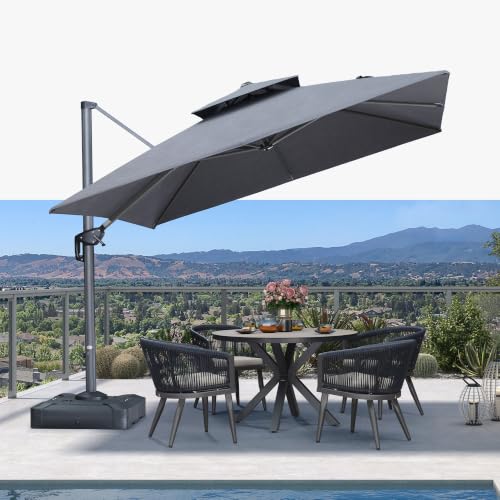
Where to buy
Check the latest price, availability and delivery on Amazon. Orders are placed on Amazon. We may earn a commission from qualifying purchases. Where a pick is marked prose-only, we could not verify it to our standard for linking, so it is discussed without a purchase link.
- Best premium pick sized for a small patio: PURPLE LEAF 10 ft Sunbrella Cantilever Umbrella, Cast Slate — Check on Amazon
- Best square cantilever for a compact footprint: PURPLE LEAF 10 x 10 ft Square Double Top Cantilever Umbrella, Beige — Check on Amazon
- Best offset shade without a table hole: Abba Patio 10 ft Vienna Offset Umbrella, Brown — Check on Amazon
- Best market umbrella for a small dining set: California Umbrella 9 ft Sunbrella Market Umbrella, Antique Beige — Check on Amazon
- Best for the smallest tables: Best Choice Products 7.5 ft Market Umbrella, Navy Blue — Check on Amazon
- Best against-the-wall solution: Pure Garden 9 ft Half Umbrella with Weighted Base, Champagne — Check on Amazon
Read the full guide ↓
Disclosure: As an Amazon Associate, dailyhomedecorating.com earns from qualifying purchases. Links to Amazon on this page are affiliate links; they cost you nothing extra. Listing details such as price and availability change often, so check the current Amazon listing before you buy — and check price on Amazon for the complete system, including any base your pick needs.
The best patio umbrella for small patios under $700 is not the biggest umbrella the budget allows — it is the one whose footprint, base and swing room respect a space where every foot is already spoken for. Small patios punish the mistakes that big yards forgive. A cantilever base that would vanish into a lawn eats the only walking path. A canopy that overhangs the railing shades the neighbour’s air instead of your chairs. And a market umbrella sized for a six-seat table turns a two-seat bistro set into a game of dodging the pole. The good news is that $700 is a lavish budget at small-patio sizes: it reaches genuine Sunbrella fabric, well-made compact cantilevers and the half-umbrella designs built specifically for tight, wall-side spaces.
Measure before you fall in love with any pick below. You need three numbers: the clear floor area where a base can sit without blocking a door swing or a chair leg, the distance from that spot to the centre of your seating, and the height from floor to any balcony above, soffit or railing top that the canopy must clear. On a small patio the base decision dominates everything: a fillable cantilever base is a large flat object, a market umbrella stand is a smaller one, and a half umbrella’s included weighted base is smaller still. The reviews below state each pick’s base situation plainly, because on a small patio the base is not an accessory — it is half the furniture.
Our short answer: most small patios should start with the PURPLE LEAF 10 ft Sunbrella cantilever in Cast Slate, which brings the longest-lived fabric in this guide to a canopy size a compact patio can actually hold. If your patio is a rectangle with the seating pushed to one side, the 10 x 10 ft square double top uses that shape best. And if your patio is truly a sliver against a wall, skip the geometry fight entirely — the Pure Garden half umbrella was designed for exactly that wall, base included, and it asks nothing of the building at all.
In this guide
Quick Picks
In a hurry? This table matches each umbrella to the situation it handles best. Full reasoning, honest limitations and base requirements for every pick follow in the detailed reviews.
| Buyer type | Pick | Why it stands out | Link |
|---|---|---|---|
| Best premium pick sized for a small patio | PURPLE LEAF 10 ft Sunbrella Cantilever Umbrella, Cast Slate | Double-top Sunbrella canopy in a 10 ft round format | Check on Amazon |
| Best square cantilever for a compact footprint | PURPLE LEAF 10 x 10 ft Square Double Top Cantilever Umbrella, Beige | 10 x 10 ft square double-top canopy suits rectangular layouts | Check on Amazon |
| Best offset shade without a table hole | Abba Patio 10 ft Vienna Offset Umbrella, Brown | 10 ft offset canopy with rotation and tilt, no table hole needed | Check on Amazon |
| Best market umbrella for a small dining set | California Umbrella 9 ft Sunbrella Market Umbrella, Antique Beige | Genuine Sunbrella acrylic with a tailored, furniture-like look | Check on Amazon |
| Best for the smallest tables | Best Choice Products 7.5 ft Market Umbrella, Navy Blue | 7.5 ft canopy stays inside most railing lines | Check on Amazon |
| Best against-the-wall solution | Pure Garden 9 ft Half Umbrella with Weighted Base, Champagne | Half-round canopy shades a wall-side strip no round umbrella can reach | Check on Amazon |
How we chose the best patio umbrella for small patios under $700
Small-patio picks were judged on fit before features. First, footprint: base size, pole position and canopy swing were weighed against patios where a door, a railing and two chairs compete for the same square metres. Second, proportional coverage — a canopy that shades the seating without swallowing the whole space or overhanging the neighbours. Third, fabric and frame quality, because a small patio offers no sheltered corner: the umbrella lives in full weather, and at this budget Sunbrella acrylic and aluminum frames are realistic expectations. Fourth, operation in tight quarters: cranks you can reach, tilt you can adjust without stepping into a planter. Every linked pick was cross-checked through the Amazon Creators API for this site, screened against CPSC recall records, and its base requirements are stated openly in its review.
Detailed reviews
PURPLE LEAF 10 ft Sunbrella Cantilever Umbrella, Cast Slate — Best premium pick sized for a small patio
PURPLE LEAF 10 ft Sunbrella Cantilever Umbrella, Cast Slate is our pick for this spot. A 10 ft round cantilever is the sweet spot most small patios are actually built for, and this is the premium version of it: a double-top Sunbrella canopy that will hold its slate colour for years, on an aluminum frame with rotation and tilt. Rotation matters doubly in a small space — you cannot move the furniture to chase the sun, so the shade has to do the moving. The base is a separate purchase, and on a small patio that is almost a feature: you can choose the lowest-profile fillable base that fits your floor plan rather than accepting whatever footprint a bundled base imposes.
The verified specification, in brief: 10 ft round double-top canopy in genuine Sunbrella solution-dyed acrylic; aluminum frame with rotation and tilt; base sold separately. Who it suits: Small-patio owners who want premium Sunbrella fabric at a holdable size. Consider the complete picture before you buy — the canopy, the base it needs, and where both will live in your space through the whole season, not just on the first sunny afternoon.
Pros
- Double-top Sunbrella canopy in a 10 ft round format
- Rotation lets the shade move because the furniture cannot
- Aluminum frame built for years of exposed small-patio weather
Honest limitation: The base is sold separately; choose the lowest-profile fillable base that fits your floor plan.
Choose / skip: Choose it if your patio can hold a compact cantilever base and you buy for the long term. Skip it if no corner can spare the base — a table or half umbrella fits better.
Ownership, in one line: keep the mechanism clean, close the canopy when it is unattended, and store it dry — this pick rewards exactly the care described in the care section below, and punishes the opposite habits faster than most.
PURPLE LEAF 10 x 10 ft Square Double Top Cantilever Umbrella, Beige — Best square cantilever for a compact footprint
PURPLE LEAF 10 x 10 ft Square Double Top Cantilever Umbrella, Beige is our pick for this spot. Rectangular patios with the seating along one side are this square cantilever’s home turf. The 10 x 10 ft canopy parks its pole in a corner, throws a square of shade that matches a loveseat-and-table layout, and the double top vents the gusts that funnel between buildings and fences — small patios are often windier than open yards for exactly that reason. The cross base needs added ballast, and on a small patio the elegant answer is a low fillable base or neatly stacked pavers that double as a plant stand footprint, not loose weights in the walking path.
The verified specification, in brief: 10 x 10 ft square double-top canopy in 240 gsm fade-resistant polyester; aluminum frame with crank lift, tilt and 360-degree rotation; cross base needs added ballast. Who it suits: Small-to-mid patios and mixed groups who want square, vented shade. Consider the complete picture before you buy — the canopy, the base it needs, and where both will live in your space through the whole season, not just on the first sunny afternoon.
Pros
- 10 x 10 ft square double-top canopy suits rectangular layouts
- Vented top handles funnelled gusts between fences and buildings
- Neutral colour works with almost any furniture
Honest limitation: The cross base needs added ballast, which must be planned into a tight floor plan.
Choose / skip: Choose it if your space is rectangular and your group is around six people. Skip it if no floor corner can spare a properly weighted base.
Ownership, in one line: keep the mechanism clean, close the canopy when it is unattended, and store it dry — this pick rewards exactly the care described in the care section below, and punishes the opposite habits faster than most.
Abba Patio 10 ft Vienna Offset Umbrella, Brown — Best offset shade without a table hole
Abba Patio 10 ft Vienna Offset Umbrella, Brown is our pick for this spot. The Vienna offset is the small-patio pick for renters of space rather than owners of a table: no centre hole required, no pole through the middle of a tiny dining set, just a 10 ft canopy swung over the seating from the side. Ten feet is the ceiling of sensible for most small patios — big enough for a loveseat and two chairs, small enough to close and tie without a wrestling match. Its cross base needs substantial added weight, and in a tight footprint that weight must be planned as furniture: a filled base box that can carry a planter, for example, rather than bags of sand in the doorway.
The verified specification, in brief: 10 ft round offset canopy; eight ribs; 360-degree rotation and easy tilt adjustment; cross base needs substantial added weight, especially anywhere exposed to gusts. Who it suits: Owners of larger ground-floor patios or terraces who need pole-free shade — with conditions. Consider the complete picture before you buy — the canopy, the base it needs, and where both will live in your space through the whole season, not just on the first sunny afternoon.
Pros
- 10 ft offset canopy with rotation and tilt, no table hole needed
- Eight-rib frame at a mid-range position
- Works where a centre pole would split a small seating group
Honest limitation: Its cross base needs substantial added weight on a proper fillable base, and it does not belong on a typical elevated balcony.
Choose / skip: Choose it only if your space is ground-level or a true terrace, your rules allow it, and you will weight and close it properly. Skip it entirely for a standard apartment balcony — the other picks in this guide exist for you.
Ownership, in one line: keep the mechanism clean, close the canopy when it is unattended, and store it dry — this pick rewards exactly the care described in the care section below, and punishes the opposite habits faster than most.
California Umbrella 9 ft Sunbrella Market Umbrella, Antique Beige — Best market umbrella for a small dining set
California Umbrella 9 ft Sunbrella Market Umbrella, Antique Beige is our pick for this spot. A small dining set with a centre hole is the one small-patio layout where a market umbrella beats every cantilever: the pole disappears into the table, the base footprint hides beneath it, and the 9 ft Sunbrella canopy is exactly proportioned to a four-seat set. The auto tilt handles the low western sun that rakes across small patios in the evening, and the bronze pole looks deliberate rather than makeshift. What it cannot do is shade a lounger or a seating nook away from the table — if your patio life happens off the table, choose a cantilever instead.
The verified specification, in brief: 9 ft round center-pole market umbrella in genuine Sunbrella acrylic; crank lift with auto tilt; heavy-duty aluminum frame with reinforced ribs and a bronze-finish pole; needs a table or a weighted stand, sold separately. Who it suits: Diners with a table centre hole who want premium fabric in a classic format. Consider the complete picture before you buy — the canopy, the base it needs, and where both will live in your space through the whole season, not just on the first sunny afternoon.
Pros
- Genuine Sunbrella acrylic with a tailored, furniture-like look
- Auto tilt engages by continuing to crank — adjustable from your chair
- Heavy-duty aluminum frame with reinforced ribs
Honest limitation: It shades the table and little else; loungers and side seating need their own solution, and a stand is sold separately.
Choose / skip: Choose it if entertaining means dinner at one table, served properly. Skip it if your seating has no table hole or your group spreads across the yard.
Ownership, in one line: keep the mechanism clean, close the canopy when it is unattended, and store it dry — this pick rewards exactly the care described in the care section below, and punishes the opposite habits faster than most.
Best Choice Products 7.5 ft Market Umbrella, Navy Blue — Best for the smallest tables
Best Choice Products 7.5 ft Market Umbrella, Navy Blue is our pick for this spot. At 7.5 ft, this is the honest size for a bistro table, a pair of chairs and a patio that measures itself in single digits. Everything about it is scaled to tight quarters: a lighter frame one person can move, a push-button tilt that needs no clearance to operate, and a canopy that closes down to a slim bundle against the wall. It will not shade a sectional and does not pretend to. On the smallest patios, the right umbrella is the one that is never in the way on the days you do not use it — and this one folds out of your life completely.
The verified specification, in brief: 7.5 ft round center-pole canopy; six ribs; push-button tilt and crank lift; sized for a small table or a narrow balcony rather than a full dining set. Who it suits: Small-table and balcony owners who need shade that disappears when unused. Consider the complete picture before you buy — the canopy, the base it needs, and where both will live in your space through the whole season, not just on the first sunny afternoon.
Pros
- 7.5 ft canopy stays inside most railing lines
- Push-button tilt needs no clearance to operate
- Light and compact enough to store in a closet over winter
Honest limitation: It will not shade a sectional or a large table, and it needs a table or a proper weighted stand.
Choose / skip: Choose it for a bistro set or a small balcony table. Skip it if your seating seats more than four.
Ownership, in one line: keep the mechanism clean, close the canopy when it is unattended, and store it dry — this pick rewards exactly the care described in the care section below, and punishes the opposite habits faster than most.
Pure Garden 9 ft Half Umbrella with Weighted Base, Champagne — Best against-the-wall solution
Pure Garden 9 ft Half Umbrella with Weighted Base, Champagne is our pick for this spot. The half umbrella is the small-patio specialist nobody expects: a 9 ft canopy cut in half, flat side against the wall, shading a strip of patio that no round umbrella can reach without wasting half its canopy over the railing. It is the answer for the narrow patio outside a sliding door, the balcony-style slab, the side yard with two chairs. The included 20 lb weighted base makes it a complete, renter-friendly purchase. Respect its limits — it shades a wall-side strip, not a open area, and it should be closed in real wind like every umbrella here — and it solves a geometry problem nothing else in this guide can.
The verified specification, in brief: 9 ft half-round canopy designed to sit flat against a wall; easy crank lift; a 20 lb weighted base is included, which is unusually complete for this style; polyester canopy. Who it suits: Balcony and narrow-patio owners whose seating sits against a wall or railing. Consider the complete picture before you buy — the canopy, the base it needs, and where both will live in your space through the whole season, not just on the first sunny afternoon.
Pros
- Half-round canopy shades a wall-side strip no round umbrella can reach
- Included 20 lb weighted base — a complete, modest footprint
- No clamps, drilling or attachment for a lease to object to
Honest limitation: It shades a strip, not an open area, and its light base means closing it promptly when gusts arrive.
Choose / skip: Choose it if your seating hugs the wall and your space is a sliver. Skip it if your seating stands in open space away from any wall.
Ownership, in one line: keep the mechanism clean, close the canopy when it is unattended, and store it dry — this pick rewards exactly the care described in the care section below, and punishes the opposite habits faster than most.
Comparison table
The six picks side by side, on the facts that decide fit. Prices are not printed in this guide — they change too often to be honest in print — so check price on Amazon for each linked pick, including the cost of any base it needs.
| Pick | Format | Canopy | Fabric class | Base situation |
|---|---|---|---|---|
| PURPLE LEAF 10 ft Sunbrella Cantilever Umbrella, Cast Slate | Cantilever | 10 ft round, double top | Sunbrella acrylic | Sold separately |
| PURPLE LEAF 10 x 10 ft Square Double Top Cantilever Umbrella, Beige | Cantilever | 10 x 10 ft square, double top | Polyester | Cross base — add ballast |
| Abba Patio 10 ft Vienna Offset Umbrella, Brown | Offset / cantilever | 10 ft round | Polyester | Cross base — add substantial weight |
| California Umbrella 9 ft Sunbrella Market Umbrella, Antique Beige | Market, centre pole | 9 ft round | Sunbrella acrylic | Stand sold separately |
| Best Choice Products 7.5 ft Market Umbrella, Navy Blue | Market, centre pole | 7.5 ft round | Polyester | Table or stand needed |
| Pure Garden 9 ft Half Umbrella with Weighted Base, Champagne | Half umbrella | 9 ft half-round | Polyester | Included, 20 lb weighted |
What the $700 budget really covers
On a small patio, $700 is a quality budget, not a size budget, and it should be spent accordingly: the best fabric class that fits the space, a frame that will not embarrass you in year three, and the lowest-profile proper base the floor plan allows. The trap at this tier is upgrading the canopy into a size the patio cannot host because the money was available. Resist it. Money left over after the right-sized premium pick is not wasted budget — it is the cover, the stand upgrade, and the replacement-canopy fund that together turn a purchase into a decade of shade. A small patio with the right 10 ft Sunbrella cantilever is better equipped than a large yard with the wrong 13 ft anything.
Measuring your space before you order
Before ordering, spend ten minutes with a tape measure; it is the cheapest insurance in this entire purchase. Record the length and width of the area the canopy must shade, the distance from the base position to the far edge of that area, and the clear height above it — a balcony slab, a pergola beam, a branch — at the canopy’s highest tilt. For a cantilever, pace out the base footprint in its intended corner and walk the path you will actually use with the base in place; if you have to sidestep it carrying a tray, move it now, on paper. For a table umbrella, measure the table’s centre hole and the clearance beneath the table where the stand must fit. Write the numbers down and compare them against the maker’s stated dimensions for your pick, including the closed umbrella’s stored length. Ten minutes of this prevents the most common return in the category: an umbrella that is perfect in every way except the one your space cannot change.
Base weight, wind and safety
Every umbrella in this guide is, structurally, a sail on a lever, and the base is what negotiates with physics on your behalf. The overturning force grows with canopy size and with height, which is why large cantilevers — whose canopies sit offset from the pole — demand far more base weight than a centre-pole umbrella of the same diameter. Makers publish base requirements for each model; those numbers are minimums for ordinary breezes, not guarantees for gusts, and they assume the base is actually filled or weighted as specified. A fillable base left half full for convenience is not half as safe; it is an installation that has not been finished.
Wind behaviour differs by design in ways worth understanding before you buy. A vented or double-top canopy gives air an escape route, reducing the bell-and-jerk motion that fatigues frames and frightens guests. Tilt, used thoughtfully, can angle a canopy to shed a light breeze rather than catch it — but tilt is a shade tool, not a storm strategy. Rotation hardware and lift cords are wear items: grit in the mechanism, a fraying cord and a crank that grinds are all messages to service or retire parts before they fail under load. Safety guidance in this category is consistent across makers and regulators alike: secure the base properly, never leave an open umbrella unattended, and close it well before strong wind arrives. The umbrellas in this guide were screened against CPSC recall records before inclusion, and the recalled designs we found in that screening — in other brands and other product lines — were excluded entirely and are not named or sold anywhere in this guide.
Placement is the last piece of the safety picture. Put the base on the firmest, flattest ground available, near a wall or structure where slabs and decks are strongest and wind is most broken. Keep the canopy’s swing clear of railings, gutters and the slab above. On a deck you own, a bolt-down or in-ground mount removes both the footprint and the guesswork. On rented or shared ground, a fully filled base you can drain and move is usually the right compromise. Either way, decide the installation before the umbrella arrives — the base is not an accessory to the purchase; it is half of it.
How to choose your patio umbrella for small patios under $700
Start with the furniture, not the catalogue. Sketch your seating as it really sits — table dimensions, chair pull-out room, the lounger that migrates with the sun — and shade that shape. A canopy should extend beyond the seating edge on the sun side, because shade is a moving patch, not a static one: between early afternoon and early evening it slides several feet. That is why tilt and rotation are worth real money. A fixed canopy, however large, abandons its seating for part of the day; a tilting market umbrella or a rotating cantilever follows the sun and keeps the same chairs comfortable for hours longer.
Next, decide the format honestly. A market umbrella is a centre pole through a table or a stand: simple, stable, and the cheapest route to quality fabric, but it can only shade what surrounds its pole. A cantilever hangs its canopy from an arm, keeping the shaded area completely clear and adding rotation — at the cost of a large, heavily weighted base and a higher price for the same fabric. A half umbrella exists for wall-side strips and nothing else does its job. Choosing the format before the brand prevents the most expensive mistake in this category: a beautiful umbrella in a geometry your space cannot use.
Fabric is where long-term value hides. Solution-dyed acrylic, sold most famously as Sunbrella, is coloured through the fibre itself, so it resists fading for years in full sun and can be cleaned without washing the colour out. Surface-dyed polyester costs less and looks identical on day one, then pales noticeably within a season or two of hard sun. Neither is a scam — the right choice depends on exposure. A shaded, north-facing space is kind to polyester; an open, south- or west-facing one will make acrylic the cheaper fabric across the umbrella’s life. Whichever you choose, a vented or double-top canopy is worth having in any exposed spot: it gives gusts an exit, so the umbrella works less and worries you less.
The frame and mechanism decide how the umbrella ages. Aluminum poles resist rust and keep weight manageable; steel is strong but must be finished well to survive seasons outdoors. Crank lifts should feel smooth, not gritty, and auto-tilt designs that engage through the crank spare you leaning across furniture to wrestle a collar. On cantilevers, look at the lift cord and the rotation hardware — these are the wear points — and treat brand claims about wind with respect rather than faith: no residential umbrella is a storm product, and every maker instructs owners to close canopies in strong wind.
Finally, plan the base before you order anything. Read the maker’s requirement for your exact canopy size, then meet it fully: a fillable base filled completely (sand outweighs water in the same volume), a market stand at or above the specified weight, or a mounted installation where the surface allows it. Place the base where the slab or deck is strongest and where the pole will not steal the walking path. Then buy a cover in the same order. A cover costs little, keeps the mechanism clean, protects the fabric from its worst enemy — filthy, folded, damp storage — and turns a seasonal purchase into a decade-long one.
Common mistakes
The first mistake is buying the canopy and improvising the base. It is also the dangerous one. An under-weighted cantilever does not fail politely; it walks, leans and eventually goes over, and incident reports in this category repeat the same story — an open umbrella, a gust, a base that was never filled to specification. Fill the base completely, on day one, before the canopy is opened for an audience.
The second mistake is leaving the umbrella open and unattended. Shade feels static, so owners treat an open umbrella as furniture; it is actually a sail attached to a lever. Close it when you go inside, close it overnight, and close it ahead of forecast wind rather than during it. Most umbrella damage, and nearly every tip-over, happens to an open canopy nobody was watching.
The third mistake is sizing by headline number instead of by furniture. A round canopy’s usable shade is a circle that shrinks as the sun drops; a square or rectangle usually covers real seating better at the same headline size. Measure the grouping, add margin on the sun side, and remember that tilt and rotation effectively enlarge any canopy by keeping its shade on target.
The fourth mistake is ignoring the space’s rules and structure. Balcony load limits, lease clauses, railing lines and the slab above are all real specifications, as binding as canopy diameter. The time to discover them is before the order, not while a delivery waits in the hallway. Measure the swing room, read the rules, and choose the umbrella your space can actually host.
The fifth mistake is storing a dirty, damp canopy. Mildew and grit do more long-term damage than sun does. Brush the fabric clean, let it dry fully open, then close, cover and store it somewhere dry. Five minutes of this in autumn is worth a season of life in spring.
Setup day: getting the installation right
Setup day decides how the next several summers go, so give it an unhurried hour. Start with the base, empty and in its final position: check the ground is flat, firm and clear of sprinkler heads, shallow cables and the door swing. Assemble the frame loosely first, confirm every bolt and pin is present, then tighten in sequence with the canopy still closed. Fill the base completely at this point — water from the hose for a first season if you may move it, sand if the position is permanent, since sand gives more weight in the same volume and does not need draining before a freeze. Only then open the canopy, slowly, watching each rib rise evenly; a rib that lags is telling you something is caught, and forcing a crank is how lift cords die young.
With the canopy open, rehearse the whole day in five minutes. Tilt it to the morning position, then to the low evening angle, and rotate it through its full arc if it is a cantilever, checking clearance from railings, gutters, branches and the wall at every point. Note where the shade actually falls at the hours you use the space — not where you assumed it would — and nudge the base now, while it is a two-person slide rather than a dismantling job. Fit the cover once, so you know how it goes on before the first stormy evening asks you to do it in the wind. Finally, walk the closing routine until it is muscle memory: tilt back to neutral, crank down steadily, tie the canopy, cover on. The household that can close its umbrella in under a minute is the household whose umbrella survives.
Care, cleaning and winter storage
Umbrellas rarely die dramatically; they fade, stiffen and mildew by neglect, all of which is preventable with light, regular care. Brush the canopy down monthly in season with a soft brush and plain water, and wash it once or twice a year with mild soap, rinsed thoroughly and dried fully in the open air before closing — never store a canopy damp, because mildew stains are permanent and the smell moves into the fabric for good. Solution-dyed acrylic tolerates this washing for years; polyester asks for a gentler hand and no bleach, ever, on either fabric.
The mechanism wants the same modest attention. Keep grit out of the crank housing and the rotation track; a soft brush and, where the maker allows it, a dry silicone lubricant keep motion smooth without attracting dust the way wet oils do. Inspect the lift cord at the start of each season for fraying, check rib joints and bolts for play, and tighten what has worked loose before it becomes a failure under load. In winter, the umbrella’s best home is dry and indoors — a garage corner, a closet, a storage bench — cleaned, fully dry and covered. Owners who give an umbrella this hour of care a year are routinely repaid with a decade of service; owners who skip it are shopping again by the third summer, wondering why the fabric and the crank gave up at the same time. They did not give up. They were stored wet and left open in the wind, and no fabric class survives that combination for long.
Final recommendation
If you read nothing else: start with the PURPLE LEAF 10 ft Sunbrella Cantilever Umbrella, Cast Slate. It earned the first spot in this guide on fit for the brief — the right geometry, the right fabric class and an honest base plan — and for most readers matching this guide’s situation it is the purchase least likely to be regretted in the third summer. Work down the list in order if your space argues against it: each following pick exists because a real situation — a wall-side strip, a single dining table, evenings that run long, a base that must come in the box — defeats the pick above it. Whatever you choose, complete the installation properly: the right base, fully weighted, a cover in the same order, and the habit of closing the canopy when nobody is under it. That discipline, more than any brand or fabric, is what separates the umbrellas still earning their place years later from the ones in the garage rafters.
FAQ
What size umbrella suits a small patio?
For most small patios, a 9 to 10 ft canopy is the practical ceiling: enough for a loveseat or a four-seat set without dominating the space. A 7.5 ft market umbrella suits a bistro set, and a 9 ft half umbrella suits a wall-side strip. Measure your seating first and let the canopy overhang it modestly; an oversized canopy on a small patio shades the neighbours and catches every gust.
Is a cantilever too big for a small patio?
Not if the base fits your floor plan. The canopy size is rarely the problem — the base footprint is. A compact fillable base tucked into a corner, with the pole outside the walking path, works on many small patios and buys you rotation that fixed umbrellas cannot offer. If no corner can spare the base, a table market umbrella or a half umbrella is the honest answer.
How do I stop a small-patio umbrella catching wind between buildings?
Choose a vented or double-top canopy, keep the base fully weighted, and close the umbrella whenever you are not sitting under it — gaps between buildings accelerate gusts. Position the pole in the most sheltered corner the layout allows, and never leave the canopy open overnight. Small patios funnel wind; treat closing as part of using the umbrella, not as storage.
Can I use a half umbrella on a regular patio?
Yes, anywhere the seating sits against a wall, fence or railing: a dining bench against the house, a pair of chairs along a fence line, a narrow side patio. It wastes no canopy beyond the barrier and its flat side sits flush. It is a poor choice for freestanding seating in open space, where a round or square canopy covers in every direction.
What base works when floor space is tight?
The lowest-profile option that still meets the maker’s weight guidance: a slim fillable base for a cantilever, a heavy flat stand under a table for a market umbrella, or the included weighted base of a half umbrella. Avoid tall, small-footprint stands on cantilevers — leverage defeats them. If a base doubles as a planter or a side-table footprint, it earns its floor space twice.
My patio is shaded in the morning and sunny at noon. What should I prioritise?
Prioritise the hours you actually sit outside, and choose tilt or rotation that serves those hours rather than the ones you are indoors for. A west-facing small patio lives or dies by its low-sun tilt in the late afternoon; a south-facing one needs honest midday coverage. Watch your patio’s sun for one ordinary day before ordering — the right pick usually announces itself by three o’clock.
Related guides
Shade is one layer of an outdoor room. These related guides on this site cover the neighbouring decisions — other sizes and budgets for the same job, and the furniture the shade has to serve:


